Susan Barton, the protagonist
of the Novel Foe by J.M.
Coetzee
by Bhavna Sosa
Prepared by : Bhavna Sosa
Paper no. 203 Postcolonial Studies
Semester : 3
Roll no. : 2
Submitted by : Department of English MKBU
About Foe :
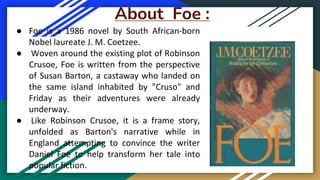
● Foe is a 1986 novel by South African-born
Nobel laureate J. M. Coetzee.
● Woven around the existing plot of Robinson
Crusoe, Foe is written from the perspective
of Susan Barton, a castaway who landed on
the same island inhabited by "Cruso" and
Friday as their adventures were already
underway.
● Like Robinson Crusoe, it is a frame story,
unfolded as Barton's narrative while in
England attempting to convince the writer
Daniel Foe to help transform her tale into
popular fiction.
About J. M. Coetzee:
● J.M. Coetzee, in full John Maxwell
Coetzee.
● He is born on February 9, 1940 in
Cape Town, South Africa.
● He is South African novelist,
critic, and translator noted for his
novels about the effects of
colonization.
● In 2003 he won the Nobel Prize
for Literature.
About Susan Barton
J.M. Coetzee introduces us to the
dynamic character of Susan Barton.
Susan Barton’s growing sense of
independence and willpower is one
unprecedented at the time, and adds
a new perspective to the story of
Robinson Crusoe.
Susan Barton : The Women on
Cruso’s Island
Susan Barton : The Women on “Cruso’s Island
Katie Debuck says,
● Throughout the novel, even long after Cruso’s death,
she describes the island as “Cruso’s island.” She
finds herself as the mere female companion to the
king and his manservant, Friday.
● Barton rationalizes Cruso’s role of king as she sees
him “on the Bluff, with the sun behind him all red
and purple, staring out to see…I thought: He is a truly
kingly figure; he is the true king of the island”
Continue….
● Barton’s role as a submissive supporting character to
Cruso displays Coetzee’s formulation of Susan as a
man’s woman.
● Susan is a sensual woman, and as the only female
character in both Defoe’s novel as well as Coetzee’s
novel, she is represented through her sexuality.
● Susan Barton is a man’s woman whose story is
told through the words of a male author both
from outside the text and inside the text.
● She is created by one man, J.M. Coetzee, as a
woman of confusion and subtlety.
● Foe is not a story about her life, but seems to
be a device to describe her male counterparts
instead.
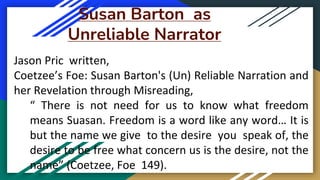
Susan Barton as
Unreliable Narrator
Jason Pric written,
Coetzee’s Foe: Susan Barton's (Un) Reliable Narration and
her Revelation through Misreading,
“ There is not need for us to know what freedom
means Suasan. Freedom is a word like any word… It is
but the name we give to the desire you speak of, the
desire to be free what concern us is the desire, not the
name” (Coetzee, Foe 149).
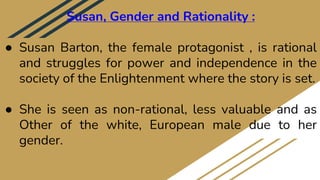
Susan, Gender and Rationality :
● Susan Barton, the female protagonist , is rational
and struggles for power and independence in the
society of the Enlightenment where the story is set.
● She is seen as non-rational, less valuable and as
Other of the white, European male due to her
gender.
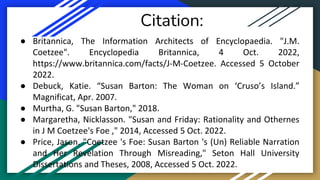
Citation:
● Britannica, The Information Architects of Encyclopaedia. "J.M.
Coetzee". Encyclopedia Britannica, 4 Oct. 2022,
https://www.britannica.com/facts/J-M-Coetzee. Accessed 5 October
2022.
● Debuck, Katie. “Susan Barton: The Woman on ‘Cruso’s Island.”
Magnificat, Apr. 2007.
● Murtha, G. "Susan Barton," 2018.
● Margaretha, Nicklasson. "Susan and Friday: Rationality and Othernes
in J M Coetzee's Foe ," 2014, Accessed 5 Oct. 2022.
● Price, Jason. "Coetzee 's Foe: Susan Barton 's (Un) Reliable Narration
and Her Revelation Through Misreading," Seton Hall University
Dissertations and Theses, 2008, Accessed 5 Oct. 2022.
Thank you

Postcolonial Studies

  • 1.
    Susan Barton, theprotagonist of the Novel Foe by J.M. Coetzee by Bhavna Sosa
  • 2.
    Prepared by :Bhavna Sosa Paper no. 203 Postcolonial Studies Semester : 3 Roll no. : 2 Submitted by : Department of English MKBU
  • 3.
    About Foe : ●Foe is a 1986 novel by South African-born Nobel laureate J. M. Coetzee. ● Woven around the existing plot of Robinson Crusoe, Foe is written from the perspective of Susan Barton, a castaway who landed on the same island inhabited by "Cruso" and Friday as their adventures were already underway. ● Like Robinson Crusoe, it is a frame story, unfolded as Barton's narrative while in England attempting to convince the writer Daniel Foe to help transform her tale into popular fiction.
  • 4.
    About J. M.Coetzee: ● J.M. Coetzee, in full John Maxwell Coetzee. ● He is born on February 9, 1940 in Cape Town, South Africa. ● He is South African novelist, critic, and translator noted for his novels about the effects of colonization. ● In 2003 he won the Nobel Prize for Literature.
  • 5.
    About Susan Barton J.M.Coetzee introduces us to the dynamic character of Susan Barton. Susan Barton’s growing sense of independence and willpower is one unprecedented at the time, and adds a new perspective to the story of Robinson Crusoe.
  • 6.
    Susan Barton :The Women on Cruso’s Island
  • 7.
    Susan Barton :The Women on “Cruso’s Island Katie Debuck says, ● Throughout the novel, even long after Cruso’s death, she describes the island as “Cruso’s island.” She finds herself as the mere female companion to the king and his manservant, Friday. ● Barton rationalizes Cruso’s role of king as she sees him “on the Bluff, with the sun behind him all red and purple, staring out to see…I thought: He is a truly kingly figure; he is the true king of the island”
  • 8.
    Continue…. ● Barton’s roleas a submissive supporting character to Cruso displays Coetzee’s formulation of Susan as a man’s woman. ● Susan is a sensual woman, and as the only female character in both Defoe’s novel as well as Coetzee’s novel, she is represented through her sexuality.
  • 9.
    ● Susan Bartonis a man’s woman whose story is told through the words of a male author both from outside the text and inside the text. ● She is created by one man, J.M. Coetzee, as a woman of confusion and subtlety. ● Foe is not a story about her life, but seems to be a device to describe her male counterparts instead.
  • 10.
    Susan Barton as UnreliableNarrator Jason Pric written, Coetzee’s Foe: Susan Barton's (Un) Reliable Narration and her Revelation through Misreading, “ There is not need for us to know what freedom means Suasan. Freedom is a word like any word… It is but the name we give to the desire you speak of, the desire to be free what concern us is the desire, not the name” (Coetzee, Foe 149).
  • 11.
    Susan, Gender andRationality : ● Susan Barton, the female protagonist , is rational and struggles for power and independence in the society of the Enlightenment where the story is set. ● She is seen as non-rational, less valuable and as Other of the white, European male due to her gender.
  • 12.
    Citation: ● Britannica, TheInformation Architects of Encyclopaedia. "J.M. Coetzee". Encyclopedia Britannica, 4 Oct. 2022, https://www.britannica.com/facts/J-M-Coetzee. Accessed 5 October 2022. ● Debuck, Katie. “Susan Barton: The Woman on ‘Cruso’s Island.” Magnificat, Apr. 2007. ● Murtha, G. "Susan Barton," 2018. ● Margaretha, Nicklasson. "Susan and Friday: Rationality and Othernes in J M Coetzee's Foe ," 2014, Accessed 5 Oct. 2022. ● Price, Jason. "Coetzee 's Foe: Susan Barton 's (Un) Reliable Narration and Her Revelation Through Misreading," Seton Hall University Dissertations and Theses, 2008, Accessed 5 Oct. 2022.
  • 13.