COLUMN 
WRITING 
By : Rojas, Xandra 
P. 
BSEd IV-A
• Columns are the most personal of all 
newspaper writing. They have a very 
personal appeal, an authoritative influence, 
and very useful contribution to make in 
spreading news and opinions. 
• They’re written to inform, to influence, or to 
entertain readers. 
• They’re high in reader-interest for they 
stimulate public discussion of the day’s 
affairs.
VARIETIES OF COLUMNS 
 Round-about-school and community columns 
 Discussive articles 
 Columns on various topics 
 Food-for-thought Columns 
 Feature columns 
 Humor columns 
 How-to-do-it columns 
 Exchange Columns 
 Critical Report Columns 
 Book Reviews
PURPOSE OF THE COLUMN 
• The main purpose of the column is to inform, 
interpret, and to a large degree, to fiscalize. 
• To explain the news. The columnist has to 
explain their significance and consequence 
by: 
a. Giving the background of an event 
b. Determining whether a certain event is 
an isolate case or part of the pattern
c. Pointing out how the event will affect 
or not affect his readers. 
d. Pooling together and assessing 
comments of readers from the different 
segments of society. 
• To entertain the readers
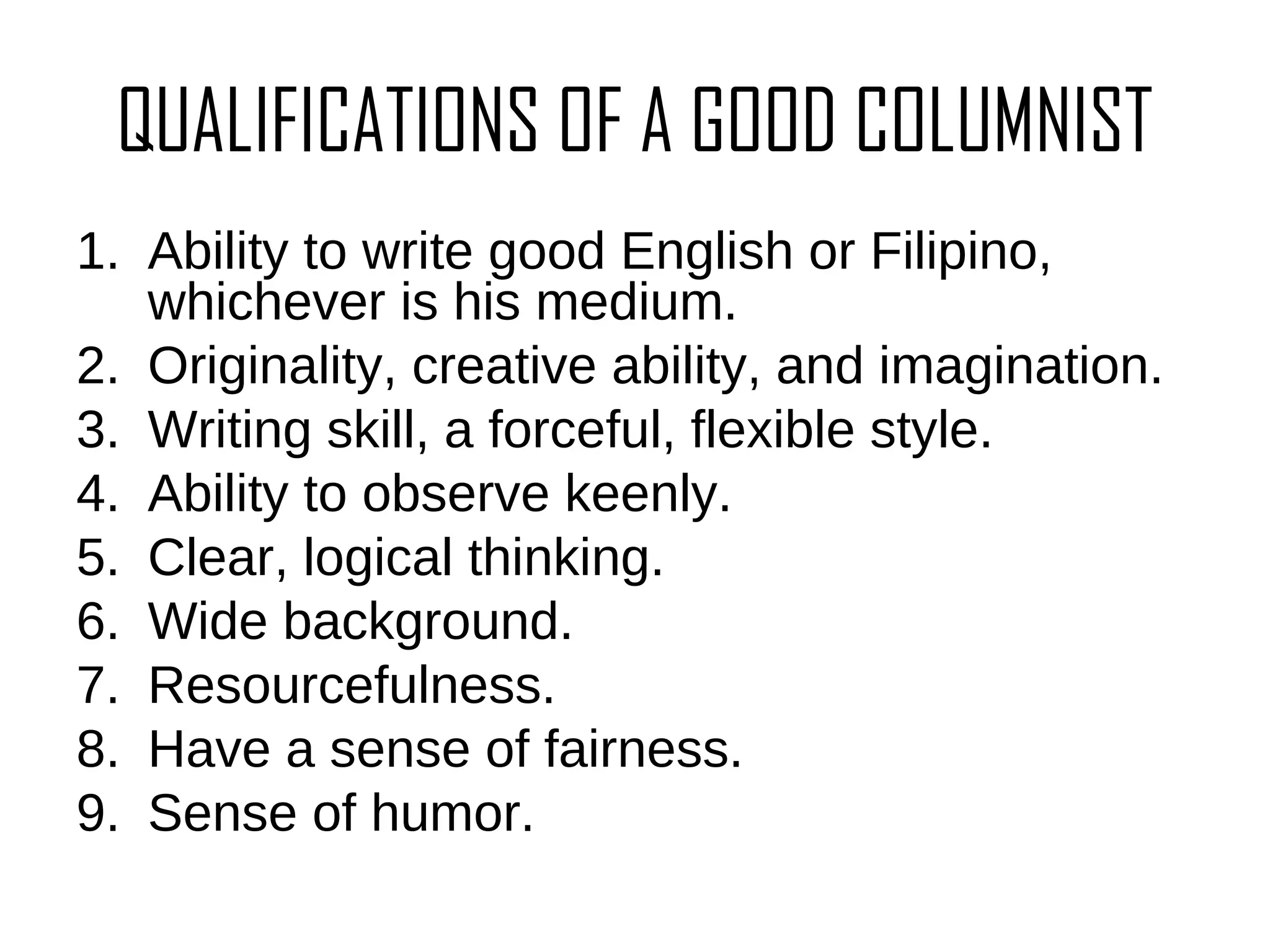
QUALIFICATIONS OF A GOOD COLUMNIST 
1. Ability to write good English or Filipino, 
whichever is his medium. 
2. Originality, creative ability, and imagination. 
3. Writing skill, a forceful, flexible style. 
4. Ability to observe keenly. 
5. Clear, logical thinking. 
6. Wide background. 
7. Resourcefulness. 
8. Have a sense of fairness. 
9. Sense of humor.
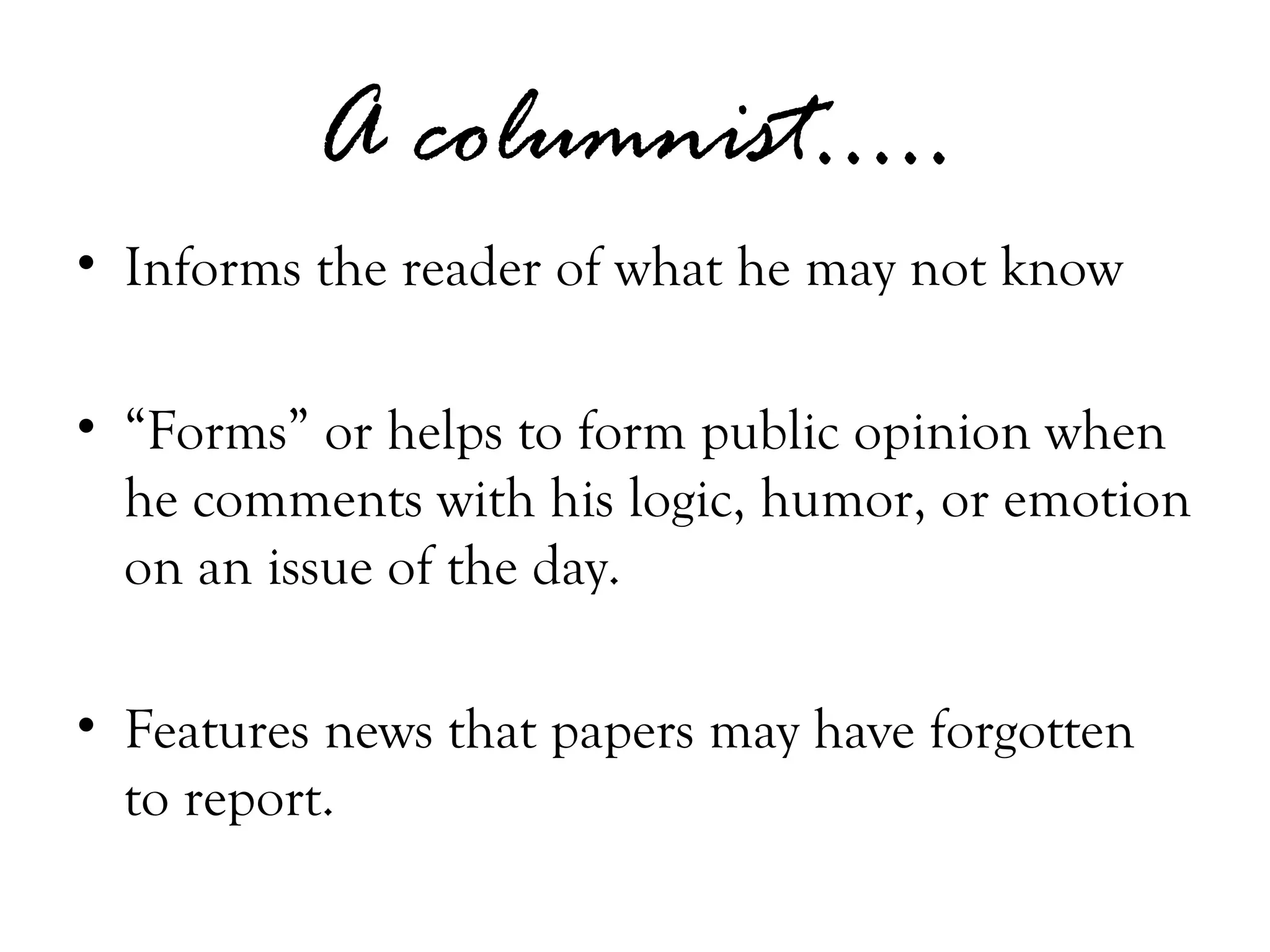
A columnist..... 
• Informs the reader of what he may not know 
• “Forms” or helps to form public opinion when 
he comments with his logic, humor, or emotion 
on an issue of the day. 
• Features news that papers may have forgotten 
to report.
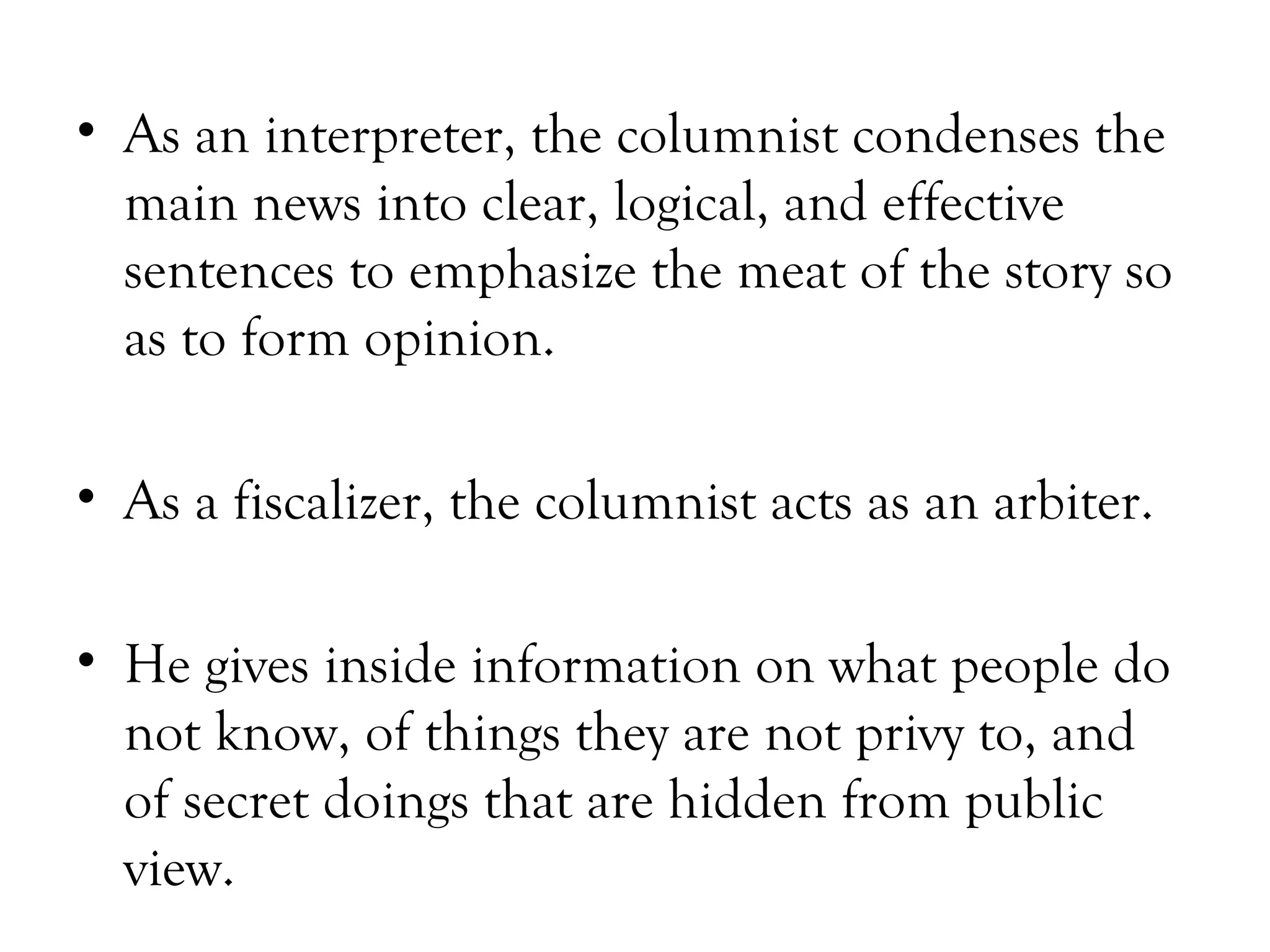
• As an interpreter, the columnist condenses the 
main news into clear, logical, and effective 
sentences to emphasize the meat of the story so 
as to form opinion. 
• As a fiscalizer, the columnist acts as an arbiter. 
• He gives inside information on what people do 
not know, of things they are not privy to, and 
of secret doings that are hidden from public 
view.
SOURCES OF MATERIALS 
• Current news 
• Observations 
• Interviews 
• Commendable projects 
• People researches 
• Investigations
FORMS OF WRITING USED IN 
COLUMNS 
• the columnist is free to use any form 
of writing. He may use the essay or the 
story form; on certain occasions, he 
may even use verse.
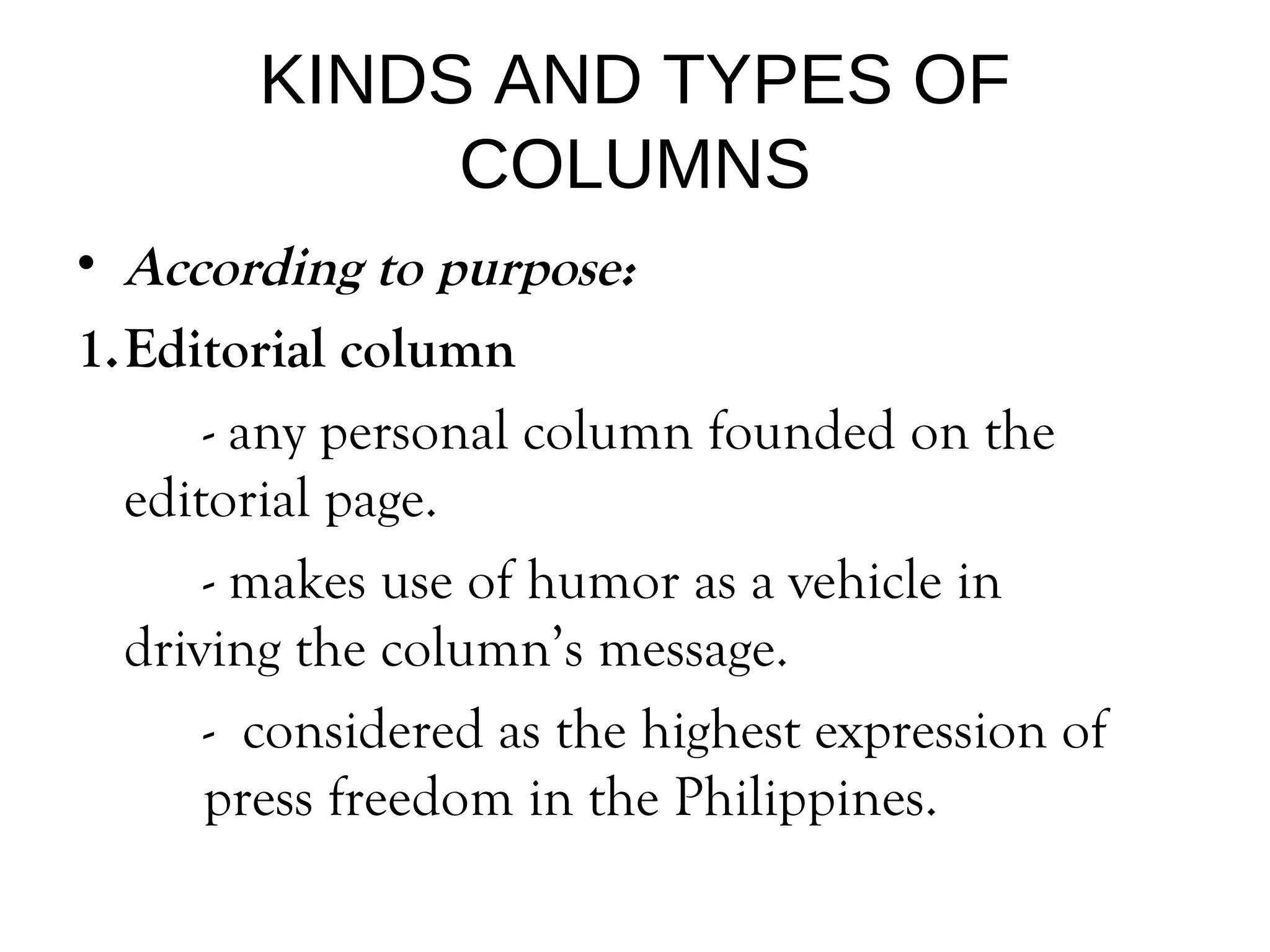
KINDS AND TYPES OF 
COLUMNS 
• According to purpose: 
1.Editorial column 
- any personal column founded on the 
editorial page. 
- makes use of humor as a vehicle in 
driving the column’s message. 
- considered as the highest expression of 
press freedom in the Philippines.
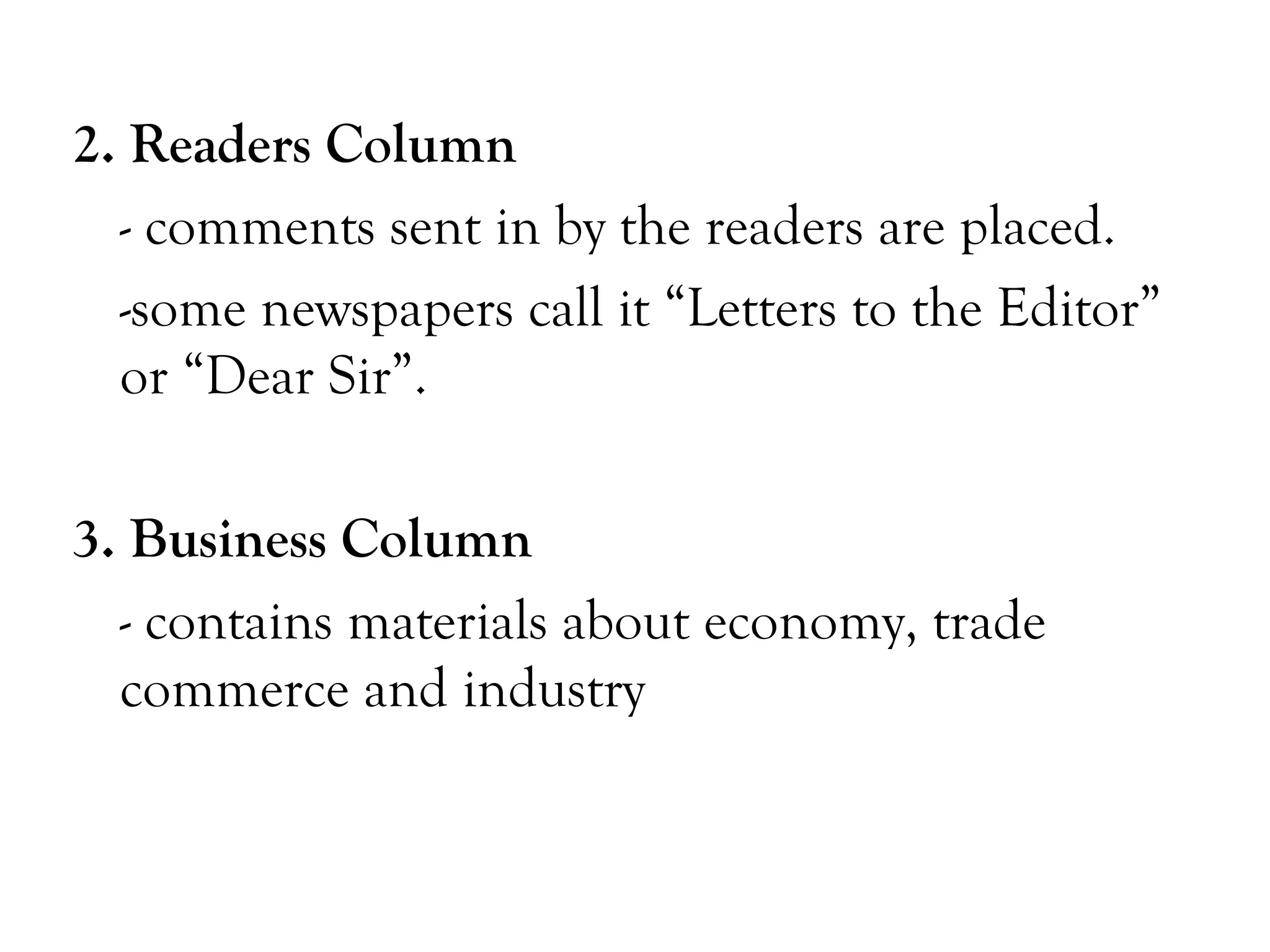
2. Readers Column 
- comments sent in by the readers are placed. 
-some newspapers call it “Letters to the Editor” 
or “Dear Sir”. 
3. Business Column 
- contains materials about economy, trade 
commerce and industry
4. Sports Column 
- deals exclusively about sports. 
5. Art Column 
- deals mostly on painting, architecture, flower 
arrangement, paper mache, ikebana, and the 
like. 
6. Women’s Column 
-concerns itself about the latest fashion, beauty 
tips and anything about homemaking.
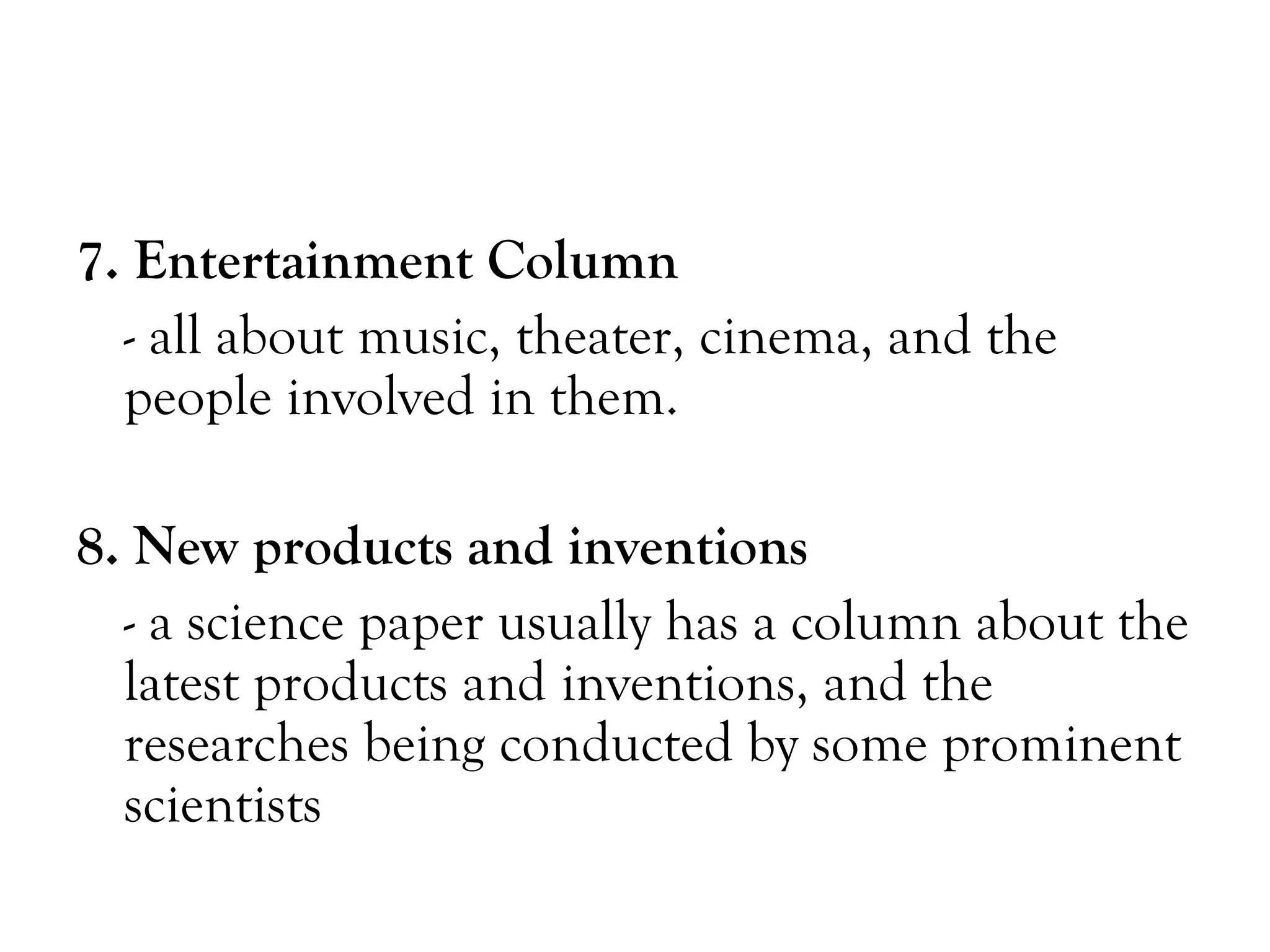
7. Entertainment Column 
- all about music, theater, cinema, and the 
people involved in them. 
8. New products and inventions 
- a science paper usually has a column about the 
latest products and inventions, and the 
researches being conducted by some prominent 
scientists
9. Personality 
- play up a famous person, his significant 
achievements, his activities, dreams, and 
ambitions. 
10. Reviews 
-review of an article, a book, a movie, a drama 
or a painting.
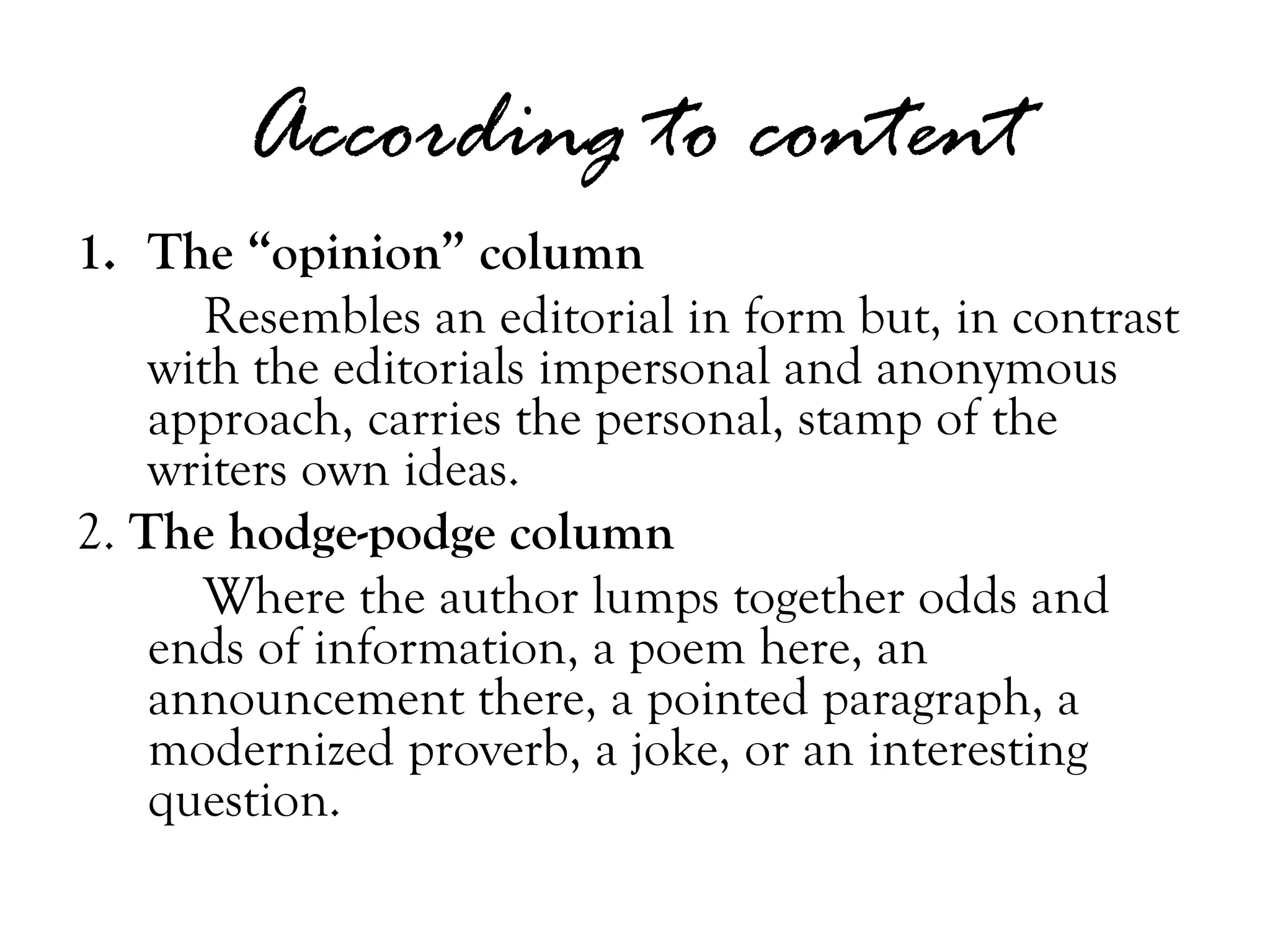
According to content 
1. The “opinion” column 
Resembles an editorial in form but, in contrast 
with the editorials impersonal and anonymous 
approach, carries the personal, stamp of the 
writers own ideas. 
2. The hodge-podge column 
Where the author lumps together odds and 
ends of information, a poem here, an 
announcement there, a pointed paragraph, a 
modernized proverb, a joke, or an interesting 
question.
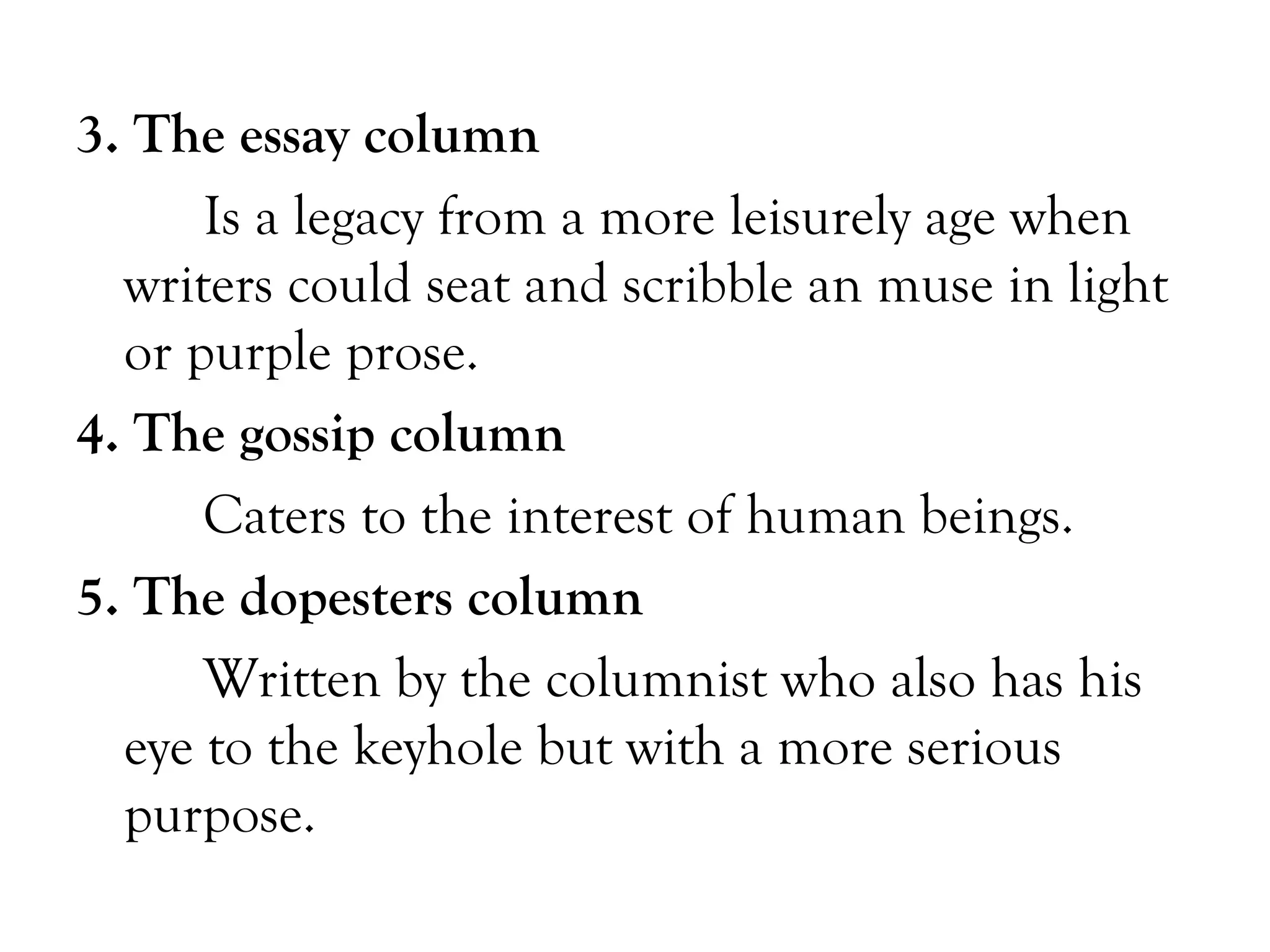
3. The essay column 
Is a legacy from a more leisurely age when 
writers could seat and scribble an muse in light 
or purple prose. 
4. The gossip column 
Caters to the interest of human beings. 
5. The dopesters column 
Written by the columnist who also has his 
eye to the keyhole but with a more serious 
purpose.
TIPS 
• Don’t be imitative of the style and 
techniques of known columnists. Try your 
own methods. 
• Go everywhere for facts and materials. 
• Study and interpret rather than moralize. 
• Apply all the principles of good writing. 
• Have intriguing titles for your columns

Column writing

  • 1.
    COLUMN WRITING By: Rojas, Xandra P. BSEd IV-A
  • 2.
    • Columns arethe most personal of all newspaper writing. They have a very personal appeal, an authoritative influence, and very useful contribution to make in spreading news and opinions. • They’re written to inform, to influence, or to entertain readers. • They’re high in reader-interest for they stimulate public discussion of the day’s affairs.
  • 3.
    VARIETIES OF COLUMNS  Round-about-school and community columns  Discussive articles  Columns on various topics  Food-for-thought Columns  Feature columns  Humor columns  How-to-do-it columns  Exchange Columns  Critical Report Columns  Book Reviews
  • 4.
    PURPOSE OF THECOLUMN • The main purpose of the column is to inform, interpret, and to a large degree, to fiscalize. • To explain the news. The columnist has to explain their significance and consequence by: a. Giving the background of an event b. Determining whether a certain event is an isolate case or part of the pattern
  • 5.
    c. Pointing outhow the event will affect or not affect his readers. d. Pooling together and assessing comments of readers from the different segments of society. • To entertain the readers
  • 6.
    QUALIFICATIONS OF AGOOD COLUMNIST 1. Ability to write good English or Filipino, whichever is his medium. 2. Originality, creative ability, and imagination. 3. Writing skill, a forceful, flexible style. 4. Ability to observe keenly. 5. Clear, logical thinking. 6. Wide background. 7. Resourcefulness. 8. Have a sense of fairness. 9. Sense of humor.
  • 7.
    A columnist..... •Informs the reader of what he may not know • “Forms” or helps to form public opinion when he comments with his logic, humor, or emotion on an issue of the day. • Features news that papers may have forgotten to report.
  • 8.
    • As aninterpreter, the columnist condenses the main news into clear, logical, and effective sentences to emphasize the meat of the story so as to form opinion. • As a fiscalizer, the columnist acts as an arbiter. • He gives inside information on what people do not know, of things they are not privy to, and of secret doings that are hidden from public view.
  • 9.
    SOURCES OF MATERIALS • Current news • Observations • Interviews • Commendable projects • People researches • Investigations
  • 10.
    FORMS OF WRITINGUSED IN COLUMNS • the columnist is free to use any form of writing. He may use the essay or the story form; on certain occasions, he may even use verse.
  • 11.
    KINDS AND TYPESOF COLUMNS • According to purpose: 1.Editorial column - any personal column founded on the editorial page. - makes use of humor as a vehicle in driving the column’s message. - considered as the highest expression of press freedom in the Philippines.
  • 12.
    2. Readers Column - comments sent in by the readers are placed. -some newspapers call it “Letters to the Editor” or “Dear Sir”. 3. Business Column - contains materials about economy, trade commerce and industry
  • 13.
    4. Sports Column - deals exclusively about sports. 5. Art Column - deals mostly on painting, architecture, flower arrangement, paper mache, ikebana, and the like. 6. Women’s Column -concerns itself about the latest fashion, beauty tips and anything about homemaking.
  • 14.
    7. Entertainment Column - all about music, theater, cinema, and the people involved in them. 8. New products and inventions - a science paper usually has a column about the latest products and inventions, and the researches being conducted by some prominent scientists
  • 15.
    9. Personality -play up a famous person, his significant achievements, his activities, dreams, and ambitions. 10. Reviews -review of an article, a book, a movie, a drama or a painting.
  • 16.
    According to content 1. The “opinion” column Resembles an editorial in form but, in contrast with the editorials impersonal and anonymous approach, carries the personal, stamp of the writers own ideas. 2. The hodge-podge column Where the author lumps together odds and ends of information, a poem here, an announcement there, a pointed paragraph, a modernized proverb, a joke, or an interesting question.
  • 17.
    3. The essaycolumn Is a legacy from a more leisurely age when writers could seat and scribble an muse in light or purple prose. 4. The gossip column Caters to the interest of human beings. 5. The dopesters column Written by the columnist who also has his eye to the keyhole but with a more serious purpose.
  • 18.
    TIPS • Don’tbe imitative of the style and techniques of known columnists. Try your own methods. • Go everywhere for facts and materials. • Study and interpret rather than moralize. • Apply all the principles of good writing. • Have intriguing titles for your columns