Its all about helping teams to achieve goals / objectives
Providing Improvement Feedback
Do you seek feedback?
Do you like receiving feedback?
Do you give feedback?
Do you like giving feedback?
What feelings you go through while giving
feedback?
How will above answers change w.r.t.
improvement/developmental feedback?
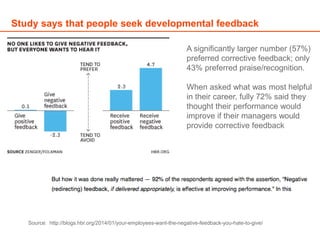
Study says that people seek developmental feedback
A significantly larger number (57%)
preferred corrective feedback; only
43% preferred praise/recognition.
When asked what was most helpful
in their career, fully 72% said they
thought their performance would
improve if their managers would
provide corrective feedback
Source: http://blogs.hbr.org/2014/01/your-employees-want-the-negative-feedback-you-hate-to-give/
Feedback vs Performance
• 09-12-2016
4
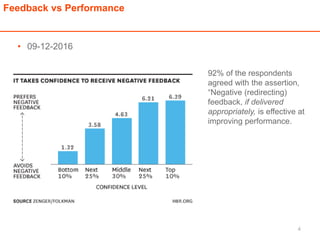
92% of the respondents
agreed with the assertion,
“Negative (redirecting)
feedback, if delivered
appropriately, is effective at
improving performance.
• A negative feedback becomes an uncomfortable conversation.
– We fear having
– We delay as much as possible
– Affects us, making us uncomfortable or even stressed
– We finally have, but can’t wait for it to be over
– Hence either we avoid giving developmental/constructive/negative feedback or rush
while delivering it thereby making it ineffective
• Our preferred ways of having such conversations:
– confront/explode
– endure until it is over
– Avoid/ ignore / delay
– have the conversation in your head
– say yes, mean no
• Costs of not giving negative feedback
What really happens
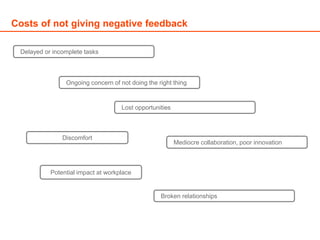
Costs of not giving negative feedback
typical costs of NOT
having conversations
typical costs of
having conversations
Potential impact at workplace
Discomfort
Mediocre collaboration, poor innovation
Lost opportunities
Delayed or incomplete tasks
Ongoing concern of not doing the right thing
Broken relationships
Case Studies
How to give constructive feedback
effectively
1. Focus on issues and not on the person
• Constructive feedback to move forward
• Intention is to HELP improve performance
• Attack the issue
• Pinpoint specific instances
• Encourage the other person to share his or her perspective
• Paraphrase and confirm understanding of the other
person’s viewpoint
• Acknowledge the person’s feelings, intentions, and values
2. Demonstrate Empathy
• Empathy vs. empathic technique
• Encouraging and inviting to talk
• Paraphrasing
• Verbal and non-verbal acknowledgement and acceptance
• Empathic Listening happens at three levels:
– Content
• What is being said?
– Feelings
• How is the person saying it?
– Value
• Why is this important to the speaker?
• Be aware of own and receiver’s emotions
3. Facilitate to achieve end goal
• You and the team reach agreement about:
– What behaviors need to change
– How to achieving and assess performance improvement
– How/what you as a coach will provide support
• Do not to try solve the problems of others
• Assist the coachee in the problem-solving process
– To identify issue or problem
– To look for root causes
– To generate solutions and consider consequences
– Find value in all ideas
– Build on existing ideas
– Combine elements to create new alternatives
– Move from “either/or” to “yes, and” thinking
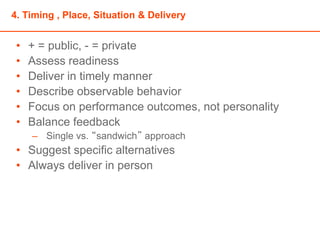
4. Timing , Place, Situation & Delivery
• + = public, - = private
• Assess readiness
• Deliver in timely manner
• Describe observable behavior
• Focus on performance outcomes, not personality
• Balance feedback
– Single vs. “sandwich” approach
• Suggest specific alternatives
• Always deliver in person
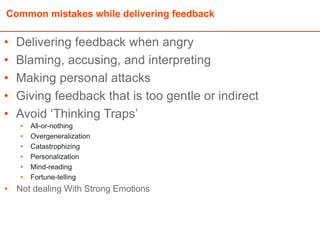
Common mistakes while delivering feedback
• Delivering feedback when angry
• Blaming, accusing, and interpreting
• Making personal attacks
• Giving feedback that is too gentle or indirect
• Avoid ‘Thinking Traps’
• All-or-nothing
• Overgeneralization
• Catastrophizing
• Personalization
• Mind-reading
• Fortune-telling
• Not dealing With Strong Emotions
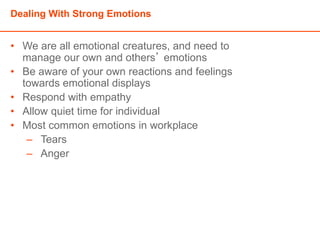
Dealing With Strong Emotions
• We are all emotional creatures, and need to
manage our own and others’ emotions
• Be aware of your own reactions and feelings
towards emotional displays
• Respond with empathy
• Allow quiet time for individual
• Most common emotions in workplace
– Tears
– Anger
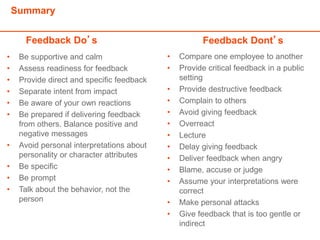
Summary
• Be supportive and calm
• Assess readiness for feedback
• Provide direct and specific feedback
• Separate intent from impact
• Be aware of your own reactions
• Be prepared if delivering feedback
from others. Balance positive and
negative messages
• Avoid personal interpretations about
personality or character attributes
• Be specific
• Be prompt
• Talk about the behavior, not the
person
Feedback Do’s Feedback Dont’s
• Compare one employee to another
• Provide critical feedback in a public
setting
• Provide destructive feedback
• Complain to others
• Avoid giving feedback
• Overreact
• Lecture
• Delay giving feedback
• Deliver feedback when angry
• Blame, accuse or judge
• Assume your interpretations were
correct
• Make personal attacks
• Give feedback that is too gentle or
indirect
Thank you

Giving developmental feedback

  • 1.
    Its all abouthelping teams to achieve goals / objectives Providing Improvement Feedback
  • 2.
    Do you seekfeedback? Do you like receiving feedback? Do you give feedback? Do you like giving feedback? What feelings you go through while giving feedback? How will above answers change w.r.t. improvement/developmental feedback?
  • 3.
    Study says thatpeople seek developmental feedback A significantly larger number (57%) preferred corrective feedback; only 43% preferred praise/recognition. When asked what was most helpful in their career, fully 72% said they thought their performance would improve if their managers would provide corrective feedback Source: http://blogs.hbr.org/2014/01/your-employees-want-the-negative-feedback-you-hate-to-give/
  • 4.
    Feedback vs Performance •09-12-2016 4 92% of the respondents agreed with the assertion, “Negative (redirecting) feedback, if delivered appropriately, is effective at improving performance.
  • 5.
    • A negativefeedback becomes an uncomfortable conversation. – We fear having – We delay as much as possible – Affects us, making us uncomfortable or even stressed – We finally have, but can’t wait for it to be over – Hence either we avoid giving developmental/constructive/negative feedback or rush while delivering it thereby making it ineffective • Our preferred ways of having such conversations: – confront/explode – endure until it is over – Avoid/ ignore / delay – have the conversation in your head – say yes, mean no • Costs of not giving negative feedback What really happens
  • 6.
    Costs of notgiving negative feedback typical costs of NOT having conversations typical costs of having conversations Potential impact at workplace Discomfort Mediocre collaboration, poor innovation Lost opportunities Delayed or incomplete tasks Ongoing concern of not doing the right thing Broken relationships
  • 7.
  • 8.
    How to giveconstructive feedback effectively
  • 9.
    1. Focus onissues and not on the person • Constructive feedback to move forward • Intention is to HELP improve performance • Attack the issue • Pinpoint specific instances • Encourage the other person to share his or her perspective • Paraphrase and confirm understanding of the other person’s viewpoint • Acknowledge the person’s feelings, intentions, and values
  • 10.
    2. Demonstrate Empathy •Empathy vs. empathic technique • Encouraging and inviting to talk • Paraphrasing • Verbal and non-verbal acknowledgement and acceptance • Empathic Listening happens at three levels: – Content • What is being said? – Feelings • How is the person saying it? – Value • Why is this important to the speaker? • Be aware of own and receiver’s emotions
  • 11.
    3. Facilitate toachieve end goal • You and the team reach agreement about: – What behaviors need to change – How to achieving and assess performance improvement – How/what you as a coach will provide support • Do not to try solve the problems of others • Assist the coachee in the problem-solving process – To identify issue or problem – To look for root causes – To generate solutions and consider consequences – Find value in all ideas – Build on existing ideas – Combine elements to create new alternatives – Move from “either/or” to “yes, and” thinking
  • 12.
    4. Timing ,Place, Situation & Delivery • + = public, - = private • Assess readiness • Deliver in timely manner • Describe observable behavior • Focus on performance outcomes, not personality • Balance feedback – Single vs. “sandwich” approach • Suggest specific alternatives • Always deliver in person
  • 13.
    Common mistakes whiledelivering feedback • Delivering feedback when angry • Blaming, accusing, and interpreting • Making personal attacks • Giving feedback that is too gentle or indirect • Avoid ‘Thinking Traps’ • All-or-nothing • Overgeneralization • Catastrophizing • Personalization • Mind-reading • Fortune-telling • Not dealing With Strong Emotions
  • 14.
    Dealing With StrongEmotions • We are all emotional creatures, and need to manage our own and others’ emotions • Be aware of your own reactions and feelings towards emotional displays • Respond with empathy • Allow quiet time for individual • Most common emotions in workplace – Tears – Anger
  • 15.
    Summary • Be supportiveand calm • Assess readiness for feedback • Provide direct and specific feedback • Separate intent from impact • Be aware of your own reactions • Be prepared if delivering feedback from others. Balance positive and negative messages • Avoid personal interpretations about personality or character attributes • Be specific • Be prompt • Talk about the behavior, not the person Feedback Do’s Feedback Dont’s • Compare one employee to another • Provide critical feedback in a public setting • Provide destructive feedback • Complain to others • Avoid giving feedback • Overreact • Lecture • Delay giving feedback • Deliver feedback when angry • Blame, accuse or judge • Assume your interpretations were correct • Make personal attacks • Give feedback that is too gentle or indirect
  • 16.