Aspect Unified IP Overview
and Physical Architecture
Vishad Garg
What is Aspect Unified IP?
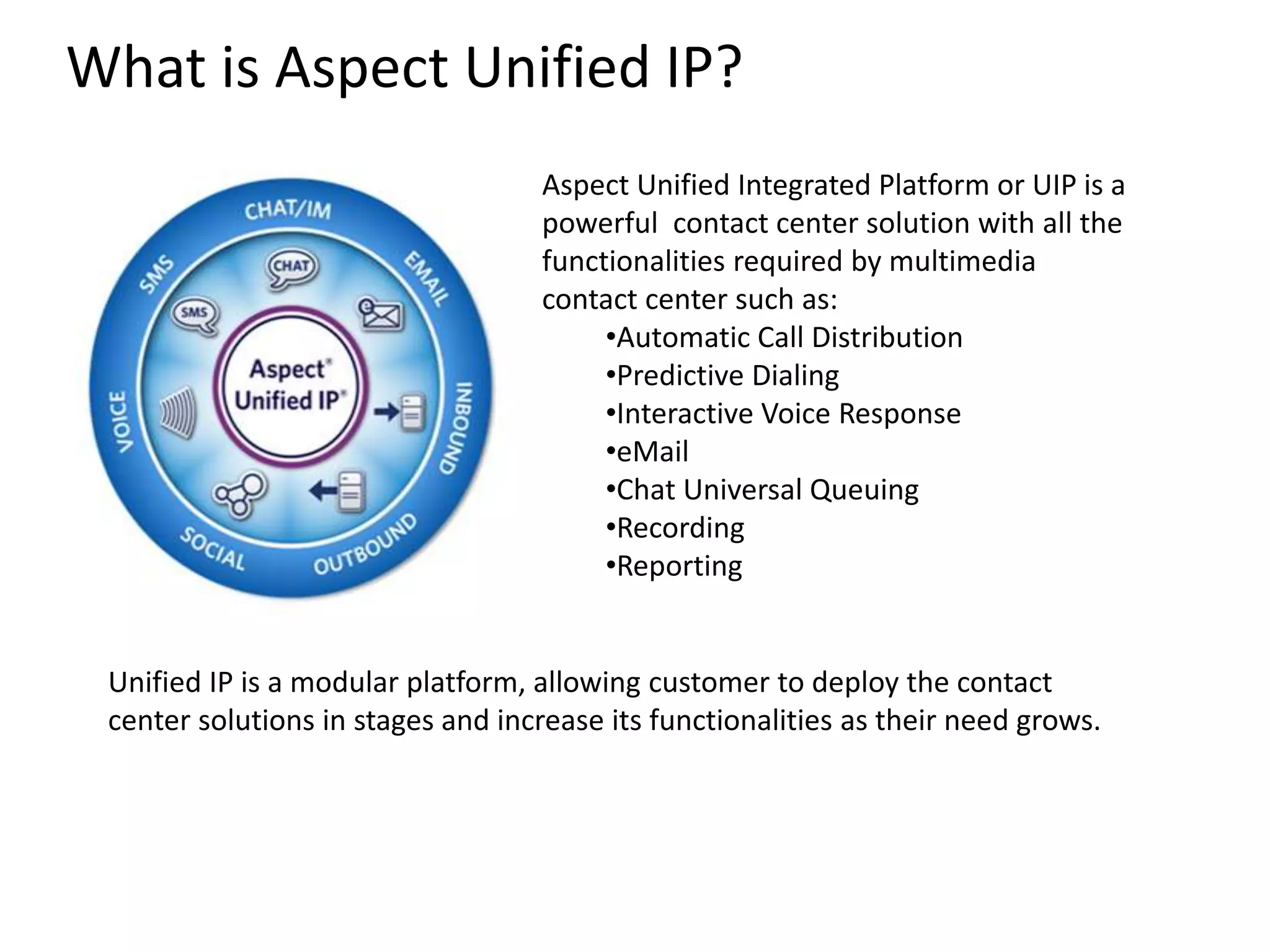
Aspect Unified Integrated Platform or UIP is a
powerful contact center solution with all the
functionalities required by multimedia
contact center such as:
•Automatic Call Distribution
•Predictive Dialing
•Interactive Voice Response
•eMail
•Chat Universal Queuing
•Recording
•Reporting
Unified IP is a modular platform, allowing customer to deploy the contact
center solutions in stages and increase its functionalities as their need grows.
Unified IP, Comprehensive Functionalities
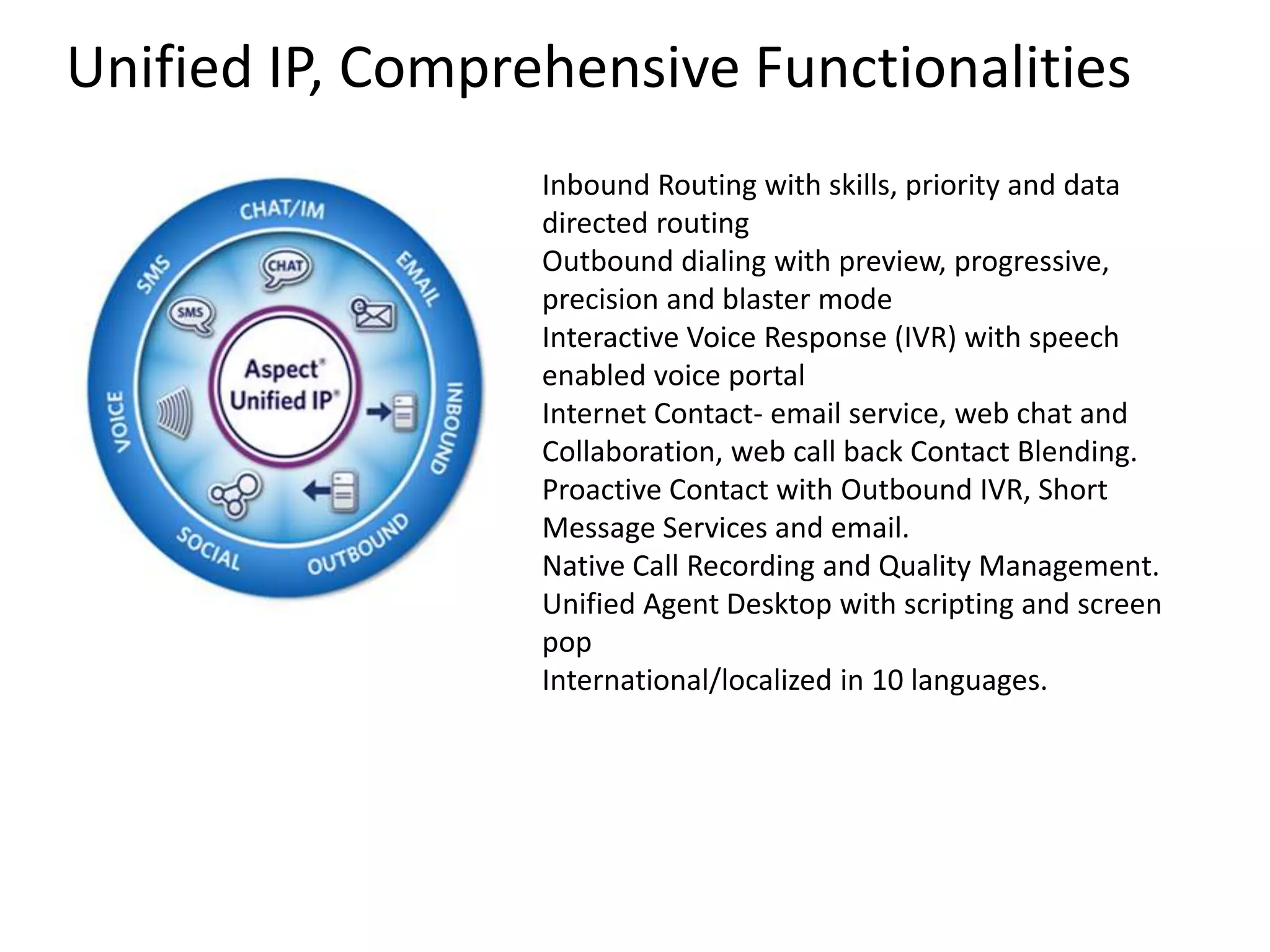
Inbound Routing with skills, priority and data
directed routing
Outbound dialing with preview, progressive,
precision and blaster mode
Interactive Voice Response (IVR) with speech
enabled voice portal
Internet Contact- email service, web chat and
Collaboration, web call back Contact Blending.
Proactive Contact with Outbound IVR, Short
Message Services and email.
Native Call Recording and Quality Management.
Unified Agent Desktop with scripting and screen
pop
International/localized in 10 languages.
Unified IP, Additional Functionalities
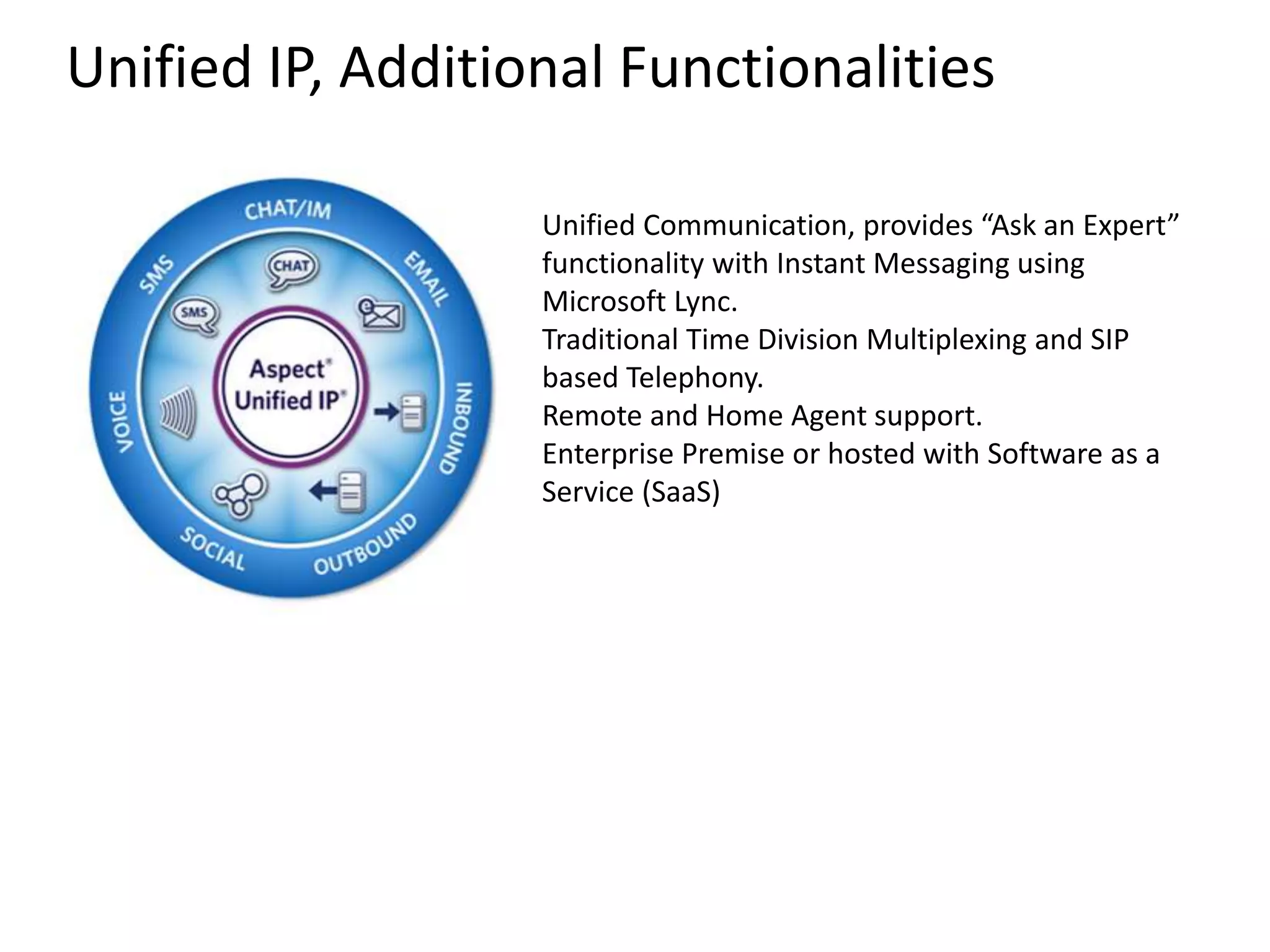
Unified Communication, provides “Ask an Expert”
functionality with Instant Messaging using
Microsoft Lync.
Traditional Time Division Multiplexing and SIP
based Telephony.
Remote and Home Agent support.
Enterprise Premise or hosted with Software as a
Service (SaaS)
Components of Unified IP
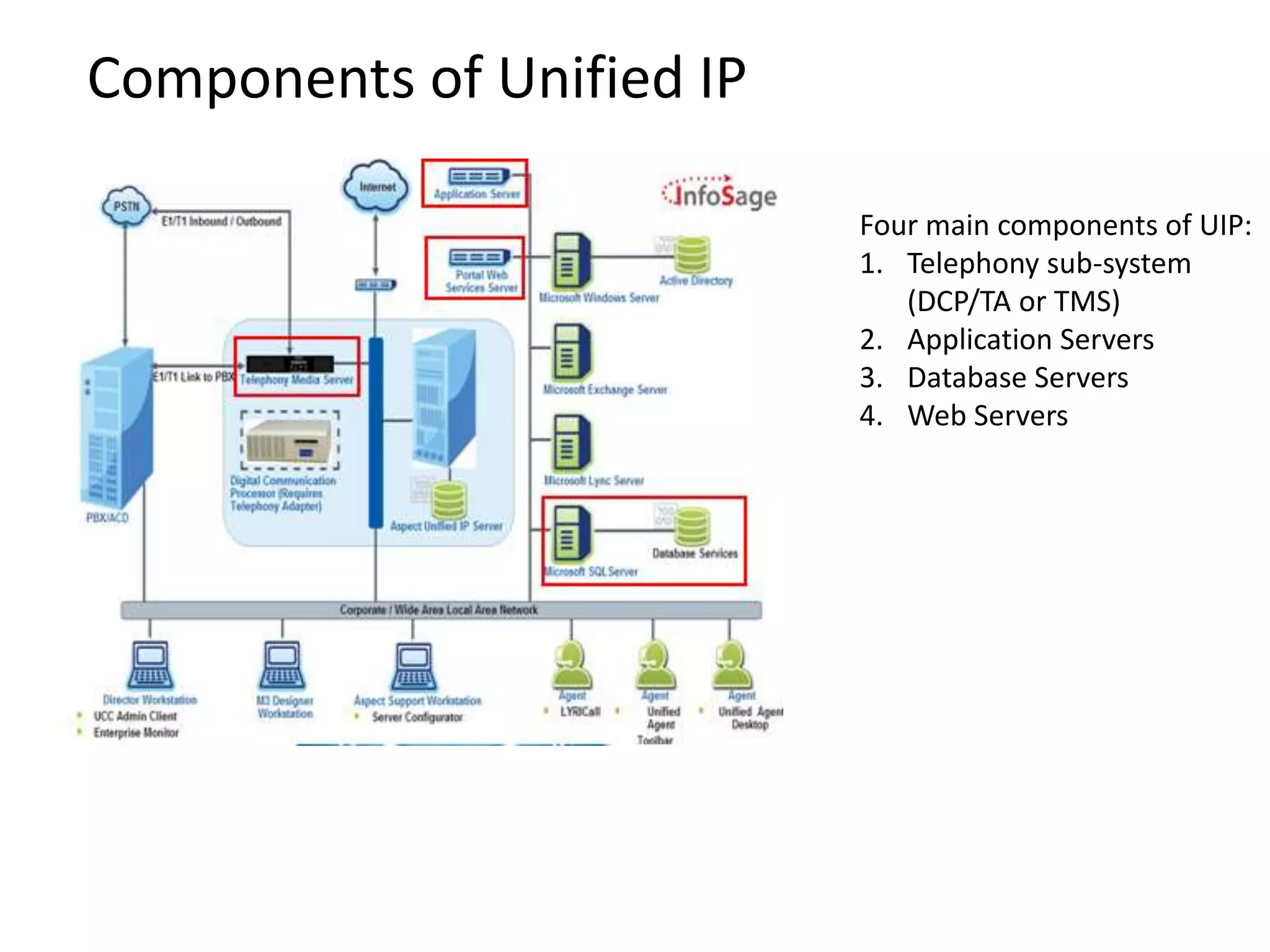
Four main components of UIP:
1. Telephony sub-system
(DCP/TA or TMS)
2. Application Servers
3. Database Servers
4. Web Servers
Components of Unified IP
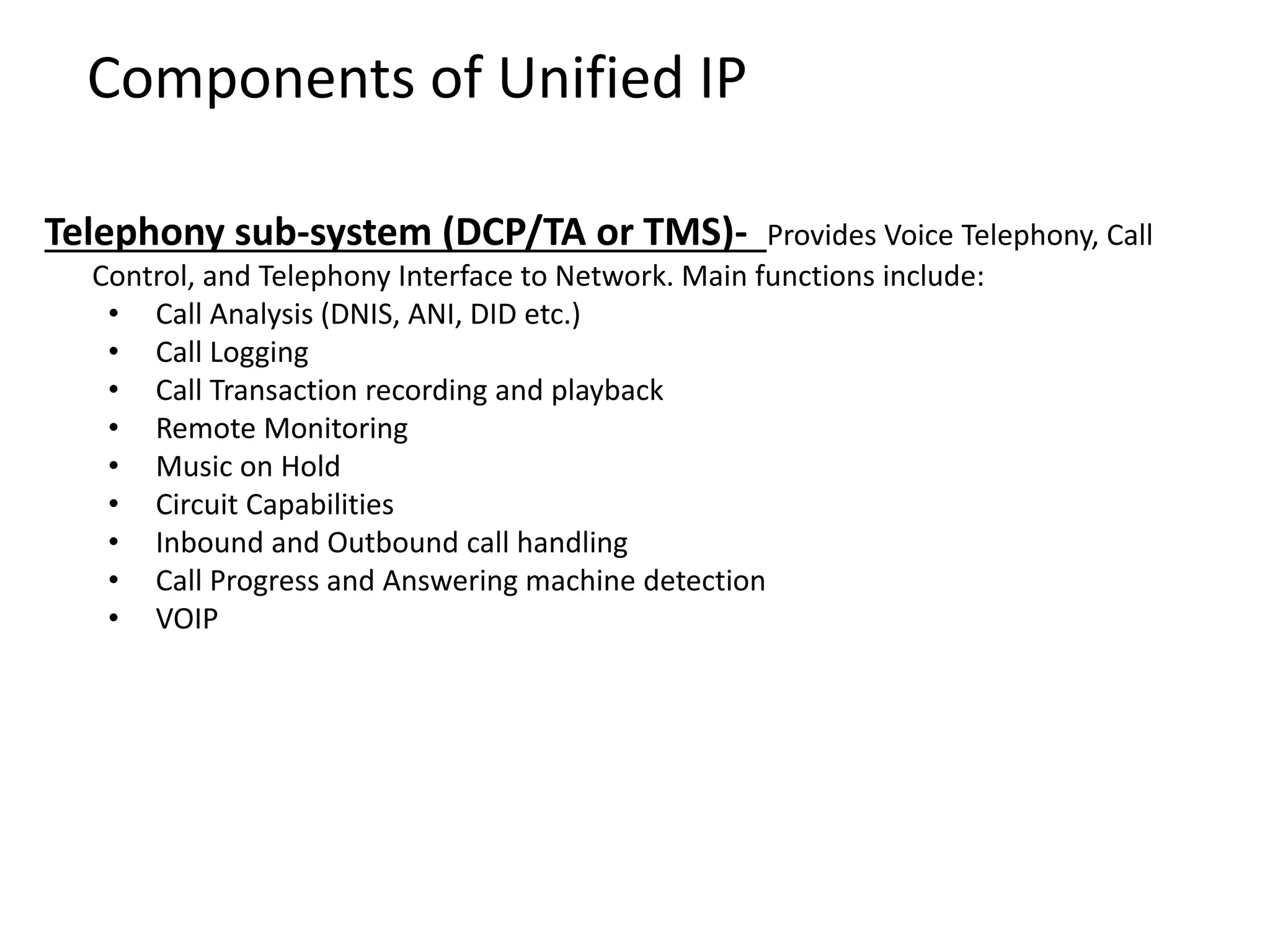
Telephony sub-system (DCP/TA or TMS)- Provides Voice Telephony, Call
Control, and Telephony Interface to Network. Main functions include:
• Call Analysis (DNIS, ANI, DID etc.)
• Call Logging
• Call Transaction recording and playback
• Remote Monitoring
• Music on Hold
• Circuit Capabilities
• Inbound and Outbound call handling
• Call Progress and Answering machine detection
• VOIP
Components of Unified IP
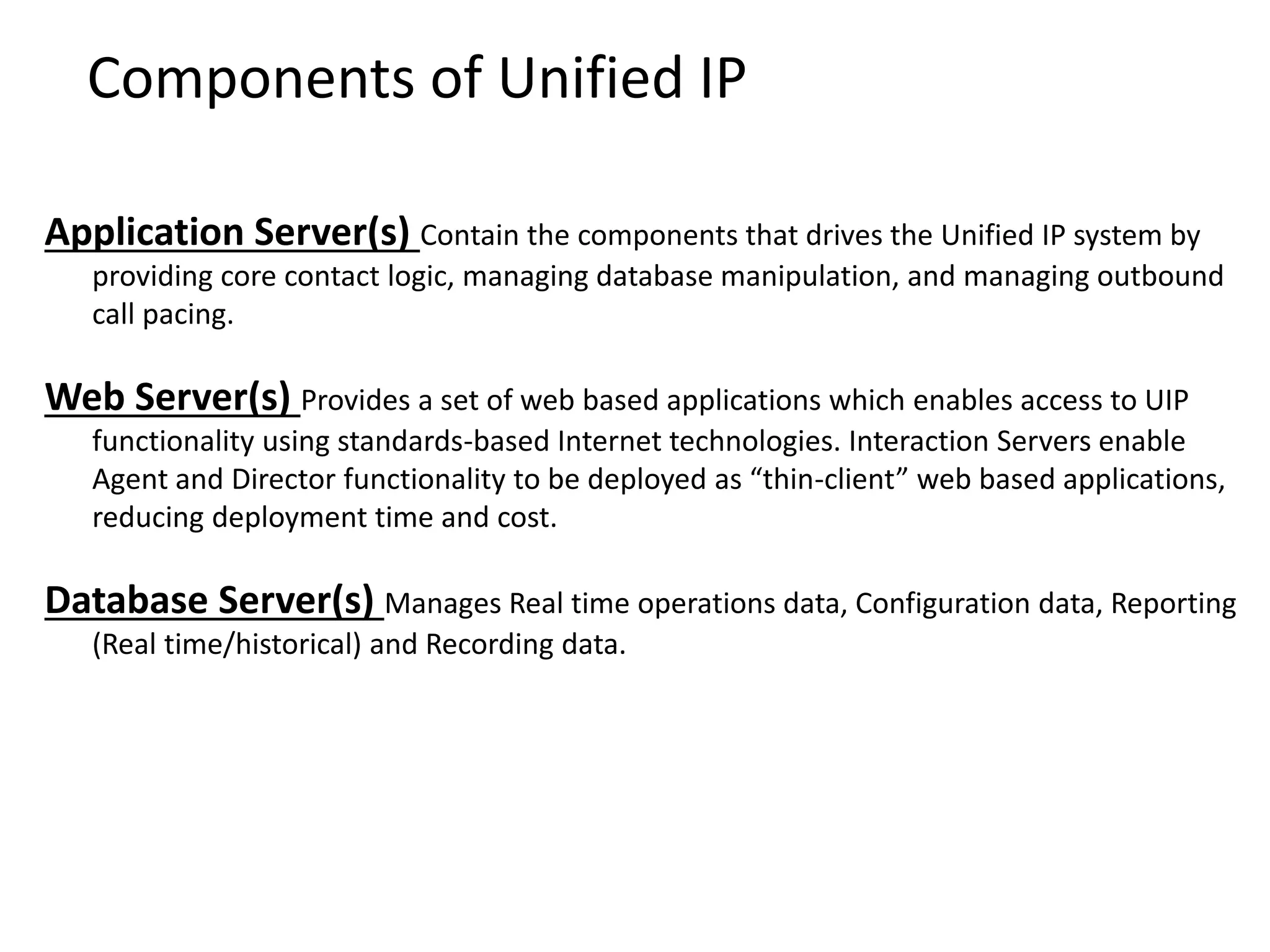
Application Server(s) Contain the components that drives the Unified IP system by
providing core contact logic, managing database manipulation, and managing outbound
call pacing.
Web Server(s) Provides a set of web based applications which enables access to UIP
functionality using standards-based Internet technologies. Interaction Servers enable
Agent and Director functionality to be deployed as “thin-client” web based applications,
reducing deployment time and cost.
Database Server(s) Manages Real time operations data, Configuration data, Reporting
(Real time/historical) and Recording data.
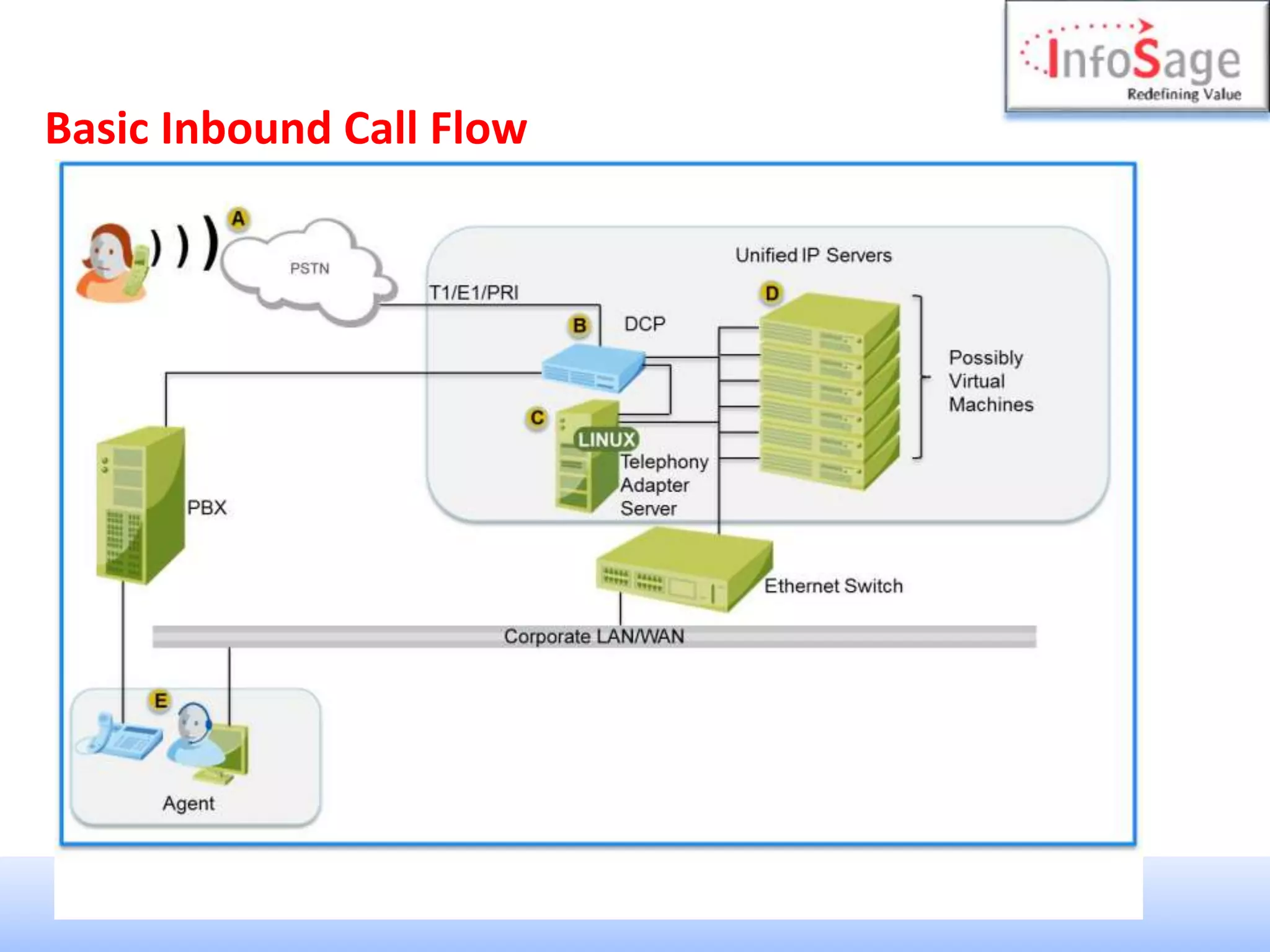
Basic Inbound Call Flow
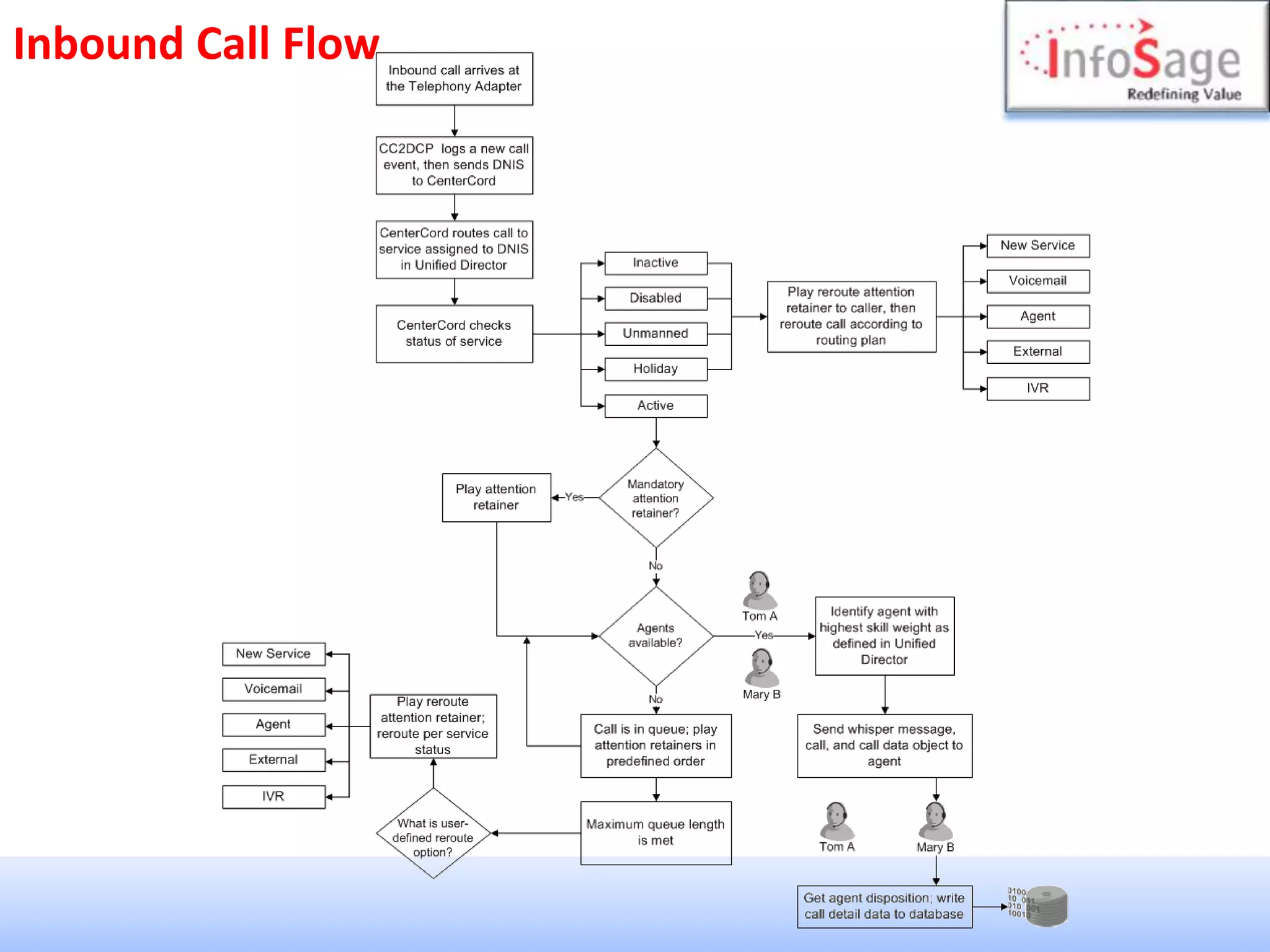
Inbound Call Flow
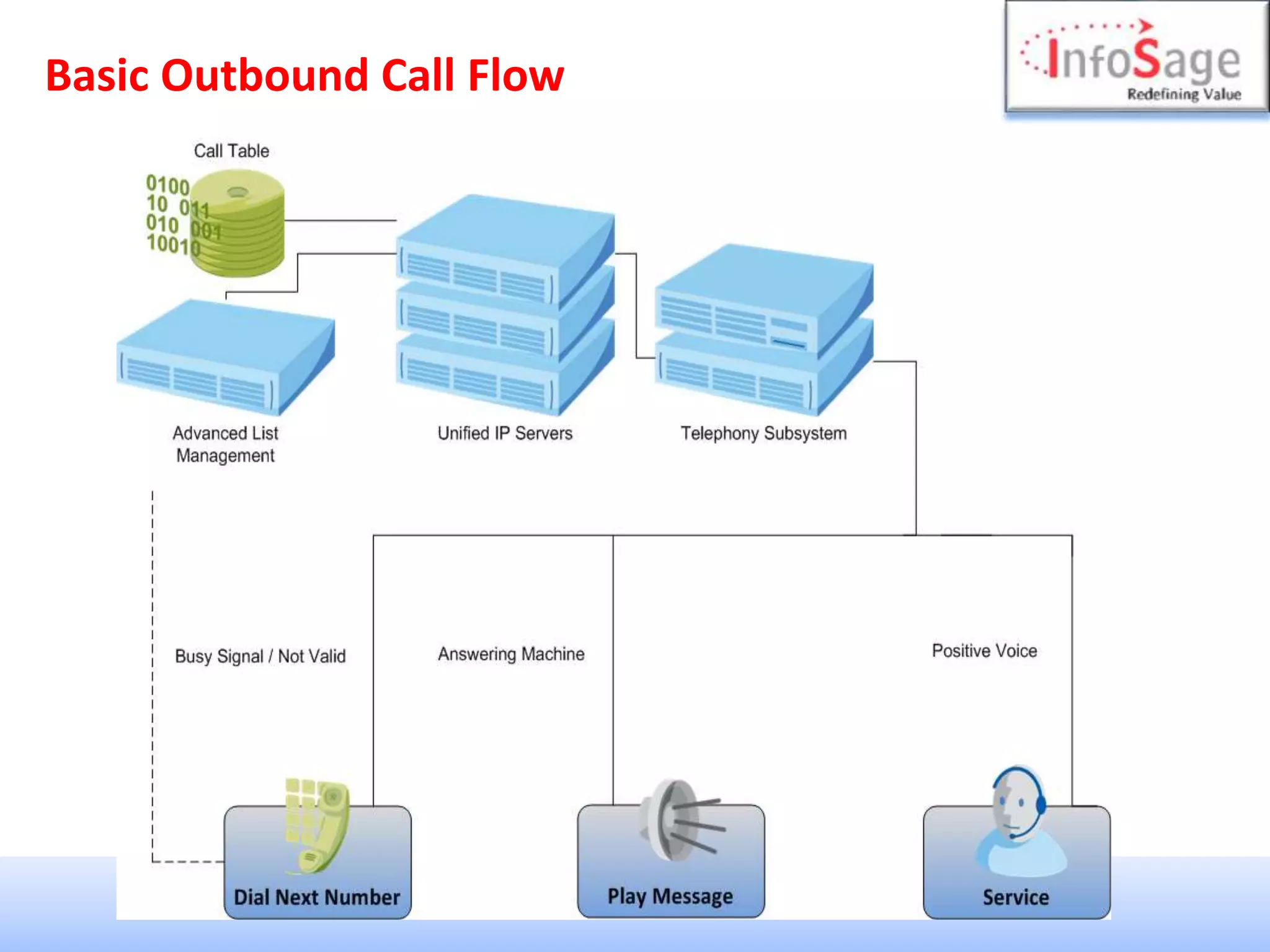
Basic Outbound Call Flow
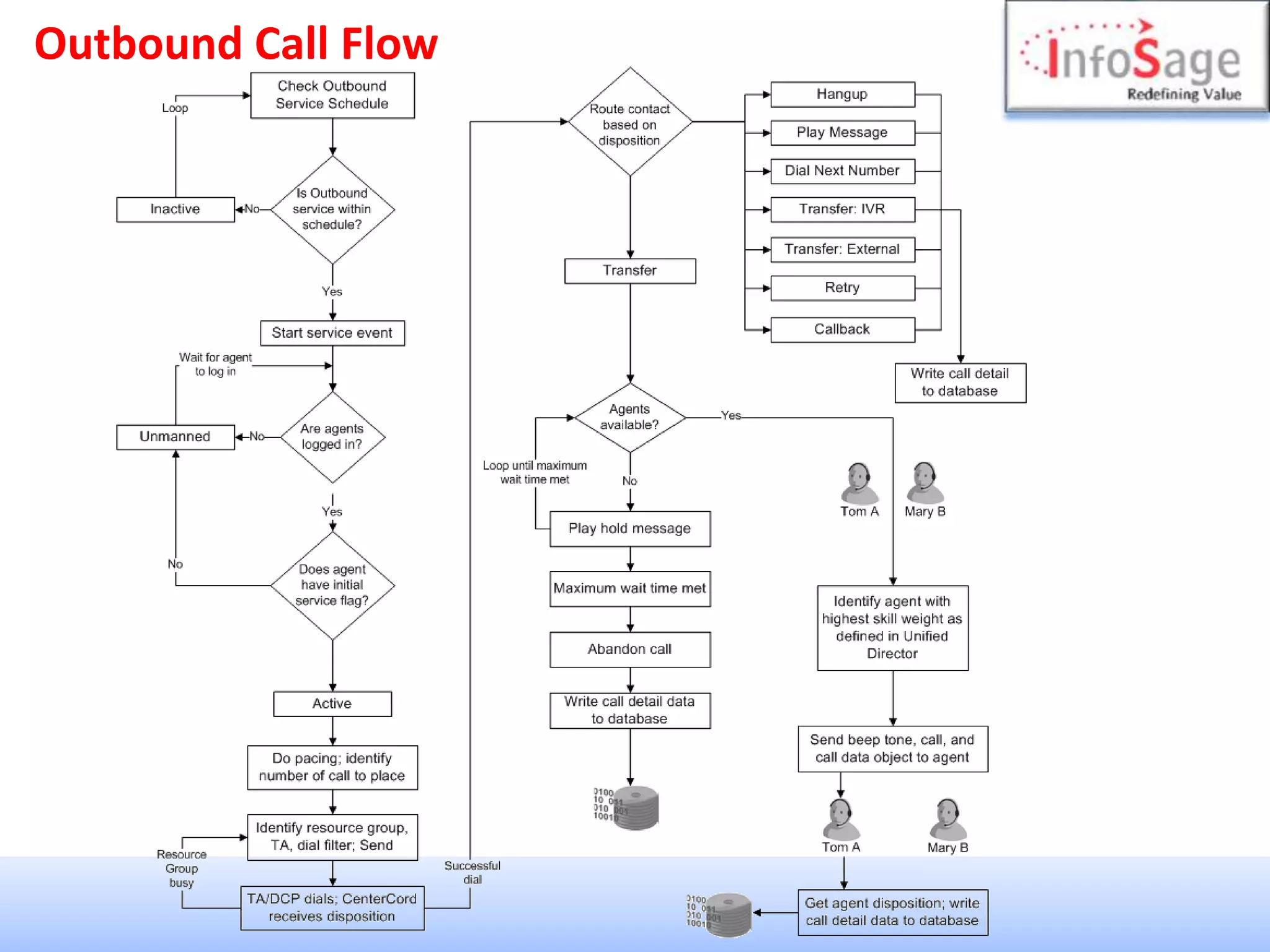
Outbound Call Flow
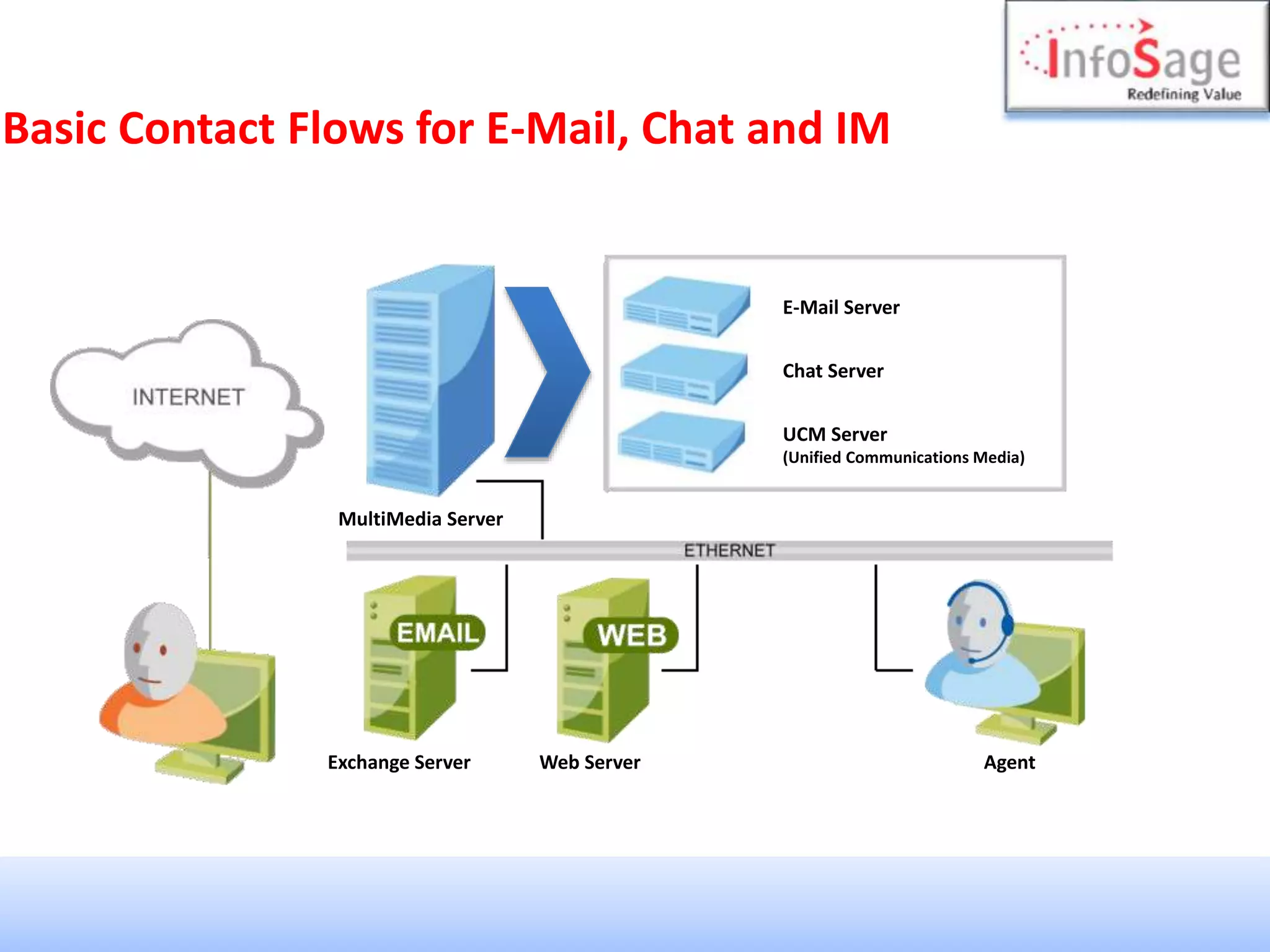
Basic Contact Flows for E-Mail, Chat and IM
E-Mail Server
Chat Server
UCM Server
(Unified Communications Media)
MultiMedia Server
Exchange Server Web Server Agent

Aspect Unified IP Overview and Physical Architecture

  • 1.
    Aspect Unified IPOverview and Physical Architecture Vishad Garg
  • 2.
    What is AspectUnified IP? Aspect Unified Integrated Platform or UIP is a powerful contact center solution with all the functionalities required by multimedia contact center such as: •Automatic Call Distribution •Predictive Dialing •Interactive Voice Response •eMail •Chat Universal Queuing •Recording •Reporting Unified IP is a modular platform, allowing customer to deploy the contact center solutions in stages and increase its functionalities as their need grows.
  • 3.
    Unified IP, ComprehensiveFunctionalities Inbound Routing with skills, priority and data directed routing Outbound dialing with preview, progressive, precision and blaster mode Interactive Voice Response (IVR) with speech enabled voice portal Internet Contact- email service, web chat and Collaboration, web call back Contact Blending. Proactive Contact with Outbound IVR, Short Message Services and email. Native Call Recording and Quality Management. Unified Agent Desktop with scripting and screen pop International/localized in 10 languages.
  • 4.
    Unified IP, AdditionalFunctionalities Unified Communication, provides “Ask an Expert” functionality with Instant Messaging using Microsoft Lync. Traditional Time Division Multiplexing and SIP based Telephony. Remote and Home Agent support. Enterprise Premise or hosted with Software as a Service (SaaS)
  • 5.
    Components of UnifiedIP Four main components of UIP: 1. Telephony sub-system (DCP/TA or TMS) 2. Application Servers 3. Database Servers 4. Web Servers
  • 6.
    Components of UnifiedIP Telephony sub-system (DCP/TA or TMS)- Provides Voice Telephony, Call Control, and Telephony Interface to Network. Main functions include: • Call Analysis (DNIS, ANI, DID etc.) • Call Logging • Call Transaction recording and playback • Remote Monitoring • Music on Hold • Circuit Capabilities • Inbound and Outbound call handling • Call Progress and Answering machine detection • VOIP
  • 7.
    Components of UnifiedIP Application Server(s) Contain the components that drives the Unified IP system by providing core contact logic, managing database manipulation, and managing outbound call pacing. Web Server(s) Provides a set of web based applications which enables access to UIP functionality using standards-based Internet technologies. Interaction Servers enable Agent and Director functionality to be deployed as “thin-client” web based applications, reducing deployment time and cost. Database Server(s) Manages Real time operations data, Configuration data, Reporting (Real time/historical) and Recording data.
  • 8.
  • 9.
  • 10.
  • 11.
  • 12.
    Basic Contact Flowsfor E-Mail, Chat and IM E-Mail Server Chat Server UCM Server (Unified Communications Media) MultiMedia Server Exchange Server Web Server Agent

Editor's Notes

  • #9 When a customer places a call (A) to one of your company’s inbound numbers, the DCP (B) accepts the call on a specific channel and sends a message through dcpsrv running on the Telephony Adapter Server (C) to CC2DCP on the core server to notify the CenterCord (D) that a call has arrived. The CenterCord (D) decides where to route the call and then sends instructions to the Telephony Adapter (C) as to which agent (E) should be connected to the audio. If data is associated with the call, the CenterCord will route the associated data for that call to the agent’s workstation.
  • #11 The CenterCord (A) selects a phone number from the customer record in a call table and sends a message through the CC2DCP on the Core server to the dcpsrv on the Telephony Adapter (B) to have the DCP (C) dial the number. The DCP (C) dials the number. If the customer (D) answers the call, the DCP (C) sends a message to the CenterCord (A) via the Telephony Adapter server (B) that the call was answered. The CenterCord (A) will then send instructions to the DCP (C) via the Telephony Adapter (B) to route the audio to a specific agent (E). CenterCord (A) will route the data associated with that call to the agent’s workstation (E).