Principles of Epidemiology
             &
  Epidemiologic methods
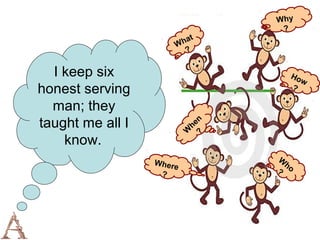
W hy
                                  ?
                           t
                      W ha
                         ?

  I keep six                        Ho
                                       w
honest serving                      ?

  man; they
taught me all I            hen
                          W ?
    know.
                  Wher           W
                      e            ho
                   ?             ?
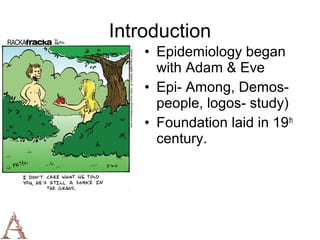
Introduction
    • Epidemiology began
      with Adam & Eve
    • Epi- Among, Demos-
      people, logos- study)
    • Foundation laid in 19th
      century.
Definition
• “The study of the distribution &
  determinants of health-related states or
  events in specified populations, and the
  application of this study to the control of
  health problems.” (John M. Last, 1988)

• Three components:
  – Studies of disease frequency,
  – Studies of the distribution and
  – Studies of the determinants.
Disease frequency
• Measurement of frequency of
  – Disease, disability, death
• Summarizing these in terms of rates & ratios.
• Essential for comparing with diff. population /
  subgroup of the same population.
• May yield important clues to disease
  aetiology & development of strategies for
  disease prevention / control.
Distribution of Disease
• Disease / health related matters not uniformly
  distributed in the populations.
• It occurs in patterns in a community &, study of
  these patterns in terms of time, place & persons
  may lead to the hypotheses about risk /
  causative factors and leads to measures for
  control / prevention of the diseases.
• This part of epidemiology “Descriptive
  epidemiology”
Determinants of diseases
• Test etiological hypotheses and identify
  the underlying risk / causative factors of
  the disease.
• Analytical epidemiology.
• Help in development of health programs,
  interventions & policies.
Aims of Epidemiology
• To describe the distribution & magnitude of
  health & disease problems in human
  populations.
• To identify etiological factors / risk factors in the
  pathogenesis of disease
• To provide the data essential to the planning,
  implementation & evaluation of services for the
  prevention, control and treatment of diseases
  and to the setting up of priorities among those
  services.

Principles of epidemiology

  • 1.
    Principles of Epidemiology & Epidemiologic methods
  • 2.
    W hy ? t W ha ? I keep six Ho w honest serving ? man; they taught me all I hen W ? know. Wher W e ho ? ?
  • 3.
    Introduction • Epidemiology began with Adam & Eve • Epi- Among, Demos- people, logos- study) • Foundation laid in 19th century.
  • 4.
    Definition • “The studyof the distribution & determinants of health-related states or events in specified populations, and the application of this study to the control of health problems.” (John M. Last, 1988) • Three components: – Studies of disease frequency, – Studies of the distribution and – Studies of the determinants.
  • 5.
    Disease frequency • Measurementof frequency of – Disease, disability, death • Summarizing these in terms of rates & ratios. • Essential for comparing with diff. population / subgroup of the same population. • May yield important clues to disease aetiology & development of strategies for disease prevention / control.
  • 6.
    Distribution of Disease •Disease / health related matters not uniformly distributed in the populations. • It occurs in patterns in a community &, study of these patterns in terms of time, place & persons may lead to the hypotheses about risk / causative factors and leads to measures for control / prevention of the diseases. • This part of epidemiology “Descriptive epidemiology”
  • 7.
    Determinants of diseases •Test etiological hypotheses and identify the underlying risk / causative factors of the disease. • Analytical epidemiology. • Help in development of health programs, interventions & policies.
  • 8.
    Aims of Epidemiology •To describe the distribution & magnitude of health & disease problems in human populations. • To identify etiological factors / risk factors in the pathogenesis of disease • To provide the data essential to the planning, implementation & evaluation of services for the prevention, control and treatment of diseases and to the setting up of priorities among those services.