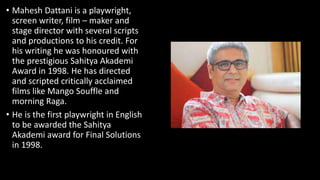
• Mahesh Dattani is a playwright,
screen writer, film – maker and
stage director with several scripts
and productions to his credit. For
his writing he was honoured with
the prestigious Sahitya Akademi
Award in 1998. He has directed
and scripted critically acclaimed
films like Mango Souffle and
morning Raga.
• He is the first playwright in English
to be awarded the Sahitya
Akademi award for Final Solutions
in 1998.
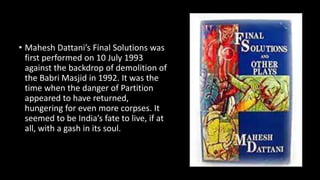
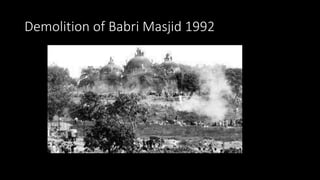
• Mahesh Dattani’s Final Solutions was
first performed on 10 July 1993
against the backdrop of demolition of
the Babri Masjid in 1992. It was the
time when the danger of Partition
appeared to have returned,
hungering for even more corpses. It
seemed to be India’s fate to live, if at
all, with a gash in its soul.
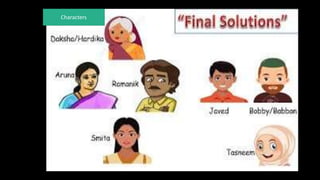
Characters
Plot
• The play opens with Hardika reading out her diary.
• The story shifts from present to past and past to present. During the
Rath Yatra procession violence broke out inflaming the communal
feelings in form of riots. Bobby and Javed two Muslims were chased
by fanatic Hindu mob and they took refuge in Ramnik Gandhi's house.
The scene was of complete destruction and devastation. So many
years after independence, conditions are still the same when it comes
to religious prejudices and communal tension.
• Bobby and Javed were chased by mob and they took refuge in Ramnik
Gandhi'shouse, a Hindu. Hardika and Aruna, Ramnik's mother and
wife issceptic about.
• Bobby and Javed but Ramnik and his daughter are liberals and were
ready to help them. Hardika was doubtful and even worried for her
family because of her past experiences. Forty years ago she had a
Muslim friend Zarine. She was ill treated by Zarine’s family.
Themes
• The theme of the play Final Solutions is to highlight human
weaknesses, selfishness, avarice and opportunism. Woven into the
play are the issues of class and communities and the clashes between
traditional and modern life style and value systems. The problem of
minorities is not confined to only Hindus and Muslims, it eats the
peace of any minority community among the majority.
Demolition of Babri Masjid 1992
While viewing task:
• How are the beginning and the end of
the movie? Do you observe any
communal effect over there?
• Do you find Hardika’s Character
symbolic? How and why?
• What do you think about the
conversation between Ramnik, Boby,
and Javed? Who is rigidly conditioned
? Why?
• Do you think the director has used
appropriate symbols in the movie?
• Comment upon the role of all the
three women in the play.
• Pre-viewing tasks:
• What is Communal Clash?
• The Backdrop of Babri Masjid
and its connection with the play.
• Introduction to the play.
Works Cited:-
• Dattani, Mahesh. Final Solutions. Penguine Group, 2005. Print.

The Final Solutions.pptx

  • 2.
    • Mahesh Dattaniis a playwright, screen writer, film – maker and stage director with several scripts and productions to his credit. For his writing he was honoured with the prestigious Sahitya Akademi Award in 1998. He has directed and scripted critically acclaimed films like Mango Souffle and morning Raga. • He is the first playwright in English to be awarded the Sahitya Akademi award for Final Solutions in 1998.
  • 3.
    • Mahesh Dattani’sFinal Solutions was first performed on 10 July 1993 against the backdrop of demolition of the Babri Masjid in 1992. It was the time when the danger of Partition appeared to have returned, hungering for even more corpses. It seemed to be India’s fate to live, if at all, with a gash in its soul.
  • 4.
  • 5.
    Plot • The playopens with Hardika reading out her diary. • The story shifts from present to past and past to present. During the Rath Yatra procession violence broke out inflaming the communal feelings in form of riots. Bobby and Javed two Muslims were chased by fanatic Hindu mob and they took refuge in Ramnik Gandhi's house. The scene was of complete destruction and devastation. So many years after independence, conditions are still the same when it comes to religious prejudices and communal tension.
  • 6.
    • Bobby andJaved were chased by mob and they took refuge in Ramnik Gandhi'shouse, a Hindu. Hardika and Aruna, Ramnik's mother and wife issceptic about. • Bobby and Javed but Ramnik and his daughter are liberals and were ready to help them. Hardika was doubtful and even worried for her family because of her past experiences. Forty years ago she had a Muslim friend Zarine. She was ill treated by Zarine’s family.
  • 7.
    Themes • The themeof the play Final Solutions is to highlight human weaknesses, selfishness, avarice and opportunism. Woven into the play are the issues of class and communities and the clashes between traditional and modern life style and value systems. The problem of minorities is not confined to only Hindus and Muslims, it eats the peace of any minority community among the majority.
  • 8.
  • 9.
    While viewing task: •How are the beginning and the end of the movie? Do you observe any communal effect over there? • Do you find Hardika’s Character symbolic? How and why? • What do you think about the conversation between Ramnik, Boby, and Javed? Who is rigidly conditioned ? Why? • Do you think the director has used appropriate symbols in the movie? • Comment upon the role of all the three women in the play. • Pre-viewing tasks: • What is Communal Clash? • The Backdrop of Babri Masjid and its connection with the play. • Introduction to the play.
  • 10.
    Works Cited:- • Dattani,Mahesh. Final Solutions. Penguine Group, 2005. Print.