Cultural Sensitivity Roots, Race, Ethnicity And Gender
What is Cultural Sensitivity? Cultural sensitivity begins with a recognition that there are differences between cultures These differences are reflected in the ways that different groups communicate and relate to one another Cultural sensitivity is more than an  awareness  that there are differences in culture in order to interact effectively A culturally competent person views all people as unique individuals and realizes that their experiences, beliefs, values, and language affect their perceptions
Increasing Awareness Recognizing differences among cultures is important, but we should also be aware that differences also exist  within  cultures The assumption that a common culture is shared by all members of a racial, linguistic, or religious group is erroneous We must recognize our own cultural values and draw parallels where possible; we should also identify any prejudices and stereotypes that prevent us from communicating effectively with people from different cultures Realize that, like it or not, we most likely hold some stereotypes about culture and gender
Questions To Ask Ourselves Do we try to learn the names of those from other cultures? Are we patient with their attempts to use English? Do we make assumptions about people based on their race, ethnicity, or gender? Are we doing everything we can to  learn about them?
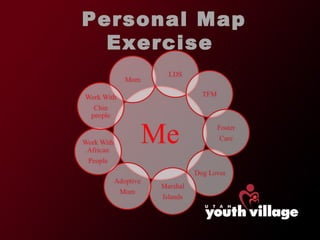
Personal Map Exercise
Stereotypes People harbor positive and negative stereotypes about people Stereotypes about race? Stereotypes about culture? Stereotypes about gender?
Discrimination Discrimination  is the  prejudicial  treatment of an individual based on their membership in a certain group or category. It involves the actual behaviors towards groups such as excluding or restricting members of one group from opportunities that are available to another group
How Discrimination Affects Us
Showing Sensitivity to Culture Take them to the school they will be attending Walk around your neighborhood Take them to the library, weekly Take them to sporting events. Outside the U.S. soccer is huge! Find an ethnic market. Have them help you buy and prepare food from their country and make it part of your regular menu Ask them to sing and/or dance for you,   if they are comfortable doing so
Showing Sensitivity to Culture Explain some of your religious traditions and ask them about theirs. Ask about times that are important to them and make them important to you Be mindful of their connection to church, community, culture, and family Be patient as they try to use new English skills
Control Emotions even when not directed at the children. They will read your body language and assume it ’s them. 80-90% of communication is non-verbal. Save frustration for  private  moments with spouse or consultant Make their church your priority Increasing Your Relationship and Building Trust
Using Interpreters Discuss the focus of the session with the interpreter before the youth arrives; be clear about what the interpreter should convey to the patient Speak in short sentences or phrases, to make translating easier for the interpreter. Make sure the youth understands what he or she has been told by asking for him/her to repeat the message in his/her own words Focus on the speaker, not the interpreter Be sensitive to cultural differences when using nonverbal communication. For example, a touch has many cultural meanings. You must be aware that personal space has different boundaries in different cultures.
Showing Sensitivity to Gender Being aware that there are differences between males and females, but those differences are not universal Aspects of gender Assignment: The gender we are given at birth, either being male or female In this aspect, our genders are prescribed by the society in which we are born
Role: This is the set of behaviors, mannerisms, and other traits that society says we should express as part of our assigned gender Identity: This is what we think our gender should be at any given time  Many people do not question their gender and let their assigned gender function as their identity.
Attribution: This is the gender we assign people when we first meet them and is based on a set of cues that differentiate from culture to culture. What is a  real  man? What is a  real  woman? What if your youth has questions about his/her gender identity?
Conclusions In our society today, communities are made up of people with a wide range of ideas and orientations, even about issues as fundamental as race, ethnicity, and gender Anyone engaging in his/her community may be challenged by ideas and orientations that they have not considered Among these ideas, differing ideas about race, culture, and gender can be very challenging, especially if a person hasn ’t thought about the issues Expectations about others affect day-to-day working relationships Drawing conclusions based on stereotypes is wrong and can be harmful

Cultural Sensitivity

  • 1.
    Cultural Sensitivity Roots,Race, Ethnicity And Gender
  • 2.
    What is CulturalSensitivity? Cultural sensitivity begins with a recognition that there are differences between cultures These differences are reflected in the ways that different groups communicate and relate to one another Cultural sensitivity is more than an awareness that there are differences in culture in order to interact effectively A culturally competent person views all people as unique individuals and realizes that their experiences, beliefs, values, and language affect their perceptions
  • 3.
    Increasing Awareness Recognizingdifferences among cultures is important, but we should also be aware that differences also exist within cultures The assumption that a common culture is shared by all members of a racial, linguistic, or religious group is erroneous We must recognize our own cultural values and draw parallels where possible; we should also identify any prejudices and stereotypes that prevent us from communicating effectively with people from different cultures Realize that, like it or not, we most likely hold some stereotypes about culture and gender
  • 4.
    Questions To AskOurselves Do we try to learn the names of those from other cultures? Are we patient with their attempts to use English? Do we make assumptions about people based on their race, ethnicity, or gender? Are we doing everything we can to learn about them?
  • 5.
  • 6.
    Stereotypes People harborpositive and negative stereotypes about people Stereotypes about race? Stereotypes about culture? Stereotypes about gender?
  • 7.
    Discrimination Discrimination is the prejudicial treatment of an individual based on their membership in a certain group or category. It involves the actual behaviors towards groups such as excluding or restricting members of one group from opportunities that are available to another group
  • 8.
  • 9.
    Showing Sensitivity toCulture Take them to the school they will be attending Walk around your neighborhood Take them to the library, weekly Take them to sporting events. Outside the U.S. soccer is huge! Find an ethnic market. Have them help you buy and prepare food from their country and make it part of your regular menu Ask them to sing and/or dance for you, if they are comfortable doing so
  • 10.
    Showing Sensitivity toCulture Explain some of your religious traditions and ask them about theirs. Ask about times that are important to them and make them important to you Be mindful of their connection to church, community, culture, and family Be patient as they try to use new English skills
  • 11.
    Control Emotions evenwhen not directed at the children. They will read your body language and assume it ’s them. 80-90% of communication is non-verbal. Save frustration for private moments with spouse or consultant Make their church your priority Increasing Your Relationship and Building Trust
  • 12.
    Using Interpreters Discussthe focus of the session with the interpreter before the youth arrives; be clear about what the interpreter should convey to the patient Speak in short sentences or phrases, to make translating easier for the interpreter. Make sure the youth understands what he or she has been told by asking for him/her to repeat the message in his/her own words Focus on the speaker, not the interpreter Be sensitive to cultural differences when using nonverbal communication. For example, a touch has many cultural meanings. You must be aware that personal space has different boundaries in different cultures.
  • 13.
    Showing Sensitivity toGender Being aware that there are differences between males and females, but those differences are not universal Aspects of gender Assignment: The gender we are given at birth, either being male or female In this aspect, our genders are prescribed by the society in which we are born
  • 14.
    Role: This isthe set of behaviors, mannerisms, and other traits that society says we should express as part of our assigned gender Identity: This is what we think our gender should be at any given time Many people do not question their gender and let their assigned gender function as their identity.
  • 15.
    Attribution: This isthe gender we assign people when we first meet them and is based on a set of cues that differentiate from culture to culture. What is a real man? What is a real woman? What if your youth has questions about his/her gender identity?
  • 16.
    Conclusions In oursociety today, communities are made up of people with a wide range of ideas and orientations, even about issues as fundamental as race, ethnicity, and gender Anyone engaging in his/her community may be challenged by ideas and orientations that they have not considered Among these ideas, differing ideas about race, culture, and gender can be very challenging, especially if a person hasn ’t thought about the issues Expectations about others affect day-to-day working relationships Drawing conclusions based on stereotypes is wrong and can be harmful

Editor's Notes

  • #6 Participants are asked to create their own personal map by writing their names on top of their paper and then identifying and listing all the "communities" that they identify with. For example, some may identify themselves as certified people, and others as Irish Americans, women, ex-Catholics, step-mothers, college professors, pet owners, environmentalists, Democrats, runners, and so on. It often helps if the facilitator shows a pre-written example of his or her own map, so the participants understand what is expected of them. Once participants finish their maps, students should be provided with time to walk around and view other participants' maps. Once all participants have had time to examine all the maps, the following questions can help to facilitate the discussion: € What did you learn about others that you didn't already know? € Did you find that you were similar to others in ways that surprised you? € Did you find that you were different from people that you thought were the same as you? € How many of the listed characteristics about a person would you have been able to tell by merely looking at them? € What are the implications of this activity when working with multicultural populations? The ensuing discussion of the above questions will compel people to engage in a face-to-face discussion of their preconceived feelings about other groups of people. Bringing these feelings out in the open can defuse anxieties that one person may have about others, and hopefully will increase his or her comfort level with people from different backgrounds.
  • #7 A stereotype is a preconceived judgment about an entire group of people, where all are believed to have the same characteristics. A stereotype often clouds the judgment of a person, preventing him or her from seeing the youth as a person with individual characteristics. For example, if a person is perceived as being an alcoholic, one might believe he or she is less trustworthy, less ambitious, or good for nothing. But what about stereotypes that appear to be positive, such as the stereotype that all African Americans are good athletes? If one assumes that all African Americans are naturally athletic, then the athletic trainer may overlook the possibility that an extra flexibility or strength training program would improve the performance of an African American athlete. The bottom line is that all stereotypes are negative, even if they have a positive connotation. Stereotyping is also dangerous because if often leads to prejudice. Prejudice is an attitude, feeling, or pre-judgment that often results in negative action against members of a group. To help debunk the merit of stereotypes, an analogy of a beach often clears things up. Think of the number of grains of sand on a beach. There are billions of grains. Stereotypes may have a grain of truth to them, but one grain is nothing compared to the billions of grains of sand that make up a beach.