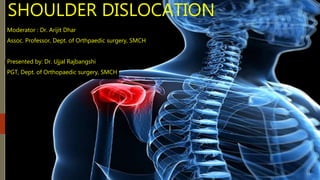
SHOULDER DISLOCATION
Moderator : Dr. Arijit Dhar
Assoc. Professor, Dept. of Orthpaedic surgery, SMCH
Presented by: Dr. Ujjal Rajbangshi
PGT, Dept. of Orthopaedic surgery, SMCH
LEARNING OBJECTIVES
 Epidemiology of shoulder dislocation
 Anatomy of shoulder joint ,with stabilizer of joint
 Pathoanatomy of shoulder dislocation
 Mechanism of injury in different types of shoulder dislocation
 Clinical presentation and radiological evaluation of shoulder joint dislocation
 Management
 Complications
 Recurrent shoulder dislocation
EPIDEMIOLOGY
 The shoulder is the most common dislocated major joint of the body, accounting
for upto 45% of dislocation.
 Anterior dislocation account for 96% of cases, posterior dislocation account for
2% -4% 0f cases , the second most common type.
 Inferior and superior shoulder dislocation are rare(0.5%).
 Incidence peaks for male in 21 to 30 years and for female in the 61-80 years .
 Recurrence rate in all ages in 50% but arises to almost 89% in 14-20 years age
group.
ANATOMY
 Shoulder girdle comprises of the clavicle ,the scapula and the humerus.
 Shoulder joint is comprises of glenohumeral joint, acromioclavicular joint , and
coracoclavicular joint.
 Shoulder joint also known as Glenohumeral joint , is a ball and socket type of
joint.
 It is inherently unstable because the ‘Ball’ is big and the ‘socket’ is small.
 Only about one-third of the humeral head is in contact with the glenoid cavity at
any one time.
ANATOMY
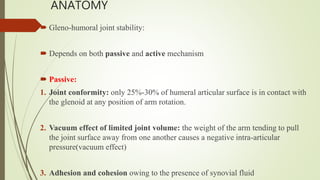
 Gleno-humoral joint stability:
 Depends on both passive and active mechanism
 Passive:
1. Joint conformity: only 25%-30% of humeral articular surface is in contact with
the glenoid at any position of arm rotation.
2. Vacuum effect of limited joint volume: the weight of the arm tending to pull
the joint surface away from one another causes a negative intra-articular
pressure(vacuum effect)
3. Adhesion and cohesion owing to the presence of synovial fluid
ANATOMY
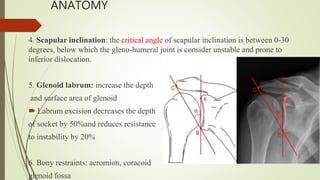
4. Scapular inclination: the critical angle of scapular inclination is between 0-30
degrees, below which the gleno-humeral joint is consider unstable and prone to
inferior dislocation.
5. Glenoid labrum: increase the depth
and surface area of glenoid
 Labrum excision decreases the depth
of socket by 50%and reduces resistance
to instability by 20%
6. Bony restraints: acromion, coracoid
glenoid fossa
ANATOMY
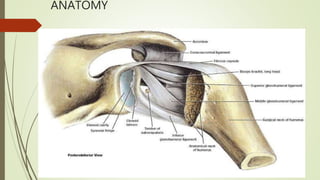
7. Ligamentous and capsular restraints:
 Joint capsule: the anteroinferior capsule limits anterior subluxation of the abducted shoulder
The posterior capsule and teres minor limits internal rotation.
The anterior capsule and lower subscapularis restrain abduction and external rotation.
 Superior glenohumeral ligament: this is the primary restraint to the inferior translation of the adducted
shoulder.
 Middle glenohumeral ligament: it limits external rotation at 45 degrees of abduction.
 Inferior glenohumeral ligament: it limits external rotation at 45-90 degrees of abduction.
 Coracohumeral ligament: this is secondry stabilizer to inferior translation.
ANATOMY
ANATOMY
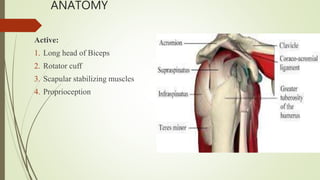
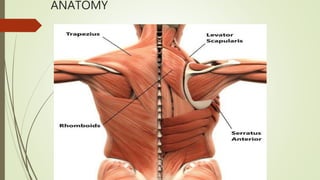
Active:
1. Long head of Biceps
2. Rotator cuff
3. Scapular stabilizing muscles
4. Proprioception
ANATOMY
Pathological changes of shoulder dislocations
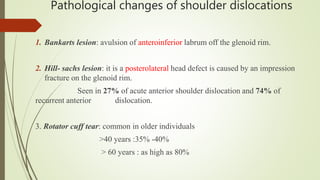
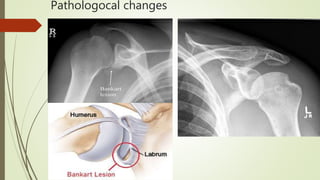
1. Bankarts lesion: avulsion of anteroinferior labrum off the glenoid rim.
2. Hill- sachs lesion: it is a posterolateral head defect is caused by an impression
fracture on the glenoid rim.
Seen in 27% of acute anterior shoulder dislocation and 74% of
recurrent anterior dislocation.
3. Rotator cuff tear: common in older individuals
>40 years :35% -40%
> 60 years : as high as 80%
Pathologocal changes
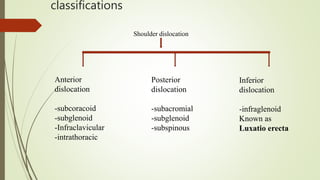
classifications
Shoulder dislocation
Anterior
dislocation
-subcoracoid
-subglenoid
-Infraclavicular
-intrathoracic
Posterior
dislocation
-subacromial
-subglenoid
-subspinous
Inferior
dislocation
-infraglenoid
Known as
Luxatio erecta
MECHANISM OF INJURIES
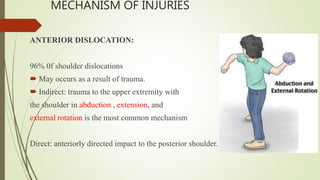
ANTERIOR DISLOCATION:
96% 0f shoulder dislocations
 May occurs as a result of trauma.
 Indirect: trauma to the upper extremity with
the shoulder in abduction , extension, and
external rotation is the most common mechanism
Direct: anteriorly directed impact to the posterior shoulder.
MECHANISM OF INJURIES
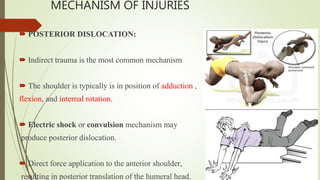
 POSTERIOR DISLOCATION:
 Indirect trauma is the most common mechanism
 The shoulder is typically is in position of adduction ,
flexion, and internal rotation.
 Electric shock or convulsion mechanism may
produce posterior dislocation.
 Direct force application to the anterior shoulder,
resulting in posterior translation of the humeral head.
CLINICAL EVALUATION:
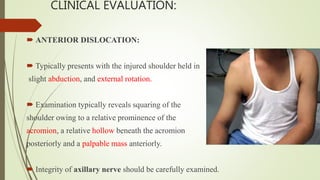
 ANTERIOR DISLOCATION:
 Typically presents with the injured shoulder held in
slight abduction, and external rotation.
 Examination typically reveals squaring of the
shoulder owing to a relative prominence of the
acromion, a relative hollow beneath the acromion
posteriorly and a palpable mass anteriorly.
 Integrity of axillary nerve should be carefully examined.
CLINICAL EVALUATION:
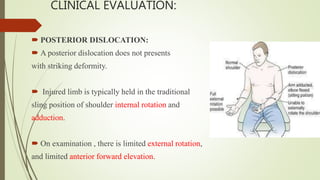
 POSTERIOR DISLOCATION:
 A posterior dislocation does not presents
with striking deformity.
 Injured limb is typically held in the traditional
sling position of shoulder internal rotation and
adduction.
 On examination , there is limited external rotation,
and limited anterior forward elevation.
CLINICAL EVALUATION
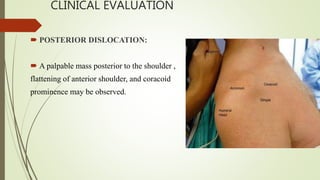
 POSTERIOR DISLOCATION:
 A palpable mass posterior to the shoulder ,
flattening of anterior shoulder, and coracoid
prominence may be observed.
RADIOGRAPHIC EVALUATION
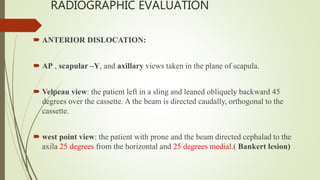
 ANTERIOR DISLOCATION:
 AP , scapular –Y, and axillary views taken in the plane of scapula.
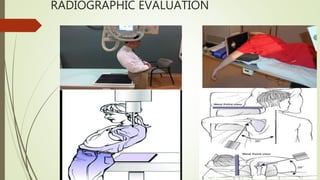
 Velpeau view: the patient left in a sling and leaned obliquely backward 45
degrees over the cassette. A the beam is directed caudally, orthogonal to the
cassette.
 west point view: the patient with prone and the beam directed cephalad to the
axila 25 degrees from the horizontal and 25 degrees medial.( Bankert lesion)
RADIOGRAPHIC EVALUATION
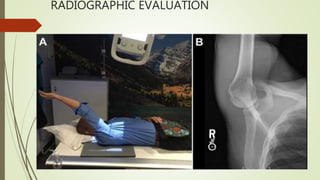
 Stryker notch view: the patients is supine with ipsilateral palm on the crown of
the head and elbow pointing straight upward. Xray taken 10 degree caphalad. To
visualize coracoid.
 Hill Sachs view: AP view is taken with the shoulder in maximally internal
rotation to visualize a Hill-Sachs lesion.
 CT is useful in defining humeral head or glenoid impression fractures, loose
bodies, and anterior labral bony injuries.
 MRI may be used to identify rotator cuff, capsular and glenoid labral
pathological process.
RADIOGRAPHIC EVALUATION
 POSTERIOR DISLOCATION:
 AP , scapular-Y, and axillary views
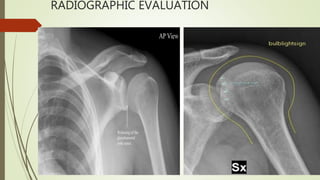
 Sign of posterior dislocation on AP view
 Vacant glenoid sign: the glenoid appear partial vacant(space between anterior
rim and humeral head >6 mm)
 Trough sign: impaction fracture of the anterior humeral head caused by the
posterior rim of glenoid(reverse Hill Sachs lesion).
 Loss of profile of humeral head: humerus is in full internal rotation.
RADIOGRAPHIC EVALUATION
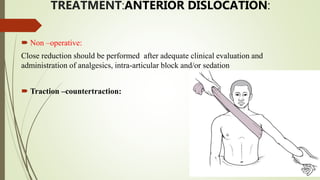
TREATMENT:ANTERIOR DISLOCATION:
 Non –operative:
Close reduction should be performed after adequate clinical evaluation and
administration of analgesics, intra-articular block and/or sedation
 Traction –countertraction:
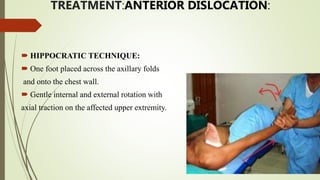
TREATMENT:ANTERIOR DISLOCATION:
 HIPPOCRATIC TECHNIQUE:
 One foot placed across the axillary folds
and onto the chest wall.
 Gentle internal and external rotation with
axial traction on the affected upper extremity.
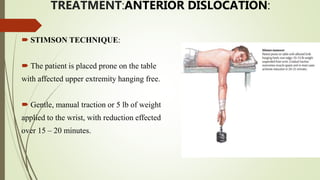
TREATMENT:ANTERIOR DISLOCATION:
 STIMSON TECHNIQUE:
 The patient is placed prone on the table
with affected upper extremity hanging free.
 Gentle, manual traction or 5 lb of weight
applied to the wrist, with reduction effected
over 15 – 20 minutes.
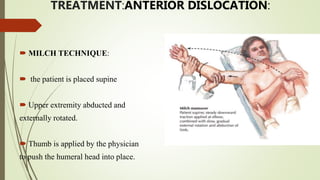
TREATMENT:ANTERIOR DISLOCATION:
 MILCH TECHNIQUE:
 the patient is placed supine
 Upper extremity abducted and
externally rotated.
 Thumb is applied by the physician
to push the humeral head into place.
TREATMENT:ANTERIOR DISLOCATION:
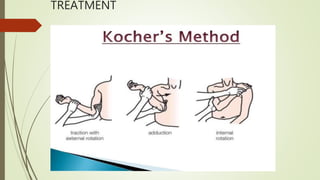
 KOCHER TECHNIQUE:
 Elbow is flexed to a right angle .
 Steady traction applied along the long axis of humerus.
 The arm is externally rotated.
 The externally rotated arm is adducted by carrying the elbow across the body towards
the midline.
 The arm is rotated internally so that the hand falls across to the opposite shoulder.
TREATMENT
TREATMENT:ANTERIOR DISLOCATION:
 After reduction limb is immobilized for 2 to 5 weeks.
 Younger patient with history of recurrent dislocation may require longer period of
immobilization.
 Therapy should be instituted following immobilization including increasing degree of
shoulder external rotation, flexion and abduction.
TREATMENT:ANTERIOR DISLOCATION:
OPERATIVE:
Indication:
1. First time dislocation in young active women.
2. Soft tissue interposition
3. Displaced greater tuberosity fracture that remains >5 mm superiorly displaced following joint
reduction.
4. Glenoid rim fracture > 5mm in size.
 Arthroscopic ligamentous repair of the anterior/inferior labrum (Bankert lesion).
 Procedures are Capsular shift, Capsulorrhaphy, Muscle or tendon transfers.
TREATMENT:POSTERIOR DISLOCATION:
Non- operative:
 Close reduction requires full muscle relaxation, sedation, and analgesics.
 The patient placed in supine, traction should be applied to the adducted arm in the line
of deformity with gentle lifting of the humeral head onto the glenoid fossa.
 Post reduction care should consist of a sling and swathe.
 After discontinuation of immobilization ,an aggressive internal rotation and external
rotation strengthening program is instituted.
TREATMENT:POSTERIOR DISLOCATION:
OPERATIVE:
Indications are:
1. Major displacement ,associated lesser tuberosity fractures.
2. A large posterior glenoid fragment.
3. Irreducible dislocation or an impacted fractures on the posterior glenoid preventing reduction.
4. Open dislocation.
5. An anteromedial humeral impaction fracture(reverse Hill-Sachs lesion)
TREATMENT:POSTERIOR DISLOCATION:
Procedures are :
Open reduction,
Infraspinatus muscle/tendon plication(Reverse Putti-Platt),
Long head od the biceps tendon transfer to the posterior glenoid margin(Boyd-Sisk
procedure),
humeral and glenoid osteotomies and
capsulorrhaphy.
COMPLICATION
ANTERIOR DISLOCATION:
 RECURRENCE
INCIDENCE: Age 20 years- 80%-90%
Age 30 years- 60%
Age 40 years- 10%-15%
 Osseous lesion: Hill-Sachs lesion, Bankart lesion, greater tuberosity fractures, Acromion or
coracoid fractures.
 Soft tissue injuries: Rotator cuff tear(older patients), Capsular or Subscapular tendon tears.
 Vascular injuries: Axillary artery injuries.
 Nerve injuries: most commonly Musculocutaneous and axillary nerves
COMPLICATION
POSTERIOR DISLOCATION:
 Fracture: Posterior glenoid rim, humeral shaft , GT or LT, humeral head.
 Recurrence
 Neurovascular injuries: Less common in posterior dislocation then anterior
dislocation.
Axillay nerve mostly affected.
 Anterior subluxation: it causes limited flexion, adduction, and internal
rotation.
INFERIOR GLENOHUMERAL DISLOCATION
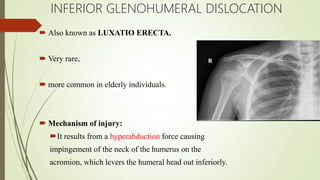
 Also known as LUXATIO ERECTA.
 Very rare,
 more common in elderly individuals.
 Mechanism of injury:
It results from a hyperabduction force causing
impingement of the neck of the humerus on the
acromion, which levers the humeral head out inferiorly.
INFERIOR GLENOHUMERAL DISLOCATION
 CLINICAL EVALUATION:
 Patients typically presents in a characteristic
‘SALUTE’ fashion.
 The humeral head is typically palpable on
the lateral chest wall and axilla.
INFERIOR GLENOHUMERAL DISLOCATION
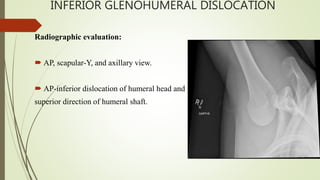
Radiographic evaluation:
 AP, scapular-Y, and axillary view.
 AP-inferior dislocation of humeral head and
superior direction of humeral shaft.
INFERIOR GLENOHUMERAL DISLOCATION
MANAGEMENT:
 Reduction may be accomplished by the use of traction- countertraction
maneuvers.
 Axial traction should be performed in the line with the humeral
position(superolaterally), with gradual decrease in shoulder abduction.
 Countertraction should be applied with a sheet around the patient, in line with ,
but opposite to the traction vector.
INFERIOR GLENOHUMERAL DISLOCATION
 MANAGEMENT:
 Operative management indicated when
- dislocated head buttonholes through the inferior capsule and
- soft tissue envelope, preventing closed reduction.
RECURRENT SHOULDER DISLOCATION
 Risk factor:
 Younger age group- age <20 years- 80%-90%.
 Posterior dislocation> anterior dislocation.
 Repetitive microtrauma(athletes and overhead activities) .
 Associated bony lesion (Bankart, Hill-Sachs lesion).
 Poor compliance with rehabilitation program.
RECURRENT SHOULDER DISLOCATION
 Physical examination:
 Divided into 3 main group:
1. Test for glenohumeral laxity
1. Anterior and posterior drawer test
2. Lachman test
3. Sulcus test
2. Test of glenohumeral instability
1. Apprehension, augmentation and relocation test
3. Test for generalized ligamentous laxity
1. Beighton criteria
RECURRENT SHOULDER DISLOCATION
CLASSIFICATION:
Matson classification
TUBS:
Traumatic, Unidirectional, frequently associated with Bakart lesion , that responds
well to Surgery.
AMBRI:
Atraumatic, Multidirectional and Bilateral often respond well to Rehabilitation.
Occasionally require an Inferior capsular shift.
RECURRENT SHOULDER DISLOCATION
 Imaging:
 AP, Scapular –Y view.
 Stryker notch view- for Hill-sach lesion.
 West point view- for Bony Bankart or glenoid fracture.
 CT scan-for assessing bone defect on humeral or glenoid side.
 MRI-
 Gold standard for capsulolabral structures especially the Bankart lesion.
 rotator cuff pathology
 Arthroscopy- excellent technique for confirming shoulder instability.
RECURRENT SHOULDER DISLOCATION
TREATMENT:
The major procedure are broadly divided into three groups
1. Capsular reattachment procedure-
Bankart repair and its modification
2. Subscapularis tightening procedure-
Putti platt procedure
Magnuson-Stack procedure
3. Bony procedure to augment the bony defect-
Bristow and Latarjet procedure
RECURRENT SHOULDER DISLOCATION
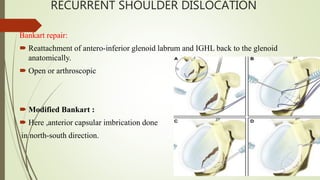
Bankart repair:
 Reattachment of antero-inferior glenoid labrum and IGHL back to the glenoid
anatomically.
 Open or arthroscopic
 Modified Bankart :
 Here ,anterior capsular imbrication done
in north-south direction.
RECURRENT SHOULDER DISLOCATION
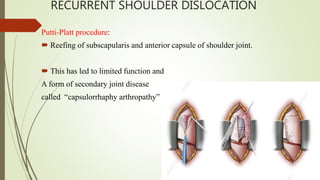
Putti-Platt procedure:
 Reefing of subscapularis and anterior capsule of shoulder joint.
 This has led to limited function and
A form of secondary joint disease
called “capsulorrhaphy arthropathy”
RECURRENT SHOULDER DISLOCATION
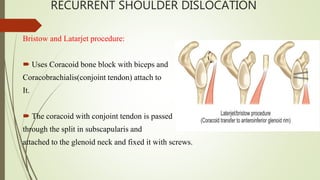
Bristow and Latarjet procedure:
 Uses Coracoid bone block with biceps and
Coracobrachialis(conjoint tendon) attach to
It.
 The coracoid with conjoint tendon is passed
through the split in subscapularis and
attached to the glenoid neck and fixed it with screws.
Shoulder dislocation

Shoulder dislocation

  • 1.
    SHOULDER DISLOCATION Moderator :Dr. Arijit Dhar Assoc. Professor, Dept. of Orthpaedic surgery, SMCH Presented by: Dr. Ujjal Rajbangshi PGT, Dept. of Orthopaedic surgery, SMCH
  • 2.
    LEARNING OBJECTIVES  Epidemiologyof shoulder dislocation  Anatomy of shoulder joint ,with stabilizer of joint  Pathoanatomy of shoulder dislocation  Mechanism of injury in different types of shoulder dislocation  Clinical presentation and radiological evaluation of shoulder joint dislocation  Management  Complications  Recurrent shoulder dislocation
  • 3.
    EPIDEMIOLOGY  The shoulderis the most common dislocated major joint of the body, accounting for upto 45% of dislocation.  Anterior dislocation account for 96% of cases, posterior dislocation account for 2% -4% 0f cases , the second most common type.  Inferior and superior shoulder dislocation are rare(0.5%).  Incidence peaks for male in 21 to 30 years and for female in the 61-80 years .  Recurrence rate in all ages in 50% but arises to almost 89% in 14-20 years age group.
  • 4.
    ANATOMY  Shoulder girdlecomprises of the clavicle ,the scapula and the humerus.  Shoulder joint is comprises of glenohumeral joint, acromioclavicular joint , and coracoclavicular joint.  Shoulder joint also known as Glenohumeral joint , is a ball and socket type of joint.  It is inherently unstable because the ‘Ball’ is big and the ‘socket’ is small.  Only about one-third of the humeral head is in contact with the glenoid cavity at any one time.
  • 5.
    ANATOMY  Gleno-humoral jointstability:  Depends on both passive and active mechanism  Passive: 1. Joint conformity: only 25%-30% of humeral articular surface is in contact with the glenoid at any position of arm rotation. 2. Vacuum effect of limited joint volume: the weight of the arm tending to pull the joint surface away from one another causes a negative intra-articular pressure(vacuum effect) 3. Adhesion and cohesion owing to the presence of synovial fluid
  • 6.
    ANATOMY 4. Scapular inclination:the critical angle of scapular inclination is between 0-30 degrees, below which the gleno-humeral joint is consider unstable and prone to inferior dislocation. 5. Glenoid labrum: increase the depth and surface area of glenoid  Labrum excision decreases the depth of socket by 50%and reduces resistance to instability by 20% 6. Bony restraints: acromion, coracoid glenoid fossa
  • 7.
    ANATOMY 7. Ligamentous andcapsular restraints:  Joint capsule: the anteroinferior capsule limits anterior subluxation of the abducted shoulder The posterior capsule and teres minor limits internal rotation. The anterior capsule and lower subscapularis restrain abduction and external rotation.  Superior glenohumeral ligament: this is the primary restraint to the inferior translation of the adducted shoulder.  Middle glenohumeral ligament: it limits external rotation at 45 degrees of abduction.  Inferior glenohumeral ligament: it limits external rotation at 45-90 degrees of abduction.  Coracohumeral ligament: this is secondry stabilizer to inferior translation.
  • 8.
  • 9.
    ANATOMY Active: 1. Long headof Biceps 2. Rotator cuff 3. Scapular stabilizing muscles 4. Proprioception
  • 10.
  • 11.
    Pathological changes ofshoulder dislocations 1. Bankarts lesion: avulsion of anteroinferior labrum off the glenoid rim. 2. Hill- sachs lesion: it is a posterolateral head defect is caused by an impression fracture on the glenoid rim. Seen in 27% of acute anterior shoulder dislocation and 74% of recurrent anterior dislocation. 3. Rotator cuff tear: common in older individuals >40 years :35% -40% > 60 years : as high as 80%
  • 12.
  • 13.
  • 14.
    MECHANISM OF INJURIES ANTERIORDISLOCATION: 96% 0f shoulder dislocations  May occurs as a result of trauma.  Indirect: trauma to the upper extremity with the shoulder in abduction , extension, and external rotation is the most common mechanism Direct: anteriorly directed impact to the posterior shoulder.
  • 15.
    MECHANISM OF INJURIES POSTERIOR DISLOCATION:  Indirect trauma is the most common mechanism  The shoulder is typically is in position of adduction , flexion, and internal rotation.  Electric shock or convulsion mechanism may produce posterior dislocation.  Direct force application to the anterior shoulder, resulting in posterior translation of the humeral head.
  • 16.
    CLINICAL EVALUATION:  ANTERIORDISLOCATION:  Typically presents with the injured shoulder held in slight abduction, and external rotation.  Examination typically reveals squaring of the shoulder owing to a relative prominence of the acromion, a relative hollow beneath the acromion posteriorly and a palpable mass anteriorly.  Integrity of axillary nerve should be carefully examined.
  • 17.
    CLINICAL EVALUATION:  POSTERIORDISLOCATION:  A posterior dislocation does not presents with striking deformity.  Injured limb is typically held in the traditional sling position of shoulder internal rotation and adduction.  On examination , there is limited external rotation, and limited anterior forward elevation.
  • 18.
    CLINICAL EVALUATION  POSTERIORDISLOCATION:  A palpable mass posterior to the shoulder , flattening of anterior shoulder, and coracoid prominence may be observed.
  • 19.
    RADIOGRAPHIC EVALUATION  ANTERIORDISLOCATION:  AP , scapular –Y, and axillary views taken in the plane of scapula.  Velpeau view: the patient left in a sling and leaned obliquely backward 45 degrees over the cassette. A the beam is directed caudally, orthogonal to the cassette.  west point view: the patient with prone and the beam directed cephalad to the axila 25 degrees from the horizontal and 25 degrees medial.( Bankert lesion)
  • 20.
  • 21.
    RADIOGRAPHIC EVALUATION  Strykernotch view: the patients is supine with ipsilateral palm on the crown of the head and elbow pointing straight upward. Xray taken 10 degree caphalad. To visualize coracoid.  Hill Sachs view: AP view is taken with the shoulder in maximally internal rotation to visualize a Hill-Sachs lesion.  CT is useful in defining humeral head or glenoid impression fractures, loose bodies, and anterior labral bony injuries.  MRI may be used to identify rotator cuff, capsular and glenoid labral pathological process.
  • 22.
  • 23.
    RADIOGRAPHIC EVALUATION  POSTERIORDISLOCATION:  AP , scapular-Y, and axillary views  Sign of posterior dislocation on AP view  Vacant glenoid sign: the glenoid appear partial vacant(space between anterior rim and humeral head >6 mm)  Trough sign: impaction fracture of the anterior humeral head caused by the posterior rim of glenoid(reverse Hill Sachs lesion).  Loss of profile of humeral head: humerus is in full internal rotation.
  • 24.
  • 25.
    TREATMENT:ANTERIOR DISLOCATION:  Non–operative: Close reduction should be performed after adequate clinical evaluation and administration of analgesics, intra-articular block and/or sedation  Traction –countertraction:
  • 26.
    TREATMENT:ANTERIOR DISLOCATION:  HIPPOCRATICTECHNIQUE:  One foot placed across the axillary folds and onto the chest wall.  Gentle internal and external rotation with axial traction on the affected upper extremity.
  • 27.
    TREATMENT:ANTERIOR DISLOCATION:  STIMSONTECHNIQUE:  The patient is placed prone on the table with affected upper extremity hanging free.  Gentle, manual traction or 5 lb of weight applied to the wrist, with reduction effected over 15 – 20 minutes.
  • 28.
    TREATMENT:ANTERIOR DISLOCATION:  MILCHTECHNIQUE:  the patient is placed supine  Upper extremity abducted and externally rotated.  Thumb is applied by the physician to push the humeral head into place.
  • 29.
    TREATMENT:ANTERIOR DISLOCATION:  KOCHERTECHNIQUE:  Elbow is flexed to a right angle .  Steady traction applied along the long axis of humerus.  The arm is externally rotated.  The externally rotated arm is adducted by carrying the elbow across the body towards the midline.  The arm is rotated internally so that the hand falls across to the opposite shoulder.
  • 30.
  • 31.
    TREATMENT:ANTERIOR DISLOCATION:  Afterreduction limb is immobilized for 2 to 5 weeks.  Younger patient with history of recurrent dislocation may require longer period of immobilization.  Therapy should be instituted following immobilization including increasing degree of shoulder external rotation, flexion and abduction.
  • 32.
    TREATMENT:ANTERIOR DISLOCATION: OPERATIVE: Indication: 1. Firsttime dislocation in young active women. 2. Soft tissue interposition 3. Displaced greater tuberosity fracture that remains >5 mm superiorly displaced following joint reduction. 4. Glenoid rim fracture > 5mm in size.  Arthroscopic ligamentous repair of the anterior/inferior labrum (Bankert lesion).  Procedures are Capsular shift, Capsulorrhaphy, Muscle or tendon transfers.
  • 33.
    TREATMENT:POSTERIOR DISLOCATION: Non- operative: Close reduction requires full muscle relaxation, sedation, and analgesics.  The patient placed in supine, traction should be applied to the adducted arm in the line of deformity with gentle lifting of the humeral head onto the glenoid fossa.  Post reduction care should consist of a sling and swathe.  After discontinuation of immobilization ,an aggressive internal rotation and external rotation strengthening program is instituted.
  • 34.
    TREATMENT:POSTERIOR DISLOCATION: OPERATIVE: Indications are: 1.Major displacement ,associated lesser tuberosity fractures. 2. A large posterior glenoid fragment. 3. Irreducible dislocation or an impacted fractures on the posterior glenoid preventing reduction. 4. Open dislocation. 5. An anteromedial humeral impaction fracture(reverse Hill-Sachs lesion)
  • 35.
    TREATMENT:POSTERIOR DISLOCATION: Procedures are: Open reduction, Infraspinatus muscle/tendon plication(Reverse Putti-Platt), Long head od the biceps tendon transfer to the posterior glenoid margin(Boyd-Sisk procedure), humeral and glenoid osteotomies and capsulorrhaphy.
  • 36.
    COMPLICATION ANTERIOR DISLOCATION:  RECURRENCE INCIDENCE:Age 20 years- 80%-90% Age 30 years- 60% Age 40 years- 10%-15%  Osseous lesion: Hill-Sachs lesion, Bankart lesion, greater tuberosity fractures, Acromion or coracoid fractures.  Soft tissue injuries: Rotator cuff tear(older patients), Capsular or Subscapular tendon tears.  Vascular injuries: Axillary artery injuries.  Nerve injuries: most commonly Musculocutaneous and axillary nerves
  • 37.
    COMPLICATION POSTERIOR DISLOCATION:  Fracture:Posterior glenoid rim, humeral shaft , GT or LT, humeral head.  Recurrence  Neurovascular injuries: Less common in posterior dislocation then anterior dislocation. Axillay nerve mostly affected.  Anterior subluxation: it causes limited flexion, adduction, and internal rotation.
  • 38.
    INFERIOR GLENOHUMERAL DISLOCATION Also known as LUXATIO ERECTA.  Very rare,  more common in elderly individuals.  Mechanism of injury: It results from a hyperabduction force causing impingement of the neck of the humerus on the acromion, which levers the humeral head out inferiorly.
  • 39.
    INFERIOR GLENOHUMERAL DISLOCATION CLINICAL EVALUATION:  Patients typically presents in a characteristic ‘SALUTE’ fashion.  The humeral head is typically palpable on the lateral chest wall and axilla.
  • 40.
    INFERIOR GLENOHUMERAL DISLOCATION Radiographicevaluation:  AP, scapular-Y, and axillary view.  AP-inferior dislocation of humeral head and superior direction of humeral shaft.
  • 41.
    INFERIOR GLENOHUMERAL DISLOCATION MANAGEMENT: Reduction may be accomplished by the use of traction- countertraction maneuvers.  Axial traction should be performed in the line with the humeral position(superolaterally), with gradual decrease in shoulder abduction.  Countertraction should be applied with a sheet around the patient, in line with , but opposite to the traction vector.
  • 42.
    INFERIOR GLENOHUMERAL DISLOCATION MANAGEMENT:  Operative management indicated when - dislocated head buttonholes through the inferior capsule and - soft tissue envelope, preventing closed reduction.
  • 43.
    RECURRENT SHOULDER DISLOCATION Risk factor:  Younger age group- age <20 years- 80%-90%.  Posterior dislocation> anterior dislocation.  Repetitive microtrauma(athletes and overhead activities) .  Associated bony lesion (Bankart, Hill-Sachs lesion).  Poor compliance with rehabilitation program.
  • 44.
    RECURRENT SHOULDER DISLOCATION Physical examination:  Divided into 3 main group: 1. Test for glenohumeral laxity 1. Anterior and posterior drawer test 2. Lachman test 3. Sulcus test 2. Test of glenohumeral instability 1. Apprehension, augmentation and relocation test 3. Test for generalized ligamentous laxity 1. Beighton criteria
  • 45.
    RECURRENT SHOULDER DISLOCATION CLASSIFICATION: Matsonclassification TUBS: Traumatic, Unidirectional, frequently associated with Bakart lesion , that responds well to Surgery. AMBRI: Atraumatic, Multidirectional and Bilateral often respond well to Rehabilitation. Occasionally require an Inferior capsular shift.
  • 46.
    RECURRENT SHOULDER DISLOCATION Imaging:  AP, Scapular –Y view.  Stryker notch view- for Hill-sach lesion.  West point view- for Bony Bankart or glenoid fracture.  CT scan-for assessing bone defect on humeral or glenoid side.  MRI-  Gold standard for capsulolabral structures especially the Bankart lesion.  rotator cuff pathology  Arthroscopy- excellent technique for confirming shoulder instability.
  • 47.
    RECURRENT SHOULDER DISLOCATION TREATMENT: Themajor procedure are broadly divided into three groups 1. Capsular reattachment procedure- Bankart repair and its modification 2. Subscapularis tightening procedure- Putti platt procedure Magnuson-Stack procedure 3. Bony procedure to augment the bony defect- Bristow and Latarjet procedure
  • 48.
    RECURRENT SHOULDER DISLOCATION Bankartrepair:  Reattachment of antero-inferior glenoid labrum and IGHL back to the glenoid anatomically.  Open or arthroscopic  Modified Bankart :  Here ,anterior capsular imbrication done in north-south direction.
  • 49.
    RECURRENT SHOULDER DISLOCATION Putti-Plattprocedure:  Reefing of subscapularis and anterior capsule of shoulder joint.  This has led to limited function and A form of secondary joint disease called “capsulorrhaphy arthropathy”
  • 50.
    RECURRENT SHOULDER DISLOCATION Bristowand Latarjet procedure:  Uses Coracoid bone block with biceps and Coracobrachialis(conjoint tendon) attach to It.  The coracoid with conjoint tendon is passed through the split in subscapularis and attached to the glenoid neck and fixed it with screws.