
Set up a startup in Italy

                              IED
                            Lesson 2

Frieda Brioschi
frieda.brioschi@gmail.com
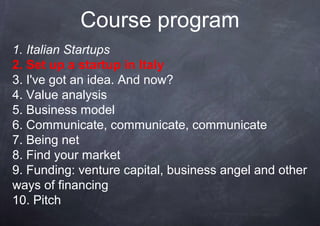
Course program
1. Italian Startups
2. Set up a startup in Italy
3. I've got an idea. And now?
4. Value analysis
5. Business model
6. Communicate, communicate, communicate
7. Being net
8. Find your market
9. Funding: venture capital, business angel and other
ways of financing
10. Pitch
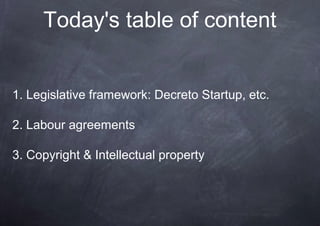
Today's table of content


1. Legislative framework: Decreto Startup, etc.

2. Labour agreements

3. Copyright & Intellectual property
Italian startups: quick recap


During last lesson we analyzed 14 different
companies started from 1995 to 2011: most of them
are “alive and kicking”, few disappeared, a couple
were re-started.
Italian startups: quick recap

What we learnt from those experiences:
• time-to-market <= 2 years
• funds availability doesn’t really make the difference
• Acquiring or be acquired could be a measure of
success
• Passion and team are core values
• Never ever ignore your customers!
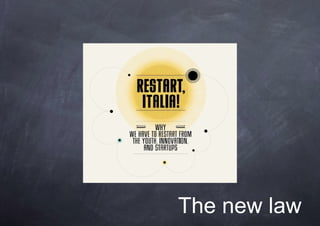
The new law
Decreto Crescita bis
On 4th October 2012, the Italian Government
approved a Law Decree on “Further urgent
measures for Italy’s economic growth”.

Section IX of the Law Decree (articles 25 to 32)
provides for specific measures which are aimed at
promoting the creation and development of
startups.
This is the first time the Italian legislation deals with
such companies.

                                                http://bit.ly/XAK87g
Decreto Crescita bis


After being approved by the Italian Government, the
Law Decree was signed by the President of the
Republic and published in the Official Journal
(Decree Law no. 179, 18th October 2012).


                                           http://bit.ly/XAK87g
Start-Up Regulation


On December 13, 2012, the Law Decree no. 179 was
modified by the Parliament and subsequently
converted into law (the Start-Up Regulation).


                   http://www.lw.com/thoughtLeadership/boosting-innovative-start-ups-italy
Start-Up Regulation
The Start-Up Regulation provides a new set of rules
promoting the creation and development of
innovative startups with a view to encouraging
innovation and strengthening of enterprises’
competitiveness.

It derives from the report by the task force on
startups established by the Minister of Economic
Development.
General idea
Over time, Italy has demonstrated that it is able to
develop by exploiting some of its great strengths:
• clothing and fashion,
• furniture,
• automation technology and mechanics,
• food and wine industry.

It has created and developed companies that can sell
their best products around the world. In many cases
they have even become global leaders.

                    http://www.sviluppoeconomico.gov.it/images/stories/documenti/startup_eng_rev.pdf
Looking overseas
In the last 10 years, startups have generated 3
million jobs in the United States.

President Obama launched Startup America which
"moved" the equivalent of 1 billion dollars in
business services.

Why are they doing this? Because they are aware of
the fact that, nowadays, 40% of the wealth in the US
is produced by enterprises that did not even exist 30
years ago.
                   http://www.sviluppoeconomico.gov.it/images/stories/documenti/startup_eng_rev.pdf
What’s a startup?

• an enterprise that has been established recently
• whose goal is to develop, produce and market
certain goods or services
• these products are the results of research, or the
company uses a high rate of innovation in its activity

Startups do not pertain just to the digital world, but
are established across all sectors.


                     http://www.sviluppoeconomico.gov.it/images/stories/documenti/startup_eng_rev.pdf
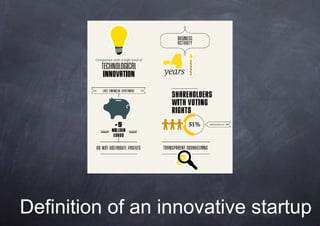
Definition of an innovative startup
Innovative startups/1


It is owned directly and for at least a 51% share by
individuals, also in terms of voting rights.


                                       http://startup.registroimprese.it/
Innovative startups/2


It must have been established for no longer than 48
months.


                                     http://startup.registroimprese.it/
Innovative startups/2bis
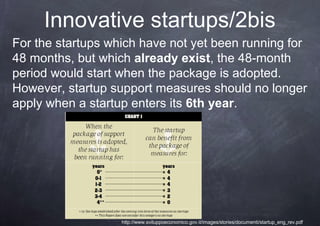
For the startups which have not yet been running for
48 months, but which already exist, the 48-month
period would start when the package is adopted.
However, startup support measures should no longer
apply when a startup enters its 6th year.


                   http://www.sviluppoeconomico.gov.it/images/stories/documenti/startup_eng_rev.pdf
Innovative startups/3


It must reside or be subject to taxation in Italy.


                                        http://startup.registroimprese.it/
Innovative startups/4


It has no turnover or has a turnover that does not
exceed 5 million euros.


                                     http://startup.registroimprese.it/
Innovative startups/5


It does not distribute profits.


                                  http://startup.registroimprese.it/
Innovative startups/6


Its core business consists of innovative goods or
services of high technological value.


                                     http://startup.registroimprese.it/
Innovative startups/7


It shall not result from the merger, division or transfer
of business from a going company.


                                         http://startup.registroimprese.it/
Innovative startups/8
                         EITHER
30% of its costs are related to R&D
                            OR
at least one third of the team is made up of people
who either hold a PhD or are PhD candidates at an
Italian or foreign university or have conducted
research for at least three year
                           OR
it is the owner or the licensee of a patent.

                                     http://startup.registroimprese.it/
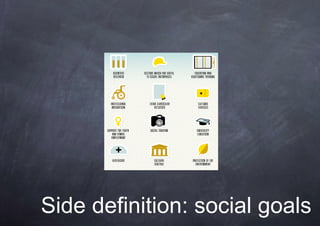
Side definition: social goals
Startups with a social goal

• same requirements that apply to ordinary startups
• operates in some specific domains
• its domain must have a considerable social value

Examples of domains are social inclusion, fight to
marginalization of disabled persons,
environmental protection etc.


                                            http://bit.ly/13PFWUI
Why social startups?
Startups with a focus on the social dimension
generally tend to adopt business models that may be
less attractive for investors.

Their reason of being is to answer society’s needs
first and foremost, along with market ones.

Thus, they have lower returns on investments and
fewer chances to develop when compared to
“ordinary” startups.

                   http://www.sviluppoeconomico.gov.it/images/stories/documenti/startup_eng_rev.pdf
Social area
•Welfare
•Healthcare
•Education
•Vocational training
•Protection of the environment
•Cultural heritage
•Sustainable tourism
•undergraduate and postgraduate education
•research
•cultural services
• ..
                  http://www.sviluppoeconomico.gov.it/images/stories/documenti/startup_eng_rev.pdf
HelpTalk


 http://vimeo.com/49388177
Benefits for innovative startups
Advantages/1

                      No setup costs
(unlike most companies, startups do not have to pay anything for
               their own creation and registration)

No stamp duties and fees paid for issuing documents
      notary public services free of charge for under 35s
            no Chamber of Commerce annual fee


                                                       http://bit.ly/13PFWUI
Advantages/2

 Special financial instruments for debt management
Extension by 12 months of the so-called “loss carry-forward period”
  (rinvio a nuovo delle perdite), to better absorb the whole initial
                   operation running at loss

   Postponement of the recapitalization obligations to the
 following financial year when needed to protect the share capital

                   Ask your financial consultant!
Advantages/3

         Simplified procedure for bankruptcy
Basically an exemption from bakruptcy procedures, innovative
 startups are subject only to the so-called “over-indebtedness
                          procedure”.

This shorten judicial liquidation, reducing consequences from a
 bankruptcy procedure on the entreprenoeur reputation .


                                                       http://bit.ly/13PFWUI
Advantages/4
Startups can hire personnel through fix-time
contracts (6 to 36 months).
Contracts can be renewed more than once.
After 36 months, the contract can be further renewed
for just one more time, for no longer than 12 months,
i.e. the total duration of the contract must not exceed
48 months.

After that, the employee can keep on working for the
startup exclusively with an open-ended contract.

                                              http://bit.ly/13PFWUI
Advantages/5

Start-ups can remunerate their team members and the
 providers of external services, including lawyers and
accountants, with STOCK OPTIONS and WORK FOR
                EQUITY respectively.

 The tax system applicable to these instruments is
 advantageous and is tailored on the most common
               needs of a startup.


                                              http://bit.ly/13PFWUI
Advantages/6
 Tax incentives for corporate and private investments in
  startups for the years 2013, 2014 and 2015, both for
  direct investments in startups and in case of indirect
investments (by the means of other companies investing
                predominantly in startups).

Tax concessions are greater if the investment concerns
 startups with a social goal or those operating in the
                   energy sector.


                                               http://bit.ly/13PFWUI
Advantages/7

           Introduction of crowdfunding.

Details regarding the functioning of this system will be
decided with a specific regulation which will be passed
                     by CONSOB.
                    (still underway)


                                                http://bit.ly/13PFWUI
Advantages/8


Fast-track, simplified and free-of-charge access for
  startups to the Fondo Centrale di Garanzia, a
 Government Fund that supports access to credit
        through guarantees on bank loans.


                                              http://bit.ly/13PFWUI
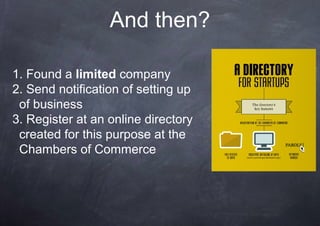
And then?

1. Found a limited company
2. Send notification of setting up
 of business
3. Register at an online directory
 created for this purpose at the
 Chambers of Commerce
Limited companies
1. joint stock companies (società per azioni),
2. share partnership companies (società in accomandita per
 azioni)
3. limited liability companies (società a responsabilità
 limitata)
4. simplified limited liability company (società a
 responsabilità limitata semplificata)
5. limited liability companies with reduced share capital
 (società a responsabiltà limitata a capitale ridotto)
6. cooperative companies (società cooperative)
Statutory minumum capital

S.p.A. and S.a.p.A.: €120,000

S.r.l.: €10,000.

S.s.r.l. and S.r.l.c.r.: > €1 and < €10,000.
S.r.l. group

1. company needs to be registered with different
 institutions (the tax office,the companies registry,
 INPS, INAIL)
2. registration can be done using ComUnica online
3. all this has to be done via notary public


                           http://www.registroimprese.it/comunica#tab=cosa&under-tab=corsi
S.r.l. obligations

1. pay an annual tax on company books,
2. issue a company valuation report,
3. pay tax for lodging the minutes of a meeting every
 time profits are distributed;
4. pay for a tax advisor;
5. pay taxes on the registration of the transfer of
 shares from one business partner to another
Liquidation
It is the process by which a company is brought to an
end, and the assets and property of the company
redistributed.

Liquidation may either be compulsory or voluntary.


                                       http://en.wikipedia.org/wiki/Liquidation
Reasons for liquidation
A liquidation or a dissolution may occur for
• term elapsed
• the company has reached the business purpose or
the object can't be reached
• unable to operate
• Statutory minumum capital less than legal minimum
• Assembly resolution
• other reasons according to the bylaws

There’s no limit to the length of a liquidation
Bankruptcy

It is a legal status of a company that cannot repay the
debts it owes to creditors. Often bankruptcy is
imposed by a court order, but can be voluntary too.

Bankruptcy can be a consequence of insolvency. All
assets of the debtor are liquidated under the
administration of a official receiver.


                          http://it.wikipedia.org/wiki/Fallimento_(ordinamento_giuridico_italiano)
Labour agreements
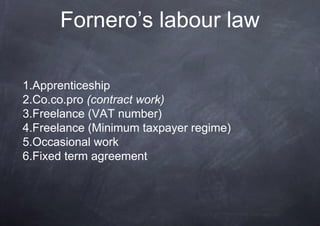
Fornero’s labour law

1.Apprenticeship
2.Co.co.pro (contract work)
3.Freelance (VAT number)
4.Freelance (Minimum taxpayer regime)
5.Occasional work
6.Fixed term agreement
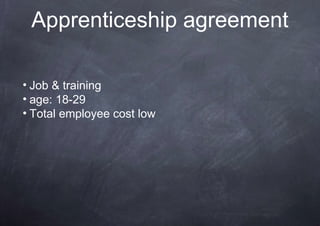
Apprenticeship agreement

• Job & training
• age: 18-29
• Total employee cost low
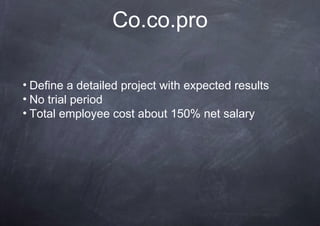
Co.co.pro

• Define a detailed project with expected results
• No trial period
• Total employee cost about 150% net salary
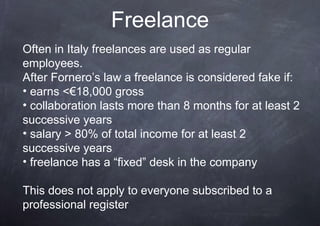
Freelance
Often in Italy freelances are used as regular
employees.
After Fornero’s law a freelance is considered fake if:
• earns <€18,000 gross
• collaboration lasts more than 8 months for at least 2
successive years
• salary > 80% of total income for at least 2
successive years
• freelance has a “fixed” desk in the company

This does not apply to everyone subscribed to a
professional register
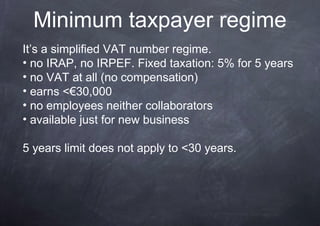
Minimum taxpayer regime
It’s a simplified VAT number regime.
• no IRAP, no IRPEF. Fixed taxation: 5% for 5 years
• no VAT at all (no compensation)
• earns <€30,000
• no employees neither collaborators
• available just for new business

5 years limit does not apply to <30 years.
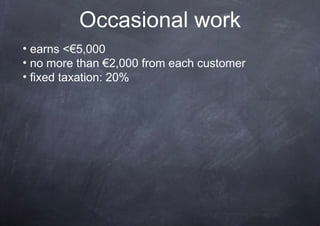
Occasional work
• earns <€5,000
• no more than €2,000 from each customer
• fixed taxation: 20%
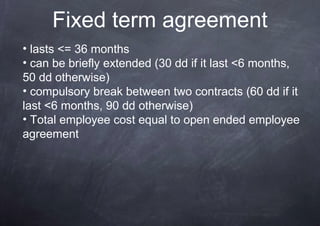
Fixed term agreement
• lasts <= 36 months
• can be briefly extended (30 dd if it last <6 months,
50 dd otherwise)
• compulsory break between two contracts (60 dd if it
last <6 months, 90 dd otherwise)
• Total employee cost equal to open ended employee
agreement
Intellectual property
IP
Intellectual property (IP) is a legal concept which
refers to creations of the mind for which exclusive
rights are recognized.

Common types of intellectual property rights include
copyright, trademarks and patents.

In italian a preferred term is "industrial property".


                                    http://en.wikipedia.org/wiki/Intellectual_property_law
Author’s rights
In Italy:
• law: 22 aprile 1941 n. 633 "Protezione del diritto
  d'autore e di altri diritti connessi al suo esercizio“

Two distinct components:
1. economic rights in the work
2. the moral rights of the author.


                                     http://it.wikipedia.org/wiki/Diritto_d%27autore_italiano
Moral rights
1.Right of attribution
2.the right to have a work published anonymously
or pseudonymously
3.right to the integrity of the work (bars the work from
alteration, distortion, or mutilation)

Anything else that may detract from the artist's
relationship with the work even after it leaves the
artist's possession or ownership may bring these
moral rights into play.

Moral rights are inalienable.
                                 http://en.wikipedia.org/wiki/Moral_rights_(copyright_law)
Economic rights
The economic rights are a property right which is
limited in time (70 years after the author’s death in
Italy) and which may be transferred by the author to
other people.

They are intended to allow the author or their holder to
profit financially from his/her creation, and include the
right to authorize the reproduction of the work in any
form. The authors of dramatic works (plays, etc.) also
have the right to authorize the public performance of
their works.

                                   http://it.wikipedia.org/wiki/Diritto_d%27autore_italiano
Copyleft
                  copyleft < > copyright

 Allows for rights to distribute copies and modified
versions of a work, and requires that the same rights
   are preserved in modified versions of the work.

 Copyleft is a general method for making a work free (libre),
and requiring all modified and extended versions of the work to
 be free as well. This free does not necessarily mean free of
 cost, but free as in freely available to be used, distributed or
                             modified.


                                                 http://en.wikipedia.org/wiki/Copyleft
Copyleft
Copyright law is usually used to prohibit others from
 reproducing, adapting, or distributing copies of the
                   author's work.

Under copyleft an author may give every person who
receives a copy of a work permission to reproduce,
 adapt or distribute it and require that any resulting
 copies or adaptations are also bound by the same
                licensing agreement.

     Creative Commons are the most known
                copyleft licences.
                                        http://en.wikipedia.org/wiki/Copyleft
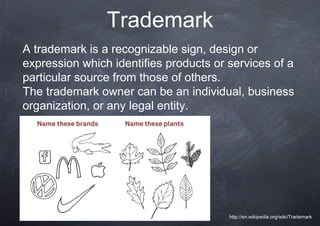
Trademark
A trademark is a recognizable sign, design or
expression which identifies products or services of a
particular source from those of others.
The trademark owner can be an individual, business
organization, or any legal entity.


                                        http://en.wikipedia.org/wiki/Trademark
Trademark
The law considers a trademark to be a form of
property. Proprietary rights in relation to a trademark
may be established through actual use in the
marketplace, or through registration of the mark with
the trademarks office.


                                       http://en.wikipedia.org/wiki/Trademark
Registered trademark
A registered trademark confers a bundle of exclusive
rights upon the registered owner, including the right
to exclusive use of the mark in relation to the
products or services for which it is registered.

In Italy the national registration process should be
sent to Ufficio Italiano Brevetti e Marchi (UIBM).
Registration lasts 10 years and is renewable.

An european registration can be done at Ufficio per
l'armonizzazione nel mercato interno (UAMI), and an
international registration can be done at WIPO.
Registered trademark
Registrations can in particular cases be
approved for preexisting designs.
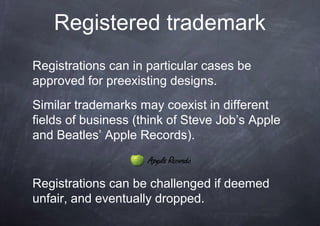
Similar trademarks may coexist in different
fields of business (think of Steve Job’s Apple
and Beatles’ Apple Records).


Registrations can be challenged if deemed
unfair, and eventually dropped.
Patent
A patent consists of a set of exclusive rights granted
by a sovereign state to an inventor or their assignee
for a limited period of time, in exchange for the public
disclosure of the invention. An invention is a solution
to a specific technological problem, and may be a
product or a process.

The exclusive right granted to a patentee in most
countries is the right to prevent others from making,
using, selling, or distributing the patented invention
without permission.

                                          http://en.wikipedia.org/wiki/Patent
Types of patents in Italy
                           Invention patent:
  it’s the stronger and higher form of protection, used for technological
innovation in products, processes or solutions (including new vegetables
                     varieties). 20 years, non renovable

                             Utility model:
A weaker patent, easier to obtain but harder to defend. Limited to products
  and physical objects. It’s used for inventions that improve on existing
   products. It protects the form, too, provided that thare is a provable
         enanchement in functions. 10 years, non renovable.

  (Pro tip: Italian law –art 84 CPI- allows to request both patents for the same
      invention, leaving the choice of the most fitting to the patent office)


                                                                http://ufficiobrevetti.it/en/patents/
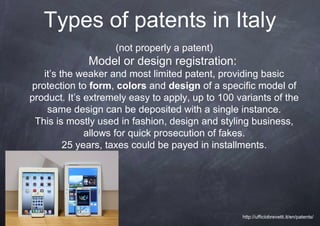
Types of patents in Italy
                    (not properly a patent)
              Model or design registration:
   it’s the weaker and most limited patent, providing basic
protection to form, colors and design of a specific model of
product. It’s extremely easy to apply, up to 100 variants of the
    same design can be deposited with a single instance.
 This is mostly used in fashion, design and styling business,
              allows for quick prosecution of fakes.
         25 years, taxes could be payed in installments.


                                                  http://ufficiobrevetti.it/en/patents/
Filing a patent
                    A prototype is not needed
     A thorough description with detailed drawings is enough

Requirements:
-Novelty (never patented before, anywhere)
-Originality (non obvious, different from current state of art)
-Industrial Applicability (no arts & crafts, must be reproduced industrially)
-Legality (must not offend morality, break law and impair order)
To maintain validity, a patent MUST BE REALIZES WITHIN 3 YEARS FROM
REGISTRATION (or 4 years from applocation).

Since 1 jan 2006 filing a patent is FREE from fees. Some costs could arise in order
to provide the required documentations, a free cost assessment could be requested
on Ufficio Brevetti’s website.

                                                                http://ufficiobrevetti.it/en/patents/
Next week


I've got an idea. And now?

Innovative startups

  • 1.
    Set up astartup in Italy IED Lesson 2 Frieda Brioschi frieda.brioschi@gmail.com
  • 2.
    Course program 1. ItalianStartups 2. Set up a startup in Italy 3. I've got an idea. And now? 4. Value analysis 5. Business model 6. Communicate, communicate, communicate 7. Being net 8. Find your market 9. Funding: venture capital, business angel and other ways of financing 10. Pitch
  • 3.
    Today's table ofcontent 1. Legislative framework: Decreto Startup, etc. 2. Labour agreements 3. Copyright & Intellectual property
  • 4.
    Italian startups: quickrecap During last lesson we analyzed 14 different companies started from 1995 to 2011: most of them are “alive and kicking”, few disappeared, a couple were re-started.
  • 5.
    Italian startups: quickrecap What we learnt from those experiences: • time-to-market <= 2 years • funds availability doesn’t really make the difference • Acquiring or be acquired could be a measure of success • Passion and team are core values • Never ever ignore your customers!
  • 6.
  • 7.
    Decreto Crescita bis On4th October 2012, the Italian Government approved a Law Decree on “Further urgent measures for Italy’s economic growth”. Section IX of the Law Decree (articles 25 to 32) provides for specific measures which are aimed at promoting the creation and development of startups. This is the first time the Italian legislation deals with such companies. http://bit.ly/XAK87g
  • 8.
    Decreto Crescita bis Afterbeing approved by the Italian Government, the Law Decree was signed by the President of the Republic and published in the Official Journal (Decree Law no. 179, 18th October 2012). http://bit.ly/XAK87g
  • 9.
    Start-Up Regulation On December13, 2012, the Law Decree no. 179 was modified by the Parliament and subsequently converted into law (the Start-Up Regulation). http://www.lw.com/thoughtLeadership/boosting-innovative-start-ups-italy
  • 10.
    Start-Up Regulation The Start-UpRegulation provides a new set of rules promoting the creation and development of innovative startups with a view to encouraging innovation and strengthening of enterprises’ competitiveness. It derives from the report by the task force on startups established by the Minister of Economic Development.
  • 11.
    General idea Over time,Italy has demonstrated that it is able to develop by exploiting some of its great strengths: • clothing and fashion, • furniture, • automation technology and mechanics, • food and wine industry. It has created and developed companies that can sell their best products around the world. In many cases they have even become global leaders. http://www.sviluppoeconomico.gov.it/images/stories/documenti/startup_eng_rev.pdf
  • 12.
    Looking overseas In thelast 10 years, startups have generated 3 million jobs in the United States. President Obama launched Startup America which "moved" the equivalent of 1 billion dollars in business services. Why are they doing this? Because they are aware of the fact that, nowadays, 40% of the wealth in the US is produced by enterprises that did not even exist 30 years ago. http://www.sviluppoeconomico.gov.it/images/stories/documenti/startup_eng_rev.pdf
  • 13.
    What’s a startup? •an enterprise that has been established recently • whose goal is to develop, produce and market certain goods or services • these products are the results of research, or the company uses a high rate of innovation in its activity Startups do not pertain just to the digital world, but are established across all sectors. http://www.sviluppoeconomico.gov.it/images/stories/documenti/startup_eng_rev.pdf
  • 14.
    Definition of aninnovative startup
  • 15.
    Innovative startups/1 It isowned directly and for at least a 51% share by individuals, also in terms of voting rights. http://startup.registroimprese.it/
  • 16.
    Innovative startups/2 It musthave been established for no longer than 48 months. http://startup.registroimprese.it/
  • 17.
    Innovative startups/2bis For thestartups which have not yet been running for 48 months, but which already exist, the 48-month period would start when the package is adopted. However, startup support measures should no longer apply when a startup enters its 6th year. http://www.sviluppoeconomico.gov.it/images/stories/documenti/startup_eng_rev.pdf
  • 18.
    Innovative startups/3 It mustreside or be subject to taxation in Italy. http://startup.registroimprese.it/
  • 19.
    Innovative startups/4 It hasno turnover or has a turnover that does not exceed 5 million euros. http://startup.registroimprese.it/
  • 20.
    Innovative startups/5 It doesnot distribute profits. http://startup.registroimprese.it/
  • 21.
    Innovative startups/6 Its corebusiness consists of innovative goods or services of high technological value. http://startup.registroimprese.it/
  • 22.
    Innovative startups/7 It shallnot result from the merger, division or transfer of business from a going company. http://startup.registroimprese.it/
  • 23.
    Innovative startups/8 EITHER 30% of its costs are related to R&D OR at least one third of the team is made up of people who either hold a PhD or are PhD candidates at an Italian or foreign university or have conducted research for at least three year OR it is the owner or the licensee of a patent. http://startup.registroimprese.it/
  • 24.
  • 25.
    Startups with asocial goal • same requirements that apply to ordinary startups • operates in some specific domains • its domain must have a considerable social value Examples of domains are social inclusion, fight to marginalization of disabled persons, environmental protection etc. http://bit.ly/13PFWUI
  • 26.
    Why social startups? Startupswith a focus on the social dimension generally tend to adopt business models that may be less attractive for investors. Their reason of being is to answer society’s needs first and foremost, along with market ones. Thus, they have lower returns on investments and fewer chances to develop when compared to “ordinary” startups. http://www.sviluppoeconomico.gov.it/images/stories/documenti/startup_eng_rev.pdf
  • 27.
    Social area •Welfare •Healthcare •Education •Vocational training •Protectionof the environment •Cultural heritage •Sustainable tourism •undergraduate and postgraduate education •research •cultural services • .. http://www.sviluppoeconomico.gov.it/images/stories/documenti/startup_eng_rev.pdf
  • 30.
  • 31.
  • 32.
    Advantages/1 No setup costs (unlike most companies, startups do not have to pay anything for their own creation and registration) No stamp duties and fees paid for issuing documents notary public services free of charge for under 35s no Chamber of Commerce annual fee http://bit.ly/13PFWUI
  • 33.
    Advantages/2 Special financialinstruments for debt management Extension by 12 months of the so-called “loss carry-forward period” (rinvio a nuovo delle perdite), to better absorb the whole initial operation running at loss Postponement of the recapitalization obligations to the following financial year when needed to protect the share capital Ask your financial consultant!
  • 34.
    Advantages/3 Simplified procedure for bankruptcy Basically an exemption from bakruptcy procedures, innovative startups are subject only to the so-called “over-indebtedness procedure”. This shorten judicial liquidation, reducing consequences from a bankruptcy procedure on the entreprenoeur reputation . http://bit.ly/13PFWUI
  • 35.
    Advantages/4 Startups can hirepersonnel through fix-time contracts (6 to 36 months). Contracts can be renewed more than once. After 36 months, the contract can be further renewed for just one more time, for no longer than 12 months, i.e. the total duration of the contract must not exceed 48 months. After that, the employee can keep on working for the startup exclusively with an open-ended contract. http://bit.ly/13PFWUI
  • 36.
    Advantages/5 Start-ups can remuneratetheir team members and the providers of external services, including lawyers and accountants, with STOCK OPTIONS and WORK FOR EQUITY respectively. The tax system applicable to these instruments is advantageous and is tailored on the most common needs of a startup. http://bit.ly/13PFWUI
  • 37.
    Advantages/6 Tax incentivesfor corporate and private investments in startups for the years 2013, 2014 and 2015, both for direct investments in startups and in case of indirect investments (by the means of other companies investing predominantly in startups). Tax concessions are greater if the investment concerns startups with a social goal or those operating in the energy sector. http://bit.ly/13PFWUI
  • 38.
    Advantages/7 Introduction of crowdfunding. Details regarding the functioning of this system will be decided with a specific regulation which will be passed by CONSOB. (still underway) http://bit.ly/13PFWUI
  • 39.
    Advantages/8 Fast-track, simplified andfree-of-charge access for startups to the Fondo Centrale di Garanzia, a Government Fund that supports access to credit through guarantees on bank loans. http://bit.ly/13PFWUI
  • 40.
    And then? 1. Founda limited company 2. Send notification of setting up of business 3. Register at an online directory created for this purpose at the Chambers of Commerce
  • 41.
    Limited companies 1. jointstock companies (società per azioni), 2. share partnership companies (società in accomandita per azioni) 3. limited liability companies (società a responsabilità limitata) 4. simplified limited liability company (società a responsabilità limitata semplificata) 5. limited liability companies with reduced share capital (società a responsabiltà limitata a capitale ridotto) 6. cooperative companies (società cooperative)
  • 42.
    Statutory minumum capital S.p.A.and S.a.p.A.: €120,000 S.r.l.: €10,000. S.s.r.l. and S.r.l.c.r.: > €1 and < €10,000.
  • 43.
    S.r.l. group 1. companyneeds to be registered with different institutions (the tax office,the companies registry, INPS, INAIL) 2. registration can be done using ComUnica online 3. all this has to be done via notary public http://www.registroimprese.it/comunica#tab=cosa&under-tab=corsi
  • 44.
    S.r.l. obligations 1. payan annual tax on company books, 2. issue a company valuation report, 3. pay tax for lodging the minutes of a meeting every time profits are distributed; 4. pay for a tax advisor; 5. pay taxes on the registration of the transfer of shares from one business partner to another
  • 45.
    Liquidation It is theprocess by which a company is brought to an end, and the assets and property of the company redistributed. Liquidation may either be compulsory or voluntary. http://en.wikipedia.org/wiki/Liquidation
  • 46.
    Reasons for liquidation Aliquidation or a dissolution may occur for • term elapsed • the company has reached the business purpose or the object can't be reached • unable to operate • Statutory minumum capital less than legal minimum • Assembly resolution • other reasons according to the bylaws There’s no limit to the length of a liquidation
  • 47.
    Bankruptcy It is alegal status of a company that cannot repay the debts it owes to creditors. Often bankruptcy is imposed by a court order, but can be voluntary too. Bankruptcy can be a consequence of insolvency. All assets of the debtor are liquidated under the administration of a official receiver. http://it.wikipedia.org/wiki/Fallimento_(ordinamento_giuridico_italiano)
  • 48.
  • 49.
    Fornero’s labour law 1.Apprenticeship 2.Co.co.pro(contract work) 3.Freelance (VAT number) 4.Freelance (Minimum taxpayer regime) 5.Occasional work 6.Fixed term agreement
  • 50.
    Apprenticeship agreement • Job& training • age: 18-29 • Total employee cost low
  • 51.
    Co.co.pro • Define adetailed project with expected results • No trial period • Total employee cost about 150% net salary
  • 52.
    Freelance Often in Italyfreelances are used as regular employees. After Fornero’s law a freelance is considered fake if: • earns <€18,000 gross • collaboration lasts more than 8 months for at least 2 successive years • salary > 80% of total income for at least 2 successive years • freelance has a “fixed” desk in the company This does not apply to everyone subscribed to a professional register
  • 53.
    Minimum taxpayer regime It’sa simplified VAT number regime. • no IRAP, no IRPEF. Fixed taxation: 5% for 5 years • no VAT at all (no compensation) • earns <€30,000 • no employees neither collaborators • available just for new business 5 years limit does not apply to <30 years.
  • 54.
    Occasional work • earns<€5,000 • no more than €2,000 from each customer • fixed taxation: 20%
  • 55.
    Fixed term agreement •lasts <= 36 months • can be briefly extended (30 dd if it last <6 months, 50 dd otherwise) • compulsory break between two contracts (60 dd if it last <6 months, 90 dd otherwise) • Total employee cost equal to open ended employee agreement
  • 56.
  • 57.
    IP Intellectual property (IP)is a legal concept which refers to creations of the mind for which exclusive rights are recognized. Common types of intellectual property rights include copyright, trademarks and patents. In italian a preferred term is "industrial property". http://en.wikipedia.org/wiki/Intellectual_property_law
  • 58.
    Author’s rights In Italy: •law: 22 aprile 1941 n. 633 "Protezione del diritto d'autore e di altri diritti connessi al suo esercizio“ Two distinct components: 1. economic rights in the work 2. the moral rights of the author. http://it.wikipedia.org/wiki/Diritto_d%27autore_italiano
  • 59.
    Moral rights 1.Right ofattribution 2.the right to have a work published anonymously or pseudonymously 3.right to the integrity of the work (bars the work from alteration, distortion, or mutilation) Anything else that may detract from the artist's relationship with the work even after it leaves the artist's possession or ownership may bring these moral rights into play. Moral rights are inalienable. http://en.wikipedia.org/wiki/Moral_rights_(copyright_law)
  • 60.
    Economic rights The economicrights are a property right which is limited in time (70 years after the author’s death in Italy) and which may be transferred by the author to other people. They are intended to allow the author or their holder to profit financially from his/her creation, and include the right to authorize the reproduction of the work in any form. The authors of dramatic works (plays, etc.) also have the right to authorize the public performance of their works. http://it.wikipedia.org/wiki/Diritto_d%27autore_italiano
  • 61.
    Copyleft copyleft < > copyright Allows for rights to distribute copies and modified versions of a work, and requires that the same rights are preserved in modified versions of the work. Copyleft is a general method for making a work free (libre), and requiring all modified and extended versions of the work to be free as well. This free does not necessarily mean free of cost, but free as in freely available to be used, distributed or modified. http://en.wikipedia.org/wiki/Copyleft
  • 62.
    Copyleft Copyright law isusually used to prohibit others from reproducing, adapting, or distributing copies of the author's work. Under copyleft an author may give every person who receives a copy of a work permission to reproduce, adapt or distribute it and require that any resulting copies or adaptations are also bound by the same licensing agreement. Creative Commons are the most known copyleft licences. http://en.wikipedia.org/wiki/Copyleft
  • 63.
    Trademark A trademark isa recognizable sign, design or expression which identifies products or services of a particular source from those of others. The trademark owner can be an individual, business organization, or any legal entity. http://en.wikipedia.org/wiki/Trademark
  • 64.
    Trademark The law considersa trademark to be a form of property. Proprietary rights in relation to a trademark may be established through actual use in the marketplace, or through registration of the mark with the trademarks office. http://en.wikipedia.org/wiki/Trademark
  • 65.
    Registered trademark A registeredtrademark confers a bundle of exclusive rights upon the registered owner, including the right to exclusive use of the mark in relation to the products or services for which it is registered. In Italy the national registration process should be sent to Ufficio Italiano Brevetti e Marchi (UIBM). Registration lasts 10 years and is renewable. An european registration can be done at Ufficio per l'armonizzazione nel mercato interno (UAMI), and an international registration can be done at WIPO.
  • 66.
    Registered trademark Registrations canin particular cases be approved for preexisting designs. Similar trademarks may coexist in different fields of business (think of Steve Job’s Apple and Beatles’ Apple Records). Registrations can be challenged if deemed unfair, and eventually dropped.
  • 67.
    Patent A patent consistsof a set of exclusive rights granted by a sovereign state to an inventor or their assignee for a limited period of time, in exchange for the public disclosure of the invention. An invention is a solution to a specific technological problem, and may be a product or a process. The exclusive right granted to a patentee in most countries is the right to prevent others from making, using, selling, or distributing the patented invention without permission. http://en.wikipedia.org/wiki/Patent
  • 68.
    Types of patentsin Italy Invention patent: it’s the stronger and higher form of protection, used for technological innovation in products, processes or solutions (including new vegetables varieties). 20 years, non renovable Utility model: A weaker patent, easier to obtain but harder to defend. Limited to products and physical objects. It’s used for inventions that improve on existing products. It protects the form, too, provided that thare is a provable enanchement in functions. 10 years, non renovable. (Pro tip: Italian law –art 84 CPI- allows to request both patents for the same invention, leaving the choice of the most fitting to the patent office) http://ufficiobrevetti.it/en/patents/
  • 69.
    Types of patentsin Italy (not properly a patent) Model or design registration: it’s the weaker and most limited patent, providing basic protection to form, colors and design of a specific model of product. It’s extremely easy to apply, up to 100 variants of the same design can be deposited with a single instance. This is mostly used in fashion, design and styling business, allows for quick prosecution of fakes. 25 years, taxes could be payed in installments. http://ufficiobrevetti.it/en/patents/
  • 70.
    Filing a patent A prototype is not needed A thorough description with detailed drawings is enough Requirements: -Novelty (never patented before, anywhere) -Originality (non obvious, different from current state of art) -Industrial Applicability (no arts & crafts, must be reproduced industrially) -Legality (must not offend morality, break law and impair order) To maintain validity, a patent MUST BE REALIZES WITHIN 3 YEARS FROM REGISTRATION (or 4 years from applocation). Since 1 jan 2006 filing a patent is FREE from fees. Some costs could arise in order to provide the required documentations, a free cost assessment could be requested on Ufficio Brevetti’s website. http://ufficiobrevetti.it/en/patents/
  • 71.
    Next week I've gotan idea. And now?