A startup isa relatively new and rapidly growing company that is focused on
bringing innovative products, services, or business models to market. These
businesses are often characterized by their agility, innovation, and a strong
desire to disrupt existing industries or create entirely new ones.
INTRODUCTIO
N
5.
KEY FEATURES
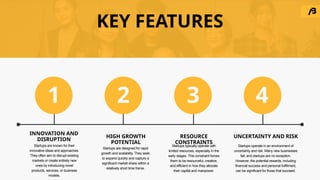
Startups areknown for their
innovative ideas and approaches.
They often aim to disrupt existing
markets or create entirely new
ones by introducing novel
products, services, or business
models.
Startups are designed for rapid
growth and scalability. They seek
to expand quickly and capture a
significant market share within a
relatively short time frame.
Startups typically operate with
limited resources, especially in the
early stages. This constraint forces
them to be resourceful, creative,
and efficient in how they allocate
their capital and manpower.
Startups operate in an environment of
uncertainty and risk. Many new businesses
fail, and startups are no exception.
However, the potential rewards, including
financial success and personal fulfillment,
can be significant for those that succeed.
INNOVATION AND
DISRUPTION
RESOURCE
CONSTRAINTS
HIGH GROWTH
POTENTIAL
UNCERTAINTY AND RISK
1 2 3 4
6.
123 Anywhere St.,Any City
hello@reallygreatsite.com
+123-456-7890
@reallygreatsite
The Startup
ecosystem
The startup ecosystem refers to the interconnected network of individuals, organizations,
resources, and activities that support the creation, growth, and success of startups
Entrepreneurs: Entrepreneurs are the driving force behind startups. They are individuals who conceive innovative
ideas, take calculated risks, and create new businesses. They often have a strong vision and the determination to bring
their ideas to fruition.
Startup Founders: These are the individuals who initiate and lead the startup. Founders are responsible for defining the
startup's mission, vision, and strategy. They typically wear multiple hats and are deeply involved in all aspects of the
business.
Investors: Investors provide the necessary capital to fund startup operations and growth. They can be categorized into
different types, including:
• Venture Capitalists (VCs): Professional investors who provide funding in exchange for equity (ownership) in startups.
• Angel Investors: Wealthy individuals who invest their own money in startups, often in the early stages.
• Corporate Investors: Large corporations that invest in or acquire startups to gain access to innovative technologies and
ideas.
7.
• Incubators andAccelerators: These organizations offer mentorship, resources, and sometimes funding
to early-stage startups. Incubators typically provide longer-term support, while accelerators offer shorter,
more intensive programs to help startups grow rapidly.
• Co-working Spaces: These shared office spaces provide affordable and flexible work environments for
startups. They often foster collaboration and networking among entrepreneurs and provide essential
amenities.
• Educational Institutions: Universities and colleges play a role by offering entrepreneurship programs,
research opportunities, and access to talent. Many successful startups have their origins in research
conducted at academic institutions.
• Government and Policy Support: Government agencies may offer grants, tax incentives, or regulatory
frameworks that support startup growth and innovation. Policymakers can create a favorable
environment for startups through policies that encourage entrepreneurship.
• Networking Events and Meetups: These gatherings provide opportunities for startups to connect with
potential investors, mentors, customers, and partners. Networking events can be critical for building
relationships in the startup world.
8.
Why start a
startup?
•Passion and Purpose: Many entrepreneurs are driven by a strong passion for a particular idea,
technology, industry, or cause. They want to create something meaningful and make a positive
impact on the world.
• Innovation: Entrepreneurs often have innovative ideas or solutions to problems that they believe can
disrupt existing industries or create entirely new ones. They want to bring their unique vision to life.
• Independence: Starting a startup allows individuals to be their own bosses and have control over
their work. They can shape the company's culture, values, and direction according to their vision.
• Financial Opportunity: While startups involve risks, they also offer the potential for substantial
financial rewards. Successful startups can generate significant profits and create wealth for their
founders and investors.
• Personal Growth: Entrepreneurship is a journey of continuous learning and personal growth.
Founders often acquire new skills, face challenges head-on, and gain valuable experience that can
benefit them in future endeavors.
9.
• Flexibility: Someentrepreneurs value the flexibility that comes with running their own
businesses. They can set their own schedules and work on projects that align with their interests
and lifestyle.
• Solving Problems: Entrepreneurs are problem solvers. They see challenges and inefficiencies in
the world and want to develop solutions that make life easier, more efficient, or more enjoyable
for others.
• Job Creation: Entrepreneurs often have a vision of creating job opportunities and contributing to
the local or global economy. Successful startups can employ a significant number of people.
• Impact: Entrepreneurs who are passionate about specific social or environmental causes may
start "impact startups." These businesses aim to create positive social or environmental change
while also generating profits.
• Freedom to Innovate: In some industries, established companies may have rigid structures and
conservative approaches. Startups offer founders the freedom to innovate and experiment with
new ideas and approaches.
10.
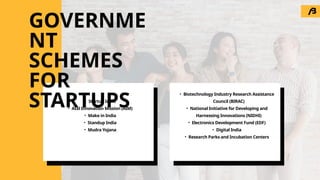
• Startup India
•Atal Innovation Mission (AIM)
• Make in India
• Standup India
• Mudra Yojana
• Biotechnology Industry Research Assistance
Council (BIRAC)
• National Initiative for Developing and
Harnessing Innovations (NIDHI)
• Electronics Development Fund (EDF)
• Digital India
• Research Parks and Incubation Centers
GOVERNME
NT
SCHEMES
FOR
STARTUPS
11.
Startup India
The StartupIndia initiative was launched in January 2016 with the goal of fostering a
culture of entrepreneurship and innovation in the country. The initiative aims to
provide a conducive environment for startups by offering various benefits and
incentives.
Some of the key features of the Startup India program include:
Self-Certification: Startups can self-certify compliance with certain labor and
environment laws for a period of 5 years from the date of incorporation.
Tax Benefits: Startups are eligible for income tax exemptions for a period of 3 years.
Faster Patent Examination: Startups can avail of fast-track examination of patent
applications.
Startup Fund: The government has established a fund of funds to provide financial
support to startups through various venture capital funds.
Startup India Hub:This online platform provides information and assistance to
startups on various aspects of business and entrepreneurship.
12.
Atal Innovation Mission(AIM)
AIM is a flagship initiative of the NITI Aayog (National Institution for Transforming India) aimed at
promoting innovation and entrepreneurship among students, researchers, and entrepreneurs. AIM
includes various programs such as Atal Tinkering Labs (ATLs) in schools, Atal Incubation Centers
(AICs), and Atal New India Challenges.
Make in India
While not exclusively focused on startups, the Make in India initiative encourages domestic
manufacturing and production, which indirectly benefits startups that are involved in manufacturing
and technology-driven innovation.
Standup India
This scheme is aimed at promoting entrepreneurship among women and marginalized communities.
It provides financial support to such individuals to set up greenfield enterprises, including startups.
Mudra Yojana
The Pradhan Mantri Mudra Yojana offers financial support to micro and small enterprises, including
startups, in the form of loans through various financial institutions.
13.
Biotechnology Industry ResearchAssistance Council (BIRAC)
BIRAC, under the Department of Biotechnology, provides funding, mentorship, and support to
biotechnology startups and entrepreneurs.
National Initiative for Developing and Harnessing Innovations (NIDHI)
NIDHI is an umbrella program that includes various schemes like NIDHI-PRAYAS, NIDHI-EIR, and NIDHI-
SSS, which provide financial support, incubation, and training to startups and innovators.
Electronics Development Fund (EDF)
The EDF aims to provide funding to startups and companies engaged in electronics manufacturing and
design.
Digital India
The Digital India initiative supports technology-driven startups by promoting the adoption of digital
technologies and providing a digital infrastructure for businesses.
Research Parks and Incubation Centers
The government has set up various research parks and incubation centers across the country to provide
startups with access to infrastructure, mentorship, and networking opportunities.
14.
Procedure for Registeringa
Startup
Business Idea and Planning
• Develop Your Business Idea: Clearly define your startup's business concept, including
your product or service, target market, and unique selling proposition.
• Market Research: Conduct market research to validate your idea and assess the
demand for your product or service.
• Business Plan: Create a comprehensive business plan that outlines your startup's
goals, strategies, financial projections, and funding needs.
Choose a Business Structure
• Select a Legal Structure: Choose a legal structure for your startup, such as a sole
proprietorship, partnership, limited liability company (LLC), or corporation. The choice
depends on factors like liability protection and tax implications.
15.
Register Your BusinessName
• Choose a Name: Select a unique and suitable name for your startup that complies
with naming regulations in your jurisdiction.
• Check Name Availability: Verify that your chosen name is available and not already
registered by another business in your jurisdiction.
• Register the Name: File the necessary paperwork to register your business name
with the appropriate government agency.
Obtain Necessary Permits and Licenses
• Business Licenses: Determine the specific permits and licenses required for your
industry and location. This may include federal, state/provincial, and local permits.
• Industry-Specific Permits: Depending on your business type, you may need
industry-specific licenses, such as health permits for restaurants or financial
licenses for fintech startups.
16.
Register for Taxes
•Get an Employer Identification Number (EIN): If your startup is in the United States,
you'll need to obtain an EIN from the Internal Revenue Service (IRS) for tax
purposes. In other countries, you may need a similar tax identification number.
• Sales Tax or VAT Registration: Depending on your location and business activities,
you may need to register for sales tax or value-added tax (VAT).
Register with Government Agencies
• Register with the Appropriate Government Authorities: Depending on your location
and business type, you may need to register with federal, state/provincial, and local
government agencies. This could include business registration, employer
registration, and industry-specific registrations.
Open a Business Bank Account
• Separate Finances: Open a dedicated business bank account to keep your personal
and business finances separate. This is important for tax and liability purposes.
17.
Secure Intellectual Property(Optional)
• Patents, Trademarks, and Copyrights: If your startup involves unique inventions,
branding, or creative content, consider registering patents, trademarks, or copyrights
to protect your intellectual property.
Comply with Employment Laws (If Hiring)
• Hiring Employees: If you plan to hire employees, make sure you comply with labor
laws and employment regulations. This includes payroll taxes, insurance, and
employment contracts.
Secure Funding (If Needed)
Seek Funding: If your startup requires capital, explore various funding options, such as
loans, venture capital, angel investors, crowdfunding, or bootstrapping.
Build Your Team and Operations
Hire Team Members: Recruit and onboard the necessary team members to help run and
grow your startup. Set Up Operations: Establish the infrastructure, processes, and
systems needed to operate your business efficiently.
18.
Launch and MarketYour Startup
Product/Service Launch: Launch your product or service to the market. - Marketing and
Sales: Implement marketing and sales strategies to attract customers and generate
revenue.
Monitor and Comply with Ongoing Requirements
Annual Filings: Keep track of annual filings, tax returns, and compliance requirements to
ensure your startup remains in good standing.
Seek Legal and Accounting Advice
Consult Professionals: Consider consulting with legal and accounting professionals who
specialize in startups to ensure compliance with all regulations and tax obligations.
19.
Apply for fundingfor
Startup
Define Your Funding Needs
Before you start seeking funding, determine how much capital your startup requires and
how you plan to use it. Create a detailed budget that outlines expenses for product
development, marketing, operations, and other key areas.
Develop a Solid Business Plan
• Create a comprehensive business plan that outlines your startup's mission, vision,
market opportunity, competitive analysis, revenue model, and financial projections.
• Be sure to highlight your startup's unique value proposition and the problem it solves
in the market.
20.
Identify the RightFunding Sources
• Research and identify funding sources that align with your startup's stage, industry,
and growth goals. Common funding sources include angel investors, venture
capitalists, grants, crowdfunding platforms, and government programs.
• Consider whether equity funding (e.g., angel or VC investment), debt financing
(e.g., loans), or non-dilutive funding (e.g., grants) is most suitable for your startup.
Prepare a Pitch Deck
• Create a compelling pitch deck that succinctly presents your startup's value
proposition, market opportunity, team, product, and financials.
• Your pitch deck should be visually appealing and designed to capture the attention
of potential investors or funding sources.
Build a Strong Online Presence
• Establish a professional online presence for your startup through a well-designed
website and active social media profiles.
• Online visibility can help potential investors learn more about your startup and
validate your credibility.
21.
Network and BuildRelationships
• Attend industry events, startup meetups, and networking gatherings to connect with
potential investors and mentors.
• Building relationships in the startup ecosystem can lead to valuable introductions and
opportunities.
Create a Targeted List of Investors
• Identify and research potential investors who have a track record of funding startups
in your industry or niche.
• Consider reaching out to angel investor networks, venture capital firms, or
crowdfunding platforms that align with your startup's focus.
Craft a Customized Pitch
• Tailor your pitch to the specific funding source you are targeting. Highlight aspects of
your startup that align with their investment criteria and interests.
• Be clear about the amount of funding you are seeking and how it will be used
22.
Submit Applications andProposals
• If you are applying for grants or government programs, carefully review the eligibility
criteria and submission requirements. Ensure that your application addresses all the
necessary components.
• For equity funding, reach out to potential investors with your pitch deck and an
introductory email or message. Be prepared to provide additional information as
requested.
Attend Pitch Meetings
If your pitch generates interest, be prepared for pitch meetings or due diligence sessions
with potential investors. These meetings are opportunities to further explain your startup
and answer questions.
Negotiate Terms
If an investor expresses interest, be ready to negotiate terms, including equity
percentages, valuation, investment amounts, and any conditions or milestones. - Consult
23.
Case Studies
Airbnb
• Industry:Hospitality and Travel
• Background: Airbnb started as a way for its founders to rent out an extra room in their
apartment to generate income. They transformed it into a platform connecting travelers with
unique lodging options worldwide.
• Success Factors: Airbnb focused on user experience, trust-building, and a sharing economy
concept. They also leveraged technology to create a user-friendly platform. Today, Airbnb is a
global giant in the travel and hospitality industry.
Uber
• Industry: Transportation and Ride-Sharing
• Background: Uber disrupted the taxi industry by offering a convenient and cost-effective
alternative to traditional taxis. It allowed individuals to become drivers using their own
vehicles.
• Success Factors: Uber capitalized on the ubiquity of smartphones, offering a seamless app-
based experience. They expanded rapidly and adapted to local markets, making
24.
Spotify
• Industry: MusicStreaming
• Background: Spotify transformed the way people listen to music by offering on-
demand streaming with a vast library of songs. They launched with a freemium model
and a focus on user playlists.
• Success Factors: Spotify's success came from its user-friendly interface, extensive
music library, and effective recommendation algorithms. They also negotiated
licensing agreements with major music labels.
Slack
• Industry: Collaboration and Communication
• Background: Slack revolutionized workplace communication with its real-time
messaging platform. It started as an internal tool within a gaming company before
being launched publicly.
• Success Factors: Slack's success can be attributed to its intuitive design, integrations
with other software, and a focus on enhancing team productivity and collaboration.
25.
CONCLUSION
Startups are innovativeenterprises known for their disruptive potential. They thrive on
innovation, high growth, and resourcefulness, accepting the risks of the
entrepreneurial journey. Funding sources vary from bootstrapping and angel
investors to venture capital and government grants. Applying for funding involves
careful planning, networking, and customized pitches. Case studies of successful
startups like Airbnb, Uber, and Tesla highlight the importance of innovation,
adaptability, and user-centric design. Launching and scaling a startup is demanding
but promising, requiring resilience and continuous learning. While success is never
guaranteed, the right mix of innovation, planning, and funding can enable startups to
flourish.