



Enculturation and Acculturation Dynamics 
within Discourse Surrounding the Exclusion 
of Manga/Anime from the 2014 Japanese 
Child Pornography Law Reform 
RENATO RIVERA RUSCA 
ASSISTANT PROFESSOR, CENTER FOR INTERNATIONAL COLLABORATION, 
MEIJI UNIVERSITY 
ICAS CONFERENCE – MONDAY, OCTOBER 27, 2014
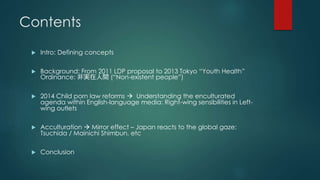
Contents 
 Intro: Defining concepts 
 Background: From 2011 LDP proposal to 2013 Tokyo “Youth Health” 
Ordinance: 非実在人間(“Non-existent people”) 
 2014 Child porn law reforms  Understanding the enculturated 
agenda within English-language media: Right-wing sensibilities in Left-wing 
outlets 
 Acculturation  Mirror effect – Japan reacts to the global gaze: 
Tsuchida / Mainichi Shimbun, etc 
 Conclusion
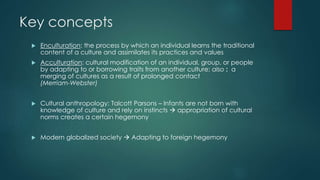
Key concepts 
 Enculturation: the process by which an individual learns the traditional 
content of a culture and assimilates its practices and values 
 Acculturation: cultural modification of an individual, group, or people 
by adapting to or borrowing traits from another culture; also : a 
merging of cultures as a result of prolonged contact 
(Merriam-Webster) 
 Cultural anthropology: Talcott Parsons – Infants are not born with 
knowledge of culture and rely on instincts  appropriation of cultural 
norms creates a certain hegemony 
 Modern globalized society  Adapting to foreign hegemony
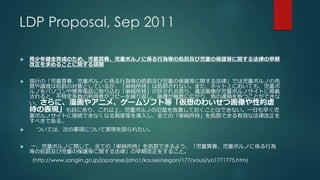
LDP Proposal, Sep 2011 
 青少年健全育成のため、児童買春、児童ポルノに係る行為等の処罰及び児童の保護等に関する法律の早期 
改正を求めることに関する請願 
 現行の「児童買春、児童ポルノに係る行為等の処罰及び児童の保護等に関する法律」では児童ポルノの売 
買や譲渡は処罰の対象としているが、「単純所持」は処罰されない。また、ネット上においても、児童ポ 
ルノをパソコンや携帯電話に取り込む「単純所持」が許される限り、違法画像が児童ポルノサイトに掲載 
されると、不特定多数の利用者がコピーを繰り返し、画像が無数に広がり、負の連鎖を断つことができな 
い。さらに、漫画やアニメ、ゲームソフト等「仮想のわいせつ画像や性的虐 
待の表現」も目に余り、これ以上、児童ポルノの氾濫を放置しておくことはできない。一日も早く児 
童ポルノサイトに接続できなくなる制度等を導入し、全ての「単純所持」を処罰できる有効な法律改正を 
すべきである。 
 ついては、次の事項について実現を図られたい。 
 一、児童ポルノに関して、全ての「単純所持」を処罰できるよう、「児童買春、児童ポルノに係る行為 
等の処罰及び児童の保護等に関する法律」の早期改正をすること。 
(http://www.sangiin.go.jp/japanese/joho1/kousei/seigan/177/yousi/yo1771775.htm)
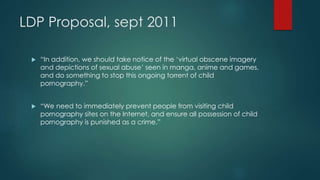
LDP Proposal, sept 2011 
 “In addition, we should take notice of the ‘virtual obscene imagery 
and depictions of sexual abuse’ seen in manga, anime and games, 
and do something to stop this ongoing torrent of child 
pornography.” 
 “We need to immediately prevent people from visiting child 
pornography sites on the Internet, and ensure all possession of child 
pornography is punished as a crime.”
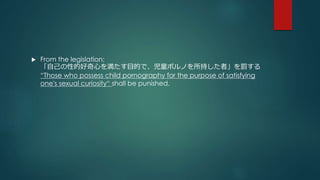
 From the legislation: 
「自己の性的好奇心を満たす目的で、児童ポルノを所持した者」を罰する 
“Those who possess child pornography for the purpose of satisfying 
one's sexual curiosity“ shall be punished.
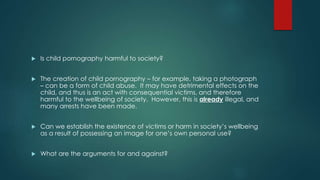
 Is child pornography harmful to society? 
 The creation of child pornography – for example, taking a photograph 
– can be a form of child abuse. It may have detrimental effects on the 
child, and thus is an act with consequential victims, and therefore 
harmful to the wellbeing of society. However, this is already illegal, and 
many arrests have been made. 
 Can we establish the existence of victims or harm in society’s wellbeing 
as a result of possessing an image for one’s own personal use? 
 What are the arguments for and against?
 The problem in trying to understand the arguments for and against is 
in the biased reporting.  The debate cannot begin because of 
certain enculturated attitudes 
 English-language news tends to lean towards a Western-centric 
attitude that condemns the very inclination of pedophilia itself 
 We need to look at Japanese sources to see the real issue, but there 
is little investigative journalism in Japan. 
 Blogs, opinion columns, editorials are the only sources for the public 
to see the true debate
 Japanese crime statistics continue to show that Japan among the safest, if 
not the safest, among developed nations. 
 The number of rape cases dropped from 4,677 in 1972 to 1,500 by 1995. Is the 
end of prohibition of pubic hair depiction in “gravure” and pornography a 
factor? 
(http://mega80s.txt-nifty.com/meganikki/2014/05/0516-0115.html) 
 If so, do looser restrictions correlate to a safer society? 
 Extreme example  What does the staggering number of child abuse 
accusations (and admissions thereof) towards clergymen tell us? 
 So what is this law actually trying to do?  Is it about protecting children, or is 
it about blocking “triggers” for criminals as a pre-emptive crackdown on 
potential crime?
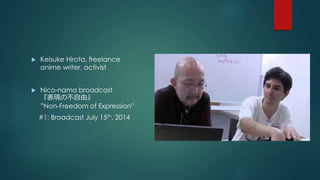
 Keisuke Hirota, freelance 
anime writer, activist 
 Nico-nama broadcast 
『表現の不自由』 
”Non-Freedom of Expression” 
#1: Broadcast July 15th, 2014
 Contextualizing the English-language news 
 The News of the World’s “name & shame” campaign (2000): 
published name list of paedophiles  mob mentality led to 
widespread violence, some against innocents 
http://news.bbc.co.uk/2/hi/uk_news/848737.stm 
 Timely news  Celebrity sex offenders – Gary Glitter, Jimmy Savile, 
Rolf Harris
 Child abuse image investigation leads to 660 arrests 
 “More than 650 suspected paedophiles have been arrested as part of a six-month 
operation targeting people accessing child abuse images online.” 
 “It just goes to show that, actually, if you're out there, you're looking at the 
images, you're doing something criminal - it's not a victimless crime.” 
Susie Hargreaves, chief executive of the Internet Watch Foundation charity 
 "Industry has to find inventive ways of blocking the flow of such horrendous 
pictures which are only produced through the suffering of defenceless children - 
many of who are not even old enough to go to school. 
"So while this operation must be rightly applauded we should view it as yet 
another warning sign that far more needs to be done if we are to stem the sordid 
trade in these images, which are often used by those who go on to abuse 
children.“ 
Claire Lilley, head of online safety at the NSPCC http://www.bbc.com/news/uk- 
28326128
Reactions to Japan: 
English-language media #1 
 Japan to finally outlaw possession of child porn, but manga gets free 
pass AFP-JIJI, JIJI, Jun 4, 2014 Japan Times 
 Lead: A ban on the possession of child pornography came a step 
closer on Wednesday, but it would exclude pedophilia portrayed in 
manga. 
 But… only the 4th and 9th paragraphs mention manga. 
 “Japan’s porn industry is huge and foreign visitors note the ubiquity of 
sexual imagery showing young-looking girls in school uniforms. While it is 
unusual to see people in Japan openly reading pedophilic manga in 
public, mainstream comic books read by commuters sometimes 
contain sexualized images that many Westerners find unpalatable.”
English-language 
media #2 
 Sexually explicit Japan manga 
evades new laws on child 
pornography, CNN, June 18, 
2014 
 “Ken Akamatsu, who lobbies 
lawmakers on behalf of the 
Japan Cartoonists Association, 
said a total ban on explicit 
content would damage the 
entire industry, making creators 
too scared to put pen to paper 
in case they risked breaking the 
rules.”
 Masatada Tsuchida (LDP) comments: “I believe that this kind of 
material is not protected by freedom of expression” 
 “[A March 2014 Government White Paper] said the number of child 
abuse victims jumped 20% between 2011 and 2012, and the number 
of victims, arrests and cases are at their highest levels since they 
started compiling statistics in 1999.” 
 But – What about before 1999  the year that the ban on 
production and distribution was implemented
English-language media #3 
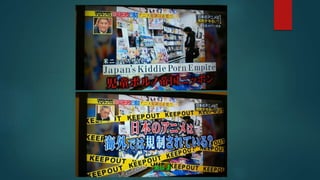
 Japan‘s Kiddie Porn Empire: Bye-Bye? 
The Daily Beast, June 3, 2014: Written by Jake Adelstein, Angela 
Erika Kubo 
(http://www.thedailybeast.com/articles/2014/06/03/japan-s-kiddie-porn- 
empire-bye-bye.html) 
 “ ‘This law is designed to protect the rights of children’, says 
Mineyuki Fukuda, an LDP politician and House of Representatives 
member who has actively supported the bill.” 
 “What it does not do is discourage fantasies about all sorts of child 
abuse stimulated by manga and anime and ever more 
sophisticated computer graphics.”
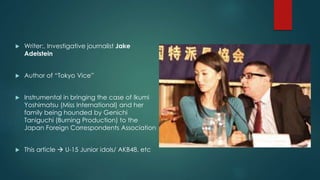
 Writer:, Investigative journalist Jake 
Adelstein 
 Author of “Tokyo Vice” 
 Instrumental in bringing the case of Ikumi 
Yoshimatsu (Miss International) and her 
family being hounded by Genichi 
Taniguchi (Burning Production) to the 
Japan Foreign Correspondents Association 
 This article  U-15 Junior idols/ AKB48, etc
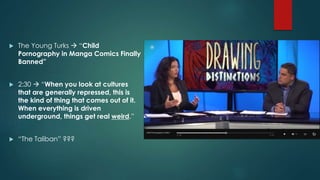
 The Young Turks  “Child 
Pornography in Manga Comics Finally 
Banned” 
 2:30  “When you look at cultures 
that are generally repressed, this is 
the kind of thing that comes out of it. 
When everything is driven 
underground, things get real weird.” 
 “The Taliban” ???
 Common points: 
 Reinforcing of a clear agenda to perpetuate a condemnation of 
certain “thoughts” 
 Comments do not necessarily reflect these views  more 
opportunities for discussion
Japan reacts to the reactions #1 
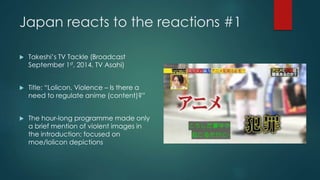
 Takeshi’s TV Tackle (Broadcast 
September 1st, 2014, TV Asahi) 
 Title: “Lolicon, Violence – Is there a 
need to regulate anime (content)?” 
 The hour-long programme made only 
a brief mention of violent images in 
the introduction; focused on 
moe/lolicon depictions
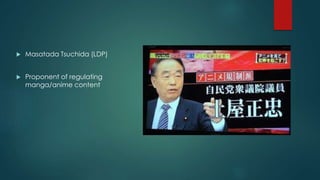
 Masatada Tsuchida (LDP) 
 Proponent of regulating 
manga/anime content
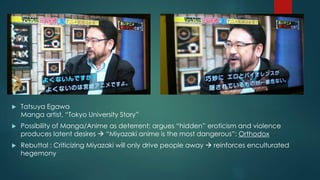
 Tatsuya Egawa 
Manga artist, “Tokyo University Story” 
 Possibility of Manga/Anime as deterrent; argues “hidden” eroticism and violence 
produces latent desires  “Miyazaki anime is the most dangerous”: Orthodox 
 Rebuttal : Criticizing Miyazaki will only drive people away  reinforces enculturated 
hegemony
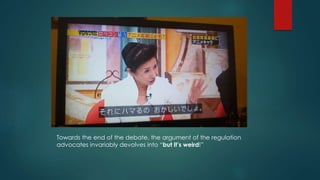
Towards the end of the debate, the argument of the regulation 
advocates invariably devolves into “but it’s weird!”
 (Rather amusingly, the end credits roll to “Sweet Child o’ Mine” by 
Guns ‘N Roses…)
Japan reacts to the reactions #2 
 社説:児童ポルノ規制子どもを守る一歩に(OPINION “Child porn ban – 
One step towards protecting children”) 
Mainichi Shimbun 毎日新聞2014年06月26日02時30分 
http://mainichi.jp/opinion/news/20140626k0000m070133000c.html 
 「日本製アニメなどの性表現の過激さが海外で強く批判されているのは確 
かだ。たとえアニメでも、子どもを性表現の対象とした作品が大手を振っ 
てまかり通っては、日本が世界から信用を失う。」 
  “It is clear that the excessive sexualized images in Japanese 
anime and the like [such as manga, games, etc.] are strongly 
criticized overseas. Even if it is just animation, the widespread 
proliferation of works in which children are sexualized will lead to a 
worldwide loss of trust for Japan.”
Japan reacts to the reactions #3 
 Keisuke Hirota, freelance anime writer, activist 
 『表現の不自由』第二回:土屋議員討論 
“Non-freedom of Expression, #2: Debate with Masatada Tsuchiya 
(Broadcast on Nico-nama, September 11th, 2014)
 Highlights: 
 “Girl, 2, killed in a supermarket toilet  manga was found in 
perpetrator’s home” (also mentioned and disputed in the TV Tackle 
special) 
 “Availability of these contents lowers the threshold for sex crimes”
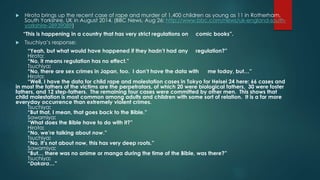
 Hirota brings up the recent case of rape and murder of 1,400 children as young as 11 in Rotherham, 
South Yorkshire, UK in August 2014. (BBC News, Aug 26: http://www.bbc.com/news/uk-england-south-yorkshire- 
28939089) 
“This is happening in a country that has very strict regulations on comic books”. 
 Tsuchiya’s response: 
“Yeah, but what would have happened if they hadn’t had any regulation?” 
Hirota: 
“No, it means regulation has no effect.” 
Tsuchiya: 
“No, there are sex crimes in Japan, too. I don’t have the data with me today, but…” 
Hirota: 
“Well, I have the data for child rape and molestation cases in Tokyo for Heisei 24 here: 66 cases and 
in most the fathers of the victims are the perpetrators, of which 20 were biological fathers, 30 were foster 
fathers, and 12 step-fathers. The remaining four cases were committed by other men. This shows that 
child molestation is most common among adults and children with some sort of relation. It is a far more 
everyday occurrence than extremely violent crimes. 
Tsuchiya: 
“But that, I mean, that goes back to the Bible.” 
Sawamiya: 
“What does the Bible have to do with it?” 
Hirota: 
“No, we’re talking about now.” 
Tsuchiya: 
“No, it’s not about now, this has very deep roots.” 
Sawamiya: 
“But… there was no anime or manga during the time of the Bible, was there?” 
Tsuchiya: 
“Dakara…”
 This seems to indicate that there has not been enough discussion on 
this topic. 
 When asked who will regulate anime/manga and how, Tsuchiya 
answered “Well, that’s difficult”. 
 The conclusion comes first, then the path to that follows
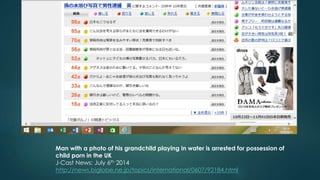
Man with a photo of his grandchild playing in water is arrested for possession of 
child porn in the UK 
J-Cast News: July 6th 2014 
http://news.biglobe.ne.jp/topics/international/0607/92184.html
Conclusion 
 The Western enculturated rhetoric regarding paedophilia 
permeates the news media, and it shows in its criticism of Japanese 
society. 
 But the comments show that people are smart; they know there is a 
debate there  there is just no forum for such a debate because of 
entrenched fear 
 Japan, always needing a mirror to look into, absorbs these reactions 
in a process of acculturation 
 Why now? “Global Standard” rhetoric / 2020 Olympics, etc.

Enculturation and Acculturation Dynamics within Discourse Surrounding the Exclusion of Manga/Anime from the 2014 Japanese Child Pornography Law Reform

  • 1.
    Enculturation and AcculturationDynamics within Discourse Surrounding the Exclusion of Manga/Anime from the 2014 Japanese Child Pornography Law Reform RENATO RIVERA RUSCA ASSISTANT PROFESSOR, CENTER FOR INTERNATIONAL COLLABORATION, MEIJI UNIVERSITY ICAS CONFERENCE – MONDAY, OCTOBER 27, 2014
  • 2.
    Contents  Intro:Defining concepts  Background: From 2011 LDP proposal to 2013 Tokyo “Youth Health” Ordinance: 非実在人間(“Non-existent people”)  2014 Child porn law reforms  Understanding the enculturated agenda within English-language media: Right-wing sensibilities in Left-wing outlets  Acculturation  Mirror effect – Japan reacts to the global gaze: Tsuchida / Mainichi Shimbun, etc  Conclusion
  • 3.
    Key concepts Enculturation: the process by which an individual learns the traditional content of a culture and assimilates its practices and values  Acculturation: cultural modification of an individual, group, or people by adapting to or borrowing traits from another culture; also : a merging of cultures as a result of prolonged contact (Merriam-Webster)  Cultural anthropology: Talcott Parsons – Infants are not born with knowledge of culture and rely on instincts  appropriation of cultural norms creates a certain hegemony  Modern globalized society  Adapting to foreign hegemony
  • 4.
    LDP Proposal, Sep2011  青少年健全育成のため、児童買春、児童ポルノに係る行為等の処罰及び児童の保護等に関する法律の早期 改正を求めることに関する請願  現行の「児童買春、児童ポルノに係る行為等の処罰及び児童の保護等に関する法律」では児童ポルノの売 買や譲渡は処罰の対象としているが、「単純所持」は処罰されない。また、ネット上においても、児童ポ ルノをパソコンや携帯電話に取り込む「単純所持」が許される限り、違法画像が児童ポルノサイトに掲載 されると、不特定多数の利用者がコピーを繰り返し、画像が無数に広がり、負の連鎖を断つことができな い。さらに、漫画やアニメ、ゲームソフト等「仮想のわいせつ画像や性的虐 待の表現」も目に余り、これ以上、児童ポルノの氾濫を放置しておくことはできない。一日も早く児 童ポルノサイトに接続できなくなる制度等を導入し、全ての「単純所持」を処罰できる有効な法律改正を すべきである。  ついては、次の事項について実現を図られたい。  一、児童ポルノに関して、全ての「単純所持」を処罰できるよう、「児童買春、児童ポルノに係る行為 等の処罰及び児童の保護等に関する法律」の早期改正をすること。 (http://www.sangiin.go.jp/japanese/joho1/kousei/seigan/177/yousi/yo1771775.htm)
  • 5.
    LDP Proposal, sept2011  “In addition, we should take notice of the ‘virtual obscene imagery and depictions of sexual abuse’ seen in manga, anime and games, and do something to stop this ongoing torrent of child pornography.”  “We need to immediately prevent people from visiting child pornography sites on the Internet, and ensure all possession of child pornography is punished as a crime.”
  • 6.
     From thelegislation: 「自己の性的好奇心を満たす目的で、児童ポルノを所持した者」を罰する “Those who possess child pornography for the purpose of satisfying one's sexual curiosity“ shall be punished.
  • 7.
     Is childpornography harmful to society?  The creation of child pornography – for example, taking a photograph – can be a form of child abuse. It may have detrimental effects on the child, and thus is an act with consequential victims, and therefore harmful to the wellbeing of society. However, this is already illegal, and many arrests have been made.  Can we establish the existence of victims or harm in society’s wellbeing as a result of possessing an image for one’s own personal use?  What are the arguments for and against?
  • 8.
     The problemin trying to understand the arguments for and against is in the biased reporting.  The debate cannot begin because of certain enculturated attitudes  English-language news tends to lean towards a Western-centric attitude that condemns the very inclination of pedophilia itself  We need to look at Japanese sources to see the real issue, but there is little investigative journalism in Japan.  Blogs, opinion columns, editorials are the only sources for the public to see the true debate
  • 9.
     Japanese crimestatistics continue to show that Japan among the safest, if not the safest, among developed nations.  The number of rape cases dropped from 4,677 in 1972 to 1,500 by 1995. Is the end of prohibition of pubic hair depiction in “gravure” and pornography a factor? (http://mega80s.txt-nifty.com/meganikki/2014/05/0516-0115.html)  If so, do looser restrictions correlate to a safer society?  Extreme example  What does the staggering number of child abuse accusations (and admissions thereof) towards clergymen tell us?  So what is this law actually trying to do?  Is it about protecting children, or is it about blocking “triggers” for criminals as a pre-emptive crackdown on potential crime?
  • 11.
     Keisuke Hirota,freelance anime writer, activist  Nico-nama broadcast 『表現の不自由』 ”Non-Freedom of Expression” #1: Broadcast July 15th, 2014
  • 12.
     Contextualizing theEnglish-language news  The News of the World’s “name & shame” campaign (2000): published name list of paedophiles  mob mentality led to widespread violence, some against innocents http://news.bbc.co.uk/2/hi/uk_news/848737.stm  Timely news  Celebrity sex offenders – Gary Glitter, Jimmy Savile, Rolf Harris
  • 13.
     Child abuseimage investigation leads to 660 arrests  “More than 650 suspected paedophiles have been arrested as part of a six-month operation targeting people accessing child abuse images online.”  “It just goes to show that, actually, if you're out there, you're looking at the images, you're doing something criminal - it's not a victimless crime.” Susie Hargreaves, chief executive of the Internet Watch Foundation charity  "Industry has to find inventive ways of blocking the flow of such horrendous pictures which are only produced through the suffering of defenceless children - many of who are not even old enough to go to school. "So while this operation must be rightly applauded we should view it as yet another warning sign that far more needs to be done if we are to stem the sordid trade in these images, which are often used by those who go on to abuse children.“ Claire Lilley, head of online safety at the NSPCC http://www.bbc.com/news/uk- 28326128
  • 14.
    Reactions to Japan: English-language media #1  Japan to finally outlaw possession of child porn, but manga gets free pass AFP-JIJI, JIJI, Jun 4, 2014 Japan Times  Lead: A ban on the possession of child pornography came a step closer on Wednesday, but it would exclude pedophilia portrayed in manga.  But… only the 4th and 9th paragraphs mention manga.  “Japan’s porn industry is huge and foreign visitors note the ubiquity of sexual imagery showing young-looking girls in school uniforms. While it is unusual to see people in Japan openly reading pedophilic manga in public, mainstream comic books read by commuters sometimes contain sexualized images that many Westerners find unpalatable.”
  • 15.
    English-language media #2  Sexually explicit Japan manga evades new laws on child pornography, CNN, June 18, 2014  “Ken Akamatsu, who lobbies lawmakers on behalf of the Japan Cartoonists Association, said a total ban on explicit content would damage the entire industry, making creators too scared to put pen to paper in case they risked breaking the rules.”
  • 16.
     Masatada Tsuchida(LDP) comments: “I believe that this kind of material is not protected by freedom of expression”  “[A March 2014 Government White Paper] said the number of child abuse victims jumped 20% between 2011 and 2012, and the number of victims, arrests and cases are at their highest levels since they started compiling statistics in 1999.”  But – What about before 1999  the year that the ban on production and distribution was implemented
  • 17.
    English-language media #3  Japan‘s Kiddie Porn Empire: Bye-Bye? The Daily Beast, June 3, 2014: Written by Jake Adelstein, Angela Erika Kubo (http://www.thedailybeast.com/articles/2014/06/03/japan-s-kiddie-porn- empire-bye-bye.html)  “ ‘This law is designed to protect the rights of children’, says Mineyuki Fukuda, an LDP politician and House of Representatives member who has actively supported the bill.”  “What it does not do is discourage fantasies about all sorts of child abuse stimulated by manga and anime and ever more sophisticated computer graphics.”
  • 18.
     Writer:, Investigativejournalist Jake Adelstein  Author of “Tokyo Vice”  Instrumental in bringing the case of Ikumi Yoshimatsu (Miss International) and her family being hounded by Genichi Taniguchi (Burning Production) to the Japan Foreign Correspondents Association  This article  U-15 Junior idols/ AKB48, etc
  • 19.
     The YoungTurks  “Child Pornography in Manga Comics Finally Banned”  2:30  “When you look at cultures that are generally repressed, this is the kind of thing that comes out of it. When everything is driven underground, things get real weird.”  “The Taliban” ???
  • 20.
     Common points:  Reinforcing of a clear agenda to perpetuate a condemnation of certain “thoughts”  Comments do not necessarily reflect these views  more opportunities for discussion
  • 21.
    Japan reacts tothe reactions #1  Takeshi’s TV Tackle (Broadcast September 1st, 2014, TV Asahi)  Title: “Lolicon, Violence – Is there a need to regulate anime (content)?”  The hour-long programme made only a brief mention of violent images in the introduction; focused on moe/lolicon depictions
  • 22.
     Masatada Tsuchida(LDP)  Proponent of regulating manga/anime content
  • 23.
     Tatsuya Egawa Manga artist, “Tokyo University Story”  Possibility of Manga/Anime as deterrent; argues “hidden” eroticism and violence produces latent desires  “Miyazaki anime is the most dangerous”: Orthodox  Rebuttal : Criticizing Miyazaki will only drive people away  reinforces enculturated hegemony
  • 25.
    Towards the endof the debate, the argument of the regulation advocates invariably devolves into “but it’s weird!”
  • 26.
     (Rather amusingly,the end credits roll to “Sweet Child o’ Mine” by Guns ‘N Roses…)
  • 27.
    Japan reacts tothe reactions #2  社説:児童ポルノ規制子どもを守る一歩に(OPINION “Child porn ban – One step towards protecting children”) Mainichi Shimbun 毎日新聞2014年06月26日02時30分 http://mainichi.jp/opinion/news/20140626k0000m070133000c.html  「日本製アニメなどの性表現の過激さが海外で強く批判されているのは確 かだ。たとえアニメでも、子どもを性表現の対象とした作品が大手を振っ てまかり通っては、日本が世界から信用を失う。」   “It is clear that the excessive sexualized images in Japanese anime and the like [such as manga, games, etc.] are strongly criticized overseas. Even if it is just animation, the widespread proliferation of works in which children are sexualized will lead to a worldwide loss of trust for Japan.”
  • 28.
    Japan reacts tothe reactions #3  Keisuke Hirota, freelance anime writer, activist  『表現の不自由』第二回:土屋議員討論 “Non-freedom of Expression, #2: Debate with Masatada Tsuchiya (Broadcast on Nico-nama, September 11th, 2014)
  • 29.
     Highlights: “Girl, 2, killed in a supermarket toilet  manga was found in perpetrator’s home” (also mentioned and disputed in the TV Tackle special)  “Availability of these contents lowers the threshold for sex crimes”
  • 30.
     Hirota bringsup the recent case of rape and murder of 1,400 children as young as 11 in Rotherham, South Yorkshire, UK in August 2014. (BBC News, Aug 26: http://www.bbc.com/news/uk-england-south-yorkshire- 28939089) “This is happening in a country that has very strict regulations on comic books”.  Tsuchiya’s response: “Yeah, but what would have happened if they hadn’t had any regulation?” Hirota: “No, it means regulation has no effect.” Tsuchiya: “No, there are sex crimes in Japan, too. I don’t have the data with me today, but…” Hirota: “Well, I have the data for child rape and molestation cases in Tokyo for Heisei 24 here: 66 cases and in most the fathers of the victims are the perpetrators, of which 20 were biological fathers, 30 were foster fathers, and 12 step-fathers. The remaining four cases were committed by other men. This shows that child molestation is most common among adults and children with some sort of relation. It is a far more everyday occurrence than extremely violent crimes. Tsuchiya: “But that, I mean, that goes back to the Bible.” Sawamiya: “What does the Bible have to do with it?” Hirota: “No, we’re talking about now.” Tsuchiya: “No, it’s not about now, this has very deep roots.” Sawamiya: “But… there was no anime or manga during the time of the Bible, was there?” Tsuchiya: “Dakara…”
  • 31.
     This seemsto indicate that there has not been enough discussion on this topic.  When asked who will regulate anime/manga and how, Tsuchiya answered “Well, that’s difficult”.  The conclusion comes first, then the path to that follows
  • 32.
    Man with aphoto of his grandchild playing in water is arrested for possession of child porn in the UK J-Cast News: July 6th 2014 http://news.biglobe.ne.jp/topics/international/0607/92184.html
  • 33.
    Conclusion  TheWestern enculturated rhetoric regarding paedophilia permeates the news media, and it shows in its criticism of Japanese society.  But the comments show that people are smart; they know there is a debate there  there is just no forum for such a debate because of entrenched fear  Japan, always needing a mirror to look into, absorbs these reactions in a process of acculturation  Why now? “Global Standard” rhetoric / 2020 Olympics, etc.