Running Head: PORNOGRAPHY AND SOCIETY
PORNOGRAPHY AND ITS EFFECT ON SOCIETY
ANA BRUNET
JOHNSON & WALES UNIVERSITY
SPRING 2015
PORNOGRAPHY AND SOCIETY 2
Abstract
This paper examines the effect that pornography has on society. This will include
pornography made with adults and children. To begin, this paper will define the term
pornography in its separate contexts. It will look at the industry of pornography, which will
include how it has grown and expanded with advancements in technology. It will also evaluate
the “business” side of the industry. There will be an exploration of the difficulties faced by law
makers when creating sanctions on crimes committed either in the making or the use of
pornography. This will include a review of First Amendment challenges in conjunction with
Supreme Court findings. Once this has been established, the argument that pornography is a civil
rights issue will also be considered. Next, this paper will tackle the issues surrounding
pornography and corrections. This relates to the proliferation of pornography in U.S. prisons and
how different institutions are dealing with this problem. The paper will then delve into the most
controversial debate surrounding pornography: is there a relationship between acts of sexual
violence and pornography; and if so, what can be done? From this discussion, this paper will
then take a look at the challenges law enforcement has in responding to crimes dealing with
pornography, especially child pornography. Finally, this paper will consolidate this information
and use it to form an opinion about the various ways pornography impacts our lives; and,
whether or not it is an issue that our society, as a whole, needs to address.
Keywords: Pornography; Child Pornography; Industry of Pornography; the Law and Porn;
Virtual Porn and the Law; the Effects of Pornography on Behavior; Corrections and Pornography
Proliferation; Law Enforcement Challenges and Pornography; Cybercrime and Pornography
PORNOGRAPHY AND SOCIETY 3
Table of Contents
Introduction..........................................................................................................................4
Defining Pornography..........................................................................................................5
Defining Child Pornography................................................................................................6
The Industry of Pornography...............................................................................................7
The Industry of Child Pornography...................................................................................10
Pornography and the Law ..................................................................................................11
Pornography as a Civil Rights Issue ..................................................................................16
The Law and Child Pornography.......................................................................................18
Pornography and Corrections.............................................................................................25
The Effect of Child Pornography on Sexual Crimes Against Children.............................31
The Effect of Pornography on Sexual Crimes ...................................................................37
Challenges to Law Enforcement........................................................................................55
Conclusion .........................................................................................................................69
References..........................................................................................................................74
Appendix A........................................................................................................................80
Appendix B........................................................................................................................81
Appendix C ........................................................................................................................82
PORNOGRAPHY AND SOCIETY 4
Introduction
This paper examines the effect that pornography has on society. This will include
pornography made with adults and children. Because these two types of pornography vary in
other aspects besides who is performing the sexual acts, the two types will be analyzed
separately but consecutively. In order to get a good understanding of the overall impact of
pornography on society, this paper will hit a number of key topics and issues that affect all areas
of the criminal justice system: courts, corrections and law enforcement. To begin, this paper will
define the term pornography in its separate contexts. It will look at the industry of pornography,
which will include how it has grown and expanded with advancements in technology. It will also
evaluate the “business” side of the industry. There will be an exploration of the difficulties faced
by law makers when creating sanctions on crimes committed either in the making or the use of
pornography. This will include a review of First Amendment challenges in conjunction with
Supreme Court findings. Pornography as a civil rights issue will also be considered.
Next, this paper will tackle the issues surrounding pornography and corrections. This
relates to the proliferation of pornography in U.S. prisons and how different institutions are
dealing with this problem. The paper will then delve into the most controversial debate
surrounding pornography: is there a relationship between acts of sexual violence and
pornography; and if so, what can be done? Due to the complexity of the issue, adult and child
pornography will be analyzed separately for this section. From this discussion, this paper will
then take a look at the challenges law enforcement has in responding to crimes dealing with
pornography, especially child pornography. This will include topics such as advances in
technology, cost to the department, etc. In addition, a possible policy that can be implemented by
a police department will also be assessed. Finally, this paper will consolidate this information
PORNOGRAPHY AND SOCIETY 5
and form an opinion about the various ways pornography impacts our lives; and, whether or not
it is an issue that our society, as a whole, needs to address.
Defining Pornography
The word pornography has been defined in many ways. Just Sex is a collection of articles
edited by Jodi Gold and Susan Villari. One of the articles by Krista K. Jacob entitled “Crime
without Punishment: Pornography in a Rape Culture,” gives the literal definition of pornography.
The word “pornography” comes from the Greek root “porne,” meaning prostitute or female
captive/slave, and “graphos,” meaning writing about or description of (Gold, 2000, p. 108). In
the study conducted by researchers John D. Foubert, Matthew W. Brosi, and R. Sean Bannon
entitled “Pornography Viewing among Fraternity Men: Effects on Bystander Intervention, Rape
Myth Acceptance and Behavioral Intent to Commit Sexual Assault,” pornography was
practically defined based on three different types. These three types included:
[1] media consisting of graphic sex actions (including penetration) being shown or
described in videos, movies, magazines, books, or online [mainstream pornography]…[2]
media consisting of sadomasochistic portrayals of bondage, whipping and spanking but
without explicit lack of consent in video, movies, magazines, books or online
[sadomasochistic pornography]…[3] media consisting of sexually explicit rape depictions
in which force is used with explicit lack of consent in videos, movies, magazines, books
or online [rape pornography] (Foubert, et.al, 2011, p. 219-220).
The definition of pornography is complex due to how explicit the wording needs to be. This is
the same when dealing with child pornography.
PORNOGRAPHY AND SOCIETY 6
Defining Child Pornography
Child pornography also has various definitions but for different reasons than adult
pornography. Child pornography is made and distributed in various ways, which has caused the
law to have to be explicit in what it calls child pornography; and the various crimes associated
with it. In federal law, child pornography is defined under 18 U.S.C §§2256 (8) as:
Any visual depiction, including any photograph, film, video, picture, or computer or
computer-generated image or picture, whether made or produced by electronic,
mechanical, or other means, of sexually explicity conduct where-
(a) The production of such visual depiction involves the use of a minor engaging
in sexually explicit conduct; or
(b) Such visual depiction is a digital image, computer image, or computer-
generated image that is, or is indistinguishable from, that of a minor engaging
in sexually explicit conduct; or
(c) Such visual depiction is engaging in sexually explicit conduct (18 U.S. Code
§§2256 (8))
The federal statute cited above includes the following conduct when describing sexually explicit:
“sexual acts such as intercourse, bestiality and masturbation as well as ‘lascivious exhibition of
the genitals or pubic area’' (18 U.S. Code §§2256 (2)). The U.S. Supreme Court has defined
‘lascivious exhibition’ broadly to include images of minors that focus on the genitals of children
even when wearing clothing” (Wolak, et.al, 2003, p. 85). This is the definition of child
pornography at the federal level; however, most state statutes follow this type of phrasing.
Before moving on to the industry of pornography, one more term needs to be addressed: virtual
pornography. In essence, virtual pornography is computer-generated pornography created using
PORNOGRAPHY AND SOCIETY 7
computer-imaging technology. This means that, in most cases, no actual person was involved in
the making of the pornography. For this reason, virtual pornography is an area where many civil
libertarians feel should be protected under the First Amendment. The debate surrounding this
matter will be acknowledged later in this paper. The above definitions are what this paper will
use when using the terms pornography, child pornography and virtual pornography. However,
these definitions alone are not enough to fully comprehend what pornography consists of. One
must review the evolution of the industry of pornography in order to achieve this understanding.
The Industry of Pornography
In order to get a full understanding of pornography, it is important to look at the industry
of pornography. Before advances in technology, specifically the Internet, pornography was
printed into magazines, books, etc. Besides images, these printed forms usually came with stories
and/or explanations of sexual acts being committed. Those who produced these prints would then
have to find ways of getting these materials into the hands of interested individuals. There were
also videos that were created of adults participating in sexual acts; but, these videos had to be
saved onto some sort of cassette tape to be played. There was still the problem of getting that
footage to those who would pay for it. With the creation of the Internet, this all changed. The
Internet allows for all forms of pornography, i.e. picture images, written stories, and videos, to be
distributed to mass amounts of people with no cost to the producer. In addition, the autonomy of
the Internet made it easier to get pornography into the hands of practically anyone; and, with the
right software, those individuals did not have to worry about others finding out what they were
viewing. This made the pornography industry explode astronomically (Dines, 2010).
On January 14, 2014, Emily Birnbaum posted a piece, entitled “Let’s Get Real About
Porn,” on an online blog called Be Young & Shut Up. This blog looks at how our politics,
PORNOGRAPHY AND SOCIETY 8
values, and perceptions are shaped by the influences of the media. In this piece, Birnbaum
attempts to give a detailed explanation of how pornography is something people are afraid to
criticize. While the bulk of her argument will be described later, it is important to note here that
her blog also gives a description of how the industry of pornography has grown. In the U.S.
market, pornography’s worth is estimated to be over 13 million and over 96 billion world-wide.
Interestingly, not all of these profits are going to the producers of porn: “Porn producers and
distributors aren’t the only ones cashing in. Mainstream industries have high stakes in the
revenue as well. Hotel chains, cell phone, internet, software, and cable companies, are also
heavily invested in porn profits” (Birnbaum, 2014). In addition, we are informed that there are
over 4.2 million porn websites and 420 million porn pages. With these kinds of numbers, it’s no
surprise that the porn industry is looking for more “creative” ways of getting people’s attention.
As Birnbaum explains, “You can’t just sell sex, you have to bring something else to the table.
What creativity has generally meant in the porn industry is making the sex acts as shocking,
violent and degrading as possible” (Birnbaum, 2014). This creativity is the catalyst for the
increase in sadomasochistic, rape, and other such types of pornography (Birnbaum, 2014).
Gail Dines, the author of Pornland: How Porn Has Hijacked Our Sexuality (2010), also
mentions how pornography has spiraled into such extremes. However she gets this insight from
actual pornography producers. In her introduction, Dines described her visit to the Adult
Entertainment Expo in Las Vegas, which is the pornographers’ annual trade show. When talking
with many of the porn producers, she found that most had no interest in sex. Rather their focus
was on making money. She describes the producers as being “turned on” by money: “The only
time they seemed excited is when they are discussing market shares, niche products, or direct
marketing versus bulk mailing in one of the many business seminars that accompany the trade
PORNOGRAPHY AND SOCIETY 9
show” (Dines, 2010, p. xvi). During her interviews, Dines found something striking: “What they
will admit is that porn is becoming more extreme, and their success depends on finding some
new, edgy sex act that will draw in users always on the lookout for that extra bit of sexual
charge” (Dines, 2010, p. xvi). In her book, Dines also gives some statistics from other studies
concerning these “edgy” acts that are becoming mainstream pornography:
In one of the few studies that have been conducted on the content of contemporary porn,
it was found that the majority of scenes from fifty of the top-rented porn movies
contained both physical and verbal abuse of the female performers. Physical aggression,
which included spanking, open-hand slapping, and gagging, occurred in over 88 percent
of scenes, while expressions of verbal aggression, calling the woman names such as bitch
or slut, were found in 48 percent of the scenes (Dines, 2010, p. xxi-xxii).
Other studies have also found an increase in this type of behavior in mainstream pornography.
Earlier, a study by Foubert, et. al, was mentioned. This study also gives a description of
how pornography has evolved. What many individuals consider to be mainstream pornography
today actually has a large number of violent acts and scenes involved. The study gives the
following percentages on some of the types of violent acts used in “mainstream” pornography:
88% of scenes include physical aggression toward women such as spanking, open-handed
slapping, hair pulling, chocking and bondage; 41% of most popular are scenes of ass to mouth or
ATM; increasing in popularity are scenes involving penises being shoved so forcefully down
woman’s throats it causes gagging and vomiting (Foubert, et.al, 2011, p. 213). Clearly,
pornography has evolved into something much more than watching other people have sex. It has
become an industry that focuses is on making money no matter the effect the product may have
on human life. This expansion is also seen in child pornography but in different ways.
PORNOGRAPHY AND SOCIETY 10
The Industry of Child Pornography
The child pornography industry exploded also with the creation of the Internet. Again it
was originally created in print and would either be saved for personal use or the producer would
find the same problems with distribution as aforementioned. The Internet eliminated some of that
problem by allowing individuals to post and share such content freely. In addition, those who
created child pornography would also be able to set up chat rooms and other such sites in order
to share images, videos, tips, etc. What makes this different from adult pornography production
is that the individuals involved have different motivation. Those who are involved in the
production of adult pornography are generally motivated by making a profit. However, the child
pornography industry is made up of individuals who seek personal gratification and/or
affirmation that what they “feel is ok.” Though there are some organized groups who use it to
attempt to make a profit (Marcum, 2014).
Based on the Attorney General’s Commission on Pornography, there are two different
types of individuals who produce child pornography:
A situational molester is one who acts out of some serious sexual or psychological need,
but who chooses children as victims only when they are ready and safely accessible.
The preferential molester, also known as a pedophile, exhibits a clear sexual preference
for children, and the offender’s deviant desires can only be satisfied by children
(Jasper, 2009, p. 63).
These above individuals are the ones who usually will be producing or creating the child
pornography. However, the industry reaches and involves other types of people. Many believe
that there is a psychological basis behind why individuals use and view child pornography.
According to the book Cyber Crime, by Catherine Marcum, there are four methods: 1) used for
PORNOGRAPHY AND SOCIETY 11
sexual arousal; 2) used for avoiding life, which means that these individuals are using child
pornography as an attempt to escape from the realities of life and instead create a world in which
they have absolute control; 3) used for collecting behavior, which simply means that they get a
thrill from collecting images; 4) used for facilitating societal relationships, which means that
some of these individuals are seeking to find acceptance with a group who also share the same
sexual desires that are not socially acceptable (Marcum, 2014, p. 33). The nature of child
pornography, however, allows for these individuals to evolve from one stage to another. The
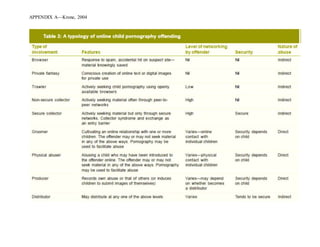
book also references a table of typologies of child pornography user behavior which came from a
2005 study by Krone (See Appendix A).The typology suggests that one may begin in the
industry as one who simply browses and views pornographic images of children but, can then
evolve into someone who actually abuses children. The impact of this evolution will be analyzed
later in the paper. Clearly there is a lot that surrounds issues of pornography which is what makes
creating statutes and sanctions concerning the production, distribution and use of pornography so
difficult. The following is an overview of some of these issues.
Pornography and the Law
The discussion of pornography and the law must begin with an understanding of the First
Amendment. The First Amendment of the United States Constitution states that: “Congress shall
make no law respecting an establishment of religion, or prohibiting the free exercise thereof, or
abridging the freedom of speech, or of the press; or the right of the people peaceably to
assemble, and to petition the Government for a redress of grievances” (U.S. Constitution
amend. I). It has long been accepted that there are certain forms of “speech” that should not be
allowed for the betterment and protection of society. For this reason, the Supreme Court has
established a list of guidelines that legislatures must follow if they wish to impose a law against
PORNOGRAPHY AND SOCIETY 12
such forms of speech. This includes: Vagueness, which requires that a law be precise enough to
give fair warning to individuals that certain conduct is criminal and provide adequate standards
to enforcement agencies, fact finders and reviewing courts; Overbroad, which is when a law is
worded to encompasses protected an unprotected speech and conduct; and Least Restrictive
Means, which means that the government must use the measure that least interferes with an
individual’s First Amendment Rights (Jasper, 2009, p. 2-3). The question becomes whether
pornography falls under the protection of the First Amendment or, if it is a form of speech that
should be regulated by the government in order to prevent harm to the citizens.
Typically when discussing First Amendment and pornography, the law makes the
distinction between what is pornographic and what is obscene. Not everything that is considered
pornographic is obscene and, not everything that is considered obscene is pornographic. This is
important because only forms of speech or print that are considered obscene are regulated.
Therefore if the pornography is not considered obscene, then the government cannot regulate it.
“The Law of Obscenity and Pornography” (2009) by Margaret Jasper gives this distinction:
The term ‘pornography’ has generally been used to describe sexually explicit material.
The term ‘obscenity’ refers to the legal definition of whether such materials are protected
under the First Amendment guarantees of free speech and free press...in general, to be
considered obscene, the material must: 1) appeal to the prurient interest, 2) be patently
offensive to the average person in society, and 3) lack serious value” (Jasper, 2009, p. 1).
In the introduction of the book “Obscenity and Pornography Decisions of the United States
Supreme Court” (2000), editors Maureen Harrison & Steve Gilbert define the two terms as:
“Obscenity—Offensive to the accepted standards of decency…Pornography—Depictions of
erotic acts intended to cause sexual excitement” (Harrison & Gilbert, 2000, p. i). Only after
PORNOGRAPHY AND SOCIETY 13
understanding this distinction can one really attempt to decipher the nuances in the legislation
surrounding pornography and its related offenses. There are several Supreme Court cases that
exemplify this; a review of which is discussed below.
On June 24, 1957, the U.S. Supreme Court heard two cases together: Roth v. United
States (1957) and Alberts v. California (1957). The first case deals with a federal law known as
the Federal Obscenity Law (1872). This law targeted several aspects; however, the one of
interest to this paper is its focus on the mailing system. It stated that “whoever knowingly
deposits for mailing material declared obscene, lewd, or lascivious, shall be fined or imprisoned”
(Harrison & Gilbert, 2000, p. 183). Samuel Roth, a pornography producer in New York City,
was charged and convicted in violation of this law. He fought this conviction arguing that the
law was an unconstitutional violation of his First Amendment rights to freedom of speech and
the press. Other constitutional questions that were considered because of this case included:
Whether these statutes violate due process, because too vague to support conviction for
crime; whether power to punish speech and press offensive to decency and morality is in
the States alone, so that the federal obscenity statute violates the Ninth and Tenth
Amendments (Harrison & Gilbert, 2000, p. 185).
The second case had a very similar state law that was enacted, which lead to the Supreme Court
combining the two cases. This second case derived from a California state law.
The state of California enacted the State Obscenity Law (1872), which stated that: “every
person who willfully or lewdly advertises or sells any obscene and indecent writing is guilty of
misdemeanor” (Harrison & Gilbert, 2000, p. 183). David Alberts, who operated a mail order
pornography business, was found to be in violation of this law. He also fought his conviction
arguing the same as Roth. In addition, his case presented these other constitutional questions:
PORNOGRAPHY AND SOCIETY 14
“whether Congress, by enacting the federal obscenity statute, under the power delegated by
Article I, Section 8, clause 7 [of the Constitution], to establish post offices and post roads,
preempted the regulation of the subject matter” (Harrison & Gilbert, 2000, p. 185). In a 6-3
decision, the Supreme Court declared that there are limitations on First Amendment freedoms of
speech and press, which obscenity falls under. It used U.S. and international laws and policies to
support this claim:
But implicit in the history of the First Amendment is the rejection of obscenity as utterly
without redeeming social importance. This rejection for that reason is mirrored in the
universal judgment that obscenity should be restrained, reflected in the international
agreement of over fifty nations, in the obscenity laws of all of the forty-eight States, and
in the twenty obscenity laws enacted by the Congress from 1842 to 1956 (Harrison &
Gilbert, 2000, p. 187).
The majority opinion, written by Justice William Brennan, also explained how the lower courts
followed the proper standard for determining obscenity, which at the time was the Hicklin test—
material was to be judged based on the effect an isolated excerpt could have upon particularly
susceptible persons (Harrison & Gilbert, 2000, p. 190). Not even 20 years later, this issue will be
presented to the Supreme Court again (Harrison & Gilbert, 2000).
The case of Miller v. California (1973) took another look at the issue of obscenity and the
law. The law in question this time was California’s 1969 updated obscenity law. This law also
focused on the mailing system and was implanted as an attempt to restrict the sale of sexually
explicit material. Interestingly, this law definitely took its wording from the aforementioned
Supreme Court case. It defined obscenity as the following:
PORNOGRAPHY AND SOCIETY 15
Obscene means that to the average person, applying contemporary standards, the
predominant appeal of the matter, taken as a whole, is to prurient interest, i.e., a shameful
or morbid interest in nudity, sex, or excretion, which goes substantially beyond
customary limits of candor in description or representation of such matters, and which is
utterly without redeeming social importance (Harrison & Gilbert, 2000, p. 137).
It was under this law that Marvin Miller was charged and convicted of a misdemeanor. The
appeal was taken all the way to the Supreme Court, which made three important determinations:
1) endorsed Roth decision that obscene material is not protected by First Amendment;
2) there are specific safeguards in which States are allowed to regulate such materials;
3) obscenity is to be determined by applying contemporary standards of society
(Harrison & Gilbert, 2000, p. 148).
Chief Justice Warren Burger wrote the majority opinion in which he discussed the Roth decision
along with other cases which support the ideal or value of regulating obscene material. In
addition, the opinion also created a new, more exact guideline for determining if material is
considered obscene or not:
The basic guidelines for the trier of fact [judge or jury] must be: (a) whether the average
person, applying contemporary community standards would find that the work, taken as a
whole, appeals to the prurient interest; (b) whether the work depicts or describes, in
patently offensive way, sexual conduct specifically defined by the applicable state law;
and (c) whether the work, taken as a whole, lacks serious literary, artistic, political, or
scientific value (Harrison & Gilbert, 2000, p. 142-143).
PORNOGRAPHY AND SOCIETY 16
This is still the standard that is used today. Another interesting way in which pornography is
looked at in terms of the law was presented by Andrea Dworkin and Catherine MacKinnon.
These women posit that pornography is not necessarily a criminal issue but a civil rights issue.
Pornography as a Civil Rights Issue
Andrea Dworkin and Catherine MacKinnon edited a book entitled In Harm’s Way: The
Pornography Civil Rights Hearings (1997). They collected testimony of advocates as well as
victims who were hurt by pornography in some way shape or form. In their introductions, these
two women exasperatingly ask the reader to really listen to what those who have been victimized
by this industry have to say. An example of the types of testimonies given during some of these
hearings includes a written submission given by a former prostitute, dancer and nude model. This
woman, who wished to stay anonymous, testified about how she started this lifestyle at the age of
17 as a topless dancer. During the next eight years, she would engage in various activities such
as giving “customer services” at massage parlors and participating in escort services, as well as
photo shoot and other similar conducts (MacKinnon & Dworkin, 1997).
She stated that in all of the places she went to, the most violent pornography she viewed
was at client’s homes that would play the porn while performing sex acts with her. She also
stated these were the ones she was most afraid of:
A lot of times these men were high on cocaine or other drugs and would watch
pornographic films for hours and hours while having sex with one woman after another. I
considered the men who were into pornography to be the most dangerous and potentially
violent since that is what aroused them (MacKinnon & Dworkin, 1997, p. 419).
She also states that “at least fifty percent of the men that I saw professionally were into fantasies
and pornography such as I have described. They were men from all over the world and all types
PORNOGRAPHY AND SOCIETY 17
of professions” (MacKinnon & Dworkin, 1997, p. 419). Equipped with testimonies such as these,
Dworkin and MacKinnon formulated the argument that pornography is a civil rights issue. They
became recognized as experts on the subject and would later be asked to testify at various
legislative hearings (MacKinnon & Dworkin, 1997).
One such legislative gathering had requested Andrea Dworkin to give her testimony
when considering the civil rights argument in terms of regulating pornography. Now her
testimony should be taken into context. She gave this testimony during the time of the civil rights
movement. By turning pornography into a civil rights issue, Dworkin was able to really catch the
attention of the people of her time. She states in this testimony that “pornography is a civil rights
issue for women because pornography sexualizes inequality; because it turns women into
subhuman creatures…it is the systematic exploitation of a group of people because of a condition
of birth” (Stan, 1995, p. 34). At the end of her testimony, Dworkin gave a list of
recommendations on how to deal with the pornography problem in terms of looking at in from
civil rights perspective:
1) Have the Justice Department instruct law-enforcement agencies to keep records of the use
of pornography in violent crimes, especially in rape and battery, in incest and child abuse,
in murder, including sexual assault after death, to take note of those murders that are
committed for sexual reasons;
2) Get pornography out of prisons;
3) Enforce laws against pimping and pandering against pornographers;
4) Make it a Justice Department priority to enforce RICO (the Racketeer Influenced and
Corrupt Ogranizations) against pornography industry;
PORNOGRAPHY AND SOCIETY 18
5) Federal civil rights legislation recognized pornography as a virulent and vicious form of
sex discrimination be pass, that I be a civil law;
6) Consider creating a criminal conspiracy provision under the civil rights law, such that
conspiring to deprive a person of their civil rights by coercing them into pornography is a
crime, and that conspiring to traffic in pornography is conspiring to deprive women of
our civil rights;
7) Think about pornography in the context of international law (Stan, 1995, pg. 37-39).
Dworkin also called for the ratification of the United Nations Convention on the Elimination of
All Forms of Discrimination Against Women, signed by President Carter.
Alan Soble and Nicholas Power were the editors of the book The Philosophy of Sex:
Contemporary Readings (2008). In chapter 25 of this book, we find Joan Mason’s essay
“Pornography as Embodied Practice.” Here she explores the arguments of Dworkin and
MacKinnon’s criticism of pornography. Mason-Grant is a part-time teacher at King’s University
College of the University of Western Ontario in the interdisciplinary Social Justice and Peace
Studies program. The focus of this essay is to explore how some view pornography as a speech
while others a more “embodied practice,” as explained in the following: “The crux of this
analysis is the claim that pornography is not merely the representation or expression of ideas,
that is, “speech,” but a material practice of subordination” (Soble & Power, 2008, p. 402). Again,
she states the following:
The constructive aim of this essay is to bring critical awareness back to the core insight of
that analysis—that pornography is a series of irreducibly embodied practices that work
quite differently from political speech—and to begin to elaborate the concept of
pornography as a practice in order to better understand how mainstream pornography
PORNOGRAPHY AND SOCIETY 19
contributes to a profoundly impoverished, overly objectifying and, yes, subordinating
sexual know-how (Soble & Power, 2008, p. 403).
The above discussion revolves around the issues surrounding the law and pornography created
with adult “actors” or “participants.” Pornography involving children has also evolved overtime
but, is regulated by the law differently than adult pornography.
The Law and Child Pornography
As displayed above, our laws are constantly adapting with societal opinions, attitudes,
etc. There are other factors that also affect this evolution, such as technology. This is also evident
in child pornography laws. The best place to begin is with the Child Pornography Prevention Act
or CCPA; and, the changes made to it since its establishment in 1996. The following is a
summary of what CCPA wanted to accomplish:
Criminalized material that depicts children engaging in sexually explicit conduct whether
or not the content in question involved real children…shifted from defining child
pornography in terms of the harm inflicted upon real children to a determination that
child pornography was evil in and of itself (Akdeniz, 2008, p. 97).
This law was created as a response to advances in technology where images, videos, etc. could
be created with the use of computer generated characters or participants. This was considered
virtual pornography, which was mentioned before. It was no surprise that the American Civil
Liberties Union (ACLU) and the Free Speech Coalition were quick to criticize this law. The
ACLU declared that the precedent case of New York v. Ferber (1982) made it clear that any
limitations on child pornography should be done so with the intent to prevent harm to actual
children during the production of such material. The Ferber case was the one that put child
pornography in the category of unprotected speech and was upheld many times through cases
PORNOGRAPHY AND SOCIETY 20
such as Osborne v. Ohio (1990) and Stanley v. Georgia (1969). However, in all those cases it
was also upheld that “the legislation sought not to control men’s minds but rather to protect
children from exploitation and harm involved in the production of child pornography” (Akdeniz,
2008, p. 95). The Free Speech Coalition would use this line of reasoning when it confronted the
constitutionality of CCPA based on the overbroad and vague language used (Akdeniz, 2008).
The first time the Free Speech Coalition took the composers of the CCPA law to court
was on August 12, 1997 (Free Speech Coalition v. Reno). The Federal District Court for the
Northern District of California upheld the law stating that it was not vague and overbroad but
that the law was “…aiming to reduce harmful secondary effects of virtual child pornography
including the exploitation and degradation of children and the encouragement of pedophilia and
molestation of children” (Vanacker, 2002). On December 17, 1999, the case was taken to the US
Court of Appeals, who reversed the judgment. This court found the law to be vague and
overbroad and ignored the “secondary effect” doctrine since it was not in line with the traditional
interpretation of the First Amendment. Finally, this case was taken to the Supreme Court on
April 16, 2002 (Ashcroft v. Free Speech Coalition). The Supreme Court agreed with the Court of
Appeals stating that the law was unconstitutional since it was “overbroad because it could
prohibit speech of literary, artistic, political, or scientific value and would therefore not pass the
test for obscenity statutes set out in Miller v. California” (Vanacker, 2002). The court also
responded to the government’s justifications for establishing CCPA. The following includes
three of these justifications and the responses given by the court:
2. Child pornography is used by pedophiles and child sexual abusers to "whet their
appetite." The majority concluded that this is a case where the government tries to control
PORNOGRAPHY AND SOCIETY 21
conduct by regulating thoughts, which is one of the greatest threats to First Amendment
freedoms.
3. Because computers can make it almost impossible to determine whether or not real
children were used in an image, it would become very difficult for the government to meet
its burden of proving that real children were used in the production of a pornographic
image. The majority ruled that the First Amendment would be turned upside down if one
were to forbid computer-generated images as well as images of real children, merely
because it is difficult to distinguish between the two.
4. Because virtual child pornography helps to sustain the market for production of visual
depictions that involve real children, the market for pornography involving real children
can only be dried up by also eliminating virtual pornography. This argument relies on the
assumption that real and virtual images are indistinguishable and are exchanged on the
market. This assumption was rejected by the majority, who stated that if this were the
case, real images would be replaced by virtual images, since nobody would risk
producing real images if virtual computer generated images would suffice [Italics own]
(Vanacker, 2002).
It is important to understand that the Supreme Court is very hesitant to restrict any form of
speech because of the provisions of the First Amendment.
The Court has determined that only certain forms of speech can be restricted, and in
general this relates to how people respond to the speech. Therefore the major issue the Supreme
Court had with the CCPA law is that there was no evidence presented that showed a connection
between virtual or computer-generated images and actual children being harmed. This ruling did
cause many to be fearful that child pornography cases would be hard to prosecute; however, this
PORNOGRAPHY AND SOCIETY 22
decision did not seem to hinder the prosecution of such cases. At the federal level, cases
following the ruling showed that the court was ready to deal with child pornography cases under
the new precedent. Examples of such cases include: U.S. v. Kimler (2003), U.S. v. Slanina
(2002), U.S. v. Deaton (2003), U.S v. Hall (1995), U.S. v. Farrelly (2004), U.S. v. Irving (2009)
and U.S. v. Rodriguez-Pacheco (2007). In all of these Supreme Court cases, the court did not
automatically require the prosecution to have the burden of proof to demonstrate that the images
were of actual children and not a computer-generated configuration. The reasoning for not
requiring such proof was based on the assumption that technology had not advanced enough to
where a jury would be unable to tell the difference between a computer-generated image and a
depiction of a real child. Regardless, there were many who were not satisfied with the ruling and
began drafting new substitute laws (Akdeniz, 2008).
The first draft of a new law to substitute CCPA was the Child Obscenity and
Pornography Prevention Bill of 2002. This bill outlined four important items: 1) make the
definition of child pornography more narrow; 2) focus on prohibiting any visual depictions of
sexual conduct of prepubescent children; 3) make it an offense to “offer to sell or provide” child
pornography images; 4) establish a database with the FBI to identify children in the images
(Akdeniz, 2008, p. 116). This bill was passed by the House of Representatives but failed in the
Senate. It was amended, now becoming the Prosecutorial Remedies and Other Tools to End the
Exploitation of Children Today Bill of 2003, also known as the PROTECT Act. The PROTECT
Act was passed by both houses and signed into law by April of that year. Under this Act,
computer-generated images could now be prosecuted as long as they were found to be obscene.
The composers of the PROTECT Act were sure to pay attention to the comments made earlier by
the Supreme Court in the CCPA evaluation (Akdeniz, 2008).
PORNOGRAPHY AND SOCIETY 23
Those who wrote the PROTECT Act took notes from what the court said about the
CCPA law and avoided using vague and overbroad language in its composition. In addition, the
Congressional findings made sure to present evidence that technology had advanced since the
Supreme Court ruling. As stated by Congressman Hatch concerning these findings: “technology
had advanced so far that even experts often cannot say with absolute certainty that an image is
real or virtual and computer-generated. For this reason, the Act permits a prosecution to proceed
when images include persons who appear virtually indistinguishable from actual minors, and
even when this occurs, the accused is afforded a complete affirmative defense by showing that
the images in question did not involve a minor” (Akdeniz, 2008, p. 118). One of the key
differences between the CCPA law and the Protect Act was the addition of an affirmative
defense, which will be discussed in more detail later.
Because of the PROTECT Act, there were several amendments made to the US Federal
Code, Chapter 10, entitled Sexual exploitation and other abuse of children. Section 2256 is
where the various definitions relating to child pornography and other related offenses are listed.
Two additional paragraphs were added after the establishment of the PROTECT Act to aid in
making the law clear and concise, which CCPA previously did not do. Section 2256(11) is where
the term indistinguishable, which was cited above by the Congressman, is defined:
The term ‘indistinguishable’ used with respect to a depiction, means virtually
indistinguishable, in that the depiction is such that an ordinary person viewing the
depiction would conclude that the depiction is of an actual minor engaged in sexually
explicit conduct. This definition does not apply to depictions that are drawings, cartoons,
sculptures, or paintings depicting minors or adults (PROTECT, 18 U.S. Code §2256).
PORNOGRAPHY AND SOCIETY 24
As mentioned before, in addition to the precise language used, the PROTECT Act added an
affirmative defense for those charged with such violations. This shifts the burden of proof to the
defendant to show that a child was not harmed in the production of the alleged child
pornography. The PROTECT Act has been amended over the years to match with continued
progression in technology and findings on causal links between possession and harm to children.
The most recent update to the Act is the Child Protection Act of 2012 (Adkeniz, 2008).
The Child Protection Act of 2012 updated eight sections of the legislature: 1) created an
increase in penalties for possession of child pornography, 2) added protection for child witnesses
in cases, 3) allocated more authority to US Marshals in the arresting of sex offenders, 4)
increased funding for Internet Crimes Against Children (ICAC) Task Forces, 5) clarified intent
for National Coordinator for Child Exploitation Prevention and Interdiction, 6) reauthorized
ICAC, 7) clarified definition of “high-priority suspect”, and 8) directed Attorney General to
report to congress on status of NID system (United States, 2012, p. 17-18). It was mentioned
above that one of the main problems the Supreme Court faced in terms of the CCPA law was the
presentation of evidence of a causal link between virtual images and child harm. In the report
submitted by the Judiciary Commission for the Child Protection Act of 2012, evidence was
presented that showed how the Internet has facilitated pedophiles and child molesters through the
use of pornography, as well as, the impact simple possession of images has on the likelihood of
someone committing an act against a child. The evidence presented included that which came
from research by the Justice Department as well as a 2009 symposium of experts on child
pornography. It was stated that:
[The] symposium participants…agreed that there is sufficient evidence of a relationship
between possession of child pornography and the commission of contact offenses against
PORNOGRAPHY AND SOCIETY 25
children to make this a cause of acute concern…not see this necessarily as a linear
relationship but considered it a relationship that must be assessed in determining
treatment and criminal justice operations because based on research using samples of
individuals convicted of child pornography offenses, a significant portion of those who
possess child pornography have committed a contact sexual offenses against a child
(United States, 2012, p. 6).
This evidence was shown in support of the update to increase penalties for possession of child
pornography but it shows the progression of the law and the evolution of society. The above
discusses pornography and how it pertains to the law. The following section takes a look at
issues with pornography within the corrections branch of the criminal justice system.
Pornography and Corrections
A major issue many correctional facilities have faced is the proliferation of pornography
within the prison. Around 2011, the topic of whether pornography should be allowed in United
States prisons was on the frontlines. In more recent years, it seems that the subject has died down
a bit. Interestingly, there is still no consistency throughout the 50 states about what to do
concerning pornography in prisons. Some institutions allow it, usually with certain exceptions,
while others ban it completely. As usual, the American Civil Liberties Union has voiced
concerns about the bans; but, they are adamant that they are not advocates for pornography in
prisons. The following will dive into this dynamic whirlwind of concerns and policies by
reviewing different state and county procedures concerning the matter; and, the involvement of
the ACLU, as well as, take a look at the current and future implications.
Currently, there is no over standing rule concerning whether or not pornography should
be allowed in United State prisons. It is up to each state and county to make their own
PORNOGRAPHY AND SOCIETY 26
determination on what their policy should be for their specific prison(s). There have even been
cases where the state will allow certain forms of pornography and one county within the state
will deny access to any pornographic material. A prime example of this was seen in Michigan in
2011. Fox News produced an article on July 4, 2011, that described a lawsuit that was submitted
against the Governor of Michigan by an inmate named Kyle Richards. He believed that it was
cruel and unusual punishment to not have access to pornography while imprisoned. The state of
Michigan had a policy that allowed prisoners to possess pornography as long as it did not depict
simulated rape, bestiality and sadomasochism; however, the Macomb County jail where he was
being held had a ban on pornography as a whole (NewsCore, 2011). This inconsistency is very
common throughout the United States. Interestingly, this conversation became a hot topic after a
lawsuit was submitted by the ACLU in South Carolina.
In June of 2011, the ACLU filed a lawsuit against the Berkeley County Jail in Moncks
Corner, South Carolina because of a literature ban that was implemented by the correctional
institution. Essentially, the ban was on a range of materials that were “bound together by tape,
staples, paper clips, or clasps…[and] material that could encourage deviant sexual
behavior”(Shahid, 2011). When the ACLU filed suit, the impression expressed by the prison
attorneys was that the ACLU wanted pornography to be allowed in prisons. This definitely
“struck a nerve,” as it were, with the ACLU representatives. From this case forward, they have
vehemently expressed that they are not supporters of pornography: “None of this is to suggest
that jails must permit pornography…merely that a jail cannot constitutionally ban all
publications that sometimes show men and women wearing underwear or dressed for the beach”
(Shahid, 2011). While the ACLU may not have had the intention of supporting the idea of
allowing pornography in prisons, this lawsuit was the spark that inflamed many new cases.
PORNOGRAPHY AND SOCIETY 27
The Michigan case with Kyle Richards, cited above, was filed only one month after the
ACLU’s suit against South Carolina. That same month, the state Department of Connecticut
made the announcement that they would also put a ban on sexually explicit material. They
defined sexually explicit as “any printed material that contains a pictorial depiction of sexual
activity or nudity, except where those materials, when taken as a whole are literary, artistic,
educational, or scientific in nature” (Owens, 2011). By October of that same year, the department
“received about three dozen letters from inmates, many of them form letters, claiming the
recently adopted ban violates the inmates’ First Amendment rights” (DailyMail, 2011). Besides
just claiming a violation of rights, these inmates are asking for alternatives if the ban won’t be
taken away completely. These suggested alternatives include the option for cable programming
that does depict sexual activity and nudity. In both these cases, the ACLU has expressed concern
about these policies being enforced capriciously; but, they are not willing to get involved beyond
voicing this concern. They could be staying out of the matter for various reasons.
First, the ACLU has already been “accused” of promoting pornography in prisons. This is
not the impression they wish to give so they need to be careful about how they word their
concerns and what cases they decide to fight. Second, the ACLU may view these later cases as
not strong enough to take to court and so do not wish to be involved until something more
concrete comes up. There are others, however, who believe that the inmates do have a case. The
Daily Mail Reporter cited a law professor at Quinnipiac University, Bill Dunlap, who said in
reference to the aforementioned Connecticut ban: “There is a constitutional argument to be
made…[but] the courts have generally sided with prison officials, as long as they can prove the
ban has a legitimate goal other than to simply suppress material that some people might find
PORNOGRAPHY AND SOCIETY 28
objectionable” (DailyMail, 2011). So what are the legitimate goals that the state Department of
Corrections in Connecticut is using to support the ban?
Brian Garnett, the department’s spokesperson, gave an overall statement saying: “This
material is detrimental to the safety and security of our institutions, to our efforts to rehabilitate
the offender population, and it creates a hostile work environment for our staff, which is exposed
to this on a daily basis” (Owens, 2011). Further breakdown of the goals or objectives of the ban
included the following two concerns: safety for the correctional staff, especially female officers
and staff; and, hindrance to rehabilitation programs with sex offenders. The first concern deals
with the correctional staff having to be exposed to pornographic images, magazines, etc. Due to
the nature of the images, it creates an environment of intense discomfort for the staff, especially
the women who have to work among all the other men in the institution. It has also been reported
that some inmates used pornography to sexually harass the officers (Owens, 2011).
The later concern deals with sex offenders who are in rehabilitative programs who then
go back to their cells where pornography is prevalent. Exposure to such materials basically
nullifies anything that the rehabilitation program may have been able to accomplish. The ban
was established with these goals in mind after the department underwent an investigation into the
issue. The following were also considered when this decision was being made: 1) reports of
prisoners using pornography as a type of currency to trade items among each other, which would
then also become a source for fighting among the inmates; and, 2) the issues and policies that
other states had dealt with or implemented concerning this issue. The question now arises, is
pornography really that dangerous that we should think of it as a hazard and safety risk? This is
very question has been the topic of debate for years (Owens, 2011).
PORNOGRAPHY AND SOCIETY 29
Elizabeth Stuart, reporter and writer for Desert News—which is an online news
magazine—published a July, 2011 article entitled Prisons Cracking Down on Porn. In this
article she addressed the question of potential dangers of pornography. On the one side, she cited
research studies conducted by Neil Malamuth and Joseph Ceniti who found:
Men were more easily angered and had a greater ‘desire to hunt’ after repeated exposure
to pornography…[and that] experimental research shows that exposure to nonviolent or
violent pornography results in increases in both attitudes supporting sexual aggression
and in actual aggression” (Stuart, 2011).
For the opposing side, she cited an article in Salon Magazine which stated “there isn’t evidence
that porn causes aggression—and yet prisons continue to ban explicit material on those very
grounds” (Stuart, 2011). The article took it further by citing Milton Diamond and Ayako
Uchiyama’s research stating: “that research linking pornography with increased aggression is
invalid because there is a fundament problem with assuming that people in the real world
function just like these laboratory experiments” (Stuart, 2011). The debate concerning whether
pornography has harmful effects will be discussed later. For now, are there other reasons why we
should not want to have pornography in our prisons?
To determine this, it’s important to take a look at what the goals of a correctional
institution are. The overall goal of corrections has changed overtime. It began with its focus
solely on punishment. As society grew and changed, other objectives were added on to this
original goal. Examples include rehabilitation, retribution and overall safety. Today, it is
generally accepted that wardens run their institutions with safety for inmates and public in mind
first with retribution and rehabilitation following suite. However, at the core of all this is the
original goal: punishment. It is obvious that prisoners are not entitled to the same rights as free
PORNOGRAPHY AND SOCIETY 30
citizens in society. There are some rights that cannot be taken away, as our Constitution so states;
but those rights mainly deal with treating every person humanely regardless of status. As long as
those rights are upheld, others can be taken away for incapacitation, which is the whole point
behind imprisoning an individual in the first place. Should the banning of pornography for
inmates be considered inhumane? There is little legal basis for believing so (Seiter, 2012).
The next goal that wardens are concerned with is safety. As aforementioned, pornography
has been used as currency among inmates, which then makes it a valuable asset. Because of this
and the lustful nature of pornography, inmates would fight over it and attempt to steal it from one
another. Anything that causes friction among inmates is not something that a warden will want in
their prison. In terms of retribution, the goal is to have inmates pay back to the victim or victim’s
family. To me, allowing pornography inside the prison nullifies anything that is trying to be
accomplished in the retribution process, especially for victims of sexual assault, rape and
molestation. Would it really make a difference if the individual is paying you money or attending
meetings designed to restore both the victim and the assailant, when you know that they are
allowed to view materials that can remind them of what they did? How does that establish
retribution? Is this effective in terms of the goals of retribution?
Finally we come to the goal of rehabilitation. In reality, rehabilitation is not a main goal
of corrections. It is nearly impossible for an institution to effectively reach all of these goals.
However, it is a goal that many believe should be a focus for correctional institutions. Therefore,
why would you make this goal any harder to achieve by allowing material that only reinforces
the individual’s previous way of thinking that got them into prison in the first place? Clearly
pornography is something that only adds problems to an already difficult environment.
Therefore, it makes a lot of sense that those who work in these institutions would want to ban it.
PORNOGRAPHY AND SOCIETY 31
This discussion leads into a controversial debate concerning pornography: is there a relationship
between pornography and its effect on the viewers’ actions? The following is an overview of that
exact question separated into child pornography, first, and then adult pornography.
The Effect of Child Pornography on Sexual Crimes Against Children
To begin the discussion of whether there is a relationship between child pornography and
actually committing a sexual offense against a child, the first thing to look at is the rate of sexual
abuse of children. Statistically, there is actually not a lot of recent data to refer to. The UCR does
not cover sex offenses against children at all. Another data collecting organization, the National
Incident-Based Reporting System (NIBRS), has outdated data. The most recent collection of data
from NIBRS covers the years from 1991-1996. In addition, this report gathered information from
law enforcement agencies in only 12 states and categorized sexual assault into four
classifications: forcible rape, forcible sodomy, sexual assault with an object, and forcible
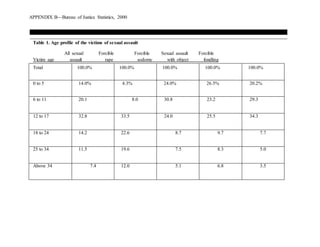
fondling (BJS, 2000). This data included both adult and child victim reports but did express the
results in a way to show the age range of the victims (See Appendix B). This data shows that a
significant percentage of these reported offenses were by minors:
The age profile of sexual assault victims varied with the nature of the crime. Juveniles
were the large majority of the victims of forcible fondling (84%), forcible sodomy (79%),
and sexual assault with an object (75%). In contrast, juveniles were the victims in less
than half (46%) of forcible rape. In each sexual assault category except forcible rape,
children below the age of 12 were about half of all victims (BJS, 2000).
However, Centers for Disease Control and Prevention does provide some more up-to-date data.
Under their Child Maltreatment Prevention section, the following statistics can be found:
PORNOGRAPHY AND SOCIETY 32
There were 678, 932 victims of child abuse and neglect reported to Child Protective
Services [CPS] in 2013. The youngest children are the most vulnerable with about 27%
of reported victims being under the age of three. CPS reports may underestimate the true
occurrence of abuse and neglect. A non-CPS study estimated that 1 in 4 children
experience some form of child maltreatment in their lifetimes. About 1,520 children died
from abuse and neglect in 2013 (Child Maltreatment, 2013).
It is important to note that this data includes offenses such as physical abuse, sexual abuse,
emotional abuse, and neglect of a child under the age of 18 by a parent, caregiver, or another
person in custodial role (Child Maltreatment, 2013). This means that these numbers do not cover
cases where the offender is someone who does not have custodial rights or obligations to the
child. In 2003, Pediatrics Today published an article that discussed sexual abuse in children and
minors; as well as, things for practitioners to be aware of concerning the matter. The article
concluded that “without doubt, sexual abuse persists, unthreatened and covert through traditional
and now nontraditional venues” (Pfitzer, 2003, p. 5). The traditional venues that the article
discusses include individuals having access to children by either family or community ties. The
Internet was considered a nontraditional venue, described by the author as the following:
Child sexual abuse has continued to develop beyond national tiers, expanding to
international levels with the development of the internet, easy to use and electronically
accessible in seconds. Disturbingly, creation of the internet has encouraged the
production and dissemination of child pornography, which has become a billion dollar
industry, the magnitude of which is unlikely to be disrupted any time soon (Pftitzer,
2003, p. 8-9).
The following looks at new way the Internet is being used to commit child sexual abuse crimes.
PORNOGRAPHY AND SOCIETY 33
In 2013 an article, entitled “Fantasy Depictions of Child Sexual Abuse: The Problem of
Ageplay in Second Life” was published in the Journal of Sexual Aggression in the United
Kingdom. The author, Carla Reeves, addresses a new development in technology that has raised
concern for child safety. The article looks into a virtual multiplayer online environment called
Second Life where in participants can partake in an activity known as sexual ageplay, which is
defined as the following: “Sexual ageplay is the virtual act of simulating child sexual abuse using
animated child characters operated by consenting adult users” (Reeves, 2013, p. 236). Second
Life is played in real-time and allows individuals the ability to communicate and interact with
one another through instant typed chat messaging and video or voice calls: “it is a free-form
computer-generated environment in which users, through their avatars, can act out a life not
unlike they would in the real world, except that in Second Life there are no physical laws and
they are not bounded by issues such as employment, social networks, or status” (Reeves, 2013, p.
238). The only rules set in place by the developers of this online environment is that only adults
are allowed to access the site. They have strict regulations set in place to separate adult users
from minor users. However, the United Kingdom legislation has found some significant
problems with the activities that occur on this site (Reeves, 2013).
In 2010, the government had passed the Coroners and Justice Act 2009 which made child
pornographic images, both real-life and what was described as “pseudophotographs”, illegal:
“this Act is the first time in England and Wales that child abuse images that are evidently not
depictions of real abuse of actual children have been prohibited” (Reeves, 2013, p. 236).
Maureen Johnson and Kevin Rogers were authors of another United Kingdom article found in
the Journal of International Commerce Law and Technology (2009). This article, entitled Too far
down the Yellow Brick Road—Cyber-hysteria and Virtual Porn, gives us a definition of
PORNOGRAPHY AND SOCIETY 34
pseudophotographs: “an image, whether made by computer graphics or otherwise howsoever,
which appear to be a photograph” (Johnson & Rogers, 2009, p. 65). The findings of Johnson and
Rogers will be presented later. Referring back to the Coroners and Justice Act, it is important to
note the reasons behind the passing of this act. The government gave the four following
arguments for justifying the enactment of this Act:
(1) Real child abuse images may be manipulated in such a way as to disguise the content
as fantasy images and so evade prosecution; (2) fantasy images of abuse are often found
in collections of photographic child abuse images and so is proffered as evidence of a
link between viewing or creating fantasy images and “real world” offending; (3) that
fantasy images could be used as a way to start grooming children by sex offenders; and
(4) that viewing fantasy images of child abuse may reinforce the viewer’s inappropriate
feelings towards, and attitudes about, children (Reeves, 2013, p. 237).
In essence, the government posits that there is a relationship between viewing virtual child sex
abuse images, or virtual child pornography, and contact offending. However in order to justify
such a statement it needs research to support it, something that is lacking in this area.
There has been limited research conducted on the subject of whether viewing and
possessing child pornography has any correlation or relationship to actually committing a sex
offense against a child. This includes both real life images and virtual ones. In respect to virtual
images, the Reeve’s article explains that in the United States the Ashcroft v. Free Speech
Coalition of 2002 did not find sufficient evidence of a link between non-photographic images
and actual commission of child abuse. However, this finding was found to be inefficient due to
the fact that the evidence did not have a clear finding and the methodology was poor (Reeves,
2003, p. 241). This does not mean that there is not a relationship between viewing and
PORNOGRAPHY AND SOCIETY 35
possessing these images and committing a sex crime, but, rather that the research itself has been
poorly conducted. Johnson and Rogers, whose work was cited before, posit that virtual images
may actually be a good thing because it could lessen the demand for real images since they
assume that individuals would choose the virtual images over real if the virtual were not made
illegal: “Most individuals are risk averse, and know of the risk they take in possessing indecent
images of this nature. Especially in situation where the user of the images is one of the growing
band of the merely curious, some would undoubtedly chose virtual over actual, the result being a
lessening of the demand for the abuse of real children” (Johnson & Rogers, 2009, p. 67). On the
other side of the argument, Reeves also cites the conclusion of authors Quayle and Taylor who
state: “that such behavior, eased by quick access to large amounts of material on the Internet,
may lead collectors to seek increasingly extreme material to maintain the excitement gained by
new and novel images” (Reeves, 2003, p. 240). Clearly there is no sound conclusion. So if it can
be conceded that more accurate and reliable research needs to be conducted in this area, are there
other reasons why it might be smart for legislatures to regulate such images?
There is no sound evidence of a causal relationship between possessing child
pornography and committing a sex offense against a child. However, research does show there
may be a more indirect type of relationship. One thing that many researchers can agree on is the
significant impact chat rooms have on potential offending. Reeves cites several studies that
express this sentiment. One in particular was written by Elliot and Beech in 2009, which was
entitled “Understanding Online Child Pornography Use: Applying Sexual Offence Theory to
Internet Offenders.” The authors discuss the following:
The rationalizations employed by offenders engaging in fantasy-only abuse tend to be
with respect to the harmless nature of the activity, but that repeated engagement and
PORNOGRAPHY AND SOCIETY 36
emersion in the online culture of the group may lead to the individual developing
rationalizations towards sexual abuse of children more generally [such as that children
enjoy sexual activity with adults] (Reeves, 2003, p. 242).
In essence, individuals who have this desire to be sexually intimate with a child are able to come
to a point where they believe there is nothing wrong with the way they feel when given the
opportunity to talk with others who feel the same way. This community is easily created on the
Internet, due to the autonomy and accessibility it provides. Individuals are able to freely express
their desires and find reassurance within this group. This is where the danger lies because such
reassurance can empower these individuals to act. Pornography has a part to play here because
most of the groups are strengthened through the sharing of images and ideas. In this way, child
pornography can have an indirect effect on potential behavior. If you refer back to the issues
surrounding the virtual online environment, Second Life, you find evidence of this even there.
It was found in 2007 that virtual prostitution rings had been established through the
game: “investigation into allegations of trading child abuse images in Second Life uncovered
markets of photographic and pseudophotographic child abuse images alongside virtual
prostitution rings trading sex with child avatars” (BBC News, 2007). If individuals are willing to
participate in such acts in a virtual environment, is there not a concern that it can fuel a desire to
do the same in the real world? And isn’t this concern increased since these individuals are
finding empowerment in this environment to commit these acts? Is this not reason enough to
want to regulate such activities and images? Are there similar findings when looking at the effect
of adult pornography and offending? The following section addresses that question.
PORNOGRAPHY AND SOCIETY 37
The Effect of Pornography on Sexual Crimes
The best way to begin this discussion is to look at the impact pornography can have on
one specific crime: rape. The occurrence of the horrendous crime of rape is not uncommon.
However this crime has been the focus of many different debates, including what the elements of
this crime consists of. The FBI has finally instituted a new definition that accounts for all the
various ways in which rape can occur. When studying the causation of rape, this new definition
will make a huge impact in how the data will be interpreted. One of the factors that seems to
have a significant impact on the why aspect of this crime is pornography. The term pornography
covers many different areas of sexual activity, and, types or styles of performing such activities.
Some of the types that will be analyzed include: mainstream, sadomasochistic, and rape
pornography. Do these different types vary in terms of their impact on the rate of rape? The
following will take a look at this question as well as touch upon other issues concerning
pornography and rape. In all cases, opposing views will be presented and analyzed. By the end of
this section, a comprehensive conclusion will be made based on the arguments presented by the
following research and insights. To begin the debate about whether pornography has a significant
effect on the crime of rape, one must begin by defining its terms.
The definition of rape has been debated for years among those in the criminal justice
field. The original definition of rape, as defined by the common law, was so specific that it
excluded many victims. The debate, spurred by activists and feminists alike, was focused on
changing the definition to include every victim of this horrendous sexual crime. However, it was
not until 2012 that the FBI’s UCR, Uniform Crime Report, finally updated their definition of
rape. Previously, the definition was “the carnal knowledge of a female forcibly and against her
will” (Frequently Asked, 2014). This definition excluded men; oral and anal rape; rape with
PORNOGRAPHY AND SOCIETY 38
objects; and it required that force was an element of the rape. Here force is defined as physical
restraint, which meant that if you didn’t have bruises or other forms of physical injury that would
show self-defense then you weren’t rape. The new definition is much more efficient:
“Penetration, no matter how slight, of the vagina or anus with any body part or object, or oral
penetration by a sex organ of another person, without consent of the victim” (FBI/UCR, 2012).
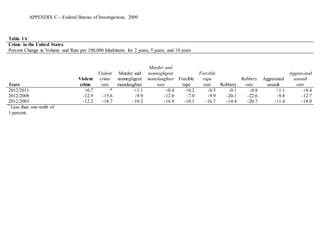
This new definition was implemented for collection of data starting January 1, 2013. Therefore,
the statistics that use this new definition have not yet been posted on the UCR for analysis. The
following data, then, still only uses the old definition. What will be interesting to see is how the
new definition will change the rate of rape in the United States. Currently, there is a debate
concerning whether or not the rate of rape is on the rise in this country. However, without the
implementation of this new definition, any crime statistics that are produced will be an
inaccurate representation. This should be kept in mind when discussing these crime statistics.
The statistics of crime in the United States are collected and published by the FBI CJIS
Division, or FBI’s Criminal Justice Information Services. This division collects data from the
UCR Summary and the NIBRS, National Incident-Based Reporting System. The Summary
collects information from law enforcement agencies in all 50 States; however some states do this
in different ways. “In all but four states, agencies are required to submit UCR data to their state
UCR Program…In Indiana, Mississippi, New Mexico, and Ohio, the individual LEA [Law
Enforcement Agencies] can submit UCR data directly to the FBI UCR Program” (FBI/UCR,
2014). The Summary will also now follow the new definition set by the UCR. However, NIBRS
is not required to do so. Currently NIBRS defines rape in three different categories:
PORNOGRAPHY AND SOCIETY 39
11A Rape (except Statutory Rape)
The carnal knowledge of a person, without the consent of the victim, including instances
where the victim is incapable of giving consent because of his/her age or because of
his/her temporary or permanent mental or physical incapacity
11B Sodomy
Oral or anal sexual intercourse with another person, without the consent of the victim,
including instances where the victim is incapable of giving consent because of his/her
age or because of his/her temporary or permanent mental or physical incapacity
11C Sexual Assault With An Object
To use an object or instrument to unlawfully penetrate, however slight, the genital or
anal opening of the body of another person, without the consent of the victim, including
instances where the victim is incapable of giving consent because of his/her age or
because of his/her temporary or permanent mental or physical in capacity
(FBI/UCR, 2014)
Therefore, the FBI UCR program will aggregate these three sex offenses when formulating the
data to put into the Crime in the United States publication.
With this new definition, it is highly probable that an increase will be seen in the rate of
rape statistics. Since these statistics have not been formulated yet, the following data are only
from those reports that fell under the old definition. With this in mind, the overview of the crime
statistics for 2012 was expressed as follows:
There were an estimated 84, 376 forcible rapes reported to law enforcement in 2012. This
estimate was 0.2 percent higher than the 2011 estimate, but 7.0 percent and 10.1 percent
PORNOGRAPHY AND SOCIETY 40
lower than the 2008 and 2003 estimates, respectively…the rate of forcible rapes in 2012
was estimated at 52.9 per 100,000 female inhabitants (FBI/UCR, 2014).
The table provided by the FBI that shows these statistical trends, as well as how it compares to
other violent crimes, can be found in Appendix C. However, incidents of rape have been
underreported for years and years because victims have been brutalized by the court system.
Many victims still fear that those issues have not been fully corrected. In addition, many of the
victims are too embarrassed or scarred to tell anyone about what had happened to them.
Therefore, in order to get an accurate idea of the rate of rape, one must conceive the numbers to
be more than what is presented. However, using this data alone, it can be seen that the
occurrence or rate of rape has not been at a constant incline or decline. For this reason, there
have been many debates on whether rape is really a crime that is on the rise. These debates on
whether rape has been increasing or decreasing overtime are centralized around the individual’s
presuppositions to the issue of rape. These premonitions lead the individual’s interpretation of
the data, as well as, the manner in which this data was collected.
It is interesting how the same set of statistics can be interpreted differently based on the
predeterminations of the individual or agency analyzing such data. Sexual Violence, edited by
Louise I. Gerdes, is a part of the Opposing Viewpoint Series by Cengage Learning publishers
(2008). The point of this book is to give two different interpretations or views on a specific issue
together in one place. At almost the beginning of the book, we are given two takes on the rise in
rape and sexual violence based on data collected by U.S. Federal agencies. The first take is a
viewpoint expressed by the National Institute of Justice (NIJ), which is one of the research
agencies in the U.S. Department of Justice. In this take, sexual violence is defined as “a specific
constellation of crimes including sexual harassment, sexual assault, and rape” (Gerdes, 2008, p.
PORNOGRAPHY AND SOCIETY 41
22). It further expresses that sexual violence can take on many different forms including a wide
range of unwanted behavior that may or may not involve actual or threatened physical force, use
of weapons, coercion, intimidation or pressure. These types of behaviors are listed as:
“Intentional touching of victim’s genitals, anus, groin, or breasts; voyeurism; exposure to
exhibitionism; undesired exposure to pornography; and public display of images that were taken
in a private context or when victim was unaware” (Gerdes, 2008, p. 22-23). The NIJ also
expresses how the definition of rape is not universal; some state legislations define it with more
accuracy than others. By this, I mean that some acknowledge rape as more than just carnal
knowledge of a female not one’s wife. Sadly, at the time of the writing of this viewpoint, the
FBI’s Uniform Crime Report (UCR) was still using this common law definition of rape that
excluded any oral or anal rape, rape with an object, rape of married women, or rape of males.
This has to be taken into consideration when analyzing the data presented about the rate of rape
or sexual violence in this country. When asked the question if rape notification rates are
increasing, the NIJ funded a study that looked for an answer. It found that “police notification
rates by third parties and by victims who had been raped by an acquaintance or intimate partner
increased significantly between 1973 and 2000” (Gerdes, 2008, p. 24). This was established
using data from the National Crime Survey (NCS) from 1973-1991 and that National Crime
Victimization Survey (NCVS) from 1992-2000.
The following excerpt in the Gerdes’ book was entitled “Rape and Sexual Violence
Appear to Be Declining” by David A. Fahrenthold. According to Fahrenthold, there seems to be
a substantial reduction in sexual violence since the 1970s. He uses the Justice Department’s
NCVS collection of data, which according to him “is the one that depicted the 85% decline in the
per-capita rape rate since 1979” (Gerdes, 2008, p. 31). In addition, he uses the FBI reports giving
PORNOGRAPHY AND SOCIETY 42
the following statistics: “…dating to the mid-1980s, show that rape reached a peak in about
1992, with 0.4 rapes reported to police per 1,000 people; since then, reported rape declined about
25% by 2004…in that year, the rate was about 0.3 reported rapes per 1,000” (Gerdes, 2008, p.
32). What needs to be taken into account with these numbers is that they reflect the number of
reported rapes. Without the proper context of these statistics, it is no surprise that someone could
infer that there seems to be a decline in rape and sexual violence.
The FBI’s UCR Program does its best to give an accurate account of the incidents of
rape, but it has its flaws. Many victims of rape do not report this crime to the police for various
reasons. To fix this, the NCVS was created. This survey attempts to get an idea of all the crimes
that go unreported. However, it is designed in a way where the head of the household answers
the questions. If you are a minor who has been raped, do you want to relay that experience
through your parent for a survey? Even if you are not a minor, would you want to relay that
experience with a total stranger for a survey? In addition, you have to look at how rape is being
defined. For both programs, the common law definition of rape was still being used. This means
that even if an incident of rape was reported to the police, if it did not fit that definition it would
not be included in the statistics published by this report. Therefore, it must be conceded that the
incident of rape in this country is higher than the numbers we are able to collect due to these
flaws or inconsistencies. Now it is time to look at the two sides of the debate.
It is already obvious that the discussion about pornography and its effects is a sensitive
subject. Aforementioned, Emily Birnbaum’s blog was quoted with a description of the industry
of pornography as it is at this current time. Her piece was about more than just this description,
however; it also attempted to show how one can be critical of the industry of pornography in a
way that can still be viewed as “sex-positive.” In other words, Birnbaum recognized the
PORNOGRAPHY AND SOCIETY 43
sensitivity of the subject of pornography and yet realized the danger in not having honest
discussion about its effects. In her own words, she explains:
…critiquing pornography is not the same thing as judging what individuals enjoy doing
with their partner(s). You can be sex-positive and still critical of the porn industry. We
need to realize this in order to have a more honest discussion of how porn affects our
sexuality and its relation to problems such as violence against women, rape culture, and
racism” (Birnbaum, 2014).
Birnbaum also covers more issues than rape in her analysis of the pornography industry. These
other issues include: its effect on the male perception of women and racism. This is what she
surmised in terms of its effect on male perception of women:
If the average boy is inundated with porn imagery from the tender age of 11, it’s not far-
fetched to suppose that he would have a confused conception of what constitutes healthy
sexual relations with women. In a country where one out of every six women is a victim
of sexual assault, these issues need to be at the forefront of our national discourse and the
feminist movement” (Birnbaum, 2014).
In conclusion, Birnbaum sums up how the industry has been ignored by different protest groups,
including feminist groups, because “it falls under the sacred umbrella of sexuality…Porn is not
our sexuality, it is our sexuality commodified” (Birnbaum, 2014). It is important that we, like
Birnbaum, take the time to really take a hard, honest look at pornography.
Once one can accept that pornography is an industry that needs an unbiased analysis, the
comparison of arguments can be truly appreciated. In the book Sexual Violence, mentioned
before, there is also a presentation of two different views on the factors of sexual violence. Both
take pornography into consideration, however, one finds it to be significant while the other does
PORNOGRAPHY AND SOCIETY 44
not. Daniel Weiss, a senior analyst for media and sexuality at Focus on the Family, wrote the
first viewpoint entitled “Pornography Is a Significant Factor in Sexual Violence.” In his analysis,
Weiss writes on how a Dr. Victor Cline describes the addictive nature of pornography. He states
that “once addicted, a person’s need for pornography escalates both in frequency and in
deviancy. The person then grows desensitized to the material, no longer getting a thrill form
what was once exciting. Finally, this escalation and desensitization drives many addicts to act out
their fantasies on others” (Stan, 2008, p. 67).
He also cites the Ottawa Rape Crisis Center’s “Sexual Violence Facts,” which gives a
description on how pornography promotes myths about women. In addition to the addictive and
humiliating nature of pornography, Weiss continues his argument by showcasing how
pornography is one of the leading causes of family breakdown. By this, he means that marriages
are destroyed because once an individual looks at life through the lens of pornography, their
perceptions about love and sex change and become clouded. Weiss finalizes his argument for
pornography being a significant factor by citing studies that found that a high percentage of
sexual offenders were hardcore pornography addicts or consumed large quantities of
pornography. “The FBI reports that the most common interest among serial killers is hardcore
pornography. Another study found that 87 percent of child molesters were regular consumers of
hardcore pornography” (Stan, 2008, p. 70). In conclusion, Weiss comments on how little
government enforcement has been established concerning pornography. While the Miller v.
California case expressed that pornography does not have First Amendment protection, precious
little has been done to enforce this rule of law.
The following excerpt, entitled “The Openness that Accompanies Pornography Reduces
Sexual Violence” by Steve Chapman, expresses the opposite opinion. Chapman begins his
PORNOGRAPHY AND SOCIETY 45
argument by citing the Washington Post, which reported that rape had diminished in frequency
by 85% since the 1970s; and the NCVS, which found the rate of rape in 1979 to be 2.8 per 1,000
people over age 11 and in 2004 to be 0.4 (Stan, 2008). Chapman believes that the increase use of
pornography is the key factor in the decline of the rate of rape. “In fact, our changing attitudes
about erotica are part of a generally more open and honest approach to matters involving sex”
(Stan, 2008, p. 75). He continues by saying that knowledge is power or that the ability for one to
view sex in this way has somehow discouraged predators and emboldens future potential victims.
However, what his argument fails to do is show how that speculation stands up to the empirical
data that show the addictive nature of pornography. How can it be preventative when the nature
of pornography is to arouse and empower individuals to act in a certain way?
Alan and Soble’s book, which was aforementioned, also gives more insight into the
debate of pornography’s effect on sexual violence, specifically pedophilia and rape. Chapter 21
of this book, entitled “Two Views of Sexual Ethics: Promiscuity, Pedophilia, and Rape,”
involves the analysis of two contrasting views of sex. This analysis was conducted by David
Benatar, who is a professor of philosophy at the University of Cape Town, South Africa. The
two views of sex that Benatar uses in his comparison are what he calls the “casual” view and the
“significance” view. He describes the casual view as: “sexual pleasure, according to this view, is
morally like any other pleasure and may be enjoyed subject only to the usual sorts of moral
constraints” (Soble & Power, 2008, p. 327). The significance view is described as: “for sex to be
morally acceptable, it must be an expression of (romantic) love…a sexual union can be
acceptable only if it reflects the reciprocal love and affection of the parties to that union” (Soble
& Power, 2008, p. 327). The author finds the two views to be too extreme on both sides.
Therefore he proposes a hybrid of the two. Benatar does make the conclusion that: “the above
PORNOGRAPHY AND SOCIETY 46
conclusions should obviously be extremely troubling to those who approve of promiscuity but
who abhor pedophilia and rape” (Soble & Power, 2008, p. 333).
The impact of pornography is also reviewed in the article by Foubert, et.al, which was
cited earlier. At one point the authors state that the “preponderance of research suggests
significant, negative impacts of pornography on men in aggregate…revealed in both correlation
and experimental studies that porn use, acceptance of aggression and violence towards women
are linked (Foubert, et.al, 2011, p. 214). Again, it is stated that “research also suggests increased
exposure is significantly correlated with behavioral aggression, trivialization of rape, greater
acceptance of rape myths, and a decrease in empathy and compassion towards victims of sexual
assault (Foubert, et.al, 2011, p. 214). The authors conducted their own research study that
surveyed men who were fraternity members at a large public university in the Midwest of the
United States. The survey used multiple scales in order to determine an accurate account of the
participants’ attitudes. These scales included: the Bystander Efficacy Scale developed by
Banyard, Plante, and Moynihan; the Bystander Willingness to Help Scale developed by Banyard,
et.al; the Illinois Rape Myth Acceptance Scale developed by Payne, et.al; and the Malamuth’s
Attraction to Sexual Aggression Scale, which was used to measure the likelihood of rape and
sexual assault. The use of these scales produced some interesting results (Foubert, et.al, 2011).
Upon completion of their study, the authors found that there was a greater behavioral
intent to commit rape or sexual assault by men who viewed mainstream porn during the last 12
months, if they could be assured of not being caught or punished, than in men who chose not to
view porn. Men who reported viewing sadomasochistic and/or rape porn had an even higher
tendency for intent to commit rape or sexual assault than those who viewed mainstream
pornography. In terms of bystander intervention, the authors found that those who saw rape porn
PORNOGRAPHY AND SOCIETY 47
reported lower level of willingness to intervene in a situation where they could help stop a
potential rape. In reference to rape myth belief, it appeared that the attitudinal variable of rape
myth acceptance is a type of attitude that has a relationship only to the types of porn where
violence is more directly inherent and not necessarily to the broader spectrum of porn (Foubert,
et.al, 2011). Other studies found some similar results.
Interestingly, a study by Neil M. Malamuth and Joseph Centiti , entitled “Repeated
Exposure to Violent and Nonviolent Pornography: Likelihood of Raping Ratings and Laboratory
Aggression Against Women,” suggested that the effects of pornography may be more of a short-
term than long-term effect. In their study, forty-two males were asked to participate in a three-
phased experiment on sexual responsiveness to both sexually violent and non-violent stimuli.
The first phase included self-reported likelihood to rape questionnaire using the Likelihood to
Rape (LR) index. This was given before and after being exposed to the sexual stimuli. In phase
two, the subjects were exposed to different types of pornography. Before the exposure, every
subject was given three written and three pictorial stories of sexual activity. Then the subjects
were randomly assigned into three different groups: sexually violent, sexually nonviolent, and
control.. Those in the sexually violent group viewed six soft-core films that contained some
scenes of sexual violence, including rape and sadomasochism. They were also given stories to
read or view in the privacy of their own home. Those in the sexually nonviolent group also saw
six soft-core films which did not depict any form of sexual violence (Malamuth & Centiti, 1986).
They were also given stories to read or view on their own. The control group was not
given any such material at all. This exposure occurred over a 4-week period. Two to three days
after the final exposure session, the subjects were brought back to assess sexual arousal to similar
stories that were shown. In the final phase, the subjects were made to believe that they were to
PORNOGRAPHY AND SOCIETY 48
participate in a different study from the sexual responsive study. Subjects were given the choice
to participate or not, since it was a “different” study. In this phase, the goal was to assess the
subjects’ aggression tendencies after being exposed to pornography. The subjects were then
assigned to work with a female confederate, who was working for the researchers. The subject
and confederate were asked to fill out questionnaires about their views on different subjects
varying from politics to other social issues. Each would be given the others responses and were
told to write an evaluation of the other person. The female would disagree with everything the
male subject would say and would basically insult him. Then they would both be brought to
separate rooms where the female would be asked questions by the male. If she answered
incorrect, the male had the choice to “punish” her. This punishment was an averse noise that the
male had a range to choose from so no actual harm was committed (Malamuth & Centiti, 1986).
Finally, the researchers took everyone who participated in any of the three phases of the
study and conducted a debriefing session where subjects were allowed to ask questions and voice
any concerns in an effort to counteract any undesirable effects of the exposure to pornography
and other aspects of the study. The researchers collected some interesting data:
With respect to likelihood of raping reports, the data on the whole suggest some
relationship with aggressive behavior…with respect to exposure effects, the results did
not reveal that repeated exposure to violent or nonviolent pornography had any
significant effect on laboratory aggression against women
(Malamuth & Ceniti, 1986, p. 6).
However, the researchers stated that this finding was inconsistent with previous research.
Therefore, they surmised that it is possible “that exposure to violent pornography might have an
PORNOGRAPHY AND SOCIETY 49
immediate impact on aggressive behavior against women but this effect may dissipate quickly
over time” (Malamuth & Ceniti, 1986, p.6).
The authors then cited the work of Berkowitz (1981) who suggests that “retrieval cues”
may reactive the message expressed through the pornography previously viewed. If you use this
argument, as the authors suggest, then the impact of violent pornography involve two processes:
First, exposure to messages in violent pornography suggesting that aggression against
women has positive consequences is justified or is erotic, may implant and/or strengthen
these ideas in the audience as well as stimulate certain arousal processes that might
“energize” aggressive responses. Second, behavioral tendencies to aggress may be
increased only if effects are measured immediately following exposure or if retrieval cues
reactive violent pornography’s messages when a later opportunity to aggress exists
(Malamuth & Ceniti, 1986, p. 6).
This is a very interesting theory that may explain the results found in the study. There are a few
things to keep in mind, one of which is that there was no assessment of aggression levels before
exposure besides intent to rape. Without this, there is no way to get an accurate assessment of
how aggression could be impacted by the exposure to pornography. Another thing to keep in
mind is that during the time this study was conducted pornography has grossly evolved. As
previously mentioned, the industry of pornography has become less and less focused on the
actual acts performed and more on coming out with the next big shocker. In this case, that means
how violent and degrading the scenes can be. The next study was conducted more recently and
has a different result that may support this assessment (Malamuth & Centi, 1986).
Dong-ouk Yang and Gayhun Youn wrote an article entitled “Effects of Exposure to
Pornography on Male Aggressive Behavioral Tendencies” (2012). This study’s aim was to
PORNOGRAPHY AND SOCIETY 50
confirm that exposure to porn can influence lab aggressive behavior through three main
objectives: Confirm, via a dart throwing task, that exposure to porn facilitates male aggressive
behavior; examined whether this facilitative effect on aggression differed according to the
content of the porn materials; and determine whether male participants more frequently chose
female than male face pictures as targets of aggression after exposure to violent porn (Yang
&Youn, 2012). What these researchers found was that aggressive tendencies were in fact
increased after exposure to pornography. “Specifically, pornography depicting violent sexual
interaction (i.e., the SM and V conditions) revealed a higher frequency of [aggressive tendencies]
than nonviolent pornography” (Yang & Youn, 2012, p. 7). They also found that even exposure
to non-violent pornography produced an impact:
In contrast, nonviolent pornography should not increase aggression, because there is no
aggression to be learned. However, in the present study, participant exposure to
nonviolent pornography also increased dart throwing at human faces, which is correlated
with aggressive tendencies, though at a lower level than violent pornography did (Yang
& Youn, 2012, p. 8).
Apart from violence toward women, there are other ways in which pornography has a negative
impact. Examples, such as male-on-male rape or health safety concerns, are discussed below.
Male-on-male rape is even more sensitive than the topic of pornography in many cases. It
is a crime that has not been really accounted for or evaluated for various reasons. Christopher N.
Kendall, in his study entitled “Gay Male Pornography and Sexual Violence: A Sex Equality
Perspective on Gay Male Rape and Partner Abuse” (2004), attempts to show some of the reasons
for this lack of investigation. One of his main arguments is that pornography, even gay
pornography, shows a status that is given to each of the partners. A role, if you will, that each
PORNOGRAPHY AND SOCIETY 51
individual is given based on their characteristics. Those who are considered dominant are the
males, while females are considered to be subservient. In gay porn, you still see this distinction.
The dominant partner is portrayed as the more masculine while the subservient is portrayed as
feminine. Therefore, even in the gay community, pornography has established a system of roles
where the strong exploit the weak. This exploitation is just as violent and dehumanizing as the
heterosexual forms of pornography. The message in gay pornography is the same as it is in
mainstream, heterosexual pornography: that one is meant to dominant and humiliate the other.
As Kendall argues “Insofar as sex equality is concerned, the result is the promotion and
maintenance of those gendered power inequalities that reject a non-assimilated gay male
sexuality and that ensure that homophobia and sexism remain intact” (Kendall, 2004, p. 902).
Therefore, males who are raped by other males may fear that they are going to be viewed as
weak or subservient, which then leads to their not reporting of the crime.
Another aspect of pornography that many ignore is the health risks involved. Those who
are involved in making these images, videos, etc., whether voluntarily or not, are at a very high
risk for many different health issues. In Dines’ aforementioned book, she cites the following list
of health concerns as expressed by the Adult Industry Medical Health Care Foundation: “HIV;
rectal gonorrhea; tears in the throat, vagina, and anus; chlamydia of the eye; and gonorrhea of the
throat” (Dines, 2010, p. xxviii). In pornographic images and scenes, the importance of protection
against such health issues is not portrayed. You don’t see the male putting on a condom before
performing whatever act that will occur in the scene; nor, do you see a “partner” to be concerned
with the physical harm that could be, or already is being, inflicted on the other. Therefore, the
message shown to the viewers is that those concerns are not important. Obviously this constitutes
a health safety issue that should be a big concern for our country.
PORNOGRAPHY AND SOCIETY 52
Regardless of all this harm, the industry of pornography is endorsed in our capitalistic
nation. The only aspect of pornography that is considered criminal involves the crimes of
prostitution and the making and possession of child pornography. There are certain reasons as to
why this is the case; however, considering all the damage pornography has caused, and has the
potential to cause, it is surprising that the industry of pornography is not on the government’s
radar. Why would this be? Sadly, the most likely reason for this is the fact that pornography is a
huge money maker in this country. As mentioned before, those who create pornography are not
the only ones who cash-in on this industry. Therefore, it is highly likely that many people do not
want pornography to come under criminal scrutiny in order to keep lining their pockets. It is also
possible that the fear of being “anti-sex” is another reason for turning a blind eye. Regardless of
what the reasons may be, the question is whether they cancel out the government’s goal to
protect the citizens of this country and I believe they do not.
Based on the studies cited above, it is clear that pornography does have an effect on our
culture and society. Pornography has become an industry that focuses on making money at the
expense of human lives. It gives no regard to the safety and well-being of those who are involved
in the making of the images, scenes, etc. In addition, it refuses to hold any responsibility in how
it might impact the viewers of this material. Instead, it claims to be a business that gives the
consumers what they want and make a profit on doing so. It is a scary thought to think that a
legitimate business can now be classified as one that ignores the basic rights of human beings.
However, beyond the industry of pornography, it is evident that pornography also has a
significant impact in how individuals view sex and the roles of its participants. This impact,
however, has been overly negative. Because pornography has become such a large consumer-
based industry, it looks for ways to keep people coming. In other words, it must get creative.
PORNOGRAPHY AND SOCIETY 53
Sadly, this creativity has resulted in the increase in sexual violence being portrayed in the
everyday “mainstream” pornography. Now imagine a young boy or girl viewing such material.
Most likely, these young people have very little knowledge on what sex is and how it is supposed
to work. What pornography does is it sends a message that says sex is meant to be a game of
domination. The man is supposed to do whatever he wishes to the woman and the woman is
supposed to not only accept it but enjoy it. In addition, it shows that sex is meant to be rough and
painful. There are no sweet caresses or concerns with fulfilling the other partner’s needs and
desires. Instead, it is meant to be a selfish act where the more powerful gets whatever they wish
out of it. Is this really a message we want to relay to our young people? Is it really that
impossible to believe that such images won’t desensitize sexual violence, which would then
result in an increase in said violence?
There are those who believe that pornography is doing a world of good for giving sexual
“knowledge” to the world. However, what those with this belief fail to realize is that
pornography is not providing individuals with knowledge of sex. Rather it is embodying sexual
inequality and portraying it as something normal and right. In a day and age where men and
women are supposed to be considered equal, it’s a very stark contradiction. In addition, those
who believe that pornography is providing more good than harm ignore the fact that pornography
is addicting. In pornography, it is very hard to just watch it a few times and be satisfied. The
sensations that occur when viewing such material become addictive. You want to keep feeling
that sensation over and over again. Why is that?
It has a lot to do with the fact that is not completely satisfying. Our human nature is
designed in a way where we crave to have sexual interactions with others. Call it what you will,
but everyone has these same cravings. Therefore, there comes a time where watching just won’t
PORNOGRAPHY AND SOCIETY 54
be enough. You will want to do it. If this is the case, then watching images of rape and/or
sadomasochistic sex acts will then spur one to wish to actually participate in such activities.
Look at the evidence: the favorite past-time that sex offenders have in common is watching
pornography. Doesn’t that tell you something about the compulsive nature of pornography?
Therefore, it is reasonable to conclude that the increase of consumption of such material will
result in the increase of incidents of such acts.
Sadly, the harm of pornography is ignored because of the money produced by the
industry. It is truly appalling to see that money is valued so much more than the safety and well-
being of humans. This statement can be made because it is the only reasonable conclusion as to
why pornography is not regulated by the government. In fact, it has been allowed to become so
powerful that many now are afraid to speak up against it. What is truly frightening about this
predicament is how much harm has already occurred due to pornography and its effect on
individuals, participants, and viewers alike. It will only be a matter of time before it truly gets out
of hand, and it is horrifying to contemplate what will be the final turning point for legislatures to
put their foot down on this commodity. The other alternative is even more terrifying: imagine a
world where pornography is allowed to continue to grow as it is now—A society where the
exploitation of individuals is not only allowed but validated; where sexual inequality has become
a social norm; where sexual violence has become desensitized. Is this truly the future we wish
for generations to come? Is this the type of society we wish to create for our children? I, for one,
hope it is not and that others will side with me in taking the time to give pornography an honest
look and see it for what is truly is: an instrumentation of destruction. So if a conclusion can be
drawn that pornography is something that needs to be addressed, what will this mean for law
PORNOGRAPHY AND SOCIETY 55
enforcement? The following explores the challenges law enforcement face concerning
cybercrimes, with a focus on pornography cases.
Challenges to Law Enforcement
Crimes committed with the use of technology are known in law enforcement as
cybercrime. Many large agencies have decided to create specific units who focus on this type of
crime. Advances in technology have been both helpful and detrimental to law enforcement. On
the positive side, it has given law enforcement new tools that provide more precise data in a very
efficient way. These tools are very effective in the investigative process. However, law
enforcement is not the only ones who have access to this new technology. Those who participate
in criminal activity also are able to use certain technologies to advance their criminal operations.
Cybercrime has also been broken down into two different categories: crimes where technology
itself is attacked and crimes where technology is used to commit the crime. Not all crimes that
fall under cybercrime were created by technology, in this case the Internet. In fact there are some
crimes that can be considered cybercrimes now that were already criminal before the invention
of the Internet. One such example is child pornography (Curtis, 2000).
Child pornography is not a new crime but advances in technology allow those who
engage in this crime to have new ways of doing it. For example, the Internet provides almost
complete anonymity since individuals can create private websites where images can be shared
without having to give any real information about themselves. This also gives pedophiles a place
to find others who feel as they do and create a sense of comradery and normalcy. This is
something anyone can take advantage of, not only those who have IT skills. Interestingly, law
enforcement agencies are also finding that those with strong IT skills are now selling their
programs that are designed to protect data on one’s files and limit who has access. There are also
PORNOGRAPHY AND SOCIETY 56
all sorts of how-to guides that anyone can find online that can be used to learn how to do things
like set up firewalls, create websites, etc. These advances in technology make it easier for those
who create and possess child pornography to distribute the images, especially in comparison to
how it was done before the Internet (Curtis, 2000).
Before the Internet, those who created and possessed child pornography circulated the
images through books and magazines. At one point, there was even a call service where one
could listen to a detailed description of a minor engaging in sex with an adult. Now with the
creation of the Internet, these individuals can anonymously share photos and stories online to
virtually anyone in the world. Chatrooms and websites can be created where these individuals
can talk about their deviant sexual desires and find acceptance in this group. Other advances in
technology also allow these individuals to use software programs that can protect their
computers and the images they are hiding (Marcum, 2014). This section will look more deeply
into the world of cybercrime that the Internet has created with a focus on child pornography and
how this crime has evolved with advances in technology. In addition, it will focus on the various
dilemmas this new fighting ground has created for law enforcement and how law enforcement is
currently responding. Finally, it will attempt to provide some suggestions on what law
enforcement could do. This will include suggestions for a potential policy that can be
implemented by law enforcement administrators.
Technology and the Internet are great inventions that have helped improve societal
functions, including those of law enforcement. However, they have also opened the doorway to
new types of crimes that can be committed. This area of crime is known as cybercrime.
“Cybercrime can be broadly defined as ‘the destruction, theft, or unauthorized or illegal use,
modification, or copying of information, programs, services, equipment, or communication
PORNOGRAPHY AND SOCIETY 57
networks” (Marcum, 2014, p. 3). It can also include any form of criminal activity that utilizes
technology. Because cybercrimes are based on technology, this area of crime has evolved
inherently with technology. Based on this evolution: it has been said that cybercrime has
undergone three generations of change: 1) illegal exploitation of mainframe computers and their
operating systems, this includes activities such as changing or deleting corporate information,
financial data, etc.; 2) utilizing networks, this includes hacking and cracking; and 3) the nature of
distribution, which includes spam and viruses (Marcum, 2014, p. 3). These changes largely focus
on crimes that came about with the creation of the Internet. Child pornography is not this type of
crime but it has been affected by this evolution of cybercrimes.
Child pornography is made and distributed in various ways, which has caused the law to
have to be explicit in what it calls child pornography and the various crimes associated with it. In
federal law, child pornography is defined under 18 U.S.C §§2256(1) and (8) as the visual
depiction of a person under the age of 18 engaged in sexually explicit conduct (Jasper, 2009, p.
48). This definition does not mean that only images of actual sex are considered child
pornography; in fact, any image of a child that is sexually suggestive is considered pornography
based on how the law defines sexually explicit conduct. The federal statute cited above includes
the following when describing sexually explicit: “sexual acts such as intercourse, bestiality and
masturbation as well as ‘lascivious exhibition of the genitals or pubic area.’ The U.S. Supreme
Court has defined ‘lascivious exhibition’ broadly to include images of minors that focus on the
genitals of children even when wearing clothing” (Wolak, Finkelhor, et.al, 2011, p. 85). The U.S.
Code, Chapter 110, for example, describes the act of producing child pornography as:
Advertises, promotes, presents, distributes, or solicits through the mails or using any
means or facility of interstate or foreign commerce or in or affecting interstate or foreign
PORNOGRAPHY AND SOCIETY 58
commerce by any means, including by computer, any material or purported material in a
manner that reflects the belief, or that is intended to cause another to believe, that the
material or purported material is, or contains—(i) an obscene visual depiction of a minor
engaging in sexually explicit conduct; or (ii) a visual depiction of an actual minor
engaging in sexually explicit conduct (Marcum, 2014, p. 26-27).
State legislations follow this same pattern when defining and creating child pornography laws. In
Rhode Island, the statute for child pornography prohibition, RIGL § 11-35-17 states:
It is a violation of this section for any person to: (1) Knowingly produce any child
pornography; (2) knowingly mail, transport, deliver or transfer by any means, including
by computer, any child pornography; (3) Knowingly reproduce any child pornography by
any means, including the computer; or (4) Knowingly possess any book, magazine,
periodical, film, videotape, computer disk, computer file or any other material that
contains an image of child pornography…For purposes of this section: (1) “Child
pornography” means any visual depiction, including any photograph, film, video, picture,
or computer or computer-generated image or picture, whether made or produced by
electronic, mechanical, or other means, of sexually explicit conduct (The State of RI).
It goes on to say explain sexually explicit conduct in a similar manner as the US federal code
cited above. These laws attempt to prevent and stop the abuse of children; however, the industry
of child pornography has grown to the point where the law and law enforcement is really behind.
Dilemmas that occur when law enforcement is trying to investigate cases of child
pornography can include many issues, ranging from the need for physical computers at law
enforcement agencies to having to identify whether an image actually constitutes child
pornography based on the specific statute. A study conducted in 2007 by Melissa Wells, David
PORNOGRAPHY AND SOCIETY 59
Finkelhor, Janis Wolak, and Kimberly Mitchell, entitled “Defining Child Pornography: Law
Enforcement Dilemmas in Investigations of Internet Child Pornography Possession,” outlined
some of these dilemmas. To begin, the study pointed out that due to the nature of the Internet
cases involving child pornography will span across multiple law enforcement jurisdictions from
all over the world. This calls for global cooperation, which can be difficult at times. As
mentioned before, the need for computers is very important for any law enforcement agency to
combat child pornography now. However it is not just the physical computer that is needed. The
systems on these computers need to constantly be upgraded in order to keep up with the systems
being used by those producing and distributing child pornography. In addition, personnel are
needed to work online to perform tasks such as undercover operations. Not everyone in these
units will know how to use this technology; therefore, additional training is also needed. In some
cases, the data on the computers of suspects has been deleted. This is when the law enforcement
agency must rely on computer forensic experts who can locate such files. On top of all of these
dilemmas, there is one that the study really focuses on as the number one issue when
investigating child pornography: identifying whether an image constitutes child pornography. On
the surface, this sounds like an easy task but in practice it is not (Wells, et.al, 2007).
Identifying images as child pornography sounds like an easy task. However, there are
some cases where this is very difficult due to the nature of the image and how child pornography
is defined in the statute. The study stated that there are:
Divergent views regarding what constitutes child pornography. First, there may not be
consensus regarding what type of images are graphic or explicit enough to fit existing
definitions of child pornography. Second, it appears that images that depict prepubescent
PORNOGRAPHY AND SOCIETY 60
children are more likely to be considered child pornography than are those portraying
older juveniles (Wells, et.al, 2007, p. 276).
The discussion of whether an image is graphic or explicit enough usually deal with images of
nude children. There are some parents who have pictures of their children nude but it is not for
any sexual arousal. In addition, there are some who believe that images of nude children can be
seen as artistic. Therefore not all images of nude children are considered child pornography.
However, there has been a general agreement that if the image of nude children are sexually
suggestive or have a specific focus on genitals and the like, then the image will be considered
pornographic. Age is the second part of the dilemma (Wells, et.al, 2007).
Many statutes specifically outline an age range for child pornography but this range
varies from statute to statute. Some will define a child as anyone under the age of 18 while others
define a child as someone under 16. Therefore, identifying the age of the minor in the image
becomes important when it is time to go to court. There have been many cases, especially with
older juveniles as mentioned above, where the prosecutor determines that there is not enough
evidence to prove the age of the minor in the photo and so the case is dropped. In order to help
combat the dilemma of age as well as to follow the Supreme Court’s ruling, the FBI has
developed the 2257 Age Verification Program. This program “is responsible for conducting
inspections at pornography producers’ places of business to ensure their compliance with 18
USC §2257 and Title 28, Code of Federal Regulations Section 75” (2257 Program, 2010). These
laws prohibit pornography producers to use individuals who are under the age of 18. In other
words, it forbids the production of child pornography. It is now time to look at how law
enforcement is currently responding to these dilemmas.
PORNOGRAPHY AND SOCIETY 61
In order to combat child pornography, law enforcement has come up with a few tactical
ways of responding based on the resources available to that particular agency. Federal law
enforcement agencies have created specialized units whose sole focus is Internet sex crimes. In
addition, some federal level departments have funded task forces, such as the Internet Crimes
Against Children Task Force funded by the US Department of Justice, who specialize in this type
of investigation techniques. These specialized units and task forces are initiated and operated by
law enforcement. However, there are times when law enforcement needs help from outside
sources. This is where organizations such as the National Center for Prosecution of Child Abuse
come into play. This particular organization works with law enforcement to help with training of
officers on the different procedures and methods needed to do online investigations (Sher, 2007).
Another example of a similar organization is the National Center for Missing and
Exploited Children, who have a CyberTipline. The CyberTipline was set up in March of 1998 so
as to “allow the public, police and Internet companies to report images of child abuse” (Sher,
2007, p. 76). The tipline was developed as a response for law enforcement due to the Supreme
Court’s ruling in 1997 concerning the Child Pornography Prevention Act that was passed by
Congress in the previous year. The ruling was that the law was unconstitutional since it allowed
for computerized images of children to be considered pornographic instead of only images of
actual children. As a result, law enforcement was forced to prove that the images were of actual
children and not animation created by a software program. The CyberTipline was a response to
this ruling which also allowed law enforcement to begin creating a child victim identification
system. Images found from investigations would be sent to NCMEC in order to be analyzed
against other photos in the identification system. “This created a self-feeding cycle: the more
pictures sent in for analysis to comply with the Supreme Court ruling to prove some of the
PORNOGRAPHY AND SOCIETY 62
images matched a “real” child that had been rescued, the more NCMEC’s database of potentially
identifiable children grew” (Sher, 2007, p. 77). NCMEC also heavily involved in research of
child sex crimes both Internet and non-Internet related. If we look back at the 2003 study by
Wolak, et.al, this is the break down that we find:
Overall, 55% of arrests were initiated by reports from non-law-enforcement sources such
as parents of victims and individuals who discovered child pornography. The other 45%
resulted directly from law-enforcement activity such as undercover operations;
monitoring of chatrooms and web sites; and, in some cases, non-Internet-related, law-
enforcement activities like drug investigations (Wolak, Mitchell, et. al, 2003, p. 25-26).
This study reinforces the idea that cases of child pornography relies on the public’s willingness
to report findings of child pornography as well as aggressive law enforcement tactics.
It is clear that law enforcement is restricted in this fight against child pornography and
other cybercrimes. The law has deemed the Internet an area where governmental interference is
preferred to be at a minimum. This is apparent in the 1997 case, Reno v. American Civil Liberties
Union. In the previous year, Congress had passed the Communications Decency Act (CDA),
which criminalized minors from viewing or accessing “obscene” or “indecent” material. It was
determined by the court that “governmental regulation of the [Internet] is more likely to interfere
with the free exchange of ideas that to encourage it. The interest in encouraging freedom of
expression in a democratic society outweighs any theoretical but unproven benefit of censorship”
(Harrison & Gilbert, 2000, p. v). As a result, law enforcement cannot attack the problem of
cybercrimes like child pornography by restricting access to such material. Instead it has to find
those who showcase actual abuse of children in order to combat this ever-widening deviant
PORNOGRAPHY AND SOCIETY 63
activity. Some suggestions that I wish to present or re-iterate include: global cooperation and
investing in computer training in local departments.
As mentioned above, the Internet has allowed crimes like child pornography to extend to
a global standing due to the versatility of the technology. If law enforcement agencies can
swallow their pride and develop relationships with other agencies both locally and
internationally, then investigations concerning these types of crimes can be more efficiently
conducted with a higher rate of success. Finally, training in computer technology and software is
essential. It is clear that technology is only going to keep progressing and law enforcement needs
to keep up with it. Otherwise, they will constantly by trying to catch up with those criminal
individuals and enterprises who are investing the time to learn and adapt to modern changes. I
understand that it is a huge investment of time and money to get local departments this type of
specialized training. However, due to the progressive nature of technology, these departments
will eventually have to invest in this type of training and specialization. It is better in the long
run to put in the investment now than wait for when a situation occurs where this training would
have been effective but was not present and something really bad happens, Administrators in
police agencies need to think proactively and take consider all these issues when trying to
establish a policy or unit to deal with this advancing criminal activity. The following is a review
of policies and programs already in place to combat child pornography.
Before looking at what some agencies are doing within the United States, let’s take a look
at an international report from our neighbors to the north who also are learning how to deal with
these new challenges. The Royal Canadian Mounty Police (RCMP) published its first report
concerning cybercrime on December 16, 2014. In its report it describes what constitutes
cybercrime, the different types, challenges with cybercrime, etc. In the section entitled online
PORNOGRAPHY AND SOCIETY 64
child sexual exploitation, one of the challenges they face is that: “In cyberspace, criminals hide
their true identities through pseudonyms and share child sexual exploitation material through
private websites and online bulletin boards” (RCMP, 2014, p.12). It then cited one of their cases
to illustrate this point. This case was entitled Operation Snapshot and basically what had
happened was the RCMP teamed up with other agencies to identify offenders who were sharing
images in peer-to-peer file sharing networks. The results of the operation are as follows:
…involved the seizure of over 100 computers and hard drives that required digital
forensic analysis, along with hundreds of thousands of child sexual exploitation
images…[and] led to the rescue of one child and the arrest of more than 15 individuals in
connection with various sexually-based offenses (RCMP, 2014, p.12).
This operation was repeated in 2013 which also had similar results.
In addition, this report identified upcoming threats, two of which are of interest to this
paper: darknets and cybercrime as a service. “Darknets are online file sharing networks that
provide users with anonymity through encryption and other cyber security technologies”
(RCMP, 2014, p. 13). This is an easy way for individuals to share their images and feel “safe”
about it. Cybercrime as a service is related to comments earlier about individuals selling their IT
protection programs. Basically, there are individuals who are willing to provide the tools and or
manage others online profiles, websites, etc. for a profit. This is a threat to law enforcement
because it changes the profile of the type of people who would commit these crimes. The reports
end with the following conclusions: technology creates new opportunities for criminals;
cybercrime is expanding; and cybercrime requires new ways of policing (RCMP, 2014, p. 14).
The report does not go into detail about how to address these conclusions; but, does say that
cooperation with other agencies, domestically and internationally, as well as public and private
PORNOGRAPHY AND SOCIETY 65
organizations will be important, along with technical training. Now let’s take a look at a report
concerning these issues from an agency within the United States (RCMP, 2014).
In 2000, the Arkansas State Police published a similar report entitled Cyber Crime: The
New Challenge An Overview of the Challenges Faced by Law Enforcement While Investigating
Computer Crimes in the Year 2000 and Beyond. The main challenge this report gave was having
the funds to acquire up-to-date equipment. “Computer technology changes are so rapid that if a
department is up to date today, their equipment will probably be outdated in six months…Their
budgets have not been increased to keep pace with the rapid change in technology. This makes it
difficult for law enforcement to keep up with this rapid change” (Curtis, 2000, p.4). In terms of
child pornography, the author identifies the following problems: jurisdiction and resources. It is
very difficult to locate the perpetrator in the first place but once located, you may find that the
victim(s) are in separate areas. The question now becomes where did the crime occur and who
has jurisdiction to investigate and prosecute. In terms of resources, one case may involve
multiple districts, undercover work, and computer forensic analysis. That is a lot of personnel
and time that must be paid for, not to mention equipment (Curtis, 2000).
The author, Sergeant Paul Curtis, strongly believes that the formation of a Cybercrime
Unit is the best way to overcome some of the challenges associated with this type of work.
However, it is very costly. Dave Johnston, author of an article entitled Cyber Crime Units-An
Expensive Proposition, was cited saying: “creating a cyber crime unit or a technological crime
unit will require a large initial investment…this unit will also require on-going operation cash
flow to ensure that training and equipment are maintained to acceptable standards” (Curtis, 2000,
p.21). Sergeant Curtis also believes that officers need to be willing to learn and accept
technology in order to advance. This means training will be required. An interesting tactic the
PORNOGRAPHY AND SOCIETY 66
Sergeant also describes is looking for recruits who have computer skills or at least a background
in information technologies. He also encourages communication between agencies, just like the
Canadian report. However, he includes the need for agencies to share what techniques are or are
not working for them so that others can learn with them on how best to deal with the situation.
Interestingly, law enforcement agencies are not the only ones who are invested in finding ways
to deal with the crime of cybercrimes, including child pornography. Some of these other
organizations and companies actual come as quite a shock (Curtis, 2000).
A great example of this is the recent involvement of a private technology development
company: Microsoft. Microsoft has recently developed a new technology called PhotoDNA that
they have donated to help law enforcement with child pornography cases. PhotoDNA is an
“image-matching technology;” basically it “creates a unique signature for a digital image,
something like a fingerprint, which can be compared with the signatures of other images to find
copies of that image” (Harmon, 2012). The goal of this technology for law enforcement is to help
find and eliminate images and track down images created by the same individual and/or of the
same victim. Microsoft and NetClean, another private technology company, have worked
together to make this technology accessible to law enforcement for free. This is done by
integrating PhotaDNA into programs already used by law enforcement agencies, such as
NetClean Analyze and the Child Exploitation Tracking System (CETS), and by offering direct
licensing (Harmon, 2012). According to the Associate General Counsel of Microsoft’s Digital
Crimes Units, Bill Harmon, Microsoft believes we should all be involved in this fight to protect
our children: “While the responsibility for finding and arresting the criminal who exploit and
abuse children rests with law enforcement, all parts of society, including the private sector and
companies like Microsoft, have an obligation to work together to help protect children and
PORNOGRAPHY AND SOCIETY 67
eliminate child pornography” (Harmon, 2012). Law enforcement is expected to do more with
less, therefore, it only makes sense that others step up and help with the fight to protect our
children. So with this information in hand, the following is a proposed outline of how a police
administrator can attempt to overcome a majority of the above challenges (Harmon, 2012).
To begin, a separate cybercrime unit needs to be created. This way there are individuals
who are able to focus solely on dealing with these types of crimes. It could also take away some
of the issues surrounding jurisdiction, especially if the unit consists of individuals from various
districts. If done in this way, the cost for personnel is shared among agencies since you pay for
only your people who are in the unit. Within this unit, there should be individuals who focus
specifically on child pornography cases. These individuals would need to be set up with the best,
up-to-date technology and have open lines of communications with other units within the agency
as well as other agencies, both domestically and internationally. They should also be in contact
with outside groups such as the National Center for Missing and Exploited Children and
international groups such as the Virtual Global Taskforce. In terms of gaining more access to
new technology, they should also have a good relationship with technology developing
companies. This way they can learn what’s the new thing or even a glimpse at up-and-coming
technology to get a head-start, depending upon the working relationship the unit or agency has
with that particular company. These individuals who are members of this unit should have
previous experience and knowledge with information technology systems so they come into the
unit hitting the ground running. As technology advances, additional training will be needed for
those already in the unit. Now the question is, where is the money going to come from?
The federal government has been giving out more money to help agencies with
cybercrimes. However, it is not nearly enough. There are ways to help cut costs, such as by
PORNOGRAPHY AND SOCIETY 68
hiring individuals who already have training and experience in the technology in order to get rid
of the cost of some training. In addition, currently many agencies use seized computers, hard-
drives, etc. to help with equipment costs. Another potential option is getting the equipment from
the private companies the agency now has a relationship with. This could be free donations, like
what happened with PhotoDNA, or discount prices for law enforcement. I do want to make a
comment here that this is not to be thought of as the same as getting gratuities where the
company is now expecting to be given favors in return. This is simply a way to share resources
in order to achieve a common goal: to stop illegal activities that occur with the use of technology
that are targeting not only citizens in the present but future generations to come.
In conclusion, it is clear that there is a lot of work to be done if law enforcement even
wants to entertain the idea of catching up with criminals who attack technology or use it as a way
to commit crimes. As an administrator for any police agency, there is a lot that you need to
consider when planning out how to deal with the various issues and concerns that affect your
department. Therefore it is imperative that administrators take the time to find out what is
happening in their agency now and what improvements can be made. Ideas on how to improve
might come from other agencies that are also up against these challenges. Learning from each
other is vital if you want to be effective. The above outline isn’t directed at any specific type of
police agency. Big or small, everyone knows that something has to be done but not necessarily in
the same way. Take what makes the most sense to you and implement those specific actions. For
example, smaller agencies might really want to consider the idea of a joint-unit or task force
where multiple agencies have individuals participating. It may help minimize the resource
problems. Larger agencies might be able to have a unit all to themselves, which is perfectly fine;
but, that unit will still have to work in collaboration with others or nothing productive will get
PORNOGRAPHY AND SOCIETY 69
done. It is obvious that a lot of cooperation and sharing of resources will be needed in order to
effectively fight against cybercrimes like child pornography. This means getting over egos and
learning implement unorthodox methods in order to work together. Without this type of
collaboration, law enforcement will never be able to catch up with these types of crimes, never
mind attempt to make a significant impact. This paper presents a lot of information concerning
both child and adult pornography and how it impacts so many aspects of our lives. The following
is a summation of the above along with personal conclusions drawn from said information.
Conclusion
The information presented above is quite extensive, but so is the issue of pornography in
our society. There are many types of pornography that have been created based on the various
interests of different people throughout the world. These types can be generalized into two
groups based on the individuals involved in the images, videos, stories, etc. The two groups are
adult and child pornography. Within these groups are sub-types of pornography that deal with
the types of actions performed. This ranges from abuse to sadomasochism to rape. Interestingly,
the content of pornography has become increasingly violent and crude due to the growing
industry that surrounds its publication and distribution. People are basically becoming bored with
what producers of pornography have come out with in the past and are looking for the new thing
that will entice them. Those who create pornography admit this demand and do their best to
fulfill it because, at the end of the day, it is a business for them. To these individuals producing
pornography is a way to make good money, even if it means exploiting others to do so. This
complex dynamic of the industry of pornography has caused great concern with many members
of society especially in the criminal justice world. However, there is not always a lot of
consensus among the various parts of the system on what to do about it.
PORNOGRAPHY AND SOCIETY 70
From a legal standpoint, legislatures appear to be limited in terms of regulating the
production, possession and distribution of child and adult pornography. First Amendment rights
and advocates for such liberties play a huge role in stopping the government from fully
regulating such things. For instance, child pornography is something that almost everyone agrees
must be criminalized since we do not want to harm children who have no ability to consent to
participating in such activities. However, advances in technology have created some new
challenges. There are now ways to create computer-generated pornography, also known as
virtual pornography, wherein actual children may not be harmed in the making of the images,
videos, etc. Due to this, there are many who believe that these materials should not be regulated
since there is no harm being committed to an actual child. Currently, the law follows this belief
with limited exceptions. Adult pornography faces a different set of challenges in the law.
First Amendment rights permit materials to be published and shared even if they are not
desirable to everyone. However, it has always been a fact that certain things are not protected by
the First Amendment due to its harmful effects on society. Obscenity is one such issue that is not
protected by the First Amendment and is the only regulation used against adult pornography.
Unless the pornography created falls under the definition of obscene, there is nothing currently in
the law that can stop its production and distribution. In addition, the underlying assumption is
that those participating in the creation of adult pornography are doing so voluntarily. Since they
are adults, they have the ability to consent to performing such actions, which then makes the
activity legal. However, there are some significant errors in this line of reasoning.
First and foremost, the law was created in order to protect citizens in three areas: harm
caused by others, harm caused by self, and moral sins (Pollock, 2013, p. 7). As described above,
the production of pornography is harmful to those who participate in it, regardless if it is
PORNOGRAPHY AND SOCIETY 71
consensual or not. There is obvious physical harm that is inflicted on these individuals as well as
potential emotional and physical harm. This harm is caused by others and can be considered as
harm to self, if it is to be believed that the inflicted pain and suffering is consensual. In addition,
is it not too far-fetched for pornography to be considered a moral sin? Granted, we live in a day
and age where society is becoming more and more accepting of activities and behaviors that
were once intolerable in terms of morality. However, does this tolerance extend to the
exploitation of human beings? Because that is exactly what pornography is when you really take
a good, hard look at it. If not, then should it not be seen as a moral sin that citizens should be
protected from? And if so, then doesn’t the government have a responsibility to regulate such
materials? This above argument addresses only pornography that is created with the use of real-
life actors and considers only the harm that is imposed on them in the creation of the material.
The legal standpoint on regulating pornography in terms of possession and the creation of virtual
pornography must be addressed separately since it posits a different assumption as its foundation.
The above considers the actual harm that is inflicted on individuals during the creation of
pornography. However, is there also potential future harm that puts individuals in danger of
being victimized as a result of pornography? This is the question posed in terms of virtual
pornography and possession of pornography in general. In virtual pornography there is no harm
being committed in its creation; therefore, in order for it to be regulated by law, there needs to be
evidence of a link between viewing such images and actually committing a sexual offense. As
aforementioned, this debate has been long yet unresolved. Unfortunately not enough research has
been conducted on the subject to really determine whether there is a significant relationship
between the two activities. The problem with such research is that behavior in general is complex
and it relies on more than just one variable. Therefore, it is immature to suggest that this one
PORNOGRAPHY AND SOCIETY 72
variable of viewing pornographic images would have such an impact on a person’s potential
behavior. However, this is not to say that it is a contributing factor that combined with other
variables can have such a relationship. If more research is to be conducted, the researchers must
look at this issue from more than one stand point and perform several meta-analyses with
different variables in order to gauge the true potential effect of pornography. Such research will
be long and tedious, which means it will be a huge investment of time and resources. However, it
is vital that such research is conducted since both federal and state legislatures won’t proceed to
restrict these materials until more concrete empirical data has been shown.
This hesitation by legislatures is completely understandable considering the structure of
our democratic foundation. Nevertheless, this opens the door to potential significant negative
impacts on society. The research presented in this paper shows that there are some obvious
relationships between viewing pornography and committing an offense. These relationships may
not be causal or direct but they still exist, which means that the danger is still a strong possibility.
It is quite understandable that many will view this statement as inefficient to use as a basis for
regulating such material. Therefore, I would like to present this question: is there any positive
reason to not regulate this material. As stated before, many present the argument that viewing
images or participating in certain acts in virtual environments allows those with such urges to
find release without actually committing a crime against a real human being. If such activities are
made illegal, then we would be taking away their outlet and almost directing them to commit
actual offenses. However, the argument made against the relationship between viewing and
offending can be made here: where is the evidence that shows that it reduces the risk of an
individual offending? In fact, research that has been conducted has also shown mixed results
with no clear answer. Therefore, if that research can be considered inconclusive, why is it used
PORNOGRAPHY AND SOCIETY 73
as a main argument for no regulation? I believe it is time that we as a society take a hard look at
what the benefits and harms of pornography actually are before we become a society that allows
the exploitation of human beings to be an acceptable practice.
PORNOGRAPHY AND SOCIETY 74
References
2257 Program—Verifying the Age of Performers in Sexually Explicit Matter. (2010, August 31).
Retrieved April 26, 2015, from http://ww.fbi.gov/about-
us/investigate/vc_majorthefts/cac/2257-program.
Akdeniz, Y. (2008). Internet child pornography and the law’s response : National and
International. Abingdon, Oxon, GBR: Ashgate Publishing Ltd. Retrieved from http://0-
www.ebrary.com.helin.uri.edu
BBC News (2007). Second life “child abuse” claim. Retrieved April 26, 2014, from
http://news.bbc.co.uk/1/hi/technology/6638331.stm
Birnbaum, E. (2014). Let’s get real About porn. Retrieved from
http://beyoungandshutup.com/2014/01/14/lets-get-real-about-porn/
Bureau of Justice Statistics (BJS). (2000, July 1). Retrieved April 25, 2015, from
http://www.bjs.gov/index.cfm?ty=pbdetail&iid=1147
Child Maltreatment Prevention. (2015, March 31). Retrieved April 25, 2015, from
http://www.cdc.gov/violenceprevention/childmaltreatment/index.html
Curtis, P. (November 12, 2000). Cyber crime: The next challenge an overview of the challenges
faced by law enforcement while investigating computer crimes in the year 2000 and
beyond. Criminal Justice Institute. Retrieved from:
www.cji.edu/site/assets/files/1921/cyber_crime_paper.pdf
Daily Mail Reporter. (October 10, 2011). Is porn a constitutional right? Connecticut prisoners
threaten lawsuit over dirty magazine ban. The Daily Mail. Retrieved from:
PORNOGRAPHY AND SOCIETY 75
http://www.dailymail.com.co.uk/news/article-2047229/Is-constitutional-right-
Connecticut-inmates-threaten-lawsuit-prison-porn-ban.html.
Dines, G. (2010). Pornland: How porn has hijacked our sexuality. Boston, MA: Beacon Press.
Federal Bureau of Investigation (2009). Crime in the United States, by State, 2009. Retrieved
from http://www2.fbi.gov/ucr/cius2009/offenses/standard_links/state.html
Frequently Asked Questions about the Change in the UCR Definition of Rape. (2014, December
11). Retrieved April 25, 2015, from http://fbi.gov/about-us/cjs/ucr/recent-program-
updates/new-rape-definition-frequently-asked-questions
Foubert, J. D., Brosi, M. W., & Bannon, R. (2011). Pornography viewing among fraternity men:
Effects on bystander intervention, rape myth acceptance and behavioral intent to commit
sexual assault. Sexual Addiction & Compulsivity, 18(4), 212-231.
doi:10.1080/10720162.2011.625552
Gerdes, L. (2008). Sexual violence. Farmington Hills: MI: Greenhaven Press, a part of Gale,
Cengage Learning.
Gold, J. & Villari, S. (2000). Just sex. Lanham, MD: Rowman & Littlefield Publishers, Inc.
Harmon, B. (March 19, 2012). Microsoft PhotoDNA technology to help law enforcement fight
child pornography. Microsoft news center. Retrieved from: news.microsoft.com/on-the-
issues/2012/03/19/microsoft-photodna-technology-to-help-law-enforcement-fight-child-
pornography/
Hamilton, M. (2012). The child pornography crusade and its net-widening effect. Cardozo Law
Review, 33(4), 1679-1732. Retrieved April 19, 2015, from Academic Search Complete.
Harrison, M. & Gilbert, S. (2000). Obscenity and pornography decisions of the united states
supreme court: Utterly without redeeming social value. Carlsbad, CA: Excellent Books.
PORNOGRAPHY AND SOCIETY 76
Hernandez, A. (Director) (2000, November). Self-reported contact sexual offense by participants
in the federal bureau of prisons’ sex offender treatment program: Implications for internet
sex offenders. 19th Annual Conference Research and Treatment Conference of the
Association for the Treatment of Sexual Abusers. Lecture conducted from, San Diego,
CA. Retrieved April 25, 2015 from http://www.ovsom.texas.gov/docs/Self-Reported-
Contact-Sexual-Offenses-Hernandez-et-al-2000.pdf
Hudson, D. (2002, September 13). Virtual child pornography. Retrieved April 25, 2015, from
http://www.firstamendmentcenter.org/virtual-child-pornography.
Jasper, M. (2009). The Law of Obscenity and Pornography. USA: Oxford University Press.
Johnson, M., & Rogers, K. (2009, January 1). Too far down the yellow brick road – Cyber-
hysteria and virtual porn. Retrieved April 25, 2015, from
http://www.jiclt.com/index.php/jiclt/article/view/71/70
Kendall, C. N. (2004). Gay male pornography and sexual violence: A sex equality perspective on
gay male rape and partner abuse. Mcgill Law Journal, 49(4), 877-923.
Krone, T. (2004, July). A typology of online child pornography offending. Retrieved April 25,
2015 from http://www.aic.gov.au/media_library/publications/tandi_pdf/tandi279.pdf
MacKinnon, C.A. & Dworkin, A. (1997). In harm’s way: The pornography civil rights hearings.
Cambridge, MA: Harvard University Press.
Malamuth, N. M., & Ceniti, J. (1986). Repeated exposure to violent and nonviolent pornography:
Likelihood of raping ratings and laboratory aggression against women. Aggressive
Behavior, 12(2), 129-137.
Marcum, C. (2014). Cyber crime. New York, NY: Wolters Kluwer Law & Business.
PORNOGRAPHY AND SOCIETY 77
NewsCore. (July 4, 2011). Michigan inmate sues state over prison’s porn ban. Fox News.
Retrieved from: http://www.foxnews.com/us/2011/07/04/michigan-inmate-sues-state-
over-prisons-porn-ban/.
Owens, D. (July 11, 2011). Porn banned from prisons. The Hartford Courant. Retrieved from:
http://articles.courant.com/2011-07-11/news/hc-no-porn-prisons-0712-
20110711_1_prisons-inmates-fight-pornography.
Pollock, J. (2013). Criminal law. Waltham, MA: Anderson Publishing.
Pfitzer, L. (2013). Sexual abuse today: Present and pervasive. Pedijatrija Danas: Pediatrics
Today, 9(1), 5-12. Retrieved April 19, 2015, from Academic Search Complete.
Reeves, C. (2013). Fantasy depictions of child sexual abuse: The problem of ageply in second
life. Journal of Sexual Aggression, 19(2), 236-246. Retrieved April 19, 2015, from
Academic Search Complete.
RCMP. (December 16, 2014). Cybercrime: An overview of incidents and issues in canada.
Retrieved from: www.rcmp-grc.gc.ca/pubs/cc-report-rapport-cc-eng.html
Seiter, R. (2012). Correctional administration: Integrating theory and practice. Upper Saddle,
NJ: Pearson Education.
Shahid, A. (June 1, 2011). ACLU sues south carolina jail over literature ban, prison’s lawyers
say ACLU wants to allow porn. Daily News. Retrieved from:
http://www.nydailynews.com/news/national/aclu-sues-south-carolina-jail-literature-ban-
prison-lawyers-aclu-porn-article-1.130464.
Sher, J. (2007). Caught in the web: Inside the police hunt to rescue children from online
predators. New York, NY: JournalismNet Enterprise, Inc.
PORNOGRAPHY AND SOCIETY 78
The State of Rhode Island General Laws. (2013) Title 11 Criminal Offenses. [Data file].
Retrieved from: http://webserver.rilin.state.ri.us/Statutes/TITLE11/11-9/11-9-1.3.HTM.
Soble, A. & Power, N. (2008). The philosophy of sex: Contemporary readings. Lanham, MD:
Rowman & Littlefield Publishers, Inc.
Stan, A. (1995). Debating sexual correctness. New York, NY: Bantam Doubleday Dell
Publishing Group, Inc.
Stuart, E. (July 20, 2011). Prisons cracking down on porn. Deseret News. Retrieved from:
http://www.deseretnews.com/article/700164572/Prisons-cracking-down-on-
porn.html?pg=all.
The PROTECT Act of 2003, 18 U.S.C. §§2256-2252 (2012).
United States. Congress. House. Committee on the Judiciary. (2012). Child Protection Act of
2012: report together with dissenting views (to accompany H.R. 6063) (Including cost
estimate of the Congressional Budget Office). (Report No. OCoLC-805949603).
Retrieved from: http://purl.fdlp.gov/GPO/gpo26204
The U.S. Department of Justice. The Federal Bureau of Investigations: Violent Crimes Against
Children. [Data file]. Retrieved from: http://www.fbi.gov/about-
us/investigate/vc_majorthefts/cac/2257-program.
Vanacker, B. (2002). Supreme court strikes down virtual child pornography law. Retrieved from
http://www.silha.umn.edu/news/spring2002.php?entry=203455
Wells, M., Finkelhor, D., Wolak, J., & Mitchel, K. (2007). Defining child pornography: Law
enforcement dilemmas in investigations of internet child pornography possession. Police
Practice and Research. 8, (3). P. 269-282.
PORNOGRAPHY AND SOCIETY 79
Wolak, J., Finkelhore, D., Mitchell, K., & Jones, L. (2011). Arrests for child pornography
production: Data at two time points from a national sample of U.S. law. Child Maltreat.
2011, (16). P.84-95. DOI: 10.1177/1077559511415837.
Wolak, J., Mitchell, K. J., & Finkelhor, D. (2003). Internet sex crimes against minors: The
response of law enforcement.
Yang, D. & Youn, G. (2012). Effects of exposure to pornography on male aggressive behavioral
tendencies. The Open Psychology Journal, 5(1), 1-10. Retrieved from
http://benthamscience.com/open/topsyj/articles/V005/1TOPSYJ.pdf
APPENDIX A—Krone, 2004
APPENDIX B—Bureau of Justice Statistics, 2000
Table 1. Age profile of the victims of sexual assault
All sexual Forcible Forcible Sexual assault Forcible
Victim age assault rape sodomy with object fondling
Total 100.0% 100.0% 100.0% 100.0% 100.0%
0 to 5 14.0% 4.3% 24.0% 26.5% 20.2%
6 to 11 20.1 8.0 30.8 23.2 29.3
12 to 17 32.8 33.5 24.0 25.5 34.3
18 to 24 14.2 22.6 8.7 9.7 7.7
25 to 34 11.5 19.6 7.5 8.3 5.0
Above 34 7.4 12.0 5.1 6.8 3.5
APPENDIX C—Federal Bureau of Investigations, 2009
Table 1A
Crime in the United States
Percent Change in Volume and Rate per 100,000 Inhabitants for 2 years, 5 years, and 10 years
Years
Violent
crime
Violent
crime
rate
Murder and
nonnegligent
manslaughter
Murder and
nonnegligent
manslaughter
rate
Forcible
rape
Forcible
rape
rate Robbery
Robbery
rate
Aggravated
assault
Aggravated
assault
rate
2012/2011 +0.7 * +1.1 +0.4 +0.2 -0.5 -0.1 -0.8 +1.1 +0.4
2012/2008 -12.9 -15.6 -9.9 -12.8 -7.0 -9.9 -20.1 -22.6 -9.8 -12.7
2012/2003 -12.2 -18.7 -10.3 -16.9 -10.1 -16.7 -14.4 -20.7 -11.4 -18.0
* Less than one-tenth of
1 percent.

Final Draft

  • 1.
    Running Head: PORNOGRAPHYAND SOCIETY PORNOGRAPHY AND ITS EFFECT ON SOCIETY ANA BRUNET JOHNSON & WALES UNIVERSITY SPRING 2015
  • 2.
    PORNOGRAPHY AND SOCIETY2 Abstract This paper examines the effect that pornography has on society. This will include pornography made with adults and children. To begin, this paper will define the term pornography in its separate contexts. It will look at the industry of pornography, which will include how it has grown and expanded with advancements in technology. It will also evaluate the “business” side of the industry. There will be an exploration of the difficulties faced by law makers when creating sanctions on crimes committed either in the making or the use of pornography. This will include a review of First Amendment challenges in conjunction with Supreme Court findings. Once this has been established, the argument that pornography is a civil rights issue will also be considered. Next, this paper will tackle the issues surrounding pornography and corrections. This relates to the proliferation of pornography in U.S. prisons and how different institutions are dealing with this problem. The paper will then delve into the most controversial debate surrounding pornography: is there a relationship between acts of sexual violence and pornography; and if so, what can be done? From this discussion, this paper will then take a look at the challenges law enforcement has in responding to crimes dealing with pornography, especially child pornography. Finally, this paper will consolidate this information and use it to form an opinion about the various ways pornography impacts our lives; and, whether or not it is an issue that our society, as a whole, needs to address. Keywords: Pornography; Child Pornography; Industry of Pornography; the Law and Porn; Virtual Porn and the Law; the Effects of Pornography on Behavior; Corrections and Pornography Proliferation; Law Enforcement Challenges and Pornography; Cybercrime and Pornography
  • 3.
    PORNOGRAPHY AND SOCIETY3 Table of Contents Introduction..........................................................................................................................4 Defining Pornography..........................................................................................................5 Defining Child Pornography................................................................................................6 The Industry of Pornography...............................................................................................7 The Industry of Child Pornography...................................................................................10 Pornography and the Law ..................................................................................................11 Pornography as a Civil Rights Issue ..................................................................................16 The Law and Child Pornography.......................................................................................18 Pornography and Corrections.............................................................................................25 The Effect of Child Pornography on Sexual Crimes Against Children.............................31 The Effect of Pornography on Sexual Crimes ...................................................................37 Challenges to Law Enforcement........................................................................................55 Conclusion .........................................................................................................................69 References..........................................................................................................................74 Appendix A........................................................................................................................80 Appendix B........................................................................................................................81 Appendix C ........................................................................................................................82
  • 4.
    PORNOGRAPHY AND SOCIETY4 Introduction This paper examines the effect that pornography has on society. This will include pornography made with adults and children. Because these two types of pornography vary in other aspects besides who is performing the sexual acts, the two types will be analyzed separately but consecutively. In order to get a good understanding of the overall impact of pornography on society, this paper will hit a number of key topics and issues that affect all areas of the criminal justice system: courts, corrections and law enforcement. To begin, this paper will define the term pornography in its separate contexts. It will look at the industry of pornography, which will include how it has grown and expanded with advancements in technology. It will also evaluate the “business” side of the industry. There will be an exploration of the difficulties faced by law makers when creating sanctions on crimes committed either in the making or the use of pornography. This will include a review of First Amendment challenges in conjunction with Supreme Court findings. Pornography as a civil rights issue will also be considered. Next, this paper will tackle the issues surrounding pornography and corrections. This relates to the proliferation of pornography in U.S. prisons and how different institutions are dealing with this problem. The paper will then delve into the most controversial debate surrounding pornography: is there a relationship between acts of sexual violence and pornography; and if so, what can be done? Due to the complexity of the issue, adult and child pornography will be analyzed separately for this section. From this discussion, this paper will then take a look at the challenges law enforcement has in responding to crimes dealing with pornography, especially child pornography. This will include topics such as advances in technology, cost to the department, etc. In addition, a possible policy that can be implemented by a police department will also be assessed. Finally, this paper will consolidate this information
  • 5.
    PORNOGRAPHY AND SOCIETY5 and form an opinion about the various ways pornography impacts our lives; and, whether or not it is an issue that our society, as a whole, needs to address. Defining Pornography The word pornography has been defined in many ways. Just Sex is a collection of articles edited by Jodi Gold and Susan Villari. One of the articles by Krista K. Jacob entitled “Crime without Punishment: Pornography in a Rape Culture,” gives the literal definition of pornography. The word “pornography” comes from the Greek root “porne,” meaning prostitute or female captive/slave, and “graphos,” meaning writing about or description of (Gold, 2000, p. 108). In the study conducted by researchers John D. Foubert, Matthew W. Brosi, and R. Sean Bannon entitled “Pornography Viewing among Fraternity Men: Effects on Bystander Intervention, Rape Myth Acceptance and Behavioral Intent to Commit Sexual Assault,” pornography was practically defined based on three different types. These three types included: [1] media consisting of graphic sex actions (including penetration) being shown or described in videos, movies, magazines, books, or online [mainstream pornography]…[2] media consisting of sadomasochistic portrayals of bondage, whipping and spanking but without explicit lack of consent in video, movies, magazines, books or online [sadomasochistic pornography]…[3] media consisting of sexually explicit rape depictions in which force is used with explicit lack of consent in videos, movies, magazines, books or online [rape pornography] (Foubert, et.al, 2011, p. 219-220). The definition of pornography is complex due to how explicit the wording needs to be. This is the same when dealing with child pornography.
  • 6.
    PORNOGRAPHY AND SOCIETY6 Defining Child Pornography Child pornography also has various definitions but for different reasons than adult pornography. Child pornography is made and distributed in various ways, which has caused the law to have to be explicit in what it calls child pornography; and the various crimes associated with it. In federal law, child pornography is defined under 18 U.S.C §§2256 (8) as: Any visual depiction, including any photograph, film, video, picture, or computer or computer-generated image or picture, whether made or produced by electronic, mechanical, or other means, of sexually explicity conduct where- (a) The production of such visual depiction involves the use of a minor engaging in sexually explicit conduct; or (b) Such visual depiction is a digital image, computer image, or computer- generated image that is, or is indistinguishable from, that of a minor engaging in sexually explicit conduct; or (c) Such visual depiction is engaging in sexually explicit conduct (18 U.S. Code §§2256 (8)) The federal statute cited above includes the following conduct when describing sexually explicit: “sexual acts such as intercourse, bestiality and masturbation as well as ‘lascivious exhibition of the genitals or pubic area’' (18 U.S. Code §§2256 (2)). The U.S. Supreme Court has defined ‘lascivious exhibition’ broadly to include images of minors that focus on the genitals of children even when wearing clothing” (Wolak, et.al, 2003, p. 85). This is the definition of child pornography at the federal level; however, most state statutes follow this type of phrasing. Before moving on to the industry of pornography, one more term needs to be addressed: virtual pornography. In essence, virtual pornography is computer-generated pornography created using
  • 7.
    PORNOGRAPHY AND SOCIETY7 computer-imaging technology. This means that, in most cases, no actual person was involved in the making of the pornography. For this reason, virtual pornography is an area where many civil libertarians feel should be protected under the First Amendment. The debate surrounding this matter will be acknowledged later in this paper. The above definitions are what this paper will use when using the terms pornography, child pornography and virtual pornography. However, these definitions alone are not enough to fully comprehend what pornography consists of. One must review the evolution of the industry of pornography in order to achieve this understanding. The Industry of Pornography In order to get a full understanding of pornography, it is important to look at the industry of pornography. Before advances in technology, specifically the Internet, pornography was printed into magazines, books, etc. Besides images, these printed forms usually came with stories and/or explanations of sexual acts being committed. Those who produced these prints would then have to find ways of getting these materials into the hands of interested individuals. There were also videos that were created of adults participating in sexual acts; but, these videos had to be saved onto some sort of cassette tape to be played. There was still the problem of getting that footage to those who would pay for it. With the creation of the Internet, this all changed. The Internet allows for all forms of pornography, i.e. picture images, written stories, and videos, to be distributed to mass amounts of people with no cost to the producer. In addition, the autonomy of the Internet made it easier to get pornography into the hands of practically anyone; and, with the right software, those individuals did not have to worry about others finding out what they were viewing. This made the pornography industry explode astronomically (Dines, 2010). On January 14, 2014, Emily Birnbaum posted a piece, entitled “Let’s Get Real About Porn,” on an online blog called Be Young & Shut Up. This blog looks at how our politics,
  • 8.
    PORNOGRAPHY AND SOCIETY8 values, and perceptions are shaped by the influences of the media. In this piece, Birnbaum attempts to give a detailed explanation of how pornography is something people are afraid to criticize. While the bulk of her argument will be described later, it is important to note here that her blog also gives a description of how the industry of pornography has grown. In the U.S. market, pornography’s worth is estimated to be over 13 million and over 96 billion world-wide. Interestingly, not all of these profits are going to the producers of porn: “Porn producers and distributors aren’t the only ones cashing in. Mainstream industries have high stakes in the revenue as well. Hotel chains, cell phone, internet, software, and cable companies, are also heavily invested in porn profits” (Birnbaum, 2014). In addition, we are informed that there are over 4.2 million porn websites and 420 million porn pages. With these kinds of numbers, it’s no surprise that the porn industry is looking for more “creative” ways of getting people’s attention. As Birnbaum explains, “You can’t just sell sex, you have to bring something else to the table. What creativity has generally meant in the porn industry is making the sex acts as shocking, violent and degrading as possible” (Birnbaum, 2014). This creativity is the catalyst for the increase in sadomasochistic, rape, and other such types of pornography (Birnbaum, 2014). Gail Dines, the author of Pornland: How Porn Has Hijacked Our Sexuality (2010), also mentions how pornography has spiraled into such extremes. However she gets this insight from actual pornography producers. In her introduction, Dines described her visit to the Adult Entertainment Expo in Las Vegas, which is the pornographers’ annual trade show. When talking with many of the porn producers, she found that most had no interest in sex. Rather their focus was on making money. She describes the producers as being “turned on” by money: “The only time they seemed excited is when they are discussing market shares, niche products, or direct marketing versus bulk mailing in one of the many business seminars that accompany the trade
  • 9.
    PORNOGRAPHY AND SOCIETY9 show” (Dines, 2010, p. xvi). During her interviews, Dines found something striking: “What they will admit is that porn is becoming more extreme, and their success depends on finding some new, edgy sex act that will draw in users always on the lookout for that extra bit of sexual charge” (Dines, 2010, p. xvi). In her book, Dines also gives some statistics from other studies concerning these “edgy” acts that are becoming mainstream pornography: In one of the few studies that have been conducted on the content of contemporary porn, it was found that the majority of scenes from fifty of the top-rented porn movies contained both physical and verbal abuse of the female performers. Physical aggression, which included spanking, open-hand slapping, and gagging, occurred in over 88 percent of scenes, while expressions of verbal aggression, calling the woman names such as bitch or slut, were found in 48 percent of the scenes (Dines, 2010, p. xxi-xxii). Other studies have also found an increase in this type of behavior in mainstream pornography. Earlier, a study by Foubert, et. al, was mentioned. This study also gives a description of how pornography has evolved. What many individuals consider to be mainstream pornography today actually has a large number of violent acts and scenes involved. The study gives the following percentages on some of the types of violent acts used in “mainstream” pornography: 88% of scenes include physical aggression toward women such as spanking, open-handed slapping, hair pulling, chocking and bondage; 41% of most popular are scenes of ass to mouth or ATM; increasing in popularity are scenes involving penises being shoved so forcefully down woman’s throats it causes gagging and vomiting (Foubert, et.al, 2011, p. 213). Clearly, pornography has evolved into something much more than watching other people have sex. It has become an industry that focuses is on making money no matter the effect the product may have on human life. This expansion is also seen in child pornography but in different ways.
  • 10.
    PORNOGRAPHY AND SOCIETY10 The Industry of Child Pornography The child pornography industry exploded also with the creation of the Internet. Again it was originally created in print and would either be saved for personal use or the producer would find the same problems with distribution as aforementioned. The Internet eliminated some of that problem by allowing individuals to post and share such content freely. In addition, those who created child pornography would also be able to set up chat rooms and other such sites in order to share images, videos, tips, etc. What makes this different from adult pornography production is that the individuals involved have different motivation. Those who are involved in the production of adult pornography are generally motivated by making a profit. However, the child pornography industry is made up of individuals who seek personal gratification and/or affirmation that what they “feel is ok.” Though there are some organized groups who use it to attempt to make a profit (Marcum, 2014). Based on the Attorney General’s Commission on Pornography, there are two different types of individuals who produce child pornography: A situational molester is one who acts out of some serious sexual or psychological need, but who chooses children as victims only when they are ready and safely accessible. The preferential molester, also known as a pedophile, exhibits a clear sexual preference for children, and the offender’s deviant desires can only be satisfied by children (Jasper, 2009, p. 63). These above individuals are the ones who usually will be producing or creating the child pornography. However, the industry reaches and involves other types of people. Many believe that there is a psychological basis behind why individuals use and view child pornography. According to the book Cyber Crime, by Catherine Marcum, there are four methods: 1) used for
  • 11.
    PORNOGRAPHY AND SOCIETY11 sexual arousal; 2) used for avoiding life, which means that these individuals are using child pornography as an attempt to escape from the realities of life and instead create a world in which they have absolute control; 3) used for collecting behavior, which simply means that they get a thrill from collecting images; 4) used for facilitating societal relationships, which means that some of these individuals are seeking to find acceptance with a group who also share the same sexual desires that are not socially acceptable (Marcum, 2014, p. 33). The nature of child pornography, however, allows for these individuals to evolve from one stage to another. The book also references a table of typologies of child pornography user behavior which came from a 2005 study by Krone (See Appendix A).The typology suggests that one may begin in the industry as one who simply browses and views pornographic images of children but, can then evolve into someone who actually abuses children. The impact of this evolution will be analyzed later in the paper. Clearly there is a lot that surrounds issues of pornography which is what makes creating statutes and sanctions concerning the production, distribution and use of pornography so difficult. The following is an overview of some of these issues. Pornography and the Law The discussion of pornography and the law must begin with an understanding of the First Amendment. The First Amendment of the United States Constitution states that: “Congress shall make no law respecting an establishment of religion, or prohibiting the free exercise thereof, or abridging the freedom of speech, or of the press; or the right of the people peaceably to assemble, and to petition the Government for a redress of grievances” (U.S. Constitution amend. I). It has long been accepted that there are certain forms of “speech” that should not be allowed for the betterment and protection of society. For this reason, the Supreme Court has established a list of guidelines that legislatures must follow if they wish to impose a law against
  • 12.
    PORNOGRAPHY AND SOCIETY12 such forms of speech. This includes: Vagueness, which requires that a law be precise enough to give fair warning to individuals that certain conduct is criminal and provide adequate standards to enforcement agencies, fact finders and reviewing courts; Overbroad, which is when a law is worded to encompasses protected an unprotected speech and conduct; and Least Restrictive Means, which means that the government must use the measure that least interferes with an individual’s First Amendment Rights (Jasper, 2009, p. 2-3). The question becomes whether pornography falls under the protection of the First Amendment or, if it is a form of speech that should be regulated by the government in order to prevent harm to the citizens. Typically when discussing First Amendment and pornography, the law makes the distinction between what is pornographic and what is obscene. Not everything that is considered pornographic is obscene and, not everything that is considered obscene is pornographic. This is important because only forms of speech or print that are considered obscene are regulated. Therefore if the pornography is not considered obscene, then the government cannot regulate it. “The Law of Obscenity and Pornography” (2009) by Margaret Jasper gives this distinction: The term ‘pornography’ has generally been used to describe sexually explicit material. The term ‘obscenity’ refers to the legal definition of whether such materials are protected under the First Amendment guarantees of free speech and free press...in general, to be considered obscene, the material must: 1) appeal to the prurient interest, 2) be patently offensive to the average person in society, and 3) lack serious value” (Jasper, 2009, p. 1). In the introduction of the book “Obscenity and Pornography Decisions of the United States Supreme Court” (2000), editors Maureen Harrison & Steve Gilbert define the two terms as: “Obscenity—Offensive to the accepted standards of decency…Pornography—Depictions of erotic acts intended to cause sexual excitement” (Harrison & Gilbert, 2000, p. i). Only after
  • 13.
    PORNOGRAPHY AND SOCIETY13 understanding this distinction can one really attempt to decipher the nuances in the legislation surrounding pornography and its related offenses. There are several Supreme Court cases that exemplify this; a review of which is discussed below. On June 24, 1957, the U.S. Supreme Court heard two cases together: Roth v. United States (1957) and Alberts v. California (1957). The first case deals with a federal law known as the Federal Obscenity Law (1872). This law targeted several aspects; however, the one of interest to this paper is its focus on the mailing system. It stated that “whoever knowingly deposits for mailing material declared obscene, lewd, or lascivious, shall be fined or imprisoned” (Harrison & Gilbert, 2000, p. 183). Samuel Roth, a pornography producer in New York City, was charged and convicted in violation of this law. He fought this conviction arguing that the law was an unconstitutional violation of his First Amendment rights to freedom of speech and the press. Other constitutional questions that were considered because of this case included: Whether these statutes violate due process, because too vague to support conviction for crime; whether power to punish speech and press offensive to decency and morality is in the States alone, so that the federal obscenity statute violates the Ninth and Tenth Amendments (Harrison & Gilbert, 2000, p. 185). The second case had a very similar state law that was enacted, which lead to the Supreme Court combining the two cases. This second case derived from a California state law. The state of California enacted the State Obscenity Law (1872), which stated that: “every person who willfully or lewdly advertises or sells any obscene and indecent writing is guilty of misdemeanor” (Harrison & Gilbert, 2000, p. 183). David Alberts, who operated a mail order pornography business, was found to be in violation of this law. He also fought his conviction arguing the same as Roth. In addition, his case presented these other constitutional questions:
  • 14.
    PORNOGRAPHY AND SOCIETY14 “whether Congress, by enacting the federal obscenity statute, under the power delegated by Article I, Section 8, clause 7 [of the Constitution], to establish post offices and post roads, preempted the regulation of the subject matter” (Harrison & Gilbert, 2000, p. 185). In a 6-3 decision, the Supreme Court declared that there are limitations on First Amendment freedoms of speech and press, which obscenity falls under. It used U.S. and international laws and policies to support this claim: But implicit in the history of the First Amendment is the rejection of obscenity as utterly without redeeming social importance. This rejection for that reason is mirrored in the universal judgment that obscenity should be restrained, reflected in the international agreement of over fifty nations, in the obscenity laws of all of the forty-eight States, and in the twenty obscenity laws enacted by the Congress from 1842 to 1956 (Harrison & Gilbert, 2000, p. 187). The majority opinion, written by Justice William Brennan, also explained how the lower courts followed the proper standard for determining obscenity, which at the time was the Hicklin test— material was to be judged based on the effect an isolated excerpt could have upon particularly susceptible persons (Harrison & Gilbert, 2000, p. 190). Not even 20 years later, this issue will be presented to the Supreme Court again (Harrison & Gilbert, 2000). The case of Miller v. California (1973) took another look at the issue of obscenity and the law. The law in question this time was California’s 1969 updated obscenity law. This law also focused on the mailing system and was implanted as an attempt to restrict the sale of sexually explicit material. Interestingly, this law definitely took its wording from the aforementioned Supreme Court case. It defined obscenity as the following:
  • 15.
    PORNOGRAPHY AND SOCIETY15 Obscene means that to the average person, applying contemporary standards, the predominant appeal of the matter, taken as a whole, is to prurient interest, i.e., a shameful or morbid interest in nudity, sex, or excretion, which goes substantially beyond customary limits of candor in description or representation of such matters, and which is utterly without redeeming social importance (Harrison & Gilbert, 2000, p. 137). It was under this law that Marvin Miller was charged and convicted of a misdemeanor. The appeal was taken all the way to the Supreme Court, which made three important determinations: 1) endorsed Roth decision that obscene material is not protected by First Amendment; 2) there are specific safeguards in which States are allowed to regulate such materials; 3) obscenity is to be determined by applying contemporary standards of society (Harrison & Gilbert, 2000, p. 148). Chief Justice Warren Burger wrote the majority opinion in which he discussed the Roth decision along with other cases which support the ideal or value of regulating obscene material. In addition, the opinion also created a new, more exact guideline for determining if material is considered obscene or not: The basic guidelines for the trier of fact [judge or jury] must be: (a) whether the average person, applying contemporary community standards would find that the work, taken as a whole, appeals to the prurient interest; (b) whether the work depicts or describes, in patently offensive way, sexual conduct specifically defined by the applicable state law; and (c) whether the work, taken as a whole, lacks serious literary, artistic, political, or scientific value (Harrison & Gilbert, 2000, p. 142-143).
  • 16.
    PORNOGRAPHY AND SOCIETY16 This is still the standard that is used today. Another interesting way in which pornography is looked at in terms of the law was presented by Andrea Dworkin and Catherine MacKinnon. These women posit that pornography is not necessarily a criminal issue but a civil rights issue. Pornography as a Civil Rights Issue Andrea Dworkin and Catherine MacKinnon edited a book entitled In Harm’s Way: The Pornography Civil Rights Hearings (1997). They collected testimony of advocates as well as victims who were hurt by pornography in some way shape or form. In their introductions, these two women exasperatingly ask the reader to really listen to what those who have been victimized by this industry have to say. An example of the types of testimonies given during some of these hearings includes a written submission given by a former prostitute, dancer and nude model. This woman, who wished to stay anonymous, testified about how she started this lifestyle at the age of 17 as a topless dancer. During the next eight years, she would engage in various activities such as giving “customer services” at massage parlors and participating in escort services, as well as photo shoot and other similar conducts (MacKinnon & Dworkin, 1997). She stated that in all of the places she went to, the most violent pornography she viewed was at client’s homes that would play the porn while performing sex acts with her. She also stated these were the ones she was most afraid of: A lot of times these men were high on cocaine or other drugs and would watch pornographic films for hours and hours while having sex with one woman after another. I considered the men who were into pornography to be the most dangerous and potentially violent since that is what aroused them (MacKinnon & Dworkin, 1997, p. 419). She also states that “at least fifty percent of the men that I saw professionally were into fantasies and pornography such as I have described. They were men from all over the world and all types
  • 17.
    PORNOGRAPHY AND SOCIETY17 of professions” (MacKinnon & Dworkin, 1997, p. 419). Equipped with testimonies such as these, Dworkin and MacKinnon formulated the argument that pornography is a civil rights issue. They became recognized as experts on the subject and would later be asked to testify at various legislative hearings (MacKinnon & Dworkin, 1997). One such legislative gathering had requested Andrea Dworkin to give her testimony when considering the civil rights argument in terms of regulating pornography. Now her testimony should be taken into context. She gave this testimony during the time of the civil rights movement. By turning pornography into a civil rights issue, Dworkin was able to really catch the attention of the people of her time. She states in this testimony that “pornography is a civil rights issue for women because pornography sexualizes inequality; because it turns women into subhuman creatures…it is the systematic exploitation of a group of people because of a condition of birth” (Stan, 1995, p. 34). At the end of her testimony, Dworkin gave a list of recommendations on how to deal with the pornography problem in terms of looking at in from civil rights perspective: 1) Have the Justice Department instruct law-enforcement agencies to keep records of the use of pornography in violent crimes, especially in rape and battery, in incest and child abuse, in murder, including sexual assault after death, to take note of those murders that are committed for sexual reasons; 2) Get pornography out of prisons; 3) Enforce laws against pimping and pandering against pornographers; 4) Make it a Justice Department priority to enforce RICO (the Racketeer Influenced and Corrupt Ogranizations) against pornography industry;
  • 18.
    PORNOGRAPHY AND SOCIETY18 5) Federal civil rights legislation recognized pornography as a virulent and vicious form of sex discrimination be pass, that I be a civil law; 6) Consider creating a criminal conspiracy provision under the civil rights law, such that conspiring to deprive a person of their civil rights by coercing them into pornography is a crime, and that conspiring to traffic in pornography is conspiring to deprive women of our civil rights; 7) Think about pornography in the context of international law (Stan, 1995, pg. 37-39). Dworkin also called for the ratification of the United Nations Convention on the Elimination of All Forms of Discrimination Against Women, signed by President Carter. Alan Soble and Nicholas Power were the editors of the book The Philosophy of Sex: Contemporary Readings (2008). In chapter 25 of this book, we find Joan Mason’s essay “Pornography as Embodied Practice.” Here she explores the arguments of Dworkin and MacKinnon’s criticism of pornography. Mason-Grant is a part-time teacher at King’s University College of the University of Western Ontario in the interdisciplinary Social Justice and Peace Studies program. The focus of this essay is to explore how some view pornography as a speech while others a more “embodied practice,” as explained in the following: “The crux of this analysis is the claim that pornography is not merely the representation or expression of ideas, that is, “speech,” but a material practice of subordination” (Soble & Power, 2008, p. 402). Again, she states the following: The constructive aim of this essay is to bring critical awareness back to the core insight of that analysis—that pornography is a series of irreducibly embodied practices that work quite differently from political speech—and to begin to elaborate the concept of pornography as a practice in order to better understand how mainstream pornography
  • 19.
    PORNOGRAPHY AND SOCIETY19 contributes to a profoundly impoverished, overly objectifying and, yes, subordinating sexual know-how (Soble & Power, 2008, p. 403). The above discussion revolves around the issues surrounding the law and pornography created with adult “actors” or “participants.” Pornography involving children has also evolved overtime but, is regulated by the law differently than adult pornography. The Law and Child Pornography As displayed above, our laws are constantly adapting with societal opinions, attitudes, etc. There are other factors that also affect this evolution, such as technology. This is also evident in child pornography laws. The best place to begin is with the Child Pornography Prevention Act or CCPA; and, the changes made to it since its establishment in 1996. The following is a summary of what CCPA wanted to accomplish: Criminalized material that depicts children engaging in sexually explicit conduct whether or not the content in question involved real children…shifted from defining child pornography in terms of the harm inflicted upon real children to a determination that child pornography was evil in and of itself (Akdeniz, 2008, p. 97). This law was created as a response to advances in technology where images, videos, etc. could be created with the use of computer generated characters or participants. This was considered virtual pornography, which was mentioned before. It was no surprise that the American Civil Liberties Union (ACLU) and the Free Speech Coalition were quick to criticize this law. The ACLU declared that the precedent case of New York v. Ferber (1982) made it clear that any limitations on child pornography should be done so with the intent to prevent harm to actual children during the production of such material. The Ferber case was the one that put child pornography in the category of unprotected speech and was upheld many times through cases
  • 20.
    PORNOGRAPHY AND SOCIETY20 such as Osborne v. Ohio (1990) and Stanley v. Georgia (1969). However, in all those cases it was also upheld that “the legislation sought not to control men’s minds but rather to protect children from exploitation and harm involved in the production of child pornography” (Akdeniz, 2008, p. 95). The Free Speech Coalition would use this line of reasoning when it confronted the constitutionality of CCPA based on the overbroad and vague language used (Akdeniz, 2008). The first time the Free Speech Coalition took the composers of the CCPA law to court was on August 12, 1997 (Free Speech Coalition v. Reno). The Federal District Court for the Northern District of California upheld the law stating that it was not vague and overbroad but that the law was “…aiming to reduce harmful secondary effects of virtual child pornography including the exploitation and degradation of children and the encouragement of pedophilia and molestation of children” (Vanacker, 2002). On December 17, 1999, the case was taken to the US Court of Appeals, who reversed the judgment. This court found the law to be vague and overbroad and ignored the “secondary effect” doctrine since it was not in line with the traditional interpretation of the First Amendment. Finally, this case was taken to the Supreme Court on April 16, 2002 (Ashcroft v. Free Speech Coalition). The Supreme Court agreed with the Court of Appeals stating that the law was unconstitutional since it was “overbroad because it could prohibit speech of literary, artistic, political, or scientific value and would therefore not pass the test for obscenity statutes set out in Miller v. California” (Vanacker, 2002). The court also responded to the government’s justifications for establishing CCPA. The following includes three of these justifications and the responses given by the court: 2. Child pornography is used by pedophiles and child sexual abusers to "whet their appetite." The majority concluded that this is a case where the government tries to control
  • 21.
    PORNOGRAPHY AND SOCIETY21 conduct by regulating thoughts, which is one of the greatest threats to First Amendment freedoms. 3. Because computers can make it almost impossible to determine whether or not real children were used in an image, it would become very difficult for the government to meet its burden of proving that real children were used in the production of a pornographic image. The majority ruled that the First Amendment would be turned upside down if one were to forbid computer-generated images as well as images of real children, merely because it is difficult to distinguish between the two. 4. Because virtual child pornography helps to sustain the market for production of visual depictions that involve real children, the market for pornography involving real children can only be dried up by also eliminating virtual pornography. This argument relies on the assumption that real and virtual images are indistinguishable and are exchanged on the market. This assumption was rejected by the majority, who stated that if this were the case, real images would be replaced by virtual images, since nobody would risk producing real images if virtual computer generated images would suffice [Italics own] (Vanacker, 2002). It is important to understand that the Supreme Court is very hesitant to restrict any form of speech because of the provisions of the First Amendment. The Court has determined that only certain forms of speech can be restricted, and in general this relates to how people respond to the speech. Therefore the major issue the Supreme Court had with the CCPA law is that there was no evidence presented that showed a connection between virtual or computer-generated images and actual children being harmed. This ruling did cause many to be fearful that child pornography cases would be hard to prosecute; however, this
  • 22.
    PORNOGRAPHY AND SOCIETY22 decision did not seem to hinder the prosecution of such cases. At the federal level, cases following the ruling showed that the court was ready to deal with child pornography cases under the new precedent. Examples of such cases include: U.S. v. Kimler (2003), U.S. v. Slanina (2002), U.S. v. Deaton (2003), U.S v. Hall (1995), U.S. v. Farrelly (2004), U.S. v. Irving (2009) and U.S. v. Rodriguez-Pacheco (2007). In all of these Supreme Court cases, the court did not automatically require the prosecution to have the burden of proof to demonstrate that the images were of actual children and not a computer-generated configuration. The reasoning for not requiring such proof was based on the assumption that technology had not advanced enough to where a jury would be unable to tell the difference between a computer-generated image and a depiction of a real child. Regardless, there were many who were not satisfied with the ruling and began drafting new substitute laws (Akdeniz, 2008). The first draft of a new law to substitute CCPA was the Child Obscenity and Pornography Prevention Bill of 2002. This bill outlined four important items: 1) make the definition of child pornography more narrow; 2) focus on prohibiting any visual depictions of sexual conduct of prepubescent children; 3) make it an offense to “offer to sell or provide” child pornography images; 4) establish a database with the FBI to identify children in the images (Akdeniz, 2008, p. 116). This bill was passed by the House of Representatives but failed in the Senate. It was amended, now becoming the Prosecutorial Remedies and Other Tools to End the Exploitation of Children Today Bill of 2003, also known as the PROTECT Act. The PROTECT Act was passed by both houses and signed into law by April of that year. Under this Act, computer-generated images could now be prosecuted as long as they were found to be obscene. The composers of the PROTECT Act were sure to pay attention to the comments made earlier by the Supreme Court in the CCPA evaluation (Akdeniz, 2008).
  • 23.
    PORNOGRAPHY AND SOCIETY23 Those who wrote the PROTECT Act took notes from what the court said about the CCPA law and avoided using vague and overbroad language in its composition. In addition, the Congressional findings made sure to present evidence that technology had advanced since the Supreme Court ruling. As stated by Congressman Hatch concerning these findings: “technology had advanced so far that even experts often cannot say with absolute certainty that an image is real or virtual and computer-generated. For this reason, the Act permits a prosecution to proceed when images include persons who appear virtually indistinguishable from actual minors, and even when this occurs, the accused is afforded a complete affirmative defense by showing that the images in question did not involve a minor” (Akdeniz, 2008, p. 118). One of the key differences between the CCPA law and the Protect Act was the addition of an affirmative defense, which will be discussed in more detail later. Because of the PROTECT Act, there were several amendments made to the US Federal Code, Chapter 10, entitled Sexual exploitation and other abuse of children. Section 2256 is where the various definitions relating to child pornography and other related offenses are listed. Two additional paragraphs were added after the establishment of the PROTECT Act to aid in making the law clear and concise, which CCPA previously did not do. Section 2256(11) is where the term indistinguishable, which was cited above by the Congressman, is defined: The term ‘indistinguishable’ used with respect to a depiction, means virtually indistinguishable, in that the depiction is such that an ordinary person viewing the depiction would conclude that the depiction is of an actual minor engaged in sexually explicit conduct. This definition does not apply to depictions that are drawings, cartoons, sculptures, or paintings depicting minors or adults (PROTECT, 18 U.S. Code §2256).
  • 24.
    PORNOGRAPHY AND SOCIETY24 As mentioned before, in addition to the precise language used, the PROTECT Act added an affirmative defense for those charged with such violations. This shifts the burden of proof to the defendant to show that a child was not harmed in the production of the alleged child pornography. The PROTECT Act has been amended over the years to match with continued progression in technology and findings on causal links between possession and harm to children. The most recent update to the Act is the Child Protection Act of 2012 (Adkeniz, 2008). The Child Protection Act of 2012 updated eight sections of the legislature: 1) created an increase in penalties for possession of child pornography, 2) added protection for child witnesses in cases, 3) allocated more authority to US Marshals in the arresting of sex offenders, 4) increased funding for Internet Crimes Against Children (ICAC) Task Forces, 5) clarified intent for National Coordinator for Child Exploitation Prevention and Interdiction, 6) reauthorized ICAC, 7) clarified definition of “high-priority suspect”, and 8) directed Attorney General to report to congress on status of NID system (United States, 2012, p. 17-18). It was mentioned above that one of the main problems the Supreme Court faced in terms of the CCPA law was the presentation of evidence of a causal link between virtual images and child harm. In the report submitted by the Judiciary Commission for the Child Protection Act of 2012, evidence was presented that showed how the Internet has facilitated pedophiles and child molesters through the use of pornography, as well as, the impact simple possession of images has on the likelihood of someone committing an act against a child. The evidence presented included that which came from research by the Justice Department as well as a 2009 symposium of experts on child pornography. It was stated that: [The] symposium participants…agreed that there is sufficient evidence of a relationship between possession of child pornography and the commission of contact offenses against
  • 25.
    PORNOGRAPHY AND SOCIETY25 children to make this a cause of acute concern…not see this necessarily as a linear relationship but considered it a relationship that must be assessed in determining treatment and criminal justice operations because based on research using samples of individuals convicted of child pornography offenses, a significant portion of those who possess child pornography have committed a contact sexual offenses against a child (United States, 2012, p. 6). This evidence was shown in support of the update to increase penalties for possession of child pornography but it shows the progression of the law and the evolution of society. The above discusses pornography and how it pertains to the law. The following section takes a look at issues with pornography within the corrections branch of the criminal justice system. Pornography and Corrections A major issue many correctional facilities have faced is the proliferation of pornography within the prison. Around 2011, the topic of whether pornography should be allowed in United States prisons was on the frontlines. In more recent years, it seems that the subject has died down a bit. Interestingly, there is still no consistency throughout the 50 states about what to do concerning pornography in prisons. Some institutions allow it, usually with certain exceptions, while others ban it completely. As usual, the American Civil Liberties Union has voiced concerns about the bans; but, they are adamant that they are not advocates for pornography in prisons. The following will dive into this dynamic whirlwind of concerns and policies by reviewing different state and county procedures concerning the matter; and, the involvement of the ACLU, as well as, take a look at the current and future implications. Currently, there is no over standing rule concerning whether or not pornography should be allowed in United State prisons. It is up to each state and county to make their own
  • 26.
    PORNOGRAPHY AND SOCIETY26 determination on what their policy should be for their specific prison(s). There have even been cases where the state will allow certain forms of pornography and one county within the state will deny access to any pornographic material. A prime example of this was seen in Michigan in 2011. Fox News produced an article on July 4, 2011, that described a lawsuit that was submitted against the Governor of Michigan by an inmate named Kyle Richards. He believed that it was cruel and unusual punishment to not have access to pornography while imprisoned. The state of Michigan had a policy that allowed prisoners to possess pornography as long as it did not depict simulated rape, bestiality and sadomasochism; however, the Macomb County jail where he was being held had a ban on pornography as a whole (NewsCore, 2011). This inconsistency is very common throughout the United States. Interestingly, this conversation became a hot topic after a lawsuit was submitted by the ACLU in South Carolina. In June of 2011, the ACLU filed a lawsuit against the Berkeley County Jail in Moncks Corner, South Carolina because of a literature ban that was implemented by the correctional institution. Essentially, the ban was on a range of materials that were “bound together by tape, staples, paper clips, or clasps…[and] material that could encourage deviant sexual behavior”(Shahid, 2011). When the ACLU filed suit, the impression expressed by the prison attorneys was that the ACLU wanted pornography to be allowed in prisons. This definitely “struck a nerve,” as it were, with the ACLU representatives. From this case forward, they have vehemently expressed that they are not supporters of pornography: “None of this is to suggest that jails must permit pornography…merely that a jail cannot constitutionally ban all publications that sometimes show men and women wearing underwear or dressed for the beach” (Shahid, 2011). While the ACLU may not have had the intention of supporting the idea of allowing pornography in prisons, this lawsuit was the spark that inflamed many new cases.
  • 27.
    PORNOGRAPHY AND SOCIETY27 The Michigan case with Kyle Richards, cited above, was filed only one month after the ACLU’s suit against South Carolina. That same month, the state Department of Connecticut made the announcement that they would also put a ban on sexually explicit material. They defined sexually explicit as “any printed material that contains a pictorial depiction of sexual activity or nudity, except where those materials, when taken as a whole are literary, artistic, educational, or scientific in nature” (Owens, 2011). By October of that same year, the department “received about three dozen letters from inmates, many of them form letters, claiming the recently adopted ban violates the inmates’ First Amendment rights” (DailyMail, 2011). Besides just claiming a violation of rights, these inmates are asking for alternatives if the ban won’t be taken away completely. These suggested alternatives include the option for cable programming that does depict sexual activity and nudity. In both these cases, the ACLU has expressed concern about these policies being enforced capriciously; but, they are not willing to get involved beyond voicing this concern. They could be staying out of the matter for various reasons. First, the ACLU has already been “accused” of promoting pornography in prisons. This is not the impression they wish to give so they need to be careful about how they word their concerns and what cases they decide to fight. Second, the ACLU may view these later cases as not strong enough to take to court and so do not wish to be involved until something more concrete comes up. There are others, however, who believe that the inmates do have a case. The Daily Mail Reporter cited a law professor at Quinnipiac University, Bill Dunlap, who said in reference to the aforementioned Connecticut ban: “There is a constitutional argument to be made…[but] the courts have generally sided with prison officials, as long as they can prove the ban has a legitimate goal other than to simply suppress material that some people might find
  • 28.
    PORNOGRAPHY AND SOCIETY28 objectionable” (DailyMail, 2011). So what are the legitimate goals that the state Department of Corrections in Connecticut is using to support the ban? Brian Garnett, the department’s spokesperson, gave an overall statement saying: “This material is detrimental to the safety and security of our institutions, to our efforts to rehabilitate the offender population, and it creates a hostile work environment for our staff, which is exposed to this on a daily basis” (Owens, 2011). Further breakdown of the goals or objectives of the ban included the following two concerns: safety for the correctional staff, especially female officers and staff; and, hindrance to rehabilitation programs with sex offenders. The first concern deals with the correctional staff having to be exposed to pornographic images, magazines, etc. Due to the nature of the images, it creates an environment of intense discomfort for the staff, especially the women who have to work among all the other men in the institution. It has also been reported that some inmates used pornography to sexually harass the officers (Owens, 2011). The later concern deals with sex offenders who are in rehabilitative programs who then go back to their cells where pornography is prevalent. Exposure to such materials basically nullifies anything that the rehabilitation program may have been able to accomplish. The ban was established with these goals in mind after the department underwent an investigation into the issue. The following were also considered when this decision was being made: 1) reports of prisoners using pornography as a type of currency to trade items among each other, which would then also become a source for fighting among the inmates; and, 2) the issues and policies that other states had dealt with or implemented concerning this issue. The question now arises, is pornography really that dangerous that we should think of it as a hazard and safety risk? This is very question has been the topic of debate for years (Owens, 2011).
  • 29.
    PORNOGRAPHY AND SOCIETY29 Elizabeth Stuart, reporter and writer for Desert News—which is an online news magazine—published a July, 2011 article entitled Prisons Cracking Down on Porn. In this article she addressed the question of potential dangers of pornography. On the one side, she cited research studies conducted by Neil Malamuth and Joseph Ceniti who found: Men were more easily angered and had a greater ‘desire to hunt’ after repeated exposure to pornography…[and that] experimental research shows that exposure to nonviolent or violent pornography results in increases in both attitudes supporting sexual aggression and in actual aggression” (Stuart, 2011). For the opposing side, she cited an article in Salon Magazine which stated “there isn’t evidence that porn causes aggression—and yet prisons continue to ban explicit material on those very grounds” (Stuart, 2011). The article took it further by citing Milton Diamond and Ayako Uchiyama’s research stating: “that research linking pornography with increased aggression is invalid because there is a fundament problem with assuming that people in the real world function just like these laboratory experiments” (Stuart, 2011). The debate concerning whether pornography has harmful effects will be discussed later. For now, are there other reasons why we should not want to have pornography in our prisons? To determine this, it’s important to take a look at what the goals of a correctional institution are. The overall goal of corrections has changed overtime. It began with its focus solely on punishment. As society grew and changed, other objectives were added on to this original goal. Examples include rehabilitation, retribution and overall safety. Today, it is generally accepted that wardens run their institutions with safety for inmates and public in mind first with retribution and rehabilitation following suite. However, at the core of all this is the original goal: punishment. It is obvious that prisoners are not entitled to the same rights as free
  • 30.
    PORNOGRAPHY AND SOCIETY30 citizens in society. There are some rights that cannot be taken away, as our Constitution so states; but those rights mainly deal with treating every person humanely regardless of status. As long as those rights are upheld, others can be taken away for incapacitation, which is the whole point behind imprisoning an individual in the first place. Should the banning of pornography for inmates be considered inhumane? There is little legal basis for believing so (Seiter, 2012). The next goal that wardens are concerned with is safety. As aforementioned, pornography has been used as currency among inmates, which then makes it a valuable asset. Because of this and the lustful nature of pornography, inmates would fight over it and attempt to steal it from one another. Anything that causes friction among inmates is not something that a warden will want in their prison. In terms of retribution, the goal is to have inmates pay back to the victim or victim’s family. To me, allowing pornography inside the prison nullifies anything that is trying to be accomplished in the retribution process, especially for victims of sexual assault, rape and molestation. Would it really make a difference if the individual is paying you money or attending meetings designed to restore both the victim and the assailant, when you know that they are allowed to view materials that can remind them of what they did? How does that establish retribution? Is this effective in terms of the goals of retribution? Finally we come to the goal of rehabilitation. In reality, rehabilitation is not a main goal of corrections. It is nearly impossible for an institution to effectively reach all of these goals. However, it is a goal that many believe should be a focus for correctional institutions. Therefore, why would you make this goal any harder to achieve by allowing material that only reinforces the individual’s previous way of thinking that got them into prison in the first place? Clearly pornography is something that only adds problems to an already difficult environment. Therefore, it makes a lot of sense that those who work in these institutions would want to ban it.
  • 31.
    PORNOGRAPHY AND SOCIETY31 This discussion leads into a controversial debate concerning pornography: is there a relationship between pornography and its effect on the viewers’ actions? The following is an overview of that exact question separated into child pornography, first, and then adult pornography. The Effect of Child Pornography on Sexual Crimes Against Children To begin the discussion of whether there is a relationship between child pornography and actually committing a sexual offense against a child, the first thing to look at is the rate of sexual abuse of children. Statistically, there is actually not a lot of recent data to refer to. The UCR does not cover sex offenses against children at all. Another data collecting organization, the National Incident-Based Reporting System (NIBRS), has outdated data. The most recent collection of data from NIBRS covers the years from 1991-1996. In addition, this report gathered information from law enforcement agencies in only 12 states and categorized sexual assault into four classifications: forcible rape, forcible sodomy, sexual assault with an object, and forcible fondling (BJS, 2000). This data included both adult and child victim reports but did express the results in a way to show the age range of the victims (See Appendix B). This data shows that a significant percentage of these reported offenses were by minors: The age profile of sexual assault victims varied with the nature of the crime. Juveniles were the large majority of the victims of forcible fondling (84%), forcible sodomy (79%), and sexual assault with an object (75%). In contrast, juveniles were the victims in less than half (46%) of forcible rape. In each sexual assault category except forcible rape, children below the age of 12 were about half of all victims (BJS, 2000). However, Centers for Disease Control and Prevention does provide some more up-to-date data. Under their Child Maltreatment Prevention section, the following statistics can be found:
  • 32.
    PORNOGRAPHY AND SOCIETY32 There were 678, 932 victims of child abuse and neglect reported to Child Protective Services [CPS] in 2013. The youngest children are the most vulnerable with about 27% of reported victims being under the age of three. CPS reports may underestimate the true occurrence of abuse and neglect. A non-CPS study estimated that 1 in 4 children experience some form of child maltreatment in their lifetimes. About 1,520 children died from abuse and neglect in 2013 (Child Maltreatment, 2013). It is important to note that this data includes offenses such as physical abuse, sexual abuse, emotional abuse, and neglect of a child under the age of 18 by a parent, caregiver, or another person in custodial role (Child Maltreatment, 2013). This means that these numbers do not cover cases where the offender is someone who does not have custodial rights or obligations to the child. In 2003, Pediatrics Today published an article that discussed sexual abuse in children and minors; as well as, things for practitioners to be aware of concerning the matter. The article concluded that “without doubt, sexual abuse persists, unthreatened and covert through traditional and now nontraditional venues” (Pfitzer, 2003, p. 5). The traditional venues that the article discusses include individuals having access to children by either family or community ties. The Internet was considered a nontraditional venue, described by the author as the following: Child sexual abuse has continued to develop beyond national tiers, expanding to international levels with the development of the internet, easy to use and electronically accessible in seconds. Disturbingly, creation of the internet has encouraged the production and dissemination of child pornography, which has become a billion dollar industry, the magnitude of which is unlikely to be disrupted any time soon (Pftitzer, 2003, p. 8-9). The following looks at new way the Internet is being used to commit child sexual abuse crimes.
  • 33.
    PORNOGRAPHY AND SOCIETY33 In 2013 an article, entitled “Fantasy Depictions of Child Sexual Abuse: The Problem of Ageplay in Second Life” was published in the Journal of Sexual Aggression in the United Kingdom. The author, Carla Reeves, addresses a new development in technology that has raised concern for child safety. The article looks into a virtual multiplayer online environment called Second Life where in participants can partake in an activity known as sexual ageplay, which is defined as the following: “Sexual ageplay is the virtual act of simulating child sexual abuse using animated child characters operated by consenting adult users” (Reeves, 2013, p. 236). Second Life is played in real-time and allows individuals the ability to communicate and interact with one another through instant typed chat messaging and video or voice calls: “it is a free-form computer-generated environment in which users, through their avatars, can act out a life not unlike they would in the real world, except that in Second Life there are no physical laws and they are not bounded by issues such as employment, social networks, or status” (Reeves, 2013, p. 238). The only rules set in place by the developers of this online environment is that only adults are allowed to access the site. They have strict regulations set in place to separate adult users from minor users. However, the United Kingdom legislation has found some significant problems with the activities that occur on this site (Reeves, 2013). In 2010, the government had passed the Coroners and Justice Act 2009 which made child pornographic images, both real-life and what was described as “pseudophotographs”, illegal: “this Act is the first time in England and Wales that child abuse images that are evidently not depictions of real abuse of actual children have been prohibited” (Reeves, 2013, p. 236). Maureen Johnson and Kevin Rogers were authors of another United Kingdom article found in the Journal of International Commerce Law and Technology (2009). This article, entitled Too far down the Yellow Brick Road—Cyber-hysteria and Virtual Porn, gives us a definition of
  • 34.
    PORNOGRAPHY AND SOCIETY34 pseudophotographs: “an image, whether made by computer graphics or otherwise howsoever, which appear to be a photograph” (Johnson & Rogers, 2009, p. 65). The findings of Johnson and Rogers will be presented later. Referring back to the Coroners and Justice Act, it is important to note the reasons behind the passing of this act. The government gave the four following arguments for justifying the enactment of this Act: (1) Real child abuse images may be manipulated in such a way as to disguise the content as fantasy images and so evade prosecution; (2) fantasy images of abuse are often found in collections of photographic child abuse images and so is proffered as evidence of a link between viewing or creating fantasy images and “real world” offending; (3) that fantasy images could be used as a way to start grooming children by sex offenders; and (4) that viewing fantasy images of child abuse may reinforce the viewer’s inappropriate feelings towards, and attitudes about, children (Reeves, 2013, p. 237). In essence, the government posits that there is a relationship between viewing virtual child sex abuse images, or virtual child pornography, and contact offending. However in order to justify such a statement it needs research to support it, something that is lacking in this area. There has been limited research conducted on the subject of whether viewing and possessing child pornography has any correlation or relationship to actually committing a sex offense against a child. This includes both real life images and virtual ones. In respect to virtual images, the Reeve’s article explains that in the United States the Ashcroft v. Free Speech Coalition of 2002 did not find sufficient evidence of a link between non-photographic images and actual commission of child abuse. However, this finding was found to be inefficient due to the fact that the evidence did not have a clear finding and the methodology was poor (Reeves, 2003, p. 241). This does not mean that there is not a relationship between viewing and
  • 35.
    PORNOGRAPHY AND SOCIETY35 possessing these images and committing a sex crime, but, rather that the research itself has been poorly conducted. Johnson and Rogers, whose work was cited before, posit that virtual images may actually be a good thing because it could lessen the demand for real images since they assume that individuals would choose the virtual images over real if the virtual were not made illegal: “Most individuals are risk averse, and know of the risk they take in possessing indecent images of this nature. Especially in situation where the user of the images is one of the growing band of the merely curious, some would undoubtedly chose virtual over actual, the result being a lessening of the demand for the abuse of real children” (Johnson & Rogers, 2009, p. 67). On the other side of the argument, Reeves also cites the conclusion of authors Quayle and Taylor who state: “that such behavior, eased by quick access to large amounts of material on the Internet, may lead collectors to seek increasingly extreme material to maintain the excitement gained by new and novel images” (Reeves, 2003, p. 240). Clearly there is no sound conclusion. So if it can be conceded that more accurate and reliable research needs to be conducted in this area, are there other reasons why it might be smart for legislatures to regulate such images? There is no sound evidence of a causal relationship between possessing child pornography and committing a sex offense against a child. However, research does show there may be a more indirect type of relationship. One thing that many researchers can agree on is the significant impact chat rooms have on potential offending. Reeves cites several studies that express this sentiment. One in particular was written by Elliot and Beech in 2009, which was entitled “Understanding Online Child Pornography Use: Applying Sexual Offence Theory to Internet Offenders.” The authors discuss the following: The rationalizations employed by offenders engaging in fantasy-only abuse tend to be with respect to the harmless nature of the activity, but that repeated engagement and
  • 36.
    PORNOGRAPHY AND SOCIETY36 emersion in the online culture of the group may lead to the individual developing rationalizations towards sexual abuse of children more generally [such as that children enjoy sexual activity with adults] (Reeves, 2003, p. 242). In essence, individuals who have this desire to be sexually intimate with a child are able to come to a point where they believe there is nothing wrong with the way they feel when given the opportunity to talk with others who feel the same way. This community is easily created on the Internet, due to the autonomy and accessibility it provides. Individuals are able to freely express their desires and find reassurance within this group. This is where the danger lies because such reassurance can empower these individuals to act. Pornography has a part to play here because most of the groups are strengthened through the sharing of images and ideas. In this way, child pornography can have an indirect effect on potential behavior. If you refer back to the issues surrounding the virtual online environment, Second Life, you find evidence of this even there. It was found in 2007 that virtual prostitution rings had been established through the game: “investigation into allegations of trading child abuse images in Second Life uncovered markets of photographic and pseudophotographic child abuse images alongside virtual prostitution rings trading sex with child avatars” (BBC News, 2007). If individuals are willing to participate in such acts in a virtual environment, is there not a concern that it can fuel a desire to do the same in the real world? And isn’t this concern increased since these individuals are finding empowerment in this environment to commit these acts? Is this not reason enough to want to regulate such activities and images? Are there similar findings when looking at the effect of adult pornography and offending? The following section addresses that question.
  • 37.
    PORNOGRAPHY AND SOCIETY37 The Effect of Pornography on Sexual Crimes The best way to begin this discussion is to look at the impact pornography can have on one specific crime: rape. The occurrence of the horrendous crime of rape is not uncommon. However this crime has been the focus of many different debates, including what the elements of this crime consists of. The FBI has finally instituted a new definition that accounts for all the various ways in which rape can occur. When studying the causation of rape, this new definition will make a huge impact in how the data will be interpreted. One of the factors that seems to have a significant impact on the why aspect of this crime is pornography. The term pornography covers many different areas of sexual activity, and, types or styles of performing such activities. Some of the types that will be analyzed include: mainstream, sadomasochistic, and rape pornography. Do these different types vary in terms of their impact on the rate of rape? The following will take a look at this question as well as touch upon other issues concerning pornography and rape. In all cases, opposing views will be presented and analyzed. By the end of this section, a comprehensive conclusion will be made based on the arguments presented by the following research and insights. To begin the debate about whether pornography has a significant effect on the crime of rape, one must begin by defining its terms. The definition of rape has been debated for years among those in the criminal justice field. The original definition of rape, as defined by the common law, was so specific that it excluded many victims. The debate, spurred by activists and feminists alike, was focused on changing the definition to include every victim of this horrendous sexual crime. However, it was not until 2012 that the FBI’s UCR, Uniform Crime Report, finally updated their definition of rape. Previously, the definition was “the carnal knowledge of a female forcibly and against her will” (Frequently Asked, 2014). This definition excluded men; oral and anal rape; rape with
  • 38.
    PORNOGRAPHY AND SOCIETY38 objects; and it required that force was an element of the rape. Here force is defined as physical restraint, which meant that if you didn’t have bruises or other forms of physical injury that would show self-defense then you weren’t rape. The new definition is much more efficient: “Penetration, no matter how slight, of the vagina or anus with any body part or object, or oral penetration by a sex organ of another person, without consent of the victim” (FBI/UCR, 2012). This new definition was implemented for collection of data starting January 1, 2013. Therefore, the statistics that use this new definition have not yet been posted on the UCR for analysis. The following data, then, still only uses the old definition. What will be interesting to see is how the new definition will change the rate of rape in the United States. Currently, there is a debate concerning whether or not the rate of rape is on the rise in this country. However, without the implementation of this new definition, any crime statistics that are produced will be an inaccurate representation. This should be kept in mind when discussing these crime statistics. The statistics of crime in the United States are collected and published by the FBI CJIS Division, or FBI’s Criminal Justice Information Services. This division collects data from the UCR Summary and the NIBRS, National Incident-Based Reporting System. The Summary collects information from law enforcement agencies in all 50 States; however some states do this in different ways. “In all but four states, agencies are required to submit UCR data to their state UCR Program…In Indiana, Mississippi, New Mexico, and Ohio, the individual LEA [Law Enforcement Agencies] can submit UCR data directly to the FBI UCR Program” (FBI/UCR, 2014). The Summary will also now follow the new definition set by the UCR. However, NIBRS is not required to do so. Currently NIBRS defines rape in three different categories:
  • 39.
    PORNOGRAPHY AND SOCIETY39 11A Rape (except Statutory Rape) The carnal knowledge of a person, without the consent of the victim, including instances where the victim is incapable of giving consent because of his/her age or because of his/her temporary or permanent mental or physical incapacity 11B Sodomy Oral or anal sexual intercourse with another person, without the consent of the victim, including instances where the victim is incapable of giving consent because of his/her age or because of his/her temporary or permanent mental or physical incapacity 11C Sexual Assault With An Object To use an object or instrument to unlawfully penetrate, however slight, the genital or anal opening of the body of another person, without the consent of the victim, including instances where the victim is incapable of giving consent because of his/her age or because of his/her temporary or permanent mental or physical in capacity (FBI/UCR, 2014) Therefore, the FBI UCR program will aggregate these three sex offenses when formulating the data to put into the Crime in the United States publication. With this new definition, it is highly probable that an increase will be seen in the rate of rape statistics. Since these statistics have not been formulated yet, the following data are only from those reports that fell under the old definition. With this in mind, the overview of the crime statistics for 2012 was expressed as follows: There were an estimated 84, 376 forcible rapes reported to law enforcement in 2012. This estimate was 0.2 percent higher than the 2011 estimate, but 7.0 percent and 10.1 percent
  • 40.
    PORNOGRAPHY AND SOCIETY40 lower than the 2008 and 2003 estimates, respectively…the rate of forcible rapes in 2012 was estimated at 52.9 per 100,000 female inhabitants (FBI/UCR, 2014). The table provided by the FBI that shows these statistical trends, as well as how it compares to other violent crimes, can be found in Appendix C. However, incidents of rape have been underreported for years and years because victims have been brutalized by the court system. Many victims still fear that those issues have not been fully corrected. In addition, many of the victims are too embarrassed or scarred to tell anyone about what had happened to them. Therefore, in order to get an accurate idea of the rate of rape, one must conceive the numbers to be more than what is presented. However, using this data alone, it can be seen that the occurrence or rate of rape has not been at a constant incline or decline. For this reason, there have been many debates on whether rape is really a crime that is on the rise. These debates on whether rape has been increasing or decreasing overtime are centralized around the individual’s presuppositions to the issue of rape. These premonitions lead the individual’s interpretation of the data, as well as, the manner in which this data was collected. It is interesting how the same set of statistics can be interpreted differently based on the predeterminations of the individual or agency analyzing such data. Sexual Violence, edited by Louise I. Gerdes, is a part of the Opposing Viewpoint Series by Cengage Learning publishers (2008). The point of this book is to give two different interpretations or views on a specific issue together in one place. At almost the beginning of the book, we are given two takes on the rise in rape and sexual violence based on data collected by U.S. Federal agencies. The first take is a viewpoint expressed by the National Institute of Justice (NIJ), which is one of the research agencies in the U.S. Department of Justice. In this take, sexual violence is defined as “a specific constellation of crimes including sexual harassment, sexual assault, and rape” (Gerdes, 2008, p.
  • 41.
    PORNOGRAPHY AND SOCIETY41 22). It further expresses that sexual violence can take on many different forms including a wide range of unwanted behavior that may or may not involve actual or threatened physical force, use of weapons, coercion, intimidation or pressure. These types of behaviors are listed as: “Intentional touching of victim’s genitals, anus, groin, or breasts; voyeurism; exposure to exhibitionism; undesired exposure to pornography; and public display of images that were taken in a private context or when victim was unaware” (Gerdes, 2008, p. 22-23). The NIJ also expresses how the definition of rape is not universal; some state legislations define it with more accuracy than others. By this, I mean that some acknowledge rape as more than just carnal knowledge of a female not one’s wife. Sadly, at the time of the writing of this viewpoint, the FBI’s Uniform Crime Report (UCR) was still using this common law definition of rape that excluded any oral or anal rape, rape with an object, rape of married women, or rape of males. This has to be taken into consideration when analyzing the data presented about the rate of rape or sexual violence in this country. When asked the question if rape notification rates are increasing, the NIJ funded a study that looked for an answer. It found that “police notification rates by third parties and by victims who had been raped by an acquaintance or intimate partner increased significantly between 1973 and 2000” (Gerdes, 2008, p. 24). This was established using data from the National Crime Survey (NCS) from 1973-1991 and that National Crime Victimization Survey (NCVS) from 1992-2000. The following excerpt in the Gerdes’ book was entitled “Rape and Sexual Violence Appear to Be Declining” by David A. Fahrenthold. According to Fahrenthold, there seems to be a substantial reduction in sexual violence since the 1970s. He uses the Justice Department’s NCVS collection of data, which according to him “is the one that depicted the 85% decline in the per-capita rape rate since 1979” (Gerdes, 2008, p. 31). In addition, he uses the FBI reports giving
  • 42.
    PORNOGRAPHY AND SOCIETY42 the following statistics: “…dating to the mid-1980s, show that rape reached a peak in about 1992, with 0.4 rapes reported to police per 1,000 people; since then, reported rape declined about 25% by 2004…in that year, the rate was about 0.3 reported rapes per 1,000” (Gerdes, 2008, p. 32). What needs to be taken into account with these numbers is that they reflect the number of reported rapes. Without the proper context of these statistics, it is no surprise that someone could infer that there seems to be a decline in rape and sexual violence. The FBI’s UCR Program does its best to give an accurate account of the incidents of rape, but it has its flaws. Many victims of rape do not report this crime to the police for various reasons. To fix this, the NCVS was created. This survey attempts to get an idea of all the crimes that go unreported. However, it is designed in a way where the head of the household answers the questions. If you are a minor who has been raped, do you want to relay that experience through your parent for a survey? Even if you are not a minor, would you want to relay that experience with a total stranger for a survey? In addition, you have to look at how rape is being defined. For both programs, the common law definition of rape was still being used. This means that even if an incident of rape was reported to the police, if it did not fit that definition it would not be included in the statistics published by this report. Therefore, it must be conceded that the incident of rape in this country is higher than the numbers we are able to collect due to these flaws or inconsistencies. Now it is time to look at the two sides of the debate. It is already obvious that the discussion about pornography and its effects is a sensitive subject. Aforementioned, Emily Birnbaum’s blog was quoted with a description of the industry of pornography as it is at this current time. Her piece was about more than just this description, however; it also attempted to show how one can be critical of the industry of pornography in a way that can still be viewed as “sex-positive.” In other words, Birnbaum recognized the
  • 43.
    PORNOGRAPHY AND SOCIETY43 sensitivity of the subject of pornography and yet realized the danger in not having honest discussion about its effects. In her own words, she explains: …critiquing pornography is not the same thing as judging what individuals enjoy doing with their partner(s). You can be sex-positive and still critical of the porn industry. We need to realize this in order to have a more honest discussion of how porn affects our sexuality and its relation to problems such as violence against women, rape culture, and racism” (Birnbaum, 2014). Birnbaum also covers more issues than rape in her analysis of the pornography industry. These other issues include: its effect on the male perception of women and racism. This is what she surmised in terms of its effect on male perception of women: If the average boy is inundated with porn imagery from the tender age of 11, it’s not far- fetched to suppose that he would have a confused conception of what constitutes healthy sexual relations with women. In a country where one out of every six women is a victim of sexual assault, these issues need to be at the forefront of our national discourse and the feminist movement” (Birnbaum, 2014). In conclusion, Birnbaum sums up how the industry has been ignored by different protest groups, including feminist groups, because “it falls under the sacred umbrella of sexuality…Porn is not our sexuality, it is our sexuality commodified” (Birnbaum, 2014). It is important that we, like Birnbaum, take the time to really take a hard, honest look at pornography. Once one can accept that pornography is an industry that needs an unbiased analysis, the comparison of arguments can be truly appreciated. In the book Sexual Violence, mentioned before, there is also a presentation of two different views on the factors of sexual violence. Both take pornography into consideration, however, one finds it to be significant while the other does
  • 44.
    PORNOGRAPHY AND SOCIETY44 not. Daniel Weiss, a senior analyst for media and sexuality at Focus on the Family, wrote the first viewpoint entitled “Pornography Is a Significant Factor in Sexual Violence.” In his analysis, Weiss writes on how a Dr. Victor Cline describes the addictive nature of pornography. He states that “once addicted, a person’s need for pornography escalates both in frequency and in deviancy. The person then grows desensitized to the material, no longer getting a thrill form what was once exciting. Finally, this escalation and desensitization drives many addicts to act out their fantasies on others” (Stan, 2008, p. 67). He also cites the Ottawa Rape Crisis Center’s “Sexual Violence Facts,” which gives a description on how pornography promotes myths about women. In addition to the addictive and humiliating nature of pornography, Weiss continues his argument by showcasing how pornography is one of the leading causes of family breakdown. By this, he means that marriages are destroyed because once an individual looks at life through the lens of pornography, their perceptions about love and sex change and become clouded. Weiss finalizes his argument for pornography being a significant factor by citing studies that found that a high percentage of sexual offenders were hardcore pornography addicts or consumed large quantities of pornography. “The FBI reports that the most common interest among serial killers is hardcore pornography. Another study found that 87 percent of child molesters were regular consumers of hardcore pornography” (Stan, 2008, p. 70). In conclusion, Weiss comments on how little government enforcement has been established concerning pornography. While the Miller v. California case expressed that pornography does not have First Amendment protection, precious little has been done to enforce this rule of law. The following excerpt, entitled “The Openness that Accompanies Pornography Reduces Sexual Violence” by Steve Chapman, expresses the opposite opinion. Chapman begins his
  • 45.
    PORNOGRAPHY AND SOCIETY45 argument by citing the Washington Post, which reported that rape had diminished in frequency by 85% since the 1970s; and the NCVS, which found the rate of rape in 1979 to be 2.8 per 1,000 people over age 11 and in 2004 to be 0.4 (Stan, 2008). Chapman believes that the increase use of pornography is the key factor in the decline of the rate of rape. “In fact, our changing attitudes about erotica are part of a generally more open and honest approach to matters involving sex” (Stan, 2008, p. 75). He continues by saying that knowledge is power or that the ability for one to view sex in this way has somehow discouraged predators and emboldens future potential victims. However, what his argument fails to do is show how that speculation stands up to the empirical data that show the addictive nature of pornography. How can it be preventative when the nature of pornography is to arouse and empower individuals to act in a certain way? Alan and Soble’s book, which was aforementioned, also gives more insight into the debate of pornography’s effect on sexual violence, specifically pedophilia and rape. Chapter 21 of this book, entitled “Two Views of Sexual Ethics: Promiscuity, Pedophilia, and Rape,” involves the analysis of two contrasting views of sex. This analysis was conducted by David Benatar, who is a professor of philosophy at the University of Cape Town, South Africa. The two views of sex that Benatar uses in his comparison are what he calls the “casual” view and the “significance” view. He describes the casual view as: “sexual pleasure, according to this view, is morally like any other pleasure and may be enjoyed subject only to the usual sorts of moral constraints” (Soble & Power, 2008, p. 327). The significance view is described as: “for sex to be morally acceptable, it must be an expression of (romantic) love…a sexual union can be acceptable only if it reflects the reciprocal love and affection of the parties to that union” (Soble & Power, 2008, p. 327). The author finds the two views to be too extreme on both sides. Therefore he proposes a hybrid of the two. Benatar does make the conclusion that: “the above
  • 46.
    PORNOGRAPHY AND SOCIETY46 conclusions should obviously be extremely troubling to those who approve of promiscuity but who abhor pedophilia and rape” (Soble & Power, 2008, p. 333). The impact of pornography is also reviewed in the article by Foubert, et.al, which was cited earlier. At one point the authors state that the “preponderance of research suggests significant, negative impacts of pornography on men in aggregate…revealed in both correlation and experimental studies that porn use, acceptance of aggression and violence towards women are linked (Foubert, et.al, 2011, p. 214). Again, it is stated that “research also suggests increased exposure is significantly correlated with behavioral aggression, trivialization of rape, greater acceptance of rape myths, and a decrease in empathy and compassion towards victims of sexual assault (Foubert, et.al, 2011, p. 214). The authors conducted their own research study that surveyed men who were fraternity members at a large public university in the Midwest of the United States. The survey used multiple scales in order to determine an accurate account of the participants’ attitudes. These scales included: the Bystander Efficacy Scale developed by Banyard, Plante, and Moynihan; the Bystander Willingness to Help Scale developed by Banyard, et.al; the Illinois Rape Myth Acceptance Scale developed by Payne, et.al; and the Malamuth’s Attraction to Sexual Aggression Scale, which was used to measure the likelihood of rape and sexual assault. The use of these scales produced some interesting results (Foubert, et.al, 2011). Upon completion of their study, the authors found that there was a greater behavioral intent to commit rape or sexual assault by men who viewed mainstream porn during the last 12 months, if they could be assured of not being caught or punished, than in men who chose not to view porn. Men who reported viewing sadomasochistic and/or rape porn had an even higher tendency for intent to commit rape or sexual assault than those who viewed mainstream pornography. In terms of bystander intervention, the authors found that those who saw rape porn
  • 47.
    PORNOGRAPHY AND SOCIETY47 reported lower level of willingness to intervene in a situation where they could help stop a potential rape. In reference to rape myth belief, it appeared that the attitudinal variable of rape myth acceptance is a type of attitude that has a relationship only to the types of porn where violence is more directly inherent and not necessarily to the broader spectrum of porn (Foubert, et.al, 2011). Other studies found some similar results. Interestingly, a study by Neil M. Malamuth and Joseph Centiti , entitled “Repeated Exposure to Violent and Nonviolent Pornography: Likelihood of Raping Ratings and Laboratory Aggression Against Women,” suggested that the effects of pornography may be more of a short- term than long-term effect. In their study, forty-two males were asked to participate in a three- phased experiment on sexual responsiveness to both sexually violent and non-violent stimuli. The first phase included self-reported likelihood to rape questionnaire using the Likelihood to Rape (LR) index. This was given before and after being exposed to the sexual stimuli. In phase two, the subjects were exposed to different types of pornography. Before the exposure, every subject was given three written and three pictorial stories of sexual activity. Then the subjects were randomly assigned into three different groups: sexually violent, sexually nonviolent, and control.. Those in the sexually violent group viewed six soft-core films that contained some scenes of sexual violence, including rape and sadomasochism. They were also given stories to read or view in the privacy of their own home. Those in the sexually nonviolent group also saw six soft-core films which did not depict any form of sexual violence (Malamuth & Centiti, 1986). They were also given stories to read or view on their own. The control group was not given any such material at all. This exposure occurred over a 4-week period. Two to three days after the final exposure session, the subjects were brought back to assess sexual arousal to similar stories that were shown. In the final phase, the subjects were made to believe that they were to
  • 48.
    PORNOGRAPHY AND SOCIETY48 participate in a different study from the sexual responsive study. Subjects were given the choice to participate or not, since it was a “different” study. In this phase, the goal was to assess the subjects’ aggression tendencies after being exposed to pornography. The subjects were then assigned to work with a female confederate, who was working for the researchers. The subject and confederate were asked to fill out questionnaires about their views on different subjects varying from politics to other social issues. Each would be given the others responses and were told to write an evaluation of the other person. The female would disagree with everything the male subject would say and would basically insult him. Then they would both be brought to separate rooms where the female would be asked questions by the male. If she answered incorrect, the male had the choice to “punish” her. This punishment was an averse noise that the male had a range to choose from so no actual harm was committed (Malamuth & Centiti, 1986). Finally, the researchers took everyone who participated in any of the three phases of the study and conducted a debriefing session where subjects were allowed to ask questions and voice any concerns in an effort to counteract any undesirable effects of the exposure to pornography and other aspects of the study. The researchers collected some interesting data: With respect to likelihood of raping reports, the data on the whole suggest some relationship with aggressive behavior…with respect to exposure effects, the results did not reveal that repeated exposure to violent or nonviolent pornography had any significant effect on laboratory aggression against women (Malamuth & Ceniti, 1986, p. 6). However, the researchers stated that this finding was inconsistent with previous research. Therefore, they surmised that it is possible “that exposure to violent pornography might have an
  • 49.
    PORNOGRAPHY AND SOCIETY49 immediate impact on aggressive behavior against women but this effect may dissipate quickly over time” (Malamuth & Ceniti, 1986, p.6). The authors then cited the work of Berkowitz (1981) who suggests that “retrieval cues” may reactive the message expressed through the pornography previously viewed. If you use this argument, as the authors suggest, then the impact of violent pornography involve two processes: First, exposure to messages in violent pornography suggesting that aggression against women has positive consequences is justified or is erotic, may implant and/or strengthen these ideas in the audience as well as stimulate certain arousal processes that might “energize” aggressive responses. Second, behavioral tendencies to aggress may be increased only if effects are measured immediately following exposure or if retrieval cues reactive violent pornography’s messages when a later opportunity to aggress exists (Malamuth & Ceniti, 1986, p. 6). This is a very interesting theory that may explain the results found in the study. There are a few things to keep in mind, one of which is that there was no assessment of aggression levels before exposure besides intent to rape. Without this, there is no way to get an accurate assessment of how aggression could be impacted by the exposure to pornography. Another thing to keep in mind is that during the time this study was conducted pornography has grossly evolved. As previously mentioned, the industry of pornography has become less and less focused on the actual acts performed and more on coming out with the next big shocker. In this case, that means how violent and degrading the scenes can be. The next study was conducted more recently and has a different result that may support this assessment (Malamuth & Centi, 1986). Dong-ouk Yang and Gayhun Youn wrote an article entitled “Effects of Exposure to Pornography on Male Aggressive Behavioral Tendencies” (2012). This study’s aim was to
  • 50.
    PORNOGRAPHY AND SOCIETY50 confirm that exposure to porn can influence lab aggressive behavior through three main objectives: Confirm, via a dart throwing task, that exposure to porn facilitates male aggressive behavior; examined whether this facilitative effect on aggression differed according to the content of the porn materials; and determine whether male participants more frequently chose female than male face pictures as targets of aggression after exposure to violent porn (Yang &Youn, 2012). What these researchers found was that aggressive tendencies were in fact increased after exposure to pornography. “Specifically, pornography depicting violent sexual interaction (i.e., the SM and V conditions) revealed a higher frequency of [aggressive tendencies] than nonviolent pornography” (Yang & Youn, 2012, p. 7). They also found that even exposure to non-violent pornography produced an impact: In contrast, nonviolent pornography should not increase aggression, because there is no aggression to be learned. However, in the present study, participant exposure to nonviolent pornography also increased dart throwing at human faces, which is correlated with aggressive tendencies, though at a lower level than violent pornography did (Yang & Youn, 2012, p. 8). Apart from violence toward women, there are other ways in which pornography has a negative impact. Examples, such as male-on-male rape or health safety concerns, are discussed below. Male-on-male rape is even more sensitive than the topic of pornography in many cases. It is a crime that has not been really accounted for or evaluated for various reasons. Christopher N. Kendall, in his study entitled “Gay Male Pornography and Sexual Violence: A Sex Equality Perspective on Gay Male Rape and Partner Abuse” (2004), attempts to show some of the reasons for this lack of investigation. One of his main arguments is that pornography, even gay pornography, shows a status that is given to each of the partners. A role, if you will, that each
  • 51.
    PORNOGRAPHY AND SOCIETY51 individual is given based on their characteristics. Those who are considered dominant are the males, while females are considered to be subservient. In gay porn, you still see this distinction. The dominant partner is portrayed as the more masculine while the subservient is portrayed as feminine. Therefore, even in the gay community, pornography has established a system of roles where the strong exploit the weak. This exploitation is just as violent and dehumanizing as the heterosexual forms of pornography. The message in gay pornography is the same as it is in mainstream, heterosexual pornography: that one is meant to dominant and humiliate the other. As Kendall argues “Insofar as sex equality is concerned, the result is the promotion and maintenance of those gendered power inequalities that reject a non-assimilated gay male sexuality and that ensure that homophobia and sexism remain intact” (Kendall, 2004, p. 902). Therefore, males who are raped by other males may fear that they are going to be viewed as weak or subservient, which then leads to their not reporting of the crime. Another aspect of pornography that many ignore is the health risks involved. Those who are involved in making these images, videos, etc., whether voluntarily or not, are at a very high risk for many different health issues. In Dines’ aforementioned book, she cites the following list of health concerns as expressed by the Adult Industry Medical Health Care Foundation: “HIV; rectal gonorrhea; tears in the throat, vagina, and anus; chlamydia of the eye; and gonorrhea of the throat” (Dines, 2010, p. xxviii). In pornographic images and scenes, the importance of protection against such health issues is not portrayed. You don’t see the male putting on a condom before performing whatever act that will occur in the scene; nor, do you see a “partner” to be concerned with the physical harm that could be, or already is being, inflicted on the other. Therefore, the message shown to the viewers is that those concerns are not important. Obviously this constitutes a health safety issue that should be a big concern for our country.
  • 52.
    PORNOGRAPHY AND SOCIETY52 Regardless of all this harm, the industry of pornography is endorsed in our capitalistic nation. The only aspect of pornography that is considered criminal involves the crimes of prostitution and the making and possession of child pornography. There are certain reasons as to why this is the case; however, considering all the damage pornography has caused, and has the potential to cause, it is surprising that the industry of pornography is not on the government’s radar. Why would this be? Sadly, the most likely reason for this is the fact that pornography is a huge money maker in this country. As mentioned before, those who create pornography are not the only ones who cash-in on this industry. Therefore, it is highly likely that many people do not want pornography to come under criminal scrutiny in order to keep lining their pockets. It is also possible that the fear of being “anti-sex” is another reason for turning a blind eye. Regardless of what the reasons may be, the question is whether they cancel out the government’s goal to protect the citizens of this country and I believe they do not. Based on the studies cited above, it is clear that pornography does have an effect on our culture and society. Pornography has become an industry that focuses on making money at the expense of human lives. It gives no regard to the safety and well-being of those who are involved in the making of the images, scenes, etc. In addition, it refuses to hold any responsibility in how it might impact the viewers of this material. Instead, it claims to be a business that gives the consumers what they want and make a profit on doing so. It is a scary thought to think that a legitimate business can now be classified as one that ignores the basic rights of human beings. However, beyond the industry of pornography, it is evident that pornography also has a significant impact in how individuals view sex and the roles of its participants. This impact, however, has been overly negative. Because pornography has become such a large consumer- based industry, it looks for ways to keep people coming. In other words, it must get creative.
  • 53.
    PORNOGRAPHY AND SOCIETY53 Sadly, this creativity has resulted in the increase in sexual violence being portrayed in the everyday “mainstream” pornography. Now imagine a young boy or girl viewing such material. Most likely, these young people have very little knowledge on what sex is and how it is supposed to work. What pornography does is it sends a message that says sex is meant to be a game of domination. The man is supposed to do whatever he wishes to the woman and the woman is supposed to not only accept it but enjoy it. In addition, it shows that sex is meant to be rough and painful. There are no sweet caresses or concerns with fulfilling the other partner’s needs and desires. Instead, it is meant to be a selfish act where the more powerful gets whatever they wish out of it. Is this really a message we want to relay to our young people? Is it really that impossible to believe that such images won’t desensitize sexual violence, which would then result in an increase in said violence? There are those who believe that pornography is doing a world of good for giving sexual “knowledge” to the world. However, what those with this belief fail to realize is that pornography is not providing individuals with knowledge of sex. Rather it is embodying sexual inequality and portraying it as something normal and right. In a day and age where men and women are supposed to be considered equal, it’s a very stark contradiction. In addition, those who believe that pornography is providing more good than harm ignore the fact that pornography is addicting. In pornography, it is very hard to just watch it a few times and be satisfied. The sensations that occur when viewing such material become addictive. You want to keep feeling that sensation over and over again. Why is that? It has a lot to do with the fact that is not completely satisfying. Our human nature is designed in a way where we crave to have sexual interactions with others. Call it what you will, but everyone has these same cravings. Therefore, there comes a time where watching just won’t
  • 54.
    PORNOGRAPHY AND SOCIETY54 be enough. You will want to do it. If this is the case, then watching images of rape and/or sadomasochistic sex acts will then spur one to wish to actually participate in such activities. Look at the evidence: the favorite past-time that sex offenders have in common is watching pornography. Doesn’t that tell you something about the compulsive nature of pornography? Therefore, it is reasonable to conclude that the increase of consumption of such material will result in the increase of incidents of such acts. Sadly, the harm of pornography is ignored because of the money produced by the industry. It is truly appalling to see that money is valued so much more than the safety and well- being of humans. This statement can be made because it is the only reasonable conclusion as to why pornography is not regulated by the government. In fact, it has been allowed to become so powerful that many now are afraid to speak up against it. What is truly frightening about this predicament is how much harm has already occurred due to pornography and its effect on individuals, participants, and viewers alike. It will only be a matter of time before it truly gets out of hand, and it is horrifying to contemplate what will be the final turning point for legislatures to put their foot down on this commodity. The other alternative is even more terrifying: imagine a world where pornography is allowed to continue to grow as it is now—A society where the exploitation of individuals is not only allowed but validated; where sexual inequality has become a social norm; where sexual violence has become desensitized. Is this truly the future we wish for generations to come? Is this the type of society we wish to create for our children? I, for one, hope it is not and that others will side with me in taking the time to give pornography an honest look and see it for what is truly is: an instrumentation of destruction. So if a conclusion can be drawn that pornography is something that needs to be addressed, what will this mean for law
  • 55.
    PORNOGRAPHY AND SOCIETY55 enforcement? The following explores the challenges law enforcement face concerning cybercrimes, with a focus on pornography cases. Challenges to Law Enforcement Crimes committed with the use of technology are known in law enforcement as cybercrime. Many large agencies have decided to create specific units who focus on this type of crime. Advances in technology have been both helpful and detrimental to law enforcement. On the positive side, it has given law enforcement new tools that provide more precise data in a very efficient way. These tools are very effective in the investigative process. However, law enforcement is not the only ones who have access to this new technology. Those who participate in criminal activity also are able to use certain technologies to advance their criminal operations. Cybercrime has also been broken down into two different categories: crimes where technology itself is attacked and crimes where technology is used to commit the crime. Not all crimes that fall under cybercrime were created by technology, in this case the Internet. In fact there are some crimes that can be considered cybercrimes now that were already criminal before the invention of the Internet. One such example is child pornography (Curtis, 2000). Child pornography is not a new crime but advances in technology allow those who engage in this crime to have new ways of doing it. For example, the Internet provides almost complete anonymity since individuals can create private websites where images can be shared without having to give any real information about themselves. This also gives pedophiles a place to find others who feel as they do and create a sense of comradery and normalcy. This is something anyone can take advantage of, not only those who have IT skills. Interestingly, law enforcement agencies are also finding that those with strong IT skills are now selling their programs that are designed to protect data on one’s files and limit who has access. There are also
  • 56.
    PORNOGRAPHY AND SOCIETY56 all sorts of how-to guides that anyone can find online that can be used to learn how to do things like set up firewalls, create websites, etc. These advances in technology make it easier for those who create and possess child pornography to distribute the images, especially in comparison to how it was done before the Internet (Curtis, 2000). Before the Internet, those who created and possessed child pornography circulated the images through books and magazines. At one point, there was even a call service where one could listen to a detailed description of a minor engaging in sex with an adult. Now with the creation of the Internet, these individuals can anonymously share photos and stories online to virtually anyone in the world. Chatrooms and websites can be created where these individuals can talk about their deviant sexual desires and find acceptance in this group. Other advances in technology also allow these individuals to use software programs that can protect their computers and the images they are hiding (Marcum, 2014). This section will look more deeply into the world of cybercrime that the Internet has created with a focus on child pornography and how this crime has evolved with advances in technology. In addition, it will focus on the various dilemmas this new fighting ground has created for law enforcement and how law enforcement is currently responding. Finally, it will attempt to provide some suggestions on what law enforcement could do. This will include suggestions for a potential policy that can be implemented by law enforcement administrators. Technology and the Internet are great inventions that have helped improve societal functions, including those of law enforcement. However, they have also opened the doorway to new types of crimes that can be committed. This area of crime is known as cybercrime. “Cybercrime can be broadly defined as ‘the destruction, theft, or unauthorized or illegal use, modification, or copying of information, programs, services, equipment, or communication
  • 57.
    PORNOGRAPHY AND SOCIETY57 networks” (Marcum, 2014, p. 3). It can also include any form of criminal activity that utilizes technology. Because cybercrimes are based on technology, this area of crime has evolved inherently with technology. Based on this evolution: it has been said that cybercrime has undergone three generations of change: 1) illegal exploitation of mainframe computers and their operating systems, this includes activities such as changing or deleting corporate information, financial data, etc.; 2) utilizing networks, this includes hacking and cracking; and 3) the nature of distribution, which includes spam and viruses (Marcum, 2014, p. 3). These changes largely focus on crimes that came about with the creation of the Internet. Child pornography is not this type of crime but it has been affected by this evolution of cybercrimes. Child pornography is made and distributed in various ways, which has caused the law to have to be explicit in what it calls child pornography and the various crimes associated with it. In federal law, child pornography is defined under 18 U.S.C §§2256(1) and (8) as the visual depiction of a person under the age of 18 engaged in sexually explicit conduct (Jasper, 2009, p. 48). This definition does not mean that only images of actual sex are considered child pornography; in fact, any image of a child that is sexually suggestive is considered pornography based on how the law defines sexually explicit conduct. The federal statute cited above includes the following when describing sexually explicit: “sexual acts such as intercourse, bestiality and masturbation as well as ‘lascivious exhibition of the genitals or pubic area.’ The U.S. Supreme Court has defined ‘lascivious exhibition’ broadly to include images of minors that focus on the genitals of children even when wearing clothing” (Wolak, Finkelhor, et.al, 2011, p. 85). The U.S. Code, Chapter 110, for example, describes the act of producing child pornography as: Advertises, promotes, presents, distributes, or solicits through the mails or using any means or facility of interstate or foreign commerce or in or affecting interstate or foreign
  • 58.
    PORNOGRAPHY AND SOCIETY58 commerce by any means, including by computer, any material or purported material in a manner that reflects the belief, or that is intended to cause another to believe, that the material or purported material is, or contains—(i) an obscene visual depiction of a minor engaging in sexually explicit conduct; or (ii) a visual depiction of an actual minor engaging in sexually explicit conduct (Marcum, 2014, p. 26-27). State legislations follow this same pattern when defining and creating child pornography laws. In Rhode Island, the statute for child pornography prohibition, RIGL § 11-35-17 states: It is a violation of this section for any person to: (1) Knowingly produce any child pornography; (2) knowingly mail, transport, deliver or transfer by any means, including by computer, any child pornography; (3) Knowingly reproduce any child pornography by any means, including the computer; or (4) Knowingly possess any book, magazine, periodical, film, videotape, computer disk, computer file or any other material that contains an image of child pornography…For purposes of this section: (1) “Child pornography” means any visual depiction, including any photograph, film, video, picture, or computer or computer-generated image or picture, whether made or produced by electronic, mechanical, or other means, of sexually explicit conduct (The State of RI). It goes on to say explain sexually explicit conduct in a similar manner as the US federal code cited above. These laws attempt to prevent and stop the abuse of children; however, the industry of child pornography has grown to the point where the law and law enforcement is really behind. Dilemmas that occur when law enforcement is trying to investigate cases of child pornography can include many issues, ranging from the need for physical computers at law enforcement agencies to having to identify whether an image actually constitutes child pornography based on the specific statute. A study conducted in 2007 by Melissa Wells, David
  • 59.
    PORNOGRAPHY AND SOCIETY59 Finkelhor, Janis Wolak, and Kimberly Mitchell, entitled “Defining Child Pornography: Law Enforcement Dilemmas in Investigations of Internet Child Pornography Possession,” outlined some of these dilemmas. To begin, the study pointed out that due to the nature of the Internet cases involving child pornography will span across multiple law enforcement jurisdictions from all over the world. This calls for global cooperation, which can be difficult at times. As mentioned before, the need for computers is very important for any law enforcement agency to combat child pornography now. However it is not just the physical computer that is needed. The systems on these computers need to constantly be upgraded in order to keep up with the systems being used by those producing and distributing child pornography. In addition, personnel are needed to work online to perform tasks such as undercover operations. Not everyone in these units will know how to use this technology; therefore, additional training is also needed. In some cases, the data on the computers of suspects has been deleted. This is when the law enforcement agency must rely on computer forensic experts who can locate such files. On top of all of these dilemmas, there is one that the study really focuses on as the number one issue when investigating child pornography: identifying whether an image constitutes child pornography. On the surface, this sounds like an easy task but in practice it is not (Wells, et.al, 2007). Identifying images as child pornography sounds like an easy task. However, there are some cases where this is very difficult due to the nature of the image and how child pornography is defined in the statute. The study stated that there are: Divergent views regarding what constitutes child pornography. First, there may not be consensus regarding what type of images are graphic or explicit enough to fit existing definitions of child pornography. Second, it appears that images that depict prepubescent
  • 60.
    PORNOGRAPHY AND SOCIETY60 children are more likely to be considered child pornography than are those portraying older juveniles (Wells, et.al, 2007, p. 276). The discussion of whether an image is graphic or explicit enough usually deal with images of nude children. There are some parents who have pictures of their children nude but it is not for any sexual arousal. In addition, there are some who believe that images of nude children can be seen as artistic. Therefore not all images of nude children are considered child pornography. However, there has been a general agreement that if the image of nude children are sexually suggestive or have a specific focus on genitals and the like, then the image will be considered pornographic. Age is the second part of the dilemma (Wells, et.al, 2007). Many statutes specifically outline an age range for child pornography but this range varies from statute to statute. Some will define a child as anyone under the age of 18 while others define a child as someone under 16. Therefore, identifying the age of the minor in the image becomes important when it is time to go to court. There have been many cases, especially with older juveniles as mentioned above, where the prosecutor determines that there is not enough evidence to prove the age of the minor in the photo and so the case is dropped. In order to help combat the dilemma of age as well as to follow the Supreme Court’s ruling, the FBI has developed the 2257 Age Verification Program. This program “is responsible for conducting inspections at pornography producers’ places of business to ensure their compliance with 18 USC §2257 and Title 28, Code of Federal Regulations Section 75” (2257 Program, 2010). These laws prohibit pornography producers to use individuals who are under the age of 18. In other words, it forbids the production of child pornography. It is now time to look at how law enforcement is currently responding to these dilemmas.
  • 61.
    PORNOGRAPHY AND SOCIETY61 In order to combat child pornography, law enforcement has come up with a few tactical ways of responding based on the resources available to that particular agency. Federal law enforcement agencies have created specialized units whose sole focus is Internet sex crimes. In addition, some federal level departments have funded task forces, such as the Internet Crimes Against Children Task Force funded by the US Department of Justice, who specialize in this type of investigation techniques. These specialized units and task forces are initiated and operated by law enforcement. However, there are times when law enforcement needs help from outside sources. This is where organizations such as the National Center for Prosecution of Child Abuse come into play. This particular organization works with law enforcement to help with training of officers on the different procedures and methods needed to do online investigations (Sher, 2007). Another example of a similar organization is the National Center for Missing and Exploited Children, who have a CyberTipline. The CyberTipline was set up in March of 1998 so as to “allow the public, police and Internet companies to report images of child abuse” (Sher, 2007, p. 76). The tipline was developed as a response for law enforcement due to the Supreme Court’s ruling in 1997 concerning the Child Pornography Prevention Act that was passed by Congress in the previous year. The ruling was that the law was unconstitutional since it allowed for computerized images of children to be considered pornographic instead of only images of actual children. As a result, law enforcement was forced to prove that the images were of actual children and not animation created by a software program. The CyberTipline was a response to this ruling which also allowed law enforcement to begin creating a child victim identification system. Images found from investigations would be sent to NCMEC in order to be analyzed against other photos in the identification system. “This created a self-feeding cycle: the more pictures sent in for analysis to comply with the Supreme Court ruling to prove some of the
  • 62.
    PORNOGRAPHY AND SOCIETY62 images matched a “real” child that had been rescued, the more NCMEC’s database of potentially identifiable children grew” (Sher, 2007, p. 77). NCMEC also heavily involved in research of child sex crimes both Internet and non-Internet related. If we look back at the 2003 study by Wolak, et.al, this is the break down that we find: Overall, 55% of arrests were initiated by reports from non-law-enforcement sources such as parents of victims and individuals who discovered child pornography. The other 45% resulted directly from law-enforcement activity such as undercover operations; monitoring of chatrooms and web sites; and, in some cases, non-Internet-related, law- enforcement activities like drug investigations (Wolak, Mitchell, et. al, 2003, p. 25-26). This study reinforces the idea that cases of child pornography relies on the public’s willingness to report findings of child pornography as well as aggressive law enforcement tactics. It is clear that law enforcement is restricted in this fight against child pornography and other cybercrimes. The law has deemed the Internet an area where governmental interference is preferred to be at a minimum. This is apparent in the 1997 case, Reno v. American Civil Liberties Union. In the previous year, Congress had passed the Communications Decency Act (CDA), which criminalized minors from viewing or accessing “obscene” or “indecent” material. It was determined by the court that “governmental regulation of the [Internet] is more likely to interfere with the free exchange of ideas that to encourage it. The interest in encouraging freedom of expression in a democratic society outweighs any theoretical but unproven benefit of censorship” (Harrison & Gilbert, 2000, p. v). As a result, law enforcement cannot attack the problem of cybercrimes like child pornography by restricting access to such material. Instead it has to find those who showcase actual abuse of children in order to combat this ever-widening deviant
  • 63.
    PORNOGRAPHY AND SOCIETY63 activity. Some suggestions that I wish to present or re-iterate include: global cooperation and investing in computer training in local departments. As mentioned above, the Internet has allowed crimes like child pornography to extend to a global standing due to the versatility of the technology. If law enforcement agencies can swallow their pride and develop relationships with other agencies both locally and internationally, then investigations concerning these types of crimes can be more efficiently conducted with a higher rate of success. Finally, training in computer technology and software is essential. It is clear that technology is only going to keep progressing and law enforcement needs to keep up with it. Otherwise, they will constantly by trying to catch up with those criminal individuals and enterprises who are investing the time to learn and adapt to modern changes. I understand that it is a huge investment of time and money to get local departments this type of specialized training. However, due to the progressive nature of technology, these departments will eventually have to invest in this type of training and specialization. It is better in the long run to put in the investment now than wait for when a situation occurs where this training would have been effective but was not present and something really bad happens, Administrators in police agencies need to think proactively and take consider all these issues when trying to establish a policy or unit to deal with this advancing criminal activity. The following is a review of policies and programs already in place to combat child pornography. Before looking at what some agencies are doing within the United States, let’s take a look at an international report from our neighbors to the north who also are learning how to deal with these new challenges. The Royal Canadian Mounty Police (RCMP) published its first report concerning cybercrime on December 16, 2014. In its report it describes what constitutes cybercrime, the different types, challenges with cybercrime, etc. In the section entitled online
  • 64.
    PORNOGRAPHY AND SOCIETY64 child sexual exploitation, one of the challenges they face is that: “In cyberspace, criminals hide their true identities through pseudonyms and share child sexual exploitation material through private websites and online bulletin boards” (RCMP, 2014, p.12). It then cited one of their cases to illustrate this point. This case was entitled Operation Snapshot and basically what had happened was the RCMP teamed up with other agencies to identify offenders who were sharing images in peer-to-peer file sharing networks. The results of the operation are as follows: …involved the seizure of over 100 computers and hard drives that required digital forensic analysis, along with hundreds of thousands of child sexual exploitation images…[and] led to the rescue of one child and the arrest of more than 15 individuals in connection with various sexually-based offenses (RCMP, 2014, p.12). This operation was repeated in 2013 which also had similar results. In addition, this report identified upcoming threats, two of which are of interest to this paper: darknets and cybercrime as a service. “Darknets are online file sharing networks that provide users with anonymity through encryption and other cyber security technologies” (RCMP, 2014, p. 13). This is an easy way for individuals to share their images and feel “safe” about it. Cybercrime as a service is related to comments earlier about individuals selling their IT protection programs. Basically, there are individuals who are willing to provide the tools and or manage others online profiles, websites, etc. for a profit. This is a threat to law enforcement because it changes the profile of the type of people who would commit these crimes. The reports end with the following conclusions: technology creates new opportunities for criminals; cybercrime is expanding; and cybercrime requires new ways of policing (RCMP, 2014, p. 14). The report does not go into detail about how to address these conclusions; but, does say that cooperation with other agencies, domestically and internationally, as well as public and private
  • 65.
    PORNOGRAPHY AND SOCIETY65 organizations will be important, along with technical training. Now let’s take a look at a report concerning these issues from an agency within the United States (RCMP, 2014). In 2000, the Arkansas State Police published a similar report entitled Cyber Crime: The New Challenge An Overview of the Challenges Faced by Law Enforcement While Investigating Computer Crimes in the Year 2000 and Beyond. The main challenge this report gave was having the funds to acquire up-to-date equipment. “Computer technology changes are so rapid that if a department is up to date today, their equipment will probably be outdated in six months…Their budgets have not been increased to keep pace with the rapid change in technology. This makes it difficult for law enforcement to keep up with this rapid change” (Curtis, 2000, p.4). In terms of child pornography, the author identifies the following problems: jurisdiction and resources. It is very difficult to locate the perpetrator in the first place but once located, you may find that the victim(s) are in separate areas. The question now becomes where did the crime occur and who has jurisdiction to investigate and prosecute. In terms of resources, one case may involve multiple districts, undercover work, and computer forensic analysis. That is a lot of personnel and time that must be paid for, not to mention equipment (Curtis, 2000). The author, Sergeant Paul Curtis, strongly believes that the formation of a Cybercrime Unit is the best way to overcome some of the challenges associated with this type of work. However, it is very costly. Dave Johnston, author of an article entitled Cyber Crime Units-An Expensive Proposition, was cited saying: “creating a cyber crime unit or a technological crime unit will require a large initial investment…this unit will also require on-going operation cash flow to ensure that training and equipment are maintained to acceptable standards” (Curtis, 2000, p.21). Sergeant Curtis also believes that officers need to be willing to learn and accept technology in order to advance. This means training will be required. An interesting tactic the
  • 66.
    PORNOGRAPHY AND SOCIETY66 Sergeant also describes is looking for recruits who have computer skills or at least a background in information technologies. He also encourages communication between agencies, just like the Canadian report. However, he includes the need for agencies to share what techniques are or are not working for them so that others can learn with them on how best to deal with the situation. Interestingly, law enforcement agencies are not the only ones who are invested in finding ways to deal with the crime of cybercrimes, including child pornography. Some of these other organizations and companies actual come as quite a shock (Curtis, 2000). A great example of this is the recent involvement of a private technology development company: Microsoft. Microsoft has recently developed a new technology called PhotoDNA that they have donated to help law enforcement with child pornography cases. PhotoDNA is an “image-matching technology;” basically it “creates a unique signature for a digital image, something like a fingerprint, which can be compared with the signatures of other images to find copies of that image” (Harmon, 2012). The goal of this technology for law enforcement is to help find and eliminate images and track down images created by the same individual and/or of the same victim. Microsoft and NetClean, another private technology company, have worked together to make this technology accessible to law enforcement for free. This is done by integrating PhotaDNA into programs already used by law enforcement agencies, such as NetClean Analyze and the Child Exploitation Tracking System (CETS), and by offering direct licensing (Harmon, 2012). According to the Associate General Counsel of Microsoft’s Digital Crimes Units, Bill Harmon, Microsoft believes we should all be involved in this fight to protect our children: “While the responsibility for finding and arresting the criminal who exploit and abuse children rests with law enforcement, all parts of society, including the private sector and companies like Microsoft, have an obligation to work together to help protect children and
  • 67.
    PORNOGRAPHY AND SOCIETY67 eliminate child pornography” (Harmon, 2012). Law enforcement is expected to do more with less, therefore, it only makes sense that others step up and help with the fight to protect our children. So with this information in hand, the following is a proposed outline of how a police administrator can attempt to overcome a majority of the above challenges (Harmon, 2012). To begin, a separate cybercrime unit needs to be created. This way there are individuals who are able to focus solely on dealing with these types of crimes. It could also take away some of the issues surrounding jurisdiction, especially if the unit consists of individuals from various districts. If done in this way, the cost for personnel is shared among agencies since you pay for only your people who are in the unit. Within this unit, there should be individuals who focus specifically on child pornography cases. These individuals would need to be set up with the best, up-to-date technology and have open lines of communications with other units within the agency as well as other agencies, both domestically and internationally. They should also be in contact with outside groups such as the National Center for Missing and Exploited Children and international groups such as the Virtual Global Taskforce. In terms of gaining more access to new technology, they should also have a good relationship with technology developing companies. This way they can learn what’s the new thing or even a glimpse at up-and-coming technology to get a head-start, depending upon the working relationship the unit or agency has with that particular company. These individuals who are members of this unit should have previous experience and knowledge with information technology systems so they come into the unit hitting the ground running. As technology advances, additional training will be needed for those already in the unit. Now the question is, where is the money going to come from? The federal government has been giving out more money to help agencies with cybercrimes. However, it is not nearly enough. There are ways to help cut costs, such as by
  • 68.
    PORNOGRAPHY AND SOCIETY68 hiring individuals who already have training and experience in the technology in order to get rid of the cost of some training. In addition, currently many agencies use seized computers, hard- drives, etc. to help with equipment costs. Another potential option is getting the equipment from the private companies the agency now has a relationship with. This could be free donations, like what happened with PhotoDNA, or discount prices for law enforcement. I do want to make a comment here that this is not to be thought of as the same as getting gratuities where the company is now expecting to be given favors in return. This is simply a way to share resources in order to achieve a common goal: to stop illegal activities that occur with the use of technology that are targeting not only citizens in the present but future generations to come. In conclusion, it is clear that there is a lot of work to be done if law enforcement even wants to entertain the idea of catching up with criminals who attack technology or use it as a way to commit crimes. As an administrator for any police agency, there is a lot that you need to consider when planning out how to deal with the various issues and concerns that affect your department. Therefore it is imperative that administrators take the time to find out what is happening in their agency now and what improvements can be made. Ideas on how to improve might come from other agencies that are also up against these challenges. Learning from each other is vital if you want to be effective. The above outline isn’t directed at any specific type of police agency. Big or small, everyone knows that something has to be done but not necessarily in the same way. Take what makes the most sense to you and implement those specific actions. For example, smaller agencies might really want to consider the idea of a joint-unit or task force where multiple agencies have individuals participating. It may help minimize the resource problems. Larger agencies might be able to have a unit all to themselves, which is perfectly fine; but, that unit will still have to work in collaboration with others or nothing productive will get
  • 69.
    PORNOGRAPHY AND SOCIETY69 done. It is obvious that a lot of cooperation and sharing of resources will be needed in order to effectively fight against cybercrimes like child pornography. This means getting over egos and learning implement unorthodox methods in order to work together. Without this type of collaboration, law enforcement will never be able to catch up with these types of crimes, never mind attempt to make a significant impact. This paper presents a lot of information concerning both child and adult pornography and how it impacts so many aspects of our lives. The following is a summation of the above along with personal conclusions drawn from said information. Conclusion The information presented above is quite extensive, but so is the issue of pornography in our society. There are many types of pornography that have been created based on the various interests of different people throughout the world. These types can be generalized into two groups based on the individuals involved in the images, videos, stories, etc. The two groups are adult and child pornography. Within these groups are sub-types of pornography that deal with the types of actions performed. This ranges from abuse to sadomasochism to rape. Interestingly, the content of pornography has become increasingly violent and crude due to the growing industry that surrounds its publication and distribution. People are basically becoming bored with what producers of pornography have come out with in the past and are looking for the new thing that will entice them. Those who create pornography admit this demand and do their best to fulfill it because, at the end of the day, it is a business for them. To these individuals producing pornography is a way to make good money, even if it means exploiting others to do so. This complex dynamic of the industry of pornography has caused great concern with many members of society especially in the criminal justice world. However, there is not always a lot of consensus among the various parts of the system on what to do about it.
  • 70.
    PORNOGRAPHY AND SOCIETY70 From a legal standpoint, legislatures appear to be limited in terms of regulating the production, possession and distribution of child and adult pornography. First Amendment rights and advocates for such liberties play a huge role in stopping the government from fully regulating such things. For instance, child pornography is something that almost everyone agrees must be criminalized since we do not want to harm children who have no ability to consent to participating in such activities. However, advances in technology have created some new challenges. There are now ways to create computer-generated pornography, also known as virtual pornography, wherein actual children may not be harmed in the making of the images, videos, etc. Due to this, there are many who believe that these materials should not be regulated since there is no harm being committed to an actual child. Currently, the law follows this belief with limited exceptions. Adult pornography faces a different set of challenges in the law. First Amendment rights permit materials to be published and shared even if they are not desirable to everyone. However, it has always been a fact that certain things are not protected by the First Amendment due to its harmful effects on society. Obscenity is one such issue that is not protected by the First Amendment and is the only regulation used against adult pornography. Unless the pornography created falls under the definition of obscene, there is nothing currently in the law that can stop its production and distribution. In addition, the underlying assumption is that those participating in the creation of adult pornography are doing so voluntarily. Since they are adults, they have the ability to consent to performing such actions, which then makes the activity legal. However, there are some significant errors in this line of reasoning. First and foremost, the law was created in order to protect citizens in three areas: harm caused by others, harm caused by self, and moral sins (Pollock, 2013, p. 7). As described above, the production of pornography is harmful to those who participate in it, regardless if it is
  • 71.
    PORNOGRAPHY AND SOCIETY71 consensual or not. There is obvious physical harm that is inflicted on these individuals as well as potential emotional and physical harm. This harm is caused by others and can be considered as harm to self, if it is to be believed that the inflicted pain and suffering is consensual. In addition, is it not too far-fetched for pornography to be considered a moral sin? Granted, we live in a day and age where society is becoming more and more accepting of activities and behaviors that were once intolerable in terms of morality. However, does this tolerance extend to the exploitation of human beings? Because that is exactly what pornography is when you really take a good, hard look at it. If not, then should it not be seen as a moral sin that citizens should be protected from? And if so, then doesn’t the government have a responsibility to regulate such materials? This above argument addresses only pornography that is created with the use of real- life actors and considers only the harm that is imposed on them in the creation of the material. The legal standpoint on regulating pornography in terms of possession and the creation of virtual pornography must be addressed separately since it posits a different assumption as its foundation. The above considers the actual harm that is inflicted on individuals during the creation of pornography. However, is there also potential future harm that puts individuals in danger of being victimized as a result of pornography? This is the question posed in terms of virtual pornography and possession of pornography in general. In virtual pornography there is no harm being committed in its creation; therefore, in order for it to be regulated by law, there needs to be evidence of a link between viewing such images and actually committing a sexual offense. As aforementioned, this debate has been long yet unresolved. Unfortunately not enough research has been conducted on the subject to really determine whether there is a significant relationship between the two activities. The problem with such research is that behavior in general is complex and it relies on more than just one variable. Therefore, it is immature to suggest that this one
  • 72.
    PORNOGRAPHY AND SOCIETY72 variable of viewing pornographic images would have such an impact on a person’s potential behavior. However, this is not to say that it is a contributing factor that combined with other variables can have such a relationship. If more research is to be conducted, the researchers must look at this issue from more than one stand point and perform several meta-analyses with different variables in order to gauge the true potential effect of pornography. Such research will be long and tedious, which means it will be a huge investment of time and resources. However, it is vital that such research is conducted since both federal and state legislatures won’t proceed to restrict these materials until more concrete empirical data has been shown. This hesitation by legislatures is completely understandable considering the structure of our democratic foundation. Nevertheless, this opens the door to potential significant negative impacts on society. The research presented in this paper shows that there are some obvious relationships between viewing pornography and committing an offense. These relationships may not be causal or direct but they still exist, which means that the danger is still a strong possibility. It is quite understandable that many will view this statement as inefficient to use as a basis for regulating such material. Therefore, I would like to present this question: is there any positive reason to not regulate this material. As stated before, many present the argument that viewing images or participating in certain acts in virtual environments allows those with such urges to find release without actually committing a crime against a real human being. If such activities are made illegal, then we would be taking away their outlet and almost directing them to commit actual offenses. However, the argument made against the relationship between viewing and offending can be made here: where is the evidence that shows that it reduces the risk of an individual offending? In fact, research that has been conducted has also shown mixed results with no clear answer. Therefore, if that research can be considered inconclusive, why is it used
  • 73.
    PORNOGRAPHY AND SOCIETY73 as a main argument for no regulation? I believe it is time that we as a society take a hard look at what the benefits and harms of pornography actually are before we become a society that allows the exploitation of human beings to be an acceptable practice.
  • 74.
    PORNOGRAPHY AND SOCIETY74 References 2257 Program—Verifying the Age of Performers in Sexually Explicit Matter. (2010, August 31). Retrieved April 26, 2015, from http://ww.fbi.gov/about- us/investigate/vc_majorthefts/cac/2257-program. Akdeniz, Y. (2008). Internet child pornography and the law’s response : National and International. Abingdon, Oxon, GBR: Ashgate Publishing Ltd. Retrieved from http://0- www.ebrary.com.helin.uri.edu BBC News (2007). Second life “child abuse” claim. Retrieved April 26, 2014, from http://news.bbc.co.uk/1/hi/technology/6638331.stm Birnbaum, E. (2014). Let’s get real About porn. Retrieved from http://beyoungandshutup.com/2014/01/14/lets-get-real-about-porn/ Bureau of Justice Statistics (BJS). (2000, July 1). Retrieved April 25, 2015, from http://www.bjs.gov/index.cfm?ty=pbdetail&iid=1147 Child Maltreatment Prevention. (2015, March 31). Retrieved April 25, 2015, from http://www.cdc.gov/violenceprevention/childmaltreatment/index.html Curtis, P. (November 12, 2000). Cyber crime: The next challenge an overview of the challenges faced by law enforcement while investigating computer crimes in the year 2000 and beyond. Criminal Justice Institute. Retrieved from: www.cji.edu/site/assets/files/1921/cyber_crime_paper.pdf Daily Mail Reporter. (October 10, 2011). Is porn a constitutional right? Connecticut prisoners threaten lawsuit over dirty magazine ban. The Daily Mail. Retrieved from:
  • 75.
    PORNOGRAPHY AND SOCIETY75 http://www.dailymail.com.co.uk/news/article-2047229/Is-constitutional-right- Connecticut-inmates-threaten-lawsuit-prison-porn-ban.html. Dines, G. (2010). Pornland: How porn has hijacked our sexuality. Boston, MA: Beacon Press. Federal Bureau of Investigation (2009). Crime in the United States, by State, 2009. Retrieved from http://www2.fbi.gov/ucr/cius2009/offenses/standard_links/state.html Frequently Asked Questions about the Change in the UCR Definition of Rape. (2014, December 11). Retrieved April 25, 2015, from http://fbi.gov/about-us/cjs/ucr/recent-program- updates/new-rape-definition-frequently-asked-questions Foubert, J. D., Brosi, M. W., & Bannon, R. (2011). Pornography viewing among fraternity men: Effects on bystander intervention, rape myth acceptance and behavioral intent to commit sexual assault. Sexual Addiction & Compulsivity, 18(4), 212-231. doi:10.1080/10720162.2011.625552 Gerdes, L. (2008). Sexual violence. Farmington Hills: MI: Greenhaven Press, a part of Gale, Cengage Learning. Gold, J. & Villari, S. (2000). Just sex. Lanham, MD: Rowman & Littlefield Publishers, Inc. Harmon, B. (March 19, 2012). Microsoft PhotoDNA technology to help law enforcement fight child pornography. Microsoft news center. Retrieved from: news.microsoft.com/on-the- issues/2012/03/19/microsoft-photodna-technology-to-help-law-enforcement-fight-child- pornography/ Hamilton, M. (2012). The child pornography crusade and its net-widening effect. Cardozo Law Review, 33(4), 1679-1732. Retrieved April 19, 2015, from Academic Search Complete. Harrison, M. & Gilbert, S. (2000). Obscenity and pornography decisions of the united states supreme court: Utterly without redeeming social value. Carlsbad, CA: Excellent Books.
  • 76.
    PORNOGRAPHY AND SOCIETY76 Hernandez, A. (Director) (2000, November). Self-reported contact sexual offense by participants in the federal bureau of prisons’ sex offender treatment program: Implications for internet sex offenders. 19th Annual Conference Research and Treatment Conference of the Association for the Treatment of Sexual Abusers. Lecture conducted from, San Diego, CA. Retrieved April 25, 2015 from http://www.ovsom.texas.gov/docs/Self-Reported- Contact-Sexual-Offenses-Hernandez-et-al-2000.pdf Hudson, D. (2002, September 13). Virtual child pornography. Retrieved April 25, 2015, from http://www.firstamendmentcenter.org/virtual-child-pornography. Jasper, M. (2009). The Law of Obscenity and Pornography. USA: Oxford University Press. Johnson, M., & Rogers, K. (2009, January 1). Too far down the yellow brick road – Cyber- hysteria and virtual porn. Retrieved April 25, 2015, from http://www.jiclt.com/index.php/jiclt/article/view/71/70 Kendall, C. N. (2004). Gay male pornography and sexual violence: A sex equality perspective on gay male rape and partner abuse. Mcgill Law Journal, 49(4), 877-923. Krone, T. (2004, July). A typology of online child pornography offending. Retrieved April 25, 2015 from http://www.aic.gov.au/media_library/publications/tandi_pdf/tandi279.pdf MacKinnon, C.A. & Dworkin, A. (1997). In harm’s way: The pornography civil rights hearings. Cambridge, MA: Harvard University Press. Malamuth, N. M., & Ceniti, J. (1986). Repeated exposure to violent and nonviolent pornography: Likelihood of raping ratings and laboratory aggression against women. Aggressive Behavior, 12(2), 129-137. Marcum, C. (2014). Cyber crime. New York, NY: Wolters Kluwer Law & Business.
  • 77.
    PORNOGRAPHY AND SOCIETY77 NewsCore. (July 4, 2011). Michigan inmate sues state over prison’s porn ban. Fox News. Retrieved from: http://www.foxnews.com/us/2011/07/04/michigan-inmate-sues-state- over-prisons-porn-ban/. Owens, D. (July 11, 2011). Porn banned from prisons. The Hartford Courant. Retrieved from: http://articles.courant.com/2011-07-11/news/hc-no-porn-prisons-0712- 20110711_1_prisons-inmates-fight-pornography. Pollock, J. (2013). Criminal law. Waltham, MA: Anderson Publishing. Pfitzer, L. (2013). Sexual abuse today: Present and pervasive. Pedijatrija Danas: Pediatrics Today, 9(1), 5-12. Retrieved April 19, 2015, from Academic Search Complete. Reeves, C. (2013). Fantasy depictions of child sexual abuse: The problem of ageply in second life. Journal of Sexual Aggression, 19(2), 236-246. Retrieved April 19, 2015, from Academic Search Complete. RCMP. (December 16, 2014). Cybercrime: An overview of incidents and issues in canada. Retrieved from: www.rcmp-grc.gc.ca/pubs/cc-report-rapport-cc-eng.html Seiter, R. (2012). Correctional administration: Integrating theory and practice. Upper Saddle, NJ: Pearson Education. Shahid, A. (June 1, 2011). ACLU sues south carolina jail over literature ban, prison’s lawyers say ACLU wants to allow porn. Daily News. Retrieved from: http://www.nydailynews.com/news/national/aclu-sues-south-carolina-jail-literature-ban- prison-lawyers-aclu-porn-article-1.130464. Sher, J. (2007). Caught in the web: Inside the police hunt to rescue children from online predators. New York, NY: JournalismNet Enterprise, Inc.
  • 78.
    PORNOGRAPHY AND SOCIETY78 The State of Rhode Island General Laws. (2013) Title 11 Criminal Offenses. [Data file]. Retrieved from: http://webserver.rilin.state.ri.us/Statutes/TITLE11/11-9/11-9-1.3.HTM. Soble, A. & Power, N. (2008). The philosophy of sex: Contemporary readings. Lanham, MD: Rowman & Littlefield Publishers, Inc. Stan, A. (1995). Debating sexual correctness. New York, NY: Bantam Doubleday Dell Publishing Group, Inc. Stuart, E. (July 20, 2011). Prisons cracking down on porn. Deseret News. Retrieved from: http://www.deseretnews.com/article/700164572/Prisons-cracking-down-on- porn.html?pg=all. The PROTECT Act of 2003, 18 U.S.C. §§2256-2252 (2012). United States. Congress. House. Committee on the Judiciary. (2012). Child Protection Act of 2012: report together with dissenting views (to accompany H.R. 6063) (Including cost estimate of the Congressional Budget Office). (Report No. OCoLC-805949603). Retrieved from: http://purl.fdlp.gov/GPO/gpo26204 The U.S. Department of Justice. The Federal Bureau of Investigations: Violent Crimes Against Children. [Data file]. Retrieved from: http://www.fbi.gov/about- us/investigate/vc_majorthefts/cac/2257-program. Vanacker, B. (2002). Supreme court strikes down virtual child pornography law. Retrieved from http://www.silha.umn.edu/news/spring2002.php?entry=203455 Wells, M., Finkelhor, D., Wolak, J., & Mitchel, K. (2007). Defining child pornography: Law enforcement dilemmas in investigations of internet child pornography possession. Police Practice and Research. 8, (3). P. 269-282.
  • 79.
    PORNOGRAPHY AND SOCIETY79 Wolak, J., Finkelhore, D., Mitchell, K., & Jones, L. (2011). Arrests for child pornography production: Data at two time points from a national sample of U.S. law. Child Maltreat. 2011, (16). P.84-95. DOI: 10.1177/1077559511415837. Wolak, J., Mitchell, K. J., & Finkelhor, D. (2003). Internet sex crimes against minors: The response of law enforcement. Yang, D. & Youn, G. (2012). Effects of exposure to pornography on male aggressive behavioral tendencies. The Open Psychology Journal, 5(1), 1-10. Retrieved from http://benthamscience.com/open/topsyj/articles/V005/1TOPSYJ.pdf
  • 80.
  • 81.
    APPENDIX B—Bureau ofJustice Statistics, 2000 Table 1. Age profile of the victims of sexual assault All sexual Forcible Forcible Sexual assault Forcible Victim age assault rape sodomy with object fondling Total 100.0% 100.0% 100.0% 100.0% 100.0% 0 to 5 14.0% 4.3% 24.0% 26.5% 20.2% 6 to 11 20.1 8.0 30.8 23.2 29.3 12 to 17 32.8 33.5 24.0 25.5 34.3 18 to 24 14.2 22.6 8.7 9.7 7.7 25 to 34 11.5 19.6 7.5 8.3 5.0 Above 34 7.4 12.0 5.1 6.8 3.5
  • 82.
    APPENDIX C—Federal Bureauof Investigations, 2009 Table 1A Crime in the United States Percent Change in Volume and Rate per 100,000 Inhabitants for 2 years, 5 years, and 10 years Years Violent crime Violent crime rate Murder and nonnegligent manslaughter Murder and nonnegligent manslaughter rate Forcible rape Forcible rape rate Robbery Robbery rate Aggravated assault Aggravated assault rate 2012/2011 +0.7 * +1.1 +0.4 +0.2 -0.5 -0.1 -0.8 +1.1 +0.4 2012/2008 -12.9 -15.6 -9.9 -12.8 -7.0 -9.9 -20.1 -22.6 -9.8 -12.7 2012/2003 -12.2 -18.7 -10.3 -16.9 -10.1 -16.7 -14.4 -20.7 -11.4 -18.0 * Less than one-tenth of 1 percent.