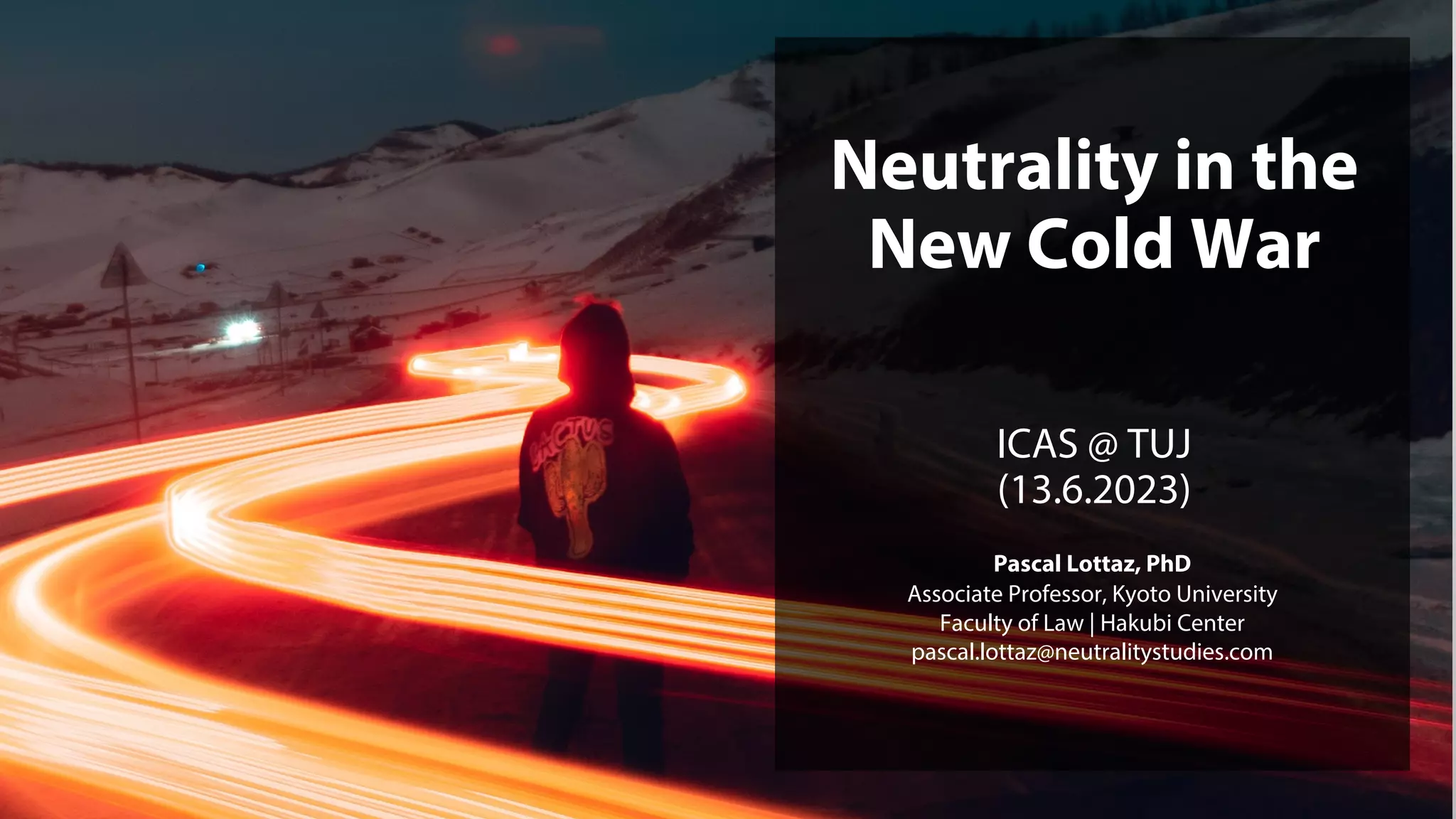

Neutrality in the
New Cold War
ICAS @ TUJ
(13.6.2023)
Pascal Lottaz, PhD
Associate Professor, Kyoto University
Faculty of Law | Hakubi Center
pascal.lottaz@neutralitystudies.com
Outline
1. A Theoretical Framework
2. Case Studies
3. Conclusion
Neutrality
in International Relations
Pascal Lottaz
07.06.23, 08:16
Neutrality and Nonalignment Are Signs of Strength
Page 1 of 5
https://foreignpolicy.com/2023/06/06/ukraine-russia-war-neutrality-nonalignment/
ARGUMENT
An expert's point of view on a current event.
In Defense of Neutrals
Why they’re more than just fence sitters.
By Pascal Lottaz, an associate professor for neutrality studies at Kyoto University, and Heinz Gärtner, a professor at the Department of
Political Science at the University of Vienna.
JUNE 6, 2023, 3:36 PM
The demise of neutrality has been much exaggerated. Finnish membership and Sweden’s
accession application to NATO have been interpreted in some corners as evidence of its decline.
In wars of aggression, refusing to pick sides is untenable, some hold, as they berate those who still
do not send weapons to Ukraine or sanction Russia.
Yet whether critics like it or not, neutrality isn’t going anywhere. Principled stances of neutrality,
always and everywhere, are reactions to conflict. So long as conflict exist, so too will neutrals. Not
even the two World Wars, the 40 years of the Cold War, or 30 years of U.S. unipolarity could get rid
of the so-called fence-sitters—a pejorative to discredit the nonparticipation of third parties to
conflicts. The argument is always the same: Not helping the good side of an epic struggle between
good and evil is equal to doing evil yourself. Yet the very logic of war and conflict ensures neutrals
don’t go away.
That’s because although wars usually devour some neutrals, they always breed new ones: The
Napoleonic wars created Switzerland’s permanent neutrality, and the Belgian revolution against
the Dutch brought about Brussels’s version of the same. The First World War destroyed the latter
but, in turn, inspired Danish and Norwegian neutrality. The Second World War ruined those (and
many more) but birthed Irish, Spanish, Portuguese, and Turkish neutrality. The Cold War did
away with the last three, but gave rise to the neutrality of Austria, Finland, and Yugoslavia—and
the entire nonaligned movement, too. The current war over Ukraine is no exception; it has given
rise to neutral policies in roughly two-thirds of the world. Nonaligned behavior of third states is a
fact of international life and will remain one.
Task
NEUTRAL STATES AND THE POST-COLD
WAR INTERNATIONAL SYSTEM
NEUTRAL BEYOND
THE COLD
Edited by
Pascal Lottaz,
Heinz Gärtner,
and Herbert R. Reginbogin
N
EUTRAL
B
EYOND
THE
C
OLD
Lottaz,
Gärtner,
and
Reginbogin
an 350 years,
Pacific region
d the Soviet
k permanent
onization led
e Nonaligned
nd the world.
culation that
Beyond the
eutrality has
t. The essays
ome variation
the book will
the multiple
rd University
ays contested
pearing here,
geographical
western and
of neutrality
long as there
”
y of Helsinki
einz Gärtner,
Kubo, Pascal
Reginbogin,
ience at the
ct researcher
onal law and
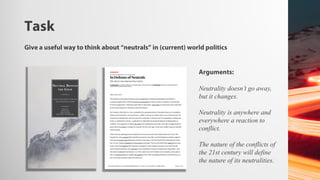
Arguments:
Neutrality doesn’t go away,
but it changes.
Neutrality is anywhere and
everywhere a reaction to
conflict.
The nature of the conflicts of
the 21st century will define
the nature of its neutralities.
Give a useful way to think about “neutrals” in (current) world politics
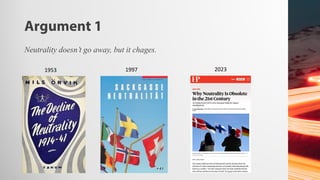
Argument 1
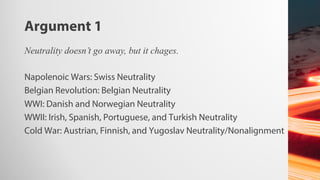
Neutrality doesn’t go away, but it chages.
1953 1997 2023
Argument 1
Neutrality doesn’t go away, but it chages.
Napolenoic Wars: Swiss Neutrality
Belgian Revolution: Belgian Neutrality
WWI: Danish and Norwegian Neutrality
WWII: Irish, Spanish, Portuguese, and Turkish Neutrality
Cold War: Austrian, Finnish, and Yugoslav Neutrality/Nonalignment
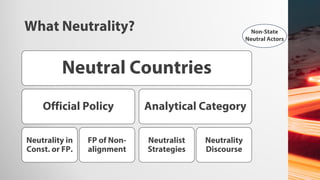
What Neutrality?
Neutral Countries
Official Policy
Neutrality in
Const. or FP.
FP of Non-
alignment
Analytical Category
Neutralist
Strategies
Neutrality
Discourse
Non-State
Neutral Actors
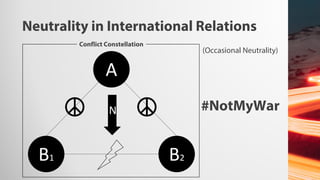
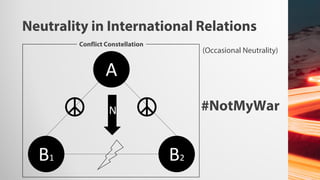
#NotMyWar
B1 B2
A
N
Conflict Constellation
Neutrality in International Relations
(Occasional Neutrality)
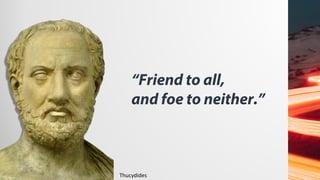
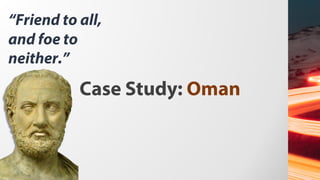
“Friend to all,
and foe to neither.”
Thucydides
Case Study: Oman
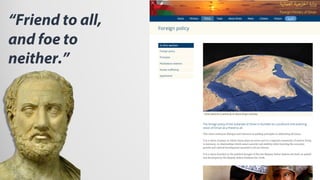
“Friend to all,
and foe to
neither.”
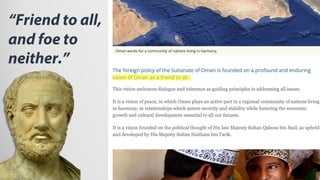
“Friend to all,
and foe to
neither.”
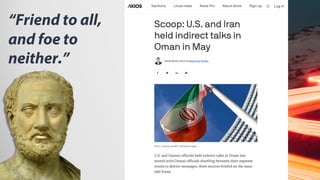
“Friend to all,
and foe to
neither.”
“Friend to all,
and foe to
neither.”
#NotMyWar
B1 B2
A
N
Conflict Constellation
Neutrality in International Relations
(Occasional Neutrality)
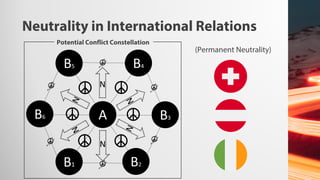
Neutrality in International Relations
B6
B5
B3
B4
A
B2
B1
N
N
N
N
N
N
Potential Conflict Constellation
(Permanent Neutrality)
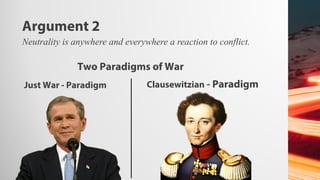
Argument 2
Two Paradigms of War
Just War - Paradigm Clausewitzian - Paradigm
Neutrality is anywhere and everywhere a reaction to conflict.
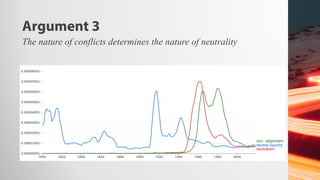
Argument 3
The nature of conflicts determines the nature of neutrality
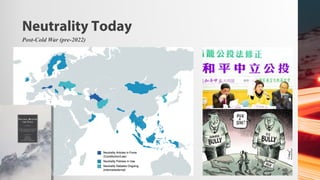
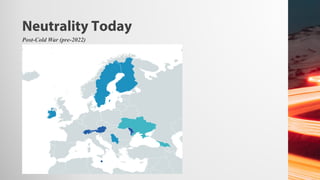
Neutrality Today
Post-Cold War (pre-2022)
NEUTRAL STATES AND THE POST-COLD
WAR INTERNATIONAL SYSTEM
NEUTRAL BEYOND
THE COLD
Edited by
Pascal Lottaz,
Heinz Gärtner,
and Herbert R. Reginbogin
Neutrality Today
Post-Cold War (pre-2022)
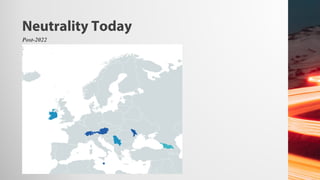
Neutrality Today
Post-2022
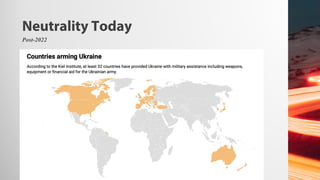
Neutrality Today
Post-2022
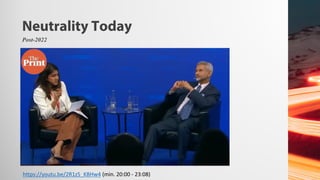
Case Study: India
Neutrality Today
Post-2022
https://youtu.be/2R1z5_KBHw4 (min. 20:00 - 23:08)
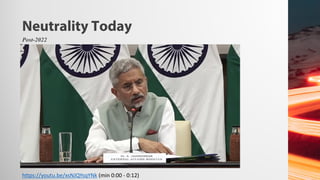
Neutrality Today
Post-2022
https://youtu.be/xsNJQYsqYNk (min 0:00 - 0:12)
Case Study: Switzerland
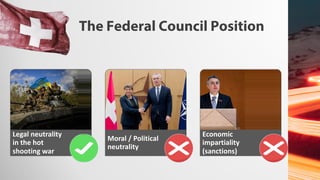
The Federal Council Position
Legal neutrality
in the hot
shooting war
Moral / Political
neutrality
Economic
impartiality
(sanctions)
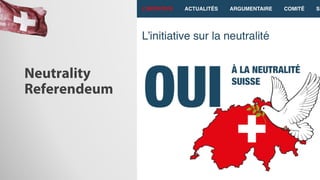
Neutrality
Referendeum
Conclusion
• Neutrality is moving out of Europe, into other parts of the world
• Countries with ”hard” neutrality laws keep the foreign policy
more readily than those without.
• Most developing nations are trying to maintain multi-directional
foreign policies.
• In the coming multi-polar system we should probably expect
more neutrality policies, not less, but adapted to the conflicts
they will be directed toward.
Neutrality in the
New Cold War
ICAS @ TUJ
(13.6.2023)
Pascal Lottaz, PhD
Associate Professor, Kyoto University
Faculty of Law | Hakubi Center
pascal.lottaz@neutralitystudies.com

Neutrality in the new Cold War

  • 1.
    Neutrality in the NewCold War ICAS @ TUJ (13.6.2023) Pascal Lottaz, PhD Associate Professor, Kyoto University Faculty of Law | Hakubi Center pascal.lottaz@neutralitystudies.com
  • 2.
    Outline 1. A TheoreticalFramework 2. Case Studies 3. Conclusion Neutrality in International Relations Pascal Lottaz
  • 3.
    07.06.23, 08:16 Neutrality andNonalignment Are Signs of Strength Page 1 of 5 https://foreignpolicy.com/2023/06/06/ukraine-russia-war-neutrality-nonalignment/ ARGUMENT An expert's point of view on a current event. In Defense of Neutrals Why they’re more than just fence sitters. By Pascal Lottaz, an associate professor for neutrality studies at Kyoto University, and Heinz Gärtner, a professor at the Department of Political Science at the University of Vienna. JUNE 6, 2023, 3:36 PM The demise of neutrality has been much exaggerated. Finnish membership and Sweden’s accession application to NATO have been interpreted in some corners as evidence of its decline. In wars of aggression, refusing to pick sides is untenable, some hold, as they berate those who still do not send weapons to Ukraine or sanction Russia. Yet whether critics like it or not, neutrality isn’t going anywhere. Principled stances of neutrality, always and everywhere, are reactions to conflict. So long as conflict exist, so too will neutrals. Not even the two World Wars, the 40 years of the Cold War, or 30 years of U.S. unipolarity could get rid of the so-called fence-sitters—a pejorative to discredit the nonparticipation of third parties to conflicts. The argument is always the same: Not helping the good side of an epic struggle between good and evil is equal to doing evil yourself. Yet the very logic of war and conflict ensures neutrals don’t go away. That’s because although wars usually devour some neutrals, they always breed new ones: The Napoleonic wars created Switzerland’s permanent neutrality, and the Belgian revolution against the Dutch brought about Brussels’s version of the same. The First World War destroyed the latter but, in turn, inspired Danish and Norwegian neutrality. The Second World War ruined those (and many more) but birthed Irish, Spanish, Portuguese, and Turkish neutrality. The Cold War did away with the last three, but gave rise to the neutrality of Austria, Finland, and Yugoslavia—and the entire nonaligned movement, too. The current war over Ukraine is no exception; it has given rise to neutral policies in roughly two-thirds of the world. Nonaligned behavior of third states is a fact of international life and will remain one. Task NEUTRAL STATES AND THE POST-COLD WAR INTERNATIONAL SYSTEM NEUTRAL BEYOND THE COLD Edited by Pascal Lottaz, Heinz Gärtner, and Herbert R. Reginbogin N EUTRAL B EYOND THE C OLD Lottaz, Gärtner, and Reginbogin an 350 years, Pacific region d the Soviet k permanent onization led e Nonaligned nd the world. culation that Beyond the eutrality has t. The essays ome variation the book will the multiple rd University ays contested pearing here, geographical western and of neutrality long as there ” y of Helsinki einz Gärtner, Kubo, Pascal Reginbogin, ience at the ct researcher onal law and Arguments: Neutrality doesn’t go away, but it changes. Neutrality is anywhere and everywhere a reaction to conflict. The nature of the conflicts of the 21st century will define the nature of its neutralities. Give a useful way to think about “neutrals” in (current) world politics
  • 4.
    Argument 1 Neutrality doesn’tgo away, but it chages. 1953 1997 2023
  • 5.
    Argument 1 Neutrality doesn’tgo away, but it chages. Napolenoic Wars: Swiss Neutrality Belgian Revolution: Belgian Neutrality WWI: Danish and Norwegian Neutrality WWII: Irish, Spanish, Portuguese, and Turkish Neutrality Cold War: Austrian, Finnish, and Yugoslav Neutrality/Nonalignment
  • 6.
    What Neutrality? Neutral Countries OfficialPolicy Neutrality in Const. or FP. FP of Non- alignment Analytical Category Neutralist Strategies Neutrality Discourse Non-State Neutral Actors
  • 7.
    #NotMyWar B1 B2 A N Conflict Constellation Neutralityin International Relations (Occasional Neutrality)
  • 8.
    “Friend to all, andfoe to neither.” Thucydides
  • 9.
    Case Study: Oman “Friendto all, and foe to neither.”
  • 10.
    “Friend to all, andfoe to neither.”
  • 11.
    “Friend to all, andfoe to neither.”
  • 12.
    “Friend to all, andfoe to neither.”
  • 13.
    #NotMyWar B1 B2 A N Conflict Constellation Neutralityin International Relations (Occasional Neutrality)
  • 14.
    Neutrality in InternationalRelations B6 B5 B3 B4 A B2 B1 N N N N N N Potential Conflict Constellation (Permanent Neutrality)
  • 15.
    Argument 2 Two Paradigmsof War Just War - Paradigm Clausewitzian - Paradigm Neutrality is anywhere and everywhere a reaction to conflict.
  • 16.
    Argument 3 The natureof conflicts determines the nature of neutrality
  • 17.
    Neutrality Today Post-Cold War(pre-2022) NEUTRAL STATES AND THE POST-COLD WAR INTERNATIONAL SYSTEM NEUTRAL BEYOND THE COLD Edited by Pascal Lottaz, Heinz Gärtner, and Herbert R. Reginbogin
  • 18.
  • 19.
  • 20.
  • 21.
  • 22.
  • 23.
  • 24.
  • 25.
    The Federal CouncilPosition Legal neutrality in the hot shooting war Moral / Political neutrality Economic impartiality (sanctions)
  • 26.
  • 27.
    Conclusion • Neutrality ismoving out of Europe, into other parts of the world • Countries with ”hard” neutrality laws keep the foreign policy more readily than those without. • Most developing nations are trying to maintain multi-directional foreign policies. • In the coming multi-polar system we should probably expect more neutrality policies, not less, but adapted to the conflicts they will be directed toward.
  • 28.
    Neutrality in the NewCold War ICAS @ TUJ (13.6.2023) Pascal Lottaz, PhD Associate Professor, Kyoto University Faculty of Law | Hakubi Center pascal.lottaz@neutralitystudies.com