Shift of Focus
•So far → Focus was on domestic challenges (nation-building, democracy,
development).
• Now → Looking at external challenges India faced after independence.
• Key External Challenges
• Foreign Policy → India adopted the innovative policy of Non-Alignment
(NAM).
Conflicts with Neighbours → India fought three major wars:
• 1962 → War with China.
• 1965 → War with Pakistan.
• 1971 → War with Pakistan (Bangladesh Liberation).
These external issues also shaped internal politics (nationalism, economy,
public opinion, etc.).
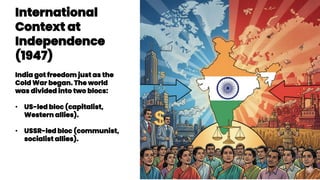
4.
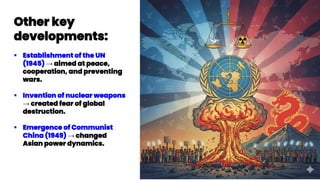
What This Chapter
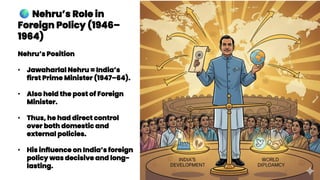
Covers
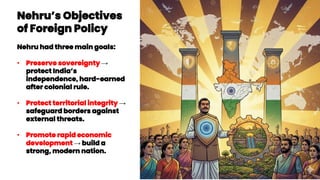
Wewill study:
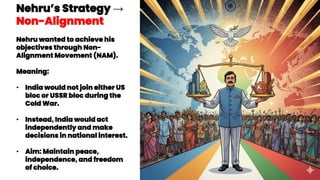
• International context → The Cold War &
global politics.
• Principles of India’s foreign policy →
Especially Non-Alignment.
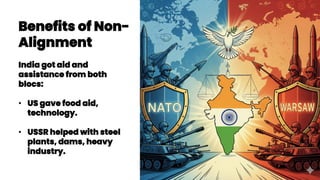
• India–China relations → Friendship, border
dispute, 1962 war.
• India–Pakistan relations → 1965 & 1971
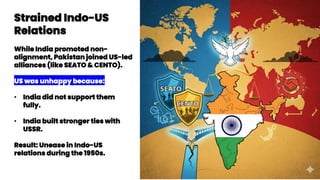
wars, ongoing tensions.
• Evolution of India’s nuclear policy →
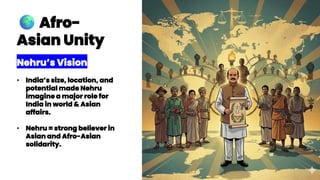
From peaceful use to nuclear tests.
5.
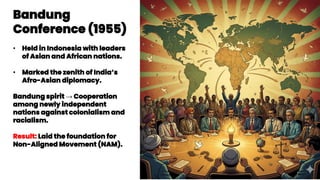
The Global Situation
afterWorld War II
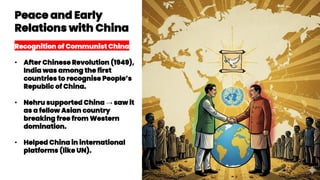
When India became independent in 1947, the
world was in a very challenging condition:
• World War II destruction → countries
were busy with reconstruction.
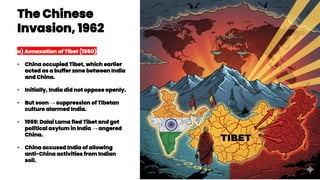
• A new international body (the United
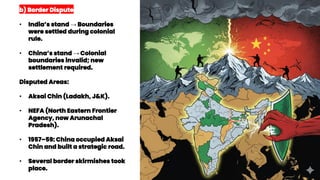
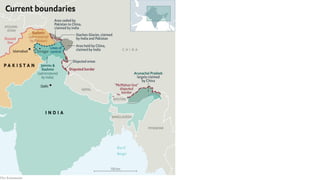
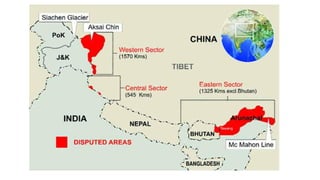
Nations) had just been formed (1945).
• Colonialism collapsing → many new
nations in Asia & Africa were emerging.
• Democracy & welfare → new nations
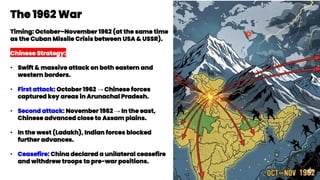
wanted to build democratic governments
while also reducing poverty.
6.
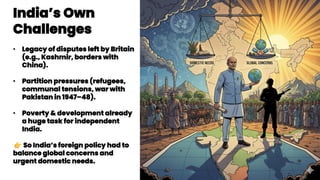
India’s Own
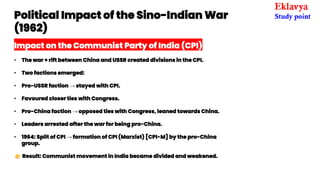
Challenges
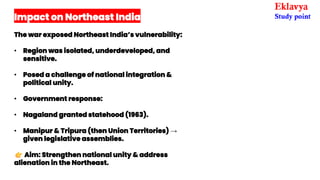
• Legacyof disputes left by Britain
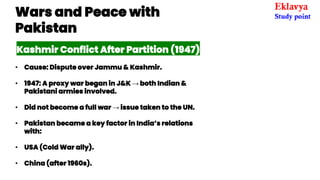
(e.g., Kashmir, borders with
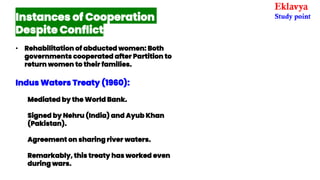
China).
• Partition pressures (refugees,
communal tensions, war with
Pakistan in 1947–48).
• Poverty & development already
a huge task for independent
India.
So India’s foreign policy had to
balance global concerns and
urgent domestic needs.
7.
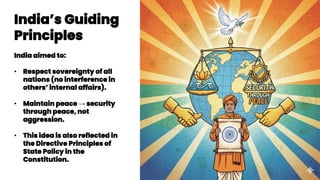
India’s Guiding
Principles
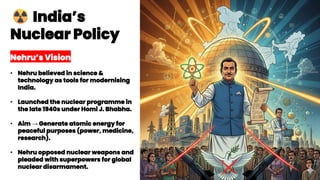
India aimedto:
• Respect sovereignty of all
nations (no interference in
others’ internal affairs).
• Maintain peace → security
through peace, not
aggression.
• This idea is also reflected in
the Directive Principles of
State Policy in the
Constitution.
8.
Developing Countries’ Position
Newlyindependent countries (like India) lacked resources
→ could not influence global politics strongly.
So their focus was on:
• Peaceful relations with neighbours.
• Development within the country.
• But their economic & security dependence on powerful
states sometimes shaped their foreign policy.
9.
The Cold WarContext
(Beginning in 1947)
After WWII, the world got divided into two rival blocs:
• USA & Western Allies (capitalist bloc).
• Soviet Union & Eastern bloc (socialist bloc).
❖ Many developing countries had to choose sides → often
influenced by aid, loans, or military support.
❖ But India (with some others) experimented with a third path
→ Non-Aligned Movement (NAM).
India played a leading role in NAM, which allowed it to:
• Stay independent of both blocs.
• Promote peace, cooperation, and decolonisation.
10.
India’s Freedom
Struggle asPart
of a Global
Movement
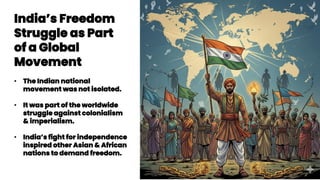
• The Indian national
movement was not isolated.
• It was part of the worldwide
struggle against colonialism
& imperialism.
• India’s fight for independence
inspired other Asian & African
nations to demand freedom.
11.
Examples of
Global Linkages
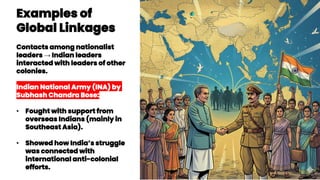
Contactsamong nationalist
leaders → Indian leaders
interacted with leaders of other
colonies.
Indian National Army (INA) by
Subhash Chandra Bose:
• Fought with support from
overseas Indians (mainly in
Southeast Asia).
• Showed how India’s struggle
was connected with
international anti-colonial
efforts.
12.
Influence on Foreign
Policy
Acountry’s foreign policy is shaped by both:
1. Domestic factors (values, needs, national
priorities).
2. External factors (international situation).
For India:
• Noble ideals of freedom struggle (anti-
colonialism, anti-racism, support for self-
determination) became part of its foreign
policy principles.
13.
International
Context at
Independence
(1947)
India gotfreedom just as the
Cold War began. The world
was divided into two blocs:
• US-led bloc (capitalist,
Western allies).
• USSR-led bloc (communist,
socialist allies).
14.
Other key
developments:
▪ Establishmentof the UN
(1945) → aimed at peace,
cooperation, and preventing
wars.
▪ Invention of nuclear weapons
→ created fear of global
destruction.
▪ Emergence of Communist
China (1949) → changed
Asian power dynamics.
15.
Nehru’s Role in
ForeignPolicy (1946–
1964)
Nehru’s Position
• Jawaharlal Nehru = India’s
first Prime Minister (1947–64).
• Also held the post of Foreign
Minister.
• Thus, he had direct control
over both domestic and
external policies.
• His influence on India’s foreign
policy was decisive and long-
lasting.
16.
Nehru’s Objectives
of ForeignPolicy
Nehru had three main goals:
• Preserve sovereignty →
protect India’s
independence, hard-earned
after colonial rule.
• Protect territorial integrity →
safeguard borders against
external threats.
• Promote rapid economic
development → build a
strong, modern nation.
17.
Nehru’s Strategy →
Non-Alignment
Nehruwanted to achieve his
objectives through Non-
Alignment Movement (NAM).
Meaning:
• India would not join either US
bloc or USSR bloc during the
Cold War.
• Instead, India would act
independently and make
decisions in national interest.
• Aim: Maintain peace,
independence, and freedom
of choice.
18.
Opposition to Nehru’sApproach
• Some parties/leaders believed India should align
with the US bloc because it claimed to support
democracy.
Example: Dr. B.R. Ambedkar.
Other anti-communist parties also pushed for a
pro-US policy, such as:
1. Bharatiya Jan Sangh (predecessor of BJP).
2. Swatantra Party.
19.
Nehru’s
Advantage
• Despite criticism,Nehru had
considerable freedom
(leeway) in making foreign
policy.
• His personal prestige, vision,
and leadership allowed him
to dominate India’s external
relations during his tenure.
20.
India’s Distance
from theTwo Camps
Policy of Non-Alignment
• Independent India dreamed of a
peaceful world.
• Adopted Non-Alignment as its
core foreign policy:
❑ Stay away from US-led and
USSR-led military alliances.
❑ Reduce Cold War tensions.
❑ Contribute to UN peacekeeping
with human resources.
21.
Military Blocs of
theCold War
• US bloc → NATO (North
Atlantic Treaty
Organisation).
• USSR bloc → Warsaw Pact.
India kept equal distance →
did not join either bloc.
22.
India’s Independent Stance(Examples)
1956 – Suez Canal Crisis:
• Britain, France, Israel attacked Egypt.
• India strongly protested → called it neo-colonial invasion.
1956 – Hungary Crisis:
• USSR invaded Hungary to crush an uprising.
• India did not publicly condemn USSR.
• Balance seemed imperfect, but India stuck to non-alignment
overall.
By and large, India kept an independent position on global
issues.
23.
Benefits of Non-
Alignment
Indiagot aid and
assistance from both
blocs:
• US gave food aid,
technology.
• USSR helped with steel
plants, dams, heavy
industry.
24.
Strained Indo-US
Relations
While Indiapromoted non-
alignment, Pakistan joined US-led
alliances (like SEATO & CENTO).
US was unhappy because:
• India did not support them
fully.
• India built stronger ties with
USSR.
Result: Unease in Indo-US
relations during the 1950s.
25.
Impact of India’s
DevelopmentPolicy
India’s economic policy = Planned
Development + Import Substitution:
• Focused on self-reliance & building
internal resource base.
• Limited export-oriented growth.
• This meant India’s economic interaction
with the outside world remained
restricted in the early decades.
26.
Afro-
Asian Unity
Nehru’s Vision
•India’s size, location, and
potential made Nehru
imagine a major role for
India in world & Asian
affairs.
• Nehru = strong believer in
Asian and Afro-Asian
solidarity.
27.
Early Initiatives
• 1947(March): India hosted the Asian
Relations Conference in Delhi (even
before independence).
• 1949: India convened an
international conference to support
Indonesia’s freedom struggle
against Dutch colonial rule.
Supported decolonisation and
opposed racism → especially
apartheid in South Africa.
28.
Bandung
Conference (1955)
• Heldin Indonesia with leaders
of Asian and African nations.
• Marked the zenith of India’s
Afro-Asian diplomacy.
Bandung spirit → Cooperation
among newly independent
nations against colonialism and
racialism.
Result: Laid the foundation for
Non-Aligned Movement (NAM).
29.
Non-Aligned Movement (1961)
•First NAM Summit → Belgrade (1961).
• India’s Nehru = co-founder of NAM, along with
leaders like Nasser (Egypt), Tito (Yugoslavia),
Sukarno (Indonesia), and Nkrumah (Ghana).
• Gave India an independent voice in world affairs.
30.
Peace and Early
Relationswith China
Recognition of Communist China
• After Chinese Revolution (1949),
India was among the first
countries to recognise People’s
Republic of China.
• Nehru supported China → saw it
as a fellow Asian country
breaking free from Western
domination.
• Helped China in international
platforms (like UN).
31.
Nehru’s View vs
Patel’sConcern
• Nehru: believed Chinese attack
was “exceedingly unlikely.”
• Patel (Home Minister): warned
of possible future Chinese
aggression.
Reflects two different
perspectives within Indian
leadership.
32.
Panchsheel Agreement (1954)
Signedby Nehru (India) and Zhou Enlai (China).
Five Principles of Peaceful Coexistence (Panchsheel):
1. Mutual respect for territorial integrity &
sovereignty.
2. Mutual non-aggression.
3. Mutual non-interference in internal affairs.
4. Equality & mutual benefit.
5. Peaceful coexistence.
Symbolised friendship and trust between India and
China.
33.
Friendly Relations
(1950s)
• Leadersexchanged visits.
• Masses in both countries welcomed
delegations warmly.
Slogan: “Hindi-Chini Bhai Bhai”
(Indians and Chinese are brothers).
34.
The Chinese
Invasion, 1962
a)Annexation of Tibet (1950)
• China occupied Tibet, which earlier
acted as a buffer zone between India
and China.
• Initially, India did not oppose openly.
• But soon → suppression of Tibetan
culture alarmed India.
• 1959: Dalai Lama fled Tibet and got
political asylum in India → angered
China.
• China accused India of allowing
anti-China activities from Indian
soil.
35.
b) Border Dispute
•India’s stand → Boundaries
were settled during colonial
rule.
• China’s stand → Colonial
boundaries invalid; new
settlement required.
Disputed Areas:
• Aksai Chin (Ladakh, J&K).
• NEFA (North Eastern Frontier
Agency, now Arunachal
Pradesh).
• 1957–59: China occupied Aksai
Chin and built a strategic road.
• Several border skirmishes took
place.
39.
The 1962 War
Timing:October–November 1962 (at the same time
as the Cuban Missile Crisis between USA & USSR).
Chinese Strategy:
• Swift & massive attack on both eastern and
western borders.
• First attack: October 1962 → Chinese forces
captured key areas in Arunachal Pradesh.
• Second attack: November 1962 → In the east,
Chinese advanced close to Assam plains.
• In the west (Ladakh), Indian forces blocked
further advances.
• Ceasefire: China declared a unilateral ceasefire
and withdrew troops to pre-war positions.
40.
Consequences of theWar
a) Political & Military Impact
• India’s image dented at home and
abroad.
• India had to request military aid from
USA and Britain.
• USSR stayed neutral.
• Army shaken: Top commanders
resigned/retired.
• Defence Minister V.K. Krishna Menon
(close to Nehru) forced to resign.
• Revealed India’s lack of military
preparedness.
41.
b) Impact onNehru
Nehru was heavily criticised for:
• Misreading China’s intentions.
• Trusting “Hindi-Chini Bhai Bhai” too
much.
• For the first time, a No-Confidence
Motion was moved against his
government in Lok Sabha.
• Congress lost several by-elections
soon after.
• Nehru’s political stature weakened,
and his health declined in following
years.
42.
c) National Sentiment
•War created national
humiliation, but also
strengthened Indian
nationalism.
• People demanded
stronger defence and
greater vigilance.
43.
Political Impact ofthe Sino-Indian War
(1962)
Impact on the Communist Party of India (CPI)
• The war + rift between China and USSR created divisions in the CPI.
• Two factions emerged:
• Pro-USSR faction → stayed with CPI.
• Favoured closer ties with Congress.
• Pro-China faction → opposed ties with Congress, leaned towards China.
• Leaders arrested after the war for being pro-China.
• 1964: Split of CPI → formation of CPI (Marxist) [CPI-M] by the pro-China
group.
Result: Communist movement in India became divided and weakened.
44.
Impact on NortheastIndia
The war exposed Northeast India’s vulnerability:
• Region was isolated, underdeveloped, and
sensitive.
• Posed a challenge of national integration &
political unity.
• Government response:
• Nagaland granted statehood (1963).
• Manipur & Tripura (then Union Territories) →
given legislative assemblies.
Aim: Strengthen national unity & address
alienation in the Northeast.
45.
Wars and Peacewith
Pakistan
Kashmir Conflict After Partition (1947)
• Cause: Dispute over Jammu & Kashmir.
• 1947: A proxy war began in J&K → both Indian &
Pakistani armies involved.
• Did not become a full war → issue taken to the UN.
• Pakistan became a key factor in India’s relations
with:
• USA (Cold War ally).
• China (after 1960s).
46.
Instances of Cooperation
DespiteConflict
• Rehabilitation of abducted women: Both
governments cooperated after Partition to
return women to their families.
Indus Waters Treaty (1960):
Mediated by the World Bank.
Signed by Nehru (India) and Ayub Khan
(Pakistan).
Agreement on sharing river waters.
Remarkably, this treaty has worked even
during wars.
47.
The 1965 War
•By 1965, Lal Bahadur Shastri was Prime Minister.
• April 1965: Pakistan attacked in Rann of Kutch (Gujarat).
August–September 1965:
• Pakistan launched a bigger offensive in Jammu &
Kashmir.
• Expected local Kashmiri support → did not happen.
India responded:
• Shastri ordered counter-offensive.
• Indian Army advanced into Punjab sector, reached close
to Lahore.
48.
End of Hostilities
UNintervened to stop the war.
January 1966: Tashkent
Agreement signed between:
• Lal Bahadur Shastri (India).
• General Ayub Khan
(Pakistan).
• Mediated by the Soviet
Union (in Tashkent, USSR).
49.
Consequences
• India inflictedserious
military losses on Pakistan.
• But the war strained India’s
economy, which was
already weak.
• Political Impact: Shastri
gained national respect for
his leadership, but he died in
Tashkent (1966) soon after
signing the agreement.
50.
Bangladesh War, 1971
Background:Crisis in Pakistan
1970 General Elections:
• West Pakistan → Won by Zulfikar Ali
Bhutto’s party.
• East Pakistan → Swept by Awami
League (Sheikh Mujibur Rahman).
• East Pakistanis (Bengalis) felt like
second-class citizens under West
Pakistani rule.
• Awami League demanded federal
system & autonomy → rejected by
rulers in West Pakistan.
51.
Repression in
East Pakistan
•Early 1971: Pakistani army
arrested Sheikh Mujib.
• Military crackdown →
mass killings & atrocities in
East Pakistan.
• Result: Popular uprising for
independence → demand
for Bangladesh.
52.
Impact on India
•Nearly 80 lakh refugees fled
to India (West Bengal,
Tripura, Assam, Bihar).
• Heavy social & economic
burden on India.
• India extended moral +
material support to the
liberation struggle.
• Pakistan accused India of
conspiracy to divide the
country.
53.
International Context
Pakistan’s Supporters:
•United States (Nixon administration).
• China (closely tied with Pakistan).
• Both saw Pakistan as a useful ally during the Cold War.
1971 US-China Rapprochement:
• US National Security Adviser Henry Kissinger secretly visited
China via Pakistan (July 1971).
• Strengthened the US-Pakistan-China axis.
India’s Counter-Move:
• Signed 20-Year Treaty of Peace and Friendship with USSR
(August 1971).
• Assured India of Soviet military and diplomatic support in
case of conflict.
54.
Bangladesh War &Its
Aftermath (1971–72)
Outbreak of War (December 1971)
Months of tensions + military build-up ended
in full-scale war.
Pakistan’s move:
• Air attacks on Punjab & Rajasthan.
• Army advanced on the Jammu & Kashmir
front.
India’s response:
• Used army, navy, and air force on both
Western & Eastern fronts.
• In East Pakistan → welcomed by locals,
Indian army advanced swiftly.
55.
India’s Decisive
Victory
• Within10 days, Indian army
surrounded Dhaka from 3 sides.
• 16 December 1971: ~90,000
Pakistani soldiers surrendered.
• Result → Bangladesh became an
independent country.
• India declared a unilateral
ceasefire.
56.
Shimla
Agreement (1972)
Signed on3 July 1972 between:
• Indira Gandhi (India).
• Zulfikar Ali Bhutto (Pakistan).
• Peace formally restored and
principles for future relations
agreed upon.
57.
Impact in India
•National jubilation → seen
as a moment of glory and
proof of India’s military
strength.
• Indira Gandhi’s popularity
soared:
• Already victorious in 1971 Lok
Sabha elections.
• After war → Congress won
large majorities in state
assembly elections.
58.
Impact on Economy
&Planning
Wars (1962, 1965, 1971) diverted resources from
development → defence.
Defence modernisation became urgent:
• Department of Defence Production (1962).
• Department of Defence Supplies (1965).
• Third Five-Year Plan (1961–66) disrupted.
• India had to rely on three Annual Plans
(1966–69) before the Fourth Plan (1969–74).
• Defence expenditure increased enormously.
59.
India’s
Nuclear Policy
Nehru’s Vision
•Nehru believed in science &
technology as tools for modernising
India.
• Launched the nuclear programme in
the late 1940s under Homi J. Bhabha.
• Aim → Generate atomic energy for
peaceful purposes (power, medicine,
research).
• Nehru opposed nuclear weapons and
pleaded with superpowers for global
nuclear disarmament.
60.
Global Nuclear
Developments
1964: CommunistChina conducted its first
nuclear test.
1968: The Nuclear Non-Proliferation Treaty
(NPT) was created by the 5 nuclear powers:
• US, USSR, UK, France, China (then Taiwan’s
seat in UN).
• NPT aimed to stop other countries from
becoming nuclear powers.
• India refused to sign NPT → considered it
discriminatory (allowed only 5 to keep
weapons, denied others).
61.
India’s First
Nuclear Test(1974)
• Conducted in May 1974 at
Pokhran, Rajasthan.
• Called a “Peaceful Nuclear
Explosion” (PNE).
India argued:
• It remained committed to
peaceful use of nuclear power.
• Nuclear energy = for
development, not aggression.
62.
Context of the1970s
Domestically, India was facing economic and
political turmoil:
• 1973 Oil Shock → sudden rise in global oil prices.
• Result → High inflation in India, economic crisis.
• Political unrest → student agitations,
movements, and a nationwide railway strike.
• Despite this, India went ahead with the nuclear
test → showed determination for self-reliance
and security.
63.
Political Consensus
• Minordifferences existed among
parties about how to deal with
foreign policy.
But broad national consensus existed
on:
▪ National integration.
▪ Defending borders.
▪ Protecting national interests.
▪ Thus, even with political changes,
foreign policy & security were not
major areas of party conflict.
 Most read