Binary vulnerability

       Alex Bazhanyuk, @Abazhanyuk


“RE” school, DefCon-UA, 2012
vulnerability
●   Binary, Logic, Web
●   Why vulnerabilities is so interesting?
●   Why we need patched our OS? (project MIT)
●   Math models for vulnerabilities
●   Lang without vulnerabilities


                                                2
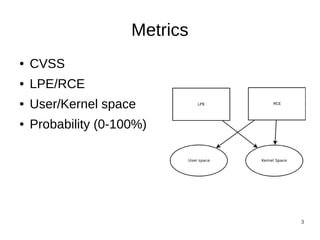
Metrics
●   CVSS
●   LPE/RCE
●   User/Kernel space
●   Probability (0-100%)


                               3
Identifier
●   CVE (http://cve.mitre.org/cve/cve.html)
●   SA (http://secunia.com/advisories/search)
●   Vupen(http://www.vupen.com/english/security-advisories/)

●   Vendors


                                                               4
Web vulnerabilities (not here)
●   Cross Site Scripting (XSS)
●   Injection Flaws (SQLi)
●   Malicious File Execution (RFI)
●   Insecure Direct Object Reference
●   Cross Site Request Forgery (CSRF)
●   Information Leakage and Improper Error Handling
●   Broken Authentication and Session Management
●   Failure to Restrict URL Access


                                                      5
Logic vulnerabilities
●   Int rand(){return 4;}
●   Client decide if authorization successful or not


●   [Ch-ch-ch-ch-ching!!! $60,000] [117226] [117230] Critical CVE-2011-3046:
    UXSS and bad history navigation. Credit to Sergey Glazunov.


●   GNU C library dynamic linker $ORIGIN expansion Vulnerability
    Tavis Ormandy.


                                                                               6
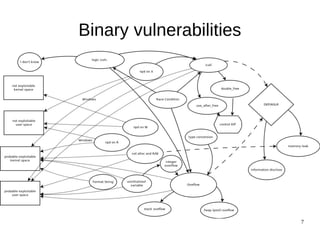
Binary vulnerabilities


                         7
Exploiting
    1) rewrite
    2) transfer of control


●   Bypass:
    - DEP/ASLR/safeSEH/SEHOP
    - HeapSpray - Nozzle/Bubble
    - Sandbox
    - Protection NPD
    - ROP in win8
●   Doesn't have protection:
    - SCADA
    - Embedded
    - Network device
                                            8
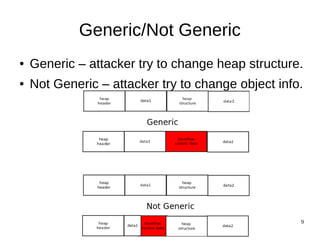
Generic/Not Generic
●   Generic – attacker try to change heap structure.
●   Not Generic – attacker try to change object info.


                                                    9
meta/data-data
●   Meta-data = header, checksum,...
●   Data-data = user data.


●   95% bugs in meta-data processing
●   5% bugs in user-data processing
                                       10
Level vulnerabilities


                        11
overflow
●   Stack
●   Heap (pool)
●   Integer


                             12
Example stack overflow
#include <string.h>

void foo (char *bar)
{
  char c[12];

    strcpy(c, bar); // no bounds checking...
}

int main (int argc, char **argv)
{
  foo(argv[1]);
}


                                               13
14
15
Example Heap overflow
#include <stdio.h>
#include <stdlib.h>
#include <unistd.h>
#include <string.h>
#define BUFSIZE 16
#define OVERSIZE 8 /* overflow buf2 by OVERSIZE bytes */
int main(){
u_long diff;
char *buf1 = (char *) malloc(BUFSIZE), *buf2 = (char *) malloc(BUFSIZE);
diff = (u_long) buf2 -(u_long) buf1;
printf("buf 1 = %p, buf2 = %p, diff = 0x% x bytesn", buf1, buf2, diff);
memset(buf2, 'A ', BUFSIZE - 1), buf2[BUFSIZE - 1] = '0';
printf("before overflow: buf2 = %sn", buf2);
memset(buf1, 'B(u_int) (diff + OVERSIZE));
printf("after overflow: buf2 = %sn", buf2);
 return 0;
 }


                                                                           16
Result of example
./heap
buf1 = 0x804e000, buf2 = 0x804eff0, diff = 0xff0
bytes
before overflow: buf2 = AAAAAAAAAAAAAAA
after overflow: buf2 = BBBBBBBBAAAAAAA


                                                   17
Overflow in disasm
●   Rep movsb
●   Rep movsd
●   Mov in loop


                                  18
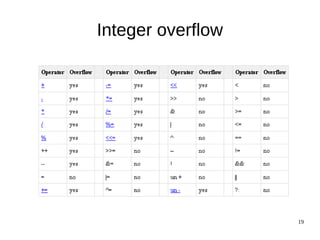
Integer overflow


                   19
Integer overflow
Integer overflow -> heap or stack overflow
Integer overflow != vulnerability


                                             20
Example integer overflow
int main(int argc, char **argv) {
char chLogin[100];
 char chPassword[100];
 int intPasswordLength;
 strcpy(chLogin, argv[1]);
 strcpy(chPassword, argv[2]);
 intPasswordLength=atoi(argv[3]);
  int admin=0;
 char chOriginalPassword[100]="administrator";
if(intPasswordLength<1) intPasswordLength=0;
 intPasswordLength++;
 if(chLogin="admin"){
admin=1;
for(i=0;i<=intPasswordLength;i++)
if((chPassword[i])!=chOriginalPassword[i])
admin=0;
 }
 setUserStastusAdmin(admin);
}


                                                 21
Result of example
intPasswordLength = 2147483647(0xFFFFFFFF)

2147483647(0xFFFFFFFF) + 1 =
Not 2147483648, It's: - 2147483648


                                             22
Pointer vulnerability
●   Heap/Jit Spray
●   NPD in user space: 1) Rewrite SEH -handler 2) [eax+bit_value]
                                      .


                                                                    23
Example NPD
Registers:
eax=00000000 ebx=0000003b ecx=0be0f1c0 edx=00000000 esi=0be0f1c0 edi=0bfa3058
eip=6a606e58 esp=02333000 ebp=0233300c iopl=0          no up ei pl nz na po nc
cs=001b ss=0023 ds=0023 es=0023 fs=003b gs=0000                efl=00010202


Code disassembly:
 6A606E48 |     80cc04 | or ah, 0x4
 6A606E4B |         0000 | add [eax], al
 6A606E4D |     8d4dff | lea ecx, [ebp-0x1]
 6A606E50 |          51 | push ecx
 6A606E51 |          52 | push edx
 6A606E52 |         8bce | mov ecx, esi
 6A606E54 |   c645ff00 | mov byte [ebp-0x1], 0x0
 6A606E58 |         ffd0 | call eax
 6A606E5A |    807dff00 | cmp byte [ebp-0x1], 0x0
 6A606E5E |         750c | jnz mshtml!createhtmlpropertypage+0x31ec1
 6A606E60 |         8b16 | mov edx, [esi]
 6A606E62 | 8b82c8040000 | mov eax, [edx+0x4c8]

                                                                                 24
Use after free
First chance exceptions are reported before any exception handling.
This exception may be expected and handled.
eax=008a0000 ebx=0011ff7c ecx=00000000 edx=00000000 esi=00c12408 edi=05b71000
eip=6bdff979 esp=0011fee8 ebp=0011ff88 iopl=0        nv up ei pl zr na pe nc
cs=001b ss=0023 ds=0023 es=0023 fs=003b gs=0000                  efl=00010246
SharedOFFICE14MSPTLS.DLL -
MSPTLS!LssbFIsSublineEmpty+0x2fdb9:
6bdff979 ff943888020000 call dword ptr <Unloaded_0.DLL>+0x287 (00000288)[eax+edi] ds:0023:06411288=????????
0:000> K
ChildEBP RetAddr
WARNING: Stack unwind information not available. Following frames may be wrong.
0011ff88 6bdce474 MSPTLS!LssbFIsSublineEmpty+0x2fdb9
0011ffb4 3179dc17 MSPTLS!LsQueryLineCpPpoint+0xb0
0011ffe0 3179dbad wwlib!GetAllocCounters+0xb6e4f
00120010 319a2cf4 wwlib!GetAllocCounters+0xb6de5
0012003c 319a2875 wwlib!DllGetLCID+0xc52fe
001200bc 31a94d48 wwlib!DllGetLCID+0xc4e7f
001204ec 31a9a05d wwlib!DllGetLCID+0x1b7352
0012052c 31a9aab5 wwlib!DllGetLCID+0x1bc667
0012064c 31785b8c wwlib!DllGetLCID+0x1bd0bf
001207a0 3176fab7 wwlib!GetAllocCounters+0x9edc4
001207c4 3176f1e5 wwlib!GetAllocCounters+0x88cef
00120808 3176b644 wwlib!GetAllocCounters+0x8841d
00120834 317691e4 wwlib!GetAllocCounters+0x8487c
00120890 31769016 wwlib!GetAllocCounters+0x8241c
001209b0 31768f9a wwlib!GetAllocCounters+0x8224e
001209d4 317642cd wwlib!GetAllocCounters+0x821d2
00120ad4 31761e22 wwlib!GetAllocCounters+0x7d505
00120afc 31761deb wwlib!GetAllocCounters+0x7b05a
00120d64 31732d59 wwlib!GetAllocCounters+0x7b023
001212b4 31926f9a wwlib!GetAllocCounters+0x4bf91
6bdff979 ff943888020000 call dword ptr <Unloaded_0.DLL>+0x287 (00000288)[eax+edi] ds:0023:06411288=????????

                                                                                                              25
Race Condition
int wmain(int argc, wchar_t *argv[])                                                   DWORD WINAPI Crack(LPVOID Context)
{                                                                                      {
  ZwOpenKey = (_ZwOpenKey *) GetProcAddress(GetModuleHandle(L"ntdll.dll"),                  POBJECT_ATTRIBUTES oa = (POBJECT_ATTRIBUTES) Context;
"ZwOpenKey");

                                                                                             DWORD *ptr = (DWORD*)&oa->ObjectName->Buffer;
        OBJECT_ATTRIBUTES oa;
        wchar_t wcKeyName[] = L"REGISTRYMACHINESOFTWAREMicrosoftDrWatson";
        UNICODE_STRING KeyName = {                                                           SetThreadPriority(GetCurrentThread(), THREAD_PRIORITY_HIGHEST);
                   sizeof wcKeyName - sizeof wcKeyName[0],                                   SetEvent(hStartEvent);
                   sizeof wcKeyName,
                   wcKeyName
                                                                                             while ( true ) {
                   };
                                                                                                  *ptr = 0x90909090;
                                                                                                  if ( WaitForSingleObject(hStopEvent, 1) == WAIT_OBJECT_0 ) break;
        DWORD ptr = (DWORD)KeyName.Buffer;
                                                                                             }

        InitializeObjectAttributes(&oa, &KeyName, OBJ_CASE_INSENSITIVE, NULL, NULL);

                                                                                           return 0;
        DWORD ThreadId;
                                                                                       }
        HANDLE hThread = CreateThread(NULL, 0, Crack, &oa, 0, &ThreadId);


        while ( !_kbhit() ) {
              HANDLE hKey;
              oa.ObjectName->Buffer
            NTSTATUS rc = ZwOpenKey(&hKey, STANDARD_RIGHTS_READ, &oa);
              if ( !NT_SUCCESS(rc) )
                   printf("Error: %xn", rc);
              else {
                   CloseHandle(hKey);
             }}
...
      return 0;}

                                                                                                                                                                 26
RE vs tester
●   Tester:
    - QA: look at and spit on the ceiling
    - Functional: Performance and Optimization,
    take part in development loop.
●   RE: exception, bug, disasm and another crap.


                                                   27
tools
●   Source code:                    ●   Binary
                                        - static : IDA
    - frama-c
                                        - dynamic:
    - Coverity                          1) mutation fuzzer, smart fuzzer
    - bddbddb                           2) peach, sulley
                                        3) hotfuzz
    - Saturn
                                        4) inmemfuzzer, fuzzgrind
    - PathFinder                        5) KLEE
    - CoreDet                           6) S2E
                                        7) Bitblaze
    - Coccinelle
                                        8) BAP
    - http://www.checkmycode.org/
                                                                           28
mutation fuzzer
    Simple mutation fuzzer
    Smart mutation fuzzer

●   Flash: 400 – Tavis Ormandy
●   Adobe Reader: 120 – Charlie Miller


                                         29
COMRaider
Company iDefense
Target: ActiveX
https://github.com/dzzie/COMRaider


                                     30
peach, sulley, hotfuzz
●   Exception monitor
●   Mutation fuzzer
●   Configuration schema protocol


●   Hotfuzz = peach + wireshark (tshark)
    http://peachfuzzer.com/
    http://hotfuzz.sourceforge.net/
    https://github.com/OpenRCE/sulley
                                           31
Fuzzgrind, fuzzball
●   Based on Valgrind
●   It's dbi with solver
●   “on-the-spot symbolic execution”
●   http://esec-lab.sogeti.com/pages/Fuzzgrind


                                                 32
BitBlaze, BAP
●   Dynamic analysis
●   Static analysis
●   Taint analysis
●   Symbolic analysis

●   Bitblaze is QEMU-based tracing system.
    http://bitblaze.cs.berkeley.edu/
●   BAP is PIN-based tracing system.
    http://bap.ece.cmu.edu/
                                             33
Real World
●   Browser = ~ 4*10^9 insns
●   Not code-based method.
●   Not input-based method.
●   Only human-based test-case: cross_fuzz


                                             34
The potential vulnerability.
●   Static – very bad (~0.1%).
●   Dynamic (taint, symbolic execution) – bad
    (~2%).
●   Dynamic (fuzzing, debugger) – not bad (~5%).


                                                   35
Thanks :)


virvdova@gmail.com

                     36

3

  • 1.
    Binary vulnerability Alex Bazhanyuk, @Abazhanyuk “RE” school, DefCon-UA, 2012
  • 2.
    vulnerability ● Binary, Logic, Web ● Why vulnerabilities is so interesting? ● Why we need patched our OS? (project MIT) ● Math models for vulnerabilities ● Lang without vulnerabilities 2
  • 3.
    Metrics ● CVSS ● LPE/RCE ● User/Kernel space ● Probability (0-100%) 3
  • 4.
    Identifier ● CVE (http://cve.mitre.org/cve/cve.html) ● SA (http://secunia.com/advisories/search) ● Vupen(http://www.vupen.com/english/security-advisories/) ● Vendors 4
  • 5.
    Web vulnerabilities (nothere) ● Cross Site Scripting (XSS) ● Injection Flaws (SQLi) ● Malicious File Execution (RFI) ● Insecure Direct Object Reference ● Cross Site Request Forgery (CSRF) ● Information Leakage and Improper Error Handling ● Broken Authentication and Session Management ● Failure to Restrict URL Access 5
  • 6.
    Logic vulnerabilities ● Int rand(){return 4;} ● Client decide if authorization successful or not ● [Ch-ch-ch-ch-ching!!! $60,000] [117226] [117230] Critical CVE-2011-3046: UXSS and bad history navigation. Credit to Sergey Glazunov. ● GNU C library dynamic linker $ORIGIN expansion Vulnerability Tavis Ormandy. 6
  • 7.
  • 8.
    Exploiting 1) rewrite 2) transfer of control ● Bypass: - DEP/ASLR/safeSEH/SEHOP - HeapSpray - Nozzle/Bubble - Sandbox - Protection NPD - ROP in win8 ● Doesn't have protection: - SCADA - Embedded - Network device 8
  • 9.
    Generic/Not Generic ● Generic – attacker try to change heap structure. ● Not Generic – attacker try to change object info. 9
  • 10.
    meta/data-data ● Meta-data = header, checksum,... ● Data-data = user data. ● 95% bugs in meta-data processing ● 5% bugs in user-data processing 10
  • 11.
  • 12.
    overflow ● Stack ● Heap (pool) ● Integer 12
  • 13.
    Example stack overflow #include<string.h> void foo (char *bar) { char c[12]; strcpy(c, bar); // no bounds checking... } int main (int argc, char **argv) { foo(argv[1]); } 13
  • 14.
  • 15.
  • 16.
    Example Heap overflow #include<stdio.h> #include <stdlib.h> #include <unistd.h> #include <string.h> #define BUFSIZE 16 #define OVERSIZE 8 /* overflow buf2 by OVERSIZE bytes */ int main(){ u_long diff; char *buf1 = (char *) malloc(BUFSIZE), *buf2 = (char *) malloc(BUFSIZE); diff = (u_long) buf2 -(u_long) buf1; printf("buf 1 = %p, buf2 = %p, diff = 0x% x bytesn", buf1, buf2, diff); memset(buf2, 'A ', BUFSIZE - 1), buf2[BUFSIZE - 1] = '0'; printf("before overflow: buf2 = %sn", buf2); memset(buf1, 'B(u_int) (diff + OVERSIZE)); printf("after overflow: buf2 = %sn", buf2); return 0; } 16
  • 17.
    Result of example ./heap buf1= 0x804e000, buf2 = 0x804eff0, diff = 0xff0 bytes before overflow: buf2 = AAAAAAAAAAAAAAA after overflow: buf2 = BBBBBBBBAAAAAAA 17
  • 18.
    Overflow in disasm ● Rep movsb ● Rep movsd ● Mov in loop 18
  • 19.
  • 20.
    Integer overflow Integer overflow-> heap or stack overflow Integer overflow != vulnerability 20
  • 21.
    Example integer overflow intmain(int argc, char **argv) { char chLogin[100]; char chPassword[100]; int intPasswordLength; strcpy(chLogin, argv[1]); strcpy(chPassword, argv[2]); intPasswordLength=atoi(argv[3]); int admin=0; char chOriginalPassword[100]="administrator"; if(intPasswordLength<1) intPasswordLength=0; intPasswordLength++; if(chLogin="admin"){ admin=1; for(i=0;i<=intPasswordLength;i++) if((chPassword[i])!=chOriginalPassword[i]) admin=0; } setUserStastusAdmin(admin); } 21
  • 22.
    Result of example intPasswordLength= 2147483647(0xFFFFFFFF) 2147483647(0xFFFFFFFF) + 1 = Not 2147483648, It's: - 2147483648 22
  • 23.
    Pointer vulnerability ● Heap/Jit Spray ● NPD in user space: 1) Rewrite SEH -handler 2) [eax+bit_value] . 23
  • 24.
    Example NPD Registers: eax=00000000 ebx=0000003becx=0be0f1c0 edx=00000000 esi=0be0f1c0 edi=0bfa3058 eip=6a606e58 esp=02333000 ebp=0233300c iopl=0 no up ei pl nz na po nc cs=001b ss=0023 ds=0023 es=0023 fs=003b gs=0000 efl=00010202 Code disassembly: 6A606E48 | 80cc04 | or ah, 0x4 6A606E4B | 0000 | add [eax], al 6A606E4D | 8d4dff | lea ecx, [ebp-0x1] 6A606E50 | 51 | push ecx 6A606E51 | 52 | push edx 6A606E52 | 8bce | mov ecx, esi 6A606E54 | c645ff00 | mov byte [ebp-0x1], 0x0 6A606E58 | ffd0 | call eax 6A606E5A | 807dff00 | cmp byte [ebp-0x1], 0x0 6A606E5E | 750c | jnz mshtml!createhtmlpropertypage+0x31ec1 6A606E60 | 8b16 | mov edx, [esi] 6A606E62 | 8b82c8040000 | mov eax, [edx+0x4c8] 24
  • 25.
    Use after free Firstchance exceptions are reported before any exception handling. This exception may be expected and handled. eax=008a0000 ebx=0011ff7c ecx=00000000 edx=00000000 esi=00c12408 edi=05b71000 eip=6bdff979 esp=0011fee8 ebp=0011ff88 iopl=0 nv up ei pl zr na pe nc cs=001b ss=0023 ds=0023 es=0023 fs=003b gs=0000 efl=00010246 SharedOFFICE14MSPTLS.DLL - MSPTLS!LssbFIsSublineEmpty+0x2fdb9: 6bdff979 ff943888020000 call dword ptr <Unloaded_0.DLL>+0x287 (00000288)[eax+edi] ds:0023:06411288=???????? 0:000> K ChildEBP RetAddr WARNING: Stack unwind information not available. Following frames may be wrong. 0011ff88 6bdce474 MSPTLS!LssbFIsSublineEmpty+0x2fdb9 0011ffb4 3179dc17 MSPTLS!LsQueryLineCpPpoint+0xb0 0011ffe0 3179dbad wwlib!GetAllocCounters+0xb6e4f 00120010 319a2cf4 wwlib!GetAllocCounters+0xb6de5 0012003c 319a2875 wwlib!DllGetLCID+0xc52fe 001200bc 31a94d48 wwlib!DllGetLCID+0xc4e7f 001204ec 31a9a05d wwlib!DllGetLCID+0x1b7352 0012052c 31a9aab5 wwlib!DllGetLCID+0x1bc667 0012064c 31785b8c wwlib!DllGetLCID+0x1bd0bf 001207a0 3176fab7 wwlib!GetAllocCounters+0x9edc4 001207c4 3176f1e5 wwlib!GetAllocCounters+0x88cef 00120808 3176b644 wwlib!GetAllocCounters+0x8841d 00120834 317691e4 wwlib!GetAllocCounters+0x8487c 00120890 31769016 wwlib!GetAllocCounters+0x8241c 001209b0 31768f9a wwlib!GetAllocCounters+0x8224e 001209d4 317642cd wwlib!GetAllocCounters+0x821d2 00120ad4 31761e22 wwlib!GetAllocCounters+0x7d505 00120afc 31761deb wwlib!GetAllocCounters+0x7b05a 00120d64 31732d59 wwlib!GetAllocCounters+0x7b023 001212b4 31926f9a wwlib!GetAllocCounters+0x4bf91 6bdff979 ff943888020000 call dword ptr <Unloaded_0.DLL>+0x287 (00000288)[eax+edi] ds:0023:06411288=???????? 25
  • 26.
    Race Condition int wmain(intargc, wchar_t *argv[]) DWORD WINAPI Crack(LPVOID Context) { { ZwOpenKey = (_ZwOpenKey *) GetProcAddress(GetModuleHandle(L"ntdll.dll"), POBJECT_ATTRIBUTES oa = (POBJECT_ATTRIBUTES) Context; "ZwOpenKey"); DWORD *ptr = (DWORD*)&oa->ObjectName->Buffer; OBJECT_ATTRIBUTES oa; wchar_t wcKeyName[] = L"REGISTRYMACHINESOFTWAREMicrosoftDrWatson"; UNICODE_STRING KeyName = { SetThreadPriority(GetCurrentThread(), THREAD_PRIORITY_HIGHEST); sizeof wcKeyName - sizeof wcKeyName[0], SetEvent(hStartEvent); sizeof wcKeyName, wcKeyName while ( true ) { }; *ptr = 0x90909090; if ( WaitForSingleObject(hStopEvent, 1) == WAIT_OBJECT_0 ) break; DWORD ptr = (DWORD)KeyName.Buffer; } InitializeObjectAttributes(&oa, &KeyName, OBJ_CASE_INSENSITIVE, NULL, NULL); return 0; DWORD ThreadId; } HANDLE hThread = CreateThread(NULL, 0, Crack, &oa, 0, &ThreadId); while ( !_kbhit() ) { HANDLE hKey; oa.ObjectName->Buffer NTSTATUS rc = ZwOpenKey(&hKey, STANDARD_RIGHTS_READ, &oa); if ( !NT_SUCCESS(rc) ) printf("Error: %xn", rc); else { CloseHandle(hKey); }} ... return 0;} 26
  • 27.
    RE vs tester ● Tester: - QA: look at and spit on the ceiling - Functional: Performance and Optimization, take part in development loop. ● RE: exception, bug, disasm and another crap. 27
  • 28.
    tools ● Source code: ● Binary - static : IDA - frama-c - dynamic: - Coverity 1) mutation fuzzer, smart fuzzer - bddbddb 2) peach, sulley 3) hotfuzz - Saturn 4) inmemfuzzer, fuzzgrind - PathFinder 5) KLEE - CoreDet 6) S2E 7) Bitblaze - Coccinelle 8) BAP - http://www.checkmycode.org/ 28
  • 29.
    mutation fuzzer Simple mutation fuzzer Smart mutation fuzzer ● Flash: 400 – Tavis Ormandy ● Adobe Reader: 120 – Charlie Miller 29
  • 30.
  • 31.
    peach, sulley, hotfuzz ● Exception monitor ● Mutation fuzzer ● Configuration schema protocol ● Hotfuzz = peach + wireshark (tshark) http://peachfuzzer.com/ http://hotfuzz.sourceforge.net/ https://github.com/OpenRCE/sulley 31
  • 32.
    Fuzzgrind, fuzzball ● Based on Valgrind ● It's dbi with solver ● “on-the-spot symbolic execution” ● http://esec-lab.sogeti.com/pages/Fuzzgrind 32
  • 33.
    BitBlaze, BAP ● Dynamic analysis ● Static analysis ● Taint analysis ● Symbolic analysis ● Bitblaze is QEMU-based tracing system. http://bitblaze.cs.berkeley.edu/ ● BAP is PIN-based tracing system. http://bap.ece.cmu.edu/ 33
  • 34.
    Real World ● Browser = ~ 4*10^9 insns ● Not code-based method. ● Not input-based method. ● Only human-based test-case: cross_fuzz 34
  • 35.
    The potential vulnerability. ● Static – very bad (~0.1%). ● Dynamic (taint, symbolic execution) – bad (~2%). ● Dynamic (fuzzing, debugger) – not bad (~5%). 35
  • 36.