Managing Performance Through
Accountability Conversations
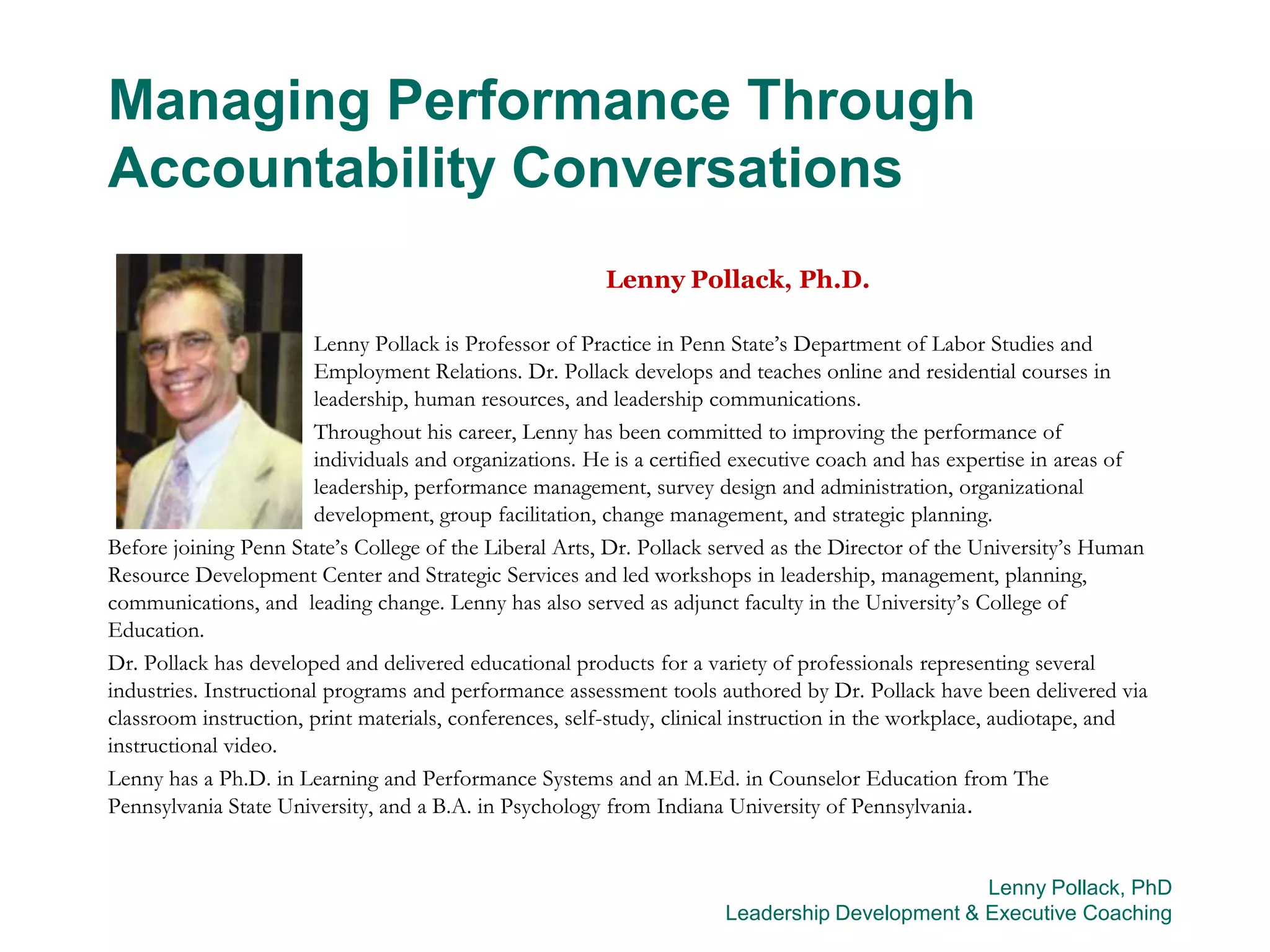
                                                        Lenny Pollack, Ph.D.

                         Lenny Pollack is Professor of Practice in Penn State’s Department of Labor Studies and
                         Employment Relations. Dr. Pollack develops and teaches online and residential courses in
                         leadership, human resources, and leadership communications.
                         Throughout his career, Lenny has been committed to improving the performance of
                         individuals and organizations. He is a certified executive coach and has expertise in areas of
                         leadership, performance management, survey design and administration, organizational
                         development, group facilitation, change management, and strategic planning.
Before joining Penn State’s College of the Liberal Arts, Dr. Pollack served as the Director of the University’s Human
Resource Development Center and Strategic Services and led workshops in leadership, management, planning,
communications, and leading change. Lenny has also served as adjunct faculty in the University’s College of
Education.
Dr. Pollack has developed and delivered educational products for a variety of professionals representing several
industries. Instructional programs and performance assessment tools authored by Dr. Pollack have been delivered via
classroom instruction, print materials, conferences, self-study, clinical instruction in the workplace, audiotape, and
instructional video.
Lenny has a Ph.D. in Learning and Performance Systems and an M.Ed. in Counselor Education from The
Pennsylvania State University, and a B.A. in Psychology from Indiana University of Pennsylvania.


                                                                                               Lenny Pollack, PhD
                                                                      Leadership Development & Executive Coaching
• HRTMS is a Talent Management software company, based
  in North Carolina that includes:
   –                : an on-line job description management tool
                       that allows you to maintain accurate &
                       up-to-date job descriptions

   –                  : an automated system to accurately evaluate
                        employee performance in your unique
                        environment

   –                  : web-based compensation solution that uses
                        your Excel workbooks


                                                                Lenny Pollack, PhD
                                       Leadership Development & Executive Coaching
Managing Performance
Through Accountability
    Conversations
                  Lenny Pollack, PhD

                         Executive Coach
         Professor of Practice, Penn State

                           June 28, 2012
Today’s Agenda:
Managing Performance
through Accountability Conversations
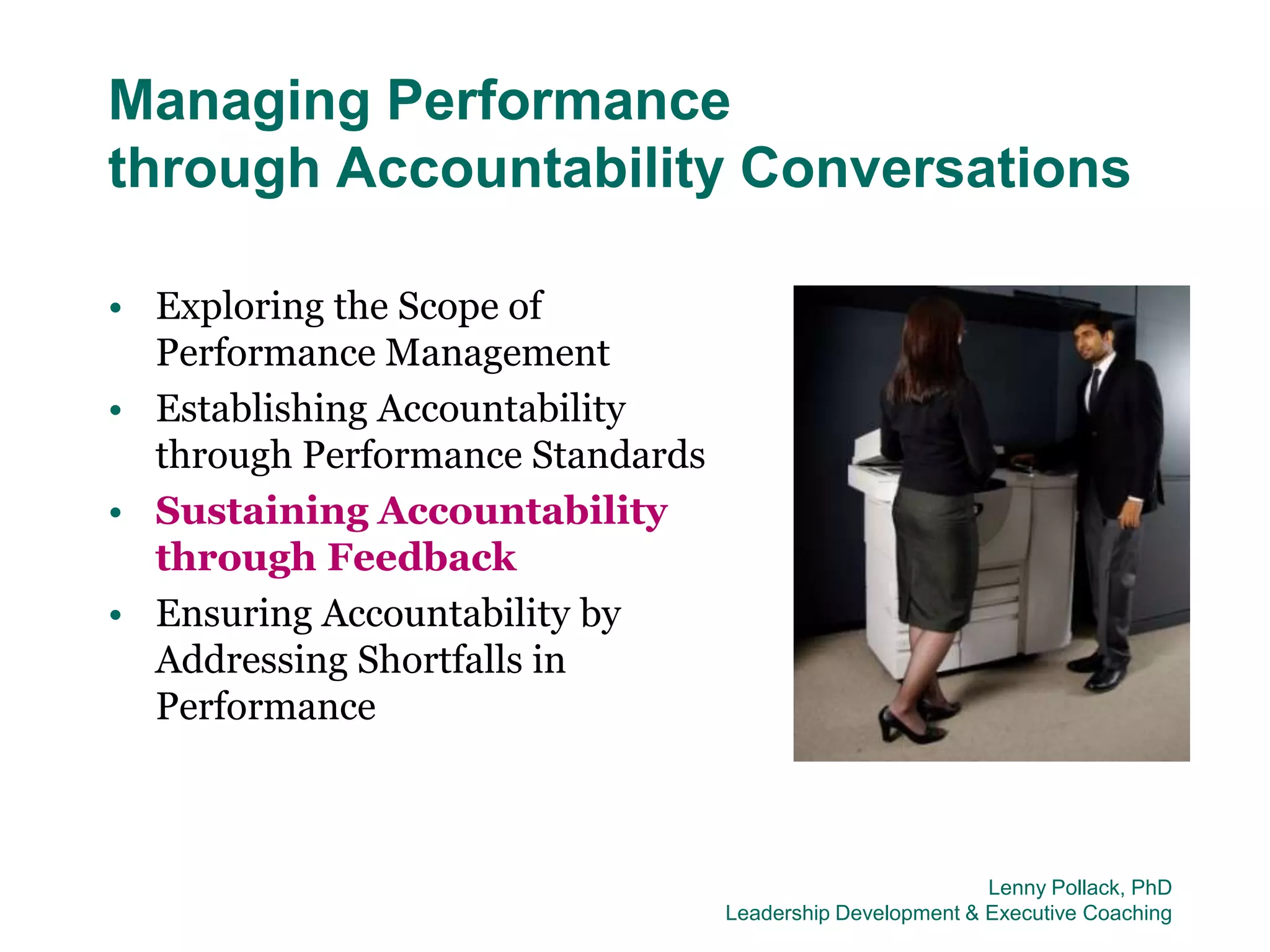
• Exploring the Scope of
  Performance Management
• Establishing Accountability
  through Performance Standards
• Sustaining Accountability
  through Feedback
• Ensuring Accountability by
  Addressing Shortfalls in
  Performance


                                                           Lenny Pollack, PhD
                                  Leadership Development & Executive Coaching
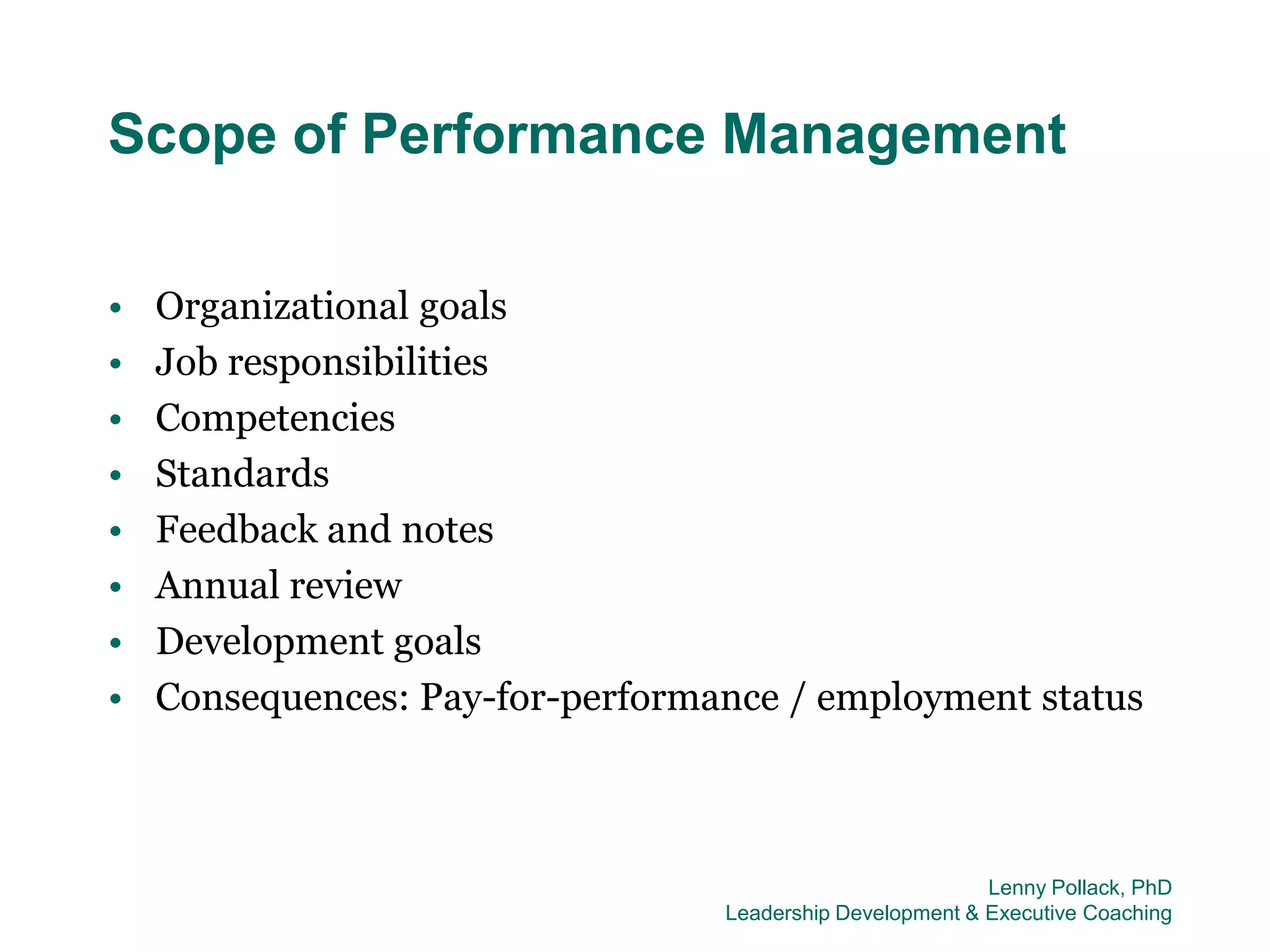
Scope of Performance Management

•   Organizational goals
•   Job responsibilities
•   Competencies
•   Standards
•   Feedback and notes
•   Annual review
•   Development goals
•   Consequences: Pay-for-performance / employment status


                                                           Lenny Pollack, PhD
                                  Leadership Development & Executive Coaching
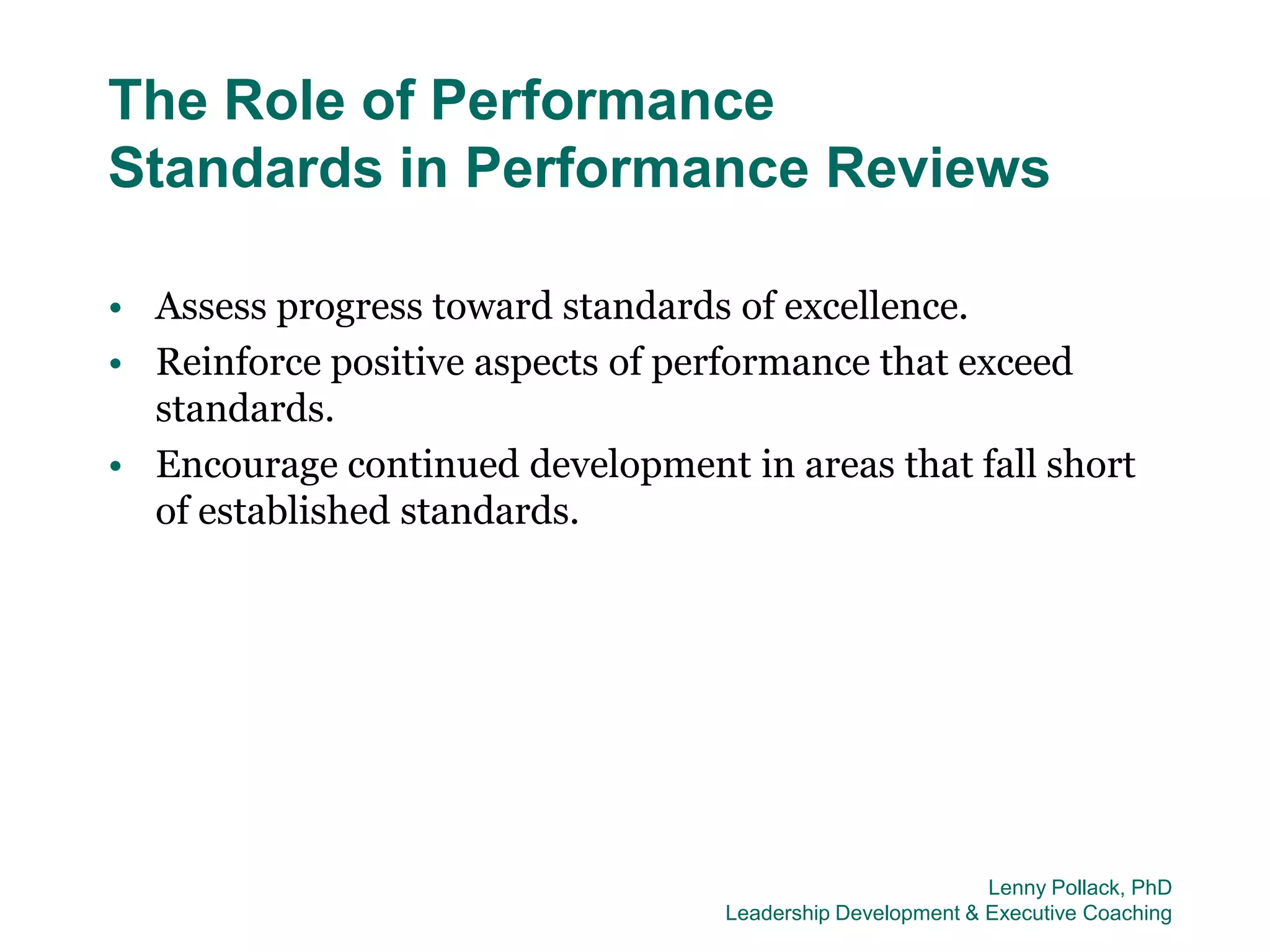
The Role of Performance
Standards in Performance Reviews

• Assess progress toward standards of excellence.
• Reinforce positive aspects of performance that exceed
  standards.
• Encourage continued development in areas that fall short
  of established standards.


                                                           Lenny Pollack, PhD
                                  Leadership Development & Executive Coaching
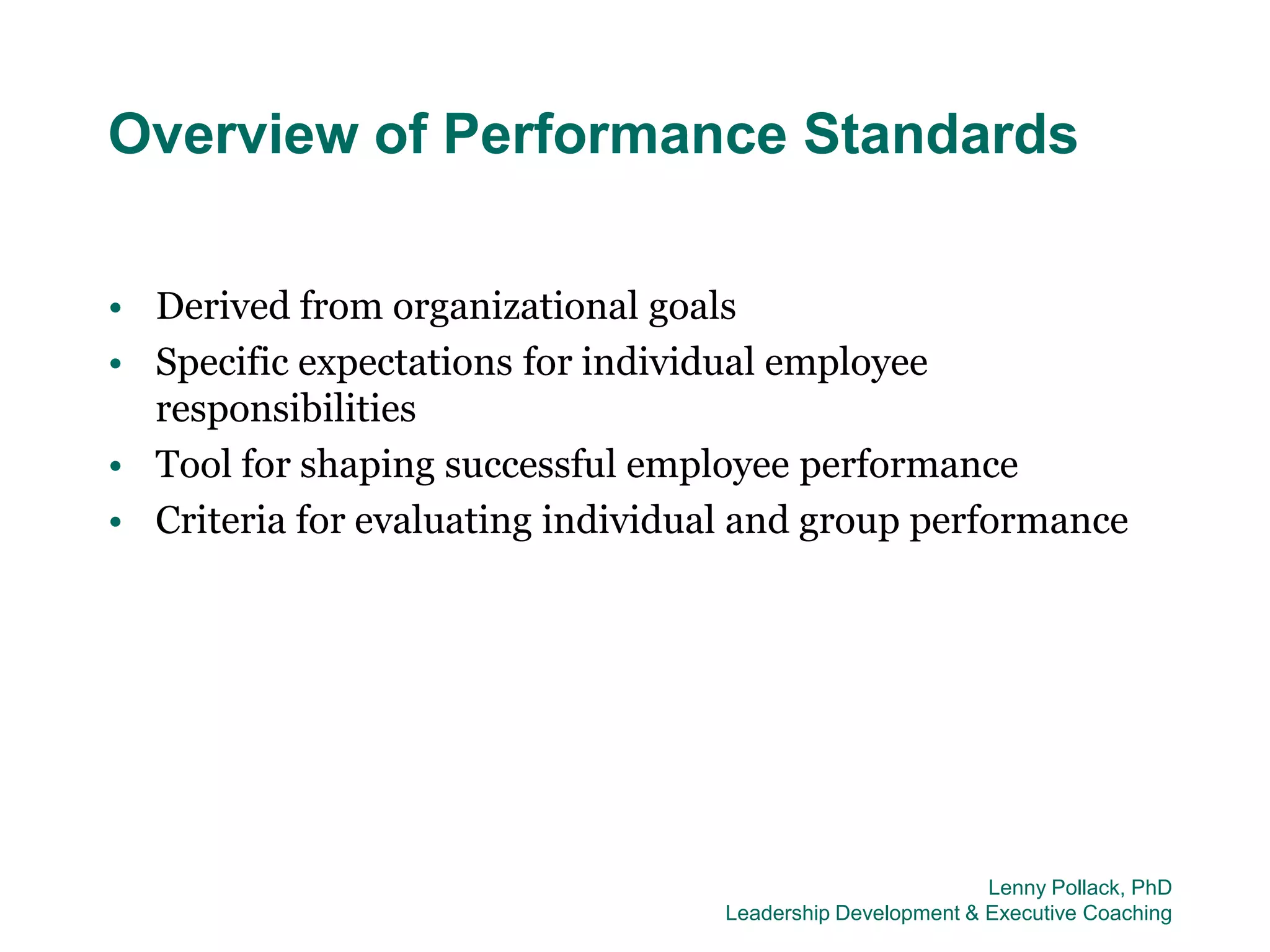
Overview of Performance Standards

• Derived from organizational goals
• Specific expectations for individual employee
  responsibilities
• Tool for shaping successful employee performance
• Criteria for evaluating individual and group performance


                                                            Lenny Pollack, PhD
                                   Leadership Development & Executive Coaching
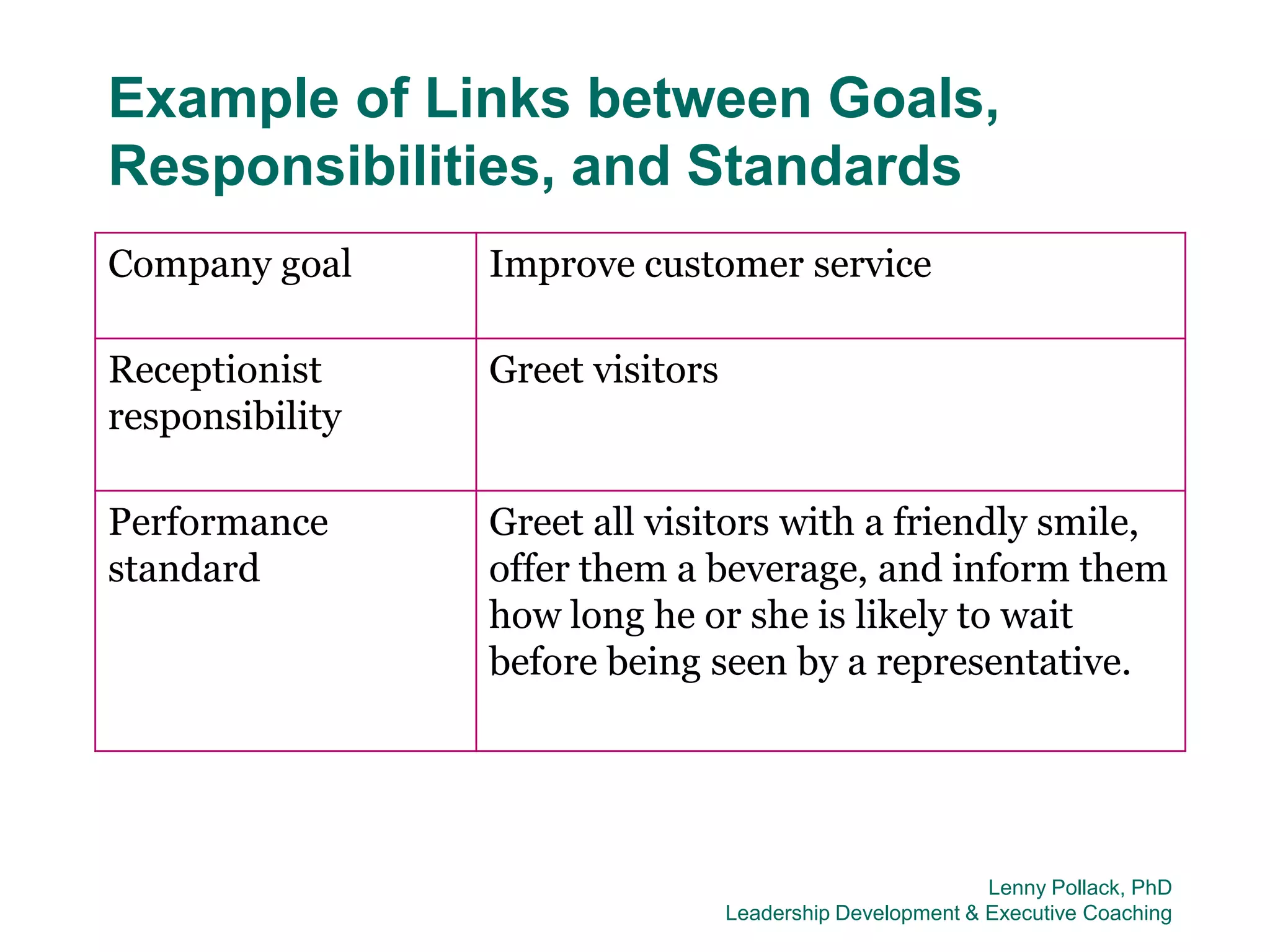
Example of Links between Goals,
Responsibilities, and Standards
Company goal     Improve customer service

Receptionist     Greet visitors
responsibility

Performance      Greet all visitors with a friendly smile,
standard         offer them a beverage, and inform them
                 how long he or she is likely to wait
                 before being seen by a representative.


                                                           Lenny Pollack, PhD
                                  Leadership Development & Executive Coaching
Using Standards to Foster
Accountability
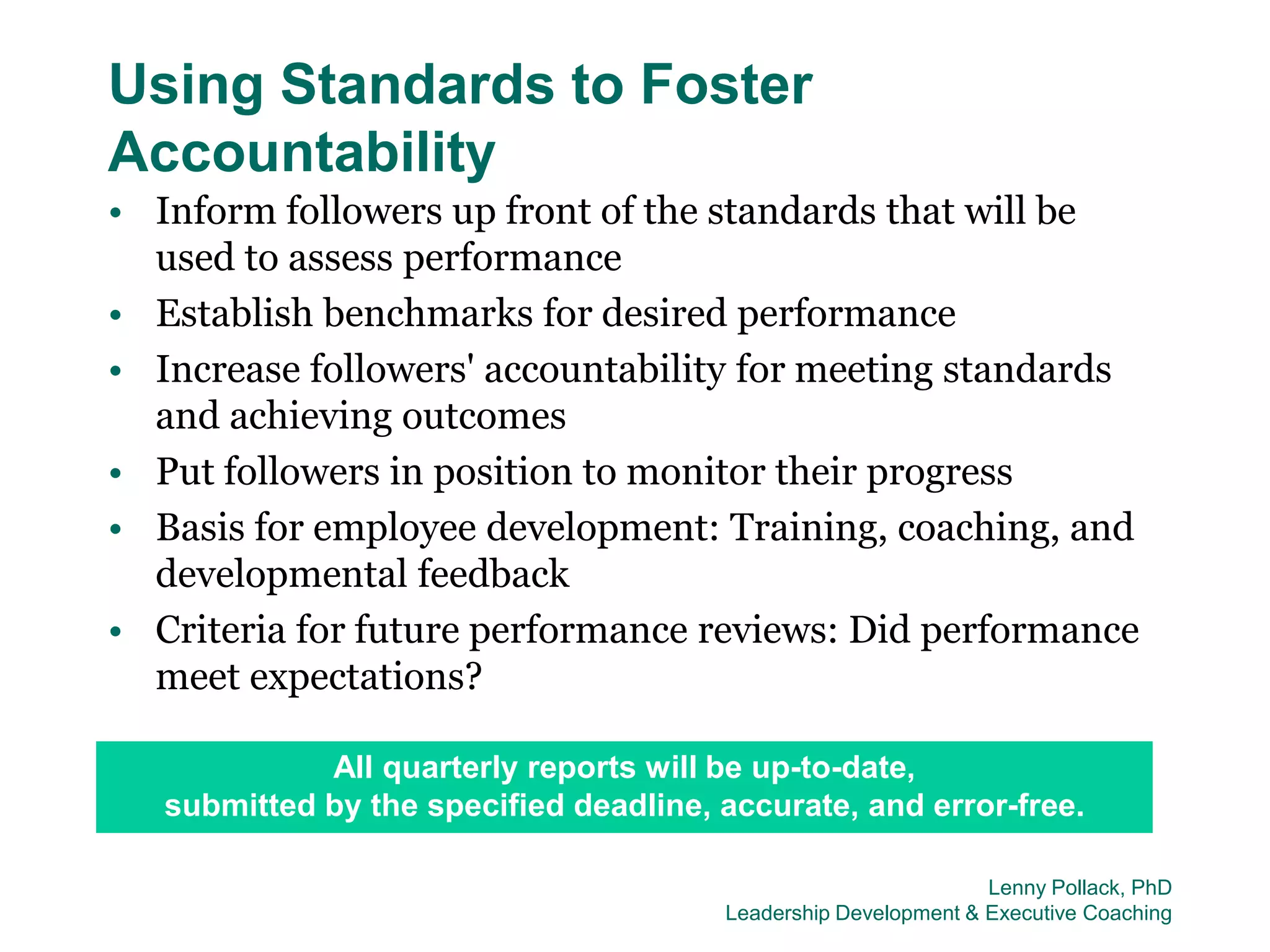
• Inform followers up front of the standards that will be
  used to assess performance
• Establish benchmarks for desired performance
• Increase followers' accountability for meeting standards
  and achieving outcomes
• Put followers in position to monitor their progress
• Basis for employee development: Training, coaching, and
  developmental feedback
• Criteria for future performance reviews: Did performance
  meet expectations?

             All quarterly reports will be up-to-date,
   submitted by the specified deadline, accurate, and error-free.

                                                                 Lenny Pollack, PhD
                                        Leadership Development & Executive Coaching
Examples of Performance Standards
• Each rest room will be spotless and fully-stocked with
  supplies after cleaning.

• Each client will be greeted politely, offered a hot or cold
  beverage, and told approximately how long they are likely
  to wait before being seen by a representative.

• The new project filing system will be fully-implemented by
  July 1; and files will be searchable by date, client name, and
  project title with online help available to all users so that all
  staff are able to use the system without the need for
  training.

                                                                Lenny Pollack, PhD
                                       Leadership Development & Executive Coaching
More Examples of Performance
Standards

• All project team meetings will begin with a review of the
  meeting’s goal and major discussion topics, adjourn the
  meeting within 5 minutes of the scheduled time, and
  conclude with a review of action items that describe
  individual tasks with due target dates.

• Monthly payroll action forms will be error-free and
  submitted for the manager’s approval at least two work
  days before each payroll deadline.


                                                             Lenny Pollack, PhD
                                    Leadership Development & Executive Coaching
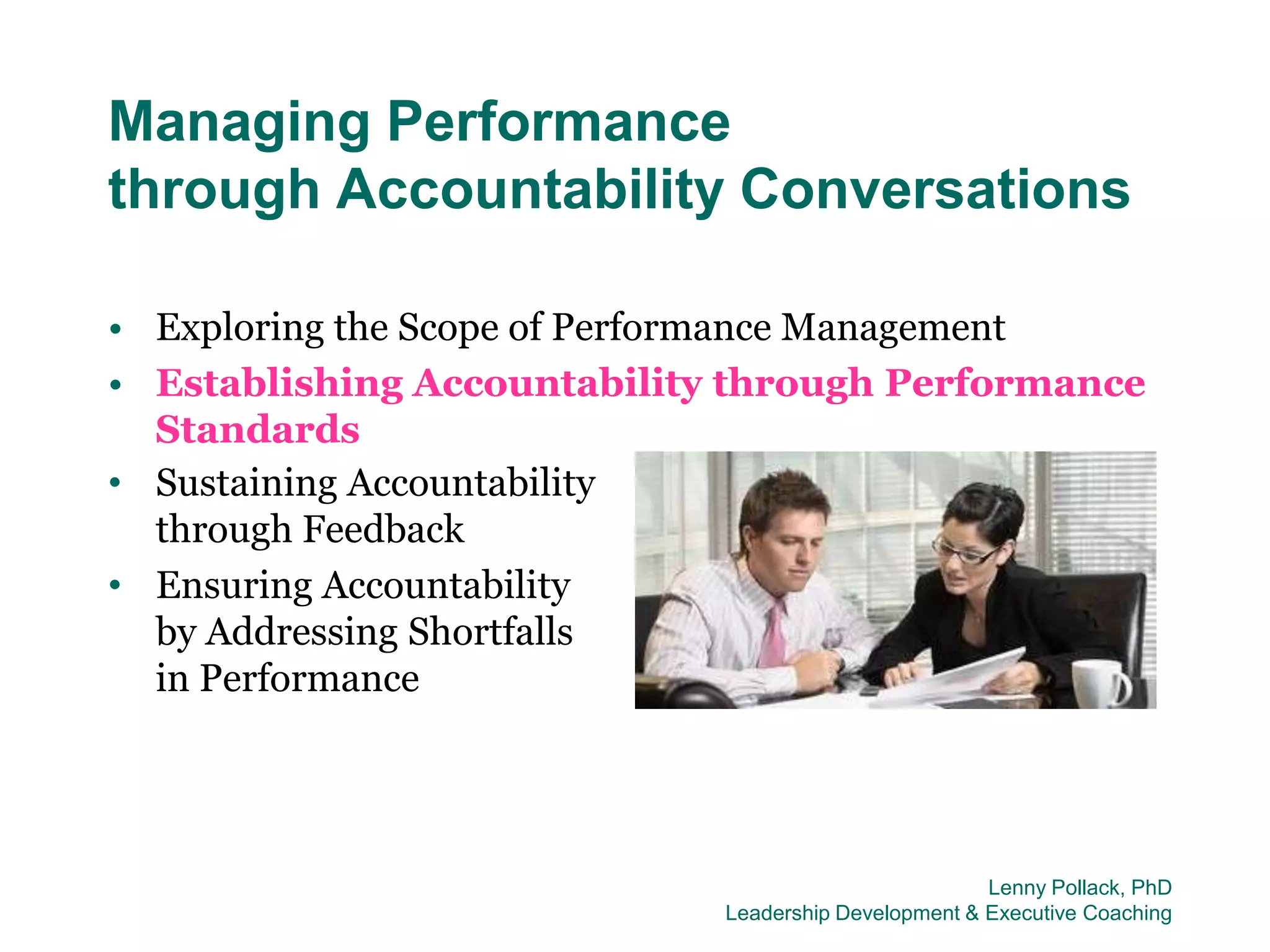
Managing Performance
through Accountability Conversations

• Exploring the Scope of Performance Management
• Establishing Accountability through Performance
  Standards
• Sustaining Accountability
  through Feedback
• Ensuring Accountability
  by Addressing Shortfalls
  in Performance


                                                      Lenny Pollack, PhD
                             Leadership Development & Executive Coaching
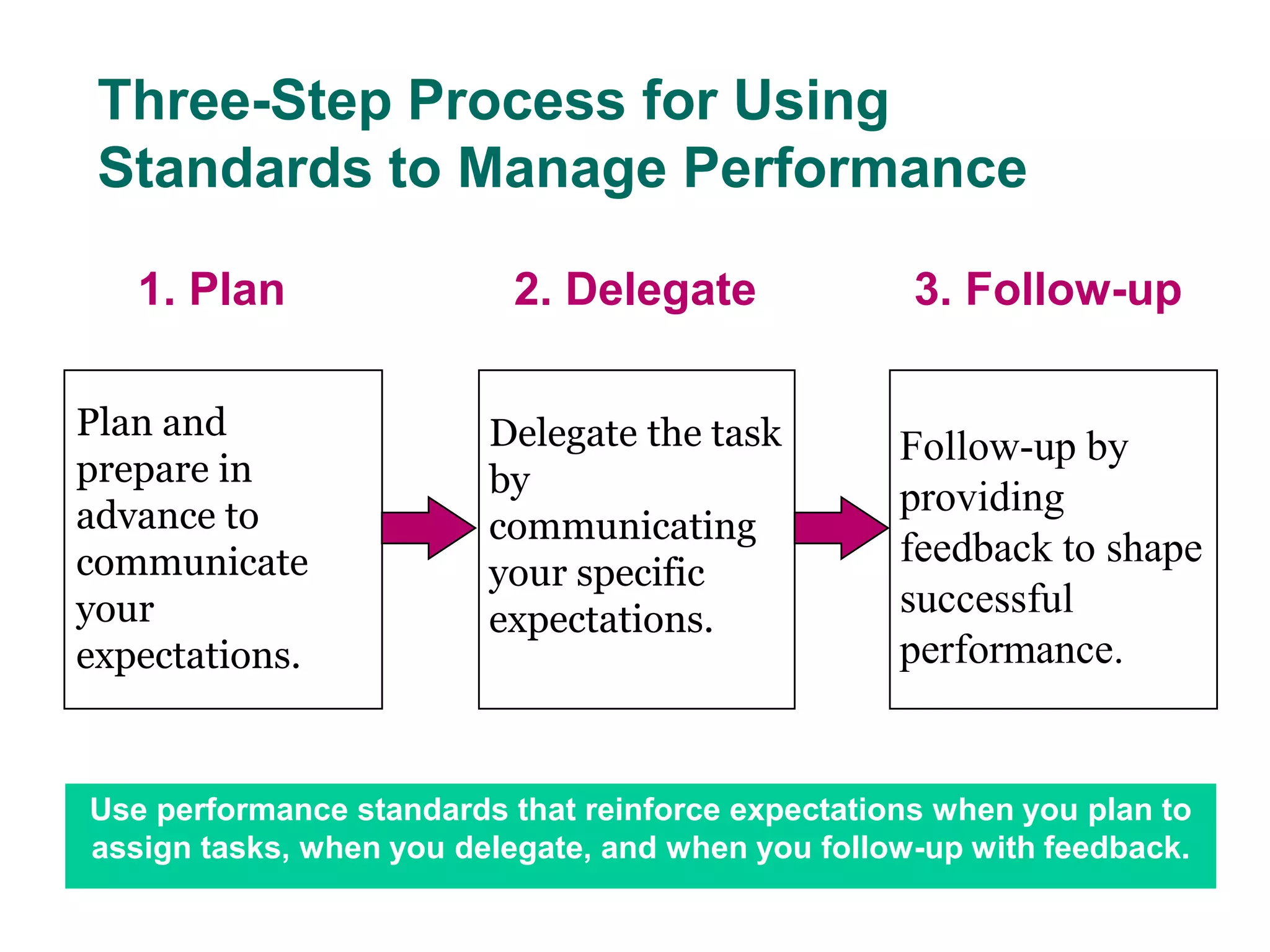
Three-Step Process for Using
 Standards to Manage Performance

   1. Plan                2. Delegate               3. Follow-up

Plan and                 Delegate the task         Follow-up by
prepare in               by
advance to                                         providing
                         communicating
communicate                                        feedback to shape
                         your specific
your                     expectations.
                                                   successful
expectations.                                      performance.


Use performance standards that reinforce expectations when you plan to
assign tasks, when you delegate, and when you follow-up with feedback.
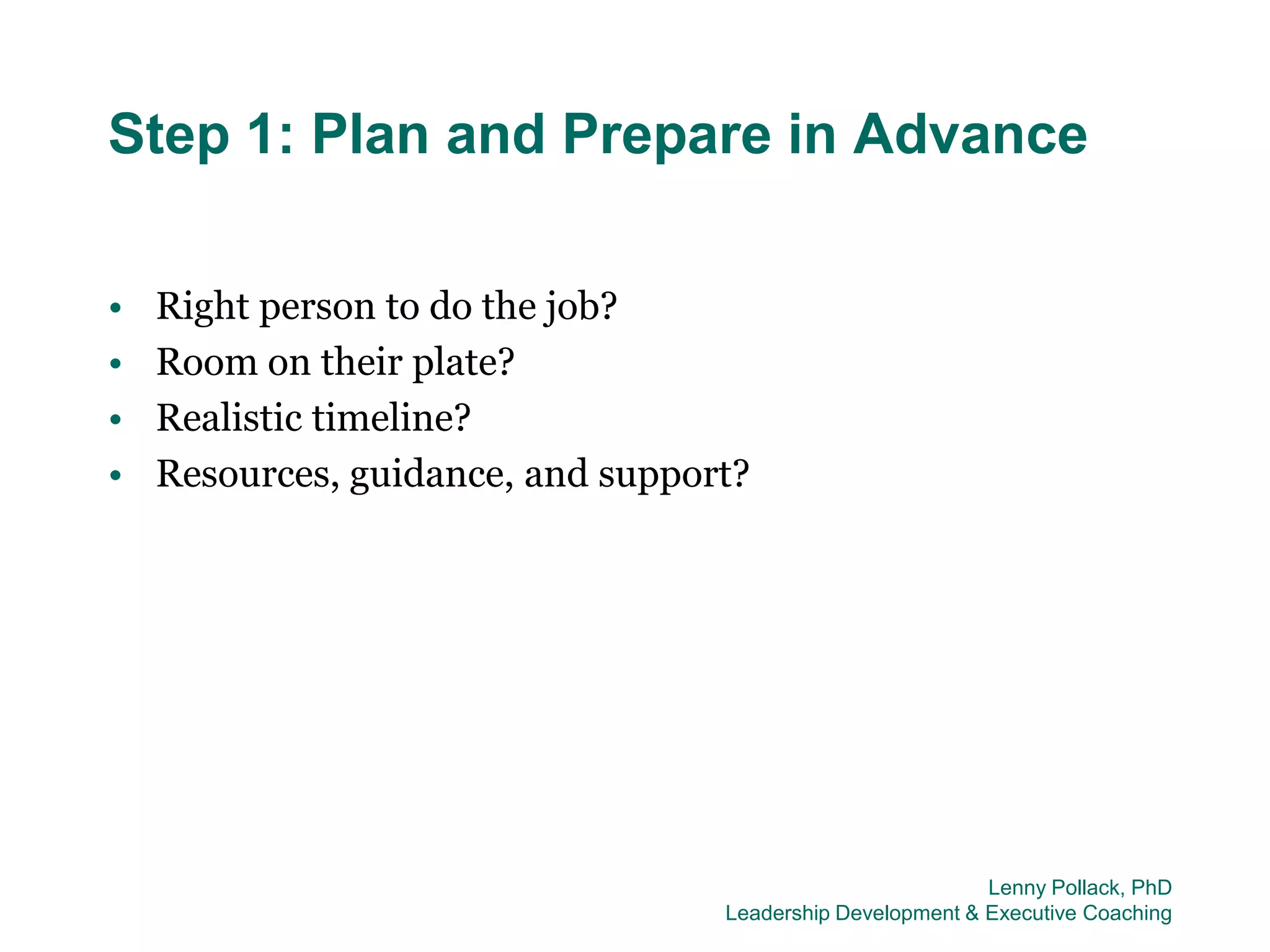
Step 1: Plan and Prepare in Advance

•   Right person to do the job?
•   Room on their plate?
•   Realistic timeline?
•   Resources, guidance, and support?


                                                            Lenny Pollack, PhD
                                   Leadership Development & Executive Coaching
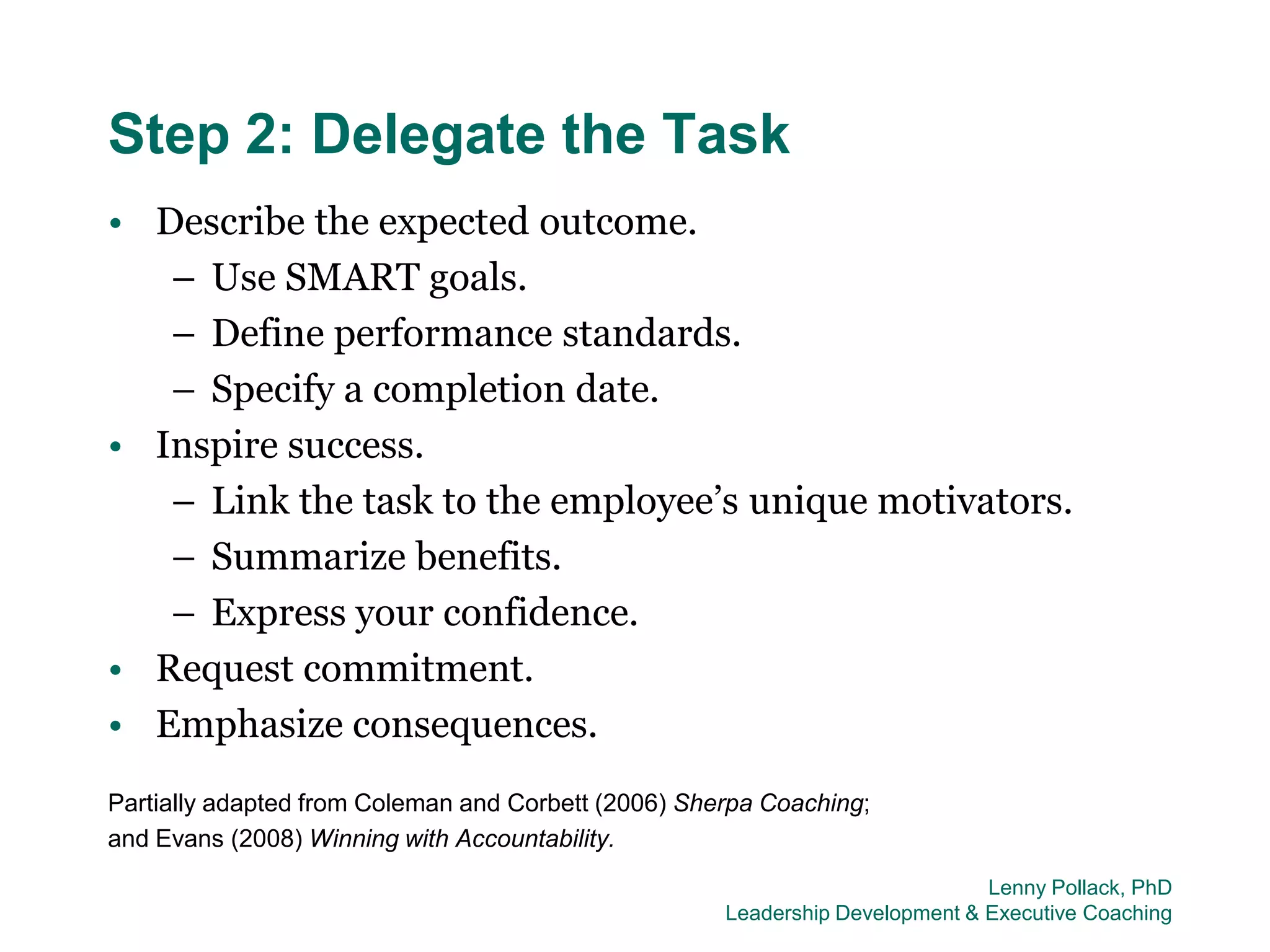
Step 2: Delegate the Task
• Describe the expected outcome.
   – Use SMART goals.
   – Define performance standards.
   – Specify a completion date.
• Inspire success.
   – Link the task to the employee’s unique motivators.
   – Summarize benefits.
   – Express your confidence.
• Request commitment.
• Emphasize consequences.
Partially adapted from Coleman and Corbett (2006) Sherpa Coaching;
and Evans (2008) Winning with Accountability.
                                                                              Lenny Pollack, PhD
                                                     Leadership Development & Executive Coaching
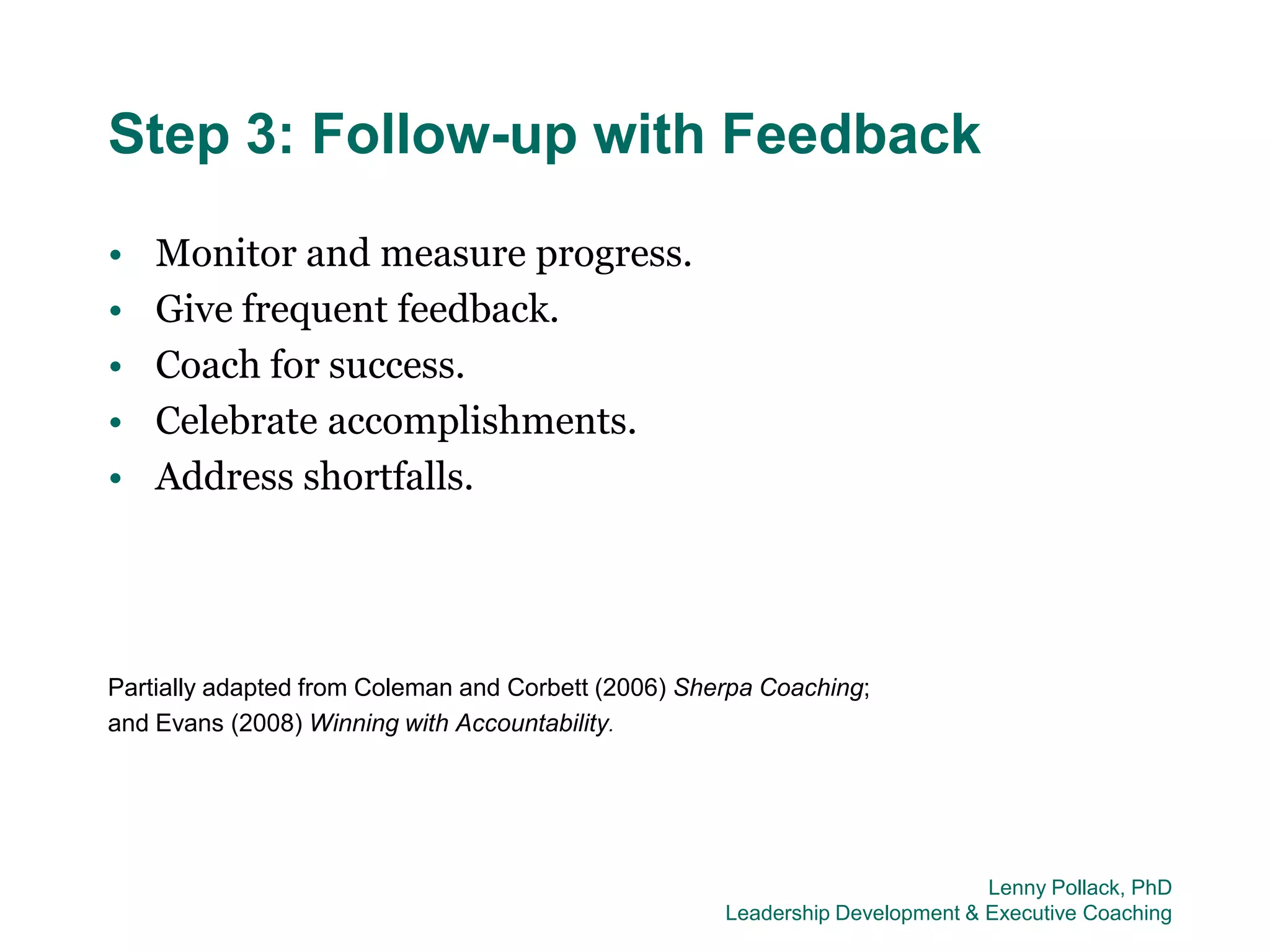
Step 3: Follow-up with Feedback
•   Monitor and measure progress.
•   Give frequent feedback.
•   Coach for success.
•   Celebrate accomplishments.
•   Address shortfalls.


Partially adapted from Coleman and Corbett (2006) Sherpa Coaching;
and Evans (2008) Winning with Accountability.


                                                                              Lenny Pollack, PhD
                                                     Leadership Development & Executive Coaching
Managing Performance
through Accountability Conversations

• Exploring the Scope of
  Performance Management
• Establishing Accountability
  through Performance Standards
• Sustaining Accountability
  through Feedback
• Ensuring Accountability by
  Addressing Shortfalls in
  Performance


                                                           Lenny Pollack, PhD
                                  Leadership Development & Executive Coaching
Possible Goals for Performance
Feedback

•   To inform followers of their effectiveness
•   To encourage improvement
•   To reinforce positive behaviors
•   To reward progressive improvement
•   To correct negative behaviors
•   To minimize future surprises
•   To increase employee engagement


                                                               Lenny Pollack, PhD
                                      Leadership Development & Executive Coaching
Characteristics of Constructive
Feedback

•   Helpful
•   Behavioral
•   Descriptive
•   Specific
•   Immediate
•   Continuous
•   Direct
•   Discussed
•   Constructive


                                               Lenny Pollack, PhD
                      Leadership Development & Executive Coaching
Skill Points for Giving Positive
Feedback

•   Describe the behavior.
•   Review the relevant performance standard.
•   Explain the upside of the positive behavior.
•   Discuss the employee’s perspective.
•   Express confidence in the employee.
•   Thank the employee for their good work.


                                                              Lenny Pollack, PhD
                                     Leadership Development & Executive Coaching
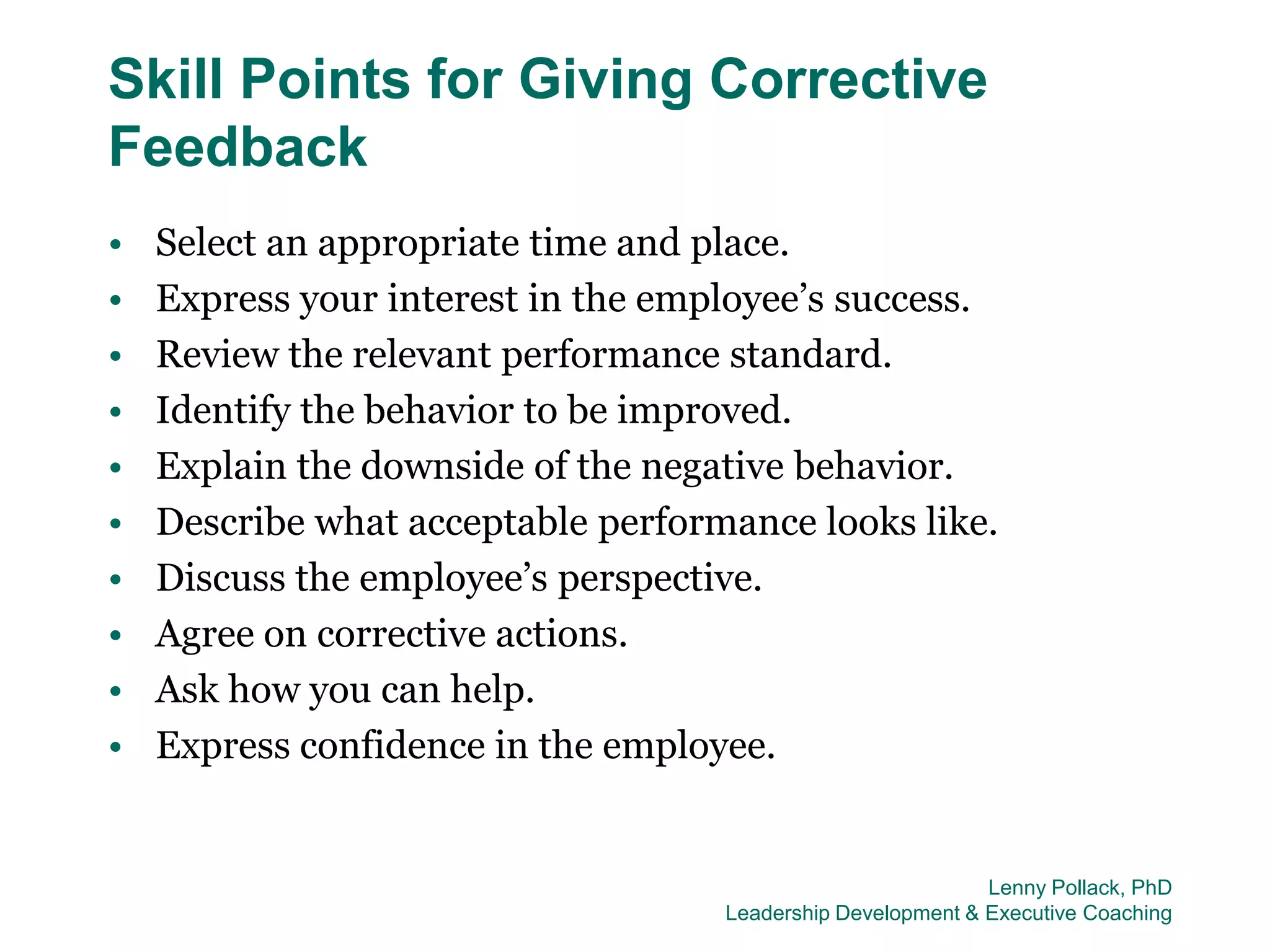
Skill Points for Giving Corrective
Feedback
•   Select an appropriate time and place.
•   Express your interest in the employee’s success.
•   Review the relevant performance standard.
•   Identify the behavior to be improved.
•   Explain the downside of the negative behavior.
•   Describe what acceptable performance looks like.
•   Discuss the employee’s perspective.
•   Agree on corrective actions.
•   Ask how you can help.
•   Express confidence in the employee.


                                                             Lenny Pollack, PhD
                                    Leadership Development & Executive Coaching
Managing Performance
through Accountability Conversations

• Exploring the Scope of Performance Management
• Establishing Accountability through Performance
  Standards
• Sustaining
  Accountability through
  Feedback
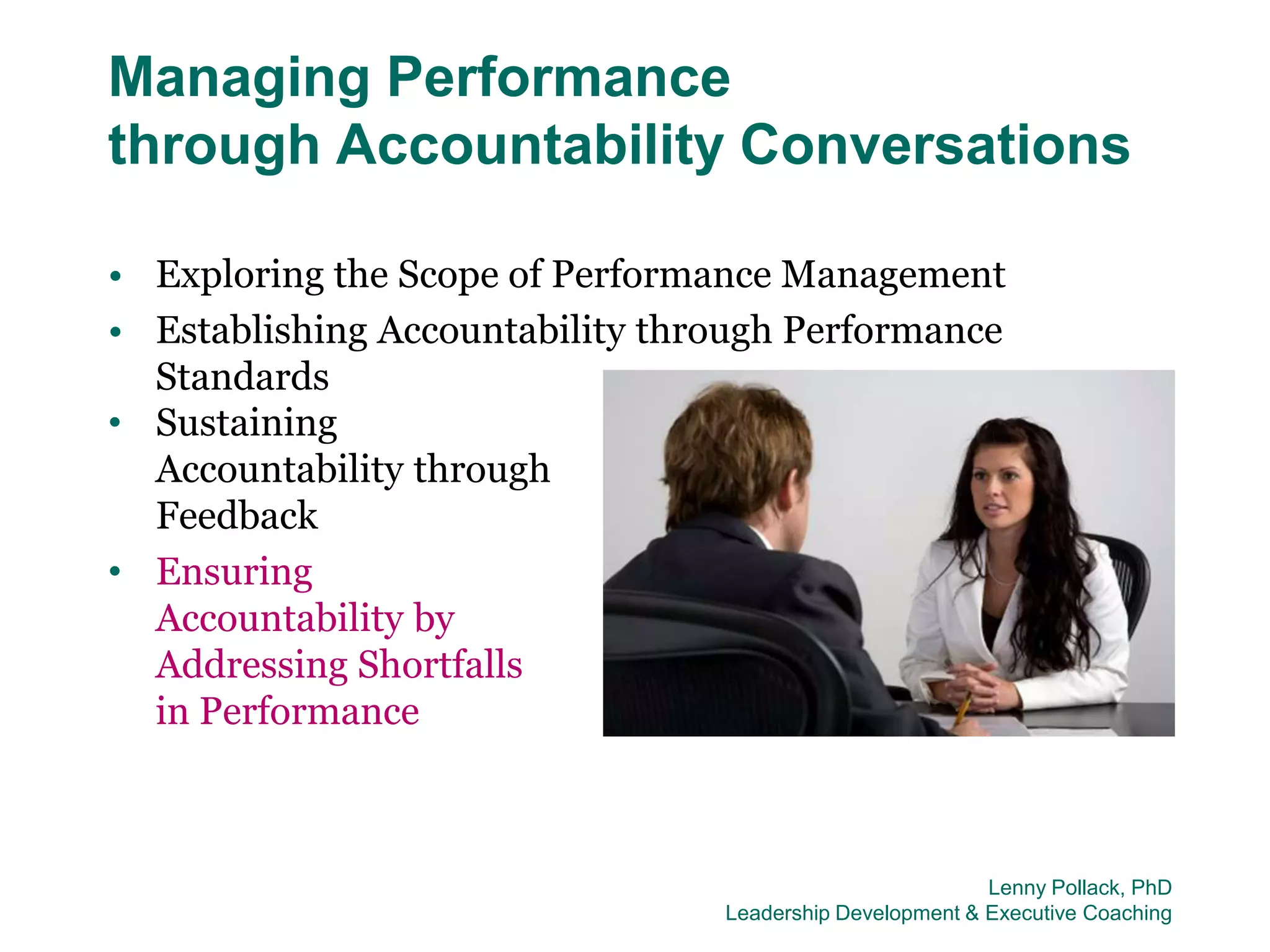
• Ensuring
  Accountability by
  Addressing Shortfalls
  in Performance


                                                          Lenny Pollack, PhD
                                 Leadership Development & Executive Coaching
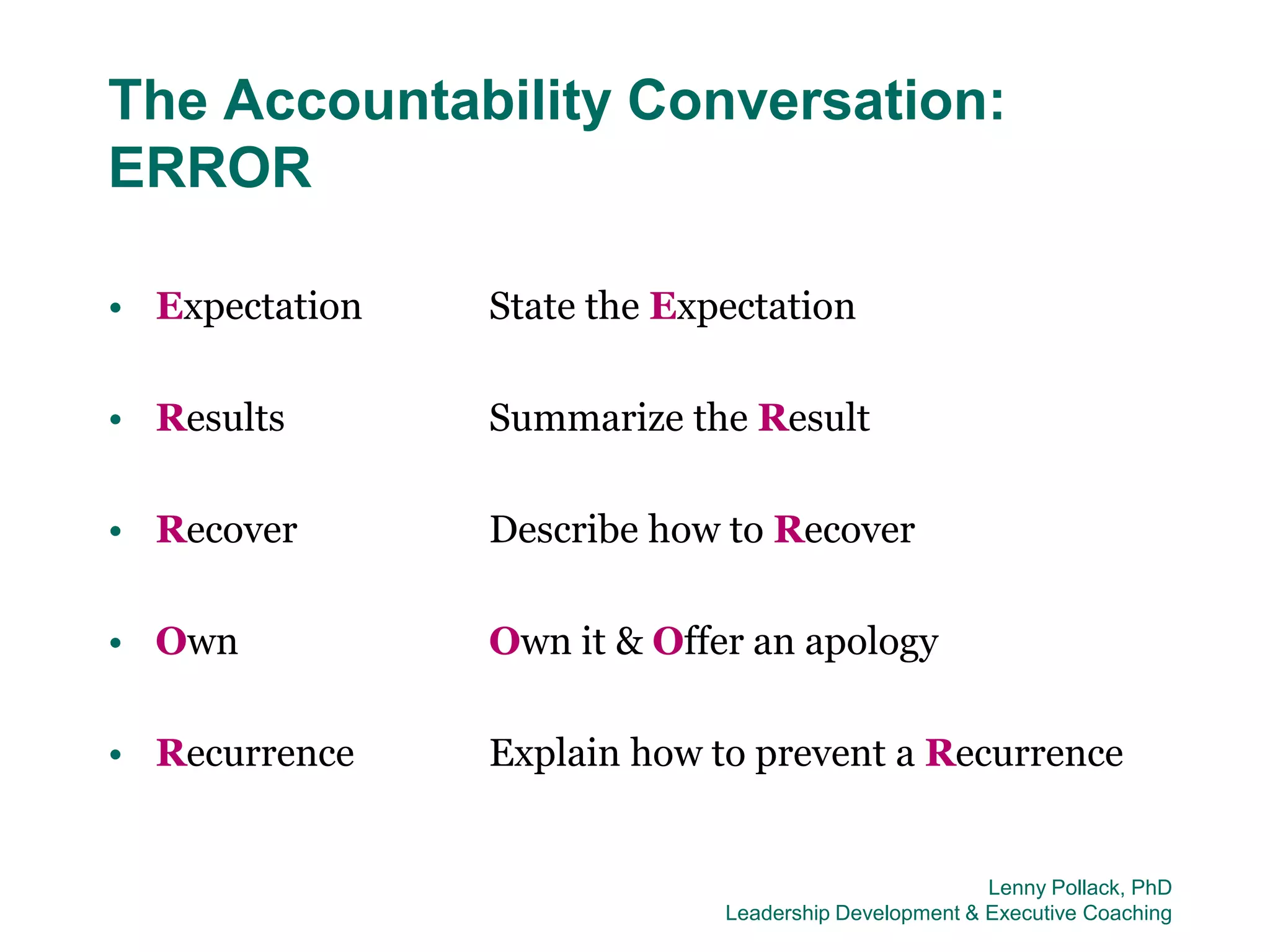
The Accountability Conversation:
ERROR

• Expectation   State the Expectation

• Results       Summarize the Result

• Recover       Describe how to Recover

• Own           Own it & Offer an apology

• Recurrence    Explain how to prevent a Recurrence


                                                      Lenny Pollack, PhD
                             Leadership Development & Executive Coaching
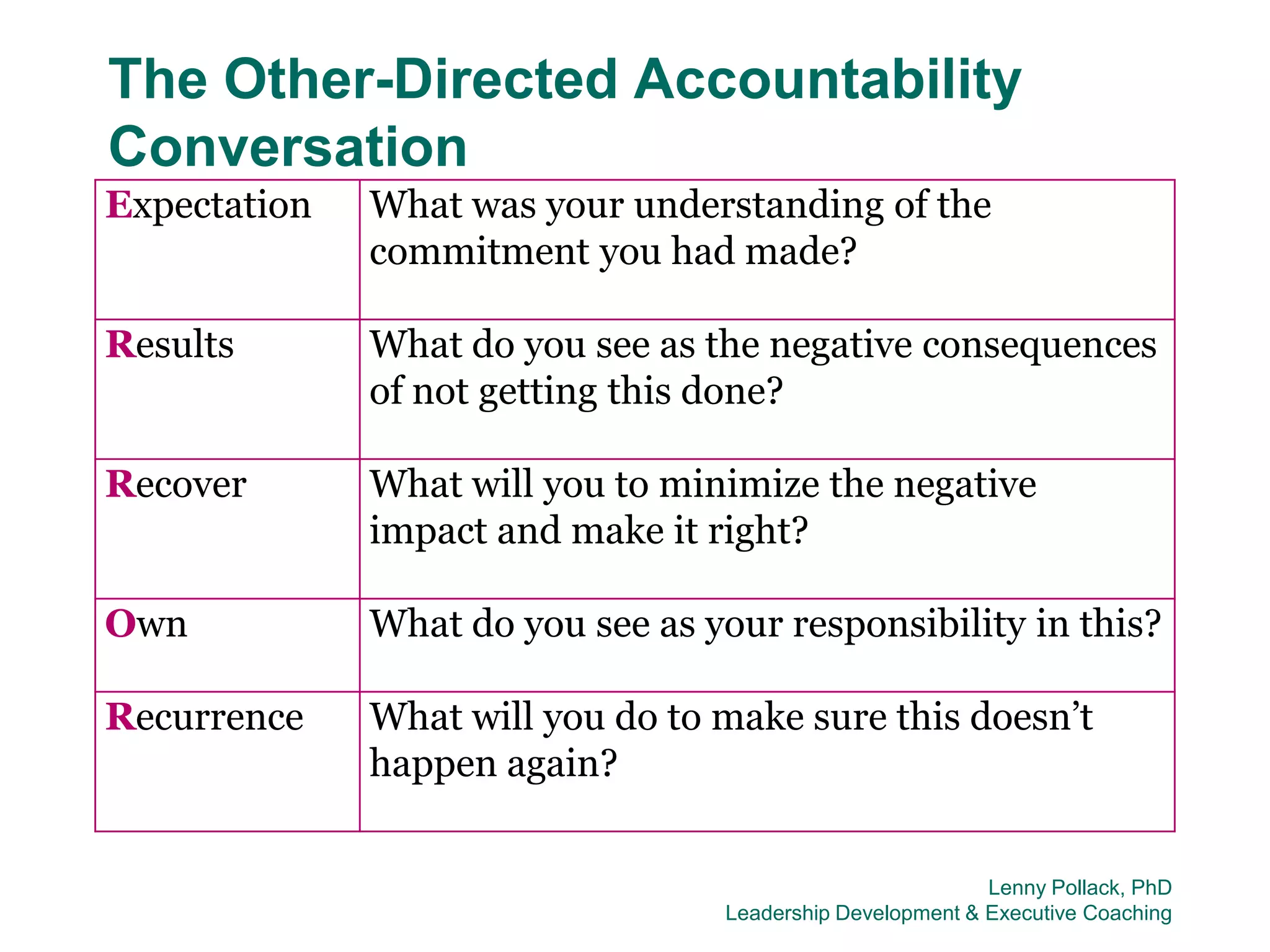
The Other-Directed Accountability
Conversation
Expectation   What was your understanding of the
              commitment you had made?

Results       What do you see as the negative consequences
              of not getting this done?

Recover       What will you to minimize the negative
              impact and make it right?

Own           What do you see as your responsibility in this?

Recurrence    What will you do to make sure this doesn’t
              happen again?


                                                            Lenny Pollack, PhD
                                   Leadership Development & Executive Coaching
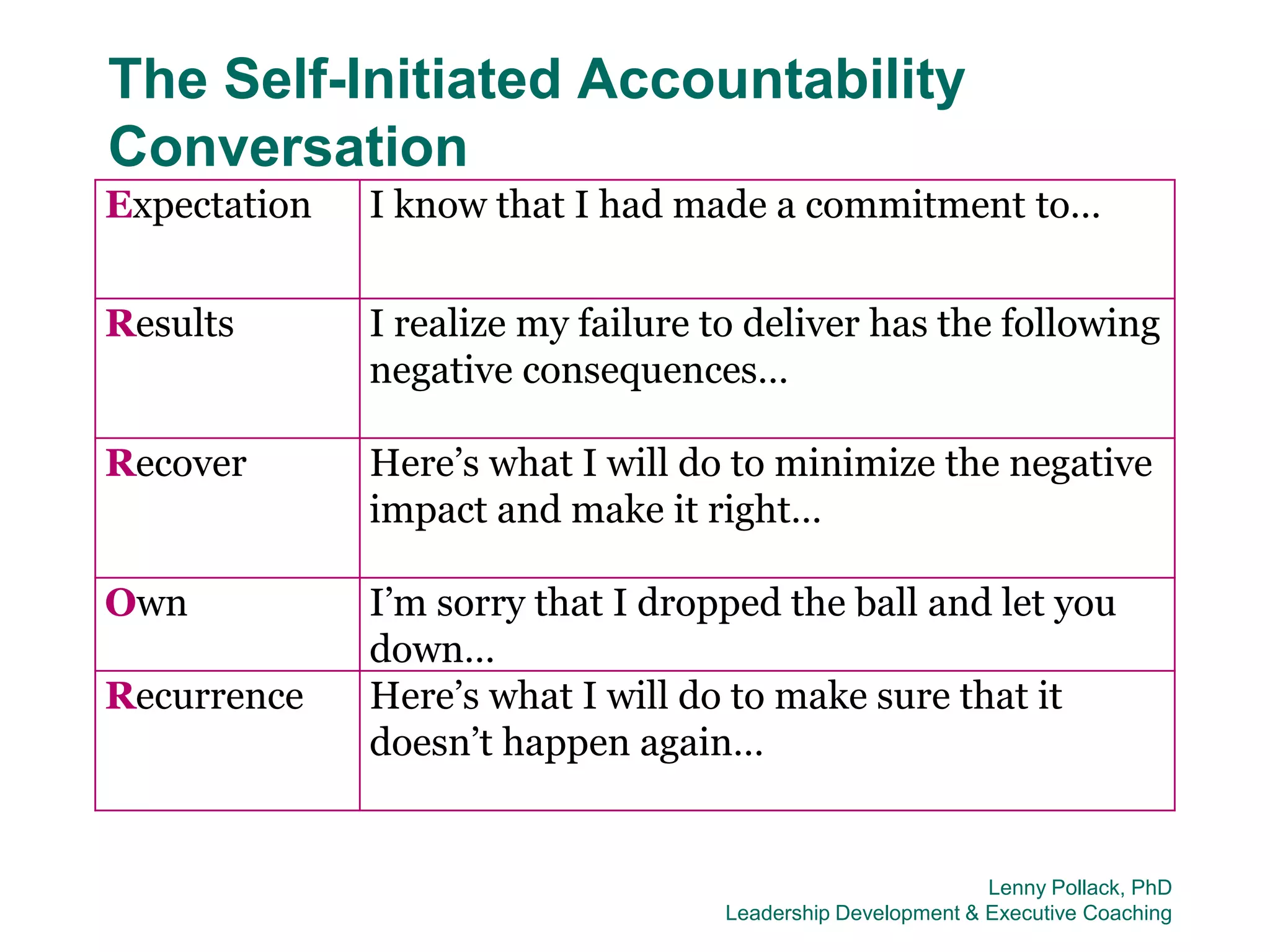
The Self-Initiated Accountability
Conversation
Expectation   I know that I had made a commitment to…


Results       I realize my failure to deliver has the following
              negative consequences…

Recover       Here’s what I will do to minimize the negative
              impact and make it right…

Own           I’m sorry that I dropped the ball and let you
              down…
Recurrence    Here’s what I will do to make sure that it
              doesn’t happen again…


                                                             Lenny Pollack, PhD
                                    Leadership Development & Executive Coaching
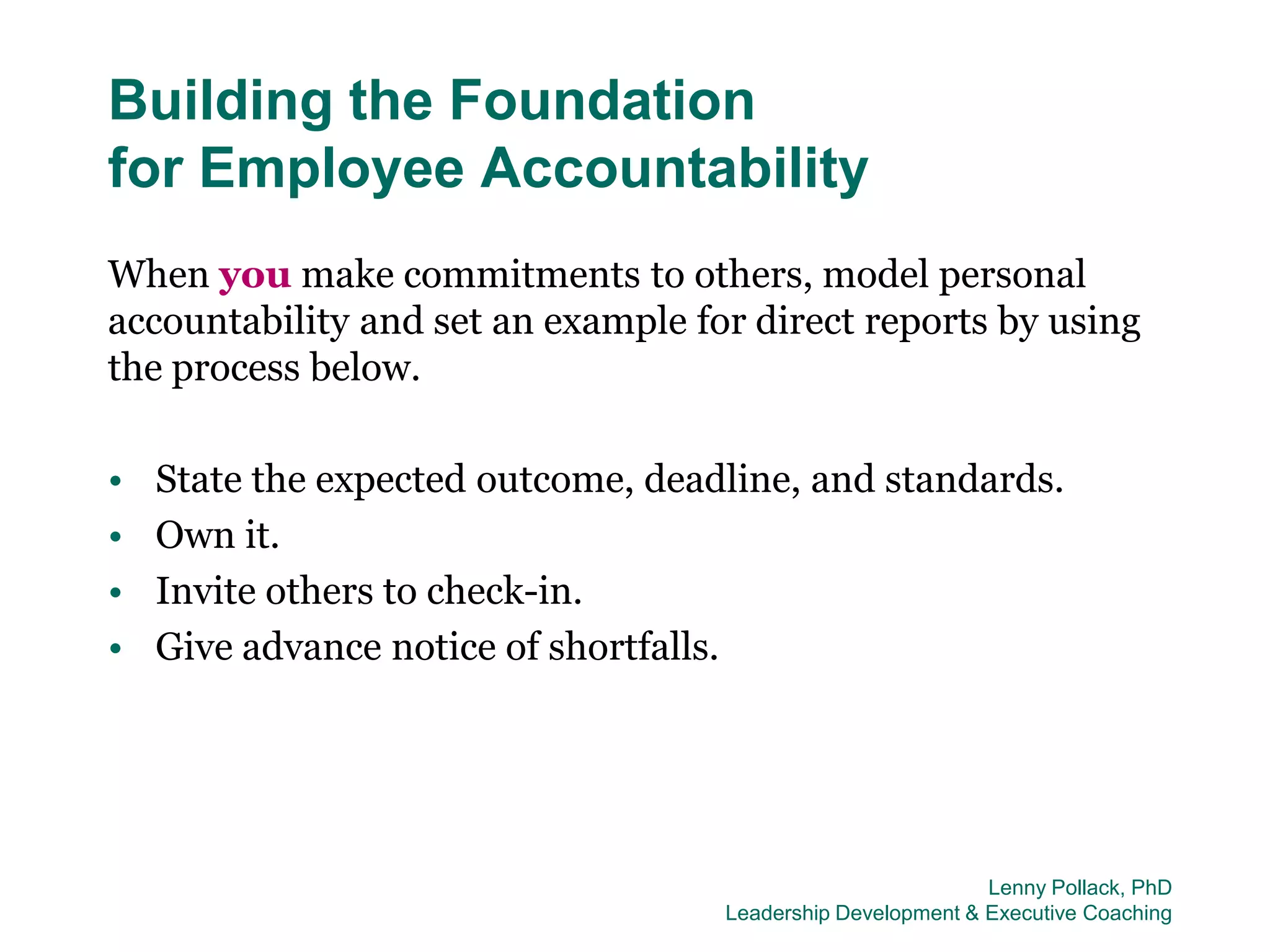
Building the Foundation
for Employee Accountability
When you make commitments to others, model personal
accountability and set an example for direct reports by using
the process below.

•   State the expected outcome, deadline, and standards.
•   Own it.
•   Invite others to check-in.
•   Give advance notice of shortfalls.


                                                             Lenny Pollack, PhD
                                    Leadership Development & Executive Coaching
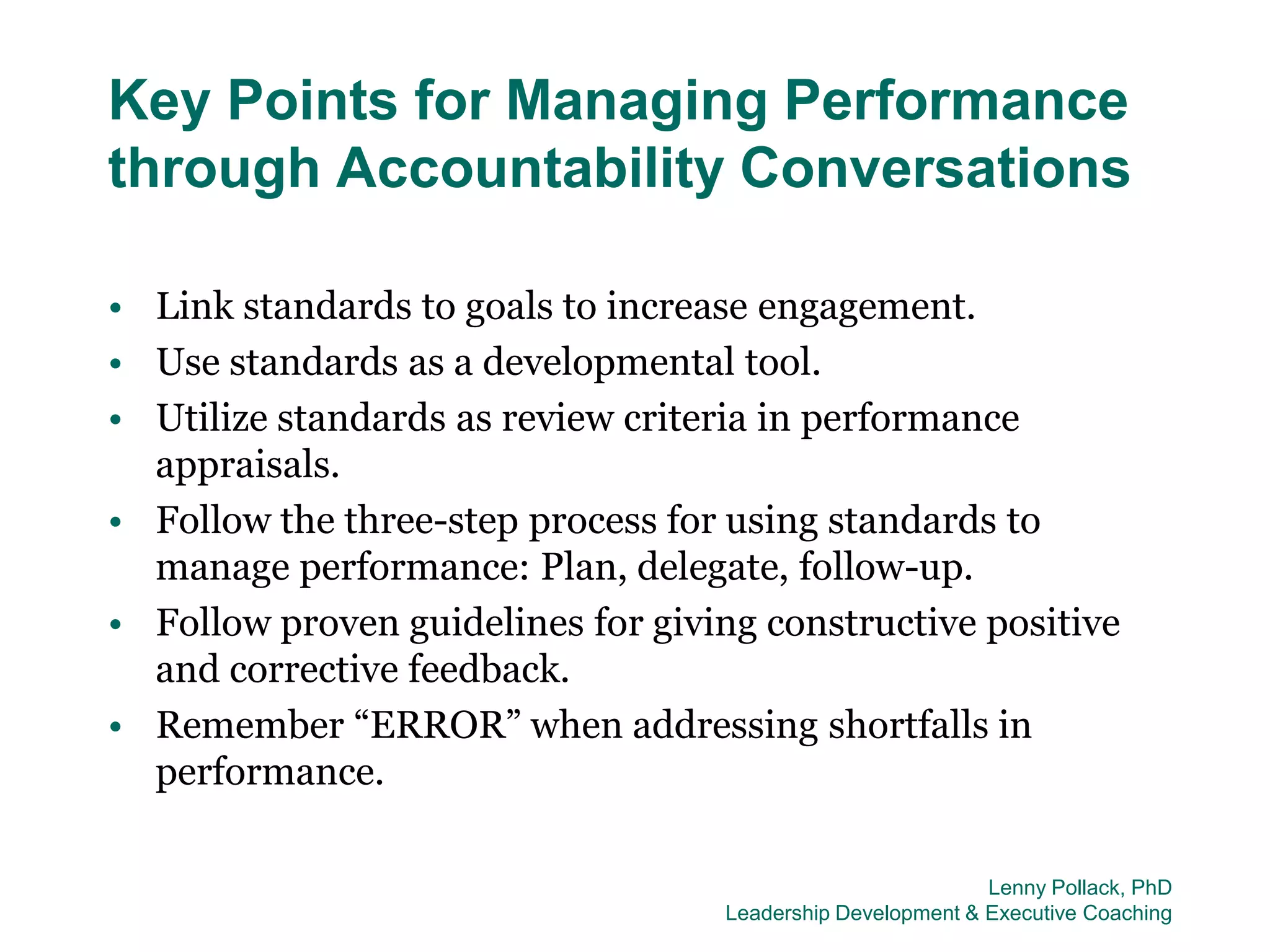
Key Points for Managing Performance
through Accountability Conversations

• Link standards to goals to increase engagement.
• Use standards as a developmental tool.
• Utilize standards as review criteria in performance
  appraisals.
• Follow the three-step process for using standards to
  manage performance: Plan, delegate, follow-up.
• Follow proven guidelines for giving constructive positive
  and corrective feedback.
• Remember “ERROR” when addressing shortfalls in
  performance.

                                                            Lenny Pollack, PhD
                                   Leadership Development & Executive Coaching
Questions

       Managing Performance
 Through Accountability Conversations

                                     Lenny Pollack
                                      lep2@psu.edu

                                       Bill Rost
                               brost@hrtms.com
                             919.351.JOBS (5627)


                                               Lenny Pollack, PhD
                      Leadership Development & Executive Coaching

Managing Performance Through Accountability Conversations

  • 1.
    Managing Performance Through AccountabilityConversations Lenny Pollack, Ph.D. Lenny Pollack is Professor of Practice in Penn State’s Department of Labor Studies and Employment Relations. Dr. Pollack develops and teaches online and residential courses in leadership, human resources, and leadership communications. Throughout his career, Lenny has been committed to improving the performance of individuals and organizations. He is a certified executive coach and has expertise in areas of leadership, performance management, survey design and administration, organizational development, group facilitation, change management, and strategic planning. Before joining Penn State’s College of the Liberal Arts, Dr. Pollack served as the Director of the University’s Human Resource Development Center and Strategic Services and led workshops in leadership, management, planning, communications, and leading change. Lenny has also served as adjunct faculty in the University’s College of Education. Dr. Pollack has developed and delivered educational products for a variety of professionals representing several industries. Instructional programs and performance assessment tools authored by Dr. Pollack have been delivered via classroom instruction, print materials, conferences, self-study, clinical instruction in the workplace, audiotape, and instructional video. Lenny has a Ph.D. in Learning and Performance Systems and an M.Ed. in Counselor Education from The Pennsylvania State University, and a B.A. in Psychology from Indiana University of Pennsylvania. Lenny Pollack, PhD Leadership Development & Executive Coaching
  • 2.
    • HRTMS isa Talent Management software company, based in North Carolina that includes: – : an on-line job description management tool that allows you to maintain accurate & up-to-date job descriptions – : an automated system to accurately evaluate employee performance in your unique environment – : web-based compensation solution that uses your Excel workbooks Lenny Pollack, PhD Leadership Development & Executive Coaching
  • 3.
    Managing Performance Through Accountability Conversations Lenny Pollack, PhD Executive Coach Professor of Practice, Penn State June 28, 2012
  • 4.
    Today’s Agenda: Managing Performance throughAccountability Conversations • Exploring the Scope of Performance Management • Establishing Accountability through Performance Standards • Sustaining Accountability through Feedback • Ensuring Accountability by Addressing Shortfalls in Performance Lenny Pollack, PhD Leadership Development & Executive Coaching
  • 5.
    Scope of PerformanceManagement • Organizational goals • Job responsibilities • Competencies • Standards • Feedback and notes • Annual review • Development goals • Consequences: Pay-for-performance / employment status Lenny Pollack, PhD Leadership Development & Executive Coaching
  • 6.
    The Role ofPerformance Standards in Performance Reviews • Assess progress toward standards of excellence. • Reinforce positive aspects of performance that exceed standards. • Encourage continued development in areas that fall short of established standards. Lenny Pollack, PhD Leadership Development & Executive Coaching
  • 7.
    Overview of PerformanceStandards • Derived from organizational goals • Specific expectations for individual employee responsibilities • Tool for shaping successful employee performance • Criteria for evaluating individual and group performance Lenny Pollack, PhD Leadership Development & Executive Coaching
  • 8.
    Example of Linksbetween Goals, Responsibilities, and Standards Company goal Improve customer service Receptionist Greet visitors responsibility Performance Greet all visitors with a friendly smile, standard offer them a beverage, and inform them how long he or she is likely to wait before being seen by a representative. Lenny Pollack, PhD Leadership Development & Executive Coaching
  • 9.
    Using Standards toFoster Accountability • Inform followers up front of the standards that will be used to assess performance • Establish benchmarks for desired performance • Increase followers' accountability for meeting standards and achieving outcomes • Put followers in position to monitor their progress • Basis for employee development: Training, coaching, and developmental feedback • Criteria for future performance reviews: Did performance meet expectations? All quarterly reports will be up-to-date, submitted by the specified deadline, accurate, and error-free. Lenny Pollack, PhD Leadership Development & Executive Coaching
  • 10.
    Examples of PerformanceStandards • Each rest room will be spotless and fully-stocked with supplies after cleaning. • Each client will be greeted politely, offered a hot or cold beverage, and told approximately how long they are likely to wait before being seen by a representative. • The new project filing system will be fully-implemented by July 1; and files will be searchable by date, client name, and project title with online help available to all users so that all staff are able to use the system without the need for training. Lenny Pollack, PhD Leadership Development & Executive Coaching
  • 11.
    More Examples ofPerformance Standards • All project team meetings will begin with a review of the meeting’s goal and major discussion topics, adjourn the meeting within 5 minutes of the scheduled time, and conclude with a review of action items that describe individual tasks with due target dates. • Monthly payroll action forms will be error-free and submitted for the manager’s approval at least two work days before each payroll deadline. Lenny Pollack, PhD Leadership Development & Executive Coaching
  • 12.
    Managing Performance through AccountabilityConversations • Exploring the Scope of Performance Management • Establishing Accountability through Performance Standards • Sustaining Accountability through Feedback • Ensuring Accountability by Addressing Shortfalls in Performance Lenny Pollack, PhD Leadership Development & Executive Coaching
  • 13.
    Three-Step Process forUsing Standards to Manage Performance 1. Plan 2. Delegate 3. Follow-up Plan and Delegate the task Follow-up by prepare in by advance to providing communicating communicate feedback to shape your specific your expectations. successful expectations. performance. Use performance standards that reinforce expectations when you plan to assign tasks, when you delegate, and when you follow-up with feedback.
  • 14.
    Step 1: Planand Prepare in Advance • Right person to do the job? • Room on their plate? • Realistic timeline? • Resources, guidance, and support? Lenny Pollack, PhD Leadership Development & Executive Coaching
  • 15.
    Step 2: Delegatethe Task • Describe the expected outcome. – Use SMART goals. – Define performance standards. – Specify a completion date. • Inspire success. – Link the task to the employee’s unique motivators. – Summarize benefits. – Express your confidence. • Request commitment. • Emphasize consequences. Partially adapted from Coleman and Corbett (2006) Sherpa Coaching; and Evans (2008) Winning with Accountability. Lenny Pollack, PhD Leadership Development & Executive Coaching
  • 16.
    Step 3: Follow-upwith Feedback • Monitor and measure progress. • Give frequent feedback. • Coach for success. • Celebrate accomplishments. • Address shortfalls. Partially adapted from Coleman and Corbett (2006) Sherpa Coaching; and Evans (2008) Winning with Accountability. Lenny Pollack, PhD Leadership Development & Executive Coaching
  • 17.
    Managing Performance through AccountabilityConversations • Exploring the Scope of Performance Management • Establishing Accountability through Performance Standards • Sustaining Accountability through Feedback • Ensuring Accountability by Addressing Shortfalls in Performance Lenny Pollack, PhD Leadership Development & Executive Coaching
  • 18.
    Possible Goals forPerformance Feedback • To inform followers of their effectiveness • To encourage improvement • To reinforce positive behaviors • To reward progressive improvement • To correct negative behaviors • To minimize future surprises • To increase employee engagement Lenny Pollack, PhD Leadership Development & Executive Coaching
  • 19.
    Characteristics of Constructive Feedback • Helpful • Behavioral • Descriptive • Specific • Immediate • Continuous • Direct • Discussed • Constructive Lenny Pollack, PhD Leadership Development & Executive Coaching
  • 20.
    Skill Points forGiving Positive Feedback • Describe the behavior. • Review the relevant performance standard. • Explain the upside of the positive behavior. • Discuss the employee’s perspective. • Express confidence in the employee. • Thank the employee for their good work. Lenny Pollack, PhD Leadership Development & Executive Coaching
  • 21.
    Skill Points forGiving Corrective Feedback • Select an appropriate time and place. • Express your interest in the employee’s success. • Review the relevant performance standard. • Identify the behavior to be improved. • Explain the downside of the negative behavior. • Describe what acceptable performance looks like. • Discuss the employee’s perspective. • Agree on corrective actions. • Ask how you can help. • Express confidence in the employee. Lenny Pollack, PhD Leadership Development & Executive Coaching
  • 22.
    Managing Performance through AccountabilityConversations • Exploring the Scope of Performance Management • Establishing Accountability through Performance Standards • Sustaining Accountability through Feedback • Ensuring Accountability by Addressing Shortfalls in Performance Lenny Pollack, PhD Leadership Development & Executive Coaching
  • 23.
    The Accountability Conversation: ERROR •Expectation State the Expectation • Results Summarize the Result • Recover Describe how to Recover • Own Own it & Offer an apology • Recurrence Explain how to prevent a Recurrence Lenny Pollack, PhD Leadership Development & Executive Coaching
  • 24.
    The Other-Directed Accountability Conversation Expectation What was your understanding of the commitment you had made? Results What do you see as the negative consequences of not getting this done? Recover What will you to minimize the negative impact and make it right? Own What do you see as your responsibility in this? Recurrence What will you do to make sure this doesn’t happen again? Lenny Pollack, PhD Leadership Development & Executive Coaching
  • 25.
    The Self-Initiated Accountability Conversation Expectation I know that I had made a commitment to… Results I realize my failure to deliver has the following negative consequences… Recover Here’s what I will do to minimize the negative impact and make it right… Own I’m sorry that I dropped the ball and let you down… Recurrence Here’s what I will do to make sure that it doesn’t happen again… Lenny Pollack, PhD Leadership Development & Executive Coaching
  • 26.
    Building the Foundation forEmployee Accountability When you make commitments to others, model personal accountability and set an example for direct reports by using the process below. • State the expected outcome, deadline, and standards. • Own it. • Invite others to check-in. • Give advance notice of shortfalls. Lenny Pollack, PhD Leadership Development & Executive Coaching
  • 27.
    Key Points forManaging Performance through Accountability Conversations • Link standards to goals to increase engagement. • Use standards as a developmental tool. • Utilize standards as review criteria in performance appraisals. • Follow the three-step process for using standards to manage performance: Plan, delegate, follow-up. • Follow proven guidelines for giving constructive positive and corrective feedback. • Remember “ERROR” when addressing shortfalls in performance. Lenny Pollack, PhD Leadership Development & Executive Coaching
  • 28.
    Questions Managing Performance Through Accountability Conversations Lenny Pollack lep2@psu.edu Bill Rost brost@hrtms.com 919.351.JOBS (5627) Lenny Pollack, PhD Leadership Development & Executive Coaching

Editor's Notes

  • #4 Review my relevant experience
  • #5 We’ll begin our discussion of Managing Performance through Accountability Conversations by examining the scope of performance management process, and then we’ll explore the use of performance standards as the keystone of that process.
  • #7 Use performance reviews (performance appraisals) as an opportunity to discuss the follower's success in meeting previously-established standards of excellence.
  • #8 Standards of excellence for broad organizational goals can be operationalized into more specific expectations for individual employees. They can be used as a tool for shaping successful employee performance, and as criteria for evaluating individual and group performance.
  • #9 When communicating standards, explain how the standard contributes to the organizational goal. Employee engagement increases when they have a clear line of sight showing how their work contributes to company priorities.
  • #10 Leaders who explicitly communicate their expectations for performance inform followers up front of the standards that will be used in the future to assess performance. By conveying standards in advance, the leader establishes benchmarks for desired performance outcomes and increases followers' accountability for meeting those standards and achieving those outcomes. Advance knowledge of performance standards puts followers in position to monitor their progress.  When concrete expectations about expected performance outcomes are discussed with employees in advance, they can be used as the basis for such employee development activities as training, coaching, providing feedback. In this way, performance standards can serve as a developmental tool for shaping successful employee performance. Performance standards can also be used as review criteria in future performance appraisals to gauge the extent to which observed performance met or exceeded expectations.
  • #15 Step 1: Plan and prepare in advance to communicate your expectations.Is this the right person to do the job? Is the task aligned with their other duties, expertise, and interests?Do they have “room on their plate?”What is a realistic timeline?What resources, guidance, and support will they need?
  • #16 Step 2: Delegate the task by communicating your specific expectations. Describe the expected outcome. Focus on the task to be completed.Use SMART goals [specific, measureable, achievable, results-oriented, and time-framed].Define performance standards--how success will be measured.Specify the date for completing the task and any milestones.Inspire success. Complement the focus on task by motivating your direct report.Link the task to each person’s unique motivators. Press the triggers that drive this individual. Highlight what’s important to them. Summarize benefits of success for the person and the organization.Express confidence in the person’s ability to succeed.Request commitment to complete the task. What is your understanding of this task?What do you need to make this happen?Can I count on you to deliver?Emphasize consequences for the person and the organization.Positives associated with successNegatives associated with shortfallsI find it useful to use this check sheet during the 1st step, when I’m planning to delegate a task, to ensure that I’m clear on all of my talking points.
  • #17 Step 3: Follow-up to shape successful performance. Monitor and measure progress toward meeting performance standards. Give frequent feedback.PositiveInformative: Achievements, progress, and “what’s working”Supportive: Confidence, recognition , and appreciationCorrective: How to refine and improve in order to meet standardsCoach for success: Provide the minimum level of guidance and structure needed for success.Reduce scaffolding as performance improves.Celebrate accomplishments.Hold “accountability conversations” to address shortfalls.
  • #19 There are a lot of good reasons for giving performance feedback. Any combination of the these possible goals could apply to a given situation. When managing performance, it’s important to be aware of your goals—what you’re trying to accomplish…and then tailor your comments accordingly.To inform followers of their effectiveness in meeting performance standardsTo encourage performance improvement and employee developmentTo reinforce positive behaviors To reward progressive improvement toward expected outcomesTo correct and redirect counter-productive behaviors To minimize surprises in future formal performance reviewsTo increase employee engagement by supporting employee development
  • #20 Characteristics of Constructive Feedback  Delivered with the intent to help rather than hurtBehavioral rather than personal: Directed toward modifiable behaviors rather than ingrained personality traits Descriptive and objective rather than judgmentalSpecific rather than generalImmediate rather than delayedContinuous rather than intermittentDirect [face-to-face] rather than indirect [email]Discussed rather than imposed: Understanding is checked rather than assumed Constructive rather than destructive tone
  • #21 Skill Points for Giving Positive Feedback  Describe the specific behavior for which the employee is being recognized.Review the relevant performance standard and explain how performance exceeds expectations.Explain how the positive behavior benefits you, the employee, and/or the work unit.Ask the employee for comments, listen actively, and discuss their perspective. . As part of this conversation, ask the employee to paraphrase their understanding of the key points that you have emphasized.Express your confidence in the employee's ability to maintain a high level of performance.Thank the employee for their good work.
  • #22 Skill Points for Giving Corrective Feedback  Select an appropriate time and place to talk.Select a time when both people are relaxed and have time to talk.Select a location where the conversation cannot be heard by others.Emphasize your shared interest in helping the employee to be successful.Review the relevant performance standard and explain how performance falls short of expectations.Identify the specific behavior that needs to be improved.Explain how the negative behavior negatively affects you, the employee, or the work unit.Describe what acceptable performance looks like.Focus on shaping the future rather than analyzing the past.“What I’d like to see next time is…”“I’d like to work with you to prevent this from happening again…”Support generalizations with specific examples.“I have the impression that…and the facts underlying my impression are…”My view is…and the observations that led to my view are…” “From my perspective…and the data that shaped my perspective are…”Ask the employee for comments, listen actively, and discuss their perspective. As part of this conversation, ask the employee to paraphrase their understanding of the key points that you have emphasized..Be sure to remain focused on the behavior, not the employee.Agree on corrective actions to meet the standard for performance.Ask how you can help the employee to meet standards in the future.Express your support and confidence in the employee's ability to achieve and maintain a high level of performance. Thank them, in advance, for their efforts to improve and for their commitment to quality.Provide follow-up feedback on the employee's future improvement efforts--recognize progress or redirect efforts, as appropriate.After giving corrective feedback, monitor and provide follow-up feedback on the employee's future improvement efforts--recognize progress or redirect efforts, as appropriate.
  • #24 When someone doesn’t deliver on a commitment, think of the acronym ERROR and create the following five-step conversation. Use one of two options to structure conversations. Other-directed [the typical starting point]--If the person who failed to meet the expectation doesn’t initiate the conversation, another individual holds them accountable by asking a series of open-ended questions corresponding to the five step process.Self-initiated [the preferred option]--The individual responsible for failing to meet the expectation talks through the five-step process with others who are impacted by the shortfall.
  • #25   The Other-Directed Accountability Conversation ExpectationState the ExpectationWhat was your understanding of the commitment you had made? ResultsSummarize the ResultWhat do you see as the negative consequences of not getting this done? RecoverDescribe how to RecoverWhat will you to minimize the negative impact and make it right? OwnOwn it & Offer an apologyWhat do you see as your responsibility in this? RecurrenceExplain how to prevent a RecurrenceWhat will you do to make sure this doesn’t happen again? 
  • #26 Self-Initiated Accountability Conversation ExpectationState the ExpectationI know that I had made a commitment to… ResultsSummarize the ResultI realize my failure to deliver has the following negative consequences… RecoverDescribe how to RecoverHere’s what I will do to minimize the negative impact and make it right… OwnOwn it & Offer an apologyI’m sorry that I dropped the ball and let you down…RecurrenceExplain how to prevent a RecurrenceHere’s what I will do to make sure that it doesn’t happen again…  
  • #27 Building the Foundation for Employee Accountability When you make commitments to others, model personal accountability and set an example for direct reports by using the process below. State the expected outcome, completion date, and performance standards.Own it: Make a public commitment to deliver quality on schedule.Invite others to check-in with you, and thank them when they do.Inform others in advance if an expectation or deadline will not be met.By modeling the way, you create leverage for holding others accountable for their commitments.
  • #28 Key Points for Managing Performance through Accountability Conversations  Use accountability conversations to leverage your impact at critical steps in the performance management process. You can leverage your impact in managing performance by: Establishing Accountability through Performance StandardsSustaining Accountability through Feedback Ensuring Accountability by Addressing Shortfalls in Performance  When communicating standards, explain how meeting performance standards contributes to organizational priorities. Employee engagement increases when they have a clear line of sight showing how their work contributes to company priorities. Use performance standards as a developmental tool for shaping successful employee performance through training, coaching, and developmental feedback.  Utilize standards as review criteria in future performance appraisals to gauge the extent to which observed performance met or exceeded expectations.  Follow a practical three-step process for using standards to manage performance Plan and prepare in advance to communicate your expectations.Delegate the task by communicating your specific expectations.Follow-up to shape successful performance. Follow proven guidelines for giving constructive positive and corrective feedback. Use the “ERROR.” acronym to address shortfalls in performance. Expectation State the ExpectationResults Summarize the ResultRecover Describe how to RecoverOwn Own it & Offer an apologyRecurrence Explain how to prevent a Recurrence