
A Theory of Practice Improvement:
Driver Diagrams
PC1: Improvement Science Basics
Alicia Grunow
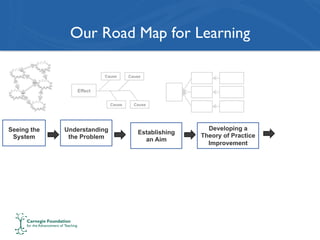
Our Road Map for Learning
Seeing the
System
Understanding
the Problem
Developing a
Theory of Practice
Improvement
Establishing
an Aim
Effect
Cause Cause
Cause Cause
3
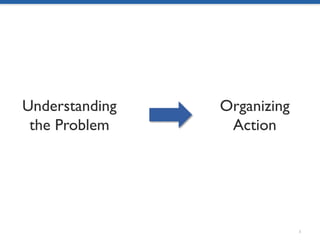
Understanding
the Problem
Organizing
Action
What is a Theory of Practice Improvement?
A working theory of most highly leveraged changes that
are needed to achieve the desired outcomes
A Driver Diagram is an improvement tool used to
communicate a theory of practice improvement
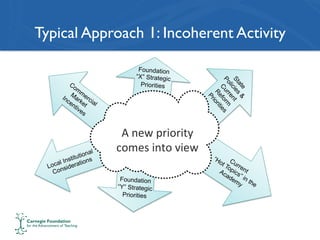
Typical Approach 1: Incoherent Activity
Foundation
“X” Strategic
Priorities
Foundation
“Y” Strategic
Priorities
Local Institutional
Considerations
A	
  new	
  priority	
  
comes	
  into	
  view	
  
6
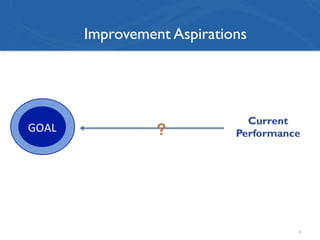
Improvement Aspirations
Current
Performance?Goal	
  GOAL	
  
Goal	
  
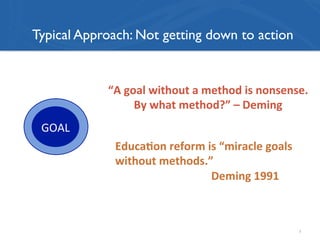
Typical Approach: Not getting down to action
7
“A	
  goal	
  without	
  a	
  method	
  is	
  nonsense.	


By	
  what	
  method?”	
  –	
  Deming	
  
Educa<on	
  reform	
  is	
  “miracle	
  goals	
  
without	
  methods.”	


  Deming	
  1991	
  
GOAL	
  
8
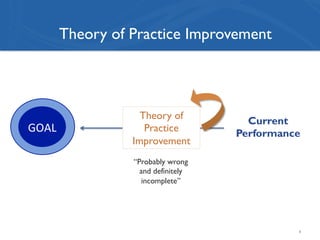
Theory of Practice Improvement
Current
Performance
Theory of
Practice
Improvement
“Probably wrong
and definitely
incomplete”
Goal	
  GOAL	
  
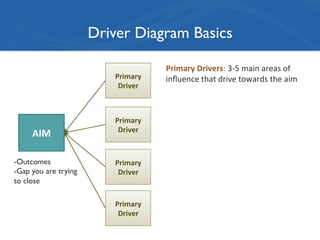
Driver Diagram Basics
	
  
AIM	


Primary	
  
Driver	
  
Primary	
  
Driver	
  
Primary	
  
Driver	
  
Primary	
  
Driver	
  
Primary	
  Drivers:	
  3-­‐5	
  main	
  areas	
  of	
  
influence	
  that	
  drive	
  towards	
  the	
  aim	


-Outcomes
-Gap you are trying
to close
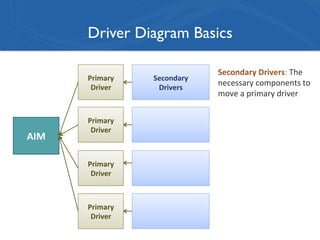
Secondary	
  
Drivers	
  
Secondary	
  Drivers:	
  The	
  
necessary	
  components	
  to	
  
move	
  a	
  primary	
  driver	


AIM	


Primary	
  
Driver	
  
Primary	
  
Driver	
  
Primary	
  
Driver	
  
Primary	
  
Driver	
  
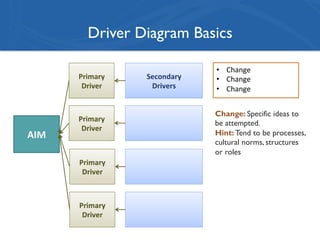
Driver Diagram Basics
•  Change	
  
•  Change	
  	
  
•  Change	


Change: Specific ideas to
be attempted.
Hint: Tend to be processes,
cultural norms, structures
or roles
Secondary	
  
Drivers	


AIM	


Primary	
  
Driver	
  
Primary	
  
Driver	
  
Primary	
  
Driver	
  
Primary	
  
Driver	
  
Driver Diagram Basics
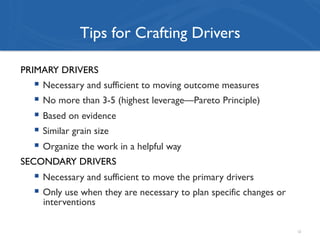
Tips for Crafting Drivers
PRIMARY DRIVERS
! Necessary and sufficient to moving outcome measures
! No more than 3-5 (highest leverage—Pareto Principle)
! Based on evidence
! Similar grain size
! Organize the work in a helpful way
SECONDARY DRIVERS
! Necessary and sufficient to move the primary drivers
! Only use when they are necessary to plan specific changes or
interventions
12
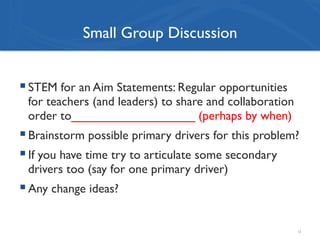
Small Group Discussion
! STEM for an Aim Statements: Regular opportunities
for teachers (and leaders) to share and collaboration
order to__________________ (perhaps by when)
! Brainstorm possible primary drivers for this problem?
! If you have time try to articulate some secondary
drivers too (say for one primary driver)
! Any change ideas?
13
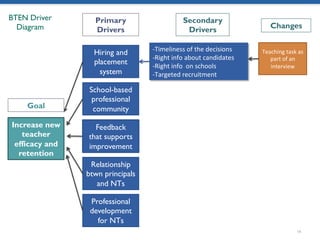
BTEN Driver
Diagram
Primary
Drivers
Secondary
Drivers
Changes
School-based
professional
community
Feedback
that supports
improvement
Relationship
btwn principals
and NTs
Hiring and
placement
system
Professional
development
for NTs
14
Feedback
that supports
improvement
Increase new
teacher
efficacy and
retention
-­‐Timeliness	
  of	
  the	
  decisions	
  
-­‐Right	
  info	
  about	
  candidates	
  	
  
-­‐Right	
  info	
  	
  on	
  schools	
  
-­‐Targeted	
  recruitment	
  
Teaching	
  task	
  as	
  
part	
  of	
  an	
  
interview	
  
Goal
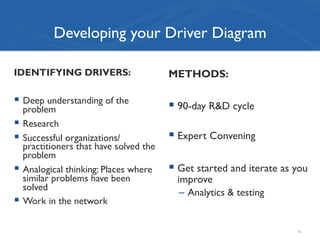
Developing your Driver Diagram
15
METHODS:
! 90-day R&D cycle
! Expert Convening
! Get started and iterate as you
improve
–  Analytics & testing
IDENTIFYING DRIVERS:
! Deep understanding of the
problem
! Research
! Successful organizations/
practitioners that have solved the
problem
! Analogical thinking: Places where
similar problems have been
solved
! Work in the network
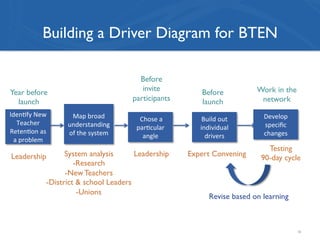
Building a Driver Diagram for BTEN
16
IdenEfy	
  New	
  
Teacher	
  
RetenEon	
  as	
  
a	
  problem	
  	
  
Map	
  broad	
  
understanding	
  
of	
  the	
  system	
  
	
  Chose	
  a	
  
parEcular	
  
angle	
  
Build	
  out	
  
individual	
  
drivers	
  
Year before
launch
Before
invite
participants
Before
launch
Leadership System analysis
-Research
-New Teachers
-District & school Leaders
-Unions
Leadership Expert Convening
Testing
90-day cycle
Develop	
  
specific	
  
changes	
  
Revise based on learning
Work in the
network
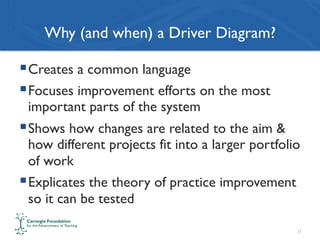
Why (and when) a Driver Diagram?
! Creates a common language
! Focuses improvement efforts on the most
important parts of the system
! Shows how changes are related to the aim &
how different projects fit into a larger portfolio
of work
! Explicates the theory of practice improvement
so it can be tested
17
Bryk 2014 Developing a Driver Diagram for a NIC

Bryk 2014 Developing a Driver Diagram for a NIC

  • 1.
    A Theory ofPractice Improvement: Driver Diagrams PC1: Improvement Science Basics Alicia Grunow
  • 2.
    Our Road Mapfor Learning Seeing the System Understanding the Problem Developing a Theory of Practice Improvement Establishing an Aim Effect Cause Cause Cause Cause
  • 3.
  • 4.
    What is aTheory of Practice Improvement? A working theory of most highly leveraged changes that are needed to achieve the desired outcomes A Driver Diagram is an improvement tool used to communicate a theory of practice improvement
  • 5.
    Typical Approach 1:Incoherent Activity Foundation “X” Strategic Priorities Foundation “Y” Strategic Priorities Local Institutional Considerations A  new  priority   comes  into  view  
  • 6.
  • 7.
    Goal   Typical Approach:Not getting down to action 7 “A  goal  without  a  method  is  nonsense.       By  what  method?”  –  Deming   Educa<on  reform  is  “miracle  goals   without  methods.”        Deming  1991   GOAL  
  • 8.
    8 Theory of PracticeImprovement Current Performance Theory of Practice Improvement “Probably wrong and definitely incomplete” Goal  GOAL  
  • 9.
    Driver Diagram Basics   AIM     Primary   Driver   Primary   Driver   Primary   Driver   Primary   Driver   Primary  Drivers:  3-­‐5  main  areas  of   influence  that  drive  towards  the  aim     -Outcomes -Gap you are trying to close
  • 10.
    Secondary   Drivers   Secondary  Drivers:  The   necessary  components  to   move  a  primary  driver     AIM     Primary   Driver   Primary   Driver   Primary   Driver   Primary   Driver   Driver Diagram Basics
  • 11.
    •  Change   • Change     •  Change     Change: Specific ideas to be attempted. Hint: Tend to be processes, cultural norms, structures or roles Secondary   Drivers     AIM     Primary   Driver   Primary   Driver   Primary   Driver   Primary   Driver   Driver Diagram Basics
  • 12.
    Tips for CraftingDrivers PRIMARY DRIVERS ! Necessary and sufficient to moving outcome measures ! No more than 3-5 (highest leverage—Pareto Principle) ! Based on evidence ! Similar grain size ! Organize the work in a helpful way SECONDARY DRIVERS ! Necessary and sufficient to move the primary drivers ! Only use when they are necessary to plan specific changes or interventions 12
  • 13.
    Small Group Discussion ! STEMfor an Aim Statements: Regular opportunities for teachers (and leaders) to share and collaboration order to__________________ (perhaps by when) ! Brainstorm possible primary drivers for this problem? ! If you have time try to articulate some secondary drivers too (say for one primary driver) ! Any change ideas? 13
  • 14.
    BTEN Driver Diagram Primary Drivers Secondary Drivers Changes School-based professional community Feedback that supports improvement Relationship btwnprincipals and NTs Hiring and placement system Professional development for NTs 14 Feedback that supports improvement Increase new teacher efficacy and retention -­‐Timeliness  of  the  decisions   -­‐Right  info  about  candidates     -­‐Right  info    on  schools   -­‐Targeted  recruitment   Teaching  task  as   part  of  an   interview   Goal
  • 15.
    Developing your DriverDiagram 15 METHODS: ! 90-day R&D cycle ! Expert Convening ! Get started and iterate as you improve –  Analytics & testing IDENTIFYING DRIVERS: ! Deep understanding of the problem ! Research ! Successful organizations/ practitioners that have solved the problem ! Analogical thinking: Places where similar problems have been solved ! Work in the network
  • 16.
    Building a DriverDiagram for BTEN 16 IdenEfy  New   Teacher   RetenEon  as   a  problem     Map  broad   understanding   of  the  system    Chose  a   parEcular   angle   Build  out   individual   drivers   Year before launch Before invite participants Before launch Leadership System analysis -Research -New Teachers -District & school Leaders -Unions Leadership Expert Convening Testing 90-day cycle Develop   specific   changes   Revise based on learning Work in the network
  • 17.
    Why (and when)a Driver Diagram? ! Creates a common language ! Focuses improvement efforts on the most important parts of the system ! Shows how changes are related to the aim & how different projects fit into a larger portfolio of work ! Explicates the theory of practice improvement so it can be tested 17