Jobs, Market Data,
           and Pay for Performance Tools

           November 18,2010
           Don Berman & Jim Haviland


GETTING COMPENSATION RIGHT
Agenda
hrtms.com


             Themes and Best Practices
             Getting Job Descriptions Right
               Multiple views of a job description
               Demo: HRTMS Jobs for collaboration with managers
             Getting the Data Right
               Market data, what it is and isn’t
               Demo: HRTMS Jobs for collaborating with job costing
                and market data services
             Getting Compensation Right
               STI, LTI, Total Rewards, Pay for Performance Strategy
               Demo: HRTMS Compensation for wholistic comp
                budgeting
Themes
hrtms.com


             There is a new context to consider (almost
              everyone is broke)
             3 Goals need 3 Strategies that align with the
                whole organization: Recruiting, Retention, and
                Rewards
               Data is not analysis is not a strategy
               A,B & C Players and A, B, and C jobs
               Pay for Performance requires a Causal
                Relationship
               Good News: We have lots of options
               V Good News: 10- 25% Gain for getting it right
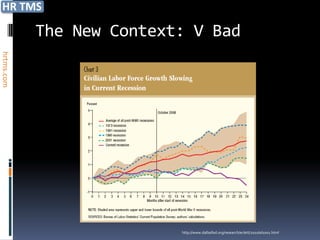
The New Context: V Bad
hrtms.com


                           http://www.dallasfed.org/research/eclett/2010/el1001.html
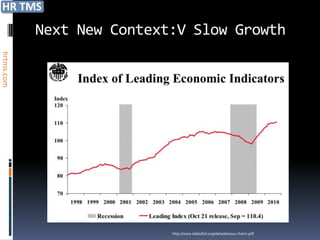
Next New Context:V Slow Growth
hrtms.com


                            http://www.dallasfed.org/data/data/us-charts.pdf
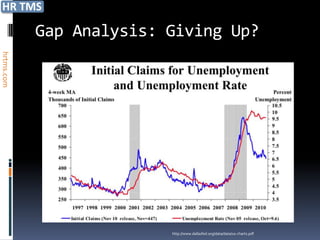
Gap Analysis: Giving Up?
hrtms.com


                          http://www.dallasfed.org/data/data/us-charts.pdf
The New Context
hrtms.com


             Recruiting
               Good: Lots of candidates to consider
               Bad: Languishing Skills, Motivation, Housing and
                Credit freeze
             Retention
               Good: It’s scarry out there
               Bad: Uneven recovery, suppressed demand
             Rewards
               Good: Low expectations, A Chance to Set New Policy
               Bad: Small budgets, little motivation, high cost of
                error
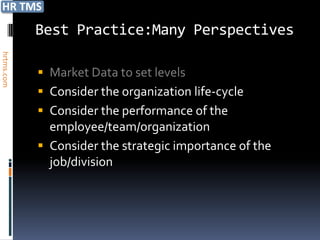
Best Practice:Many Perspectives
hrtms.com


             Market Data to set levels
             Consider the organization life-cycle
             Consider the performance of the
              employee/team/organization
             Consider the strategic importance of the
              job/division
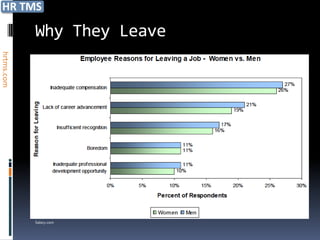
Why They Leave
hrtms.com


            Salary.com
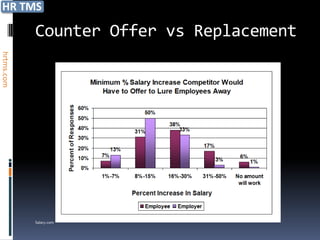
Counter Offer vs Replacement
hrtms.com


            Salary.com
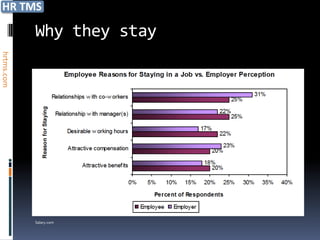
Why they stay
hrtms.com


            Salary.com
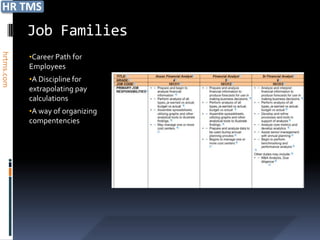
Job Families
hrtms.com


            •Career Path for
            Employees
            •A Discipline for
            extrapolating pay
            calculations
            •A way of organizing
            compentencies
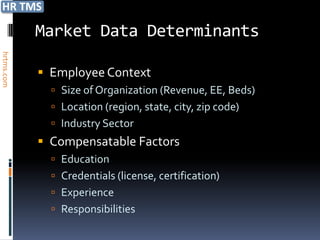
Market Data Determinants
hrtms.com


             Employee Context
               Size of Organization (Revenue, EE, Beds)
               Location (region, state, city, zip code)
               Industry Sector
             Compensatable Factors
               Education
               Credentials (license, certification)
               Experience
               Responsibilities
Collaborating on the Job Description


Demonstration

HR TMS JOBS
Best Practice:Many Perspectives
hrtms.com


            
             Consider the organization life-cycle
             Consider the performance of the
              employee/team/organization
             Consider the strategic importance of the
                job/division
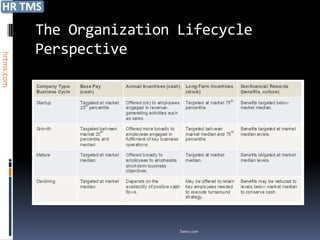
The Organization Lifecycle
            Perspective
hrtms.com


                             Salary.com
Applying Talent Analytics
hrtms.com


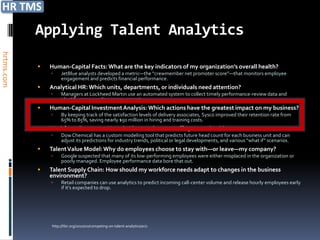
               Human-Capital Facts: What are the key indicators of my organization’s overall health?
                    JetBlue analysts developed a metric—the “crewmember net promoter score”—that monitors employee
                     engagement and predicts financial performance.
               Analytical HR: Which units, departments, or individuals need attention?
                    Managers at Lockheed Martin use an automated system to collect timely performance-review data and
                     identify areas needing improvement.
               Human-Capital Investment Analysis: Which actions have the greatest impact on my business?
                    By keeping track of the satisfaction levels of delivery associates, Sysco improved their retention rate from
                     65% to 85%, saving nearly $50 million in hiring and training costs.
               Workforce Forecasts: How do I know when to staff up or cut back?
                    Dow Chemical has a custom modeling tool that predicts future head count for each business unit and can
                     adjust its predictions for industry trends, political or legal developments, and various “what if” scenarios.
               Talent Value Model: Why do employees choose to stay with—or leave—my company?
                    Google suspected that many of its low-performing employees were either misplaced in the organization or
                     poorly managed. Employee performance data bore that out.
               Talent Supply Chain: How should my workforce needs adapt to changes in the business
                environment?
                    Retail companies can use analytics to predict incoming call-center volume and release hourly employees early
                     if it’s expected to drop.


                http://hbr.org/2010/10/competing-on-talent-analytics/ar/1
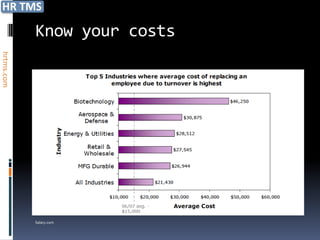
Know your costs
hrtms.com


            Salary.com
Perforamce
hrtms.com


             Core Competencies
               Fit for the organization
               General Skills
             Job/Team Specific Compentencies
               Tasks and Skills
               Specific operating environment
             Goals – Progress & Resolve
             Developent – Compliance & Initiative
             Operational Data
               POS, Customer Satisfaction, Team ratings
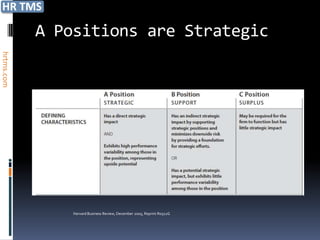
A Positions are Strategic
hrtms.com


                Harvard Business Review, December 2005, Reprint R0512G
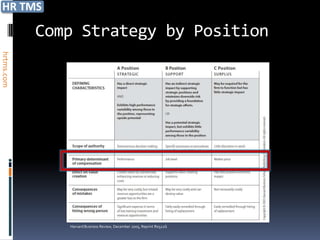
Comp Strategy by Position
hrtms.com


               Harvard Business Review, December 2005, Reprint R0512G
A Positions: Examples
hrtms.com


             Nordstrom and Costco both rely on customer
              satisfaction to drive growth and shareholder
              value.
             Nordstrom’s strategy hinges on personalized
              service and advice, while Costco’s relies on
              low prices and product availability.
             Nordstrom’s A positions include frontline
              sales associate jobs, while Costco’s includes
              purchasingmanager roles.
Are We Differentiating Enough?
hrtms.com


            Positions
               __ Position descriptions are based on history, not strategic value.
               __ Most positions are paid at about the market midpoint.
               __ Recruitment and retention for all positions involve the same effort and budget.
               __ The same selection process is used for all positions.
               __ Little developmental rotation occurs.
               __ Few C positions are eliminated or outsourced.
            Players
               __ Performance evaluation forms are completed rarely or only at salary review.
               __ There is little candor in performance reviews.
               __ Many or most employees are rated the same.
               __ Forced distribution of ratings is used.
               __ Those receiving the middle rating are labeled “proficient” or “successful” and
               receive regular pay raises despite being viewed as average or marginal.
               __ Both very tough and very lenient raters operate without consequences.
               __ Poor performers stay yet don’t improve.
               __ Top management is not rigorously evaluated.
Comp Data in the Job Description


Demonstration

HR TMS JOBS
Questions?


Demonstration

HR TMS JOBS
Compensation Elements
hrtms.com


             Compensation should align with strategy
               metrics that matter
             Compensation should be based on real world
              knowledge
               job descriptions that represent the real work being done
               market data that relates to the job
               a career progression for all
             Compensation should motivate in the long term and
              the short term
               pay for performance
               pay for retention
               non-financial rewards
Scrap Stock-Based Compensation
            and Go Back to Principles
hrtms.com


             To what extent do executives have control over increasing the market's
              expectations about the future performance of the company? Very little.
              That is proven by the degree to which expectations fluctuate
              dramatically more than real results of publicly-traded companies. Real
              results dropped slightly in the fall of 2008 and expectations plummeted
              to half their previous level.
             Do we really want first and foremost the expectations of stock market
              participants to rise regardless of anything else? I guess one could say the
              answer is yes if expectations could rise forever. But interestingly, that
              has never happened with any stock - ever. Expectations fluctuate
              because they are the product of imagination and speculation, not actual
              company results. What is more true is that we would wish that real
              variables, like earnings per share or market share or return on invested
              capital, would grow from their previous levels. If they grow, then
              expectations and stock price will grow with a sound underpinning rather
              than through idle speculation.
            http://blogs.hbr.org/hbr/how-to-fix-executive-pay/2009/07/scrap-stock-based-compensation.html
Netflix Employee Policies
hrtms.com


             Values: hard work, initiative, creativity, and
                accountability
               All salaries are at top of market range
               All Exempt Employees Choose their own mix of Cash
                and Options (up to 60% discounted options)
               No vesting restrictions
               Unlimited Vacation Time
               “The real company values, as opposed to the nice-
                sounding values, are shown by who gets rewarded,
                promoted, or let go” CEO Reed Hastings
               “fully formed adult” culture
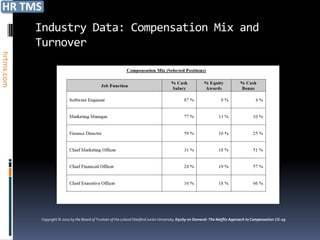
Industry Data: Compensation Mix and
            Turnover
hrtms.com


            Copyright © 2010 by the Board of Trustees of the Leland Stanford Junior University, Equity on Demand: The Netflix Approach to Compensation CG-19
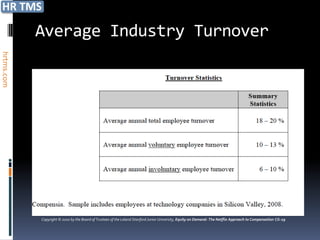
Average Industry Turnover
hrtms.com


            Copyright © 2010 by the Board of Trustees of the Leland Stanford Junior University, Equity on Demand: The Netflix Approach to Compensation CG-19
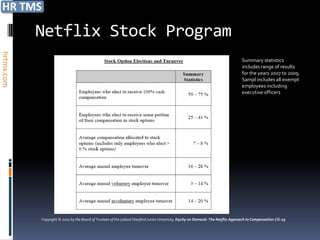
Netflix Stock Program
hrtms.com


                                                                                                                                  Summary statistics
                                                                                                                                  includes range of results
                                                                                                                                  for the years 2007 to 2009.
                                                                                                                                  Sampl includes all exempt
                                                                                                                                  employees including
                                                                                                                                  executive officers


            Copyright © 2010 by the Board of Trustees of the Leland Stanford Junior University, Equity on Demand: The Netflix Approach to Compensation CG-19
Sustainability as Value
hrtms.com


               Intel has been pushed by investors for years to address issues of say-on-pay, the human right to
                water, and sustainability as part of a board's fiduciary obligation. So it's not surprising that Intel
                links employee compensation to sustainability results. What is surprising is that Intel is doing this
                for its entire workforce. Since 2008, every single employee's annual bonus is calculated on the basis
                of the firm's performance on measures like product energy efficiency, completion of renewable
                energy and clean energy projects, and the company's reputation for environmental leadership.
                Last year, Intel added into the equation performance on reducing the company's carbon footprint.
                This is a smart move that will empower employees up and down the organization to find
                reductions big and small.
               National Grid's compensation model shows how to embed sustainability practices into a
                company's DNA. In talking with company president Tom King recently, I asked how he knows that
                sustainability is really being addressed across his company. His instant response was that it's part
                of everyday conversation at National Grid, and that there are no executive meetings that don't
                touch on environmental performance. Like Intel, National Grid has tied CEO and other executive
                compensation to performance on the company's greenhouse gas (GHG) reduction goals. But
                what's most interesting here is how aggressive those goals are: an 80% reduction by 2050, with
                45% by 2020. That's a lot of executive pay at stake — and this from a major electric power utility.

            http://blogs.hbr.org/cs/2010/04/compensation_and_sustainabilit.html
Toward Pay-for-Performance
hrtms.com


             3 Steps
               Job Descriptions
                 Consistent review of descriptions
                 Strategic Prioritization of Positions
               Performance Reviews
                 Core Competencies
                 Position-specific measures
                 Data Integration
               Compensation Planning
                 STI
                 LTI
                 Total Rewards
Toward Pay-for-Performance
hrtms.com


             Measure what matters not what’s easy to
              measure
             Is performance tied to individual, teams, or
              groups?
             Reward for things people can effect
             Correlate bio-data with performance data
Compensation Budgeting – Spending Wisely


Demonstration

HR TMS COMPENSATION
Questions?


Demonstration

HR TMS COMPENSATION
Like I Said…
hrtms.com


             Compensation should align with strategy
             Compensation should be based on real world
                knowledge
               Compensation should motivate in the long term
                and the short term
               There is a new context to consider (almost
                everyone is broke)
               3 Goals need 3 Strategies: Recruiting, Retention,
                and Rewards
               V Good News: 10- 25% Gain for getting it right
Jobs, Market Data,
           and Pay for Performance Tools

           November 18,2010
           Don Berman & Jim Haviland


GETTING COMPENSATION RIGHT

Getting Compensation Right

  • 1.
    Jobs, Market Data, and Pay for Performance Tools November 18,2010 Don Berman & Jim Haviland GETTING COMPENSATION RIGHT
  • 2.
    Agenda hrtms.com  Themes and Best Practices  Getting Job Descriptions Right  Multiple views of a job description  Demo: HRTMS Jobs for collaboration with managers  Getting the Data Right  Market data, what it is and isn’t  Demo: HRTMS Jobs for collaborating with job costing and market data services  Getting Compensation Right  STI, LTI, Total Rewards, Pay for Performance Strategy  Demo: HRTMS Compensation for wholistic comp budgeting
  • 3.
    Themes hrtms.com  There is a new context to consider (almost everyone is broke)  3 Goals need 3 Strategies that align with the whole organization: Recruiting, Retention, and Rewards  Data is not analysis is not a strategy  A,B & C Players and A, B, and C jobs  Pay for Performance requires a Causal Relationship  Good News: We have lots of options  V Good News: 10- 25% Gain for getting it right
  • 4.
    The New Context:V Bad hrtms.com http://www.dallasfed.org/research/eclett/2010/el1001.html
  • 5.
    Next New Context:VSlow Growth hrtms.com http://www.dallasfed.org/data/data/us-charts.pdf
  • 6.
    Gap Analysis: GivingUp? hrtms.com http://www.dallasfed.org/data/data/us-charts.pdf
  • 7.
    The New Context hrtms.com  Recruiting  Good: Lots of candidates to consider  Bad: Languishing Skills, Motivation, Housing and Credit freeze  Retention  Good: It’s scarry out there  Bad: Uneven recovery, suppressed demand  Rewards  Good: Low expectations, A Chance to Set New Policy  Bad: Small budgets, little motivation, high cost of error
  • 8.
    Best Practice:Many Perspectives hrtms.com  Market Data to set levels  Consider the organization life-cycle  Consider the performance of the employee/team/organization  Consider the strategic importance of the job/division
  • 9.
  • 10.
    Counter Offer vsReplacement hrtms.com Salary.com
  • 11.
  • 12.
    Job Families hrtms.com •Career Path for Employees •A Discipline for extrapolating pay calculations •A way of organizing compentencies
  • 13.
    Market Data Determinants hrtms.com  Employee Context  Size of Organization (Revenue, EE, Beds)  Location (region, state, city, zip code)  Industry Sector  Compensatable Factors  Education  Credentials (license, certification)  Experience  Responsibilities
  • 14.
    Collaborating on theJob Description Demonstration HR TMS JOBS
  • 15.
    Best Practice:Many Perspectives hrtms.com   Consider the organization life-cycle  Consider the performance of the employee/team/organization  Consider the strategic importance of the job/division
  • 16.
    The Organization Lifecycle Perspective hrtms.com Salary.com
  • 17.
    Applying Talent Analytics hrtms.com  Human-Capital Facts: What are the key indicators of my organization’s overall health?  JetBlue analysts developed a metric—the “crewmember net promoter score”—that monitors employee engagement and predicts financial performance.  Analytical HR: Which units, departments, or individuals need attention?  Managers at Lockheed Martin use an automated system to collect timely performance-review data and identify areas needing improvement.  Human-Capital Investment Analysis: Which actions have the greatest impact on my business?  By keeping track of the satisfaction levels of delivery associates, Sysco improved their retention rate from 65% to 85%, saving nearly $50 million in hiring and training costs.  Workforce Forecasts: How do I know when to staff up or cut back?  Dow Chemical has a custom modeling tool that predicts future head count for each business unit and can adjust its predictions for industry trends, political or legal developments, and various “what if” scenarios.  Talent Value Model: Why do employees choose to stay with—or leave—my company?  Google suspected that many of its low-performing employees were either misplaced in the organization or poorly managed. Employee performance data bore that out.  Talent Supply Chain: How should my workforce needs adapt to changes in the business environment?  Retail companies can use analytics to predict incoming call-center volume and release hourly employees early if it’s expected to drop. http://hbr.org/2010/10/competing-on-talent-analytics/ar/1
  • 18.
  • 19.
    Perforamce hrtms.com  Core Competencies  Fit for the organization  General Skills  Job/Team Specific Compentencies  Tasks and Skills  Specific operating environment  Goals – Progress & Resolve  Developent – Compliance & Initiative  Operational Data  POS, Customer Satisfaction, Team ratings
  • 20.
    A Positions areStrategic hrtms.com Harvard Business Review, December 2005, Reprint R0512G
  • 21.
    Comp Strategy byPosition hrtms.com Harvard Business Review, December 2005, Reprint R0512G
  • 22.
    A Positions: Examples hrtms.com  Nordstrom and Costco both rely on customer satisfaction to drive growth and shareholder value.  Nordstrom’s strategy hinges on personalized service and advice, while Costco’s relies on low prices and product availability.  Nordstrom’s A positions include frontline sales associate jobs, while Costco’s includes purchasingmanager roles.
  • 23.
    Are We DifferentiatingEnough? hrtms.com Positions  __ Position descriptions are based on history, not strategic value.  __ Most positions are paid at about the market midpoint.  __ Recruitment and retention for all positions involve the same effort and budget.  __ The same selection process is used for all positions.  __ Little developmental rotation occurs.  __ Few C positions are eliminated or outsourced. Players  __ Performance evaluation forms are completed rarely or only at salary review.  __ There is little candor in performance reviews.  __ Many or most employees are rated the same.  __ Forced distribution of ratings is used.  __ Those receiving the middle rating are labeled “proficient” or “successful” and  receive regular pay raises despite being viewed as average or marginal.  __ Both very tough and very lenient raters operate without consequences.  __ Poor performers stay yet don’t improve.  __ Top management is not rigorously evaluated.
  • 24.
    Comp Data inthe Job Description Demonstration HR TMS JOBS
  • 25.
  • 26.
    Compensation Elements hrtms.com  Compensation should align with strategy  metrics that matter  Compensation should be based on real world knowledge  job descriptions that represent the real work being done  market data that relates to the job  a career progression for all  Compensation should motivate in the long term and the short term  pay for performance  pay for retention  non-financial rewards
  • 27.
    Scrap Stock-Based Compensation and Go Back to Principles hrtms.com  To what extent do executives have control over increasing the market's expectations about the future performance of the company? Very little. That is proven by the degree to which expectations fluctuate dramatically more than real results of publicly-traded companies. Real results dropped slightly in the fall of 2008 and expectations plummeted to half their previous level.  Do we really want first and foremost the expectations of stock market participants to rise regardless of anything else? I guess one could say the answer is yes if expectations could rise forever. But interestingly, that has never happened with any stock - ever. Expectations fluctuate because they are the product of imagination and speculation, not actual company results. What is more true is that we would wish that real variables, like earnings per share or market share or return on invested capital, would grow from their previous levels. If they grow, then expectations and stock price will grow with a sound underpinning rather than through idle speculation. http://blogs.hbr.org/hbr/how-to-fix-executive-pay/2009/07/scrap-stock-based-compensation.html
  • 28.
    Netflix Employee Policies hrtms.com  Values: hard work, initiative, creativity, and accountability  All salaries are at top of market range  All Exempt Employees Choose their own mix of Cash and Options (up to 60% discounted options)  No vesting restrictions  Unlimited Vacation Time  “The real company values, as opposed to the nice- sounding values, are shown by who gets rewarded, promoted, or let go” CEO Reed Hastings  “fully formed adult” culture
  • 29.
    Industry Data: CompensationMix and Turnover hrtms.com Copyright © 2010 by the Board of Trustees of the Leland Stanford Junior University, Equity on Demand: The Netflix Approach to Compensation CG-19
  • 30.
    Average Industry Turnover hrtms.com Copyright © 2010 by the Board of Trustees of the Leland Stanford Junior University, Equity on Demand: The Netflix Approach to Compensation CG-19
  • 31.
    Netflix Stock Program hrtms.com Summary statistics includes range of results for the years 2007 to 2009. Sampl includes all exempt employees including executive officers Copyright © 2010 by the Board of Trustees of the Leland Stanford Junior University, Equity on Demand: The Netflix Approach to Compensation CG-19
  • 32.
    Sustainability as Value hrtms.com  Intel has been pushed by investors for years to address issues of say-on-pay, the human right to water, and sustainability as part of a board's fiduciary obligation. So it's not surprising that Intel links employee compensation to sustainability results. What is surprising is that Intel is doing this for its entire workforce. Since 2008, every single employee's annual bonus is calculated on the basis of the firm's performance on measures like product energy efficiency, completion of renewable energy and clean energy projects, and the company's reputation for environmental leadership. Last year, Intel added into the equation performance on reducing the company's carbon footprint. This is a smart move that will empower employees up and down the organization to find reductions big and small.  National Grid's compensation model shows how to embed sustainability practices into a company's DNA. In talking with company president Tom King recently, I asked how he knows that sustainability is really being addressed across his company. His instant response was that it's part of everyday conversation at National Grid, and that there are no executive meetings that don't touch on environmental performance. Like Intel, National Grid has tied CEO and other executive compensation to performance on the company's greenhouse gas (GHG) reduction goals. But what's most interesting here is how aggressive those goals are: an 80% reduction by 2050, with 45% by 2020. That's a lot of executive pay at stake — and this from a major electric power utility. http://blogs.hbr.org/cs/2010/04/compensation_and_sustainabilit.html
  • 33.
    Toward Pay-for-Performance hrtms.com  3 Steps  Job Descriptions  Consistent review of descriptions  Strategic Prioritization of Positions  Performance Reviews  Core Competencies  Position-specific measures  Data Integration  Compensation Planning  STI  LTI  Total Rewards
  • 34.
    Toward Pay-for-Performance hrtms.com  Measure what matters not what’s easy to measure  Is performance tied to individual, teams, or groups?  Reward for things people can effect  Correlate bio-data with performance data
  • 35.
    Compensation Budgeting –Spending Wisely Demonstration HR TMS COMPENSATION
  • 36.
  • 37.
    Like I Said… hrtms.com  Compensation should align with strategy  Compensation should be based on real world knowledge  Compensation should motivate in the long term and the short term  There is a new context to consider (almost everyone is broke)  3 Goals need 3 Strategies: Recruiting, Retention, and Rewards  V Good News: 10- 25% Gain for getting it right
  • 38.
    Jobs, Market Data, and Pay for Performance Tools November 18,2010 Don Berman & Jim Haviland GETTING COMPENSATION RIGHT

Editor's Notes

  • #2 Hello everyone and welcome to todays presentation “Getting Compensation Right: Jobs, Market Data, and Pay-for-Performance tools.” My name is Jim Haviland and I’m coming to you today from Durham North Carolina, which by the wy gives me the right to refer to second person plural subjects as “Y’all”And I’m joined by Don Berman who is nesteled into the command center in a secret location just outside of New York City.
  • #3 Today we are going to talk about some tactics and tools anyone can use to move towards a more thoughtful approach to compensation. This isn’t a prescription but an attempt at an overview of the breadth and depth to which we see efforts by organizations of all sizes and in all industries taking talent management. I will present some best practices – which in compensation involves a great range and occaisionally disparity of ideas – and case studies and other materials to go to to learn more. My friend and colleague Don Berman will present a demonstration of two of the compenents of our talent management suite; specificially the Jobs application and the Compensation applicationMy presentation today is not meant to suggest that I have specific expertise in Compensation best practice. Our objective is to show y’all some of the ideas and best practices that we have built our tools to address. The HRTMS suite is, bar none, and I will throw down on this topic, the most configurable solution in the marketplace aside from building your own development team and we do that because we recognize that every organization could and probably should apply what makes them particualrly special and successful to their approch to talent management and we want them to have a great tool to take the drudgery out of that process.
  • #4 These are the ideas that I will be presenting today in a number of ways:The current economic reality is extraordinary and must be considered as part of your strategyYou should be consider your deliberate, conscious strategy for the three goals of HR: recruiting, retention, and rewards, in terms that are entirely relted to corp strategyStrategy should be based on the analysis of good, real world, wholisticly sourced dataSegment people, positions and the organization to focus limited resourcesA successful pay for performacne program requires that you are measuring what matters and what people can have an impact on.AS HR professionals, We do have lots of tools and techniques at our disposal to put in place that can support the organization’s strategy and goalsBest of all, depending on your industry, you can realize significant overall performance improvements if you get it right
  • #5 The context for operating today is unique for any American younger than 80, but there are some universal truths that still need to be dealt with. How can we use compensation policy to impact Recruitment, Retention, and Rewards – and by rewards I mean incenting the right behaviors with ever more accurate precision and recognizing those who are successful, perhaps aiming what meager resources are available to those who are most responsible for generating those resources.
  • #6 Most economists, pundits, and investors are looking at a slow recovery . As things improve, managers will have to deal with a new set of pressures when it comes to motivating, hiring, and retaining key staff. Some idustries and regions will recover faster than others. Some things will settle into a New Normal – but we don’t know what those things are
  • #7 And we have a new breed of worker to consider – people who were valuable and productive in 2008 but are no unemployed for no reason of their own – not because they weren’t an A player but because circumstances changed the employment status of milions without careful consideration. Have they given up? Are they waiting to get back into the market? Will they have the skills they need when they return? Will I be able to recognize A players amongst an onslaught of resumes even when some of them have been unemployed for 18 months or more?
  • #8 The best part of this, from our perspective, is that you really have a great opportunity to set policies that reflect strategic direction. If your organization has been stuck in paying percentage increases to all those who breathe, then this is a chance to change that expectation and direct the rewards at those who deserve them – and those rewards will go a lot farther
  • #9 To take on all of what fits into the world of conpensation best practices, we need to be able to look at the organization from a number of perspectives, both internal and eternal and align these realities with where the organiation wants to be in 12 to 18 months
  • #10 First, I have a few slides on Retenion – which, as I said, has probably been easy of late but may face ne challenges.People’s lives have continued inspite of the economy and they face new economic pressures of their own. If you haven’t been incenting or rewarding of late – there are probably some A players who are considering their options.
  • #11 The good news is that it takes very little to keep people in their
  • #12 It is also important to remember that people stay for a broad array or reasons – many of them that don’t relate directly to HR. Satisfaction and Engagement are realtively low-cost means of compensation that in some instances do as much for retention, morale and performance as cash. We’ll see some examples of this as time allows.
  • #13 An impotant tactic that we see a lot of companies considering right now is the definition of Job Families.
  • #14 You ability to price a job is only as good as the detail around a job descriptionDifferent services and consultants will approach this diferently, but in general you to provide some context for the organization and accurate data around the job itself.
  • #16 So while Don sends the job info off to be considered by the analyst (not really – we are pretending) let’s ook at some of these other perspectives that lead to a meaningful compensation plan
  • #17 In the same way that market analysis provides an external perspective on compensation, we should be willing to place the organization in a life-cycle bucket. You may not agree with all of the ideas in each of these cells, but what is really important here is recognizing that compensation can and should look very different depending on where you are. And this can be a strategic choice. I have helped Mature businesses set up new ventures, fully funded by the mature organization, maybe living off their infrastrucutre and partially staffed by them, but with a new culture and a new comp plan – one with much more LTI and much less STI – which could be a valuable tool for funding the efforts
  • #18 In general, it is important to develop an approach to analytics in HR if we are going to get good at this.  . Six kinds of analytics can help companies answer critical talent questions—listed here from simplest to most sophisticated. Human-Capital FactsWhat are the key indicators of my organization’s overall health?JetBlue analysts developed a metric—the “crewmember net promoter score”—that monitors employee engagement and predicts financial performance.Analytical HRWhich units, departments, or individuals need attention?Managers at Lockheed Martin use an automated system to collect timely performance-review data and identify areas needing improvement.Human-Capital Investment AnalysisWhich actions have the greatest impact on my business?By keeping track of the satisfaction levels of delivery associates, Sysco improved their retention rate from 65% to 85%, saving nearly $50 million in hiring and training costs.Workforce ForecastsHow do I know when to staff up or cut back?Dow Chemical has a custom modeling tool that predicts future head count for each business unit and can adjust its predictions for industry trends, political or legal developments, and various “what if” scenarios.Talent Value ModelWhy do employees choose to stay with—or leave—my company?Google suspected that many of its low-performing employees were either misplaced in the organization or poorly managed. Employee performance data bore that out. Talent Supply ChainHow should my workforce needs adapt to changes in the business environment?Retail companies can use analytics to predict incoming call-center volume and release hourly employees early if it’s expected to drop.
  • #19 In 2006/2007 employers estimated replacement costs due to turnover to average approximately $15,000.►This year employers estimate costs will average $21,000 which represents a 40% increase.
  • #20 Performance reviews should provide a means of addressing both the tactical and strategic needs of the organization – is this the right person in the right position?This should create a rich set of data points that the organization can use to rate an employee and determine what should happen next
  • #21 Lastly in this analytics and segmentation section, I want to talk about segmenting jobs. For my money, we don’t see nearly enough of this but in this economy we have a great opportunity to add this to our approach and yied some dramatic insight and results.
  • #22 Everything about you’re a positions is more importat – what you spend to find the right person, to screen people, how you support them, compensate them, intice them to stay and engageOnce again, you may differ on your thoughts about how to approach these segments, but there’s no doubt that treating them appropriately can make for a win
  • #25 And now we return to Don Berman to see how we are going to include the survey data in the system
  • #29 In hiring, the company targeted high-performance employees who were capable of doing thework of two or three people. According to Hastings, “We endeavor to have only outstandingemployees. One outstanding employee gets more done and costs less than two adequateemployees.” To attract these individuals, the company was willing to pay top-of-market wages.Netflix did not want a talented employee to leave the company to work elsewhere in a similarposition for the same or higher wages. The company’s philosophy was, “Pay them more thananyone else likely would. Pay them as much as a replacement would cost. Pay them as much aswe would pay to keep them if they had a higher offer from elsewhere.”14Similarly, the company was demanding in its expectations for on-the-job performance. Only thehighest-performing employees were retained. All others were let go so that their positions couldbe made available to more effective replacements. According to Hastings, “At most companies,average performers get an average raise. At Netflix, they get a generous severance package.”15
  • #30 Industries standards that Netflix determined were not a fit for their organization
  • #31 Remember that cost to replace data? Some of those numbers were at 30 to 50% of the average FTE cost. If you turn over two or three people you loose a whole person of productivity – obviously there is money to be saved here
  • #34 These things build on each other
  • #36 Let go back to our retail business where the compensation plan reflects what was really important to the company - sales