Alfred Wegener’s Theory 
and Evidence 
By Tiara, Evelyn and Katelen
Wegener’s Theory 
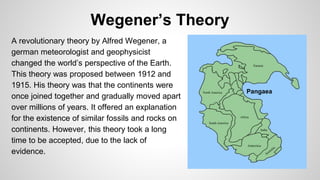
A revolutionary theory by Alfred Wegener, a 
german meteorologist and geophysicist 
changed the world’s perspective of the Earth. 
This theory was proposed between 1912 and 
1915. His theory was that the continents were 
once joined together and gradually moved apart 
over millions of years. It offered an explanation 
for the existence of similar fossils and rocks on 
continents. However, this theory took a long 
time to be accepted, due to the lack of 
evidence. 
Pangaea
From Pangaea to Gondwana and 
Laurasia 
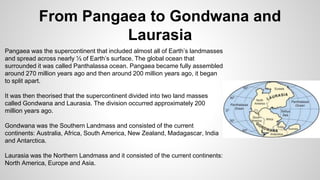
Pangaea was the supercontinent that included almost all of Earth’s landmasses 
and spread across nearly ⅓ of Earth’s surface. The global ocean that 
surrounded it was called Panthalassa ocean. Pangaea became fully assembled 
around 270 million years ago and then around 200 million years ago, it began 
to split apart. 
It was then theorised that the supercontinent divided into two land masses 
called Gondwana and Laurasia. The division occurred approximately 200 
million years ago. 
Gondwana was the Southern Landmass and consisted of the current 
continents: Australia, Africa, South America, New Zealand, Madagascar, India 
and Antarctica. 
Laurasia was the Northern Landmass and it consisted of the current continents: 
North America, Europe and Asia.
Continental Drift 
- Geological theory states that the positions of the continents on Earth have moved to 
different positions over time. This movement was called ‘Continental Drift’. 
Continental Drift is a result of large convection currents in the earth’s mantle. There 
is now, much evidence to support this theory of the continents moving. Similar plant 
and animal fossils can be found on the shores of various continents, further implying 
that they were all once joined. For example: a crocodile fossil was found in both 
Brazil & South Africa, another reptile’s fossils were found in South America, Africa 
and Antarctica. In addition, there is also some living evidence—species of some 
earthworm families found on South America and Africa. Therefore the theory was 
proved by three main pieces of evidence : 
- Landforms 
- Fossils 
- Climate
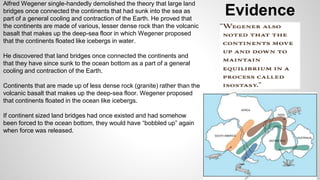
Evidence Alfred Wegener single-handedly demolished the theory that large land 
bridges once connected the continents that had sunk into the sea as 
part of a general cooling and contraction of the Earth. He proved that 
the continents are made of various, lesser dense rock than the volcanic 
basalt that makes up the deep-sea floor in which Wegener proposed 
that the continents floated like icebergs in water. 
He discovered that land bridges once connected the continents and 
that they have since sunk to the ocean bottom as a part of a general 
cooling and contraction of the Earth. 
Continents that are made up of less dense rock (granite) rather than the 
volcanic basalt that makes up the deep-sea floor. Wegener proposed 
that continents floated in the ocean like icebergs. 
If continent sized land bridges had once existed and had somehow 
been forced to the ocean bottom, they would have “bobbled up” again 
when force was released.
Thankyou

Alfred wegener presentation

  • 1.
    Alfred Wegener’s Theory and Evidence By Tiara, Evelyn and Katelen
  • 3.
    Wegener’s Theory Arevolutionary theory by Alfred Wegener, a german meteorologist and geophysicist changed the world’s perspective of the Earth. This theory was proposed between 1912 and 1915. His theory was that the continents were once joined together and gradually moved apart over millions of years. It offered an explanation for the existence of similar fossils and rocks on continents. However, this theory took a long time to be accepted, due to the lack of evidence. Pangaea
  • 5.
    From Pangaea toGondwana and Laurasia Pangaea was the supercontinent that included almost all of Earth’s landmasses and spread across nearly ⅓ of Earth’s surface. The global ocean that surrounded it was called Panthalassa ocean. Pangaea became fully assembled around 270 million years ago and then around 200 million years ago, it began to split apart. It was then theorised that the supercontinent divided into two land masses called Gondwana and Laurasia. The division occurred approximately 200 million years ago. Gondwana was the Southern Landmass and consisted of the current continents: Australia, Africa, South America, New Zealand, Madagascar, India and Antarctica. Laurasia was the Northern Landmass and it consisted of the current continents: North America, Europe and Asia.
  • 6.
    Continental Drift -Geological theory states that the positions of the continents on Earth have moved to different positions over time. This movement was called ‘Continental Drift’. Continental Drift is a result of large convection currents in the earth’s mantle. There is now, much evidence to support this theory of the continents moving. Similar plant and animal fossils can be found on the shores of various continents, further implying that they were all once joined. For example: a crocodile fossil was found in both Brazil & South Africa, another reptile’s fossils were found in South America, Africa and Antarctica. In addition, there is also some living evidence—species of some earthworm families found on South America and Africa. Therefore the theory was proved by three main pieces of evidence : - Landforms - Fossils - Climate
  • 7.
    Evidence Alfred Wegenersingle-handedly demolished the theory that large land bridges once connected the continents that had sunk into the sea as part of a general cooling and contraction of the Earth. He proved that the continents are made of various, lesser dense rock than the volcanic basalt that makes up the deep-sea floor in which Wegener proposed that the continents floated like icebergs in water. He discovered that land bridges once connected the continents and that they have since sunk to the ocean bottom as a part of a general cooling and contraction of the Earth. Continents that are made up of less dense rock (granite) rather than the volcanic basalt that makes up the deep-sea floor. Wegener proposed that continents floated in the ocean like icebergs. If continent sized land bridges had once existed and had somehow been forced to the ocean bottom, they would have “bobbled up” again when force was released.
  • 8.