World Geography Chapter 14 Regional Atlas: Introduction to  Western Europe Copyright © 2003 by Pearson Education, Inc., publishing as Prentice Hall, Upper Saddle River, NJ. All rights reserved.
World Geography Copyright © 2003 by Pearson Education, Inc., publishing as Prentice Hall, Upper Saddle River, NJ. All rights reserved. Section 1:  Historic Overview Section 2:  Physical Characteristics Section 3:  Climates Section 4:  Ecosystems Chapter 14: Regional Atlas: Introduction to Western Europe Section 5:  People and Cultures Section 6:  Economics, Technology, and Environment Section 7:  Database
Historical Overview The Greek and Roman civilization spread through Western Europe until the western Roman Empire was conquered by Germanic tribes around A.D. 500. During the  Renaissance,  or “rebirth,” Western Europeans began to explore and colonize other parts of the world. The  Industrial Revolution  saw the growing use of machines and the extension of rights to more citizens. After two deadly world wars and the Cold War, the nations of Western Europe pursued greater political and economic cooperation. Farming spread into Europe by about 5400  B.C . through the process of  cultural diffusion. 1
Physical Characteristics 2
Physical Characteristics The summits, or heights, of the Alps contrast with the flat Northern European plain. Oceans and seas surround much of Western Europe. Many rivers wind through fertile valleys. Western Europe is a small region with a great variety of physical features. 2
Climates 3
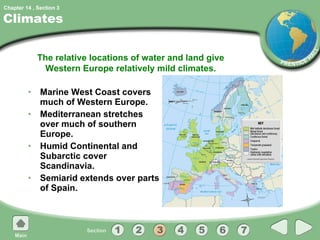
Climates Marine West Coast covers much of Western Europe. Mediterranean stretches over much of southern Europe. Humid Continental and Subarctic cover Scandinavia. Semiarid extends over parts of Spain. The relative locations of water and land give Western Europe relatively mild climates. 3
Ecosystems 4
Ecosystems Mid-latitude deciduous forest extends over much of Western Europe. Mixed forest borders the deciduous forest to the south, east, and north. Chaparral covers much of the land bordering the Mediterranean Sea. Coniferous forest and tundra ecosystems extend across much of Scandinavia and Iceland. Much of Western Europe’s ecosystem has been altered by humans, with much of the original land cleared for farms and settlements. 4
People and Cultures 5
People and Cultures Many European cities are a blend of old and new. Soaring cathedrals were once the religious, social, and cultural centers of Western European cities. Strong economies in Western European nations have encouraged people to migrate from all across the world. Although small in area, Western Europe is densely populated and home to many cultures. 5
Economics, Technology, and Environment 6
Economics, Technology, and Environment Manufacturing and trade are the dominant economic activities in large parts of Western Europe. Commercial farming is practiced through most of Western Europe. A number of countries have formed the European Union, and they share a common currency.. Hydroelectric power is produced in more mountainous areas. The Industrial Revolution transformed Western Europe from an agricultural society to an industrial society. 6
Database In Finland, education is  compulsory,  or required, for a certain number of years, and most students go on to attend college or university. The French national government controls the curriculum and sets high standards for French students. Many Italian students drop out of school early, and Italy has a relatively low attendance rate at its universities. A system of examinations in the United Kingdom determines whether students will be admitted to one of the country’s many universities. The idea of free nationwide education emerged in Europe in the 1800s. 7

Chapter 14

  • 1.
    World Geography Chapter14 Regional Atlas: Introduction to Western Europe Copyright © 2003 by Pearson Education, Inc., publishing as Prentice Hall, Upper Saddle River, NJ. All rights reserved.
  • 2.
    World Geography Copyright© 2003 by Pearson Education, Inc., publishing as Prentice Hall, Upper Saddle River, NJ. All rights reserved. Section 1: Historic Overview Section 2: Physical Characteristics Section 3: Climates Section 4: Ecosystems Chapter 14: Regional Atlas: Introduction to Western Europe Section 5: People and Cultures Section 6: Economics, Technology, and Environment Section 7: Database
  • 3.
    Historical Overview TheGreek and Roman civilization spread through Western Europe until the western Roman Empire was conquered by Germanic tribes around A.D. 500. During the Renaissance, or “rebirth,” Western Europeans began to explore and colonize other parts of the world. The Industrial Revolution saw the growing use of machines and the extension of rights to more citizens. After two deadly world wars and the Cold War, the nations of Western Europe pursued greater political and economic cooperation. Farming spread into Europe by about 5400 B.C . through the process of cultural diffusion. 1
  • 4.
  • 5.
    Physical Characteristics Thesummits, or heights, of the Alps contrast with the flat Northern European plain. Oceans and seas surround much of Western Europe. Many rivers wind through fertile valleys. Western Europe is a small region with a great variety of physical features. 2
  • 6.
  • 7.
    Climates Marine WestCoast covers much of Western Europe. Mediterranean stretches over much of southern Europe. Humid Continental and Subarctic cover Scandinavia. Semiarid extends over parts of Spain. The relative locations of water and land give Western Europe relatively mild climates. 3
  • 8.
  • 9.
    Ecosystems Mid-latitude deciduousforest extends over much of Western Europe. Mixed forest borders the deciduous forest to the south, east, and north. Chaparral covers much of the land bordering the Mediterranean Sea. Coniferous forest and tundra ecosystems extend across much of Scandinavia and Iceland. Much of Western Europe’s ecosystem has been altered by humans, with much of the original land cleared for farms and settlements. 4
  • 10.
  • 11.
    People and CulturesMany European cities are a blend of old and new. Soaring cathedrals were once the religious, social, and cultural centers of Western European cities. Strong economies in Western European nations have encouraged people to migrate from all across the world. Although small in area, Western Europe is densely populated and home to many cultures. 5
  • 12.
  • 13.
    Economics, Technology, andEnvironment Manufacturing and trade are the dominant economic activities in large parts of Western Europe. Commercial farming is practiced through most of Western Europe. A number of countries have formed the European Union, and they share a common currency.. Hydroelectric power is produced in more mountainous areas. The Industrial Revolution transformed Western Europe from an agricultural society to an industrial society. 6
  • 14.
    Database In Finland,education is compulsory, or required, for a certain number of years, and most students go on to attend college or university. The French national government controls the curriculum and sets high standards for French students. Many Italian students drop out of school early, and Italy has a relatively low attendance rate at its universities. A system of examinations in the United Kingdom determines whether students will be admitted to one of the country’s many universities. The idea of free nationwide education emerged in Europe in the 1800s. 7