© Teaching Packs - Space - Page 1
By Helen and Mark Warner
www.teachingpacks.co.uk
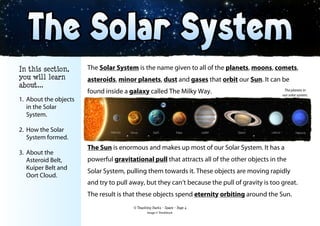
The Solar System is the name given to all of the planets, moons, comets,
asteroids, minor planets, dust and gases that orbit our Sun. It can be
found inside a galaxy called The Milky Way.
The Sun is enormous and makes up most of our Solar System. It has a
powerful gravitational pull that attracts all of the other objects in the
Solar System, pulling them towards it. These objects are moving rapidly
and try to pull away, but they can’t because the pull of gravity is too great.
The result is that these objects spend eternity orbiting around the Sun.
© Teaching Packs - Space - Page 4
In this section,
you will learn
about...
1. About the objects
in the Solar
System.
2. How the Solar
System formed.
3. About the
Asteroid Belt,
Kuiper Belt and
Oort Cloud.
The planets in
our solar system.
Image © ThinkStock
The Earth is the biggest planet in the inner solar system. It is roughly
spherical in shape and has a diameter of 7,926 miles. 70% of Earth is
covered in water and it supports a population of about 7 billion people.
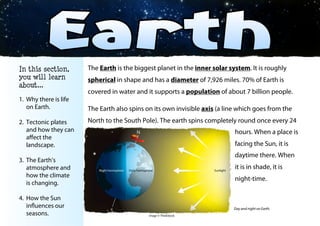
The Earth also spins on its own invisible axis (a line which goes from the
North to the South Pole). The earth spins completely round once every 24
hours. When a place is
facing the Sun, it is
daytime there. When it
is in shade, it is night-
time.
© Teaching Packs - Space - Page 17
In this section,
you will learn
about...
1. Why there is life
on Earth.
2. Tectonic plates
and how they can
affect the
landscape.
3. The Earth’s
atmosphere and
how the climate
is changing.
4. How the Sun
influences our
seasons.
Day and night on Earth.
Image © ThinkStock
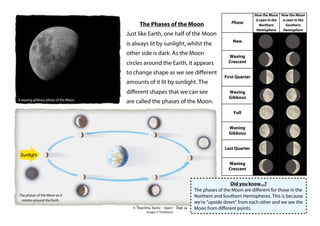
The Phases of the Moon
Just like Earth, one half of the Moon is
always lit by sunlight, whilst the other
side is dark. As the Moon circles
around the Earth, it appears to
change shape as we see different
amounts of it lit by sunlight. The
different shapes that we can see are
called the phases of the Moon.
© Teaching Packs - Space - Page 24
Phase
How the Moon
is seen in the
Northern
Hemisphere
How the Moon
is seen in the
Southern
Hemisphere
New
Waxing
Crescent
First Quarter
Waxing
Gibbous
Full
Waning
Gibbous
Last Quarter
Waning
Crescent
Sunlight
The phases of the Moon as it
rotates around the Earth.
Images © ThinkStock
Did you know...?
The phases of the Moon are different for those in the
Northern and Southern Hemispheres. This is because
we’re “upside down” from each other and we see the
Moon from different points.
A waxing gibbous phase of the Moon.
© Teaching Packs - Space - Page 36
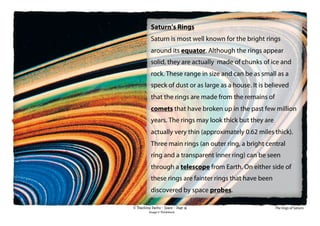
Saturn’s Rings
Saturn is most well known for the bright rings
around its equator. Although the rings appear
solid, they are actually made of chunks of ice and
rock. These range in size and can be as small as a
speck of dust or as large as a house. It is believed
that the rings are made from the remains of
comets that have broken up in the past few million
years. The rings may look thick but they are
actually very thin (approximately 0.62 miles thick).
Three main rings (an outer ring, a bright central
ring and a transparent inner ring) can be seen
through a telescope from Earth. On either side of
these rings are fainter rings that have been
discovered by space probes.
The rings of Saturn.
Image © ThinkStock
© Teaching Packs - Space - Page 50
Absolute zero
The lowest temperature possible.
Alien
A being from another planet.
Asteroid
A small rocky body that orbits the Sun.
Asteroid belt
A disc in the Solar System (between Mars and
Jupiter) that is occupied by asteroids and minor
planets.
Astronaut
A person who travels into space.
Astronomer
A person who studies the stars, planets and other
objects in space.
Atmosphere
The layer of gases around a planet, moon or star.
Atom
The smallest particle of an element.
Axis
An imaginary line through the centre of a planet or
star.
Big bang
An explosive event that is believed to have created
the universe.
Billion
One thousand million (1,000,000,000).
Black Hole
A collapsed star whose gravity is so strong that
nothing can escape it.
Canyon
A deep gorge.
Carbon
One of the most common elements in the universe.
Celestial object
Objects seen in the sky, including planets, stars and
galaxies.
Cluster
A group of something.
Comet
A small object (made from ice and rock dust) that
melts and develops and head and two tails when it
travels too near to the Sun.
Constellation
A pattern of stars and the sky around then.
Contracting
Getting smaller, shrinking.
Core
The centre of something.
Cosmologist
A person who studies the evolution and future of the
universe.
Crater
A hollow on the surface of a planet or moon.
Crust
The rocky surface of a planet or moon.
Degree
A unit of measuring angles.
Density
How compact something is.
Diameter
The distance from one side of a circular object to the
other, passing through the centre.
Double planet
A pair of stars or planets that orbit around each
other.
Dune
A mound or ridge or sand.
Dust
Tiny particles of earth and other matter.
Dwarf planet
An object that orbits the Sun but hasn’t cleared other
objects in the area of its orbit.
Earth
The planet on which we live.
Earthquake
A sudden shaking of the ground.
www.teachingpacks.co.uk
Images: © ThinkStock
©
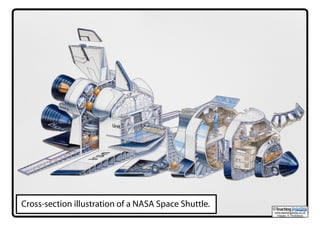
Cross-section illustration of a NASA Space Shuttle.
www.teachingpacks.co.uk
Images: © ThinkStock
©
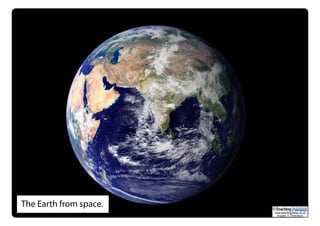
The Earth from space.
www.teachingpacks.co.uk
Images: © ThinkStock
©
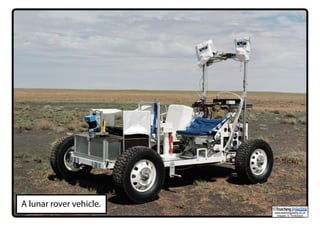
A lunar rover vehicle.
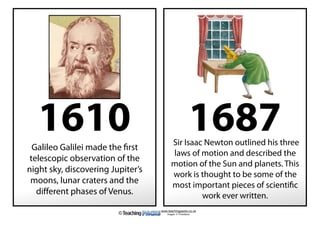
1610Galileo Galilei made the first
telescopic observation of the
night sky, discovering Jupiter’s
moons, lunar craters and the
different phases of Venus.
1687Sir Isaac Newton outlined his three
laws of motion and described the
motion of the Sun and planets. This
work is thought to be some of the
most important pieces of scientific
work ever written.
www.teachingpacks.co.uk
Images: © ThinkStock©
1801
The first asteroid, Ceres, was
discovered by Giuseppe Piazzi.
1840
The first clear telescopic
photograph of The Moon was
taken by John William Draper.
www.teachingpacks.co.uk
Images: © ThinkStock©
1927The Society for Space Travel was
formed in Germany. This group
brought together many of the
engineers who made important
discoveries and contributions to
space flight. 
1930
American astronomer Clyde
Tombaugh discovered Pluto.
www.teachingpacks.co.uk
Images: © ThinkStock©
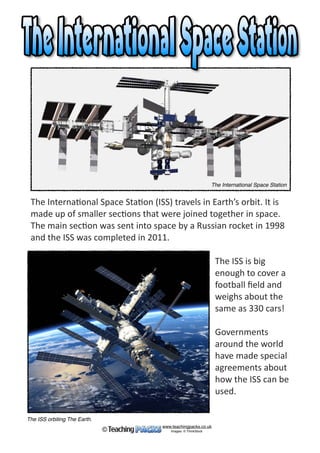
The	Interna*onal	Space	Sta*on	(ISS)	travels	in	Earth’s	orbit.	It	is	
made	up	of	smaller	sec*ons	that	were	joined	together	in	space.	
The	main	sec*on	was	sent	into	space	by	a	Russian	rocket	in	1998	
and	the	ISS	was	completed	in	2011.	
The	ISS	is	big	
enough	to	cover	a	
football	field	and	
weighs	about	the	
same	as	330	cars!	
Governments	
around	the	world	
have	made	special	
agreements	about	
how	the	ISS	can	be	
used.	
www.teachingpacks.co.uk
Images: © ThinkStock©
The International Space Station
The ISS orbiting The Earth.
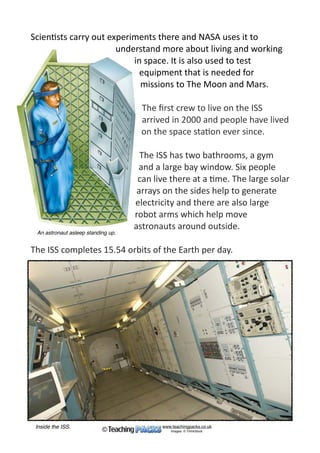
Scien*sts	carry	out	experiments	there	and	NASA	uses	it	to	
understand	more	about	living	and	working	
in	space.	It	is	also	used	to	test	
equipment	that	is	needed	for	
missions	to	The	Moon	and	Mars.	
The	first	crew	to	live	on	the	ISS	
arrived	in	2000	and	people	have	lived	
on	the	space	sta*on	ever	since.		
		
The	ISS	has	two	bathrooms,	a	gym	
and	a	large	bay	window.	Six	people	
can	live	there	at	a	*me.	The	large	solar	
arrays	on	the	sides	help	to	generate	
electricity	and	there	are	also	large	
robot	arms	which	help	move	
astronauts	around	outside.	
		
The	ISS	completes	15.54	orbits	of	the	Earth	per	day.

www.teachingpacks.co.uk
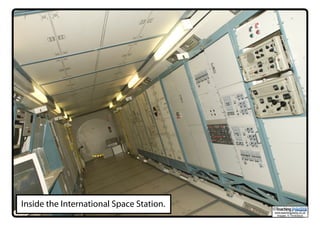
Images: © ThinkStock©Inside the ISS.
An astronaut asleep standing up.
Ques%ons:	
	 1.	 What	does	ISS	stand	for?

	 2.	 When	was	the	main	sec*on	of	the	ISS	sent	into	space?

	 3.	 When	was	the	ISS	complete?

	 4.	 How	much	does	the	ISS	weigh?

	 5.	 What	do	scien*sts	do	on	the	ISS?

	 6.	 When	did	the	first	crew	begin	to	live	on	the	ISS?

	 7.	 Name	some	of	the	rooms	in	the	ISS.

	 8.	 How	many	people	can	live	on	the	ISS	at	the	same	*me?

	 9.	 What	do	the	robot	arms	do?

	 10.	 Write	a	sentence	to	describe	what	it	would	be	like	living	on	the	ISS.

www.teachingpacks.co.uk
Images: © ThinkStock©
Thank you for looking at this preview
of our Space Pack.
The full pack includes many other
teaching, activity and display
resources. Download it from
http://www.teachingpacks.co.uk/

the-space-pack/
Helen and Mark
www.teachingpacks.co.uk

The Space Pack

  • 1.
    © Teaching Packs- Space - Page 1 By Helen and Mark Warner www.teachingpacks.co.uk
  • 2.
    The Solar Systemis the name given to all of the planets, moons, comets, asteroids, minor planets, dust and gases that orbit our Sun. It can be found inside a galaxy called The Milky Way. The Sun is enormous and makes up most of our Solar System. It has a powerful gravitational pull that attracts all of the other objects in the Solar System, pulling them towards it. These objects are moving rapidly and try to pull away, but they can’t because the pull of gravity is too great. The result is that these objects spend eternity orbiting around the Sun. © Teaching Packs - Space - Page 4 In this section, you will learn about... 1. About the objects in the Solar System. 2. How the Solar System formed. 3. About the Asteroid Belt, Kuiper Belt and Oort Cloud. The planets in our solar system. Image © ThinkStock
  • 3.
    The Earth isthe biggest planet in the inner solar system. It is roughly spherical in shape and has a diameter of 7,926 miles. 70% of Earth is covered in water and it supports a population of about 7 billion people. The Earth also spins on its own invisible axis (a line which goes from the North to the South Pole). The earth spins completely round once every 24 hours. When a place is facing the Sun, it is daytime there. When it is in shade, it is night- time. © Teaching Packs - Space - Page 17 In this section, you will learn about... 1. Why there is life on Earth. 2. Tectonic plates and how they can affect the landscape. 3. The Earth’s atmosphere and how the climate is changing. 4. How the Sun influences our seasons. Day and night on Earth. Image © ThinkStock
  • 4.
    The Phases ofthe Moon Just like Earth, one half of the Moon is always lit by sunlight, whilst the other side is dark. As the Moon circles around the Earth, it appears to change shape as we see different amounts of it lit by sunlight. The different shapes that we can see are called the phases of the Moon. © Teaching Packs - Space - Page 24 Phase How the Moon is seen in the Northern Hemisphere How the Moon is seen in the Southern Hemisphere New Waxing Crescent First Quarter Waxing Gibbous Full Waning Gibbous Last Quarter Waning Crescent Sunlight The phases of the Moon as it rotates around the Earth. Images © ThinkStock Did you know...? The phases of the Moon are different for those in the Northern and Southern Hemispheres. This is because we’re “upside down” from each other and we see the Moon from different points. A waxing gibbous phase of the Moon.
  • 5.
    © Teaching Packs- Space - Page 36 Saturn’s Rings Saturn is most well known for the bright rings around its equator. Although the rings appear solid, they are actually made of chunks of ice and rock. These range in size and can be as small as a speck of dust or as large as a house. It is believed that the rings are made from the remains of comets that have broken up in the past few million years. The rings may look thick but they are actually very thin (approximately 0.62 miles thick). Three main rings (an outer ring, a bright central ring and a transparent inner ring) can be seen through a telescope from Earth. On either side of these rings are fainter rings that have been discovered by space probes. The rings of Saturn. Image © ThinkStock
  • 6.
    © Teaching Packs- Space - Page 50 Absolute zero The lowest temperature possible. Alien A being from another planet. Asteroid A small rocky body that orbits the Sun. Asteroid belt A disc in the Solar System (between Mars and Jupiter) that is occupied by asteroids and minor planets. Astronaut A person who travels into space. Astronomer A person who studies the stars, planets and other objects in space. Atmosphere The layer of gases around a planet, moon or star. Atom The smallest particle of an element. Axis An imaginary line through the centre of a planet or star. Big bang An explosive event that is believed to have created the universe. Billion One thousand million (1,000,000,000). Black Hole A collapsed star whose gravity is so strong that nothing can escape it. Canyon A deep gorge. Carbon One of the most common elements in the universe. Celestial object Objects seen in the sky, including planets, stars and galaxies. Cluster A group of something. Comet A small object (made from ice and rock dust) that melts and develops and head and two tails when it travels too near to the Sun. Constellation A pattern of stars and the sky around then. Contracting Getting smaller, shrinking. Core The centre of something. Cosmologist A person who studies the evolution and future of the universe. Crater A hollow on the surface of a planet or moon. Crust The rocky surface of a planet or moon. Degree A unit of measuring angles. Density How compact something is. Diameter The distance from one side of a circular object to the other, passing through the centre. Double planet A pair of stars or planets that orbit around each other. Dune A mound or ridge or sand. Dust Tiny particles of earth and other matter. Dwarf planet An object that orbits the Sun but hasn’t cleared other objects in the area of its orbit. Earth The planet on which we live. Earthquake A sudden shaking of the ground.
  • 7.
  • 8.
  • 9.
  • 10.
    1610Galileo Galilei madethe first telescopic observation of the night sky, discovering Jupiter’s moons, lunar craters and the different phases of Venus. 1687Sir Isaac Newton outlined his three laws of motion and described the motion of the Sun and planets. This work is thought to be some of the most important pieces of scientific work ever written. www.teachingpacks.co.uk Images: © ThinkStock©
  • 11.
    1801 The first asteroid,Ceres, was discovered by Giuseppe Piazzi. 1840 The first clear telescopic photograph of The Moon was taken by John William Draper. www.teachingpacks.co.uk Images: © ThinkStock©
  • 12.
    1927The Society forSpace Travel was formed in Germany. This group brought together many of the engineers who made important discoveries and contributions to space flight.  1930 American astronomer Clyde Tombaugh discovered Pluto. www.teachingpacks.co.uk Images: © ThinkStock©
  • 13.
  • 14.
  • 15.
    Ques%ons: 1. What does ISS stand for?
 2. When was the main sec*on of the ISS sent into space?
 3. When was the ISS complete?
 4. How much does the ISS weigh?
 5. What do scien*sts do on the ISS?
 6. When did the first crew begin to live on the ISS?
 7. Name some of the rooms in the ISS.
 8. How many people can live on the ISS at the same *me?
 9. What do the robot arms do?
 10. Write a sentence to describe what it would be like living on the ISS.
 www.teachingpacks.co.uk Images: © ThinkStock©
  • 16.
    Thank you forlooking at this preview of our Space Pack. The full pack includes many other teaching, activity and display resources. Download it from http://www.teachingpacks.co.uk/
 the-space-pack/ Helen and Mark www.teachingpacks.co.uk