Kinder cognition
Quick SurveyHow many of you……have taught/are teaching?…have talked to a 5 or 6 year old recently?What comes to mind when you think “kindergarten”?
InspirationA conversation with Dean Culp:Kris: How do you like teaching Kindergarten?Me: They’re like aliens!They pee in their pantsThey can’t tell the difference between a question and a statementThey can barely write their namesThey don’t know what’s at the other end of the hall
The PlanHistorical triviaTeachingLearning & Kindergarten CognitionConversation
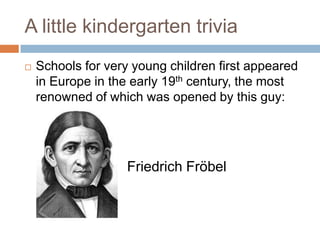
A little kindergarten triviaSchools for very young children first appeared in Europe in the early 19th century, the most renowned of which was opened by this guy:		Friedrich Fröbel
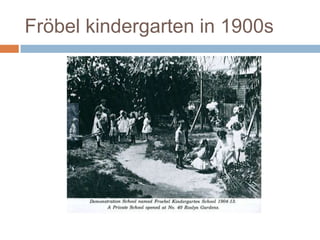
Fröbel kindergarten in 1900s
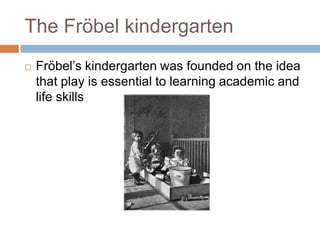
The Fröbel kindergartenFröbel’s kindergarten was founded on the idea that play is essential to learning academic and life skills
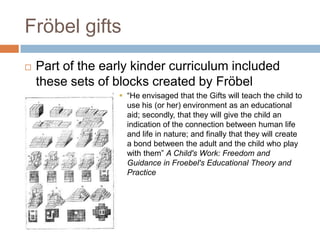
Fröbel giftsPart of the early kinder curriculum included these sets of blocks created by Fröbel“He envisaged that the Gifts will teach the child to use his (or her) environment as an educational aid; secondly, that they will give the child an indication of the connection between human life and life in nature; and finally that they will create a bond between the adult and the child who play with them” A Child's Work: Freedom and Guidance in Froebel's Educational Theory and Practice
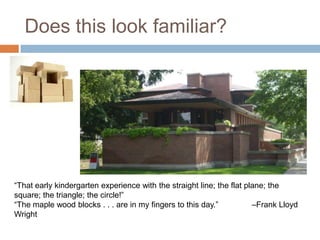
Does this look familiar?“That early kindergarten experience with the straight line; the flat plane; the square; the triangle; the circle!”“The maple wood blocks . . . are in my fingers to this day.”               –Frank Lloyd Wright
The importance of playOut of a 19th century belief in the importance of play emerged one of the world’s most renowned architectLet’s fast forward from Fröbel……to the founding of parish schools in American cities…to the establishment of free public education…to the segregation and desegregation of public schools…to the first Head Start programs and pre-Kindergarten…to the testing and standards movementIn terms of Kindergarten curriculum, where are we now?
The importance of playThere is renewed interest in the value of play in developing multiple areas of learning and development (social, physical, intrapersonal)
Stuart Brown from the National Institute for Play, 2008 (Ted Talks)
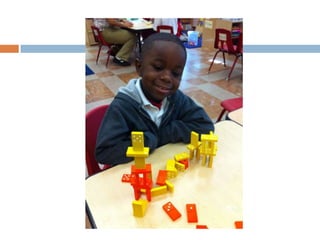
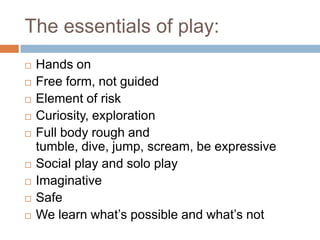
The essentials of play: Hands onFree form, not guidedElement of riskCuriosity, explorationFull body rough and tumble, dive, jump, scream, be expressiveSocial play and solo playImaginativeSafeWe learn what’s possible and what’s not
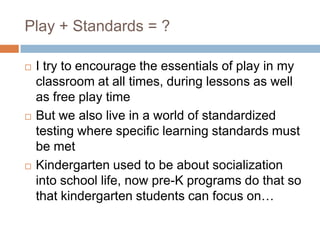
Play + Standards = ?I try to encourage the essentials of play in my classroom at all times, during lessons as well as free play timeBut we also live in a world of standardized testing where specific learning standards must be metKindergarten used to be about socialization into school life, now pre-K programs do that so that kindergarten students can focus on…
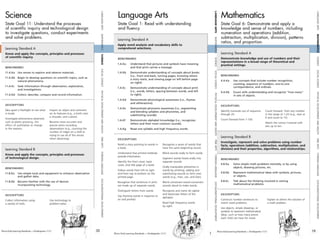
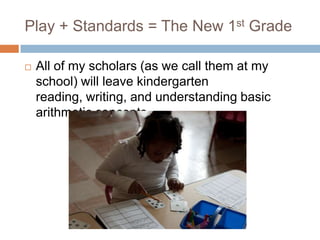
Play + Standards = The New 1st GradeAll of my scholars (as we call them at my school) will leave kindergarten reading, writing, and understanding basic arithmetic concepts
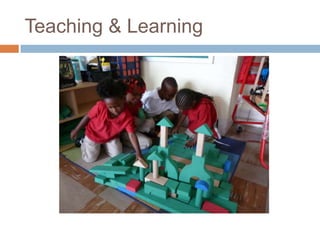
Teaching & Learning
TeachingA little bit about meI graduated from the University of Chicago’s Urban Teacher Education Program in 2009This is my 2nd year teaching KindergartenI work at Legacy Charter School in the West Lawndale community on the far west side of Chicago
Teaching at LegacyDynamic and committed leadership: Lisa KennerPre-K through 8th gradeTwo classes per grade26 scholars in each classTwo full-time instructors in each Kindergarten classMajority of scholars are African AmericanEdubabble: 90-90-90 school
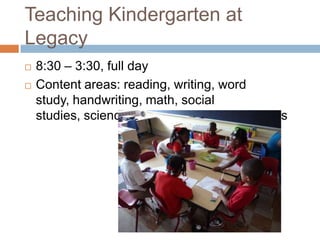
Teaching Kindergarten at Legacy8:30 – 3:30, full dayContent areas: reading, writing, word study, handwriting, math, social studies, science, music, art, P.E., computers
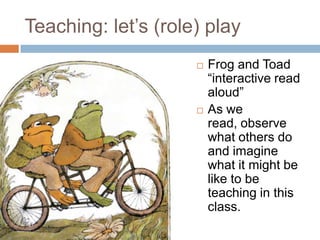
Teaching: let’s (role) playFrog and Toad “interactive read aloud”As we read, observe what others do and imagine what it might be like to be teaching in this class.
Teaching	What did you notice?What might be challenging?
Learning
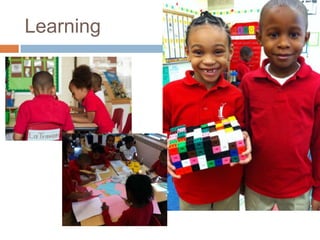
Learning: what we know about kindergartenersWhen they turn from 5 to 6 years, increasing their entire life span by 16%Very interested in bodies because their physical coordination (both fine and gross motor) is increasingAttention spans are increasing, most children can focus on one thing for 10-15 minutes throughout the kindergarten yearThey want to be helpful and follow the rules; they seek approval and love from adultsBeginning to understand emotions and that others react to your choices (“When you said, ‘You stank,’ it hurt her feelings.”)Lose teeth, need naps, poop and pee in their pants
Learning: cognitive developmentIn children ages 4-6 the brain grows from 70-90% of its eventual adult weightSignificant development in the frontal lobes (executive functioning) of the brain; children begin to regulate emotions and behaviorGreater ability to problem solve, conceptualize categories, and manage simple representational abstractionsFor example: “If you have two cookies and I give you three more, how many do you have altogether?” The fingers represent the cookies, a child doesn’t actually have to hold two and then three cookies.
Learning: like a spongeFive and six year olds have almost twice as many neural connections in some areas of the brain as adultsKindergarten brains have greater physiological “plasticity” and therefore a high capacity for new learningYoung children really do have minds that absorb things like a sponge
Learning: planning and memoryThe average adult can hold 5-7 things in her working memoryThat’s why our phone numbers are 7 digits long plus an area codeOver the course of the Kindergarten year, most children grow to be able to retain 3 things in their working memory
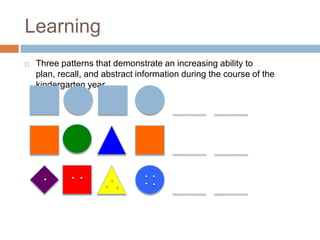
LearningThree patterns that demonstrate an increasing ability to plan, recall, and abstract information during the course of the kindergarten year
Teaching & Learning: the kindergarten caveatAside from the fact that all people learn in different ways at different times, consider that some children enter kindergarten having just turned 5, others will turn 6 within weeks of beginning their kinder year…And consider what you now know about the massive changes that are occurring in kindergarteners’ minds and bodies…Age + Time = an enormous range of cognitive, physical, emotional, social, behavioral states all interacting with each otherThis developmental diversity makes teaching and learning in kindergarten unique among the grades, uniquely challenging
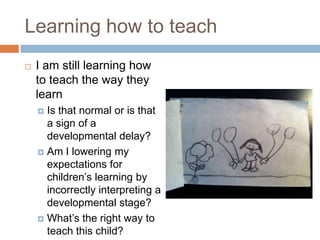
Learning how to teachI am still learning how to teach the way they learnIs that normal or is that a sign of a developmental delay?Am I lowering my expectations for children’s learning by incorrectly interpreting a developmental stage?What’s the right way to teach this child?
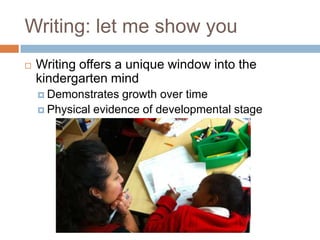
Writing: let me show youWriting offers a unique window into the kindergarten mindDemonstrates growth over timePhysical evidence of developmental stage
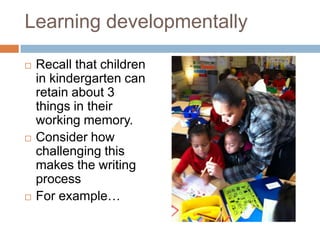
Learning developmentallyRecall that children in kindergarten can retain about 3 things in their working memory. Consider how challenging this makes the writing processFor example…
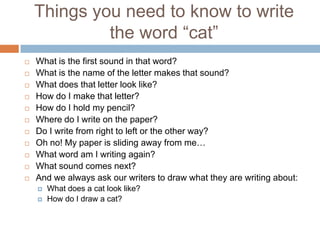
Things you need to know to write the word “cat”What is the first sound in that word?What is the name of the letter makes that sound?What does that letter look like?How do I make that letter?How do I hold my pencil?Where do I write on the paper?Do I write from right to left or the other way?Oh no! My paper is sliding away from me…What word am I writing again?What sound comes next?And we always ask our writers to draw what they are writing about:What does a cat look like?How do I draw a cat?
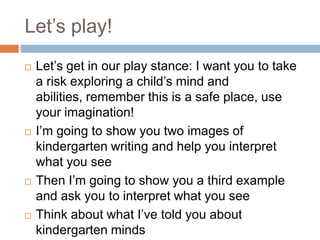
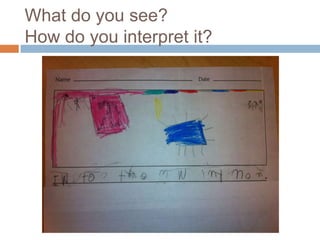
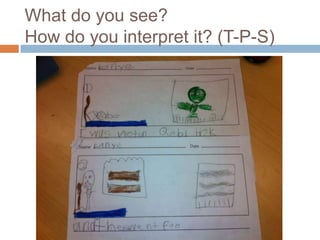
Let’s play!Let’s get in our play stance: I want you to take a risk exploring a child’s mind and abilities, remember this is a safe place, use your imagination!I’m going to show you two images of kindergarten writing and help you interpret what you seeThen I’m going to show you a third example and ask you to interpret what you seeThink about what I’ve told you about kindergarten minds
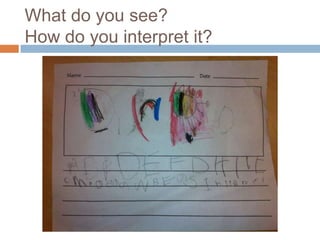
What do you see?How do you interpret it?
What do you see?How do you interpret it? (T-P-S)
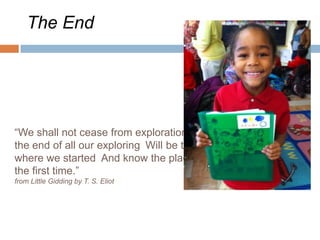
The End“We shall not cease from exploration
And the end of all our exploring
Will be to arrive where we started
And know the place for the first time.”from Little Gidding by T. S. Eliot

Kindergarten Cognition

  • 1.
  • 2.
    Quick SurveyHow manyof you……have taught/are teaching?…have talked to a 5 or 6 year old recently?What comes to mind when you think “kindergarten”?
  • 3.
    InspirationA conversation withDean Culp:Kris: How do you like teaching Kindergarten?Me: They’re like aliens!They pee in their pantsThey can’t tell the difference between a question and a statementThey can barely write their namesThey don’t know what’s at the other end of the hall
  • 4.
    The PlanHistorical triviaTeachingLearning& Kindergarten CognitionConversation
  • 5.
    A little kindergartentriviaSchools for very young children first appeared in Europe in the early 19th century, the most renowned of which was opened by this guy: Friedrich Fröbel
  • 6.
  • 7.
    The Fröbel kindergartenFröbel’skindergarten was founded on the idea that play is essential to learning academic and life skills
  • 8.
    Fröbel giftsPart ofthe early kinder curriculum included these sets of blocks created by Fröbel“He envisaged that the Gifts will teach the child to use his (or her) environment as an educational aid; secondly, that they will give the child an indication of the connection between human life and life in nature; and finally that they will create a bond between the adult and the child who play with them” A Child's Work: Freedom and Guidance in Froebel's Educational Theory and Practice
  • 9.
    Does this lookfamiliar?“That early kindergarten experience with the straight line; the flat plane; the square; the triangle; the circle!”“The maple wood blocks . . . are in my fingers to this day.” –Frank Lloyd Wright
  • 11.
    The importance ofplayOut of a 19th century belief in the importance of play emerged one of the world’s most renowned architectLet’s fast forward from Fröbel……to the founding of parish schools in American cities…to the establishment of free public education…to the segregation and desegregation of public schools…to the first Head Start programs and pre-Kindergarten…to the testing and standards movementIn terms of Kindergarten curriculum, where are we now?
  • 12.
    The importance ofplayThere is renewed interest in the value of play in developing multiple areas of learning and development (social, physical, intrapersonal)
  • 13.
    Stuart Brown fromthe National Institute for Play, 2008 (Ted Talks)
  • 14.
    The essentials ofplay: Hands onFree form, not guidedElement of riskCuriosity, explorationFull body rough and tumble, dive, jump, scream, be expressiveSocial play and solo playImaginativeSafeWe learn what’s possible and what’s not
  • 15.
    Play + Standards= ?I try to encourage the essentials of play in my classroom at all times, during lessons as well as free play timeBut we also live in a world of standardized testing where specific learning standards must be metKindergarten used to be about socialization into school life, now pre-K programs do that so that kindergarten students can focus on…
  • 17.
    Play + Standards= The New 1st GradeAll of my scholars (as we call them at my school) will leave kindergarten reading, writing, and understanding basic arithmetic concepts
  • 18.
  • 19.
    TeachingA little bitabout meI graduated from the University of Chicago’s Urban Teacher Education Program in 2009This is my 2nd year teaching KindergartenI work at Legacy Charter School in the West Lawndale community on the far west side of Chicago
  • 20.
    Teaching at LegacyDynamicand committed leadership: Lisa KennerPre-K through 8th gradeTwo classes per grade26 scholars in each classTwo full-time instructors in each Kindergarten classMajority of scholars are African AmericanEdubabble: 90-90-90 school
  • 21.
    Teaching Kindergarten atLegacy8:30 – 3:30, full dayContent areas: reading, writing, word study, handwriting, math, social studies, science, music, art, P.E., computers
  • 22.
    Teaching: let’s (role)playFrog and Toad “interactive read aloud”As we read, observe what others do and imagine what it might be like to be teaching in this class.
  • 23.
    Teaching What did younotice?What might be challenging?
  • 24.
  • 25.
    Learning: what weknow about kindergartenersWhen they turn from 5 to 6 years, increasing their entire life span by 16%Very interested in bodies because their physical coordination (both fine and gross motor) is increasingAttention spans are increasing, most children can focus on one thing for 10-15 minutes throughout the kindergarten yearThey want to be helpful and follow the rules; they seek approval and love from adultsBeginning to understand emotions and that others react to your choices (“When you said, ‘You stank,’ it hurt her feelings.”)Lose teeth, need naps, poop and pee in their pants
  • 26.
    Learning: cognitive developmentInchildren ages 4-6 the brain grows from 70-90% of its eventual adult weightSignificant development in the frontal lobes (executive functioning) of the brain; children begin to regulate emotions and behaviorGreater ability to problem solve, conceptualize categories, and manage simple representational abstractionsFor example: “If you have two cookies and I give you three more, how many do you have altogether?” The fingers represent the cookies, a child doesn’t actually have to hold two and then three cookies.
  • 27.
    Learning: like aspongeFive and six year olds have almost twice as many neural connections in some areas of the brain as adultsKindergarten brains have greater physiological “plasticity” and therefore a high capacity for new learningYoung children really do have minds that absorb things like a sponge
  • 28.
    Learning: planning andmemoryThe average adult can hold 5-7 things in her working memoryThat’s why our phone numbers are 7 digits long plus an area codeOver the course of the Kindergarten year, most children grow to be able to retain 3 things in their working memory
  • 29.
    LearningThree patterns thatdemonstrate an increasing ability to plan, recall, and abstract information during the course of the kindergarten year
  • 30.
    Teaching & Learning:the kindergarten caveatAside from the fact that all people learn in different ways at different times, consider that some children enter kindergarten having just turned 5, others will turn 6 within weeks of beginning their kinder year…And consider what you now know about the massive changes that are occurring in kindergarteners’ minds and bodies…Age + Time = an enormous range of cognitive, physical, emotional, social, behavioral states all interacting with each otherThis developmental diversity makes teaching and learning in kindergarten unique among the grades, uniquely challenging
  • 31.
    Learning how toteachI am still learning how to teach the way they learnIs that normal or is that a sign of a developmental delay?Am I lowering my expectations for children’s learning by incorrectly interpreting a developmental stage?What’s the right way to teach this child?
  • 32.
    Writing: let meshow youWriting offers a unique window into the kindergarten mindDemonstrates growth over timePhysical evidence of developmental stage
  • 33.
    Learning developmentallyRecall thatchildren in kindergarten can retain about 3 things in their working memory. Consider how challenging this makes the writing processFor example…
  • 34.
    Things you needto know to write the word “cat”What is the first sound in that word?What is the name of the letter makes that sound?What does that letter look like?How do I make that letter?How do I hold my pencil?Where do I write on the paper?Do I write from right to left or the other way?Oh no! My paper is sliding away from me…What word am I writing again?What sound comes next?And we always ask our writers to draw what they are writing about:What does a cat look like?How do I draw a cat?
  • 35.
    Let’s play!Let’s getin our play stance: I want you to take a risk exploring a child’s mind and abilities, remember this is a safe place, use your imagination!I’m going to show you two images of kindergarten writing and help you interpret what you seeThen I’m going to show you a third example and ask you to interpret what you seeThink about what I’ve told you about kindergarten minds
  • 36.
    What do yousee?How do you interpret it?
  • 37.
    What do yousee?How do you interpret it?
  • 38.
    What do yousee?How do you interpret it? (T-P-S)
  • 39.
    The End“We shallnot cease from exploration
And the end of all our exploring
Will be to arrive where we started
And know the place for the first time.”from Little Gidding by T. S. Eliot

Editor's Notes

  • #4 Not a parent, interned in 7th and 2nd grade so I knew next to nothing about early childhood education when I beganThey can’t talk, they can barely write their names, they pee their pants, they don’t know what is at the other end of the hall
  • #9 Have someone read this quote
  • #13 Play to 9:51
  • #15 We do these in kinder with song, play time, learning centers
  • #18 I’m not bragging or stating a goal. This is what really happens now in Kindergarten (at least at Legacy).
  • #19 The rest of my presentation will focus a little bit on my teaching and a longer bit on learning, then we’ll have time for conversation and questions
  • #21 Dynamic: FRAK at meetings
  • #26 VOLUNTEER READS
  • #27 VOLUNTEER READS
  • #30 VOLUNTEER COMPLETES PATTERNS
  • #31 Children are literally different people by the end of their kinder yearThey don’t learn from long lectures
  • #38 This is the same child