SYNHETIC RUBBER
MNUFCTURING
BY: SYED MEHRAN FARID
We will learn today :
 Introduction
 Classification
 Natural Rubber Brief
 Synthetic Rubber Intro.
 Industrial Processing
INTRODUCTION
Rubber, elastic substance obtained
from the exudations of certain tropical
plants (natural rubber) or derived
from petroleum and natural
gas (synthetic rubber).
Because of its elasticity, resilience,
and toughness, rubber is the
basic constituent of the tires used in
automotive vehicles, aircraft, and
bicycles.
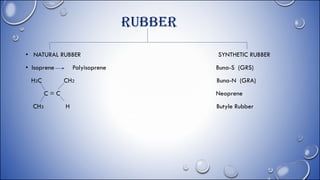
RUBBER
• NATURAL RUBBER SYNTHETIC RUBBER
• Isoprene Polyisoprene Buna-S (GRS)
H2C CH2 Buna-N (GRA)
C = C Neoprene
CH3 H Butyle Rubber
NATURAL RUBBER
• Natural rubber is obtained from a tree
called Hevea brasiliensis as an
aqueous suspension.
• Low plasticity
• Low tensile strength(load bearing capacity)
• High water absorption (weak)
• High unsaturation(more reactive)
These problems can be overcome by Vulcanization.
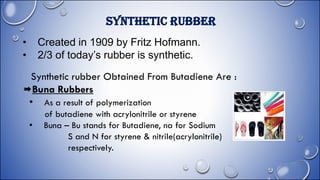
SYNTHETIC RUBBER
• Created in 1909 by Fritz Hofmann.
• 2/3 of today’s rubber is synthetic.
Synthetic rubber Obtained From Butadiene Are :
Buna Rubbers
• As a result of polymerization
of butadiene with acrylonitrile or styrene
• Buna – Bu stands for Butadiene, na for Sodium
S and N for styrene & nitrile(acrylonitrile)
respectively.
FILLERS
Carbon Black
Silica
Cellulose filler
Clay filler
Sulphur
PROCESSING
1. Mastication/Compounding
2. Mixing
3. Shaping
4. Curing/Vulcanization
1. MASTICATION
• The process of softening by means of mechanical shearing
is known as mastication.
• Rubber is always compounded with additives(carbon black)
• Mastication shortens rubber
Molecular chains,
Resulting in a reduced molecular weight and
Reduces its viscosity
Improve Plasticity.
• This process involves the use of special mechanical
equipment and additives at low temperatures.
MASTICATION CONT….
OTHER FILLERS AND ADDITIVES
• China clay – Hydrous Alumina Silicates ,used when black is not
acceptable
• other polymers, such as styrene, pvc, and phenolics.
• recycled rubber added in some rubber products, but usually 10% or less.
• coloring pigments; plasticizers and softening oils; blowing agents in
the production of foamed rubber; and mold release compounds.
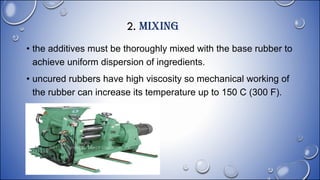
2. MIXING
• the additives must be thoroughly mixed with the base rubber to
achieve uniform dispersion of ingredients.
• uncured rubbers have high viscosity so mechanical working of
the rubber can increase its temperature up to 150 C (300 F).
MIXING CONT…
• to avoid premature vulcanization, a two-stage mixing process
is usually employed
stage 1 - carbon black and other non-vulcanizing
additives are combined with the raw rubber.
 The term master batch is used for this first-stage mixture
stage 2 - after stage 1 mixing has been completed, and
time for cooling has been allowed, stage 2 mixing is carried out in
which vulcanizing agents are added
3. SHAPING & RELATED PROCESSES
• Shaping processes for rubber products can be
divided into four basic categories:
1. Extrusion
2. Calendering
3. Coating
4. Molding and Casting
• Some products require several basic processes
plus assembly work
-- Example: tires
SHAPING CONT…..
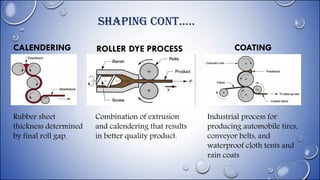
CALENDERING ROLLER DYE PROCESS COATING
Rubber sheet
thickness determined
by final roll gap.
Combination of extrusion
and calendering that results
in better quality product.
Industrial process for
producing automobile tires,
conveyor belts, and
waterproof cloth tents and
rain coats
4. VULCANIZATION
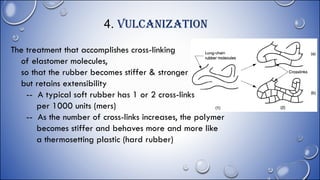
The treatment that accomplishes cross-linking
of elastomer molecules,
so that the rubber becomes stiffer & stronger
but retains extensibility
-- A typical soft rubber has 1 or 2 cross-links
per 1000 units (mers)
-- As the number of cross-links increases, the polymer
becomes stiffer and behaves more and more like
a thermosetting plastic (hard rubber)
VULCANIZATION CHEMICALS
• As it was first invented by Goodyear in 1839, vulcanization used sulfur
(about 8 parts by weight of S mixed with 100 parts of NR) at 140c (280f)
for about 5 hours
- Vulcanization with sulfur alone is no longer used today, due to the
long curing times
• various other chemicals are combined with smaller doses of sulfur
accelerate and strengthen the treatment
-The resulting cure time is 15-20 minutes
Rubber manufacturing pdf

Rubber manufacturing pdf

  • 1.
  • 2.
    We will learntoday :  Introduction  Classification  Natural Rubber Brief  Synthetic Rubber Intro.  Industrial Processing
  • 3.
    INTRODUCTION Rubber, elastic substanceobtained from the exudations of certain tropical plants (natural rubber) or derived from petroleum and natural gas (synthetic rubber). Because of its elasticity, resilience, and toughness, rubber is the basic constituent of the tires used in automotive vehicles, aircraft, and bicycles.
  • 4.
    RUBBER • NATURAL RUBBERSYNTHETIC RUBBER • Isoprene Polyisoprene Buna-S (GRS) H2C CH2 Buna-N (GRA) C = C Neoprene CH3 H Butyle Rubber
  • 5.
    NATURAL RUBBER • Naturalrubber is obtained from a tree called Hevea brasiliensis as an aqueous suspension. • Low plasticity • Low tensile strength(load bearing capacity) • High water absorption (weak) • High unsaturation(more reactive) These problems can be overcome by Vulcanization.
  • 6.
    SYNTHETIC RUBBER • Createdin 1909 by Fritz Hofmann. • 2/3 of today’s rubber is synthetic. Synthetic rubber Obtained From Butadiene Are : Buna Rubbers • As a result of polymerization of butadiene with acrylonitrile or styrene • Buna – Bu stands for Butadiene, na for Sodium S and N for styrene & nitrile(acrylonitrile) respectively.
  • 7.
  • 8.
  • 9.
    1. MASTICATION • Theprocess of softening by means of mechanical shearing is known as mastication. • Rubber is always compounded with additives(carbon black) • Mastication shortens rubber Molecular chains, Resulting in a reduced molecular weight and Reduces its viscosity Improve Plasticity. • This process involves the use of special mechanical equipment and additives at low temperatures.
  • 10.
    MASTICATION CONT…. OTHER FILLERSAND ADDITIVES • China clay – Hydrous Alumina Silicates ,used when black is not acceptable • other polymers, such as styrene, pvc, and phenolics. • recycled rubber added in some rubber products, but usually 10% or less. • coloring pigments; plasticizers and softening oils; blowing agents in the production of foamed rubber; and mold release compounds.
  • 11.
    2. MIXING • theadditives must be thoroughly mixed with the base rubber to achieve uniform dispersion of ingredients. • uncured rubbers have high viscosity so mechanical working of the rubber can increase its temperature up to 150 C (300 F).
  • 12.
    MIXING CONT… • toavoid premature vulcanization, a two-stage mixing process is usually employed stage 1 - carbon black and other non-vulcanizing additives are combined with the raw rubber.  The term master batch is used for this first-stage mixture stage 2 - after stage 1 mixing has been completed, and time for cooling has been allowed, stage 2 mixing is carried out in which vulcanizing agents are added
  • 13.
    3. SHAPING &RELATED PROCESSES • Shaping processes for rubber products can be divided into four basic categories: 1. Extrusion 2. Calendering 3. Coating 4. Molding and Casting • Some products require several basic processes plus assembly work -- Example: tires
  • 14.
    SHAPING CONT….. CALENDERING ROLLERDYE PROCESS COATING Rubber sheet thickness determined by final roll gap. Combination of extrusion and calendering that results in better quality product. Industrial process for producing automobile tires, conveyor belts, and waterproof cloth tents and rain coats
  • 15.
    4. VULCANIZATION The treatmentthat accomplishes cross-linking of elastomer molecules, so that the rubber becomes stiffer & stronger but retains extensibility -- A typical soft rubber has 1 or 2 cross-links per 1000 units (mers) -- As the number of cross-links increases, the polymer becomes stiffer and behaves more and more like a thermosetting plastic (hard rubber)
  • 16.
    VULCANIZATION CHEMICALS • Asit was first invented by Goodyear in 1839, vulcanization used sulfur (about 8 parts by weight of S mixed with 100 parts of NR) at 140c (280f) for about 5 hours - Vulcanization with sulfur alone is no longer used today, due to the long curing times • various other chemicals are combined with smaller doses of sulfur accelerate and strengthen the treatment -The resulting cure time is 15-20 minutes