Policy Governance ® Reviewed Suzanne Benoit, LCSW Benoit   Consulting Services ® Policy Governance is .  “Policy Governance” is the registered service mark of John Carver.  The authoritative website for the Policy Governance® model is:  www.carvergovernance.com .
The opinions and suggestions contained in this presentation are those of the author, Suzanne V. Benoit, LCSW, SPHR, alone, based upon her research and experience.  They are not developed or sanctioned by the Carver organization though Carver’s trade mark is clearly noted.
Participants will learn about: The “Carver ® Model” What those who use it, think of it Implementation options Benefits Critique
Presentation outline Why interest in this model today? Common board problems The concept explained Implementation options Potential benefits of this model Critique of the model Why not full implementation? Survey results – implementations Increase the chance of success
Why interest in this model today? New IRS 990 requirements - - key policies and other requirements promoting nonprofit accountability, the public trust Nonprofit funding shortages lead to interest in accountability & outcomes Nonprofit failures on the rise Those who fully implement Carver ®, like it and some won’t work without it
Common board operation problems Frustration with board decision-making process Uncertainty, inconsistency of board role Debilitating discussions that lead to nowhere or philosophical differences among board members Lack of the right information or too much of the wrong information Preoccupation with minute/operation details Board members directing staff  Poor ED (exec dir) performance, at best and unethical/questionable activities, at worst Insular attitude – no accountability for public trust
The concept explained -  background Intellectual construct for organizing and delegating nonprofit board responsibilities It is not a management model When was it developed?  Originally designed for publically traded for profit business 1990 first article by Carver on the application of the model to nonprofits and governmental groups A number of nonprofits tried it early on– many had difficulty Renewed interest more recently since ethical scandals and nonprofit financial woes
The concept explained Built on four basic principles Accountability for public trust Clean, clear delegation of authority Strict boundary maintenance between Board and staff Efficiency – Board member time and organizational oversight
List of model concepts Clear organizational purpose - ENDS Org. accountability to “owners” – the community (like stockholders) Board delegates its authority to ED, only Identify the MEANS the ED is not allowed to use Clear standards for org. success Clear standards for ED performance success Clear standards for board operation . . .
1. Ends “Policy” Desired end results of org services Relate to the elements covered by the organization mission Individual goal statements What organization is striving to improve Includes enough detail to allow board to monitor achievement Like outcomes but broader/strategic
2. Accountability to “owners” The nonprofit Board is accountable to community/owners to ensure that the organization achieves its social purpose or end results Owners includes clients but much more: Members in membership orgs Community at large Tax payers and vulnerable populations Those with any interest in the mission
3. Delegates authority to ED Board defines ED accountabilities ED accomplishes these accountabilities through paid staff ED supervises the staff and evaluates their performance ED reports on relevant metrics to show the board that policies are followed Board does not delegate or assign tasks to staff, nor do they evaluate them
4. MEANs the ED may not use Board defines organization goals Board defines ED accountabilities Board defines the MEANs the ED may not use called executive limitations Unethical, illegal, unlawful, inappropriate, disrespectful, discriminatory All other MEANs are fair game for the ED to use in achieving org goals
5. Clear standards for org success How you know if the ENDs are achieved? How achievement is measured What information the ED must produce (the minimal needed) for the board to assess his or her achievement
6. Clear standards for ED perf. How you know if the ED’s accountabilities are achieved How the achievement is measured What information the ED must produce (the minimal needed) for the board at what intervals to assess the achievement
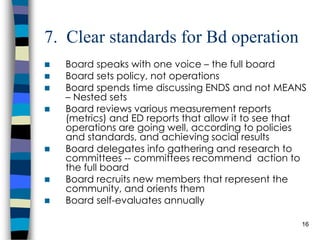
7.  Clear standards for Bd operation Board speaks with one voice – the full board Board sets policy, not operations Board spends time discussing ENDS and not MEANS – Nested sets Board reviews various measurement reports (metrics) and ED reports that allow it to see that operations are going well, according to policies and standards, and achieving social results Board delegates info gathering and research to committees -- committees recommend  action to the full board Board recruits new members that represent the community, and orients them Board self-evaluates annually
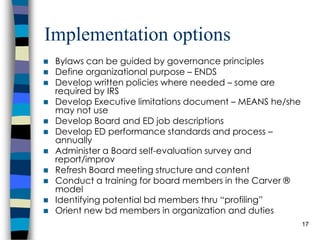
Implementation options Bylaws can be guided by governance principles Define organizational purpose – ENDS Develop written policies where needed – some are required by IRS Develop Executive limitations document – MEANS he/she may not use Develop Board and ED job descriptions Develop ED performance standards and process – annually Administer a Board self-evaluation survey and report/improv Refresh Board meeting structure and content Conduct a training for board members in the Carver ® model Identifying potential bd members thru “profiling” Orient new bd members in organization and duties
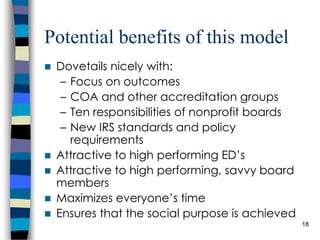
Potential benefits of this model Dovetails nicely with: Focus on outcomes COA and other accreditation groups Ten responsibilities of nonprofit boards New IRS standards and policy requirements Attractive to high performing ED’s Attractive to high performing, savvy board members Maximizes everyone’s time Ensures that the social purpose is achieved
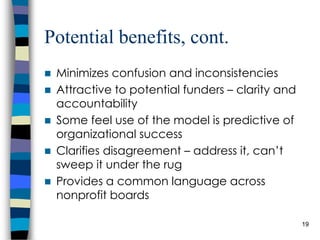
Potential benefits, cont. Minimizes confusion and inconsistencies Attractive to potential funders – clarity and accountability Some feel use of the model is predictive of organizational success Clarifies disagreement – address it, can’t sweep it under the rug Provides a common language across nonprofit boards
Critique of the model Some feel it is functional only for larger organizations Goes against human nature – board members gravitate to details! Too much pressure on the executive director Can lead to board disconnect from operation Not always possible to separate ENDS from MEANS Requires sophisticated/professional board members Requires board members who like accountability
Why not full implementation? Complex structure – most board members know a little bit, full training can be expensive Resources - many nonprofits don’t have the will or resources for full implementation Not many nonprofit consultants are trained Takes  much, up-front  work to set the framework Takes discipline – goes against human nature Requires tough discussions with errant ED and ineffective or disrupting board members
Past BCS Survey results Small number of Maine and NH nonprofits 40 surveys 17 returned Representing 15 separate organizations
Major findings Most popular concepts used Committees research and recommend Clear annual evaluation of ED performance Clear sense of community as org. owners Clear delegation exclusively through ED
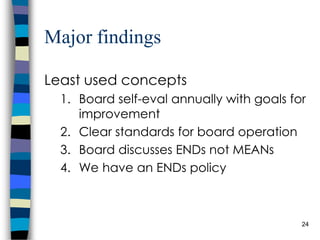
Major findings Least used concepts  Board self-eval annually with goals for improvement Clear standards for board operation Board discusses ENDs not MEANs We have an ENDs policy
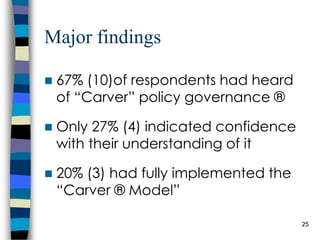
Major findings 67% (10)of respondents had heard of “Carver” policy governance ® Only 27% (4) indicated confidence with their understanding of it 20% (3) had fully implemented the “Carver ® Model”
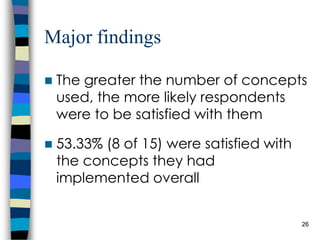
Major findings The greater the number of concepts used, the more likely respondents were to be satisfied with them 53.33% (8 of 15) were satisfied with the concepts they had implemented overall
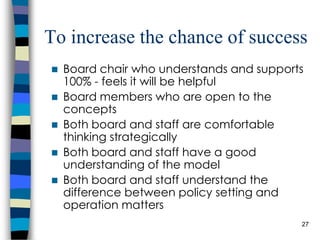
To increase the chance of success Board chair who understands and supports 100% - feels it will be helpful Board members who are open to the concepts Both board and staff are comfortable thinking strategically Both board and staff have a good understanding of the model Both board and staff understand the difference between policy setting and operation matters
For more information . . . Questions? For more information or customized board training, contact me at: [email_address] 207-632-1050 Visit me at:  http://www.linkedin.com/in/benoitconsulting

Policy governance reviewed

  • 1.
    Policy Governance ®Reviewed Suzanne Benoit, LCSW Benoit Consulting Services ® Policy Governance is . “Policy Governance” is the registered service mark of John Carver. The authoritative website for the Policy Governance® model is: www.carvergovernance.com .
  • 2.
    The opinions andsuggestions contained in this presentation are those of the author, Suzanne V. Benoit, LCSW, SPHR, alone, based upon her research and experience. They are not developed or sanctioned by the Carver organization though Carver’s trade mark is clearly noted.
  • 3.
    Participants will learnabout: The “Carver ® Model” What those who use it, think of it Implementation options Benefits Critique
  • 4.
    Presentation outline Whyinterest in this model today? Common board problems The concept explained Implementation options Potential benefits of this model Critique of the model Why not full implementation? Survey results – implementations Increase the chance of success
  • 5.
    Why interest inthis model today? New IRS 990 requirements - - key policies and other requirements promoting nonprofit accountability, the public trust Nonprofit funding shortages lead to interest in accountability & outcomes Nonprofit failures on the rise Those who fully implement Carver ®, like it and some won’t work without it
  • 6.
    Common board operationproblems Frustration with board decision-making process Uncertainty, inconsistency of board role Debilitating discussions that lead to nowhere or philosophical differences among board members Lack of the right information or too much of the wrong information Preoccupation with minute/operation details Board members directing staff Poor ED (exec dir) performance, at best and unethical/questionable activities, at worst Insular attitude – no accountability for public trust
  • 7.
    The concept explained- background Intellectual construct for organizing and delegating nonprofit board responsibilities It is not a management model When was it developed? Originally designed for publically traded for profit business 1990 first article by Carver on the application of the model to nonprofits and governmental groups A number of nonprofits tried it early on– many had difficulty Renewed interest more recently since ethical scandals and nonprofit financial woes
  • 8.
    The concept explainedBuilt on four basic principles Accountability for public trust Clean, clear delegation of authority Strict boundary maintenance between Board and staff Efficiency – Board member time and organizational oversight
  • 9.
    List of modelconcepts Clear organizational purpose - ENDS Org. accountability to “owners” – the community (like stockholders) Board delegates its authority to ED, only Identify the MEANS the ED is not allowed to use Clear standards for org. success Clear standards for ED performance success Clear standards for board operation . . .
  • 10.
    1. Ends “Policy”Desired end results of org services Relate to the elements covered by the organization mission Individual goal statements What organization is striving to improve Includes enough detail to allow board to monitor achievement Like outcomes but broader/strategic
  • 11.
    2. Accountability to“owners” The nonprofit Board is accountable to community/owners to ensure that the organization achieves its social purpose or end results Owners includes clients but much more: Members in membership orgs Community at large Tax payers and vulnerable populations Those with any interest in the mission
  • 12.
    3. Delegates authorityto ED Board defines ED accountabilities ED accomplishes these accountabilities through paid staff ED supervises the staff and evaluates their performance ED reports on relevant metrics to show the board that policies are followed Board does not delegate or assign tasks to staff, nor do they evaluate them
  • 13.
    4. MEANs theED may not use Board defines organization goals Board defines ED accountabilities Board defines the MEANs the ED may not use called executive limitations Unethical, illegal, unlawful, inappropriate, disrespectful, discriminatory All other MEANs are fair game for the ED to use in achieving org goals
  • 14.
    5. Clear standardsfor org success How you know if the ENDs are achieved? How achievement is measured What information the ED must produce (the minimal needed) for the board to assess his or her achievement
  • 15.
    6. Clear standardsfor ED perf. How you know if the ED’s accountabilities are achieved How the achievement is measured What information the ED must produce (the minimal needed) for the board at what intervals to assess the achievement
  • 16.
    7. Clearstandards for Bd operation Board speaks with one voice – the full board Board sets policy, not operations Board spends time discussing ENDS and not MEANS – Nested sets Board reviews various measurement reports (metrics) and ED reports that allow it to see that operations are going well, according to policies and standards, and achieving social results Board delegates info gathering and research to committees -- committees recommend action to the full board Board recruits new members that represent the community, and orients them Board self-evaluates annually
  • 17.
    Implementation options Bylawscan be guided by governance principles Define organizational purpose – ENDS Develop written policies where needed – some are required by IRS Develop Executive limitations document – MEANS he/she may not use Develop Board and ED job descriptions Develop ED performance standards and process – annually Administer a Board self-evaluation survey and report/improv Refresh Board meeting structure and content Conduct a training for board members in the Carver ® model Identifying potential bd members thru “profiling” Orient new bd members in organization and duties
  • 18.
    Potential benefits ofthis model Dovetails nicely with: Focus on outcomes COA and other accreditation groups Ten responsibilities of nonprofit boards New IRS standards and policy requirements Attractive to high performing ED’s Attractive to high performing, savvy board members Maximizes everyone’s time Ensures that the social purpose is achieved
  • 19.
    Potential benefits, cont.Minimizes confusion and inconsistencies Attractive to potential funders – clarity and accountability Some feel use of the model is predictive of organizational success Clarifies disagreement – address it, can’t sweep it under the rug Provides a common language across nonprofit boards
  • 20.
    Critique of themodel Some feel it is functional only for larger organizations Goes against human nature – board members gravitate to details! Too much pressure on the executive director Can lead to board disconnect from operation Not always possible to separate ENDS from MEANS Requires sophisticated/professional board members Requires board members who like accountability
  • 21.
    Why not fullimplementation? Complex structure – most board members know a little bit, full training can be expensive Resources - many nonprofits don’t have the will or resources for full implementation Not many nonprofit consultants are trained Takes much, up-front work to set the framework Takes discipline – goes against human nature Requires tough discussions with errant ED and ineffective or disrupting board members
  • 22.
    Past BCS Surveyresults Small number of Maine and NH nonprofits 40 surveys 17 returned Representing 15 separate organizations
  • 23.
    Major findings Mostpopular concepts used Committees research and recommend Clear annual evaluation of ED performance Clear sense of community as org. owners Clear delegation exclusively through ED
  • 24.
    Major findings Leastused concepts Board self-eval annually with goals for improvement Clear standards for board operation Board discusses ENDs not MEANs We have an ENDs policy
  • 25.
    Major findings 67%(10)of respondents had heard of “Carver” policy governance ® Only 27% (4) indicated confidence with their understanding of it 20% (3) had fully implemented the “Carver ® Model”
  • 26.
    Major findings Thegreater the number of concepts used, the more likely respondents were to be satisfied with them 53.33% (8 of 15) were satisfied with the concepts they had implemented overall
  • 27.
    To increase thechance of success Board chair who understands and supports 100% - feels it will be helpful Board members who are open to the concepts Both board and staff are comfortable thinking strategically Both board and staff have a good understanding of the model Both board and staff understand the difference between policy setting and operation matters
  • 28.
    For more information. . . Questions? For more information or customized board training, contact me at: [email_address] 207-632-1050 Visit me at: http://www.linkedin.com/in/benoitconsulting