“Ethics and the Law”
Program Transcript
[MUSIC PLAYING]
NARRATOR: In this program, Matthew Joseph describe some
ethical issues
encountered by nonprofit organizations and explains how
managers and leaders
might address them.
MATTHEW JOSEPH: Advocates for Children and Youth is an
independent
organization. We don't take public funds so that we can be
completely
independent of government, and we can say what we think is
important for
children. And so we're very, very careful not to, in any way,
have a situation
where we are constrained. And the price we pay is having to
raise money for the
private sector every year for our funds.
So in terms of board members and staff, we have a strict
conflict of interest issue
so that we would never be in a situation that we can't say this
because a board
member is representing someone involved in our issue. So if
that ever happens,
what it means is that the board member has to step down, and
they are so
committed to the mission that they would want to step down.
Because the reason why they think Advocates for Children and
Youth should
exist is so that we can be free of those kind of constraints. And
these are
volunteers, and they often times have very high powered jobs.
They're very
involved in representing companies or issues as an lawyer, as an
accountant.
Just a variety of different ways.
And so we have to be really open with them about the issues
that we're involved
in and how they might be conflicting with one of the needs and
one of their
clients. And that, unfortunately, does happen where we will find
out that we're
involved in an issue where it turns out that a client of a board
member has a
contrary position.
And that just means that that board member has to take leave of
absence during
that period of time, and hopefully it's just a temporary time, and
then they can
come back on. As you might imagine, Advocates for Children
and Youth has a lot
of people who are interested in politics and policy that
oftentimes means that
they're interested in specific candidates.
They may be interested in certain parties, but we are a
501(c)(3). We can be
very, very aggressive as advocates. We can be pushing the
decision makers as
much as we want, but we cannot be partisan. We cannot say we
favor
Democrats or Republicans. We cannot be involved in any
elections of a particular
candidate for or against a candidate.
© 2013 Laureate Education, Inc. 1
And that means that, as individuals within the office, they need
to be clear that
they cannot in any way have us exposed. So, for example, if
someone liked a
particular candidate, they could not have a sign for that
candidate on their
window that looks out to the public, because to the public that
might seem like
Advocates for Children and Youth is promoting that candidate.
And we could lose our tax exempt status for that. So people, as
soon as they
understand that and as soon as they understand what's at stake,
they know that
that just means they can put it on their bumper sticker and they
can do what they
want to do in their private time. But when it comes to their time
as employees of
Advocates for Children and Youth, they need to be really clear
that we are not
supporting specific candidates, we're not opposed to any
candidates, and we're
not affiliated with any particular political party.
NARRATOR: Next, David Osborne discusses some ethical and
legal issues
related to public organizations, and explains how managers and
leaders might
address each.
DAVID OSBORNE: There are all the traditional ethical issues
about fraud and
abuse in the public sector, and those haven't changed. It's very
important for
public sector managers to have systems in place that measure
where the
money's going, that follow the money, that can detect fraud,
because it still
occurs.
Human beings being who they are, a very small percentage of
them will cheat
and steal, and you need to be able to catch that. But there's a
whole new
dimension to it that stems from this shift from bureaucracy to
post bureaucratic
government, because in bureaucracy, you're supposed to follow
the rules. There
are all kinds of rules, and you're supposed to follow them.
Your budgets have all these line items and the ethical thing is to
spend every
penny of every line item. And if you don't, somebody will slap
your wrist and
consider it an ethical violation. In today's world, we need to
produce results. And
if the money's in the wrong line items, what's an ethical
manager supposed to
do?
Let's say you've got a very important result to produce having to
do with getting
people off welfare and into jobs through training and job
placement, but you
discover that the budget allocations are-- you don't have enough
money for
training, you don't have enough money to support people once
they get jobs
because it turns out that they need support for the first six
months.
They need help if they never had a job. They need help in how
to keep that job,
how to act on the job, how to dress on the job. So you're really
doing your job,
you've figured out what produces results, and you don't have the
budget to fund
© 2013 Laureate Education, Inc. 2
what produces results. What's the ethical thing to do? Is it to
spend according to
the line items in the budget? No, it's to produce the result.
So you can go ask permission to change the money from one
account to
another, one line item to another, but typically, when you do,
the answer is, you
go to the budget office and they say, oh, we're glad to hear you
don't need all the
money in this account, because we have a shortage elsewhere,
so we're going to
take it. But we can't afford to give it to you in the other
account.
So it usually doesn't work. It's very risky. So, good managers
today engage in
something that beat some people call creative insubordination.
They start moving
the money to get the result. And what we need are systems that
give them the
authority to do that. But if you haven't got those systems in
place, if they don't
have the authority, then they have an ethical dilemma.
They can follow the rules or they can produce the results, but
they can't do both.
And that is a dilemma that is very common in the public sector
now. A lot of
innovators who are really trying to do what's best and who
deeply care about the
results get in trouble because they have to bend rules to produce
the results.
And we need to reorient our definition of what ethics is all
about. Ethics should be
about producing the best value for the citizens, for the dollar
spent. Value for
money, return on investment. Sure, some things will always be
prohibited. You
can't let people steal, you can't let people discriminate based on
race, or gender,
or sexual orientation.
But a lot of the rules and restrictions need to go away so that we
can empower
our managers and our employees to actually go achieve those
results. And we're
kind of halfway there. We're in the midst of a change, and that,
therefore, creates
a lot of ethical dilemmas.
So public managers need to help educate their employees about
this and
develop methods those employees can use to decide what is the
ethical path
here, including consultation with their managers and including a
set of values,
organizational values, that they can kind of use as a checklist.
And results ought
to be one of those big values in today's world.
The culture in most bureaucracies is one of the status quo. You
just do what you
did last year. You don't make waves, you don't take risks, you
lay low and go
slow. So for many managers and employees, doing the bare
minimum is
acceptable and ethical. It's the norm. That's not good enough in
today's world.
That should be an ethical issue.
We need to create organizations in which we measure results
and we hold
people accountable for achieving them. And the ethical thing is
to do almost
whatever it takes to achieve the result. Not quite, because there
are certain rules
© 2013 Laureate Education, Inc. 3
we've got to keep in place, certain behaviors that are absolutely
unacceptable.
And managers need to make clear to their employees what those
behaviors are.
That's very important.
But within that, there should be a lot of scope for the employees
to use creative,
what some call creative subordination, to bend this rule and
bend that rule to
deliver the result to the customer. Preserving the status quo
should not be
considered the most ethical behavior in the public sector.
Delivering the results
that are important to citizens at a price they're willing to pay.
That's ethical
behavior.
© 2013 Laureate Education, Inc. 4
The Ethical Commitment
to Compliance:
BUILDING VALUE-BASED
CULTURES
Tom Tyler
John Dienhart
Terry Thomas
T
he 1991 Federal Sentencing Guidelines for Organizations are
cred-
ited with the rapid spread of ethics and compliance offices in
orga-
nizations.1 The Guidelines laid out the now well-known “seven
steps” for an effective ethics and compliance program. To
induce
companies to implement the seven steps, the Guidelines offered
a carrot and a
stick. Companies with effective ethics and compliance programs
can reduce fines
by up to 95%. Those without effective programs can have fines
increased by up
to 400%. As a result, organizations created ethics and
compliance offices to
reduce the legal liability of the organization.
As the number of ethics officers grew, the development of
professional
organizations such as the Ethics Officers Association2 and the
Fellows Program
at the Ethics Resource Center3 followed.4 An interesting
dichotomy developed
between what ethics and compliance officers did at work and
the programmatic
emphasis of these new professional organizations. At work, the
emphasis was on
a command-and-control approach to promote compliance: rules,
punishment,
training, and reporting. At the EOA and the ERC Fellows
Program, the emphasis
was on values and integrity to promote compliance. The values-
and-integrity
approach can be thought of as a market-based approach because
employees are
asked to “buy into” the values of the organization. Which of
these approaches is
more effective in promoting compliance?
31CALIFORNIA MANAGEMENT REVIEW VOL. 50, NO. 2
WINTER 2008 CMR.BERKELEY.EDU
This article is based upon a presentation first made at the Ethics
Resource Center in Washington DC,
July 2005. We presented revised versions at the meetings of the
Ethics and Compliance Officers
Association in Santa Fe, New Mexico, in April 2006 and in Salt
Lake City, Utah, in October 2006.
We thank the participants at these sessions for valuable
feedback and suggestions regarding our
approach. We also thank Ryan T. Hicks for his assistance in
preparing this manuscript. We thank
Scott Killingsworth, Linda Treviño, and an anonymous reviewer
for helpful comments on drafts of
this article.
In 1994, Lynne Sharp Paine of Harvard argued that the values-
and-
integrity approach is more effective in promoting compliance in
her now famous
HBR article, “Managing for Organizational Integrity.”5 The
values-and-integrity
approach, Paine argues, rests on employees governing their own
behavior by
voluntarily choosing compliance behavior
because they believe it to be the best way to
act. Paine argues that the goal is to have the
employees engage with and adopt the values
of the organization as their own. Prominent
in her examples are managers and employees
talking about the values and how people of
integrity use them to guide decision-making.
When this engagement occurs, employees are
more likely to comply with rules even when
they are not monitored. Such employees
come to be good stewards of the company’s values, helping to
instill them in
new employees and actively discouraging those who seek to
violate them. In this
approach, enforcement of standards does not belong solely to
ethics officers and
their designees, but to all employees.
A study by Treviño et al. in 1999 was the first large-scale
attempt to mea-
sure and compare the effectiveness of a rules-and-punishment
approach with a
values-and-integrity approach to compliance.6 This study
supports Paine’s con-
tention that a values approach is more effective than a
compliance approach.
The researchers surveyed 10,000 employees in six industries.
Compared to com-
pliance-based programs, values-based programs had fewer
reports of unethical
conduct, higher levels of ethical awareness, more employees
seeking advice
about ethical issues, and a higher likelihood of employees
reporting violations.
Treviño et al. also looked at ethical culture as a factor separate
from for-
mal programs, and here the results were especially eye-opening.
Culture had more
influence than did either ethics or compliance programs.
Cultures in which employees
reported most frequently following rules had a good leadership
models and, in
order of importance, were fair, rewarded ethical behavior, and
punished unethi-
cal behavior. Research by Tyler and Blader further supports the
importance of
culture.7 They found that estimates of the likelihood of being
caught and pun-
ished for wrongdoing has a less powerful influence on rule-
related behavior
than did values.
In 2002, Sarbanes-Oxley was passed in response to the large
corporate
frauds of Enron, WorldCom, and others. Ethics officers at the
Ethics Resource
Center and the Officers Association talked about how the
Sarbanes-Oxley act
was influencing their organizations to take a more command-
and-control
approach to compliance. Ethics officers were getting little
traction by presenting
research that a market approach based on values-and-integrity
programs was
more effective than a command-and-control approach to
programs and culture.
The 2004 revisions to the Federal Sentencing Guidelines for
Organiza-
tions changed the ethics and compliance landscape once again.
One of the most
The Ethical Commitment to Compliance: Building Value-Based
Cultures
UNIVERSITY OF CALIFORNIA, BERKELEY VOL. 50, NO. 2
WINTER 2008 CMR.BERKELEY.EDU32
Tom R. Tyler is a Professor at New York
University in the Psychology Department and
the Law School. <[email protected]>
John W. Dienhart is the Frank Shrontz Chair for
Professional Ethics at Seattle University and an
Invited Fellow of the Ethics Resource Center.
<[email protected]>
Terry R. Thomas is the Vice President, Ethics
and Business Conduct, Premera Blue Cross.
<[email protected]>
significant revisions in the 2004 Guidelines was the emphasis
on organizational
culture. The Guidelines stated that organizations should
“promote an organiza-
tional culture that encourages ethical conduct and a commitment
to compliance
with the law.”8 Especially powerful here is the notion of a
“commitment to com-
pliance,” which goes beyond behavior. It signals the importance
of engaging
employee values to generate a commitment to comply with the
law. If a com-
pany does not establish a “culture that encourages ethical
conduct and a com-
mitment to compliance,” all the positive work done to establish
formal ethics
and conduct programs would be at risk.
If organizations want to build a culture that encourages ethical
conduct
and a commitment to compliance, the research shows that they
should focus on
fairness. While fairness can be interpreted in many ways, we
will focus on two:
outcome fairness and procedural fairness. Outcome fairness is
determined by what
people think they deserve. For example, if the cost of living
goes up 5% and
your wages go up 5%, and all other things are equal, then most
people will
think this is a fair outcome. Procedural fairness applies to the
processes that create
outcomes. Studies of procedural justice indicate that people
typically consider two
aspects of how decisions are being made. First, the processes of
decision making,
including whether people are given an opportunity to present
their views;
whether procedures are neutral, transparent, and fact-based; and
whether rules
and policies are consistently applied across people and over
time.
Second, the manner in which people are treated while decisions
are being
made include whether processes are dignified and the people in
them are treated
politely, whether people’s rights are respected, and whether the
authorities
involved are sincerely trying to do what is right for all of the
people in the situa-
tion, For example, if it is agreed that the objective and
transparent rules for
determining year-end bonuses are fair, and these rules are
followed, the bonus
an employee gets is fair. It is important to note that the
procedural fairness does
not concern employees getting what they want. Granted,
employees are not
likely to be happy about a procedurally fair, but small bonus.
Still, they are likely
to remain loyal to the organization because they lost in a fair
process. Empirical
research in a number of organizational settings—including law,
management,
and public policy—indicate that procedural fairness is more
important than out-
come fairness in promoting employee commitment and
compliance.9
Organizational Legitimacy, Procedural Fairness,
and Extra-Role Behavior
We argue for two connected propositions. The first is that
employees will
comply and act ethically if they view management as legitimate
and see man-
agerial policies as congruent with their own moral values.
Second, employees
are most likely to believe that management is legitimate and
management policy
moral when they believe that organizational procedures are fair.
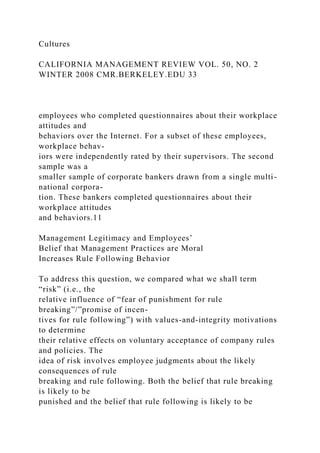
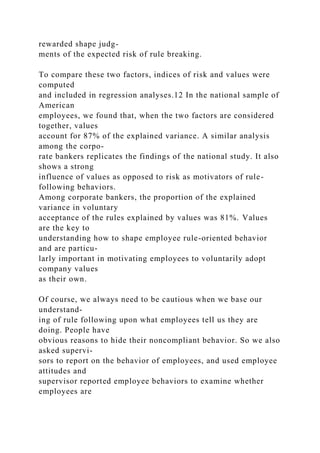
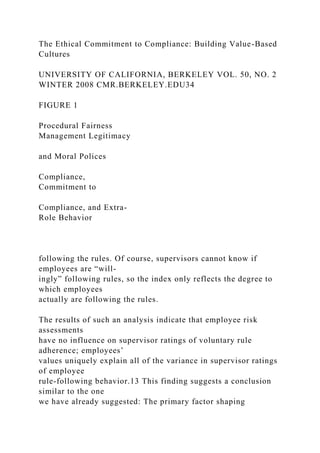
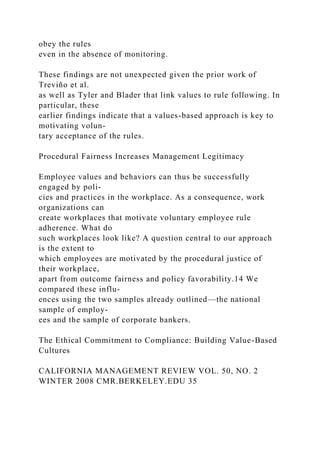
(See Figure 1.)
We support these propositions with data drawn from two
samples of
American employees.10 The first is a large and random sample
of American
The Ethical Commitment to Compliance: Building Value-Based
Cultures
CALIFORNIA MANAGEMENT REVIEW VOL. 50, NO. 2
WINTER 2008 CMR.BERKELEY.EDU 33
employees who completed questionnaires about their workplace
attitudes and
behaviors over the Internet. For a subset of these employees,
workplace behav-
iors were independently rated by their supervisors. The second
sample was a
smaller sample of corporate bankers drawn from a single multi-
national corpora-
tion. These bankers completed questionnaires about their
workplace attitudes
and behaviors.11
Management Legitimacy and Employees’
Belief that Management Practices are Moral
Increases Rule Following Behavior
To address this question, we compared what we shall term
“risk” (i.e., the
relative influence of “fear of punishment for rule
breaking”/”promise of incen-
tives for rule following”) with values-and-integrity motivations
to determine
their relative effects on voluntary acceptance of company rules
and policies. The
idea of risk involves employee judgments about the likely
consequences of rule
breaking and rule following. Both the belief that rule breaking
is likely to be
punished and the belief that rule following is likely to be
rewarded shape judg-
ments of the expected risk of rule breaking.
To compare these two factors, indices of risk and values were
computed
and included in regression analyses.12 In the national sample of
American
employees, we found that, when the two factors are considered
together, values
account for 87% of the explained variance. A similar analysis
among the corpo-
rate bankers replicates the findings of the national study. It also
shows a strong
influence of values as opposed to risk as motivators of rule-
following behaviors.
Among corporate bankers, the proportion of the explained
variance in voluntary
acceptance of the rules explained by values was 81%. Values
are the key to
understanding how to shape employee rule-oriented behavior
and are particu-
larly important in motivating employees to voluntarily adopt
company values
as their own.
Of course, we always need to be cautious when we base our
understand-
ing of rule following upon what employees tell us they are
doing. People have
obvious reasons to hide their noncompliant behavior. So we also
asked supervi-
sors to report on the behavior of employees, and used employee
attitudes and
supervisor reported employee behaviors to examine whether
employees are
The Ethical Commitment to Compliance: Building Value-Based
Cultures
UNIVERSITY OF CALIFORNIA, BERKELEY VOL. 50, NO. 2
WINTER 2008 CMR.BERKELEY.EDU34
FIGURE 1
Procedural Fairness
Management Legitimacy
and Moral Polices
Compliance,
Commitment to
Compliance, and Extra-
Role Behavior
following the rules. Of course, supervisors cannot know if
employees are “will-
ingly” following rules, so the index only reflects the degree to
which employees
actually are following the rules.
The results of such an analysis indicate that employee risk
assessments
have no influence on supervisor ratings of voluntary rule
adherence; employees’
values uniquely explain all of the variance in supervisor ratings
of employee
rule-following behavior.13 This finding suggests a conclusion
similar to the one
we have already suggested: The primary factor shaping
employee rule following
is whether or not employees say that management is legitimate
and follows poli-
cies congruent with the employee’s values. If employees say
management is
legitimate and moral, managers say that those employees are
adhering more
closely to organizational rules.
These results indicate that even if fear of punishment or the
anticipation
of reward, which we term risk, is sometimes a viable way to
encourage compli-
ance, it is a poor way to motivate voluntary commitment to
rules—as required by
the 2004 revisions to the Guidelines—which is almost totally
responsive to legit-
imacy and to whether employees view management practices as
moral. Volun-
tary acceptance is important because it motivates employees to
comply when
detection for violations is unlikely.
Conclusion #1
These findings show that employee values—i.e., their views
about the
legitimacy of management and the employees believing that
management prac-
tices are moral—have an important influence upon employee
rule adherence.
These values are particularly important in motivating voluntary
acceptance of
the rules. If employees have a personal commitment to the
organization, and if
they believe the rules are morally right, they are motivated to
obey the rules
even in the absence of monitoring.
These findings are not unexpected given the prior work of
Treviño et al.
as well as Tyler and Blader that link values to rule following. In
particular, these
earlier findings indicate that a values-based approach is key to
motivating volun-
tary acceptance of the rules.
Procedural Fairness Increases Management Legitimacy
Employee values and behaviors can thus be successfully
engaged by poli-
cies and practices in the workplace. As a consequence, work
organizations can
create workplaces that motivate voluntary employee rule
adherence. What do
such workplaces look like? A question central to our approach
is the extent to
which employees are motivated by the procedural justice of
their workplace,
apart from outcome fairness and policy favorability.14 We
compared these influ-
ences using the two samples already outlined—the national
sample of employ-
ees and the sample of corporate bankers.
The Ethical Commitment to Compliance: Building Value-Based
Cultures
CALIFORNIA MANAGEMENT REVIEW VOL. 50, NO. 2
WINTER 2008 CMR.BERKELEY.EDU 35
Does the fairness of organizational procedures influence
employee views
of the legitimacy of management and/or the employees’ view
that workplace
policies are moral? To answer this question we directly
contrasted the influence
of three workplace characteristics: procedural fairness;
distributive fairness;15 and
policy favorability (when employees believe that the policy
benefit them).16 The
analysis examined these three workplace characteristics upon
two dependent
variables; whether employees view management as
legitimate/moral and
whether employees follow organizational rules.
In both of the samples considered, employees judged the
legitimacy of
management and the morality of company policies primarily in
terms of proce-
dural fairness.17 In both samples, procedural fairness judgments
accounted for
most of the explained influence on employee values. It
explained an average of
73% of the variance in values. We can also consider a similar
analysis, but one
which focuses upon the direct influence of workplace
characteristics on volun-
tary employee rule acceptance. On average, 74% of the variance
in rule accep-
tance was explained by procedural justice.
This procedural influence was also found when we considered
the influ-
ence of employee judgments about the workplace on supervisor
reports about
employee rule following.18 In the national sample, procedural
justice was four
times as important in explaining employee rule following as was
either distribu-
tive justice or policy favorability.
Conclusion #2
Given the important role that employee values played in shaping
employee behavior, an effective ethics program needs to be
linked to those
aspects of workplace policies and practices that influence
whether employees
feel that they ought to obey the rules and policies in their
workplace and/or that
they are consistent with the employee’s sense of what is right
and wrong (hence,
are what employees feel that they ought to do).
The results outlined tell us clearly which aspects of the
workplace are
central to shaping values. However, consider first what they tell
us is not true.
The rewards that people receive from the organization, their
salary and benefits;
the degree to which company policies favor them; and the risks
of punishment
that they face if caught violating rules do not effectively engage
employee values. Fur-
ther, the fairness of organizational outcomes is not the primary
driver. We are not
saying that rewards and punishments are not important to
employees in many
ways. However, our focus here is on how to engage employee
values so that
they will willingly comply, even when not monitored. It is in
this area that pro-
cedural justice matters most.
Our studies tell us that employee beliefs about whether their
organiza-
tions are legitimate and moral and whether employees see
managers making
decisions using procedures that they believe are fair are the key
factors that engage
employee values. As we have argued, employees care about the
fairness of their
work environment. In particular, they are sensitive to the
fairness of the proce-
dures used within their work organization. The role of
procedural justice is
The Ethical Commitment to Compliance: Building Value-Based
Cultures
UNIVERSITY OF CALIFORNIA, BERKELEY VOL. 50, NO. 2
WINTER 2008 CMR.BERKELEY.EDU36
important even if we ignore values and simply look at the role
of procedural
justice in increasing rule-following behavior.
When employees are asked about their work environments, they
typically
respond in terms of the fairness of workplace policies and
practices. Fairness,
and in particular procedural fairness, is what is most important
to employees.
A Procedurally Just Workplace
When employees indicate that their workplace is or is not
procedurally
fair, what do they mean? Answering this question is
fundamental to under-
standing how to design workplaces that engage employee values
and encourage
rule and policy compliance. Prior studies of procedural justice
in work settings
identify two key dimensions of employee procedural fairness
judgments: fairness
of decision making and fairness of interpersonal treatment.
These two types of
fairness can be evaluated at the organizational and workgroup
level. This results
in four procedural factors: decision-making fairness at the
organizational level,
interpersonal fairness at the organizational level, decision-
making fairness at the
workgroup level, and interpersonal fairness at the workgroup
level.
Studies suggest that employees are influenced by all four of
these aspects
of procedural justice. At the organizational level, employees
evaluate the proce-
dural fairness of their overall organization, its policies and
procedures, and the
actions of the CEO and board. Separately, they assess the
fairness of the proce-
dures used by their workgroup supervisor and coworkers. At
each level, both
aspects of procedure, decision making and interpersonal
treatment, indepen-
dently and collectively contribute to overall procedural fairness
evaluations.
The ideal is to have a result like that portrayed in Figure 2,
where procedural
aspects of decision making and interpersonal fairness dominate
the organization
and its workgroups.
The Ethical Commitment to Compliance: Building Value-Based
Cultures
CALIFORNIA MANAGEMENT REVIEW VOL. 50, NO. 2
WINTER 2008 CMR.BERKELEY.EDU 37
FIGURE 2
Yes Yes
Yes Yes
Fairness of
Interpersonal
Treatment
Fairness of
Decision Making
Organization Workgroups
How can an organization achieve the result portrayed in Figure
2? First,
it is important to realize that employees evaluate fairness along
several dimen-
sions. First, do they have opportunities for input before
decisions are made?
Second, are decisions made following understandable and
transparent rules?
Third, are decision-making bodies acting neutrally, basing their
decisions upon
objective information and appropriate criteria, rather than
acting out of personal
prejudices and biases? Fourth, are the rules applied consistently
across people
and over time?
Quality of interpersonal treatment is equally important. It
involves the
manner in which people are treated during the decision-making
process. First,
are people’s rights as employees respected? For example, do
managers follow the
rules specified in organizational manuals or employment
contracts? Second, is
their right as a person to be treated politely and with dignity
acknowledged, and
does such treatment occur? Third, do managers consider
employee input when
making decisions, and are the decision makers concerned about
employee needs
and concerns when they make decisions? Finally, do the
decision makers
account for their actions by giving honest explanations about
what they have
decided and why they made their decisions?
Research shows that each of these four aspects plays a distinct
role in
shaping employee judgments about whether their workplace is
fair.19 Our argu-
ment is supported by an empirical analysis in which the
influence of the four
elements is considered in each of the two studies we examined.
The results indi-
cate that each element is independently important in the overall
equations for
both samples. Further, when considered alone, each is of
approximately equal
importance.20
Conclusion #3
Ethics and compliance officers can improve the ethical culture
of their
organizations by focusing on two levels: the organizational and
workgroup level.
On each level, they can target two issues: the quality of
decision making and
the quality of interpersonal treatment. The findings of the
studies outlined make
clear that both the formal organization (i.e., the leaders such as
the CEO and the
formal policies implemented at the organizational level) and the
actions of
supervisors (including informal work procedures and actions
taken within par-
ticular offices) shape the climate of procedural fairness in the
organization. A
consideration of these issues suggests the type of behaviors that
both CEOs and
managers might engage in to implement a strategy of procedural
fairness.
Efforts to improve the quality of decision making should be
made by
those managing the overall company and by supervisors. For
example, consider
the simple rule at Costco, promulgated by CEO James Senegal,
that no one who
has worked there for more than two years can be fired without
approval from a
senior vice president. The message this sends to employees is
that they are pro-
tected from arbitrary personality conflicts when it comes to
keeping their job. It
further shows them a process they can go through to explain the
problem and
petition to not be fired.
The Ethical Commitment to Compliance: Building Value-Based
Cultures
UNIVERSITY OF CALIFORNIA, BERKELEY VOL. 50, NO. 2
WINTER 2008 CMR.BERKELEY.EDU38
At the supervisor level, procedural and interpersonal fairness
suggest
that supervisors discuss work rules and company policies with
employees before
making decisions. This gives employees an opportunity to make
arguments
about what they believe should be done. It also includes making
efforts to
clearly articulate the procedures being used to make decisions
about issues
such as pay, promotion, and work assignments, as well as the
criteria involved
in making those decisions. For example, if a manager knows
that she will be
distributing a bonus among her reports at the end of the year,
she could engage
them in a discussion about the criteria she will use. She could
ask the following
questions: What is the best way to evaluate their work? What
about people who
join the group midyear? What about those out for maternity
leave? How do we
compare the hard work of a new person who is still learning the
job and not
generating revenue with the experienced person who does not
work hard but
produces revenue? The manager could take this input and
present a policy for
distributing the bonuses that she gives to her reports for review.
The policy for
distributing bonuses would form the basis for a renewed
discussion next year
to see how the policy could be improved.
Another example at the supervisory level is a manager we
interviewed at
a large manufacturing organization. She brought her reports
together to discuss
the vision and mission of their workgroup. The vision
articulates the business
goals of the workgroup and the mission articulates how they
achieve it. The
vision and mission at the workgroup level are coordinated with
the vision and
mission of the organization. Whenever the workgroup is in a
time crunch, they
use their vision and mission of the organization to set priorities
for projects. This
sends a message that priorities are about objective standards,
not about who
owns which project. Yet another example of procedural and
interpersonal fair-
ness was a manager at a large public Midwestern university who
was known to
dislike the lifestyle of one of his reports. As it turned out, this
report was the
most productive member of the workgroup. When it came time
to assign yearly
salary increases, this person received the largest increase. Once
again, the mes-
sage was about objective standards and rewarding people for
merit.
These processes reflect the importance of transparency, with
people view-
ing procedures as fairer when they know how and why decisions
are made. An
addition benefit of transparent procedures is that they allow
managers to high-
light the consistency of decision making across people to
minimize the belief that
some people receive favorable treatment or that others are
subject to prejudice
or other biases. When presenting decisions, managers can
explain them by refer-
ence to the rules and policies via which they are made to
emphasize the fairness
of those decisions.
The quality of interpersonal treatment is improved when a focus
is placed
upon respecting employees and their rights, both as employees
and as people.
People in all organizations value their good standing in the
group, and treatment
with courtesy and dignity affirms that they are valued and
respected. The impor-
tance of interpersonal respect can be illustrated by referring to
the bonus exam-
ple above. If a person that the supervisor does not get along
with turns out to
The Ethical Commitment to Compliance: Building Value-Based
Cultures
CALIFORNIA MANAGEMENT REVIEW VOL. 50, NO. 2
WINTER 2008 CMR.BERKELEY.EDU 39
get the largest bonus, the supervisor should award this bonus
graciously and, if
appropriate, publicly, emphasizing the merit-based nature of the
bonus. This not
only sends a message that personal bias did not affect this bonus
decision, but
that the workgroup in general is evaluated on merit and not on
personal likes
and dislikes. In general, both CEOs and supervisors create a
climate of fairness
when they focus upon making procedures in ways that treat
employees respect-
fully. Further, articulating the values outlined at an
organizational level, for
example via a corporate mission statement or a CEO statement
of values, pro-
motes procedural fairness.
Employees want to trust management and to believe that those
making
decisions care about their needs, concerns, and well-being.
While studies often
find that employees are cynical about their managers, they
consistently show
that employees who are asked about what they want in a
workplace indicate
that they want to work for people that they trust.21 Managers
can communicate
that they are trustworthy by listening to their employees and,
when implement-
ing decisions, accounting for their actions by explaining how
they have consid-
ered the needs and concerns of their employees. Even when
people cannot be
given what they want, their concerns can be acknowledged and
the validity of
their perspective recognized. It is sincere consideration of their
concerns that is
central to gaining trust.
Getting employee input does not mean that managers must do
what
employees suggest; regardless of the ultimate outcome,
employees tend to accept
management decisions when they feel that their perspective has
been consid-
ered during the decision making process, even if their preferred
course of action
is not taken. Nor do employees need voice for all decisions and
procedures. We
are by no means advocating management’s abdication of the
responsibility to
make decisions. We do, however, suggest that transparency in
the process of
decision making will result in higher levels of employee
engagement and all the
benefits thereof.
As noted, studies consistently support the value of “tone at the
top,” indi-
cating that in large companies in which people may never have
met or talked
with their companies’ leaders, formal statements of the value of
justice shape
people’s views about the company. In particular, people focus
on whether the
overall policies and practices of their organization are fair.
To summarize, the four key issues are voice, dignity,
objectivity, and con-
cern. First, people want to have an opportunity to tell their story
to an authority
who listens to their concerns. The key issue shaping reactions to
voice is the
belief that the authority considers arguments, more than that
they accept them.
Authorities should therefore describe how they have considered
employee input
when explaining their decision. Dignity reflects the fact that
people value being
treated with respect and courtesy. This involves acknowledging
people’s rights as
people and as employees, including a basic entitlement to
decent treatment.
Objective decisions are more easily accepted because they are
based upon facts
and on the consistent, unbiased application of rules, rather than
prejudice or
subjective whims. Emphasizing the role of facts in the decision
is important.
The Ethical Commitment to Compliance: Building Value-Based
Cultures
UNIVERSITY OF CALIFORNIA, BERKELEY VOL. 50, NO. 2
WINTER 2008 CMR.BERKELEY.EDU40
Finally, communicating caring and concern in the people over
whom one exer-
cises authority and in doing what is right for them and others in
the situation is
central to creating and maintaining trust.22
Motivating Voluntary Behavior:
A Win-Win with Management
Ethics and compliance officers often say that they are cast in
the position
of naysayers—telling others in their companies that they cannot
engage in prof-
itable activities because those activities violate ethical precepts
or codes of
behavior. There is room for an expanded role for ethics and
compliance officers
that brings them into alignment with the general management
goal of increasing
productivity and building company worth. Beyond motivating
rule adherence,
the strategies we have outlined have the additional benefit of
more broadly
engaging employees in their work organizations, leading them
to be willing to
engage in voluntary activities on behalf of their companies.
Hence, there is a
win-win solution in which these strategies also motivate
generally valuable
workplace behaviors, behaviors linked to company profitability.
Our study of corporate bankers provides an example. Their
multinational
organization benefits when these bankers are more willing to act
voluntarily on
behalf of their firm, doing things at work that help the company
but for which
they will not necessarily receive credit or compensation. This is
especially impor-
tant in the service industries where networking and information
about the
financial environment are crucial to the firm’s success. No one
person can cap-
ture and hold all the information necessary to do their job well.
What motivates corporate bankers to voluntarily help their
banks? Of the
three workplace factors already outlined—procedural fairness,
distributive fair-
ness, and judgments of policy and outcome favorability—the
only predictor of
voluntary behavior to help the organization is the procedural
fairness of the
workplace.23 Among the broader sample of employees,
procedural justice was
the primary factor shaping extra role behavior.24
This finding suggests that ethics and compliance officers are not
at odds
with other managers in their organization about the importance
of reaching
business objectives. The strategies for motivating employees to
adhere to rules
and follow policies also advance the more general goals of
management. They
simultaneously help increase company value by leading to a
more engaged
workforce that is more willing to do what is needed to help the
company suc-
ceed, as well as to help prevent losses by virtue of greater
compliance. Hence,
ethics and business success can go hand in hand.
Voluntary acceptance is a desirable form of employee behavior
because
it frees companies to use their resources for productive
purposes, rather than
having to enact costly surveillance and oversight mechanisms.
While some sur-
veillance is important, and the threat of sanctions is an essential
component of
regulation,25 companies can minimize the need for this costly
set of regulatory
mechanisms by emphasizing values-based self-regulation.
Similarly, companies
The Ethical Commitment to Compliance: Building Value-Based
Cultures
CALIFORNIA MANAGEMENT REVIEW VOL. 50, NO. 2
WINTER 2008 CMR.BERKELEY.EDU 41
can benefit when employees engage in voluntary extra-role
behaviors motivated
by the desire to help their organization be successful.26
Implications for Organizations and Public Policy
The results shown indicate that a market-based value approach
grounded
in fair procedures is not only possible, but it is more effective
than is the tradi-
tional command-and-control approach. As noted, this has
important implica-
tions for companies who want to meet the culture requirements
of the 2004
revision of the Federal Sentencing Guidelines for Organizations
that require
organizations to “promote an organizational culture that
encourages ethical
conduct and a commitment to compliance with the law.”27 In
conjunction with
earlier studies, the data presented here shows that a
procedurally just culture
will promote both ethical conduct and a commitment to comply
with the law
more than the command-and-control approach.28
Just as companies must do due diligence when hiring, auditing,
or other
activities that present risks to the organization, our work
suggests that compa-
nies should use due diligence regarding the procedural fairness
of the enterprise
and workgroups. It is here that ethics and compliance officers
can play a broader
role in their organizations than being ethical gatekeepers. The
values-based
approach is literally “good for business” because the same
procedural features
that are key to voluntary acceptance of the rules are also the
antecedents of
voluntary “extra-role” behavior. Such voluntary behavior on
behalf of work
organizations is desirable on its own terms and has benefits that
go beyond the
arena of ethics and regulation. Thus, an effective ethics and
compliance organi-
zation is one that makes the business case for ethical behavior
in a positive
sense, rather than solely as a preventative or loss-avoidance
measure. Ethics
officers are well advised to translate, to the greatest extent
possible, the tangible
monetary benefits to be gained by an energized, empowered
workforce.
Our study also has policy implications for developing state and
national
regulations to influence the behavior of organizations. While it
is always danger-
ous to transfer practices at one level of analysis to another,
there are striking
similarities to what we see inside organizations and
developments in govern-
ment regulation of business. As shown, command-and-control
programs in
organizations do not effectively engage employee values. The
limitations of the
command-and-control approach used by government to regulate
business have
been understood since the 1980s. It was during this time that
government began
instituting environmental regulations that relied on market
mechanisms.29 In
Europe there is a movement towards “soft law” or “cooperative
regulation.”
Cooperative regulation stipulates goals organizations should
attain, but leaves
room for the participation of those regulated to make sure that
goals are attained
in the most efficient and fair way.30
Unfortunately, the recent U.S. response to business scandals
such as
Enron and WorldCom has been a major step the wrong
direction. In passing
Sarbanes-Oxley in 2002, the U.S. Congress moved many of the
best practices
The Ethical Commitment to Compliance: Building Value-Based
Cultures
UNIVERSITY OF CALIFORNIA, BERKELEY VOL. 50, NO. 2
WINTER 2008 CMR.BERKELEY.EDU42
encouraging values and integrity into the realm of mandated
activity. Thus, iron-
ically, the legislative response to a handful of ethical failures—
admittedly spec-
tacular and devastating—was to impose upon all companies a
set of the very
sorts of rigid command-and-control-based compliance
requirements that are
demonstrably less effective than a values-and-integrity
approach. Beyond the
enormous social costs and financial burdens incurred by the
heightened level of
vigilance required by Sarbanes-Oxley, our data suggest that
such an approach is
actually harmful to the goal of creating cultures where rule
following is volun-
tarily, even enthusiastically, embraced. For this reason, we
believe that the sti-
fling restrictions of Sarbanes-Oxley, hastily passed in the
heated aftermath of the
spate of corporate disasters that befell the United States in the
span of just a few
months should be reevaluated.
We are not so naive as to suggest that the practices we advocate
will guar-
antee that another Enron or WorldCom will never happen.
Scoundrels and
cheats will exist in any human system, and, where they ascend
to the top of the
corporate ladder, as they did in these scandals, they will likely
violate the rules
to the greatest extent they can. We do argue, however, that a
culture of volun-
tary rule following will minimize their opportunities to do so in
several impor-
tant ways. First, in a culture where transparent procedures are
voluntarily
embraced, the self-policing mechanisms that will thrive in the
organization will
be more likely to expose wrongdoing in its infancy. Second, a
culture where rule
following is the expected norm, and cynicism is low, will be a
far less comfort-
able environment for those who would prefer to break the rules.
Finally, in a
culture where rule following is the accepted norm, scoundrels
and cheats will
be far less likely to ascend to the positions of power in which
they can do sig-
nificant damage.
Procedural Justice Benchmarks
How does a particular organization compare to others in terms
of the
procedural justice of your organizational climate? Those in any
particular orga-
nization can compare their organization to others using the
results of a national
survey of American employees, conducted in the spring of 2001.
This study
sampled the views of 4,430 employees, and the results presented
here reflect
a weighting of those employees to approximate a random
sample of American
workers. In the sample, 25.7% of those interviewed worked in
one location
companies with 100 or fewer employees; 19.5% worked in one
location com-
panies with over 100 employees; 37.4% worked in companies
with multiple
American locations; and 17.5% worked for multinational
companies. Bench-
mark data from this national study are shown in Appendix A.
Summary
Our goal is to articulate a broader role for the ethics and
compliance offi-
cer than the traditional one of managing compliance with
organizational rules
The Ethical Commitment to Compliance: Building Value-Based
Cultures
CALIFORNIA MANAGEMENT REVIEW VOL. 50, NO. 2
WINTER 2008 CMR.BERKELEY.EDU 43
via monitoring and sanctioning. We argue, consistent with the
findings of others
in the field of ethics, that a values-based approach, in which
organizations seek
to motivate employees to develop and act on ethical values is a
more effective
approach to managing rule adherence. This argument is
supported by empirical
research, which particularly points to the importance of values
as an antecedent
of accepting rules. The organizational feature most strongly
associated with both
the development of supportive values and the acceptance of
rules is procedural
justice.
The key role that procedural justice plays in shaping adherence
to rules
provides an opportunity for an expanded role for the ethics and
compliance
officer, since the same aspects of organizational procedures that
promote the
development of ethical values also lead employees to be
productive and to
engage in voluntary behavior on behalf of the organization.
Finally, empirical
research points to key factors shaping employee judgments
about the fairness of
the procedures within work organizations. We identify these
factors and provide
cross-organizational benchmarks regarding both the level and
the importance of
various aspects of procedures within American companies.
APPENDIX A
Questions to Measure Procedural Fairness in Organizations
In Tables 6 and 7, we list questions organizations can use to
evaluate
the level of procedural fairness. If this questionnaire were given
at the enterprise
level, for example—and there were ways to track respondents
by business unit,
divisions, or workgroups—the results would show not only the
overall level of
procedural fairness of the organization, but should also reveal
areas where pro-
cedural fairness is dangerously low. In keeping with the
distinctions we have
already made, we divide the questions into two sections: one
focused on the
immediate workgroup and the other on overall companies and
their policies.
A wide variety of issues are addressed in the study, and the
questions shown
are those that emerge as most important.
The Procedural Justice of the American Workplace
Employees were first asked to make overall ratings of their
workplace.
Responses are shown in Table 6. They suggest that employees
generally rated
their organizations slightly better than neutral (with 3 being
neutral on a 1-5
scale). Their ratings of personal treatment were slightly higher
than their ratings
of the fairness of decision making, but both ratings ranged
between 3 and 3.5.
In addition to making general ratings, employees were asked to
rate their
company and their workgroup/supervisor. These ratings are
shown in Table 7.
The mean is shown, as well as the correlation of each item to an
overall scale
of workplace fairness created by averaging the seven items in
Table 6.
On the company level several factors create the sense that the
company
is generally procedurally just. Most important are employees’
judgments about
The Ethical Commitment to Compliance: Building Value-Based
Cultures
UNIVERSITY OF CALIFORNIA, BERKELEY VOL. 50, NO. 2
WINTER 2008 CMR.BERKELEY.EDU44
whether management uses accurate information in decision
making. This is
followed by judgments about whether management acts in the
best interests
of the employee and acts in accord with employee rights. Work
organizations
receive moderately positive ratings for using accurate
information (mean =
3.26), and for doing what is in the best interests of the
employee (mean = 3.21).
They receive high ratings for respecting rights (mean = 3.51).
On the work group level, the key issue is whether their
supervisor acts
in the best interests of the employee, recognizes their rights,
gives them honest
feedback, and acts on behalf of employee needs. Supervisors get
moderately
high ratings for acting in the best interests of employees (mean
= 3.26) and high
ratings for respecting employee rights (mean = 3.52). They
receive lower ratings
for honest feedback (mean = 3.11) and for meeting employee
needs (mean =
3.18).
APPENDIX B
The Ethical Commitment to Compliance: Building Value-Based
Cultures
CALIFORNIA MANAGEMENT REVIEW VOL. 50, NO. 2
WINTER 2008 CMR.BERKELEY.EDU 45
TABLE 1. The Antecedents of Voluntary Acceptance
Betaa Adj. R-sq.b Step-up in SSregc
Employees
Values .50*** 27%*** 1,199.76*** (f(1,4837))***
Incentives/Sanctions .10*** 3%*** 52.57*** (f(1,4837))***
Total 28%***
Corporate Bankers
Values .30*** 11%*** 20.44 (f(1,531))***
Incentives/Sanctions .07*** 2%*** 0.92 (f(1,531))
Totald 11%***
Notes:
a. Beta weights are the standardized regression coefficient when
all terms are entered together.
b. Indicates the amount of variances explained by each term
when considered alone.
c. Indicates the increment in the sum of squares (and degrees of
freedom for the F test) for each index
when it is entered after all other variables in the equation.
d. Indicates the adjusted total R-squared for all factors entered
at one time.
* p < .05 ** p < .01 *** p < .001
The Ethical Commitment to Compliance: Building Value-Based
Cultures
UNIVERSITY OF CALIFORNIA, BERKELEY VOL. 50, NO. 2
WINTER 2008 CMR.BERKELEY.EDU46
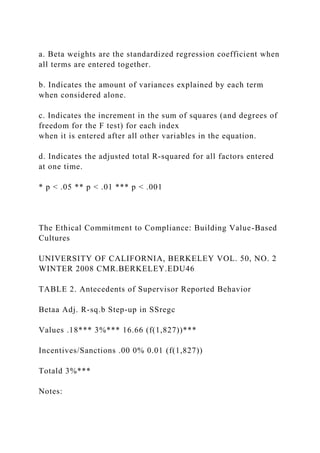
TABLE 2. Antecedents of Supervisor Reported Behavior
Betaa Adj. R-sq.b Step-up in SSregc
Values .18*** 3%*** 16.66 (f(1,827))***
Incentives/Sanctions .00 0% 0.01 (f(1,827))
Totald 3%***
Notes:
a. Beta weights are the standardized regression coefficient when
all terms are entered together.
b. Indicates the amount of variances explained by each term
when considered alone.
c. Indicates the increment in the sum of squares (and degrees of
freedom for the F test) for each index
when it is entered after all other variables in the equation.
d. Indicates the adjusted total R-squared for all factors entered
at one time.
* p < .05 ** p < .01 *** p < .001
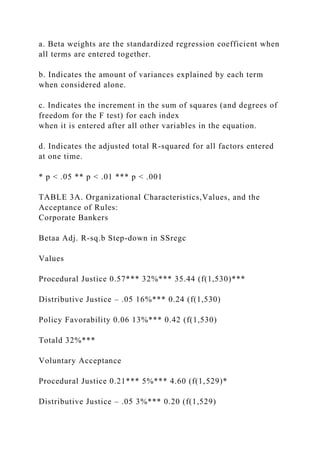
TABLE 3A. Organizational Characteristics,Values, and the
Acceptance of Rules:
Corporate Bankers
Betaa Adj. R-sq.b Step-down in SSregc
Values
Procedural Justice 0.57*** 32%*** 35.44 (f(1,530)***
Distributive Justice – .05 16%*** 0.24 (f(1,530)
Policy Favorability 0.06 13%*** 0.42 (f(1,530)
Totald 32%***
Voluntary Acceptance
Procedural Justice 0.21*** 5%*** 4.60 (f(1,529)*
Distributive Justice – .05 3%*** 0.20 (f(1,529)
Policy Favorability 0.09*** 3%*** 0.97 (f(1,529)
Totald 5%***
Notes:
a. Beta weights are the standardized regression coefficient when
all terms are entered together.
b. Indicates the amount of variances explained by each term
when considered alone.
c. Indicates the increment in the sum of squares (and degrees of
freedom for the F test) for each index
when it is entered after all other variables in the equation.
d. Indicates the adjusted total R-squared for all factors entered
at one time.
* p < .05 ** p < .01 *** p < .001
The Ethical Commitment to Compliance: Building Value-Based
Cultures
CALIFORNIA MANAGEMENT REVIEW VOL. 50, NO. 2
WINTER 2008 CMR.BERKELEY.EDU 47
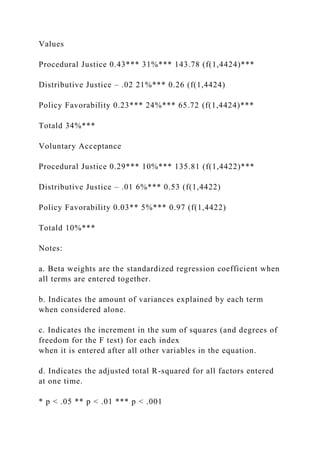
TABLE 3B. Organizational Characteristics,Values, and the
Acceptance of Rules:
Employees
Betaa Adj. R-sq.b Step-down in SSregc
Values
Procedural Justice 0.43*** 31%*** 143.78 (f(1,4424)***
Distributive Justice – .02 21%*** 0.26 (f(1,4424)
Policy Favorability 0.23*** 24%*** 65.72 (f(1,4424)***
Totald 34%***
Voluntary Acceptance
Procedural Justice 0.29*** 10%*** 135.81 (f(1,4422)***
Distributive Justice – .01 6%*** 0.53 (f(1,4422)
Policy Favorability 0.03** 5%*** 0.97 (f(1,4422)
Totald 10%***
Notes:
a. Beta weights are the standardized regression coefficient when
all terms are entered together.
b. Indicates the amount of variances explained by each term
when considered alone.
c. Indicates the increment in the sum of squares (and degrees of
freedom for the F test) for each index
when it is entered after all other variables in the equation.
d. Indicates the adjusted total R-squared for all factors entered
at one time.
* p < .05 ** p < .01 *** p < .001
TABLE 4. The Influence of Organizational Characteristics on
Supervisor Reported
Behavior
Betaa Adj. R-sq.b Step-up in SSregc
Procedural Justice 0.26*** 4%*** 13.32 (f(1,826))***
Distributive Justice – .07 1%** 1.08 (f(1,826))
Policy Favorability – .01 1%** 0.04 (f(1,826))
Totald 4%***
Notes:
a. Beta weights are the standardized regression coefficient when
all terms are entered together.
b. Indicates the amount of variances explained by each term
when considered alone.
c. Indicates the increment in the sum of squares (and degrees of
freedom for the F test) for each index
when it is entered after all other variables in the equation.
d. Indicates the adjusted total R-squared for all factors entered
at one time.
* p < .05 ** p < .01 *** p < .001
The Ethical Commitment to Compliance: Building Value-Based
Cultures
UNIVERSITY OF CALIFORNIA, BERKELEY VOL. 50, NO. 2
WINTER 2008 CMR.BERKELEY.EDU48
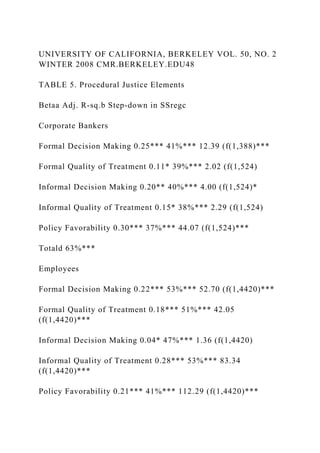
TABLE 5. Procedural Justice Elements
Betaa Adj. R-sq.b Step-down in SSregc
Corporate Bankers
Formal Decision Making 0.25*** 41%*** 12.39 (f(1,388)***
Formal Quality of Treatment 0.11* 39%*** 2.02 (f(1,524)
Informal Decision Making 0.20** 40%*** 4.00 (f(1,524)*
Informal Quality of Treatment 0.15* 38%*** 2.29 (f(1,524)
Policy Favorability 0.30*** 37%*** 44.07 (f(1,524)***
Totald 63%***
Employees
Formal Decision Making 0.22*** 53%*** 52.70 (f(1,4420)***
Formal Quality of Treatment 0.18*** 51%*** 42.05
(f(1,4420)***
Informal Decision Making 0.04* 47%*** 1.36 (f(1,4420)
Informal Quality of Treatment 0.28*** 53%*** 83.34
(f(1,4420)***
Policy Favorability 0.21*** 41%*** 112.29 (f(1,4420)***
Totald 65%***
Notes:
a. Beta weights are the standardized regression coefficient when
all terms are entered together.
b. Indicates the amount of variances explained by each term
when considered alone.
c. Indicates the increment in the sum of squares (and degrees of
freedom for the F test) for each index
when it is entered after all other variables in the equation.
d. Indicates the adjusted total R-squared for all factors entered
at one time.
* p < .05 ** p < .01 *** p < .001
TABLE 6. Overall Fairness Ratings of American Work
Organizations
Overall Fairness
My company puts an effort into making decisions that affect me
in fair ways. 3.02
Decisions are usually made in fair ways at my company. 3.03
My company puts an effort into making decisions in fair ways.
3.09
Decisions that affect me are usually made in fair ways in my
company. 3.11
Overall, people are treated fairly where I work. 3.23
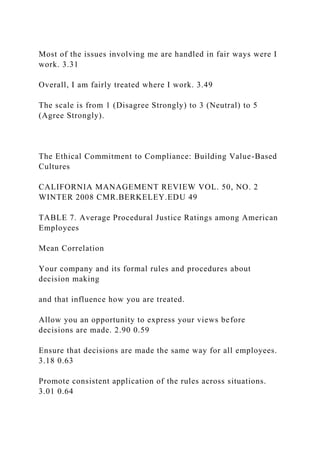
Most of the issues involving me are handled in fair ways were I
work. 3.31
Overall, I am fairly treated where I work. 3.49
The scale is from 1 (Disagree Strongly) to 3 (Neutral) to 5
(Agree Strongly).
The Ethical Commitment to Compliance: Building Value-Based
Cultures
CALIFORNIA MANAGEMENT REVIEW VOL. 50, NO. 2
WINTER 2008 CMR.BERKELEY.EDU 49
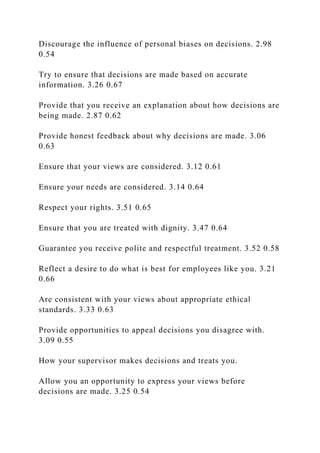
TABLE 7. Average Procedural Justice Ratings among American
Employees
Mean Correlation
Your company and its formal rules and procedures about
decision making
and that influence how you are treated.
Allow you an opportunity to express your views before
decisions are made. 2.90 0.59
Ensure that decisions are made the same way for all employees.
3.18 0.63
Promote consistent application of the rules across situations.
3.01 0.64
Discourage the influence of personal biases on decisions. 2.98
0.54
Try to ensure that decisions are made based on accurate
information. 3.26 0.67
Provide that you receive an explanation about how decisions are
being made. 2.87 0.62
Provide honest feedback about why decisions are made. 3.06
0.63
Ensure that your views are considered. 3.12 0.61
Ensure your needs are considered. 3.14 0.64
Respect your rights. 3.51 0.65
Ensure that you are treated with dignity. 3.47 0.64
Guarantee you receive polite and respectful treatment. 3.52 0.58
Reflect a desire to do what is best for employees like you. 3.21
0.66
Are consistent with your views about appropriate ethical
standards. 3.33 0.63
Provide opportunities to appeal decisions you disagree with.
3.09 0.55
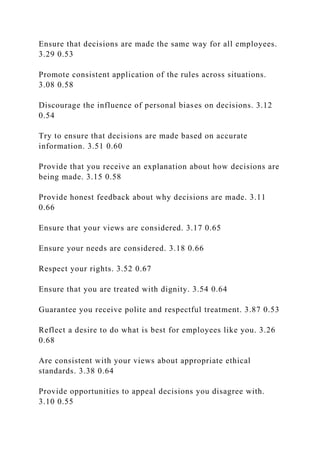
How your supervisor makes decisions and treats you.
Allow you an opportunity to express your views before
decisions are made. 3.25 0.54
Ensure that decisions are made the same way for all employees.
3.29 0.53
Promote consistent application of the rules across situations.
3.08 0.58
Discourage the influence of personal biases on decisions. 3.12
0.54
Try to ensure that decisions are made based on accurate
information. 3.51 0.60
Provide that you receive an explanation about how decisions are
being made. 3.15 0.58
Provide honest feedback about why decisions are made. 3.11
0.66
Ensure that your views are considered. 3.17 0.65
Ensure your needs are considered. 3.18 0.66
Respect your rights. 3.52 0.67
Ensure that you are treated with dignity. 3.54 0.64
Guarantee you receive polite and respectful treatment. 3.87 0.53
Reflect a desire to do what is best for employees like you. 3.26
0.68
Are consistent with your views about appropriate ethical
standards. 3.38 0.64
Provide opportunities to appeal decisions you disagree with.
3.10 0.55
The scale is from 1 (Disagree Strongly) to 3 (Neutral) to 5
(Agree Strongly). The overall fairness scale is composed of the
seven items listed in
table 1. Correlations are the strength of the link to that overall
scale.
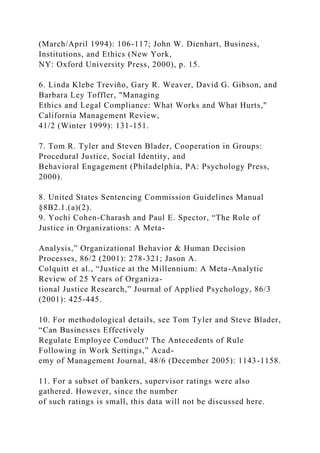
Notes
1. The revised Federal Sentencing Guidelines for Organizations
state that organizations should
“promote an organizational climate that encourages ethical
conduct and a commitment to
compliance with the law.” United States Sentencing
Commission Guidelines Manual
§8B2.1.(a)(2).
2. The Ethics Officers Association changed its name to the
Ethics and Compliance Officers
Association in 2006.
3. Tyler and Dienhart are Invited Academic Fellows of the
Ethics Resource Center, while
Thomas was a Corporate Fellow as Vice President of Ethics
Operations for the executive
team that ran MCI after the WorldCom scandal.
4. M. Schminke, Managerial Ethics (Mahwah, NJ: Erlbaum,
1998); Linda Klebe Treviño and
K.A. Nelson, Managing Business Ethics, 4th edition (New York,
NY: Wiley, 2007).
5. Lynne Sharp Paine, “Managing for Organizational Integrity,”
Harvard Business Review, 72/2
(March/April 1994): 106-117; John W. Dienhart, Business,
Institutions, and Ethics (New York,
NY: Oxford University Press, 2000), p. 15.
6. Linda Klebe Treviño, Gary R. Weaver, David G. Gibson, and
Barbara Ley Toffler, "Managing
Ethics and Legal Compliance: What Works and What Hurts,"
California Management Review,
41/2 (Winter 1999): 131-151.
7. Tom R. Tyler and Steven Blader, Cooperation in Groups:
Procedural Justice, Social Identity, and
Behavioral Engagement (Philadelphia, PA: Psychology Press,
2000).
8. United States Sentencing Commission Guidelines Manual
§8B2.1.(a)(2).
9. Yochi Cohen-Charash and Paul E. Spector, “The Role of
Justice in Organizations: A Meta-
Analysis,” Organizational Behavior & Human Decision
Processes, 86/2 (2001): 278-321; Jason A.
Colquitt et al., “Justice at the Millennium: A Meta-Analytic
Review of 25 Years of Organiza-
tional Justice Research,” Journal of Applied Psychology, 86/3
(2001): 425-445.
10. For methodological details, see Tom Tyler and Steve Blader,
“Can Businesses Effectively
Regulate Employee Conduct? The Antecedents of Rule
Following in Work Settings,” Acad-
emy of Management Journal, 48/6 (December 2005): 1143-1158.
11. For a subset of bankers, supervisor ratings were also
gathered. However, since the number
of such ratings is small, this data will not be discussed here.
Tyler and Blader (2005), op. cit.
12. Three types of data are calculated. First, the beta weight for
each term when both are
included simultaneously in an equation used to predict
acceptance. We also include the total
amount of variance in the dependent variable explained when all
terms are entered. Second
the ability of each index to explain variance in acceptance when
it is considered alone. Third
the increment in the regression sum of squares when each
variable is included above and
beyond all other variables in the equation. Jacob Cohen, Patricia
Cohen, Stephen West, and
Leona Aiken, Applied Multiple Regression/Correlation Analysis
for the Behavioral Sciences, 3rd
edition (Mahwah, NJ: Erlbaum, 2003), p. 507. All of these
findings are shown in Appendix
B. The numbers presented in the text are the proportion of
explained variance explained by
each factor. They are calculated using the beta weights shown in
the tables.
13. These results are from the national sample. See Table 2 in
Appendix B.
14. The argument that there is a connection between
organizational justice and employee
behavior receives support in a study by Treviño and Weaver,
which links general organiza-
tional justice to employee ethical behavior. Linda Treviño and
Gary Weaver, “Organizational
Justice and Ethics Program “Follow-Through”: Influences on
Employees’ Harmful and
Helpful Behavior,” Business Ethics Quarterly, 11 (2001): 651-
671. Unfortunately, this study
does not distinguish among different types of justice, so it does
not directly link procedural
justice to behavior. The suggestion that organizational justice is
important in shaping
employee behavior has similarly been made by Russell
Cropanzano, David Bowen, and
Stephen Gilliland, “The Management of Organizational Justice,”
Academy of Management
Perspectives, 21/4 (November 2007): 34-48; Joel Brockner,
“Why It’s So Hard to Be Fair,”
Harvard Business Review, 84/3 (March 2006): 122-129.
15. Distributive fairness is the extent to which employee believe
outcomes are fair independent
of the procedure used to create the outcome. For example, if the
cost of living goes up 5%
and employees get a 5% raise, they may see that as a fair
outcome.
16. Policy favorability is the extent to which the outcome is
perceived as promoting or damag-
ing employee interests.
17. See Appendix B, Tables 3a and 3b.
18. Shown in Appendix B, Table 4.
The Ethical Commitment to Compliance: Building Value-Based
Cultures
UNIVERSITY OF CALIFORNIA, BERKELEY VOL. 50, NO. 2
WINTER 2008 CMR.BERKELEY.EDU50
19. Steven L. Blader and Tom R. Tyler, “What Constitutes
Fairness in Work Settings? A Four-
Component Model of Procedural Justice,” Human Resource
Management Review. 13/1 (Spring
2003): 107-126.
20. See Appendix B, Table 5.
21. Tyler and Blader (2005), op. cit.
22. These concerns are not only important in managerial
settings. Studies of legal authorities
also suggest that people who deal with the police and the courts
care about issues of proce-
dural justice. See David Rottman, “Trust and Confidence in the
California Courts,” Adminis-
trative Office of the Courts, 2005; Tom R. Tyler, “Public Trust
and Confidence in Legal
Authorities: What Do Majority and Minority Group Members
Want from the Law and Legal
Institutions,” Behavioral Sciences and the Law, 19 (2001): 215-
235; Tom R. Tyler and Yuen J.
Huo, Trust in the Law (New York, NY: Russell-Sage, 2002).
23. The beta weight for procedural justice was 0.37 (p < .001);
for distributive justice -.15 (n.s.);
and for outcome favorability (n.s.). The total equation explains
6% of the variance in extra
role behavior. When considered alone procedural justice
explains 4% of the variance in
extra role behavior, while distributive justice and policy
favorability each explain 0%.
24. The beta weight for procedural justice was 0.25 (p < .001);
for distributive justice .13
(p < .001); and for outcome favorability -.02 (n.s.). The total
equation explains 15% of
the variance in extra role behavior. When considered alone,
procedural justice explains
12% of the variance in extra role behavior, while distributive
justice explains 10% and
policy favorability explains 5%.
25. Studies consistently find that people evaluate the legitimacy
of management, in part, by
whether or not those who break rules are punished. Hence, there
is clearly a command-
and-control element to legitimacy in addition to value
influences.
26. C. Ann Smith, Dennis W. Organ, and Janet P. Near,
“Organizational Citizenship Behavior:
Its Nature and Antecedents,” Journal of Applied Psychology,
68/4 (1983): 653-663.
27. United States Sentencing Commission Guidelines Manual
§8B2.1.(a)(2).
28. By emphasizing the importance of justice, we do not mean
to argue that a justice focus is
inconsistent with compliance. As noted, in addition to building
values via justice it is impor-
tant to have accountability and disciplinary systems, so that
people believe that those who
break rules will be held responsible for their behavior. For a
discussion of this point, see
Linda Treviño and Gary Weaver, “Organizational Justice and
Ethics Program “Follow-
Through”: Influences on Employees’ Harmful and Helpful
Behavior,” Business Ethics
Quarterly, 11/4 (October 2001): 651-671.
29. Terry L. Anderson and Donald R. Leal, Free Market
Environmentalism (New York, NY: Pal-
grave, 2001), pp. 9-26.
30. Linda Senden, “Soft Law, Self-Regulation and Co-
Regulation in European Law,” Electronic
Journal of Comparative Law, 9/1 (January 2005),
<http://www.ejcl.org/91/art91-3.html>,
accessed June 1, 2007; Jane Collier, “Corporate Governance in
the European Context:
Evolving and Adapting,” Business and Society Review, 112/2
(Summer 2007): 271-285.
The Ethical Commitment to Compliance: Building Value-Based
Cultures
CALIFORNIA MANAGEMENT REVIEW VOL. 50, NO. 2
WINTER 2008 CMR.BERKELEY.EDU 51

Ethics and the Law”.docx

  • 1.
    “Ethics and theLaw” Program Transcript [MUSIC PLAYING] NARRATOR: In this program, Matthew Joseph describe some ethical issues encountered by nonprofit organizations and explains how managers and leaders might address them.
  • 2.
    MATTHEW JOSEPH: Advocatesfor Children and Youth is an independent organization. We don't take public funds so that we can be completely independent of government, and we can say what we think is important for children. And so we're very, very careful not to, in any way, have a situation where we are constrained. And the price we pay is having to raise money for the private sector every year for our funds. So in terms of board members and staff, we have a strict conflict of interest issue so that we would never be in a situation that we can't say this because a board member is representing someone involved in our issue. So if that ever happens, what it means is that the board member has to step down, and they are so committed to the mission that they would want to step down. Because the reason why they think Advocates for Children and Youth should exist is so that we can be free of those kind of constraints. And these are volunteers, and they often times have very high powered jobs. They're very involved in representing companies or issues as an lawyer, as an accountant. Just a variety of different ways. And so we have to be really open with them about the issues that we're involved in and how they might be conflicting with one of the needs and one of their
  • 3.
    clients. And that,unfortunately, does happen where we will find out that we're involved in an issue where it turns out that a client of a board member has a contrary position. And that just means that that board member has to take leave of absence during that period of time, and hopefully it's just a temporary time, and then they can come back on. As you might imagine, Advocates for Children and Youth has a lot of people who are interested in politics and policy that oftentimes means that they're interested in specific candidates. They may be interested in certain parties, but we are a 501(c)(3). We can be very, very aggressive as advocates. We can be pushing the decision makers as much as we want, but we cannot be partisan. We cannot say we favor Democrats or Republicans. We cannot be involved in any elections of a particular candidate for or against a candidate. © 2013 Laureate Education, Inc. 1
  • 4.
    And that meansthat, as individuals within the office, they need to be clear that they cannot in any way have us exposed. So, for example, if someone liked a particular candidate, they could not have a sign for that candidate on their window that looks out to the public, because to the public that might seem like Advocates for Children and Youth is promoting that candidate. And we could lose our tax exempt status for that. So people, as soon as they understand that and as soon as they understand what's at stake, they know that that just means they can put it on their bumper sticker and they can do what they want to do in their private time. But when it comes to their time as employees of
  • 5.
    Advocates for Childrenand Youth, they need to be really clear that we are not supporting specific candidates, we're not opposed to any candidates, and we're not affiliated with any particular political party. NARRATOR: Next, David Osborne discusses some ethical and legal issues related to public organizations, and explains how managers and leaders might address each. DAVID OSBORNE: There are all the traditional ethical issues about fraud and abuse in the public sector, and those haven't changed. It's very important for public sector managers to have systems in place that measure where the money's going, that follow the money, that can detect fraud, because it still occurs. Human beings being who they are, a very small percentage of them will cheat and steal, and you need to be able to catch that. But there's a whole new dimension to it that stems from this shift from bureaucracy to post bureaucratic government, because in bureaucracy, you're supposed to follow the rules. There are all kinds of rules, and you're supposed to follow them. Your budgets have all these line items and the ethical thing is to spend every penny of every line item. And if you don't, somebody will slap your wrist and
  • 6.
    consider it anethical violation. In today's world, we need to produce results. And if the money's in the wrong line items, what's an ethical manager supposed to do? Let's say you've got a very important result to produce having to do with getting people off welfare and into jobs through training and job placement, but you discover that the budget allocations are-- you don't have enough money for training, you don't have enough money to support people once they get jobs because it turns out that they need support for the first six months. They need help if they never had a job. They need help in how to keep that job, how to act on the job, how to dress on the job. So you're really doing your job, you've figured out what produces results, and you don't have the budget to fund © 2013 Laureate Education, Inc. 2
  • 7.
    what produces results.What's the ethical thing to do? Is it to spend according to the line items in the budget? No, it's to produce the result. So you can go ask permission to change the money from one account to another, one line item to another, but typically, when you do, the answer is, you go to the budget office and they say, oh, we're glad to hear you don't need all the money in this account, because we have a shortage elsewhere, so we're going to take it. But we can't afford to give it to you in the other account. So it usually doesn't work. It's very risky. So, good managers today engage in something that beat some people call creative insubordination. They start moving the money to get the result. And what we need are systems that
  • 8.
    give them the authorityto do that. But if you haven't got those systems in place, if they don't have the authority, then they have an ethical dilemma. They can follow the rules or they can produce the results, but they can't do both. And that is a dilemma that is very common in the public sector now. A lot of innovators who are really trying to do what's best and who deeply care about the results get in trouble because they have to bend rules to produce the results. And we need to reorient our definition of what ethics is all about. Ethics should be about producing the best value for the citizens, for the dollar spent. Value for money, return on investment. Sure, some things will always be prohibited. You can't let people steal, you can't let people discriminate based on race, or gender, or sexual orientation. But a lot of the rules and restrictions need to go away so that we can empower our managers and our employees to actually go achieve those results. And we're kind of halfway there. We're in the midst of a change, and that, therefore, creates a lot of ethical dilemmas. So public managers need to help educate their employees about this and develop methods those employees can use to decide what is the ethical path
  • 9.
    here, including consultationwith their managers and including a set of values, organizational values, that they can kind of use as a checklist. And results ought to be one of those big values in today's world. The culture in most bureaucracies is one of the status quo. You just do what you did last year. You don't make waves, you don't take risks, you lay low and go slow. So for many managers and employees, doing the bare minimum is acceptable and ethical. It's the norm. That's not good enough in today's world. That should be an ethical issue. We need to create organizations in which we measure results and we hold people accountable for achieving them. And the ethical thing is to do almost whatever it takes to achieve the result. Not quite, because there are certain rules © 2013 Laureate Education, Inc. 3 we've got to keep in place, certain behaviors that are absolutely
  • 10.
    unacceptable. And managers needto make clear to their employees what those behaviors are. That's very important. But within that, there should be a lot of scope for the employees to use creative, what some call creative subordination, to bend this rule and bend that rule to deliver the result to the customer. Preserving the status quo should not be considered the most ethical behavior in the public sector. Delivering the results that are important to citizens at a price they're willing to pay. That's ethical behavior. © 2013 Laureate Education, Inc. 4 The Ethical Commitment to Compliance: BUILDING VALUE-BASED CULTURES Tom Tyler John Dienhart Terry Thomas T he 1991 Federal Sentencing Guidelines for Organizations are cred-
  • 11.
    ited with therapid spread of ethics and compliance offices in orga- nizations.1 The Guidelines laid out the now well-known “seven steps” for an effective ethics and compliance program. To induce companies to implement the seven steps, the Guidelines offered a carrot and a stick. Companies with effective ethics and compliance programs can reduce fines by up to 95%. Those without effective programs can have fines increased by up to 400%. As a result, organizations created ethics and compliance offices to reduce the legal liability of the organization. As the number of ethics officers grew, the development of professional organizations such as the Ethics Officers Association2 and the Fellows Program at the Ethics Resource Center3 followed.4 An interesting dichotomy developed between what ethics and compliance officers did at work and the programmatic emphasis of these new professional organizations. At work, the emphasis was on a command-and-control approach to promote compliance: rules, punishment, training, and reporting. At the EOA and the ERC Fellows Program, the emphasis was on values and integrity to promote compliance. The values- and-integrity approach can be thought of as a market-based approach because employees are asked to “buy into” the values of the organization. Which of these approaches is
  • 12.
    more effective inpromoting compliance? 31CALIFORNIA MANAGEMENT REVIEW VOL. 50, NO. 2 WINTER 2008 CMR.BERKELEY.EDU This article is based upon a presentation first made at the Ethics Resource Center in Washington DC, July 2005. We presented revised versions at the meetings of the Ethics and Compliance Officers Association in Santa Fe, New Mexico, in April 2006 and in Salt Lake City, Utah, in October 2006. We thank the participants at these sessions for valuable feedback and suggestions regarding our approach. We also thank Ryan T. Hicks for his assistance in preparing this manuscript. We thank Scott Killingsworth, Linda Treviño, and an anonymous reviewer for helpful comments on drafts of this article. In 1994, Lynne Sharp Paine of Harvard argued that the values- and- integrity approach is more effective in promoting compliance in her now famous HBR article, “Managing for Organizational Integrity.”5 The values-and-integrity approach, Paine argues, rests on employees governing their own behavior by voluntarily choosing compliance behavior because they believe it to be the best way to act. Paine argues that the goal is to have the employees engage with and adopt the values of the organization as their own. Prominent in her examples are managers and employees
  • 13.
    talking about thevalues and how people of integrity use them to guide decision-making. When this engagement occurs, employees are more likely to comply with rules even when they are not monitored. Such employees come to be good stewards of the company’s values, helping to instill them in new employees and actively discouraging those who seek to violate them. In this approach, enforcement of standards does not belong solely to ethics officers and their designees, but to all employees. A study by Treviño et al. in 1999 was the first large-scale attempt to mea- sure and compare the effectiveness of a rules-and-punishment approach with a values-and-integrity approach to compliance.6 This study supports Paine’s con- tention that a values approach is more effective than a compliance approach. The researchers surveyed 10,000 employees in six industries. Compared to com- pliance-based programs, values-based programs had fewer reports of unethical conduct, higher levels of ethical awareness, more employees seeking advice about ethical issues, and a higher likelihood of employees reporting violations. Treviño et al. also looked at ethical culture as a factor separate from for- mal programs, and here the results were especially eye-opening. Culture had more influence than did either ethics or compliance programs.
  • 14.
    Cultures in whichemployees reported most frequently following rules had a good leadership models and, in order of importance, were fair, rewarded ethical behavior, and punished unethi- cal behavior. Research by Tyler and Blader further supports the importance of culture.7 They found that estimates of the likelihood of being caught and pun- ished for wrongdoing has a less powerful influence on rule- related behavior than did values. In 2002, Sarbanes-Oxley was passed in response to the large corporate frauds of Enron, WorldCom, and others. Ethics officers at the Ethics Resource Center and the Officers Association talked about how the Sarbanes-Oxley act was influencing their organizations to take a more command- and-control approach to compliance. Ethics officers were getting little traction by presenting research that a market approach based on values-and-integrity programs was more effective than a command-and-control approach to programs and culture. The 2004 revisions to the Federal Sentencing Guidelines for Organiza- tions changed the ethics and compliance landscape once again. One of the most The Ethical Commitment to Compliance: Building Value-Based Cultures
  • 15.
    UNIVERSITY OF CALIFORNIA,BERKELEY VOL. 50, NO. 2 WINTER 2008 CMR.BERKELEY.EDU32 Tom R. Tyler is a Professor at New York University in the Psychology Department and the Law School. <[email protected]> John W. Dienhart is the Frank Shrontz Chair for Professional Ethics at Seattle University and an Invited Fellow of the Ethics Resource Center. <[email protected]> Terry R. Thomas is the Vice President, Ethics and Business Conduct, Premera Blue Cross. <[email protected]> significant revisions in the 2004 Guidelines was the emphasis on organizational culture. The Guidelines stated that organizations should “promote an organiza- tional culture that encourages ethical conduct and a commitment to compliance with the law.”8 Especially powerful here is the notion of a “commitment to com- pliance,” which goes beyond behavior. It signals the importance of engaging employee values to generate a commitment to comply with the law. If a com- pany does not establish a “culture that encourages ethical conduct and a com- mitment to compliance,” all the positive work done to establish formal ethics and conduct programs would be at risk.
  • 16.
    If organizations wantto build a culture that encourages ethical conduct and a commitment to compliance, the research shows that they should focus on fairness. While fairness can be interpreted in many ways, we will focus on two: outcome fairness and procedural fairness. Outcome fairness is determined by what people think they deserve. For example, if the cost of living goes up 5% and your wages go up 5%, and all other things are equal, then most people will think this is a fair outcome. Procedural fairness applies to the processes that create outcomes. Studies of procedural justice indicate that people typically consider two aspects of how decisions are being made. First, the processes of decision making, including whether people are given an opportunity to present their views; whether procedures are neutral, transparent, and fact-based; and whether rules and policies are consistently applied across people and over time. Second, the manner in which people are treated while decisions are being made include whether processes are dignified and the people in them are treated politely, whether people’s rights are respected, and whether the authorities involved are sincerely trying to do what is right for all of the people in the situa- tion, For example, if it is agreed that the objective and transparent rules for determining year-end bonuses are fair, and these rules are
  • 17.
    followed, the bonus anemployee gets is fair. It is important to note that the procedural fairness does not concern employees getting what they want. Granted, employees are not likely to be happy about a procedurally fair, but small bonus. Still, they are likely to remain loyal to the organization because they lost in a fair process. Empirical research in a number of organizational settings—including law, management, and public policy—indicate that procedural fairness is more important than out- come fairness in promoting employee commitment and compliance.9 Organizational Legitimacy, Procedural Fairness, and Extra-Role Behavior We argue for two connected propositions. The first is that employees will comply and act ethically if they view management as legitimate and see man- agerial policies as congruent with their own moral values. Second, employees are most likely to believe that management is legitimate and management policy moral when they believe that organizational procedures are fair. (See Figure 1.) We support these propositions with data drawn from two samples of American employees.10 The first is a large and random sample of American The Ethical Commitment to Compliance: Building Value-Based
  • 18.
    Cultures CALIFORNIA MANAGEMENT REVIEWVOL. 50, NO. 2 WINTER 2008 CMR.BERKELEY.EDU 33 employees who completed questionnaires about their workplace attitudes and behaviors over the Internet. For a subset of these employees, workplace behav- iors were independently rated by their supervisors. The second sample was a smaller sample of corporate bankers drawn from a single multi- national corpora- tion. These bankers completed questionnaires about their workplace attitudes and behaviors.11 Management Legitimacy and Employees’ Belief that Management Practices are Moral Increases Rule Following Behavior To address this question, we compared what we shall term “risk” (i.e., the relative influence of “fear of punishment for rule breaking”/”promise of incen- tives for rule following”) with values-and-integrity motivations to determine their relative effects on voluntary acceptance of company rules and policies. The idea of risk involves employee judgments about the likely consequences of rule breaking and rule following. Both the belief that rule breaking is likely to be punished and the belief that rule following is likely to be
  • 19.
    rewarded shape judg- mentsof the expected risk of rule breaking. To compare these two factors, indices of risk and values were computed and included in regression analyses.12 In the national sample of American employees, we found that, when the two factors are considered together, values account for 87% of the explained variance. A similar analysis among the corpo- rate bankers replicates the findings of the national study. It also shows a strong influence of values as opposed to risk as motivators of rule- following behaviors. Among corporate bankers, the proportion of the explained variance in voluntary acceptance of the rules explained by values was 81%. Values are the key to understanding how to shape employee rule-oriented behavior and are particu- larly important in motivating employees to voluntarily adopt company values as their own. Of course, we always need to be cautious when we base our understand- ing of rule following upon what employees tell us they are doing. People have obvious reasons to hide their noncompliant behavior. So we also asked supervi- sors to report on the behavior of employees, and used employee attitudes and supervisor reported employee behaviors to examine whether employees are
  • 20.
    The Ethical Commitmentto Compliance: Building Value-Based Cultures UNIVERSITY OF CALIFORNIA, BERKELEY VOL. 50, NO. 2 WINTER 2008 CMR.BERKELEY.EDU34 FIGURE 1 Procedural Fairness Management Legitimacy and Moral Polices Compliance, Commitment to Compliance, and Extra- Role Behavior following the rules. Of course, supervisors cannot know if employees are “will- ingly” following rules, so the index only reflects the degree to which employees actually are following the rules. The results of such an analysis indicate that employee risk assessments have no influence on supervisor ratings of voluntary rule adherence; employees’ values uniquely explain all of the variance in supervisor ratings of employee rule-following behavior.13 This finding suggests a conclusion similar to the one we have already suggested: The primary factor shaping
  • 21.
    employee rule following iswhether or not employees say that management is legitimate and follows poli- cies congruent with the employee’s values. If employees say management is legitimate and moral, managers say that those employees are adhering more closely to organizational rules. These results indicate that even if fear of punishment or the anticipation of reward, which we term risk, is sometimes a viable way to encourage compli- ance, it is a poor way to motivate voluntary commitment to rules—as required by the 2004 revisions to the Guidelines—which is almost totally responsive to legit- imacy and to whether employees view management practices as moral. Volun- tary acceptance is important because it motivates employees to comply when detection for violations is unlikely. Conclusion #1 These findings show that employee values—i.e., their views about the legitimacy of management and the employees believing that management prac- tices are moral—have an important influence upon employee rule adherence. These values are particularly important in motivating voluntary acceptance of the rules. If employees have a personal commitment to the organization, and if they believe the rules are morally right, they are motivated to
  • 22.
    obey the rules evenin the absence of monitoring. These findings are not unexpected given the prior work of Treviño et al. as well as Tyler and Blader that link values to rule following. In particular, these earlier findings indicate that a values-based approach is key to motivating volun- tary acceptance of the rules. Procedural Fairness Increases Management Legitimacy Employee values and behaviors can thus be successfully engaged by poli- cies and practices in the workplace. As a consequence, work organizations can create workplaces that motivate voluntary employee rule adherence. What do such workplaces look like? A question central to our approach is the extent to which employees are motivated by the procedural justice of their workplace, apart from outcome fairness and policy favorability.14 We compared these influ- ences using the two samples already outlined—the national sample of employ- ees and the sample of corporate bankers. The Ethical Commitment to Compliance: Building Value-Based Cultures CALIFORNIA MANAGEMENT REVIEW VOL. 50, NO. 2 WINTER 2008 CMR.BERKELEY.EDU 35
  • 23.
    Does the fairnessof organizational procedures influence employee views of the legitimacy of management and/or the employees’ view that workplace policies are moral? To answer this question we directly contrasted the influence of three workplace characteristics: procedural fairness; distributive fairness;15 and policy favorability (when employees believe that the policy benefit them).16 The analysis examined these three workplace characteristics upon two dependent variables; whether employees view management as legitimate/moral and whether employees follow organizational rules. In both of the samples considered, employees judged the legitimacy of management and the morality of company policies primarily in terms of proce- dural fairness.17 In both samples, procedural fairness judgments accounted for most of the explained influence on employee values. It explained an average of 73% of the variance in values. We can also consider a similar analysis, but one which focuses upon the direct influence of workplace characteristics on volun- tary employee rule acceptance. On average, 74% of the variance in rule accep- tance was explained by procedural justice. This procedural influence was also found when we considered the influ- ence of employee judgments about the workplace on supervisor
  • 24.
    reports about employee rulefollowing.18 In the national sample, procedural justice was four times as important in explaining employee rule following as was either distribu- tive justice or policy favorability. Conclusion #2 Given the important role that employee values played in shaping employee behavior, an effective ethics program needs to be linked to those aspects of workplace policies and practices that influence whether employees feel that they ought to obey the rules and policies in their workplace and/or that they are consistent with the employee’s sense of what is right and wrong (hence, are what employees feel that they ought to do). The results outlined tell us clearly which aspects of the workplace are central to shaping values. However, consider first what they tell us is not true. The rewards that people receive from the organization, their salary and benefits; the degree to which company policies favor them; and the risks of punishment that they face if caught violating rules do not effectively engage employee values. Fur- ther, the fairness of organizational outcomes is not the primary driver. We are not saying that rewards and punishments are not important to employees in many ways. However, our focus here is on how to engage employee values so that
  • 25.
    they will willinglycomply, even when not monitored. It is in this area that pro- cedural justice matters most. Our studies tell us that employee beliefs about whether their organiza- tions are legitimate and moral and whether employees see managers making decisions using procedures that they believe are fair are the key factors that engage employee values. As we have argued, employees care about the fairness of their work environment. In particular, they are sensitive to the fairness of the proce- dures used within their work organization. The role of procedural justice is The Ethical Commitment to Compliance: Building Value-Based Cultures UNIVERSITY OF CALIFORNIA, BERKELEY VOL. 50, NO. 2 WINTER 2008 CMR.BERKELEY.EDU36 important even if we ignore values and simply look at the role of procedural justice in increasing rule-following behavior. When employees are asked about their work environments, they typically respond in terms of the fairness of workplace policies and practices. Fairness, and in particular procedural fairness, is what is most important to employees.
  • 26.
    A Procedurally JustWorkplace When employees indicate that their workplace is or is not procedurally fair, what do they mean? Answering this question is fundamental to under- standing how to design workplaces that engage employee values and encourage rule and policy compliance. Prior studies of procedural justice in work settings identify two key dimensions of employee procedural fairness judgments: fairness of decision making and fairness of interpersonal treatment. These two types of fairness can be evaluated at the organizational and workgroup level. This results in four procedural factors: decision-making fairness at the organizational level, interpersonal fairness at the organizational level, decision- making fairness at the workgroup level, and interpersonal fairness at the workgroup level. Studies suggest that employees are influenced by all four of these aspects of procedural justice. At the organizational level, employees evaluate the proce- dural fairness of their overall organization, its policies and procedures, and the actions of the CEO and board. Separately, they assess the fairness of the proce- dures used by their workgroup supervisor and coworkers. At each level, both aspects of procedure, decision making and interpersonal treatment, indepen- dently and collectively contribute to overall procedural fairness
  • 27.
    evaluations. The ideal isto have a result like that portrayed in Figure 2, where procedural aspects of decision making and interpersonal fairness dominate the organization and its workgroups. The Ethical Commitment to Compliance: Building Value-Based Cultures CALIFORNIA MANAGEMENT REVIEW VOL. 50, NO. 2 WINTER 2008 CMR.BERKELEY.EDU 37 FIGURE 2 Yes Yes Yes Yes Fairness of Interpersonal Treatment Fairness of Decision Making Organization Workgroups How can an organization achieve the result portrayed in Figure 2? First, it is important to realize that employees evaluate fairness along several dimen- sions. First, do they have opportunities for input before
  • 28.
    decisions are made? Second,are decisions made following understandable and transparent rules? Third, are decision-making bodies acting neutrally, basing their decisions upon objective information and appropriate criteria, rather than acting out of personal prejudices and biases? Fourth, are the rules applied consistently across people and over time? Quality of interpersonal treatment is equally important. It involves the manner in which people are treated during the decision-making process. First, are people’s rights as employees respected? For example, do managers follow the rules specified in organizational manuals or employment contracts? Second, is their right as a person to be treated politely and with dignity acknowledged, and does such treatment occur? Third, do managers consider employee input when making decisions, and are the decision makers concerned about employee needs and concerns when they make decisions? Finally, do the decision makers account for their actions by giving honest explanations about what they have decided and why they made their decisions? Research shows that each of these four aspects plays a distinct role in shaping employee judgments about whether their workplace is fair.19 Our argu- ment is supported by an empirical analysis in which the
  • 29.
    influence of thefour elements is considered in each of the two studies we examined. The results indi- cate that each element is independently important in the overall equations for both samples. Further, when considered alone, each is of approximately equal importance.20 Conclusion #3 Ethics and compliance officers can improve the ethical culture of their organizations by focusing on two levels: the organizational and workgroup level. On each level, they can target two issues: the quality of decision making and the quality of interpersonal treatment. The findings of the studies outlined make clear that both the formal organization (i.e., the leaders such as the CEO and the formal policies implemented at the organizational level) and the actions of supervisors (including informal work procedures and actions taken within par- ticular offices) shape the climate of procedural fairness in the organization. A consideration of these issues suggests the type of behaviors that both CEOs and managers might engage in to implement a strategy of procedural fairness. Efforts to improve the quality of decision making should be made by those managing the overall company and by supervisors. For example, consider
  • 30.
    the simple ruleat Costco, promulgated by CEO James Senegal, that no one who has worked there for more than two years can be fired without approval from a senior vice president. The message this sends to employees is that they are pro- tected from arbitrary personality conflicts when it comes to keeping their job. It further shows them a process they can go through to explain the problem and petition to not be fired. The Ethical Commitment to Compliance: Building Value-Based Cultures UNIVERSITY OF CALIFORNIA, BERKELEY VOL. 50, NO. 2 WINTER 2008 CMR.BERKELEY.EDU38 At the supervisor level, procedural and interpersonal fairness suggest that supervisors discuss work rules and company policies with employees before making decisions. This gives employees an opportunity to make arguments about what they believe should be done. It also includes making efforts to clearly articulate the procedures being used to make decisions about issues such as pay, promotion, and work assignments, as well as the criteria involved in making those decisions. For example, if a manager knows that she will be distributing a bonus among her reports at the end of the year, she could engage
  • 31.
    them in adiscussion about the criteria she will use. She could ask the following questions: What is the best way to evaluate their work? What about people who join the group midyear? What about those out for maternity leave? How do we compare the hard work of a new person who is still learning the job and not generating revenue with the experienced person who does not work hard but produces revenue? The manager could take this input and present a policy for distributing the bonuses that she gives to her reports for review. The policy for distributing bonuses would form the basis for a renewed discussion next year to see how the policy could be improved. Another example at the supervisory level is a manager we interviewed at a large manufacturing organization. She brought her reports together to discuss the vision and mission of their workgroup. The vision articulates the business goals of the workgroup and the mission articulates how they achieve it. The vision and mission at the workgroup level are coordinated with the vision and mission of the organization. Whenever the workgroup is in a time crunch, they use their vision and mission of the organization to set priorities for projects. This sends a message that priorities are about objective standards, not about who owns which project. Yet another example of procedural and interpersonal fair-
  • 32.
    ness was amanager at a large public Midwestern university who was known to dislike the lifestyle of one of his reports. As it turned out, this report was the most productive member of the workgroup. When it came time to assign yearly salary increases, this person received the largest increase. Once again, the mes- sage was about objective standards and rewarding people for merit. These processes reflect the importance of transparency, with people view- ing procedures as fairer when they know how and why decisions are made. An addition benefit of transparent procedures is that they allow managers to high- light the consistency of decision making across people to minimize the belief that some people receive favorable treatment or that others are subject to prejudice or other biases. When presenting decisions, managers can explain them by refer- ence to the rules and policies via which they are made to emphasize the fairness of those decisions. The quality of interpersonal treatment is improved when a focus is placed upon respecting employees and their rights, both as employees and as people. People in all organizations value their good standing in the group, and treatment with courtesy and dignity affirms that they are valued and respected. The impor- tance of interpersonal respect can be illustrated by referring to
  • 33.
    the bonus exam- pleabove. If a person that the supervisor does not get along with turns out to The Ethical Commitment to Compliance: Building Value-Based Cultures CALIFORNIA MANAGEMENT REVIEW VOL. 50, NO. 2 WINTER 2008 CMR.BERKELEY.EDU 39 get the largest bonus, the supervisor should award this bonus graciously and, if appropriate, publicly, emphasizing the merit-based nature of the bonus. This not only sends a message that personal bias did not affect this bonus decision, but that the workgroup in general is evaluated on merit and not on personal likes and dislikes. In general, both CEOs and supervisors create a climate of fairness when they focus upon making procedures in ways that treat employees respect- fully. Further, articulating the values outlined at an organizational level, for example via a corporate mission statement or a CEO statement of values, pro- motes procedural fairness. Employees want to trust management and to believe that those making decisions care about their needs, concerns, and well-being. While studies often find that employees are cynical about their managers, they consistently show
  • 34.
    that employees whoare asked about what they want in a workplace indicate that they want to work for people that they trust.21 Managers can communicate that they are trustworthy by listening to their employees and, when implement- ing decisions, accounting for their actions by explaining how they have consid- ered the needs and concerns of their employees. Even when people cannot be given what they want, their concerns can be acknowledged and the validity of their perspective recognized. It is sincere consideration of their concerns that is central to gaining trust. Getting employee input does not mean that managers must do what employees suggest; regardless of the ultimate outcome, employees tend to accept management decisions when they feel that their perspective has been consid- ered during the decision making process, even if their preferred course of action is not taken. Nor do employees need voice for all decisions and procedures. We are by no means advocating management’s abdication of the responsibility to make decisions. We do, however, suggest that transparency in the process of decision making will result in higher levels of employee engagement and all the benefits thereof. As noted, studies consistently support the value of “tone at the top,” indi-
  • 35.
    cating that inlarge companies in which people may never have met or talked with their companies’ leaders, formal statements of the value of justice shape people’s views about the company. In particular, people focus on whether the overall policies and practices of their organization are fair. To summarize, the four key issues are voice, dignity, objectivity, and con- cern. First, people want to have an opportunity to tell their story to an authority who listens to their concerns. The key issue shaping reactions to voice is the belief that the authority considers arguments, more than that they accept them. Authorities should therefore describe how they have considered employee input when explaining their decision. Dignity reflects the fact that people value being treated with respect and courtesy. This involves acknowledging people’s rights as people and as employees, including a basic entitlement to decent treatment. Objective decisions are more easily accepted because they are based upon facts and on the consistent, unbiased application of rules, rather than prejudice or subjective whims. Emphasizing the role of facts in the decision is important. The Ethical Commitment to Compliance: Building Value-Based Cultures UNIVERSITY OF CALIFORNIA, BERKELEY VOL. 50, NO. 2 WINTER 2008 CMR.BERKELEY.EDU40
  • 36.
    Finally, communicating caringand concern in the people over whom one exer- cises authority and in doing what is right for them and others in the situation is central to creating and maintaining trust.22 Motivating Voluntary Behavior: A Win-Win with Management Ethics and compliance officers often say that they are cast in the position of naysayers—telling others in their companies that they cannot engage in prof- itable activities because those activities violate ethical precepts or codes of behavior. There is room for an expanded role for ethics and compliance officers that brings them into alignment with the general management goal of increasing productivity and building company worth. Beyond motivating rule adherence, the strategies we have outlined have the additional benefit of more broadly engaging employees in their work organizations, leading them to be willing to engage in voluntary activities on behalf of their companies. Hence, there is a win-win solution in which these strategies also motivate generally valuable workplace behaviors, behaviors linked to company profitability. Our study of corporate bankers provides an example. Their multinational
  • 37.
    organization benefits whenthese bankers are more willing to act voluntarily on behalf of their firm, doing things at work that help the company but for which they will not necessarily receive credit or compensation. This is especially impor- tant in the service industries where networking and information about the financial environment are crucial to the firm’s success. No one person can cap- ture and hold all the information necessary to do their job well. What motivates corporate bankers to voluntarily help their banks? Of the three workplace factors already outlined—procedural fairness, distributive fair- ness, and judgments of policy and outcome favorability—the only predictor of voluntary behavior to help the organization is the procedural fairness of the workplace.23 Among the broader sample of employees, procedural justice was the primary factor shaping extra role behavior.24 This finding suggests that ethics and compliance officers are not at odds with other managers in their organization about the importance of reaching business objectives. The strategies for motivating employees to adhere to rules and follow policies also advance the more general goals of management. They simultaneously help increase company value by leading to a more engaged workforce that is more willing to do what is needed to help the company suc-
  • 38.
    ceed, as wellas to help prevent losses by virtue of greater compliance. Hence, ethics and business success can go hand in hand. Voluntary acceptance is a desirable form of employee behavior because it frees companies to use their resources for productive purposes, rather than having to enact costly surveillance and oversight mechanisms. While some sur- veillance is important, and the threat of sanctions is an essential component of regulation,25 companies can minimize the need for this costly set of regulatory mechanisms by emphasizing values-based self-regulation. Similarly, companies The Ethical Commitment to Compliance: Building Value-Based Cultures CALIFORNIA MANAGEMENT REVIEW VOL. 50, NO. 2 WINTER 2008 CMR.BERKELEY.EDU 41 can benefit when employees engage in voluntary extra-role behaviors motivated by the desire to help their organization be successful.26 Implications for Organizations and Public Policy The results shown indicate that a market-based value approach grounded in fair procedures is not only possible, but it is more effective than is the tradi- tional command-and-control approach. As noted, this has
  • 39.
    important implica- tions forcompanies who want to meet the culture requirements of the 2004 revision of the Federal Sentencing Guidelines for Organizations that require organizations to “promote an organizational culture that encourages ethical conduct and a commitment to compliance with the law.”27 In conjunction with earlier studies, the data presented here shows that a procedurally just culture will promote both ethical conduct and a commitment to comply with the law more than the command-and-control approach.28 Just as companies must do due diligence when hiring, auditing, or other activities that present risks to the organization, our work suggests that compa- nies should use due diligence regarding the procedural fairness of the enterprise and workgroups. It is here that ethics and compliance officers can play a broader role in their organizations than being ethical gatekeepers. The values-based approach is literally “good for business” because the same procedural features that are key to voluntary acceptance of the rules are also the antecedents of voluntary “extra-role” behavior. Such voluntary behavior on behalf of work organizations is desirable on its own terms and has benefits that go beyond the arena of ethics and regulation. Thus, an effective ethics and compliance organi- zation is one that makes the business case for ethical behavior
  • 40.
    in a positive sense,rather than solely as a preventative or loss-avoidance measure. Ethics officers are well advised to translate, to the greatest extent possible, the tangible monetary benefits to be gained by an energized, empowered workforce. Our study also has policy implications for developing state and national regulations to influence the behavior of organizations. While it is always danger- ous to transfer practices at one level of analysis to another, there are striking similarities to what we see inside organizations and developments in govern- ment regulation of business. As shown, command-and-control programs in organizations do not effectively engage employee values. The limitations of the command-and-control approach used by government to regulate business have been understood since the 1980s. It was during this time that government began instituting environmental regulations that relied on market mechanisms.29 In Europe there is a movement towards “soft law” or “cooperative regulation.” Cooperative regulation stipulates goals organizations should attain, but leaves room for the participation of those regulated to make sure that goals are attained in the most efficient and fair way.30 Unfortunately, the recent U.S. response to business scandals such as
  • 41.
    Enron and WorldComhas been a major step the wrong direction. In passing Sarbanes-Oxley in 2002, the U.S. Congress moved many of the best practices The Ethical Commitment to Compliance: Building Value-Based Cultures UNIVERSITY OF CALIFORNIA, BERKELEY VOL. 50, NO. 2 WINTER 2008 CMR.BERKELEY.EDU42 encouraging values and integrity into the realm of mandated activity. Thus, iron- ically, the legislative response to a handful of ethical failures— admittedly spec- tacular and devastating—was to impose upon all companies a set of the very sorts of rigid command-and-control-based compliance requirements that are demonstrably less effective than a values-and-integrity approach. Beyond the enormous social costs and financial burdens incurred by the heightened level of vigilance required by Sarbanes-Oxley, our data suggest that such an approach is actually harmful to the goal of creating cultures where rule following is volun- tarily, even enthusiastically, embraced. For this reason, we believe that the sti- fling restrictions of Sarbanes-Oxley, hastily passed in the heated aftermath of the spate of corporate disasters that befell the United States in the span of just a few months should be reevaluated.
  • 42.
    We are notso naive as to suggest that the practices we advocate will guar- antee that another Enron or WorldCom will never happen. Scoundrels and cheats will exist in any human system, and, where they ascend to the top of the corporate ladder, as they did in these scandals, they will likely violate the rules to the greatest extent they can. We do argue, however, that a culture of volun- tary rule following will minimize their opportunities to do so in several impor- tant ways. First, in a culture where transparent procedures are voluntarily embraced, the self-policing mechanisms that will thrive in the organization will be more likely to expose wrongdoing in its infancy. Second, a culture where rule following is the expected norm, and cynicism is low, will be a far less comfort- able environment for those who would prefer to break the rules. Finally, in a culture where rule following is the accepted norm, scoundrels and cheats will be far less likely to ascend to the positions of power in which they can do sig- nificant damage. Procedural Justice Benchmarks How does a particular organization compare to others in terms of the procedural justice of your organizational climate? Those in any particular orga- nization can compare their organization to others using the
  • 43.
    results of anational survey of American employees, conducted in the spring of 2001. This study sampled the views of 4,430 employees, and the results presented here reflect a weighting of those employees to approximate a random sample of American workers. In the sample, 25.7% of those interviewed worked in one location companies with 100 or fewer employees; 19.5% worked in one location com- panies with over 100 employees; 37.4% worked in companies with multiple American locations; and 17.5% worked for multinational companies. Bench- mark data from this national study are shown in Appendix A. Summary Our goal is to articulate a broader role for the ethics and compliance offi- cer than the traditional one of managing compliance with organizational rules The Ethical Commitment to Compliance: Building Value-Based Cultures CALIFORNIA MANAGEMENT REVIEW VOL. 50, NO. 2 WINTER 2008 CMR.BERKELEY.EDU 43 via monitoring and sanctioning. We argue, consistent with the findings of others in the field of ethics, that a values-based approach, in which organizations seek
  • 44.
    to motivate employeesto develop and act on ethical values is a more effective approach to managing rule adherence. This argument is supported by empirical research, which particularly points to the importance of values as an antecedent of accepting rules. The organizational feature most strongly associated with both the development of supportive values and the acceptance of rules is procedural justice. The key role that procedural justice plays in shaping adherence to rules provides an opportunity for an expanded role for the ethics and compliance officer, since the same aspects of organizational procedures that promote the development of ethical values also lead employees to be productive and to engage in voluntary behavior on behalf of the organization. Finally, empirical research points to key factors shaping employee judgments about the fairness of the procedures within work organizations. We identify these factors and provide cross-organizational benchmarks regarding both the level and the importance of various aspects of procedures within American companies. APPENDIX A Questions to Measure Procedural Fairness in Organizations In Tables 6 and 7, we list questions organizations can use to evaluate
  • 45.
    the level ofprocedural fairness. If this questionnaire were given at the enterprise level, for example—and there were ways to track respondents by business unit, divisions, or workgroups—the results would show not only the overall level of procedural fairness of the organization, but should also reveal areas where pro- cedural fairness is dangerously low. In keeping with the distinctions we have already made, we divide the questions into two sections: one focused on the immediate workgroup and the other on overall companies and their policies. A wide variety of issues are addressed in the study, and the questions shown are those that emerge as most important. The Procedural Justice of the American Workplace Employees were first asked to make overall ratings of their workplace. Responses are shown in Table 6. They suggest that employees generally rated their organizations slightly better than neutral (with 3 being neutral on a 1-5 scale). Their ratings of personal treatment were slightly higher than their ratings of the fairness of decision making, but both ratings ranged between 3 and 3.5. In addition to making general ratings, employees were asked to rate their company and their workgroup/supervisor. These ratings are shown in Table 7. The mean is shown, as well as the correlation of each item to an
  • 46.
    overall scale of workplacefairness created by averaging the seven items in Table 6. On the company level several factors create the sense that the company is generally procedurally just. Most important are employees’ judgments about The Ethical Commitment to Compliance: Building Value-Based Cultures UNIVERSITY OF CALIFORNIA, BERKELEY VOL. 50, NO. 2 WINTER 2008 CMR.BERKELEY.EDU44 whether management uses accurate information in decision making. This is followed by judgments about whether management acts in the best interests of the employee and acts in accord with employee rights. Work organizations receive moderately positive ratings for using accurate information (mean = 3.26), and for doing what is in the best interests of the employee (mean = 3.21). They receive high ratings for respecting rights (mean = 3.51). On the work group level, the key issue is whether their supervisor acts in the best interests of the employee, recognizes their rights, gives them honest feedback, and acts on behalf of employee needs. Supervisors get moderately high ratings for acting in the best interests of employees (mean
  • 47.
    = 3.26) andhigh ratings for respecting employee rights (mean = 3.52). They receive lower ratings for honest feedback (mean = 3.11) and for meeting employee needs (mean = 3.18). APPENDIX B The Ethical Commitment to Compliance: Building Value-Based Cultures CALIFORNIA MANAGEMENT REVIEW VOL. 50, NO. 2 WINTER 2008 CMR.BERKELEY.EDU 45 TABLE 1. The Antecedents of Voluntary Acceptance Betaa Adj. R-sq.b Step-up in SSregc Employees Values .50*** 27%*** 1,199.76*** (f(1,4837))*** Incentives/Sanctions .10*** 3%*** 52.57*** (f(1,4837))*** Total 28%*** Corporate Bankers Values .30*** 11%*** 20.44 (f(1,531))*** Incentives/Sanctions .07*** 2%*** 0.92 (f(1,531)) Totald 11%*** Notes:
  • 48.
    a. Beta weightsare the standardized regression coefficient when all terms are entered together. b. Indicates the amount of variances explained by each term when considered alone. c. Indicates the increment in the sum of squares (and degrees of freedom for the F test) for each index when it is entered after all other variables in the equation. d. Indicates the adjusted total R-squared for all factors entered at one time. * p < .05 ** p < .01 *** p < .001 The Ethical Commitment to Compliance: Building Value-Based Cultures UNIVERSITY OF CALIFORNIA, BERKELEY VOL. 50, NO. 2 WINTER 2008 CMR.BERKELEY.EDU46 TABLE 2. Antecedents of Supervisor Reported Behavior Betaa Adj. R-sq.b Step-up in SSregc Values .18*** 3%*** 16.66 (f(1,827))*** Incentives/Sanctions .00 0% 0.01 (f(1,827)) Totald 3%*** Notes:
  • 49.
    a. Beta weightsare the standardized regression coefficient when all terms are entered together. b. Indicates the amount of variances explained by each term when considered alone. c. Indicates the increment in the sum of squares (and degrees of freedom for the F test) for each index when it is entered after all other variables in the equation. d. Indicates the adjusted total R-squared for all factors entered at one time. * p < .05 ** p < .01 *** p < .001 TABLE 3A. Organizational Characteristics,Values, and the Acceptance of Rules: Corporate Bankers Betaa Adj. R-sq.b Step-down in SSregc Values Procedural Justice 0.57*** 32%*** 35.44 (f(1,530)*** Distributive Justice – .05 16%*** 0.24 (f(1,530) Policy Favorability 0.06 13%*** 0.42 (f(1,530) Totald 32%*** Voluntary Acceptance Procedural Justice 0.21*** 5%*** 4.60 (f(1,529)* Distributive Justice – .05 3%*** 0.20 (f(1,529)
  • 50.
    Policy Favorability 0.09***3%*** 0.97 (f(1,529) Totald 5%*** Notes: a. Beta weights are the standardized regression coefficient when all terms are entered together. b. Indicates the amount of variances explained by each term when considered alone. c. Indicates the increment in the sum of squares (and degrees of freedom for the F test) for each index when it is entered after all other variables in the equation. d. Indicates the adjusted total R-squared for all factors entered at one time. * p < .05 ** p < .01 *** p < .001 The Ethical Commitment to Compliance: Building Value-Based Cultures CALIFORNIA MANAGEMENT REVIEW VOL. 50, NO. 2 WINTER 2008 CMR.BERKELEY.EDU 47 TABLE 3B. Organizational Characteristics,Values, and the Acceptance of Rules: Employees Betaa Adj. R-sq.b Step-down in SSregc
  • 51.
    Values Procedural Justice 0.43***31%*** 143.78 (f(1,4424)*** Distributive Justice – .02 21%*** 0.26 (f(1,4424) Policy Favorability 0.23*** 24%*** 65.72 (f(1,4424)*** Totald 34%*** Voluntary Acceptance Procedural Justice 0.29*** 10%*** 135.81 (f(1,4422)*** Distributive Justice – .01 6%*** 0.53 (f(1,4422) Policy Favorability 0.03** 5%*** 0.97 (f(1,4422) Totald 10%*** Notes: a. Beta weights are the standardized regression coefficient when all terms are entered together. b. Indicates the amount of variances explained by each term when considered alone. c. Indicates the increment in the sum of squares (and degrees of freedom for the F test) for each index when it is entered after all other variables in the equation. d. Indicates the adjusted total R-squared for all factors entered at one time. * p < .05 ** p < .01 *** p < .001
  • 52.
    TABLE 4. TheInfluence of Organizational Characteristics on Supervisor Reported Behavior Betaa Adj. R-sq.b Step-up in SSregc Procedural Justice 0.26*** 4%*** 13.32 (f(1,826))*** Distributive Justice – .07 1%** 1.08 (f(1,826)) Policy Favorability – .01 1%** 0.04 (f(1,826)) Totald 4%*** Notes: a. Beta weights are the standardized regression coefficient when all terms are entered together. b. Indicates the amount of variances explained by each term when considered alone. c. Indicates the increment in the sum of squares (and degrees of freedom for the F test) for each index when it is entered after all other variables in the equation. d. Indicates the adjusted total R-squared for all factors entered at one time. * p < .05 ** p < .01 *** p < .001 The Ethical Commitment to Compliance: Building Value-Based Cultures
  • 53.
    UNIVERSITY OF CALIFORNIA,BERKELEY VOL. 50, NO. 2 WINTER 2008 CMR.BERKELEY.EDU48 TABLE 5. Procedural Justice Elements Betaa Adj. R-sq.b Step-down in SSregc Corporate Bankers Formal Decision Making 0.25*** 41%*** 12.39 (f(1,388)*** Formal Quality of Treatment 0.11* 39%*** 2.02 (f(1,524) Informal Decision Making 0.20** 40%*** 4.00 (f(1,524)* Informal Quality of Treatment 0.15* 38%*** 2.29 (f(1,524) Policy Favorability 0.30*** 37%*** 44.07 (f(1,524)*** Totald 63%*** Employees Formal Decision Making 0.22*** 53%*** 52.70 (f(1,4420)*** Formal Quality of Treatment 0.18*** 51%*** 42.05 (f(1,4420)*** Informal Decision Making 0.04* 47%*** 1.36 (f(1,4420) Informal Quality of Treatment 0.28*** 53%*** 83.34 (f(1,4420)*** Policy Favorability 0.21*** 41%*** 112.29 (f(1,4420)***
  • 54.
    Totald 65%*** Notes: a. Betaweights are the standardized regression coefficient when all terms are entered together. b. Indicates the amount of variances explained by each term when considered alone. c. Indicates the increment in the sum of squares (and degrees of freedom for the F test) for each index when it is entered after all other variables in the equation. d. Indicates the adjusted total R-squared for all factors entered at one time. * p < .05 ** p < .01 *** p < .001 TABLE 6. Overall Fairness Ratings of American Work Organizations Overall Fairness My company puts an effort into making decisions that affect me in fair ways. 3.02 Decisions are usually made in fair ways at my company. 3.03 My company puts an effort into making decisions in fair ways. 3.09 Decisions that affect me are usually made in fair ways in my company. 3.11 Overall, people are treated fairly where I work. 3.23
  • 55.
    Most of theissues involving me are handled in fair ways were I work. 3.31 Overall, I am fairly treated where I work. 3.49 The scale is from 1 (Disagree Strongly) to 3 (Neutral) to 5 (Agree Strongly). The Ethical Commitment to Compliance: Building Value-Based Cultures CALIFORNIA MANAGEMENT REVIEW VOL. 50, NO. 2 WINTER 2008 CMR.BERKELEY.EDU 49 TABLE 7. Average Procedural Justice Ratings among American Employees Mean Correlation Your company and its formal rules and procedures about decision making and that influence how you are treated. Allow you an opportunity to express your views before decisions are made. 2.90 0.59 Ensure that decisions are made the same way for all employees. 3.18 0.63 Promote consistent application of the rules across situations. 3.01 0.64
  • 56.
    Discourage the influenceof personal biases on decisions. 2.98 0.54 Try to ensure that decisions are made based on accurate information. 3.26 0.67 Provide that you receive an explanation about how decisions are being made. 2.87 0.62 Provide honest feedback about why decisions are made. 3.06 0.63 Ensure that your views are considered. 3.12 0.61 Ensure your needs are considered. 3.14 0.64 Respect your rights. 3.51 0.65 Ensure that you are treated with dignity. 3.47 0.64 Guarantee you receive polite and respectful treatment. 3.52 0.58 Reflect a desire to do what is best for employees like you. 3.21 0.66 Are consistent with your views about appropriate ethical standards. 3.33 0.63 Provide opportunities to appeal decisions you disagree with. 3.09 0.55 How your supervisor makes decisions and treats you. Allow you an opportunity to express your views before decisions are made. 3.25 0.54
  • 57.
    Ensure that decisionsare made the same way for all employees. 3.29 0.53 Promote consistent application of the rules across situations. 3.08 0.58 Discourage the influence of personal biases on decisions. 3.12 0.54 Try to ensure that decisions are made based on accurate information. 3.51 0.60 Provide that you receive an explanation about how decisions are being made. 3.15 0.58 Provide honest feedback about why decisions are made. 3.11 0.66 Ensure that your views are considered. 3.17 0.65 Ensure your needs are considered. 3.18 0.66 Respect your rights. 3.52 0.67 Ensure that you are treated with dignity. 3.54 0.64 Guarantee you receive polite and respectful treatment. 3.87 0.53 Reflect a desire to do what is best for employees like you. 3.26 0.68 Are consistent with your views about appropriate ethical standards. 3.38 0.64 Provide opportunities to appeal decisions you disagree with. 3.10 0.55
  • 58.
    The scale isfrom 1 (Disagree Strongly) to 3 (Neutral) to 5 (Agree Strongly). The overall fairness scale is composed of the seven items listed in table 1. Correlations are the strength of the link to that overall scale. Notes 1. The revised Federal Sentencing Guidelines for Organizations state that organizations should “promote an organizational climate that encourages ethical conduct and a commitment to compliance with the law.” United States Sentencing Commission Guidelines Manual §8B2.1.(a)(2). 2. The Ethics Officers Association changed its name to the Ethics and Compliance Officers Association in 2006. 3. Tyler and Dienhart are Invited Academic Fellows of the Ethics Resource Center, while Thomas was a Corporate Fellow as Vice President of Ethics Operations for the executive team that ran MCI after the WorldCom scandal. 4. M. Schminke, Managerial Ethics (Mahwah, NJ: Erlbaum, 1998); Linda Klebe Treviño and K.A. Nelson, Managing Business Ethics, 4th edition (New York, NY: Wiley, 2007). 5. Lynne Sharp Paine, “Managing for Organizational Integrity,” Harvard Business Review, 72/2
  • 59.
    (March/April 1994): 106-117;John W. Dienhart, Business, Institutions, and Ethics (New York, NY: Oxford University Press, 2000), p. 15. 6. Linda Klebe Treviño, Gary R. Weaver, David G. Gibson, and Barbara Ley Toffler, "Managing Ethics and Legal Compliance: What Works and What Hurts," California Management Review, 41/2 (Winter 1999): 131-151. 7. Tom R. Tyler and Steven Blader, Cooperation in Groups: Procedural Justice, Social Identity, and Behavioral Engagement (Philadelphia, PA: Psychology Press, 2000). 8. United States Sentencing Commission Guidelines Manual §8B2.1.(a)(2). 9. Yochi Cohen-Charash and Paul E. Spector, “The Role of Justice in Organizations: A Meta- Analysis,” Organizational Behavior & Human Decision Processes, 86/2 (2001): 278-321; Jason A. Colquitt et al., “Justice at the Millennium: A Meta-Analytic Review of 25 Years of Organiza- tional Justice Research,” Journal of Applied Psychology, 86/3 (2001): 425-445. 10. For methodological details, see Tom Tyler and Steve Blader, “Can Businesses Effectively Regulate Employee Conduct? The Antecedents of Rule Following in Work Settings,” Acad- emy of Management Journal, 48/6 (December 2005): 1143-1158. 11. For a subset of bankers, supervisor ratings were also gathered. However, since the number of such ratings is small, this data will not be discussed here.
  • 60.
    Tyler and Blader(2005), op. cit. 12. Three types of data are calculated. First, the beta weight for each term when both are included simultaneously in an equation used to predict acceptance. We also include the total amount of variance in the dependent variable explained when all terms are entered. Second the ability of each index to explain variance in acceptance when it is considered alone. Third the increment in the regression sum of squares when each variable is included above and beyond all other variables in the equation. Jacob Cohen, Patricia Cohen, Stephen West, and Leona Aiken, Applied Multiple Regression/Correlation Analysis for the Behavioral Sciences, 3rd edition (Mahwah, NJ: Erlbaum, 2003), p. 507. All of these findings are shown in Appendix B. The numbers presented in the text are the proportion of explained variance explained by each factor. They are calculated using the beta weights shown in the tables. 13. These results are from the national sample. See Table 2 in Appendix B. 14. The argument that there is a connection between organizational justice and employee behavior receives support in a study by Treviño and Weaver, which links general organiza- tional justice to employee ethical behavior. Linda Treviño and Gary Weaver, “Organizational Justice and Ethics Program “Follow-Through”: Influences on Employees’ Harmful and Helpful Behavior,” Business Ethics Quarterly, 11 (2001): 651- 671. Unfortunately, this study
  • 61.
    does not distinguishamong different types of justice, so it does not directly link procedural justice to behavior. The suggestion that organizational justice is important in shaping employee behavior has similarly been made by Russell Cropanzano, David Bowen, and Stephen Gilliland, “The Management of Organizational Justice,” Academy of Management Perspectives, 21/4 (November 2007): 34-48; Joel Brockner, “Why It’s So Hard to Be Fair,” Harvard Business Review, 84/3 (March 2006): 122-129. 15. Distributive fairness is the extent to which employee believe outcomes are fair independent of the procedure used to create the outcome. For example, if the cost of living goes up 5% and employees get a 5% raise, they may see that as a fair outcome. 16. Policy favorability is the extent to which the outcome is perceived as promoting or damag- ing employee interests. 17. See Appendix B, Tables 3a and 3b. 18. Shown in Appendix B, Table 4. The Ethical Commitment to Compliance: Building Value-Based Cultures UNIVERSITY OF CALIFORNIA, BERKELEY VOL. 50, NO. 2 WINTER 2008 CMR.BERKELEY.EDU50 19. Steven L. Blader and Tom R. Tyler, “What Constitutes Fairness in Work Settings? A Four-
  • 62.
    Component Model ofProcedural Justice,” Human Resource Management Review. 13/1 (Spring 2003): 107-126. 20. See Appendix B, Table 5. 21. Tyler and Blader (2005), op. cit. 22. These concerns are not only important in managerial settings. Studies of legal authorities also suggest that people who deal with the police and the courts care about issues of proce- dural justice. See David Rottman, “Trust and Confidence in the California Courts,” Adminis- trative Office of the Courts, 2005; Tom R. Tyler, “Public Trust and Confidence in Legal Authorities: What Do Majority and Minority Group Members Want from the Law and Legal Institutions,” Behavioral Sciences and the Law, 19 (2001): 215- 235; Tom R. Tyler and Yuen J. Huo, Trust in the Law (New York, NY: Russell-Sage, 2002). 23. The beta weight for procedural justice was 0.37 (p < .001); for distributive justice -.15 (n.s.); and for outcome favorability (n.s.). The total equation explains 6% of the variance in extra role behavior. When considered alone procedural justice explains 4% of the variance in extra role behavior, while distributive justice and policy favorability each explain 0%. 24. The beta weight for procedural justice was 0.25 (p < .001); for distributive justice .13 (p < .001); and for outcome favorability -.02 (n.s.). The total equation explains 15% of the variance in extra role behavior. When considered alone, procedural justice explains
  • 63.
    12% of thevariance in extra role behavior, while distributive justice explains 10% and policy favorability explains 5%. 25. Studies consistently find that people evaluate the legitimacy of management, in part, by whether or not those who break rules are punished. Hence, there is clearly a command- and-control element to legitimacy in addition to value influences. 26. C. Ann Smith, Dennis W. Organ, and Janet P. Near, “Organizational Citizenship Behavior: Its Nature and Antecedents,” Journal of Applied Psychology, 68/4 (1983): 653-663. 27. United States Sentencing Commission Guidelines Manual §8B2.1.(a)(2). 28. By emphasizing the importance of justice, we do not mean to argue that a justice focus is inconsistent with compliance. As noted, in addition to building values via justice it is impor- tant to have accountability and disciplinary systems, so that people believe that those who break rules will be held responsible for their behavior. For a discussion of this point, see Linda Treviño and Gary Weaver, “Organizational Justice and Ethics Program “Follow- Through”: Influences on Employees’ Harmful and Helpful Behavior,” Business Ethics Quarterly, 11/4 (October 2001): 651-671. 29. Terry L. Anderson and Donald R. Leal, Free Market Environmentalism (New York, NY: Pal- grave, 2001), pp. 9-26.
  • 64.
    30. Linda Senden,“Soft Law, Self-Regulation and Co- Regulation in European Law,” Electronic Journal of Comparative Law, 9/1 (January 2005), <http://www.ejcl.org/91/art91-3.html>, accessed June 1, 2007; Jane Collier, “Corporate Governance in the European Context: Evolving and Adapting,” Business and Society Review, 112/2 (Summer 2007): 271-285. The Ethical Commitment to Compliance: Building Value-Based Cultures CALIFORNIA MANAGEMENT REVIEW VOL. 50, NO. 2 WINTER 2008 CMR.BERKELEY.EDU 51