Medically important Arthropods
Presenter – Dr. Sukumar T K
Arthropods
• Invertebrate animals with jointed legs.
• Exoskeleton – chitin.
• Segmented bodies.
• Bilaterally symmetrical
• Tubular alimentary canal with mouth and anus.
• Coelom
Medical anthropodology
• Majority of arthropods are not harmful to
humans.
• Arthropod related with human health.
– Harmful – nuisance, discomfort, bites.
– Ectoparasites – live and feed on exterior of host
without transmitting germs.
– Mechanical transporters.
– Vectors .
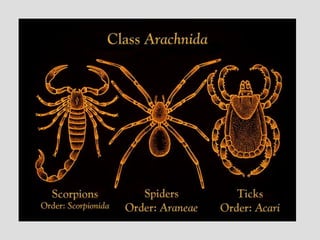
• Class Arachnida
– Ticks and mites (order Acarina)
• Class Insecta
– True flies (order Diptera)
– True bugs (order Heteroptera / Hemiptera)
– Lice (order Anoplura)
– Fleas (order Siphonaptera)
Class
• Insecta
– 3 disntict regions
– 3 pairs of legs
– Wings present
– 1 pair of antennae
– Segmented abdomen.
• Arachnids
– 2 regions
– 4 pair of legs
– No wings
– No antennae
– Abdomen usually not
segmented.
Metamorphosis
• The change in form during an insect’s
development is called metamorphosis.
• Complete metamorphosis.
• Incomplete metamorphosis
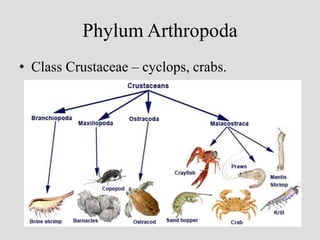
Phylum Arthropoda
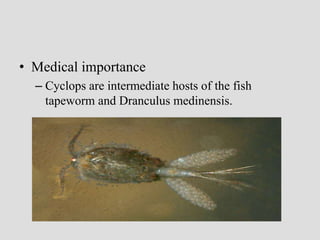
• Class Crustaceae – cyclops, crabs.
• Medical importance
– Cyclops are intermediate hosts of the fish
tapeworm and Dranculus medinensis.
• Spiders, scorpions, ticks and mites.
• 4 pair of legs
• Pedipalps – aid in chewing
• Incomplete metamorphosis
Order Acarina
• Only group in Arachnida that sucks blood and
serves as vector.
• Commonly called
• Ticks
– Hard tick (family Ixodidae)
– Soft tick (Argasidae)
• Mite
– Trombiculid mite, itch mite, dust mite
• Medical importance
– Tick paralysis
– Bite injury
– Ixodidae – Borrelia burgdoferi, Babesia microti
and Ehrlichia spp.
– Soft tick – vectors of endemic relapsing fever and
Q Fever.
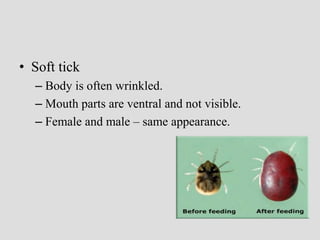
• Soft tick
– Body is often wrinkled.
– Mouth parts are ventral and not visible.
– Female and male – same appearance.
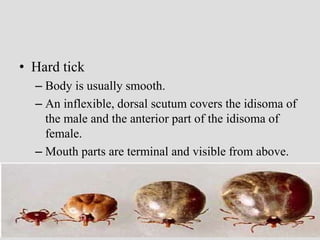
• Hard tick
– Body is usually smooth.
– An inflexible, dorsal scutum covers the idisoma of
the male and the anterior part of the idisoma of
female.
– Mouth parts are terminal and visible from above.
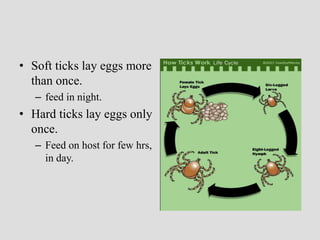
• Soft ticks lay eggs more
than once.
– feed in night.
• Hard ticks lay eggs only
once.
– Feed on host for few hrs,
in day.
• Control
– Environmental management
– Acaricides
– Personal protection
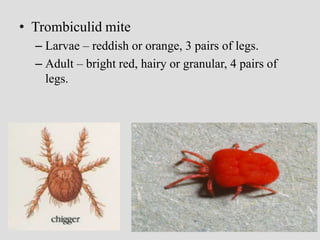
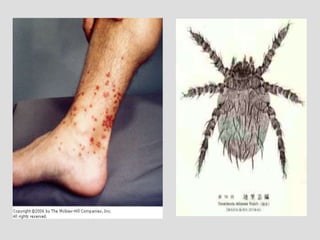
• Trombiculid mite
– Larvae – reddish or orange, 3 pairs of legs.
– Adult – bright red, hairy or granular, 4 pairs of
legs.
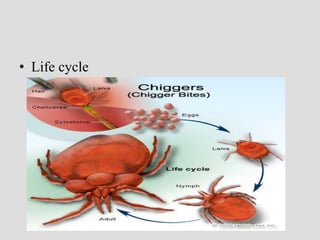
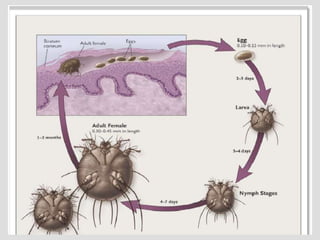
• Life cycle
• Chiggers – parasitic with low specificity.
• Chigger dermatitis – reaction of host.
• Scab – raised, reddened wheal with a
depressed center.
• Scrub typhus
• Epidemic haemorrhagic fever??
• Diagnosis
– Recent h/o being to grassy area
– Fever, itching papules, scab
• Prevention
– Eradication of wild weed
– Control of rats and mice
– DDT
– Personal protection
• Sarcoptes scabiei
– Commonly called itch mite.
– Causes scabies
– Disc shaped with distinctive sculptured lines
– Stubby legs
– Male – 4th pair has amlulacra
– Female – 4th pair terminate in long setae
• Female burrows in the skin and lays eggs in
sinuous tunnel.
• Selects places where skin is thin and wrinkled,
between fingers, elbows, feet, etc.
• Children – whole body.
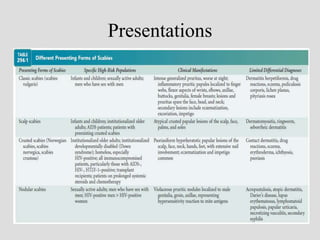
Presentations
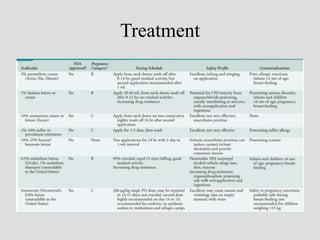
Treatment
• Prevention
– Aggressive treatment of infested patients and all
close contacts,
– Disposal or hot wash-dry sterilization of clothes.
– Provision of improved access for personal hygiene
and health care
– Aggressive control of outbreaks of zoonotic
scabies with the potential for human transmission
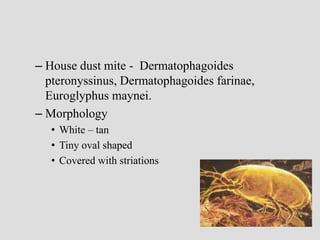
– House dust mite - Dermatophagoides
pteronyssinus, Dermatophagoides farinae,
Euroglyphus maynei.
– Morphology
• White – tan
• Tiny oval shaped
• Covered with striations
Class Insecta
• Lice
– Head louse - Pediculous humanus var capitis
• Pediculosis
– Body louse - Pediculoushumanus var carporis
• Epidemic fever, Trench fever, Relapsing fever
– Pubic / Crab louse – Pthrius pubis
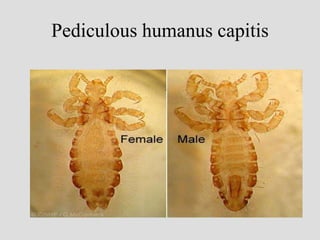
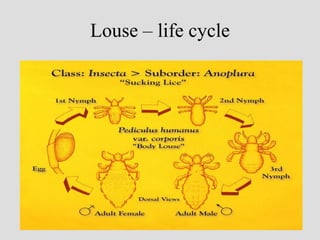
• Morphology – Pediculous humans
– Greyish, wingless, 3pairs of legs.
– Abdomen
• Male – V
• Female - W
Pediculous humanus capitis
Louse – life cycle
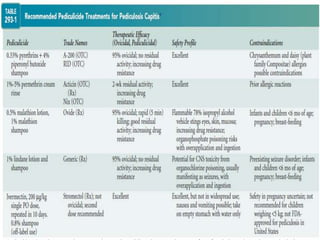
• Therapy
– Management of pediculosis capitis includes two
topical or systemic treatments with pediculocides,
7 to 10 days apart.
– Removal of all viable nits by carefully combing
wet hair.
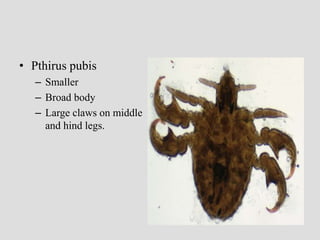
• Pthirus pubis
– Smaller
– Broad body
– Large claws on middle
and hind legs.
• Therapy
– Management includes initial bathing with soap and
water, followed by two topical or systemic
treatments with pediculicides, 7 to 10 days apart
Prevention
• Prevention strategies
– Combinations of sanitizing the environment.
– Eliminating all human reservoirs of head lice in
households, apartments, housing complexes,
classrooms, and schools.
• Common preventive interventions
– avoiding contact with potentially contaminated
items
– soaking all combs and brushes in isopropyl alcohol
or 2% Lysol solution
– sanitizing the household environment by high heat
cycle washing and drying of all bedding, clothing
and headgear
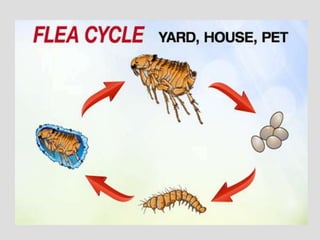
• Fleas
– Oriental / Tropical rat flea – Xynopsilla cheopis
• Plague, Endemic Typhus, Host of Hymenolipis
tapeworm.
– Northern rat flea – Nasopsylla fasciatus
• Endemic typhus
– Human flea – Pulex irritans
• Skin irritation, Intermediate host of Hymenolepis and
Dipylidium tapeworm larvae.
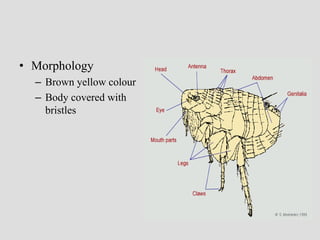
• Morphology
– Brown yellow colour
– Body covered with
bristles
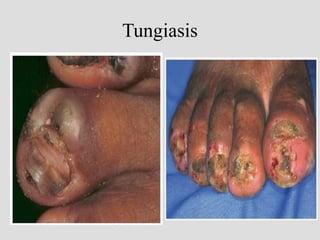
Tungiasis
• Bugs
– Bed bugs – Cimex lectularius, Cimex hemipterus
• Allergy, secondary bacterial infection.
– Reduvid bug – Rhodnius, Triatoma, Pastrongylus
• American trypanosomiasis ( Chaga’s disease)
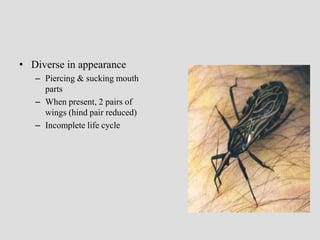
• Diverse in appearance
– Piercing & sucking mouth
parts
– When present, 2 pairs of
wings (hind pair reduced)
– Incomplete life cycle
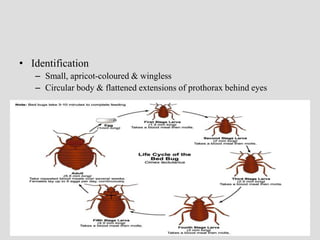
• Identification
– Small, apricot-coloured & wingless
– Circular body & flattened extensions of prothorax behind eyes
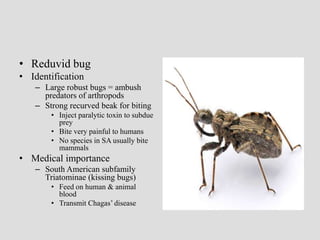
• Reduvid bug
• Identification
– Large robust bugs = ambush
predators of arthropods
– Strong recurved beak for biting
• Inject paralytic toxin to subdue
prey
• Bite very painful to humans
• No species in SA usually bite
mammals
• Medical importance
– South American subfamily
Triatominae (kissing bugs)
• Feed on human & animal
blood
• Transmit Chagas’ disease
• Flies
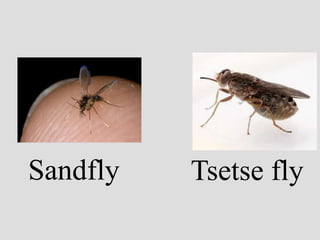
– Sandfly – Phlebotomus, Lutzomyia
• Leishmaniasis, Bartonellosis, sandflyfever
– Black fly/Buffalo gnats - Simulium
• Onchocercariasis / river blindness
– Tsetse fly – Glossina
• African trypanosomiasis
– Deer fly/ Yellow fly – Chrysops
• Loiasis, Tularemia
– Domestic fly – Musca domestica
Sandfly Tsetse fly
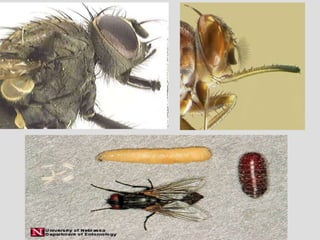
Flies
• Morphology
– 1pair of membranous fore wings
– Hind wings reduced to form halters
– Mouth parts – proboscus / piercing like.
• Larval
– No conspicuous head.
– Legless
– Slender bodies.
• Mosquitoes
– Anopheline
• Anopheles culcifacies – Malaria
• Clear, stagnant/ sluggishly moving water.
• Rest at an angle to the resting surface.
– Culicine
• Filarial - Culex fasciatus
– Stagnant, polluted water
– Lymphatic filariasis
• J.E - Culex gelidus, Culex tritaeniorhyncus, Culex
fuscocephela
– Japanese encephalitis
• Aedes
– Aedes aegypti
• Urban vectors.
• Man made small collection of clear water.
• Dusk and dawn biters
– Aedes albopictus
• Rural vectors
• Natural collections of clear water
• Dengue, Yellow fever, Chickungunya
• Mansonia
– Rural vector
– Breeds on the undersurface of water plants
– Brugian filariasis, transmits Dirofilaria repens.
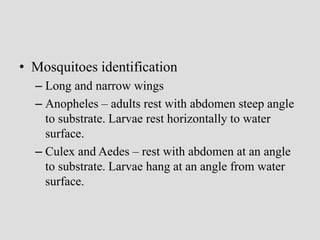
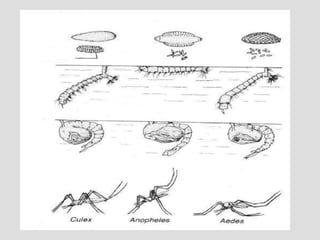
• Mosquitoes identification
– Long and narrow wings
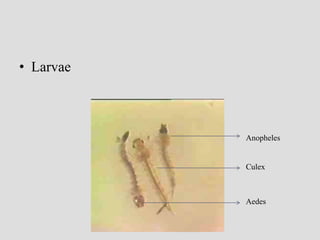
– Anopheles – adults rest with abdomen steep angle
to substrate. Larvae rest horizontally to water
surface.
– Culex and Aedes – rest with abdomen at an angle
to substrate. Larvae hang at an angle from water
surface.
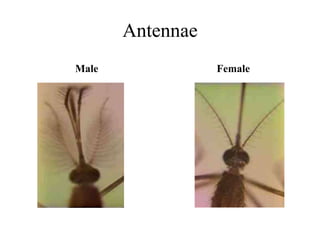
Antennae
Male Female
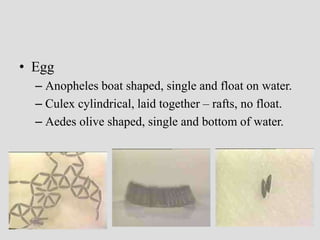
• Egg
– Anopheles boat shaped, single and float on water.
– Culex cylindrical, laid together – rafts, no float.
– Aedes olive shaped, single and bottom of water.
• Larvae
Anopheles
Culex
Aedes
References
• Meical Parasitology – Ruth Leventhal, Russel
F. Cheadle.
• Principles and Practices of Infectious Diseases
7th Edition – Mandell, Douglous, Bennet.
THANK YOU

Medically important Arthropods

  • 1.
  • 2.
    Arthropods • Invertebrate animalswith jointed legs. • Exoskeleton – chitin. • Segmented bodies. • Bilaterally symmetrical • Tubular alimentary canal with mouth and anus. • Coelom
  • 3.
    Medical anthropodology • Majorityof arthropods are not harmful to humans. • Arthropod related with human health. – Harmful – nuisance, discomfort, bites. – Ectoparasites – live and feed on exterior of host without transmitting germs. – Mechanical transporters. – Vectors .
  • 4.
    • Class Arachnida –Ticks and mites (order Acarina)
  • 5.
    • Class Insecta –True flies (order Diptera) – True bugs (order Heteroptera / Hemiptera) – Lice (order Anoplura) – Fleas (order Siphonaptera)
  • 6.
    Class • Insecta – 3disntict regions – 3 pairs of legs – Wings present – 1 pair of antennae – Segmented abdomen. • Arachnids – 2 regions – 4 pair of legs – No wings – No antennae – Abdomen usually not segmented.
  • 7.
    Metamorphosis • The changein form during an insect’s development is called metamorphosis. • Complete metamorphosis. • Incomplete metamorphosis
  • 8.
    Phylum Arthropoda • ClassCrustaceae – cyclops, crabs.
  • 9.
    • Medical importance –Cyclops are intermediate hosts of the fish tapeworm and Dranculus medinensis.
  • 11.
    • Spiders, scorpions,ticks and mites. • 4 pair of legs • Pedipalps – aid in chewing • Incomplete metamorphosis
  • 12.
    Order Acarina • Onlygroup in Arachnida that sucks blood and serves as vector. • Commonly called • Ticks – Hard tick (family Ixodidae) – Soft tick (Argasidae) • Mite – Trombiculid mite, itch mite, dust mite
  • 13.
    • Medical importance –Tick paralysis – Bite injury – Ixodidae – Borrelia burgdoferi, Babesia microti and Ehrlichia spp. – Soft tick – vectors of endemic relapsing fever and Q Fever.
  • 14.
    • Soft tick –Body is often wrinkled. – Mouth parts are ventral and not visible. – Female and male – same appearance.
  • 15.
    • Hard tick –Body is usually smooth. – An inflexible, dorsal scutum covers the idisoma of the male and the anterior part of the idisoma of female. – Mouth parts are terminal and visible from above.
  • 16.
    • Soft tickslay eggs more than once. – feed in night. • Hard ticks lay eggs only once. – Feed on host for few hrs, in day.
  • 17.
    • Control – Environmentalmanagement – Acaricides – Personal protection
  • 18.
    • Trombiculid mite –Larvae – reddish or orange, 3 pairs of legs. – Adult – bright red, hairy or granular, 4 pairs of legs.
  • 19.
  • 20.
    • Chiggers –parasitic with low specificity. • Chigger dermatitis – reaction of host. • Scab – raised, reddened wheal with a depressed center. • Scrub typhus • Epidemic haemorrhagic fever??
  • 22.
    • Diagnosis – Recenth/o being to grassy area – Fever, itching papules, scab • Prevention – Eradication of wild weed – Control of rats and mice – DDT – Personal protection
  • 23.
    • Sarcoptes scabiei –Commonly called itch mite. – Causes scabies – Disc shaped with distinctive sculptured lines – Stubby legs – Male – 4th pair has amlulacra – Female – 4th pair terminate in long setae
  • 25.
    • Female burrowsin the skin and lays eggs in sinuous tunnel. • Selects places where skin is thin and wrinkled, between fingers, elbows, feet, etc. • Children – whole body.
  • 26.
  • 27.
  • 28.
    • Prevention – Aggressivetreatment of infested patients and all close contacts, – Disposal or hot wash-dry sterilization of clothes. – Provision of improved access for personal hygiene and health care – Aggressive control of outbreaks of zoonotic scabies with the potential for human transmission
  • 29.
    – House dustmite - Dermatophagoides pteronyssinus, Dermatophagoides farinae, Euroglyphus maynei. – Morphology • White – tan • Tiny oval shaped • Covered with striations
  • 30.
    Class Insecta • Lice –Head louse - Pediculous humanus var capitis • Pediculosis – Body louse - Pediculoushumanus var carporis • Epidemic fever, Trench fever, Relapsing fever – Pubic / Crab louse – Pthrius pubis
  • 31.
    • Morphology –Pediculous humans – Greyish, wingless, 3pairs of legs. – Abdomen • Male – V • Female - W
  • 32.
  • 33.
  • 34.
    • Therapy – Managementof pediculosis capitis includes two topical or systemic treatments with pediculocides, 7 to 10 days apart. – Removal of all viable nits by carefully combing wet hair.
  • 35.
    • Pthirus pubis –Smaller – Broad body – Large claws on middle and hind legs.
  • 36.
    • Therapy – Managementincludes initial bathing with soap and water, followed by two topical or systemic treatments with pediculicides, 7 to 10 days apart
  • 37.
    Prevention • Prevention strategies –Combinations of sanitizing the environment. – Eliminating all human reservoirs of head lice in households, apartments, housing complexes, classrooms, and schools.
  • 38.
    • Common preventiveinterventions – avoiding contact with potentially contaminated items – soaking all combs and brushes in isopropyl alcohol or 2% Lysol solution – sanitizing the household environment by high heat cycle washing and drying of all bedding, clothing and headgear
  • 40.
    • Fleas – Oriental/ Tropical rat flea – Xynopsilla cheopis • Plague, Endemic Typhus, Host of Hymenolipis tapeworm. – Northern rat flea – Nasopsylla fasciatus • Endemic typhus – Human flea – Pulex irritans • Skin irritation, Intermediate host of Hymenolepis and Dipylidium tapeworm larvae.
  • 41.
    • Morphology – Brownyellow colour – Body covered with bristles
  • 43.
  • 44.
    • Bugs – Bedbugs – Cimex lectularius, Cimex hemipterus • Allergy, secondary bacterial infection. – Reduvid bug – Rhodnius, Triatoma, Pastrongylus • American trypanosomiasis ( Chaga’s disease)
  • 45.
    • Diverse inappearance – Piercing & sucking mouth parts – When present, 2 pairs of wings (hind pair reduced) – Incomplete life cycle
  • 46.
    • Identification – Small,apricot-coloured & wingless – Circular body & flattened extensions of prothorax behind eyes
  • 47.
    • Reduvid bug •Identification – Large robust bugs = ambush predators of arthropods – Strong recurved beak for biting • Inject paralytic toxin to subdue prey • Bite very painful to humans • No species in SA usually bite mammals • Medical importance – South American subfamily Triatominae (kissing bugs) • Feed on human & animal blood • Transmit Chagas’ disease
  • 48.
    • Flies – Sandfly– Phlebotomus, Lutzomyia • Leishmaniasis, Bartonellosis, sandflyfever – Black fly/Buffalo gnats - Simulium • Onchocercariasis / river blindness – Tsetse fly – Glossina • African trypanosomiasis – Deer fly/ Yellow fly – Chrysops • Loiasis, Tularemia – Domestic fly – Musca domestica
  • 49.
  • 50.
    Flies • Morphology – 1pairof membranous fore wings – Hind wings reduced to form halters – Mouth parts – proboscus / piercing like. • Larval – No conspicuous head. – Legless – Slender bodies.
  • 53.
    • Mosquitoes – Anopheline •Anopheles culcifacies – Malaria • Clear, stagnant/ sluggishly moving water. • Rest at an angle to the resting surface.
  • 54.
    – Culicine • Filarial- Culex fasciatus – Stagnant, polluted water – Lymphatic filariasis • J.E - Culex gelidus, Culex tritaeniorhyncus, Culex fuscocephela – Japanese encephalitis
  • 55.
    • Aedes – Aedesaegypti • Urban vectors. • Man made small collection of clear water. • Dusk and dawn biters – Aedes albopictus • Rural vectors • Natural collections of clear water • Dengue, Yellow fever, Chickungunya
  • 56.
    • Mansonia – Ruralvector – Breeds on the undersurface of water plants – Brugian filariasis, transmits Dirofilaria repens.
  • 57.
    • Mosquitoes identification –Long and narrow wings – Anopheles – adults rest with abdomen steep angle to substrate. Larvae rest horizontally to water surface. – Culex and Aedes – rest with abdomen at an angle to substrate. Larvae hang at an angle from water surface.
  • 59.
  • 60.
    • Egg – Anophelesboat shaped, single and float on water. – Culex cylindrical, laid together – rafts, no float. – Aedes olive shaped, single and bottom of water.
  • 61.
  • 62.
    References • Meical Parasitology– Ruth Leventhal, Russel F. Cheadle. • Principles and Practices of Infectious Diseases 7th Edition – Mandell, Douglous, Bennet.
  • 63.