1
SECURITY PROBLEMS IN TCP/IP
     Reference: Security Problems in the TCP/IP Protocol Suite : by
        Steve Bellovin


     R-services
     Source-routing
     ARP attacks
     Session hijacking
     TCP session stealing


                                                                      2
SECURITY PROBLEMS IN R-SERVICES
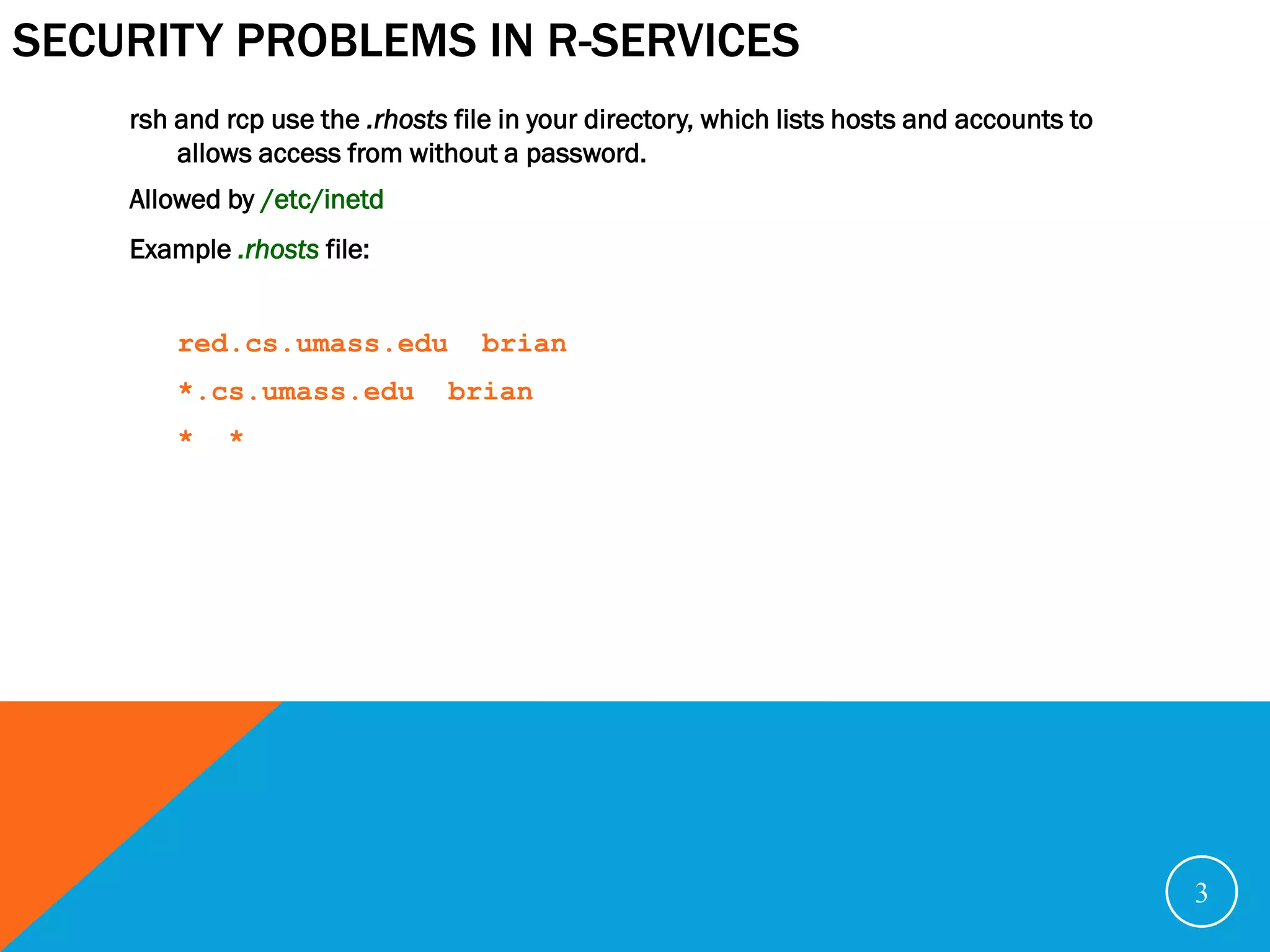
    rsh and rcp use the .rhosts file in your directory, which lists hosts and accounts to
        allows access from without a password.
    Allowed by /etc/inetd
    Example .rhosts file:


        red.cs.umass.edu           brian
        *.cs.umass.edu          brian
        *   *


                                                                                            3
SECURITY PROBLEMS IN R-SERVICES
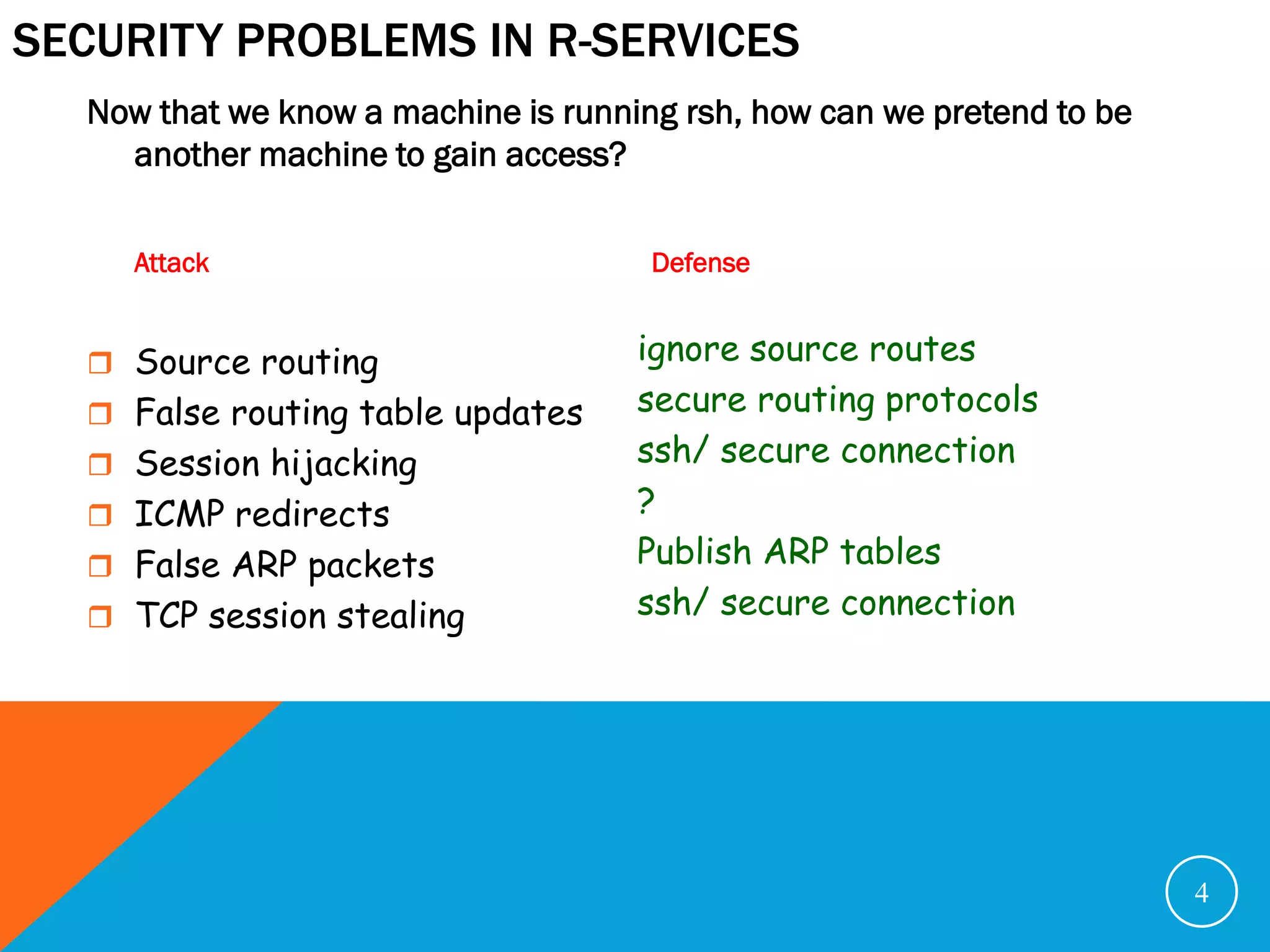
  Now that we know a machine is running rsh, how can we pretend to be
    another machine to gain access?


     Attack                           Defense


   Source routing                   ignore source routes
   False routing table updates      secure routing protocols
   Session hijacking                ssh/ secure connection
   ICMP redirects                   ?
   False ARP packets                Publish ARP tables
   TCP session stealing             ssh/ secure connection


                                                                        4
SECURITY PROBLEMS IN R-SERVICES


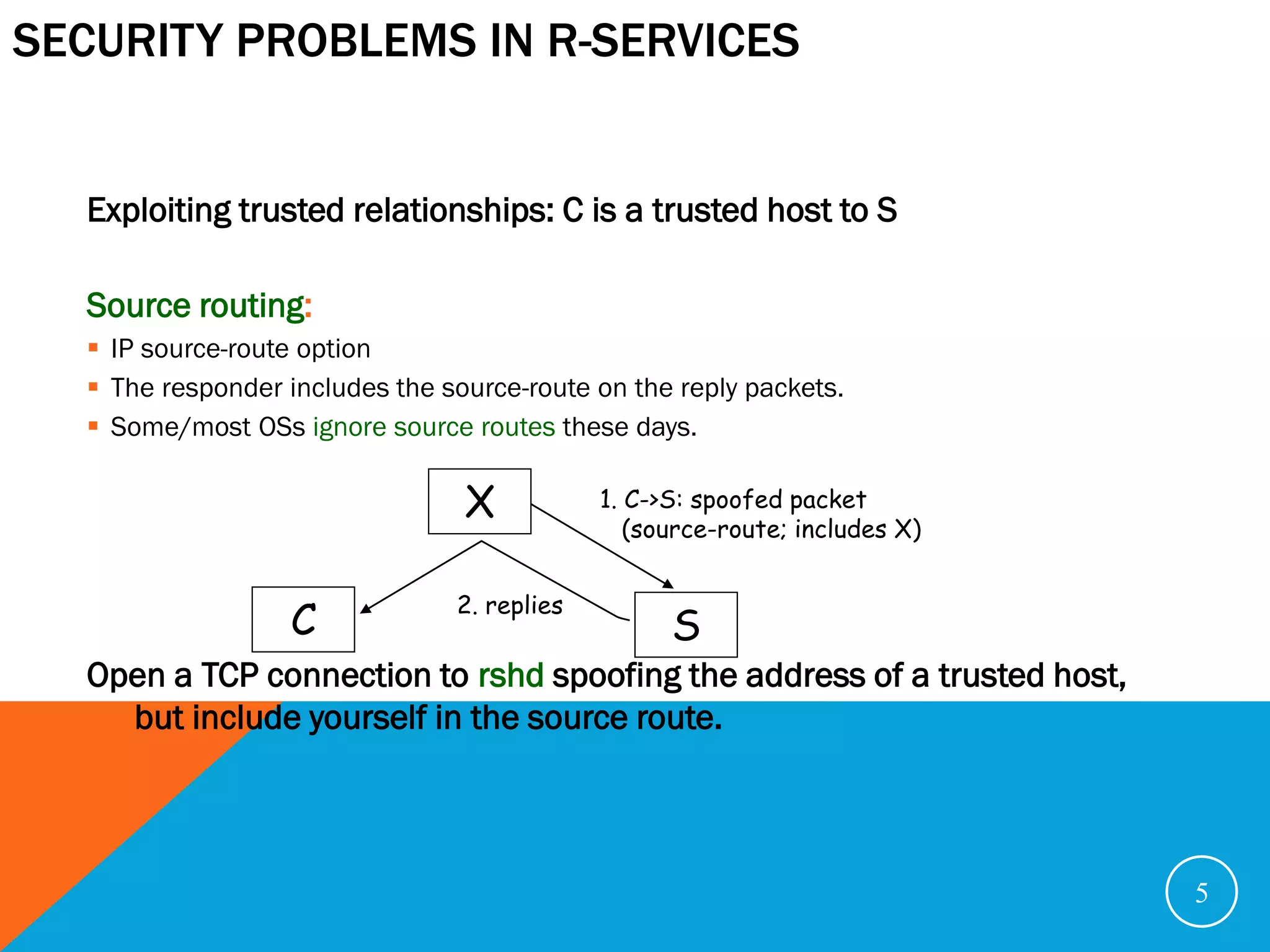
  Exploiting trusted relationships: C is a trusted host to S

  Source routing:
   IP source-route option
   The responder includes the source-route on the reply packets.
   Some/most OSs ignore source routes these days.

                                 X           1. C->S: spoofed packet
                                                (source-route; includes X)


                                2. replies
                  C                                S
  Open a TCP connection to rshd spoofing the address of a trusted host,
    but include yourself in the source route.


                                                                             5
SESSION HIJACKING

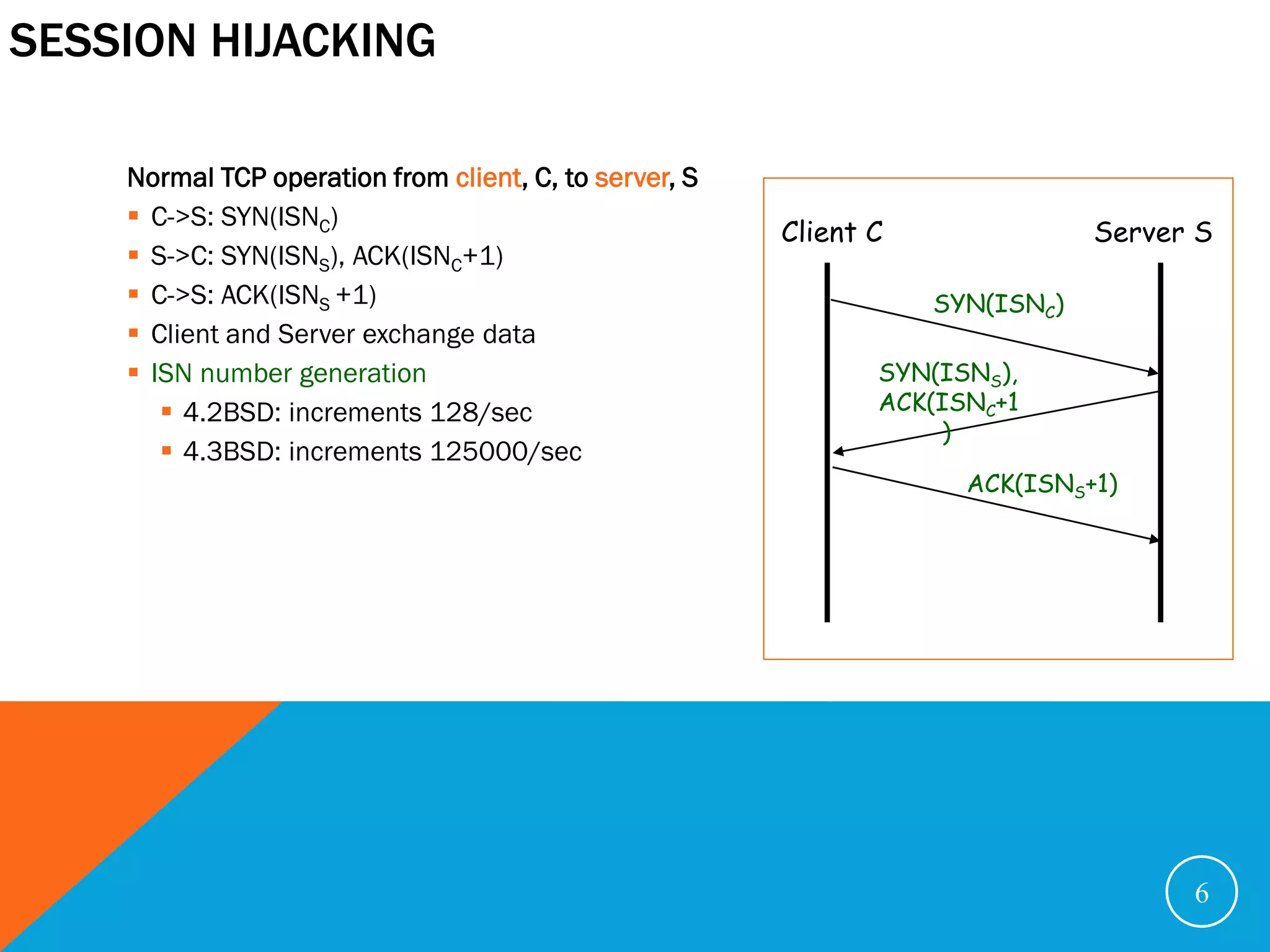
    Normal TCP operation from client, C, to server, S
     C->S: SYN(ISNC)
                                                        Client C               Server S
     S->C: SYN(ISNS), ACK(ISNC+1)
     C->S: ACK(ISNS +1)                                           SYN(ISNC)
     Client and Server exchange data
     ISN number generation                                    SYN(ISNS),
        4.2BSD: increments 128/sec                            ACK(ISNC+1
                                                                   )
        4.3BSD: increments 125000/sec
                                                                     ACK(ISNS+1)


                                                                                     6
SESSION HIJACKING

    Session hijacking: Find a machine, C, that’s down, guess the ISN. Usually in regular
        increments.
     X->S: SYN(ISNX) [spoofs C]               S: rshd server
     S->C: SYN(ISNS), ACK(ISNX +1)
     X->S: ACK(ISNS +1) [spoofs C; estimates ISNS]
     X->S: [ echo “* *” >> ~/.rhosts]         [spoofs C]
     X->S: RESET [spoofs C]
     X rlogins from anywhere in the world.

                                                        X          3. SYN(5000), ACK(1001)
        1. ISN estimation:       1: Disables C

                                                   2. SYN(1000)
                                      C                                    S
                                                 Trusted relationship


                                                                                             7
SESSION HIJACKING


    2. Session hijacking:

                                  X
                                                6: ACK(ISNS +1)
                                                     (spoofs C; estimates ISNS)
                                4: SYN(ISNX)
                                   (spoofs C)
                 C                                       S
                        5: SYN(ISNS), ACK(ISNX+1)


     3. Executes remote commands:

                                    X
                                                   7: [echo “* *” >> ~/.rhosts]
                                                              (spoofs C)
                                      8: RESET
                                      (spoofs C)
                            C                              S                      8
DISABLING HOSTS: SYN FLOODING DOS
   Send lots of spoofed SYN packets to a victim host


   Each SYN packet received causes a buffer to be allocated, and the limits of the
      listen()call to be reached.


   Morris invented SYN flooding just to launch a session hijacking attack, later used
      against Yahoo!


                                                                                        9
ATTACKING ROUTING TO EXPLOIT RSH


  Two types of routing: dynamic routing vs. static routing
  Dynamic routing updates
   OSPF: link-state algorithm
   RIP: distance vector algorithm

  Attacker injects a RIP update stating she has a path to host C
   All subsequent packets to C will be routed to the attacker.
   The attacker initiates connection to rshd of the server. (spoofing C)
  Defense: uses secure routing protocols
   Only accept authenticated updates.
   Requires key management.


                                                                            10
ICMP ATTACK


  ICMP redirect: forces a machine to route through you.
   Requires an existing connection
   Open a spoofed connection to the host you want to attack.
   Then send a spoofed ICMP redirect to the victim redirecting it to the gateway you’ve
    compromised.


  Others
   ICMP destination unreachable
   Frequent ICMP source quenches


                                                                                           11
ARP ATTACKS

    When a machines sends an ARP request out, you could answer that you own the
       address.
     But in a race condition with the real machine.
    Unfortunately, ARP will just accept replies without requests!
    Just send a spoofed reply message saying your MAC address owns a certain IP
        address.
     Repeat frequently so that cache doesn’t timeout


    Messages are routed through you to sniff or modify.


                                                                                  12
ARP SPOOFING - COUNTERMEASURES


  “Publish” MAC address of router/default gateway and trusted hosts to prevent ARP spoof

   Statically defining the IP to Ethernet address mapping


  Example:
        arp -s hostname 00:01:02:03:04:ab pub


                                                                                           13
TCP SESSION STEALING

    Reference: “A Simple Active Attack Against TCP” by Laurent Joncheray.
        In Proceedings of 5th USENIX Unix Security Symposium. June 1995

    Active attack using desynchronized states
           The attacker is in the path b/w the client and the server
           The attacker can sniff all the packets and inject some spoofed packets
           Steps:
            1. The attacker sniffs the communication b/w the two.
            2. The attacker disables the communication by desynchronizing the
            client and the server.
            3. The attacker injects spoofed packets that acceptable for both ends.


                                                                                     14
TCP SESSION STEALING

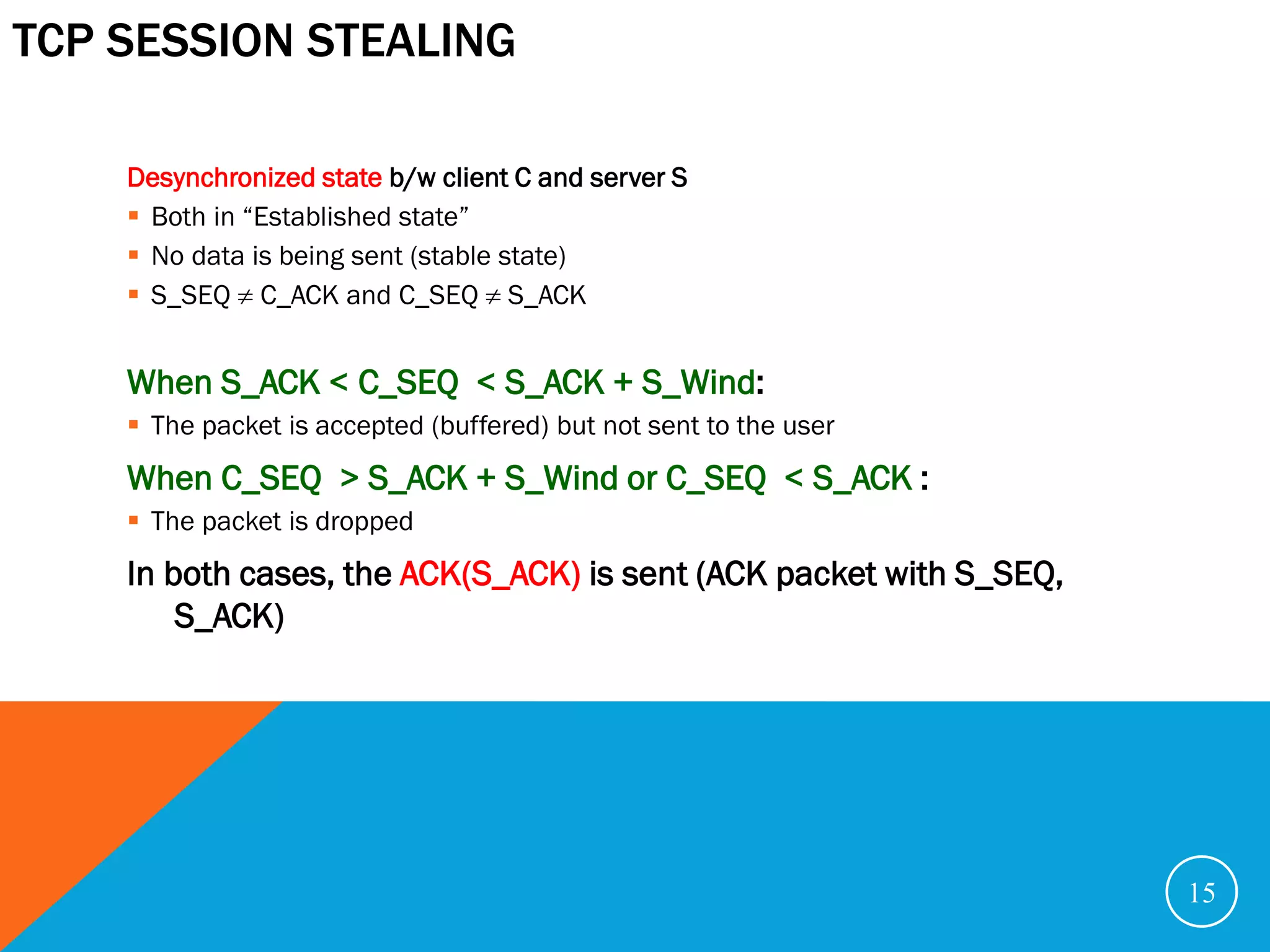
    Desynchronized state b/w client C and server S
     Both in “Established state”
     No data is being sent (stable state)
     S_SEQ  C_ACK and C_SEQ  S_ACK


    When S_ACK < C_SEQ < S_ACK + S_Wind:
     The packet is accepted (buffered) but not sent to the user
    When C_SEQ > S_ACK + S_Wind or C_SEQ < S_ACK :
     The packet is dropped
    In both cases, the ACK(S_ACK) is sent (ACK packet with S_SEQ,
        S_ACK)


                                                                    15
TCP SESSION STEALING

    In a desynchronized state, the attacker can send any acceptable data to the server
     E.g. [echo myhost >> ~/.rhost] for rlogin


                                       X          2: X->S (spoofing C): S_ACK, S_SEQ
     1: C->S: C_SEQ, C_ACK
                                                            [echo myhost >> ~/.rhost]

                                                               (accepted)
                                               (dropped)
                  C                                           S
           C_SEQ, C_ACK                                    S_SEQ, S_ACK

                      S_SEQ  C_ACK and C_SEQ  S_ACK

                                                                                         16
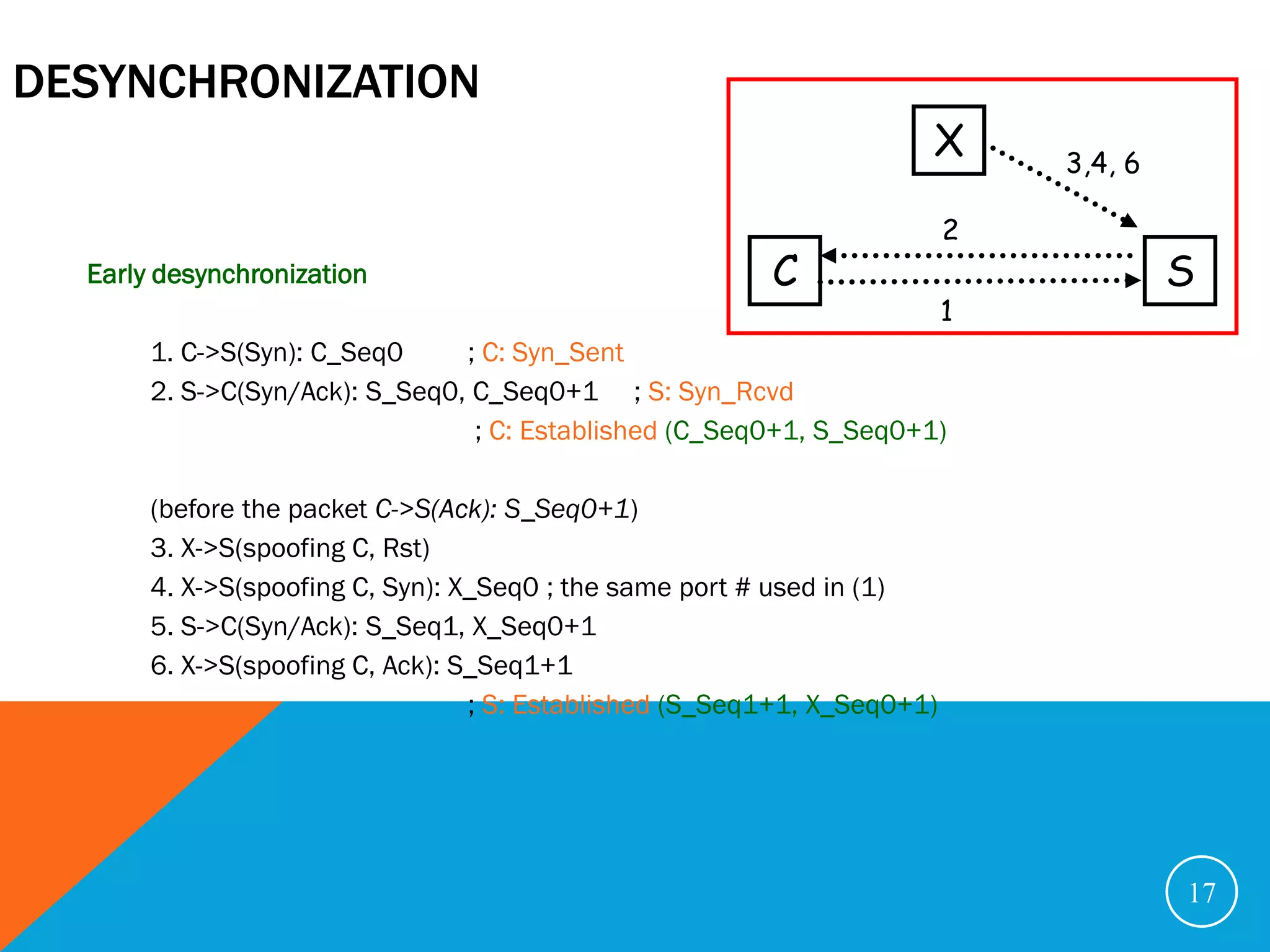
DESYNCHRONIZATION
                                                                      X       3,4, 6

                                                                          2
  Early desynchronization                                C                             S
                                                                          1
       1. C->S(Syn): C_Seq0     ; C: Syn_Sent
       2. S->C(Syn/Ack): S_Seq0, C_Seq0+1 ; S: Syn_Rcvd
                                 ; C: Established (C_Seq0+1, S_Seq0+1)

       (before the packet C->S(Ack): S_Seq0+1)
       3. X->S(spoofing C, Rst)
       4. X->S(spoofing C, Syn): X_Seq0 ; the same port # used in (1)
       5. S->C(Syn/Ack): S_Seq1, X_Seq0+1
       6. X->S(spoofing C, Ack): S_Seq1+1
                                  ; S: Established (S_Seq1+1, X_Seq0+1)


                                                                                       17
THE ATTACK

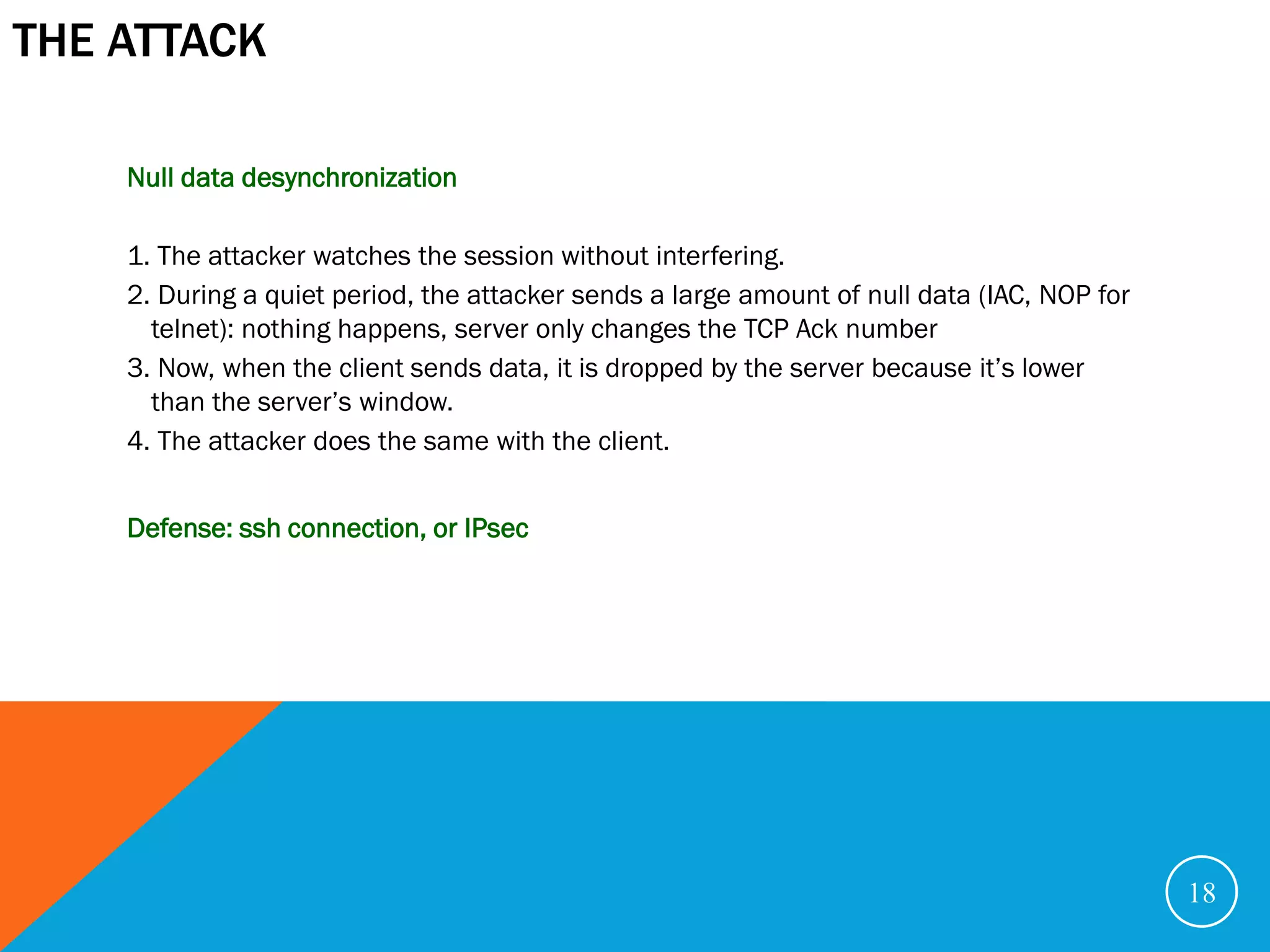
    Null data desynchronization

    1. The attacker watches the session without interfering.
    2. During a quiet period, the attacker sends a large amount of null data (IAC, NOP for
      telnet): nothing happens, server only changes the TCP Ack number
    3. Now, when the client sends data, it is dropped by the server because it’s lower
      than the server’s window.
    4. The attacker does the same with the client.


    Defense: ssh connection, or IPsec


                                                                                             18

Security problems in TCP/IP

  • 1.
  • 2.
    SECURITY PROBLEMS INTCP/IP Reference: Security Problems in the TCP/IP Protocol Suite : by Steve Bellovin R-services Source-routing ARP attacks Session hijacking TCP session stealing 2
  • 3.
    SECURITY PROBLEMS INR-SERVICES rsh and rcp use the .rhosts file in your directory, which lists hosts and accounts to allows access from without a password. Allowed by /etc/inetd Example .rhosts file: red.cs.umass.edu brian *.cs.umass.edu brian * * 3
  • 4.
    SECURITY PROBLEMS INR-SERVICES Now that we know a machine is running rsh, how can we pretend to be another machine to gain access? Attack Defense  Source routing ignore source routes  False routing table updates secure routing protocols  Session hijacking ssh/ secure connection  ICMP redirects ?  False ARP packets Publish ARP tables  TCP session stealing ssh/ secure connection 4
  • 5.
    SECURITY PROBLEMS INR-SERVICES Exploiting trusted relationships: C is a trusted host to S Source routing:  IP source-route option  The responder includes the source-route on the reply packets.  Some/most OSs ignore source routes these days. X 1. C->S: spoofed packet (source-route; includes X) 2. replies C S Open a TCP connection to rshd spoofing the address of a trusted host, but include yourself in the source route. 5
  • 6.
    SESSION HIJACKING Normal TCP operation from client, C, to server, S  C->S: SYN(ISNC) Client C Server S  S->C: SYN(ISNS), ACK(ISNC+1)  C->S: ACK(ISNS +1) SYN(ISNC)  Client and Server exchange data  ISN number generation SYN(ISNS),  4.2BSD: increments 128/sec ACK(ISNC+1 )  4.3BSD: increments 125000/sec ACK(ISNS+1) 6
  • 7.
    SESSION HIJACKING Session hijacking: Find a machine, C, that’s down, guess the ISN. Usually in regular increments.  X->S: SYN(ISNX) [spoofs C] S: rshd server  S->C: SYN(ISNS), ACK(ISNX +1)  X->S: ACK(ISNS +1) [spoofs C; estimates ISNS]  X->S: [ echo “* *” >> ~/.rhosts] [spoofs C]  X->S: RESET [spoofs C]  X rlogins from anywhere in the world. X 3. SYN(5000), ACK(1001) 1. ISN estimation: 1: Disables C 2. SYN(1000) C S Trusted relationship 7
  • 8.
    SESSION HIJACKING 2. Session hijacking: X 6: ACK(ISNS +1) (spoofs C; estimates ISNS) 4: SYN(ISNX) (spoofs C) C S 5: SYN(ISNS), ACK(ISNX+1) 3. Executes remote commands: X 7: [echo “* *” >> ~/.rhosts] (spoofs C) 8: RESET (spoofs C) C S 8
  • 9.
    DISABLING HOSTS: SYNFLOODING DOS Send lots of spoofed SYN packets to a victim host Each SYN packet received causes a buffer to be allocated, and the limits of the listen()call to be reached. Morris invented SYN flooding just to launch a session hijacking attack, later used against Yahoo! 9
  • 10.
    ATTACKING ROUTING TOEXPLOIT RSH Two types of routing: dynamic routing vs. static routing Dynamic routing updates  OSPF: link-state algorithm  RIP: distance vector algorithm Attacker injects a RIP update stating she has a path to host C  All subsequent packets to C will be routed to the attacker.  The attacker initiates connection to rshd of the server. (spoofing C) Defense: uses secure routing protocols  Only accept authenticated updates.  Requires key management. 10
  • 11.
    ICMP ATTACK ICMP redirect: forces a machine to route through you.  Requires an existing connection  Open a spoofed connection to the host you want to attack.  Then send a spoofed ICMP redirect to the victim redirecting it to the gateway you’ve compromised. Others  ICMP destination unreachable  Frequent ICMP source quenches 11
  • 12.
    ARP ATTACKS When a machines sends an ARP request out, you could answer that you own the address.  But in a race condition with the real machine. Unfortunately, ARP will just accept replies without requests! Just send a spoofed reply message saying your MAC address owns a certain IP address.  Repeat frequently so that cache doesn’t timeout Messages are routed through you to sniff or modify. 12
  • 13.
    ARP SPOOFING -COUNTERMEASURES “Publish” MAC address of router/default gateway and trusted hosts to prevent ARP spoof  Statically defining the IP to Ethernet address mapping Example: arp -s hostname 00:01:02:03:04:ab pub 13
  • 14.
    TCP SESSION STEALING Reference: “A Simple Active Attack Against TCP” by Laurent Joncheray. In Proceedings of 5th USENIX Unix Security Symposium. June 1995 Active attack using desynchronized states  The attacker is in the path b/w the client and the server  The attacker can sniff all the packets and inject some spoofed packets  Steps: 1. The attacker sniffs the communication b/w the two. 2. The attacker disables the communication by desynchronizing the client and the server. 3. The attacker injects spoofed packets that acceptable for both ends. 14
  • 15.
    TCP SESSION STEALING Desynchronized state b/w client C and server S  Both in “Established state”  No data is being sent (stable state)  S_SEQ  C_ACK and C_SEQ  S_ACK When S_ACK < C_SEQ < S_ACK + S_Wind:  The packet is accepted (buffered) but not sent to the user When C_SEQ > S_ACK + S_Wind or C_SEQ < S_ACK :  The packet is dropped In both cases, the ACK(S_ACK) is sent (ACK packet with S_SEQ, S_ACK) 15
  • 16.
    TCP SESSION STEALING In a desynchronized state, the attacker can send any acceptable data to the server  E.g. [echo myhost >> ~/.rhost] for rlogin X 2: X->S (spoofing C): S_ACK, S_SEQ 1: C->S: C_SEQ, C_ACK [echo myhost >> ~/.rhost] (accepted) (dropped) C S C_SEQ, C_ACK S_SEQ, S_ACK S_SEQ  C_ACK and C_SEQ  S_ACK 16
  • 17.
    DESYNCHRONIZATION X 3,4, 6 2 Early desynchronization C S 1 1. C->S(Syn): C_Seq0 ; C: Syn_Sent 2. S->C(Syn/Ack): S_Seq0, C_Seq0+1 ; S: Syn_Rcvd ; C: Established (C_Seq0+1, S_Seq0+1) (before the packet C->S(Ack): S_Seq0+1) 3. X->S(spoofing C, Rst) 4. X->S(spoofing C, Syn): X_Seq0 ; the same port # used in (1) 5. S->C(Syn/Ack): S_Seq1, X_Seq0+1 6. X->S(spoofing C, Ack): S_Seq1+1 ; S: Established (S_Seq1+1, X_Seq0+1) 17
  • 18.
    THE ATTACK Null data desynchronization 1. The attacker watches the session without interfering. 2. During a quiet period, the attacker sends a large amount of null data (IAC, NOP for telnet): nothing happens, server only changes the TCP Ack number 3. Now, when the client sends data, it is dropped by the server because it’s lower than the server’s window. 4. The attacker does the same with the client. Defense: ssh connection, or IPsec 18