THE INTENDED ADOPTER
Kelly Celmer
Marian Moore
Stefanie Trentacoste
PRESENTED BY:
(Ellsworth, 2000, pages 134-149)
Background
• First proposed by Hall, Wallace, and Dossett
• Change begins at the individual level, not the system
level.
• Intended adaptor must facilitate how the change can
benefit the client in order for the client to
understand and adjust to the change appropriately.
• Focuses on their clients needs and progress
o Individual (client) will either adopt or reject decision
themselves.
o Therefore, change must be applicable to relevant to
client for intended change to occur.
CONCERNS-BASED ADOPTION MODEL
(Ellsworth, 2000, pages 134-149)
• Change facilitators only can offer strategies and
support with the use of diagnostic tools.
• Use instruments to collect data to prescribe
diagnostic interventions
 This leads to specific strategies for
implementation.
• Measure and administer multiple times
o Change is a process, not an event.
o Change needs to be observed in practice rather
than discussed.
(Ellsworth, 2000, pages 134-149)
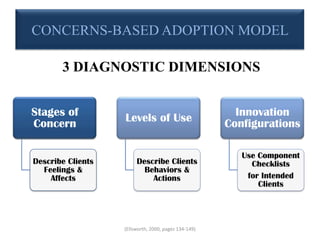
CONCERNS-BASED ADOPTION MODEL
Stages of
Concern
Describe Clients
Feelings &
Affects
Levels of Use
Describe Clients
Behaviors &
Actions
Innovation
Configurations
Use Component
Checklists
for Intended
Clients
3 DIAGNOSTIC DIMENSIONS
(Ellsworth, 2000, pages 134-149)
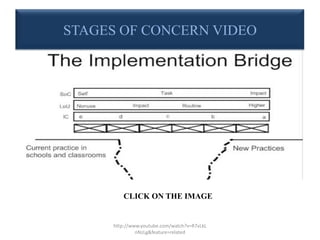
http://www.youtube.com/watch?v=R7xLkL
nNzLg&feature=related
STAGES OF CONCERN VIDEO
CLICK ON THE IMAGE
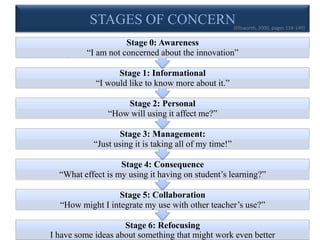
STAGES OF CONCERN
Stage 6: Refocusing
I have some ideas about something that might work even better
Stage 5: Collaboration
“How might I integrate my use with other teacher’s use?”
Stage 4: Consequence
“What effect is my using it having on student’s learning?”
Stage 3: Management:
“Just using it is taking all of my time!”
Stage 2: Personal
“How will using it affect me?”
Stage 1: Informational
“I would like to know more about it.”
Stage 0: Awareness
“I am not concerned about the innovation”
(Ellsworth, 2000, pages 134-149)
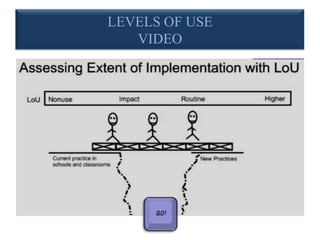
LEVELS OF USE
VIDEO
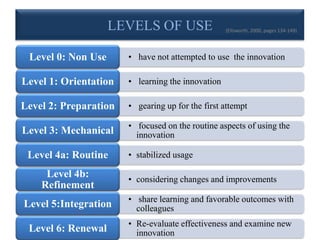
• have not attempted to use the innovationLevel 0: Non Use
• learning the innovationLevel 1: Orientation
• gearing up for the first attemptLevel 2: Preparation
• focused on the routine aspects of using the
innovationLevel 3: Mechanical
• stabilized usageLevel 4a: Routine
• considering changes and improvements
Level 4b:
Refinement
• share learning and favorable outcomes with
colleaguesLevel 5:Integration
• Re-evaluate effectiveness and examine new
innovationLevel 6: Renewal
LEVELS OF USE (Ellsworth, 2000, pages 134-149)
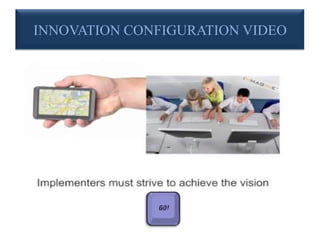
INNOVATION CONFIGURATION VIDEO
Innovcatio
• Change Facilitators
o to ensure that they can use it to advise teachers and
administrators
• Administrators
o to ensure that the innovation as defined is consistent with
their vision.
• Teachers
o to ensure that they understand what implementations is
supposed to look like in their classrooms.
• Evaluators
o to ensure that they understand what they are supposed to be
looking for when assessing implementation.
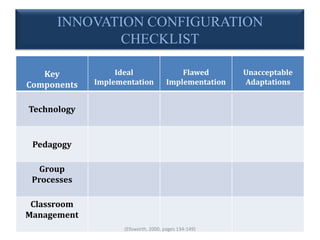
INNOVATION CONFIGURATION
(Ellsworth, 2000, page 142)
Key
Components
Ideal
Implementation
Flawed
Implementation
Unacceptable
Adaptations
Technology
Pedagogy
Group
Processes
Classroom
Management
INNOVATION CONFIGURATION
CHECKLIST
(Ellsworth, 2000, pages 134-149)
DIG DEEPER INTO CBAM
• Ellsworth, J. (2000). Surviving Change: A Survey of
Educational Change Models. Washington, DC: ERIC
Publications.
• Image retrieved from
http://office.microsoft.com/en-
us/images/results.aspx?qu=TEACHER&ctt=1#ai:
MP900443080|mt:2|
BIBLIOGRAPHY
(Ellsworth, 2000, pages 134-149)
VIDEO RESOURCES
• Stages of Concern:
• http://www.youtube.com/watch?v=R7xLkLnNzLg&feature=related
• Levels of Use:
• http://www.youtube.com/watch?v=PsAf5wKEEvs&feature=related
• Implementation Configuration:
• http://www.youtube.com/watch?v=A75fjhv866M&feature=related
• Dig Deeper into CBAM:
• http://www.youtube.com/watch?v=6E3rarcATqU&list=PL175633190
530CC61&index=1&feature=plpp_video

CBAM

  • 1.
    THE INTENDED ADOPTER KellyCelmer Marian Moore Stefanie Trentacoste PRESENTED BY: (Ellsworth, 2000, pages 134-149)
  • 2.
    Background • First proposedby Hall, Wallace, and Dossett • Change begins at the individual level, not the system level. • Intended adaptor must facilitate how the change can benefit the client in order for the client to understand and adjust to the change appropriately. • Focuses on their clients needs and progress o Individual (client) will either adopt or reject decision themselves. o Therefore, change must be applicable to relevant to client for intended change to occur. CONCERNS-BASED ADOPTION MODEL (Ellsworth, 2000, pages 134-149)
  • 3.
    • Change facilitatorsonly can offer strategies and support with the use of diagnostic tools. • Use instruments to collect data to prescribe diagnostic interventions  This leads to specific strategies for implementation. • Measure and administer multiple times o Change is a process, not an event. o Change needs to be observed in practice rather than discussed. (Ellsworth, 2000, pages 134-149) CONCERNS-BASED ADOPTION MODEL
  • 4.
    CONCERNS-BASED ADOPTION MODEL Stagesof Concern Describe Clients Feelings & Affects Levels of Use Describe Clients Behaviors & Actions Innovation Configurations Use Component Checklists for Intended Clients 3 DIAGNOSTIC DIMENSIONS (Ellsworth, 2000, pages 134-149)
  • 5.
  • 6.
    STAGES OF CONCERN Stage6: Refocusing I have some ideas about something that might work even better Stage 5: Collaboration “How might I integrate my use with other teacher’s use?” Stage 4: Consequence “What effect is my using it having on student’s learning?” Stage 3: Management: “Just using it is taking all of my time!” Stage 2: Personal “How will using it affect me?” Stage 1: Informational “I would like to know more about it.” Stage 0: Awareness “I am not concerned about the innovation” (Ellsworth, 2000, pages 134-149)
  • 7.
  • 8.
    • have notattempted to use the innovationLevel 0: Non Use • learning the innovationLevel 1: Orientation • gearing up for the first attemptLevel 2: Preparation • focused on the routine aspects of using the innovationLevel 3: Mechanical • stabilized usageLevel 4a: Routine • considering changes and improvements Level 4b: Refinement • share learning and favorable outcomes with colleaguesLevel 5:Integration • Re-evaluate effectiveness and examine new innovationLevel 6: Renewal LEVELS OF USE (Ellsworth, 2000, pages 134-149)
  • 9.
  • 10.
    Innovcatio • Change Facilitators oto ensure that they can use it to advise teachers and administrators • Administrators o to ensure that the innovation as defined is consistent with their vision. • Teachers o to ensure that they understand what implementations is supposed to look like in their classrooms. • Evaluators o to ensure that they understand what they are supposed to be looking for when assessing implementation. INNOVATION CONFIGURATION (Ellsworth, 2000, page 142)
  • 11.
  • 12.
  • 13.
    • Ellsworth, J.(2000). Surviving Change: A Survey of Educational Change Models. Washington, DC: ERIC Publications. • Image retrieved from http://office.microsoft.com/en- us/images/results.aspx?qu=TEACHER&ctt=1#ai: MP900443080|mt:2| BIBLIOGRAPHY (Ellsworth, 2000, pages 134-149)
  • 14.
    VIDEO RESOURCES • Stagesof Concern: • http://www.youtube.com/watch?v=R7xLkLnNzLg&feature=related • Levels of Use: • http://www.youtube.com/watch?v=PsAf5wKEEvs&feature=related • Implementation Configuration: • http://www.youtube.com/watch?v=A75fjhv866M&feature=related • Dig Deeper into CBAM: • http://www.youtube.com/watch?v=6E3rarcATqU&list=PL175633190 530CC61&index=1&feature=plpp_video