1 Unlocking Knowledge, Empowering Minds
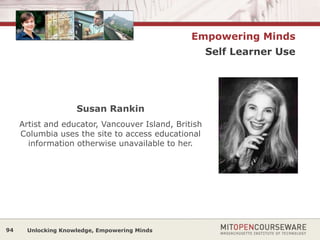
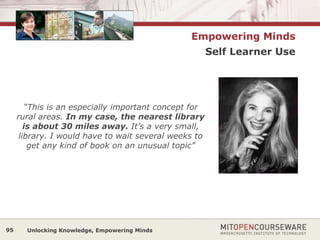
Unlocking Knowledge, Empowering Minds.
23 November 2010
Your Name Here
2 Unlocking Knowledge, Empowering Minds
3 Unlocking Knowledge, Empowering Minds
“To open up the institution’s vast reservoirs of knowledge
is a monumental and inspiring endeavor.”
— Student, Canada
Educators
Students
Self learners
MIT Community
Donors & Supporters
4 Unlocking Knowledge, Empowering Minds
Empowering Minds
Institutional Use
Full Case Study - NOT FOR PROJECTION
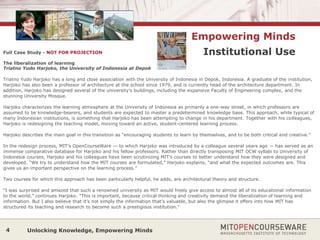
The liberalization of learning
Triatno Yudo Harjoko, the University of Indonesia at Depok
Triatno Yudo Harjoko has a long and close association with the University of Indonesia in Depok, Indonesia. A graduate of the institution,
Harjoko has also been a professor of architecture at the school since 1979, and is currently head of the architecture department. In
addition, Harjoko has designed several of the university’s buildings, including the expansive Faculty of Engineering complex, and the
stunning University Mosque.
Harjoko characterizes the learning atmosphere at the University of Indonesia as primarily a one-way street, in which professors are
assumed to be knowledge-bearers, and students are expected to master a predetermined knowledge base. This approach, while typical of
many Indonesian institutions, is something that Harjoko has been attempting to change in his department. Together with his colleagues,
Harjoko is redesigning the teaching model, moving toward an active, student-centered learning process.
Harjoko describes the main goal in this transition as “encouraging students to learn by themselves, and to be both critical and creative.”
In the redesign process, MIT’s OpenCourseWare — to which Harjoko was introduced by a colleague several years ago — has served as an
immense comparative database for Harjoko and his fellow professors. Rather than directly transposing MIT OCW syllabi to University of
Indonesia courses, Harjoko and his colleagues have been scrutinizing MIT’s courses to better understand how they were designed and
developed. “We try to understand how the MIT courses are formulated,” Harjoko explains, “and what the expected outcomes are. This
gives us an important perspective on the learning process.”
Two courses for which this approach has been particularly helpful, he adds, are architectural theory and structure.
“I was surprised and amazed that such a renowned university as MIT would freely give access to almost all of its educational information
to the world,” continues Harjoko. “This is important, because critical thinking and creativity demand the liberalization of learning and
information. But I also believe that it’s not simply the information that’s valuable, but also the glimpse it offers into how MIT has
structured its teaching and research to become such a prestigious institution.”
5 Unlocking Knowledge, Empowering Minds
Empowering Minds
Institutional Use
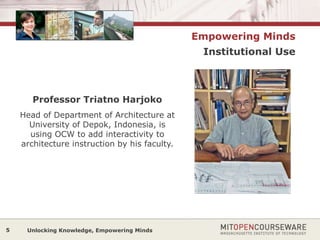
Professor Triatno Harjoko
Head of Department of Architecture at
University of Depok, Indonesia, is
using OCW to add interactivity to
architecture instruction by his faculty.
6 Unlocking Knowledge, Empowering Minds
Empowering Minds
Institutional Use
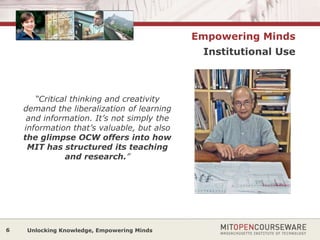
“Critical thinking and creativity
demand the liberalization of learning
and information. It’s not simply the
information that’s valuable, but also
the glimpse OCW offers into how
MIT has structured its teaching
and research.”
7 Unlocking Knowledge, Empowering Minds
Empowering Minds
Educator Use
Full Case Study - NOT FOR PROJECTION
Brushing up… and then some
Richard Hall, LaTrobe University in Melbourne, Australia
Richard Hall received a Ph.D. in computer science from LaTrobe University in Melbourne, Australia, in 2002. Shortly thereafter, Hall
found himself playing a different role in LaTrobe’s laboratories and lecture halls: teaching courses in introductory information
systems, beginning microprocessors, and advanced computer-aided software engineering.
In early 2005, Hall learned that he would also be teaching a fourth-year computer graphics course later in the year. Hall knew
immediately that the subject would demand a lot of work on his part, since he had had little experience with this rapidly changing
field over the previous 10 years. While casting about for a means to brush up on the topic — intensively, and in hurry! — Hall
recalled hearing something about MIT’s OpenCourseWare from a member of LaTrobe’s technical support staff. He decided to visit
the site to see if he could find a solution there.
To his great relief, Hall quickly located the lectures and labs from MIT’s Course 6.837 – Computer Graphics, which guided him
through an in-depth review of the subject. In fact, Hall credits the 6.837’s labs — which he completed over the course of several
months — with not only fine-tuning his existing skills, but also adding new techniques to his repertoire. The whole process,
according to Hall, saved him “an enormous amount of time and stress.”
Based on this experience, Hall plans to use a subset of the lectures and labs in his own course next semester. The MIT OCW
resource has enabled Hall to offer a course at what he calls a “stunning” level of quality. One of the best things about the MIT OCW
computer graphics materials, reports Hall, is how quickly and completely the students are empowered. “The students can get to the
fun stuff immediately,” Hall notes. “They’re generating aesthetic pictures right from the start, and all the while their math
understanding is growing almost visibly in the background.”
And Hall is equally impressed by the aesthetic approach of the materials. “I was also delighted by the weaving in of historical art
techniques,” he adds, “and the way the material is so coherently presented. It is truly inspiring to see this level of excellence.”
8 Unlocking Knowledge, Empowering Minds
Empowering Minds
Educator Use
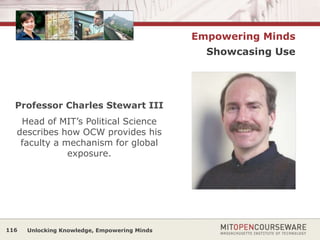
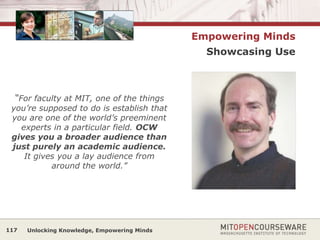
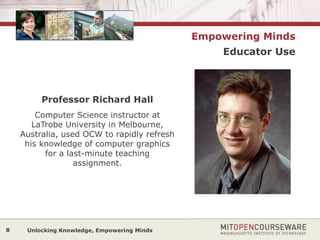
Professor Richard Hall
Computer Science instructor at
LaTrobe University in Melbourne,
Australia, used OCW to rapidly refresh
his knowledge of computer graphics
for a last-minute teaching
assignment.
9 Unlocking Knowledge, Empowering Minds
Empowering Minds
Educator Use
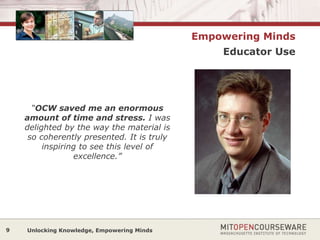
“OCW saved me an enormous
amount of time and stress. I was
delighted by the way the material is
so coherently presented. It is truly
inspiring to see this level of
excellence.”
10 Unlocking Knowledge, Empowering Minds
Full Case Study - NOT FOR PROJECTION
Experiencing the ‘Western’ approach
Kian Wah Liew, secondary school math teacher in Kuala Lampur, Malaysia
A secondary school mathematics teacher in Kuala Lumpur, Malaysia, Kian Wah Liew introduces his 18-year-old students to a range of complex
concepts, such as matrices, determinants, and differential equations. Though his lessons are conducted in Mandarin, the students use an English
textbook — which tends to make Liew’s life more complicated, since his students possess a wide range of abilities in both English and
mathematics.
Liew, who discovered MIT OpenCourseWare several years ago while searching the Internet for self-study resources in math and physics,
sometimes uses MIT OCW video lectures to supplement his teaching. Because the topics are difficult, and the students’ grasp of spoken English
imperfect, Liew finds that he often has to narrate the videos as they play.
“Since a few lectures in the introductory level courses on OCW are similar to our syllabi, and because I like the way the lecturers conduct their
lessons,” Liew explains, “I sometimes use the lectures in the classroom. I let the students watch a lecture — for example, the 18.03 Differential
Equations video — accompanied by my own explanations.”
Liew readily admits that the MIT OCW video lectures are sometimes too difficult for his students to fully grasp. But at the very least, he believes,
the lectures introduce students to another approach to education. “OCW provides a chance for the students, who never learned in an English-
speaking environment, to get an idea of how it would be when studying abroad,” he explains. In addition, Liew sometimes steers his most gifted
students to other courses on the site to supplement their education. For example, he recently introduced a talented student to Course 18.06 –
Linear Algebra.
The students are not the only beneficiaries. Liew, whose own education took place in Malaysia and Taiwan (a bachelor’s of science in mathematics
in Taiwan, and a master’s of science in statistics in Malaysia), also appreciates MIT OCW because it allows him to experience a Western approach
to teaching: “The Western style spends more time on ‘ideas’ than ‘examples.’ Here, we spend 20 percent of the time introducing ideas and 80
percent in demonstrating these ideas through examples. At MIT, most of the time is spent on clarifying the ideas, and very few examples are
given during the lectures.”
Liew has only limited freedom to change his teaching approach, due to the tight syllabus-related constraints that he must work within. Even so,
he says, OCW has been a very important resource to him: “The impact on my mind,” he concludes, “has been great.”
15
Empowering Minds
Educator Use
11 Unlocking Knowledge, Empowering Minds
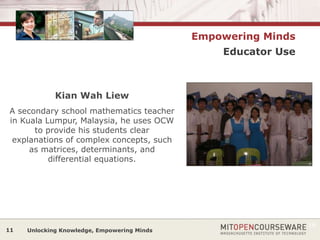
Kian Wah Liew
A secondary school mathematics teacher
in Kuala Lumpur, Malaysia, he uses OCW
to provide his students clear
explanations of complex concepts, such
as matrices, determinants, and
differential equations.
16
Empowering Minds
Educator Use
12 Unlocking Knowledge, Empowering Minds
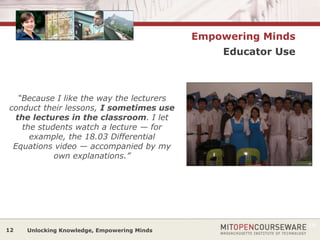
“Because I like the way the lecturers
conduct their lessons, I sometimes use
the lectures in the classroom. I let
the students watch a lecture — for
example, the 18.03 Differential
Equations video — accompanied by my
own explanations.”
16
Empowering Minds
Educator Use
13 Unlocking Knowledge, Empowering Minds
Full Case Study - NOT FOR PROJECTION
Filling the management void - Ludmila Matiash, educator and management consultant in Kiev, Ukraine
More than 15 years after the Soviet economic system dissolved, management professionals and educators in Ukraine are defining a new paradigm for
business. Ludmila Matiash and her colleagues at the Internet project Management: Methodology and Practice are addressing the need for resource
materials on management education and organizational transformation in Ukraine.
“Universities can’t respond fast enough to the needs of businesses here. Educators are redesigning their curricula but teaching methods take longer to
change,” Matiash explained. “As management consultants we were experimenting with ways to improve our training and found OpenCourseWare. We
were inspired by the philosophy of the approach and the strategic implications. So we began to introduce the concept of open knowledge to Ukrainian
institutions."
The legacy of the Soviet university system left a void in business education. “Business management is a new phenomenon in Ukraine — a completely
different mentality. This calls for new skills and new thinking,” Matiash said. “We started Management.com.ua because our business clients needed these
materials. Soon we realized that the Web site is a change tool. We get to define what modern business management in Ukraine should be like.”
Management.com.ua serves as a learning community in the Ukrainian, Russian, and English languages, offering Internet forum discussions on such topics
as leadership and authority, quality issues, and motivating employees, to name a few. “We think we can form interesting discussion groups around the
use of OCW materials,” Matiash said. “If the process is moderated well, this would add value to different audiences.”
For example, the preparatory questions and materials from MIT OCW's Course 15.269: Literature, Ethics, and Authority are helpful training and
pedagogical tools. “Business leaders here are experimenting with the guiding principles of decision-making and leadership,” Matiash said. “If we include
examples from Ukrainian literature and historical experience we make the discussions relevant and more meaningful.”
Management.com.ua already offered users an Internet glossary of management and business terms in translated Ukrainian before MIT OCW, but now,
with the help of MIT materials and other sources, Matiash and her colleagues have upgraded the dictionary to be more interdisciplinary. “We're adding
entries which define key principles of organizational development, including concepts from [MIT faculty] Peter Senge and Stephen Covey,” she explained.
Born in the United States after her parents emigrated from Ukraine, Matiash first went to Ukraine in 1992 with the Peace Corps. She later worked for the
World Bank and served with Management.com.ua in Kyiv for six years.
15
Empowering Minds
Educator Use
14 Unlocking Knowledge, Empowering Minds
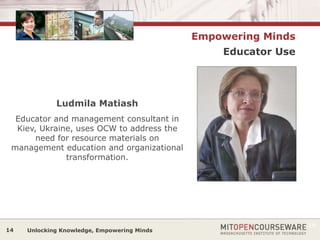
Ludmila Matiash
Educator and management consultant in
Kiev, Ukraine, uses OCW to address the
need for resource materials on
management education and organizational
transformation.
16
Empowering Minds
Educator Use
15 Unlocking Knowledge, Empowering Minds
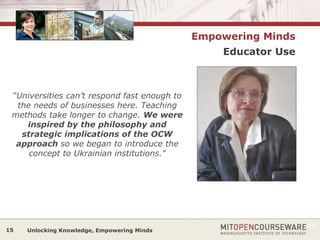
“Universities can’t respond fast enough to
the needs of businesses here. Teaching
methods take longer to change. We were
inspired by the philosophy and
strategic implications of the OCW
approach so we began to introduce the
concept to Ukrainian institutions."
16
Empowering Minds
Educator Use
16 Unlocking Knowledge, Empowering Minds
Full Case Study - NOT FOR PROJECTION
Teaching teachers in Guatemala
Waleska Aldana Segura, educator at the University of San Carlos
For more than 300 years, since its establishment in 1676, the University of San Carlos has served as the center of higher education in Guatemala.
In the past half century, it has also been a place where alternative opinions can be voiced, and new realities envisioned.
But the institution also has limitations, many related to its age and relative isolation. Waleska Aldana Segura, a professor of physics at San Carlos,
runs up against these limitations in the thermodynamics class she offers for physics instructors. “When you try to teach certain subjects and you
don’t have labs, or equipment, or any kind of visualization,” she explains, “the students end up lacking the expertise necessary for their future
success as physics professors.”
Segura therefore found herself looking for resources to supplement her teaching. Her first Internet explorations led her to the International Center
for Theoretical Physics E-journal service in 2001, and the Los Alamos National Laboratory Web site, but these resources often proved too highly
specialized for her students’ needs.
Then, three years ago, she discovered MIT’s OpenCourseWare initiative through a Google search — and the effects of that discovery have been
transformative. In Segura’s thermodynamics class, for example, the students regularly use simulations from MIT courses to explore complex
physical phenomena. For the first time, Segura’s students can actually see what’s happening, even without access to a high-tech laboratory. This
past semester, Segura also used the syllabus and exams from MIT OCW’s Course 3.00 – Thermodynamics of Materials and Course 3.205 –
Thermodynamics and Kinetics of Materials for her own thermodynamics class. Some of Segura’s indigenous students balk at using course
materials in English; in these cases, Universia’s Spanish language resources have provided a crucial alternative.
Segura is also involved in a long-term initiative to implement a faculty of education at the University of San Carlos — and in this context, too, MIT
OCW is proving an invaluable resource. Guatemala’s mountainous terrain makes travel arduous — and underscores the potential importance of
online communication. Segura hopes to implement a site similar to MIT OCW at the University of San Carlos, to allow students from all over
Guatemala to access the university without the difficulty and expense of daily travel. This concept has the potential to transform education in
Guatemala — and according to Segura, MIT OCW is an important inspiration as the program moves forward. “The fact that MIT provides these
materials, from so far away, without cost,” she says, “is simply extraordinary.”
15
Empowering Minds
Educator Use
17 Unlocking Knowledge, Empowering Minds
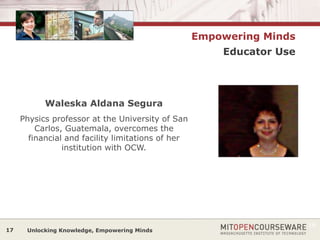
Waleska Aldana Segura
Physics professor at the University of San
Carlos, Guatemala, overcomes the
financial and facility limitations of her
institution with OCW.
16
Empowering Minds
Educator Use
18 Unlocking Knowledge, Empowering Minds
“When you try to teach certain subjects
and you don’t have labs, or equipment, or
any kind of visualization, students end up
lacking the expertise necessary for their
future success. That MIT provides these
materials, from so far away, without
cost is simply extraordinary.”
16
Empowering Minds
Educator Use
19 Unlocking Knowledge, Empowering Minds
Full Case Study - NOT FOR PROJECTION
Recovering precious minutes of class time
Hemalatha Thiagarajan, National Institute of Technology in Tiruchirappalli, India
Hemalatha Thiagarajan first discovered MIT’s OpenCourseWare Web site several years ago during an Internet search for materials
on artificial intelligence. A professor of mathematics and computer science at the National Institute of Technology Tiruchirappalli, in
Tamil Nadu, India, Thiagarajan was dissatisfied with the traditional textbook on artificial intelligence, and was hoping to find
materials to supplement her lectures.
The MIT OCW materials she found for Course 6.825 – Techniques in Artificial Intelligence were just what she was looking for, and
she quickly adapted several PowerPoint presentations and lectures to fit her syllabus. To her surprise, however the materials didn’t
just improve the content of her lectures; they also allowed her to cover more material in the same number of classes. “I used to
spend a lot of class time drawing the pictures on the board,” Thiagarajan confesses. “In data structures, for example, I need to
show a lot of pictures of data trees and structures, and I had to draw all of them. Here, with the click of a button, I can show them
something which has been very neatly and very beautifully done.”
Initially, Thiagarajan notes, the students were not entirely happy with her new approach. “For the first month,” she recalls, with
evident amusement, “many of them felt that the course was moving too fast. Obviously, when I have to write everything on the
board, I go more slowly, so they get a lot of time to follow the whole thing. When I use the slides, everything moves more quickly.”
In the end, though, Thiagarajan received rave reviews from her students — both on the amount of material she was able to cover,
and the quality of the MIT materials.
Thiagarajan also has found that MIT OCW is a valuable resource for students who would benefit from a deeper look at a particular
topic. In her own teaching, Thiagarajan is constrained by a rigid university syllabus. So when a topic emerges in class that she
cannot spend enough time on, she is quick to steer her students to MIT OCW. “I’ve told my students that some of the OCW courses
would be very, very useful for them. Things like, for example, database management, or microprocessors. I can’t cover these
topics fully enough, but they’re important to the students. And when the students do follow up, and look at the material, they find
it very useful.”
15
Empowering Minds
Educator Use
20 Unlocking Knowledge, Empowering Minds
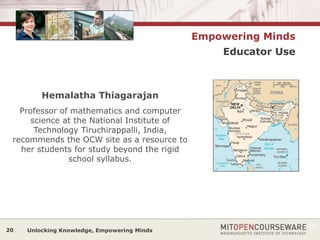
Hemalatha Thiagarajan
Professor of mathematics and computer
science at the National Institute of
Technology Tiruchirappalli, India,
recommends the OCW site as a resource to
her students for study beyond the rigid
school syllabus.
16
Empowering Minds
Educator Use
21 Unlocking Knowledge, Empowering Minds
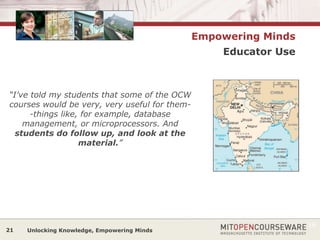
“I’ve told my students that some of the OCW
courses would be very, very useful for them-
-things like, for example, database
management, or microprocessors. And
students do follow up, and look at the
material.”
16
Empowering Minds
Educator Use
22 Unlocking Knowledge, Empowering Minds
Full Case Study - NOT FOR PROJECTION
Points of access in the developing world
François Viruly, University of the Witwatersrand in South Africa
As director of Viruly Consulting — a leading South African real estate analysis firm — property economist François Viruly has
acquired extensive experience in the South African commercial real estate market over the past decade. Viruly is passionate about
his field, and makes an effort to share his expertise with students at the University of the Witwatersrand in Johannesburg, as well
as the University of Cape Town and the University of Pretoria.
One of Viruly’s regular courses is a property investment module for graduate students at the University of the Witwatersrand.
When Viruly first began teaching the module several years ago, he chose as his textbook Commercial Real Estate Analysis &
Investments, a graduate-level real estate text written by MIT Professor David Geltner. As Viruly began to design the module as a
complement to the text, he came across MIT’s OpenCourseWare, and was excited to discover that the author himself had already
structured a course, Course 11.431J – Real Estate Finance and Investment, to fit the text. Viruly readily adapted a similar structure
to fit his module.
“OCW is just a great system,” declares Viruly. “It opens up knowledge across the world, which I think is critical. And it allows
universities like ours—and I think this is important by itself—to benchmark our teaching. It gives us confidence that we’re in close
contact with the international body of knowledge, and international standards. In addition, it assures the students that they are
receiving high-quality instruction. What it really means to them is that we are following a course and a methodology which is of the
highest caliber.”
Asked if real estate instruction can really follow the same model in countries as different as the United States and South Africa,
Viruly admits that there are some crucial distinctions. “Obviously, some of the course material is focused on the United States,” he
agrees. “We have specific issues in a developing country, and so we complement the OCW materials with South African material,
and substitute different assignments. Nevertheless, I think the OCW model is especially important in developing cultures. It can
make such a difference to students here to have access to the best professors in the world.”
15
Empowering Minds
Educator Use
23 Unlocking Knowledge, Empowering Minds
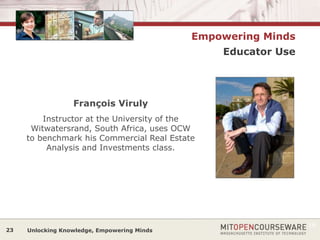
François Viruly
Instructor at the University of the
Witwatersrand, South Africa, uses OCW
to benchmark his Commercial Real Estate
Analysis and Investments class.
16
Empowering Minds
Educator Use
24 Unlocking Knowledge, Empowering Minds
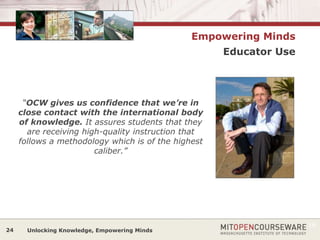
“OCW gives us confidence that we’re in
close contact with the international body
of knowledge. It assures students that they
are receiving high-quality instruction that
follows a methodology which is of the highest
caliber.”
16
Empowering Minds
Educator Use
25 Unlocking Knowledge, Empowering Minds
Full Case Study - NOT FOR PROJECTION
Why reinvent the wheel?
James Wixson, product development instructor at the University of Idaho
When the University of Idaho asked James Wixson to design a new course on product development, the assignment struck Wixson
as somewhat daunting.
The subject matter was not the problem. Wixson — an advisory engineer in systems engineering at the Idaho National
Laboratories, and affiliate instructor for the University of Idaho — had extensive experience in product development. In fact, his
MBA thesis detailed techniques for improving new product development through value engineering. But Wixson had designed
courses from scratch before, and he knew from experience how arduous and time-consuming the process could be. “I learned the
hard way,” Wixson chuckles. “The last course took such a long time… So I thought this time, I’ll do a little research, and find out
what other people are doing out there.”
Wixson’s research led him to MIT’s Course 15.783J – Product Design and Development on the OpenCourseWare Web site, and he
was immediately impressed by both the content and format of the material. “I was looking specifically for courses in product
development,” he explains, “to see what texts that they were using, and get an idea of the syllabi, and see how they taught the
course. I had run across some other courses out there in product development, but this really stood out. This was such a complete,
complex course, and they had a good syllabus — so I decided I’d just basically use it, with some minor modifications.” These
modifications included additional content on value engineering and systems engineering, reflecting Wixson’s own interests and
background.
Wixson worked closely with MIT OCW staff to adapt the MIT course content for the University of Idaho. The resulting site, housed
on Wixson’s university Web page, looks remarkably like the original MIT OCW page — but with added lines of magenta text that
reflect Wixson’s content modifications. The collaboration has resulted in a course that is deep, rigorous, and tested.
The most surprising part, for Wixson, was that MIT’s materials were available free of charge. “I couldn’t possibly have paid for this
curriculum — it would have been prohibitive,“ notes Wixson. “So it certainly helped me out, to have this course, rather than
starting from zero.”
15
Empowering Minds
Educator Use
26 Unlocking Knowledge, Empowering Minds
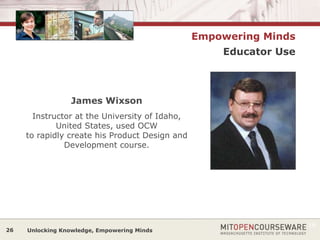
James Wixson
Instructor at the University of Idaho,
United States, used OCW
to rapidly create his Product Design and
Development course.
16
Empowering Minds
Educator Use
27 Unlocking Knowledge, Empowering Minds
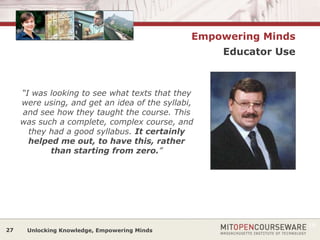
“I was looking to see what texts that they
were using, and get an idea of the syllabi,
and see how they taught the course. This
was such a complete, complex course, and
they had a good syllabus. It certainly
helped me out, to have this, rather
than starting from zero.”
16
Empowering Minds
Educator Use
28 Unlocking Knowledge, Empowering Minds
Full Case Study - NOT FOR PROJECTION
Unexpected opportunities
Zhang Wenhua, Mudanjiang Medical College in Heilongjiang, China
When Zhang Wenhua first visited MIT’s OpenCourseWare online, he was hoping to find resources that would help him teach
electrical technology to his students at Mudanjiang Medical College, in the Heilongjiang Province of China.
Zhang was not disappointed.
In fact, the MIT OCW materials on electrical technology transformed both the content of his courses and his approach to teaching.
But to his delight, Zhang also found resources that helped his own research on motor control — a topic that had fascinated him for
years.
Zhang first heard about MIT OCW in early 2004, through a program on Chinese national television. At the time, a limited amount of
higher education information was available from Chinese universities, but Zhang was immediately intrigued by the possibility of
getting additional material from MIT. He did an Internet search, and easily located the MIT OCW Web site.
“I teach the students electrical technology,” Zhang explains, “including information on circuitry, and the basic principles of
transformers and motors. On OCW, I found information on this subject that was very helpful. And in addition, I was able to find
courses on motor control — microprocessors, and control theory. This is something I’m really interested in, and I wanted to do
some big research, some application, try to put the technology of motor control in practice. MIT’s OCW gave me the resources to
do this work.”
Zhang was also profoundly influenced by the pedagogical approach of MIT’s professors. “When I first visited OCW,” Zhang noted, “I
watched several clips of demonstrations in electromagnetics and other subjects. I was amazed by the fact that the professors at
MIT do quite a lot of experiments. They provide us with clips, short movies, about these experiments. I realized, watching these
clips, that these experiments help the students to better understand the theory. This has changed my method of teaching. Since
then, I have been trying to provide the students with more demonstrations, and to ask them to do their own experiments more
carefully to understand the theory.”
15
Empowering Minds
Educator Use
29 Unlocking Knowledge, Empowering Minds
18
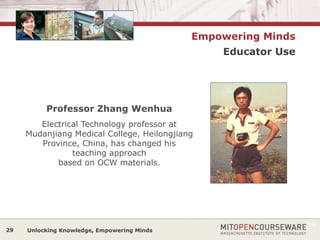
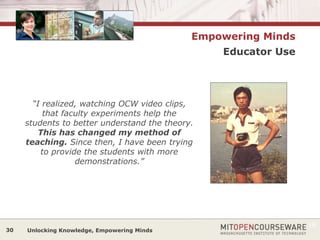
Professor Zhang Wenhua
Electrical Technology professor at
Mudanjiang Medical College, Heilongjiang
Province, China, has changed his
teaching approach
based on OCW materials.
Empowering Minds
Educator Use
30 Unlocking Knowledge, Empowering Minds
18
“I realized, watching OCW video clips,
that faculty experiments help the
students to better understand the theory.
This has changed my method of
teaching. Since then, I have been trying
to provide the students with more
demonstrations.”
Empowering Minds
Educator Use
31 Unlocking Knowledge, Empowering Minds
Full Case Study - NOT FOR PROJECTION
‘INSPIRING’
John Navarra, Monsignor Donovan High School, New Jersey
Full case study unavailable.
Empowering Minds
Educator Use
32 Unlocking Knowledge, Empowering Minds
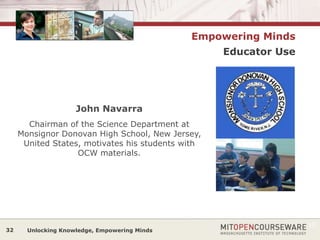
John Navarra
Chairman of the Science Department at
Monsignor Donovan High School, New Jersey,
United States, motivates his students with
OCW materials.
10
Empowering Minds
Educator Use
33 Unlocking Knowledge, Empowering Minds
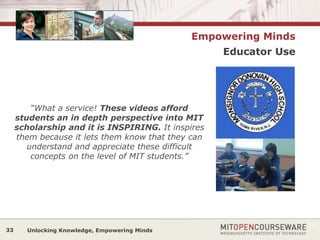
“What a service! These videos afford
students an in depth perspective into MIT
scholarship and it is INSPIRING. It inspires
them because it lets them know that they can
understand and appreciate these difficult
concepts on the level of MIT students.”
10
Empowering Minds
Educator Use
34 Unlocking Knowledge, Empowering Minds
Full Case Study - NOT FOR PROJECTION
‘It really does motivate them.’
Shirley Harrell, Assistant Professor, School of Management, Cambridge College, Cambridge MA
Shirley Harrell, an assistant professor in the School of Management at Cambridge College in Cambridge, MA, speaks with pride of the educational
environment of her institution. As an open-enrollment school, she explains, Cambridge has "a gate at the end, not the beginning," and welcomes
students from a wide range of backgrounds, experiences, and abilities.
This range requires a delicate balancing of student needs and academic standards — a challenge that Harrell is mindful of as she designs the four
management courses that she teaches at Cambridge each year. According to Harrell, this challenge was more than a little daunting when she first
began teaching. "When you come through a graduate program," she explains, "they don't really teach you to teach. There's no course that says,
'This is how you construct a graduate course in organizational theory and behavior.'”
A crucial reference tool
So when Harrell first heard about MIT OpenCourseWare on a CNN feature in 2004, she was quick to visit the site. Almost immediately, OCW became
a crucial reference tool for her, both for curriculum design and as a benchmark. Harrell describes OCW as a "gold standard" against which she can
assess her course materials, and also track the success of her students. "I look at grading policies, reading lists, writing requirements, assignments,
attendance policies, and assessment," she says. "For me, it's an important way to ensure the quality of my courses.”
OCW has been especially important in her assessment of individual students' contributions to teams. "I ran into a real difficulty with teamwork,"
Harrell notes. "In MIT's Organizational Processes course, they've developed rubrics whereby team members can give feedback on other team
members, and the instructors can then use that as a way to gauge grading for the course. These rubrics really changed how I thought about
assessment.”
Imposing high standards
The process of adapting MIT materials for her students can sometimes be challenging, as Harrell readily admits — but the improvement in her
students' work has more than justified that investment. And OCW can also be a motivating touchstone for the students, as Harrell explains: "The
students are very focused on the quality of the education they're getting here. They want reassurance that an open-enrollment school like this can
impose high standards. So sometimes I'll point out to them, very deliberately, 'These are the readings from MIT. This is comparable to what they're
doing at the Sloan School.' And it really does motivate them."
Empowering Minds
Educator Use
35 Unlocking Knowledge, Empowering Minds
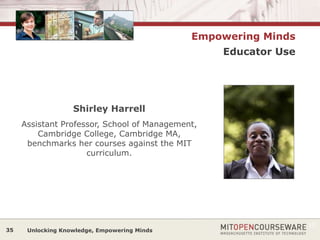
Shirley Harrell
Assistant Professor, School of Management,
Cambridge College, Cambridge MA,
benchmarks her courses against the MIT
curriculum.
10
Empowering Minds
Educator Use
36 Unlocking Knowledge, Empowering Minds
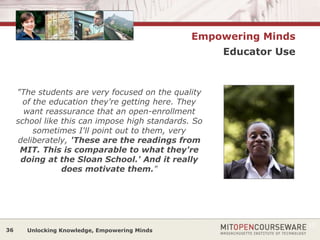
"The students are very focused on the quality
of the education they're getting here. They
want reassurance that an open-enrollment
school like this can impose high standards. So
sometimes I'll point out to them, very
deliberately, 'These are the readings from
MIT. This is comparable to what they're
doing at the Sloan School.' And it really
does motivate them."
10
Empowering Minds
Educator Use
37 Unlocking Knowledge, Empowering Minds
“OCW motivates my students and gives them
access to a wider knowledge base."
— Educator, India
Educators
Students
Self learners
MIT Community
Donors & Supporters
38 Unlocking Knowledge, Empowering Minds
Empowering Minds
Student Use
Full Case Study - NOT FOR PROJECTION
‘Students need to know about this’
Kunle Adejumo, student at Ahmadu Bello Universit
in Zaria Nigeria
Kunle Adejumo is finishing up his fourth year of engineering studies at Ahmadu Bello University in Zaria, Nigeria. By all rights, he should
now be in his fifth and final year, but local strikes and instability in Nigeria have added almost a full year to his studies at Ahmadu Bello.
Established in 1952, Ahmadu Bello is Nigeria’s largest university, with 35,000 students. Though the university boasts a large and well-
maintained physical infrastructure, its Internet access — like that of almost all Nigerian universities — is extremely limited. Even the
computer lab does not have a Web connection. And because of the large number of students and the limited number of terminals,
students can sign up for only 20 minutes each week on university computers.
When Adejumo was first introduced to MIT’s OpenCourseWare through a CD-ROM in the university computer lab, therefore, he had only 20
minutes to look through the material. Immediately impressed with the content, he asked the computer lab for a copy of the CD; when
they were unable to give him one, Adejumo decided to find the site on his own, and copied down the Web address. From his home
computer, he has enjoyed regular access to MIT OCW, and has used it to complement the course materials he has gotten through Ahmadu
Bello.
“For example, last semester, I had a course in metallurgical engineering,” offers Adejumo. “For one of the lectures, having to do with ion
making, I didn’t have notes, and I couldn’t find the information I needed, so I went to OCW. I was able to download a course outline on
this, and also some review questions. I actually took these to the university and gave them to the lecturer to answer. He was able to
answer these questions, and helped me gain a deeper understanding of the material.”
As much as Adejumo has benefited from MIT OCW, it worries him that this resource is not available to the vast majority of students in
Nigeria. “You see,” he explains, “in this part of the world, only the rich can afford Internet access. Probably only 500 students at Ahmadu
Bello have an Internet connection. In my own case, I visit about four times a week. But most cannot do this.”
For this reason, Adejumo hopes eventually to work with the local radio station to broadcast MIT OCW course material, as well as publicize
the site. “I run the Web site for a local radio station,” he says, “and they are interested in broadcasting educational programs. OCW would
be the perfect fit… And in the process, more students will learn about the site. Students need to know that these things are available.”
39 Unlocking Knowledge, Empowering Minds
Empowering Minds
Student Use
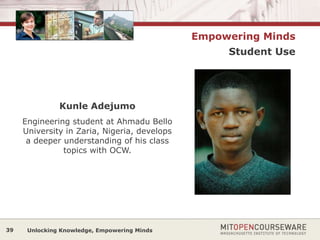
Kunle Adejumo
Engineering student at Ahmadu Bello
University in Zaria, Nigeria, develops
a deeper understanding of his class
topics with OCW.
40 Unlocking Knowledge, Empowering Minds
Empowering Minds
Student Use
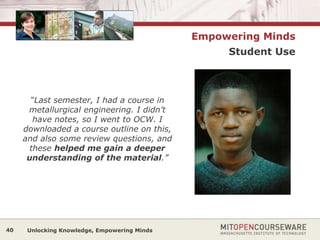
“Last semester, I had a course in
metallurgical engineering. I didn’t
have notes, so I went to OCW. I
downloaded a course outline on this,
and also some review questions, and
these helped me gain a deeper
understanding of the material.”
41 Unlocking Knowledge, Empowering Minds
Full Case Study - NOT FOR PROJECTION
From diving to ‘surfing’
Rogelio Morales, PhD candidate at Central University of Venezuela
A metallurgical engineering graduate of the Central University of Venezuela, Rogelio Morales has some unusual entries on his resume. For one
thing, he is a licensed commercial diver, and once worked as a professional diver for eight months with Titan Maritime, and as the trainer for
commercial Diving with the Divers Institute of Technology, in Seattle, Washington.
Morales loved his underwater work, but quickly decided that he was more interested in underwater inspection than in commercial diving. This led
him back home, to a master’s program at Central University of Venezuela in non-destructive testing. “It’s a less-invasive method of testing,”
Morales explains. “You don’t have to destroy something to see if it is warped. You can use different methods, like X-rays, testing magnetic
particles, and ultrasonic. It fits in well with my background in metallurgical engineering.”
Morales first encountered MIT’s OpenCourseWare when he was looking on the Internet for information on stereoscopic vision, which has
enormous potential for divers encountering turbid water conditions. Morales was able to find helpful information on MIT OCW, especially in Course
9.537 – Special Topics in Vision Science. The projects for Course 13.017 – Design of Ocean Systems I, also provided Morales with a wealth of new
and useful concepts.
Morales acknowledges that some of the same ideas he has found on MIT OCW are probably also available in the Central University library, in
books or journals. “But with books,” he argues, “it’s much harder to find this information in a timely fashion. And with OCW, you also know that
it’s new information.”
Morales has been quick to share information about MIT OCW with other students — and professors — in his program. “I often download
information from the Web site in different topics,” he explains, “and give it to a professor in my faculty. Sometimes we discuss the information,
other times they use the slides from the site in class. It’s a great resource.”
Morales also feels that MIT OCW has a broader potential in Venezuela. “Not everybody in Venezuela has the opportunity to go to college,” he
points out. “It’s really hard to get into university, so OCW is a great option. For example, there’s a program here called New Neighborhood. They
use OCW to download information for poor people on technology, or humanities, or other areas. This has allowed a lot of people to access this
information who might otherwise have been unable to do so. OCW has enormous potential for our country.”
15
Empowering Minds
Student Use
42 Unlocking Knowledge, Empowering Minds
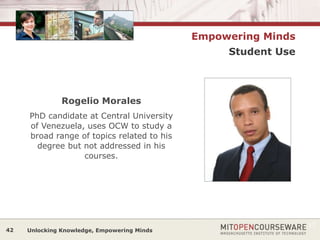
Rogelio Morales
PhD candidate at Central University
of Venezuela, uses OCW to study a
broad range of topics related to his
degree but not addressed in his
courses.
17
Empowering Minds
Student Use
43 Unlocking Knowledge, Empowering Minds
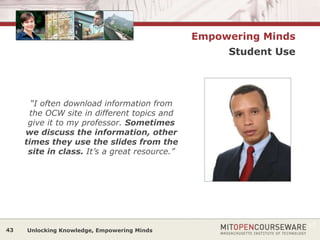
“I often download information from
the OCW site in different topics and
give it to my professor. Sometimes
we discuss the information, other
times they use the slides from the
site in class. It’s a great resource.”
17
Empowering Minds
Student Use
44 Unlocking Knowledge, Empowering Minds
Full Case Study - NOT FOR PROJECTION
Teaching fundamentals… and hope
Margaret Adams, doctoral student at UNC-Charlotte
A first-year doctoral student in mathematics curriculum and instruction at the University of North Carolina at Charlotte, Margaret
Adams hopes eventually to use her degree to help public school systems modify their math curricula to better prepare low-
performing students for secondary and post-secondary educational opportunities.
As a student of education, Adams is a staunch believer in the potential of the Internet to help students of all levels and
backgrounds achieve educational success outside of the traditional classroom. It is a success she has experienced first-hand: for
example, Adams’ use of Gilbert Strang’s Course 18.06 – Linear Algebra on MIT’s OpenCourseWare has helped her develop a better
grasp of the subject than classroom work alone.
“I’m not really a math major, but rather somebody who wants to get a background in math,” she explains. “The extra supplements
on the Internet have really helped me develop the foundation that I need to be successful in this subject.”
Adams is keenly aware that it is not simply placing information online that creates impact. Different teaching styles can have an
enormous effect on a student’s understanding — and enjoyment — of difficult concepts. As an example, Adams again cites Dr.
Strang’s course. “I think his down-to-earth approach is what makes the difference,” Adams explains. “He explains things on a very
basic level, and gives wonderful examples. He’ll set the stage for what’s about to come… for me it’s almost like reading a novel. It
holds my attention, unlike most math books, which generally are very cut-and-dried. It’s different from the traditional lecture
format that I receive at the university.”
In addition to helping her grasp the fundamentals of linear algebra, Adams adds, Strang’s teaching has had a larger impact on her
education. Adams describes Strang’s course as giving her hope.
“If that Web site were not there,” she explains, “I think a lot of people would give up in their current courses, and maybe even give
up in the whole field of mathematics — just like typical middle and high school students do. But he makes it so that people can
start to learn, and enjoy math, and be successful overall. He gives people hope.”
15
Empowering Minds
Student Use
45 Unlocking Knowledge, Empowering Minds
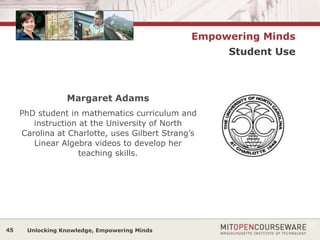
Margaret Adams
PhD student in mathematics curriculum and
instruction at the University of North
Carolina at Charlotte, uses Gilbert Strang’s
Linear Algebra videos to develop her
teaching skills.
17
Empowering Minds
Student Use
46 Unlocking Knowledge, Empowering Minds
“He explains things on a very basic level,
and gives wonderful examples. He’ll set the
stage for what’s about to come… for me it’s
almost like reading a novel. It’s different
from the traditional lecture format.”
17
Empowering Minds
Student Use
47 Unlocking Knowledge, Empowering Minds
Full Case Study - NOT FOR PROJECTION
Setting a standard
Saud Khan, student at Mohammad Ali Jinnah University in Pakistan
Saud Khan, currently in the final year of a Masters program in Telecommunications Engineering at Mohammad Ali Jinnah University
in Pakistan, has been using the resources of MIT’s OpenCourseWare for several years now. Khan, who is specializing in digital
signal processing and adaptive filters, is about to begin a thesis on adaptive beam-forming, a process that has applications in
radar, speech, and acoustic signal processing, and which distinguishes between the spatial properties of signal and noise.
Khan was first introduced to MIT OCW by Dr. Shoaib Ahmed Khan, one of his professors during his undergraduate study at the
National University of Sciences and Technology. Dr. Khan, formerly a visiting professor at the University of Massachusetts, knew of
Khan’s interest in digital communications, and suggested that he look over MIT OCW’s offerings on the subject.
Khan found the site incredibly useful, especially as a supplement to his existing courses. At the time, he was taking a difficult
course on electromagnetics, and the lecture notes he found on MIT OCW (including Course 6.013 – Electromagnetics and
Applications) helped him gain a better understanding of the material. “I found that there was a lot of difference in the courses on
OCW,” Khan elaborates. “They were very comprehensive, and very precise. There was a level of detail I hadn’t experienced in my
own courses.”
Khan has also found the materials on MIT OCW helpful because of the high cost of textbooks in Pakistan. “Technical books,” he
explains, “especially from authors in the U.S. and Britain, are financially impossible for me to afford. OCW has been an important
alternate source of information.”
More recently, MIT OCW has been helping Khan with his thesis work. “Mathematics are quite exceptional at MIT, and a strong
background in mathematics really matters for thesis work. I have found OCW really helpful as I prepare to write my thesis.” MIT
OCW also allows Khan to benchmark his own education against one of the top engineering schools in the world. “MIT is a dream
university,” says Khan simply. “Most people won’t have the chance to be admitted, due to academic deficiencies or other reasons.
But OCW gives people an idea of what it is to be at MIT. And if you do want to try to go to MIT, you can go to the OCW site first
and experience the level of mathematics or physics taught at MIT. It sets a standard.”
15
Empowering Minds
Student Use
48 Unlocking Knowledge, Empowering Minds
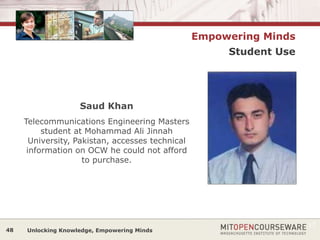
Saud Khan
Telecommunications Engineering Masters
student at Mohammad Ali Jinnah
University, Pakistan, accesses technical
information on OCW he could not afford
to purchase.
17
Empowering Minds
Student Use
49 Unlocking Knowledge, Empowering Minds
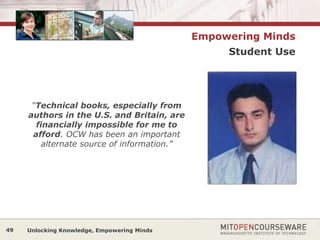
“Technical books, especially from
authors in the U.S. and Britain, are
financially impossible for me to
afford. OCW has been an important
alternate source of information.”
17
Empowering Minds
Student Use
50 Unlocking Knowledge, Empowering Minds
Full Case Study - NOT FOR PROJECTION
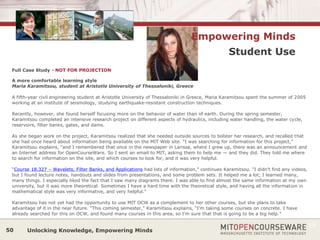
A more comfortable learning style
Maria Karamitsou, student at Aristotle University of Thessaloniki, Greece
A fifth-year civil engineering student at Aristotle University of Thessaloniki in Greece, Maria Karamitsou spent the summer of 2005
working at an institute of seismology, studying earthquake-resistant construction techniques.
Recently, however, she found herself focusing more on the behavior of water than of earth. During the spring semester,
Karamitsou completed an intensive research project on different aspects of hydraulics, including water handling, the water cycle,
reservoirs, filter banks, gates, and dams.
As she began work on the project, Karamitsou realized that she needed outside sources to bolster her research, and recalled that
she had once heard about information being available on the MIT Web site. “I was searching for information for this project,”
Karamitsou explains, “and I remembered that once in the newspaper in Larissa, where I grew up, there was an announcement and
an Internet address for OpenCourseWare. So I sent an email to MIT, asking them to help me — and they did. They told me where
to search for information on the site, and which courses to look for, and it was very helpful.
“Course 18.327 – Wavelets, Filter Banks, and Applications had lots of information,” continues Karamitsou. “I didn’t find any videos,
but I found lecture notes, handouts and slides from presentations, and some problem sets. It helped me a lot; I learned many,
many things. I especially liked the fact that I saw many diagrams there. I was able to find almost the same information at my own
university, but it was more theoretical. Sometimes I have a hard time with the theoretical style, and having all the information in
mathematical style was very informative, and very helpful.”
Karamitsou has not yet had the opportunity to use MIT OCW as a complement to her other courses, but she plans to take
advantage of it in the near future. “This coming semester,” Karamitsou explains, “I’m taking some courses on concrete. I have
already searched for this on OCW, and found many courses in this area, so I’m sure that that is going to be a big help.”
15
Empowering Minds
Student Use
51 Unlocking Knowledge, Empowering Minds
19
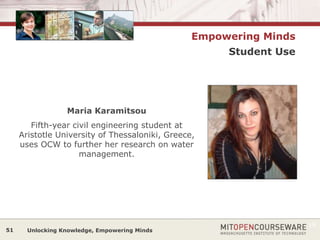
Maria Karamitsou
Fifth-year civil engineering student at
Aristotle University of Thessaloniki, Greece,
uses OCW to further her research on water
management.
Empowering Minds
Student Use
52 Unlocking Knowledge, Empowering Minds
19
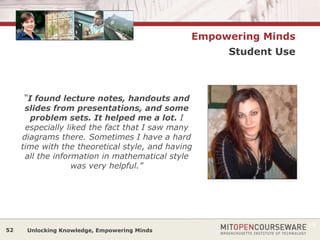
“I found lecture notes, handouts and
slides from presentations, and some
problem sets. It helped me a lot. I
especially liked the fact that I saw many
diagrams there. Sometimes I have a hard
time with the theoretical style, and having
all the information in mathematical style
was very helpful.”
Empowering Minds
Student Use
53 Unlocking Knowledge, Empowering Minds
Full Case Study - NOT FOR PROJECTION
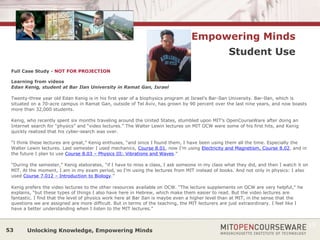
Learning from videos
Edan Kenig, student at Bar Ilan University in Ramat Gan, Israel
Twenty-three year old Edan Kenig is in his first year of a biophysics program at Israel’s Bar-Ilan University. Bar-Ilan, which is
situated on a 70-acre campus in Ramat Gan, outside of Tel Aviv, has grown by 90 percent over the last nine years, and now boasts
more than 32,000 students.
Kenig, who recently spent six months traveling around the United States, stumbled upon MIT’s OpenCourseWare after doing an
Internet search for “physics” and “video lectures.” The Walter Lewin lectures on MIT OCW were some of his first hits, and Kenig
quickly realized that his cyber-search was over.
“I think these lectures are great,” Kenig enthuses, “and since I found them, I have been using them all the time. Especially the
Walter Lewin lectures. Last semester I used mechanics, Course 8.01, now I’m using Electricity and Magnetism, Course 8.02, and in
the future I plan to use Course 8.03 – Physics III: Vibrations and Waves.”
“During the semester,” Kenig elaborates, “if I have to miss a class, I ask someone in my class what they did, and then I watch it on
MIT. At the moment, I am in my exam period, so I’m using the lectures from MIT instead of books. And not only in physics: I also
used Course 7.012 – Introduction to Biology.”
Kenig prefers the video lectures to the other resources available on OCW. “The lecture supplements on OCW are very helpful,” he
explains, “but these types of things I also have here in Hebrew, which make them easier to read. But the video lectures are
fantastic. I find that the level of physics work here at Bar Ilan is maybe even a higher level than at MIT, in the sense that the
questions we are assigned are more difficult. But in terms of the teaching, the MIT lecturers are just extraordinary. I feel like I
have a better understanding when I listen to the MIT lectures.”
15
Empowering Minds
Student Use
54 Unlocking Knowledge, Empowering Minds
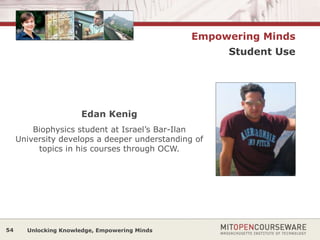
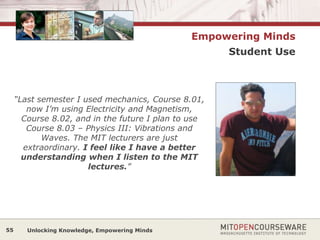
Edan Kenig
Biophysics student at Israel’s Bar-Ilan
University develops a deeper understanding of
topics in his courses through OCW.
Empowering Minds
Student Use
55 Unlocking Knowledge, Empowering Minds
“Last semester I used mechanics, Course 8.01,
now I’m using Electricity and Magnetism,
Course 8.02, and in the future I plan to use
Course 8.03 – Physics III: Vibrations and
Waves. The MIT lecturers are just
extraordinary. I feel like I have a better
understanding when I listen to the MIT
lectures.”
Empowering Minds
Student Use
56 Unlocking Knowledge, Empowering Minds
Full Case Study - NOT FOR PROJECTION
Revisiting an old favorite
Peteris Krumins, student at the University of Latvia in Riga
A 20-year-old physics major at the University of Latvia in Riga, Peteris Krumins chose to pursue physics in college because, he says, he’s “really
interested in how things work in nature.” It is an interest he also indulged in high school at the Riga English Grammar School, where he took (and
excelled at) a course in physics in 10th grade.
Krumins first came across MIT’s OpenCourseWare during this formative period. “I was really interested in video lectures in high school,” Krumins
explains, “and I was Googling around, and I came across OCW. I opened it up, and searched for video lectures, and there they were, in different
categories like physics, and mathematics, and even the English language. They were pretty cool!”
Krumins was preparing for his high school physics exam at the time, so he watched the entire set of Walter Lewin’s video lectures of Course 8.01
– Physics I to help him improve his skills. It worked: he admits, when pressed, that he did very well on his high school physics exam. Encouraged
by this success, Krumins decided to watch Gilbert Strang’s lectures on Linear Algebra, as well. These lectures were harder for him to grasp, as he
had not been exposed to the material in high school. But he still enjoyed them… and years later, when taking linear algebra at the University of
Latvia, Krumins returned to the video lectures to give them another try.
Krumins has also revisited the Lewin lectures while at the University of Latvia. “The very first term,” he explains, “we had a mechanics course in
our university which followed MIT’s Course 8.01 pretty closely. It was really great: I listened to the lectures at our university, and then I went
home, opened up the media player, and watched the lecture again. It had really great demonstrations, some of which we had in our course, and
some of which we didn’t. It was also great to get more familiar with the terms in English.”
On several occasions, Lewin’s demonstrations have helped clarify topics that Krumins had been struggling with. “I think every student has
difficulty understanding subjects like torque and angular momentum,” Krumins explains, “and the examples in Walter Lewin’s lectures really made
these easier to understand. On torque, for example, he did a very clear demonstration with the wheel that showed that if he turned the wheel to
the left, the motion will be in the opposite direction if he stands on a rotating wheel.”
Krumins admits, happily, that he has barely scratched the surface of what MIT OCW has to offer him. “We have electricity and magnetism next
year,” he says. “OCW offers this course, as well, and I look forward to watching it.”
Empowering Minds
Student Use
57 Unlocking Knowledge, Empowering Minds
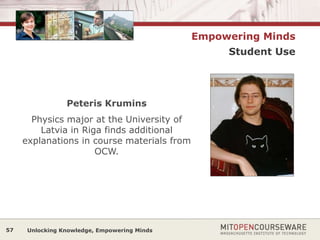
Peteris Krumins
Physics major at the University of
Latvia in Riga finds additional
explanations in course materials from
OCW.
Empowering Minds
Student Use
58 Unlocking Knowledge, Empowering Minds
“We had a mechanics course in our
university that followed MIT’s Course 8.01
pretty closely. It was great — I listened to
the lectures at our university, and then
went home and watched the MIT lecture. It
helped me understand some of the
difficult concepts, and to get familiar
with the English terms.”
Empowering Minds
Student Use
59 Unlocking Knowledge, Empowering Minds
Full Case Study - NOT FOR PROJECTION
Tales out of class
Alan Ryan, PhD candidate at the University of Ireland in Galway
Currently working on his Ph.D. in information technology at the University of Ireland at Galway, graduate student Alan Ryan has spent the last
several months working on background material for his thesis, which deals with fault tolerance at the virtual machine level of the Java software
program.
Ryan’s Ph.D. program includes an extended period of research and a dissertation, but no formal class work. So while Ryan has had frequent and
intensive meetings with his supervisor on his thesis topic, he has had little opportunity to attend lectures on core subjects. Because of this, he has
occasionally struggled to find clear explanations for complex mathematical concepts.
One day, in passing, a fellow student recommended that Ryan take a look at MIT’s OpenCourseWare. Although Ryan was intrigued by what he
saw there, he initially gave the Web site little more than a cursory glance. Several weeks later, though — in the midst of his literature review —
he found himself stuck on the concept of differential equations. He returned to MIT OCW, and was excited to find a reference to several lectures
on the subject by MIT Professors Arthur Mattuck and Gilbert Strang. He immediately watched the Course 18.03 – Differential Equations video
lectures on his computer, and was stunned by the professors’ ability to explain, in only 45 minutes, material that he had been struggling with for
weeks.
“Just like that, my problem was solved,” Ryan says. “Apart from getting me out of a tight spot, this has changed my whole outlook. I had always
intended to pursue math to a post-graduate level, but felt a little intimidated by it. If the difficult stuff can be explained this clearly, maybe it
won't be as difficult as I had imagined.”
Ryan has also appreciated the convenience of having the lectures at his fingertips. “This is really easy to use at my own pace,” Ryan comments. “I
can watch the lectures, pause to reference items as I need, and replay the tricky stuff. The level was just right, too. They made very fair
assumptions about prerequisite knowledge, erring on the side of caution, if anything.”
Ryan plans to continue to use the site over the coming year, as he completes his dissertation. “I certainly intend to watch the entire video series
of quite a few modules,” Ryan adds. “And I plan to share the information, as well. I've already shown a friend of mine the material, and I have
another few people in mind whom I know will appreciate the resource.”
Empowering Minds
Student Use
60 Unlocking Knowledge, Empowering Minds
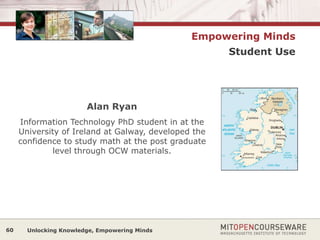
Alan Ryan
Information Technology PhD student in at the
University of Ireland at Galway, developed the
confidence to study math at the post graduate
level through OCW materials.
Empowering Minds
Student Use
61 Unlocking Knowledge, Empowering Minds
“This has changed my whole outlook. I had
always intended to pursue
math at a post-graduate level, but felt a little
intimidated by it. If the
difficult stuff can be explained this clearly,
maybe it won't be as difficult
as I had imagined.”
Empowering Minds
Student Use
62 Unlocking Knowledge, Empowering Minds
Full Case Study - NOT FOR PROJECTION
‘I feel more like a physicist’
Justin Song, student at Imperial College of London
Nineteen-year-old Justin Song is embarking on his second year of physics at Imperial College London. Malaysian by background,
Song’s family is based in Singapore, and the Singapore government is paying for his education in London.
Song, who heard about MIT’s OpenCourseWare early in his studies, regularly visits MIT OCW as part of his study routines.
Sometimes, MIT OCW helps Song fill in information that was not covered in one of his Imperial College classes. For example, Song
felt that his first-year electricity and magnetism course did not fully explain the phenomenon of electromagnetic waves, so he went
to the MIT OCW Web site — specifically, to MIT Professor Walter Lewin’s video lecture covering resonance, electromagnetic waves,
and speed of light from Course 8.02 – Electricity and Magnetism — and found additional information on the topic.
More often, though, the lectures offer another perspective on material already covered by Song’s professors, helping to solidify his
understanding of core concepts.
Lewin’s lectures from Courses 8.01, 8.02, and 8.03 have quickly become favorites of Song’s, and in his opinion, were a central part
of his first-year physics experience. In fact, he credits these lectures with changing his whole outlook on education. “After my
exposure to Professor Lewin,” Song explains, “I don't study my notes as much anymore. I take a blank piece of paper and try to
answer a fundamental question or problem. If I can't, I put it to a friend. When that breaks down, we turn to books or to someone
more able. His lectures have made me understand that it’s not knowledge alone that’s important, it's how you are able to use it.”
The lectures, Song adds, have also made him more trusting of his own abilities. “Lewin’s lectures never fail to leave me in awe of
physics. As a result, I feel more like a physicist, and that makes me feel more confident.”
The MIT OCW web site has also had a profound effect on Song’s study habits. “One thing MIT OCW has made me do,” he explains,
“is study constantly. Maybe study is the wrong word. I would say it’s become easier to inquire constantly.”
Empowering Minds
Student Use
63 Unlocking Knowledge, Empowering Minds
Justin Song
Physics student at Imperial College London, has
altered his approach to learning based on his
experiences with OCW materials.
Empowering Minds
Student Use
64 Unlocking Knowledge, Empowering Minds
“One thing MIT OCW has made me do is study
constantly. Maybe study is the wrong word. I
would say it’s become easier to enquire
constantly. I don't study my notes as much
anymore. I take a blank piece of paper and
try to answer a fundamental question or
problem.”
Empowering Minds
Student Use
65 Unlocking Knowledge, Empowering Minds
Full Case Study - NOT FOR PROJECTION
‘It's a great opportunity for students to become extraordinary engineers.’
Juan Eduardo Leal Lara, engineering student at Tecnológico de Monterrey
In 1998 Juan Eduardo Leal Lara's father, an industrial electronics engineer, was selected by the National Polytechnic Institute of Mexico to
establish a mechatronics program for Mexican universities. When he told his then eight-year-old son about this combination of mechanical
engineering, electronic engineering, and computer engineering, Lara's interest was immediate. "I wanted to learn more," says Lara, "and I asked
my father to teach me about engineering.”
Lara's father bought him a set of K'NEX® from the local Radio Shack® and they set to work building robots, and learning the workings of motors,
batteries, and resistors. When he was 12, Lara began to study calculus, linear algebra, classical mechanics, and learned mechanical drawing using
AutoCAD®.
His father worked hard to foster his enthusiasm for learning, and as Lara grew older, he knew he would make a career of engineering. But he
learned another important lesson from his father: he should do all he could to inspire learning in others.
Stumbling across a resource
In March 2005, Lara began searching for a university mechatronics program and stumbled across MIT OpenCourseWare. He spent hours reading
and exploring the site, making connections between what he already knew and what he still had to learn. "I have been using OCW regularly since
that day because I find it useful to get ideas for my projects," says Lara. "It helps me learn more from my courses.”
Building on a resource
As a student at the Tecnológico de Monterrey, Campus Monterrey, Lara has joined with Sergio Sedas, who received a Ph.D. from Carnegie Mellon
University, to create a program for first-year students through the High Performance Engineering Association (HPEA), which provides workshops
and other project-based opportunities for students to practice what they're learning. The HPEA is working with the Entrepreneurship Program of
the University so students can develop their projects and ultimately create businesses around them.
Lara says the most fundamental concept of HPEA is built on the MIT philosophy of learning by doing. He's based all of the HPEA material on MIT
course materials from OCW: 6.002 Circuits and Electronics, 6.003 Signals and Systems, 8.01 Classical Mechanics, 18.02 Multivariable Calculus ,
and others. "I have found OCW very helpful," says Lara, "and I think it's a great opportunity for students to become extraordinary engineers."
Empowering Minds
Student Use
66 Unlocking Knowledge, Empowering Minds
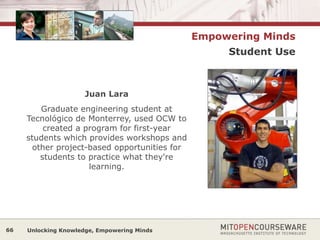
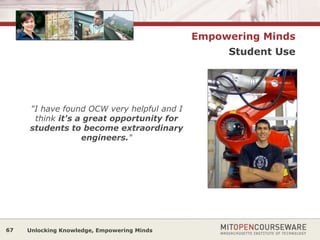
Juan Lara
Graduate engineering student at
Tecnológico de Monterrey, used OCW to
created a program for first-year
students which provides workshops and
other project-based opportunities for
students to practice what they're
learning.
Empowering Minds
Student Use
67 Unlocking Knowledge, Empowering Minds
"I have found OCW very helpful and I
think it's a great opportunity for
students to become extraordinary
engineers."
Empowering Minds
Student Use
68 Unlocking Knowledge, Empowering Minds
Full Case Study - NOT FOR PROJECTION
‘I can handle this!’
Ali Sheikh, high school AP physics student
When Ali Sheikh was studying for the AP Physics exam, his teacher directed him to MIT OpenCourseWare for additional help. "There are a lot of
sites out there for taking classes online or studying. But OCW was comprehensive. Not just a couple of exercises, or one or two videos. It had all
of those things and described the theory behind the concepts.”
A confidence boost
That focus on the theory behind the concepts is a particularly important one to Sheikh, a second-year electrical engineering student at Penn State.
"Courses like [Walter Lewin's] Electricity and Magnetism gave me a confidence boost. I always knew I wanted be in applied math or science in
college. When I watched those videos and realized I could follow along with the content in an MIT course... I thought, 'I can handle this!'”
Now that he's in college, Sheikh's use of OCW has shifted into other areas than physics, to courses such as Gil Strang's Linear Algebra, and for
help with electives like biology.
Sheikh believes students focus too much on grades and just getting through the next test. "People don't realize that when you understand the
theory, those good grades will come naturally.”
Logic and methodology
After he completes his degree, Sheikh's next stop is law school. That might seem a surprising choice after engineering school, but Sheikh says it
makes perfect sense. "Engineering and law are all about logic. There's a methodology to each; they're philosophical. OCW helped me understand
that in the first place."
Empowering Minds
Student Use
69 Unlocking Knowledge, Empowering Minds
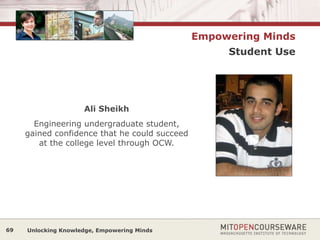
Ali Sheikh
Engineering undergraduate student,
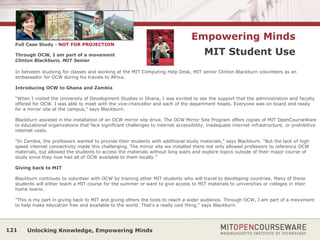
gained confidence that he could succeed
at the college level through OCW.
Empowering Minds
Student Use
70 Unlocking Knowledge, Empowering Minds
"Courses like [Walter Lewin's] Electricity
and Magnetism gave me a confidence
boost. I always knew I wanted be in
applied math or science in college.
When I watched those videos and
realized I could follow along with
the content in an MIT course... I
thought, 'I can handle this!'”
Empowering Minds
Student Use
71 Unlocking Knowledge, Empowering Minds
“The future of our global village looks bright to me
when I see this knowledge opened to one and all.”
— Self learner, United States
Educators
Students
Self learners
MIT Community
Donors & Supporters
72 Unlocking Knowledge, Empowering Minds
Empowering Minds
Self Learner Use
Full Case Study - NOT FOR PROJECTION
‘I went to your site – boom’
Bill Humes, Patuxent River Naval Air Station in Maryland
Full case study unavailable.
73 Unlocking Knowledge, Empowering Minds
Empowering Minds
Self Learner Use
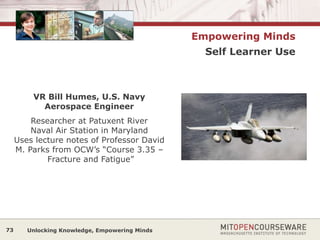
VR Bill Humes, U.S. Navy
Aerospace Engineer
Researcher at Patuxent River
Naval Air Station in Maryland
Uses lecture notes of Professor David
M. Parks from OCW’s “Course 3.35 –
Fracture and Fatigue”
74 Unlocking Knowledge, Empowering Minds
Empowering Minds
Self Learner Use
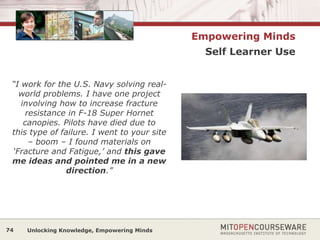
“I work for the U.S. Navy solving real-
world problems. I have one project
involving how to increase fracture
resistance in F-18 Super Hornet
canopies. Pilots have died due to
this type of failure. I went to your site
– boom – I found materials on
‘Fracture and Fatigue,’ and this gave
me ideas and pointed me in a new
direction.”
75 Unlocking Knowledge, Empowering Minds
Full Case Study - NOT FOR PROJECTION
‘An intellectual gem
Captain Kevin Gannon, Southwest Regional Maintenance Center, U.S. Navy
Based at the San Diego Naval Station, the Southwest Regional Maintenance Center (SWRMC) provides maintenance support and maintenance training to
more than 50 surface ships, aircraft carriers, and submarines of the U.S. Navy and Coast Guard. This is a weighty responsibility for Captain Kevin Gannon,
Commander of the SWRMC — as is the complement of roughly 3,000 sailors and civilians under his command.
Captain Gannon, who describes himself as a “lifelong learner,” holds an undergraduate degree from Tulane University in mathematics, an MS in
Mechanical Engineering from the Naval Postgraduate School in Monterey, and an MS in Systems Engineering from University of Virginia. But he is quick to
point out that his education is not confined to formal schooling; in each of his positions in the Navy, Gannon has worked to keep abreast of new
developments in his fields of expertise.
Gannon describes his main responsibilities at SWRMC as overseeing lots of industrial processes (anything from fixing a pump to overhauling a gun) — and
he is constantly looking for ways to streamline these processes. This quest led him to MIT’s OpenCourseWare several years ago, while browsing for
information on lean manufacturing.
“Lean is a tool that industry has been using for the last couple of years,” explains Gannon, “focusing on process improvement, and minimizing waste. I
was looking generically for lean information, and stumbled across OCW. I was really impressed. This site is a true intellectual gem. They have a couple of
lean classes in the engineering section, such as Course ESD.60 – Lean/Six Sigma Processes, that were very useful.”
MIT OCW has also proved helpful in other areas of Gannon’s job. For example: leadership training for the sailors under his command is one of his major
concerns. So, soon after discovering the MIT OCW Web site, Gannon browsed through the MIT Sloan School courses on OCW to see if any of these
courses could be helpful. “The Leading Organizations course [Course 15.322] has turned me on to all sorts of useful references,” Gannon says. “We’ve
used a bunch of books mentioned in the syllabus. And the lecture notes are also an important tool. They include documents on the problems and
prospects of a changing organizational world, and models of organizational change. We’ve used these for our discussion and our teaching here.”
“OCW has definitely accelerated our ability to train,” Gannon continues. “As far as I’m concerned, these courses are already tried-and-true. They’ve
worked with a high-performing group. They’re a nicely bundled package, and they’re free. How can you beat that?”
Empowering Minds
Self Learner Use
76 Unlocking Knowledge, Empowering Minds
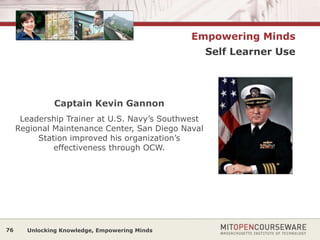
Captain Kevin Gannon
Leadership Trainer at U.S. Navy’s Southwest
Regional Maintenance Center, San Diego Naval
Station improved his organization’s
effectiveness through OCW.
Empowering Minds
Self Learner Use
77 Unlocking Knowledge, Empowering Minds
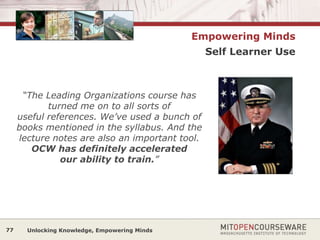
“The Leading Organizations course has
turned me on to all sorts of
useful references. We’ve used a bunch of
books mentioned in the syllabus. And the
lecture notes are also an important tool.
OCW has definitely accelerated
our ability to train.”
Empowering Minds
Self Learner Use
78 Unlocking Knowledge, Empowering Minds
Full Case Study - NOT FOR PROJECTION
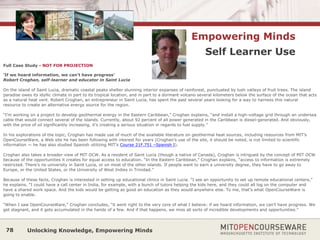
‘If we hoard information, we can’t have progress’
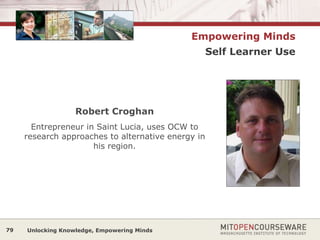
Robert Croghan, self-learner and educator in Saint Lucia
On the island of Saint Lucia, dramatic coastal peaks shelter stunning interior expanses of rainforest, punctuated by lush valleys of fruit trees. The island
paradise owes its idyllic climate in part to its tropical location, and in part to a dormant volcano several kilometers below the surface of the ocean that acts
as a natural heat vent. Robert Croghan, an entrepreneur in Saint Lucia, has spent the past several years looking for a way to harness this natural
resource to create an alternative energy source for the region.
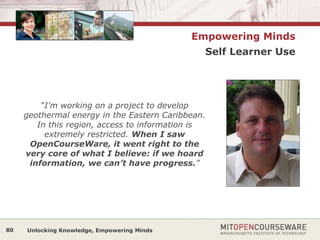
“I’m working on a project to develop geothermal energy in the Eastern Caribbean,” Croghan explains, “and install a high-voltage grid through an undersea
cable that would connect several of the islands. Currently, about 92 percent of all power generated in the Caribbean is diesel-generated. And obviously,
with the price of oil significantly increasing, it’s creating a serious situation in regards to fuel supply.”
In his explorations of the topic, Croghan has made use of much of the available literature on geothermal heat sources, including resources from MIT’s
OpenCourseWare, a Web site he has been following with interest for years (Croghan’s use of the site, it should be noted, is not limited to scientific
information — he has also studied Spanish utilizing MIT’s Course 21F.751 –Spanish I).
Croghan also takes a broader view of MIT OCW. As a resident of Saint Lucia (though a native of Canada), Croghan is intrigued by the concept of MIT OCW
because of the opportunities it creates for equal access to education. “In the Eastern Caribbean,” Croghan explains, “access to information is extremely
restricted. There’s no university in Saint Lucia, or on most of the other islands. If people want to earn a university degree, they have to go away to
Europe, or the United States, or the University of West Indies in Trinidad.”
Because of these facts, Croghan is interested in setting up educational clinics in Saint Lucia. “I see an opportunity to set up remote educational centers,”
he explains. “I could have a call center in India, for example, with a bunch of tutors helping the kids here, and they could all log on the computer and
have a shared work space. And the kids would be getting as good an education as they would anywhere else. To me, that’s what OpenCourseWare is
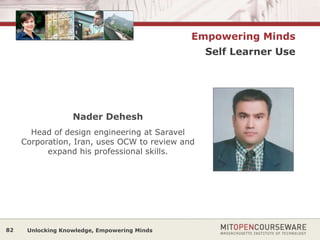
going to enable.
“When I saw OpenCourseWare,” Croghan concludes, “it went right to the very core of what I believe: if we hoard information, we can’t have progress. We
get stagnant, and it gets accumulated in the hands of a few. And if that happens, we miss all sorts of incredible developments and opportunities.”
Empowering Minds
Self Learner Use
79 Unlocking Knowledge, Empowering Minds
Robert Croghan
Entrepreneur in Saint Lucia, uses OCW to
research approaches to alternative energy in
his region.
Empowering Minds
Self Learner Use
80 Unlocking Knowledge, Empowering Minds
“I’m working on a project to develop
geothermal energy in the Eastern Caribbean.
In this region, access to information is
extremely restricted. When I saw
OpenCourseWare, it went right to the
very core of what I believe: if we hoard
information, we can’t have progress.”
Empowering Minds
Self Learner Use
81 Unlocking Knowledge, Empowering Minds
Full Case Study - NOT FOR PROJECTION
Debunking myths
Nader Dehesh, self-learner at the Saravel Corporation in Iran
Nader Dehesh, head of design engineering at Saravel Corporation — a prominent air conditioner manufacturer in Iran — has firsthand experience with the
U.S. educational system. He received an undergraduate degree in physics from Allegheny College in Pennsylvania, a second undergraduate degree in
mechanical engineering from the University of Pittsburgh, and a master’s degree in metallurgical engineering from the same institution.
Since his return to Iran in 1994 to join Saravel Corporation — a family-owned business that had been taken over by the government after the 1979
Iranian Revolution, and returned to the family in 1994 — Dehesh has stayed in touch with engineering schools in the U.S. via the Internet. It is a hobby
that allows him to keep abreast of new developments and review the basics in his field. And among the sites that he visits regularly is MIT
OpenCourseWare.
“My primary incentive in visiting OCW is to read up on things I have already learned,” explains Dehesh, “but which I have had to put aside due to the
managerial aspects of my work, which often pull me away from the technical side. Through OCW, I can refresh fundamentals, as well as explore new
courses on design and manufacturing.
“Unfortunately,” Dehesh continues, “living in Iran can be somewhat limiting due to the speed of the Internet and long download times.” When Dehesh first
visited OCW, he tried to download Professor John Leinhard’s textbook from Course 2.51 –Intermediate Heat and Mass Transfer, but he was unable to do
so due to the size of the file. In the end, he had to ask a friend in the U.S. to download the file and burn it on a CD for him. “I think videotaped lectures by
professors may be the best route for Third World nations which do not have high speed Internet connections,” Dehesh adds.
Despite these technological drawbacks, MIT OCW has been an important gateway for Dehesh, allowing him to keep up to date with new developments in
his field. “I think OCW is a wonderful tool and can serve practicing engineers all over the world,” he says.
MIT OCW has also made the Institute more real to Dehesh, clearing up some long-held misconceptions about MIT. “Prior to my inquiry on OCW, I had a
notion of MIT as an assembly line of self-operating, whiz-kid automatons,” Dehesh explains. “The introductory remarks for Course 2.737 – Mechatronics,
debunked that notion. The students are instructed on when to attend the lab and the procedures they should follow, and even the fine for non-return of
the equipment! I realized that pedagogy is the driving force, rather than experimental investigation; that instructions are needed for the gifted students
as well as the ordinary ones. This certainly was myth-breaking for me!”
Empowering Minds
Self Learner Use
82 Unlocking Knowledge, Empowering Minds
Nader Dehesh
Head of design engineering at Saravel
Corporation, Iran, uses OCW to review and
expand his professional skills.
Empowering Minds
Self Learner Use
83 Unlocking Knowledge, Empowering Minds
“I read up on things I have already learned,
but which I have had to put aside due to the
managerial aspects of my work. Through
OCW, I can refresh fundamentals, as well
as explore new courses on design and
manufacturing.”
Empowering Minds
Self Learner Use
84 Unlocking Knowledge, Empowering Minds
Full Case Study - NOT FOR PROJECTION
Grounded in learning by doing and building
Malcolm Douglas, self-learner at Telstra in Australia
With the exception of a brief detour into management in the late 1980s, Malcolm Douglas has spent most of his career as an
engineer in the wireless and radio transmission field. For the last four years, Douglas has worked in the information technology
department of Telstra — a large telecommunications firm in Australia — designing and supervising the installation of Internet
protocol networks and server farms.
But Douglas also defines the term “lifelong learner.” He holds a bachelor’s degree in Communications Engineering from the Royal
Melbourne Institute of Technology, as well as a postgraduate diploma in accountancy from Deakin University. He has achieved
Cisco certification through the Cisco Academy, and has taken Microsoft Windows and Sun Solaris 9 courses to keep him up to date
in his field. In addition, he regularly trolls through the research pages of top engineering institutions — such as MIT, Stanford,
Berkeley, and UCLA — to keep abreast of current trends.
From MIT’s OpenCourseWare, Douglas has downloaded syllabi and lecture notes for many of the courses in the computer
engineering section (including Courses 6.111, 6.823, 6.826, and 6.828). Douglas credits the detailed syllabi with creating the
necessary structure and focus to allow him to systematically work through a broad subject and absorb the key concepts. Douglas
also finds the references in the course notes very helpful, and often uses them to locate classic papers or publications that he had
not previously encountered, opening new areas of inquiry.
In Douglas’ opinion, the MIT courses offer an unusual blend of theory and practice. “I have found that MIT has an almost unique
way of looking at the learning and teaching experience,” Douglas explains. “It is theoretically advanced, but grounded in learning
by doing and building.”
“Many courses at other institutions offer the same old textbooks and materials that very rarely change,” Douglas continues. “In
fact, I often wonder how students learn to think! I am very impressed with the MIT approach, and it is also very refreshing for a
practicing engineer to learn this way, because this is how we continue to learn in the workplace.”
Empowering Minds
Self Learner Use
85 Unlocking Knowledge, Empowering Minds
Malcolm Douglas
Engineer, information technology department of
Telstra, Australia, finds a fresh approach to
independent learning on OCW.
Empowering Minds
Self Learner Use
86 Unlocking Knowledge, Empowering Minds
“MIT has an almost unique way of looking
at the learning and teaching experience. It
is theoretically advanced, but grounded in
learning by doing and building. It is very
refreshing for a practicing engineer to learn this
way, because this is how we continue to learn in
the workplace.”
Empowering Minds
Self Learner Use
87 Unlocking Knowledge, Empowering Minds
Full Case Study - NOT FOR PROJECTION
A diverse and comprehensive resource
Kushal Duneja, Operations Manager at CitiGroup in Bahrain
An operations manager for CitiGroup in Manama, Bahrain, Kushal Duneja has spent many years in the financial services field, working for Ernst & Young,
PricewaterhouseCoopers, and CDC Capital Partners as an auditor, investment analyst, and private equity analyst. Duneja — who grew up in India,
Tanzania, Zambia, and South Africa — holds degrees from the University of London, the University of Delhi, and the University of South Africa.
Duneja came across MIT OpenCourseWare several years ago while surfing the Internet for information on financial engineering. “It was sometime back,”
he recalls, “and I remember it was on my Blackberry, so it was really tiny… but when I started to scroll down, I was really excited. I thought to myself,
‘Wow, this is great, I’ve been looking for stuff like this!’ So I went back and looked at it on a full screen, and downloaded some courses.”
Duneja has found a wide range of useful materials, including information on real estate investing. In addition, somewhat to his surprise, he has found
Course 15.280 – Communications for Managers, to be a very helpful tool. “I haven’t done many of the hard skill courses,” Duneja explains. “But some of
the softer skill courses have been very helpful. ‘Communications for Managers’ is an excellent presentation of how managers can improve communication,
and how we tend to use our credibility instead of the subject matter when trying to sell ideas. It also had some very useful tips on preparing
presentations. That was something I could use and apply immediately.
“I thought this material was so helpful,” Duneja continues, “that I’ve also downloaded some of the stuff and shared it with my colleagues. Their feedback
was very positive — they really thought it was quite insightful.”
Duneja is not the only one in his family who has benefited from MIT OCW. “My wife actually discovered OCW without me ever mentioning it to her – it was
quite funny!” he explains. “One day I got home and she was looking at MIT’s Web site, and downloading stuff, and I said, ‘Hey, what are you doing, how
did you find this?’ She’s a lecturer in computer applications, and she found OCW on the Web, and started to use material from the site.”
Duneja is an experienced consumer of information on the Web, and — in his opinion — MIT OCW stands apart from other sites. “I think OCW certainly one
of the most diverse and comprehensive collection of courses on the net,” Duneja says. “I haven’t yet come across any other university site or public
institution site that provides that sort of information. You can get all the stats from the Federal Reserve and other places, but nothing as comprehensive
as what exists on MIT.”
Empowering Minds
Self Learner Use
88 Unlocking Knowledge, Empowering Minds
Kushal Duneja
Operations Manager for CitiGroup in Manama,
Bahrain, has expanded his professional skill
set using OCW.
Empowering Minds
Self Learner Use
89 Unlocking Knowledge, Empowering Minds
“Some of the softer skill courses have been
very helpful. ‘Communications for Managers’ is
an excellent presentation of how managers
can improve communication. It also had some
very useful tips on preparing presentations.
That was something I could use and apply
immediately.”
Empowering Minds
Self Learner Use
90 Unlocking Knowledge, Empowering Minds
Full Case Study - NOT FOR PROJECTION
Making the most of an interlude
Vikash Hurrydoss, self-learner in Mauritius
Vikash Hurrydoss recently completed a degree in software engineering from the University of Technology Mauritius. Though he wanted to
continue on for an MS or a Ph.D. immediately, three years of university study had cut deeply into his savings. So Hurrydoss decided
instead to take a position with a local software engineering firm. He plans to return to his education full-time in two to three years; in the
meantime, he has turned to MIT’s OpenCourseWare to keep abreast of new developments in his field — and also to explore new areas of
interest.
Hurrydoss, who first discovered MITOCW during his student years, is currently making his way through three MIT courses: Professor
Walter Lewin’s Course 8.01 – Physics I video lectures, Professor Gilbert Strang’s video lectures for Course 18.06 – Linear Algebra, and S.P.
Kothari’s Course 15.511 – Financial Accounting.
He generally begins his day with one of Lewin’s lectures: “I watch the Lewin classes in the morning,” Hurrydoss says, “just after I wake
up. My mind is quite fresh, you see, and I find it’s a good time to think really deeply.”
The courses allow Hurrydoss to pursue new interests, such as economics, and at the same time to plug some gaps in his education. “The
Strang class has been very helpful to me,” Hurrydoss explains, “because the mathematics in my own course of study was somewhat
insubstantial. There was much more focus on IT programming.” In addition, Hurrydoss feels that MIT OCW will help him determine the
direction of his future studies. “I want to return to school in the next several years,” Hurrydoss explains, “and I feel that OCW will allow
me to resume my studies without having fallen behind in any way. And OCW may also help me figure out what I will pursue when I
return.”
“OCW has all of the things I believe a true education system should provide,” Hurrydoss concludes. “An openness, and a sense of sharing.
Not just for the sake of money, or getting the certificate, but just for the sake of learning, of sharing knowledge. Of course you have
books, and libraries. But the fascinating thing about OCW, in my opinion, is that you have access to the work of professors who are doing
research in their areas that is quite new — and all this for free!”
Empowering Minds
Self Learner Use
91 Unlocking Knowledge, Empowering Minds
Vikash Hurrydoss
Software developer, Mauritius, uses OCW to keep
his academic skills sharp while he saves money
to attend graduate school.
Empowering Minds
Self Learner Use
92 Unlocking Knowledge, Empowering Minds
“I feel that OCW will allow me to resume
my studies without having fallen behind in
any way. And OCW may also help me figure out
what I will pursue when I return.”
Empowering Minds
Self Learner Use
93 Unlocking Knowledge, Empowering Minds
Full Case Study - NOT FOR PROJECTION
‘It’s important to human evolution’
Susan Rankin, British Columbia
Susan Rankin, an artist and educator who lives on idyllic Vancouver Island, is
grateful that she’s been able to create a profession around the things that matter most to her. “My interests are music, science, and children’s
education,” Rankin explains. “I put that all together into a presentation that I call ‘Suzee Science-Singer.’ I go into schools, libraries, and daycare
centers, and I sing songs about science. And then we play some games and do some art projects, all around various science concepts.”
Rankin, who is also in the process of designing and programming educational video games to complement her science programs, is a strong
proponent of making educational materials available to the widest possible audience. She herself uses materials from “all over the place,” and is
never sure where or when something she has learned will emerge in her work.
In her estimation, MIT’s OpenCourseWare, which she discovered several years ago through an article in the online edition of The New York Times,
will be useful to her over a long period of time, as she continues to develop her educational software and her musical lectures.
Rankin does not tend to use OCW to find specific information, but she explores the site frequently to find interesting topics. Currently, she is
working her way through a course on thermodynamics — a subject that does not have any immediate application to her lectures, but may well show
up there in the future. She has also downloaded a music program from Course 21M.113 – Developing Musical Structures, “to play around with,” as
she puts it.
“I was really excited when I heard about OCW,” Rankin explains, “because as far as I’m concerned, information is power. And to keep information
from people because they aren’t smart enough or rich enough to get it is antidemocratic.
“This is an especially important concept for rural areas,” Rankin continues. “In my case, the nearest library is about 30 miles away. It’s a very small,
rural library. I would probably have to wait several weeks to get any kind of book on an unusual topic… If I were even able to figure out which books
to get. So I think that this is just a phenomenal concept, and I hope that all the universities do this. I think it’s really important to human evolution.”
Empowering Minds
Self Learner Use
94 Unlocking Knowledge, Empowering Minds
Susan Rankin
Artist and educator, Vancouver Island, British
Columbia uses the site to access educational
information otherwise unavailable to her.
Empowering Minds
Self Learner Use
95 Unlocking Knowledge, Empowering Minds
“This is an especially important concept for
rural areas. In my case, the nearest library
is about 30 miles away. It’s a very small,
library. I would have to wait several weeks to
get any kind of book on an unusual topic”
Empowering Minds
Self Learner Use
96 Unlocking Knowledge, Empowering Minds
Full Case Study - NOT FOR PROJECTION
‘Something…that the girls might actually enjoy’
Amy Santee, homeschooling parent, United States
Homeschooling her daughters means that Amy Santee knows how to think outside the box. She takes them on field trips to places like Gettysburg Battlefield and the
Smithsonian Institution to make lessons more tangible and immediate, and finds a wide variety of outside activities for them like ballet and choir. Her freedom to step
outside the classroom keeps the lessons fresh and exciting. "I realize that not all learning is fun," says Santee. "But I strive to make as much as possible enjoyable
and educational at the same time.”
The real challenge, though, is science.
"They don't particularly like science," says Santee. "So I wanted to find something that would be worth a high school credit of lab science that the girls might actually
enjoy." A friend sent her to MIT OpenCourseWare's Highlights for High School. "Homeschoolers tend to have this unofficial emailing system. When we find something
that we like or that we think would be helpful to someone else, we email each other. It's not official, just passing information among friends.”
Improvising chemistry without a blowtorch
In Kitchen Chemistry, fundamental concepts of chemistry are explored in the kitchen. Students keep detailed journals of their findings as they learn about the "blue"
in blue cheese, find out why scone dough is never kneaded long, and observe what happens to sugar when it's heated with a blow torch. Santee and the girls were
loathe to buy a blowtorch, and liquid nitrogen can be surprisingly hard to come by. But they improvised with another ice cream recipe and put the crème brûlée under
the broiler.
"There was not much writing involved," says Santee, "so at the end of the year I had them choose any topic from the class and write a standard essay. Then they read
their reports out loud at our final class where the girls served their final 'experiments' of spaghetti and meatballs, and crème brûlée. I added a little party, an essay,
and a speech just to round out the class.”
Santee notes that Food Network's "Good Eats" made an excellent supplement to the course, and that the text recommended for this course, On Food and Cooking, The
Science and Lore of the Kitchen, was particularly good. "The information about the history of food and cooking was well placed to break up difficult chemistry
explanations.”
Balanced learning
"I find that adding these little things throughout the year helps balance out the time that I spent working our way through textbooks," says Santee. "I thought that
perhaps the girls would enjoy the cooking part of the class, if not the science. But they did enjoy it, and now they can apply what they learned in this class to other
cooking experiences."
Empowering Minds
Self Learner Use
97 Unlocking Knowledge, Empowering Minds
Amy Santee
Homeschooling parent in the US, uses OCW’s
‘Kitchen Chemistry’ course to add a little spice
to her daughters’ curriculum.
Empowering Minds
Self Learner Use
98 Unlocking Knowledge, Empowering Minds
“I wanted to find something that would be
worth a high school credit of lab science that
the girls might actually enjoy. I thought that
perhaps the girls would enjoy the cooking part
of the class, if not the science. But they did
enjoy it, and now they can apply what
they learned in this class to other cooking
experiences."
Empowering Minds
Self Learner Use
99 Unlocking Knowledge, Empowering Minds
Full Case Study - NOT FOR PROJECTION
‘To have access to such quality materials is fantastic’
Wendy Ermold, Physicist, University of Washington's Polar Science Center
Physicist Wendy Ermold's career in as a researcher at University of Washington's Polar Science Center has taken her places some would never
dream of going - at least not without a very heavy coat. She's lived and worked for two weeks at a camp on the frozen ocean 190 miles northeast of
Prudhoe Bay, Alaska. She traveled to the Chukchi Borderland in the Bering Sea with no prior seagoing experience (the team referred to her as a
"greenie"). Ermold's often traveling for weeks at a time, water sampling, filing protocols, preparing instruments, and performing other tasks
required in her direct-observation work.
A career like this requires constant learning. "I really, really love pure physics," says Ermold. "But sometimes I feel a little slow. I'm like the little
guy who wants to play football!" Ermold channels that enthusiasm into learning new concepts and ideas in her rare off hours. "I recently picked up a
book on string theory," she says. "I was having trouble working through it, so I decided I needed to really go back to basics and work my way up at
my own pace. Having the video lectures [on MIT OpenCourseWare] really helps make this possible.”
Even better than live
Ermold says watching Walter Lewin's 8.01 Classical Mechanics on OCW reminds her how fun it is to be in the classroom, but with a flexibility not
possible in a traditional classroom. "I can just watch and listen, then try to recreate everything in my own notebook," says Ermold. "Then I go back
to the video to see if I missed anything. Or I can pause it and see if I can work it out myself before Walter does it. But really, it's Walter himself that
makes it so fun. He's really entertaining.”
A self-guided pace
"What is so great about OCW," says Ermold, "is that it makes physics and math (and other subjects) available to the very interested and intelligent
people who can't go to school for one reason or another, or who can't handle the fast pace. It puts a previously untouchable subject within reach for
anyone who is interested. A lot of people crave good food for their brains, and to have access to such quality materials is fantastic!”
Ermold says she recently purchased an iPod® just so she could watch Walter Lewin's videos during her commute to and from work. "I’m planning to
watch Gilbert Strang teach mathematical methods next," she says. "A guy on the bus told me he was pretty good too. I'm looking forward to that."
Empowering Minds
Self Learner Use
100 Unlocking Knowledge, Empowering Minds
Wendy Ermold
Physicist, University of Washington's Polar
Science Center, learns from OCW in one of the
most remote locations imaginable.
Empowering Minds
Self Learner Use
101 Unlocking Knowledge, Empowering Minds
"What is so great about OCW, is that it makes
physics and math (and other subjects)
available to the very interested and intelligent
people who can't go to school for one reason or
another, or who can't handle the fast pace. It
puts a previously untouchable subject
within reach for anyone who is
interested."
Empowering Minds
Self Learner Use
102 Unlocking Knowledge, Empowering Minds
Full Case Study - NOT FOR PROJECTION
‘To have access to such quality materials is fantastic’
Jean-Ronel Noel and Alex Georges, Entrepreneurs, Cite Soleil, Haiti
Entrepreneurs Jean-Ronel Noel and Alex Georges are working to bring renewable energy to communities throughout Haiti. Through
their company, Enersa (enersahaiti.com) they planned to create solar panels to serve the needs of their country, but in their research
and development process, they required guidance in electrical engineering. Noel found the materials he needed on MIT
OpenCourseWare. “I was able to use the OpenCourseWare to learn the principles of integrated circuits. I found out that I could use
an existing integrated circuit to make things more efficient, and I wanted an explanation about how it worked. I was able to learn
this through the MIT OpenCourseWare.”
Enersa’s work has been supported by the non-profit Appropriate Infrastructure Development Group (AIDG). AIDG Executive Director
Peter Haas describes how Noel and Georges leveraged OCW to build a successful business. “I was immediately impressed by [Noel],
an engineer who taught himself the electrical engineering he was missing by using the free online engineering resources of MIT
OpenCourseWare,” said Haas. “Also, after seeing the dramatic bootstrapping JR and Alex had done in starting their business, it was
clear this team was different.” [www.aidg.org/incubation/enersa.htm]
Jean-Ronel Noel, a mechanical engineer by training, describes why OCW was his resource of choice: “It was much better than any
other information I found on the Internet, since the other sites were written by electronics experts who assumed that it would be
read by other experts. I didn't want to just copy the circuit without understanding it. MIT OpenCourseWare was different because it
explained things step by step. Using the OpenCourseWare saved us a lot of time and money.”
Through Enersa, OCW touches lives well beyond Noel’s and Georges’. Enersa employs 18 full-time solar technicians drawn from the
communities they serve, and Enersa’s products affect the daily lives of thousands of Haitians. Enersa produces residential and
commercial solar systems and solar chargers for smaller items such as cell phones and lamps, but their signature product is a solar
street lamp. In just two and a half years, they have installed more than 500 of these in 58 cities and remote villages in Haiti.
Enersa’s activities were briefly interrupted by the January 12, 2010 earthquake, but with an emergency loan from AIDG, they are
back to full operation.
Empowering Minds
Self Learner Use
103 Unlocking Knowledge, Empowering Minds
Jean-Ronel Noel and Alex Georges
Entrepreneurs, Cité Soleil, Haiti, used OCW to
develop solar-powered street lights for some of
Haiti’s poorest communities.
Empowering Minds
Self Learner Use
104 Unlocking Knowledge, Empowering Minds
“It was much better than any other information
I found on the Internet, since the other sites
were written by electronics experts who
assumed that it would be read by other
experts. I didn't want to just copy the circuit
without understanding it. MIT
OpenCourseWare was different because it
explained things step by step. Using the
OpenCourseWare saved us a lot of time
and money.”
Empowering Minds
Self Learner Use
105 Unlocking Knowledge, Empowering Minds
Full Case Study - NOT FOR PROJECTION
‘We could not have done it without OCW’
Megan Brewster, volunteer, Guatemala
When Megan Brewster, a recent Materials Sciences BS graduate of the University of Washington, arrived in Guatemala to begin
volunteer work for the non-profit Appropriate Infrastructure Development Group (AIDG), she immediately wished she’d brought her
old textbooks with her.
AIDG was trying to develop a small-scale plastics recycling program to address the problem of the disposable water bottles that
littered the Guatemalan countryside. With no budget for consultants or access to a library, Brewster found herself without the
information she needed to design the recycling protocol.
Initially, she turned to Wikipedia for an overview of the possible processes, but she needed information that was more in-depth and
developed by experts in the field. Then she remembered OCW. Through OCW, she was able to find the information on polymers,
casting and injection molding she needed to complete the protocol.
“I returned to OCW again and again for information on plastics, recycling technologies, water filtration, and more. The project was a
success, and we could not have done it without OCW,” says Brewster. After volunteering in Guatemala, Brewster came to MIT to
pursue graduate studies in materials science and engineering.
Empowering Minds
Self Learner Use
106 Unlocking Knowledge, Empowering Minds
Megan Brewster
Volunteer, Appropriate Infrastructure
Development Group (AIDG), Guatemala,
designed a small-scale locally appropriate
recycling protocol with OCW.
Empowering Minds
Self Learner Use
107 Unlocking Knowledge, Empowering Minds
“I returned to OCW again and again for
information on plastics, recycling
technologies, water filtration, and more.
The project was a success, and we
could not have done it without OCW.”
Empowering Minds
Self Learner Use
108 Unlocking Knowledge, Empowering Minds
“The future of our global village looks bright to me
when I see this knowledge opened to one and all.”
— Self learner, United States
Educators
Students
Self learners
MIT Community
Donors & Supporters
109 Unlocking Knowledge, Empowering Minds
Empowering Minds
MIT Faculty Use
Full Case Study - NOT FOR PROJECTION
Making the connections explicit
Karen Willcox, MIT Department of Aeronautics and Astronautics
Professor Karen Willcox, a member of the MIT faculty since 2001, has been teaching a required course in aeronautics and astronautics to
MIT juniors every year since she arrived at MIT. In her first year, Willcox was surprised — and disappointed — to find that many of her
students were less proficient in math than she expected, and she has been working ever since both to better understand this
phenomenon, and to counteract it.
“I really had the impression coming here that all the students would just be fantastic in math,” explains Willcox. “When I realized this was
not the case, the first thing I did was to try to understand the source of the problem. I started talking to the math faculty, and I realized
that there was this huge disconnect between the math department and the engineering department – who are the downstream users of
the material that’s taught in the math classes. For example, even though I relied heavily on material from Course 18.03 – Differential
Equations, I had no idea how it was being taught — or for that matter, what was being taught.”
Her students were “falling into this gap a little bit,” continues Willcox. “So one part of the solution — and of course, the materials on OCW
were very helpful for this — was to really understand exactly what was in those courses, and for those professors to also understand how
that material would be used by their downstream colleagues, and get some context for teaching it.”
Once Willcox better understood the relationships between her course and related math department classes, she realized she needed to
make these connections clear to her students. “The next step,” she explains, “was to make these links explicit for the students. I got
started on this last fall. So in my first lecture, I’d say, ‘This is what we’re talking about today in aeronautics, and this is directly related to
what you learned in this math class.’ And then with the pointer, I could show them the OCW Web site, and the lecture, and the problem
sets related to what we’re learning.”
Willcox has already seen improvements — but in her opinion, it’s only the beginning. “I think there are even more opportunities in this
direction,” she explains. “Down the line, I’d like to bring more of the technology into the classroom, so that while I was giving a lecture, I
could give them a flashback to something they had seen in a previous course — a visual reminder up on the screen of something that they
would have seen in their math class, or a little clip of a video. My sense is that this will really enable us to create better linkages, and to
fully integrate the learning experience. Our students will have the opportunity to look broadly across their education, and that will have
enormous implications for learning.”
110 Unlocking Knowledge, Empowering Minds
Empowering Minds
MIT Faculty Use
Professor Karen Willcox
Teaches foundational course to MIT
juniors in Department of Aeronautics
and Astronautics
111 Unlocking Knowledge, Empowering Minds
Empowering Minds
MIT Faculty Use
“I realized there was this huge
disconnect between the math
department and the engineering
department – who are the
downstream users of the material
that’s taught in the math classes… I
had no idea how or what was being
taught.”
112 Unlocking Knowledge, Empowering Minds
Empowering Minds
MIT Faculty Use
Full Case Study - NOT FOR PROJECTION
The intangibles of an MIT education
Aron Walker, MIT undergraduate student
MIT junior Aron Walker is an environmental science and chemical engineering major who hails from San Francisco. Walker decided to
attend MIT, he recalls, because he wanted to study in a vibrant atmosphere, filled with people who were passionate about what they
were doing.
Though he had never experienced MIT’s OpenCourseWare before coming to the Institute, Walker heard about the site from a friend
soon after his arrival in Cambridge, and quickly found that it was a valuable resource for MIT students.
“As far as a practical use,” Walker explains, “students here visit OpenCourseWare to get a sense of what a class is like. Yes, MIT also
has course evaluations, which are compiled, quantified, and put online — and people definitely use those, as well. But the evaluations
don’t offer much information about the actual content of the class. It’s more, ‘What have my peers thought of this class in past
years? What have my peers thought of this professor?’ The OCW course sites are more detailed than an evaluation, or a course
description, because they include the actual course material.”
Students also visit the site to find materials for review purposes. “I think students also use it,” Walker said, “if they’re taking some
class one year, and they want more practice doing things. They look at material from a previous year, and they adopt that as
something to practice with.”
But for Walker, the most valuable aspect of OCW is the perspective it offers on the unique aspects of an MIT education. “I think that
for me,” he says, “the biggest advantage of OpenCourseWare is that it brings into focus the things that you can only find here at
MIT, and not on the Web. It highlights the programs that aren’t on OCW because they can’t be — things like research, and doing
programs with other students who are all really focused and excited about the work… Not to mention the discussions that happen
here, the people who are here, the ideas floating around.
“For me, it moves the educational focus back towards the intangibles, rather than just, ‘Here’s a sheet of paper with some problems
on it, and I want you to do them,’” he continued. “There’s a very strong community of ideas here, and there’s a lot of energy in that
community — and that’s what really sets MIT apart.”
113 Unlocking Knowledge, Empowering Minds
Empowering Minds
MIT Student Use
Aron Walker
Junior, environmental science and
chemical engineering major, sees
OCW as highlighting the real benefits
of an MIT education.
114 Unlocking Knowledge, Empowering Minds
Empowering Minds
MIT Student Use
“OCW brings into focus the things
that you can only find here at MIT,
and not on the Web. It highlights the
programs that aren’t on OCW because
they can’t be — things like research,
and doing programs with other
students who are all really focused
and excited about the work.”
115 Unlocking Knowledge, Empowering Minds
Empowering Minds
MIT Faculty Use
Full Case Study - NOT FOR PROJECTION
Finding a global audience
Professor Charles Stewart III, MIT Department of Political Science
Professor Charles Stewart III, head of the Department of Political Science in MIT’s School of Humanities, Arts, and Social Sciences, is
a specialist in the fields of American politics and behavior, political institutions, and research methodology.
Stewart, who has long been a proponent both of using technology as a teaching aid, and also of free and open access to ideas, was
an early fan of the OpenCourseWare concept. And now that the concept has become a reality, he has become a strong advocate for
the site. “I think that OCW serves the higher purposes that have been touted for it,” Stewart explains. “It really does provide
opportunities for people around the world to see what we do at MIT, and perhaps learn from it. There are heartwarming stories of
faculty, out in the middle of nowhere, who somehow get to the OCW site, and discover our stuff, and use it to teach classes. I think
that’s really important and valuable.”
In addition to these global benefits, Stewart has found that OCW can provide important exposure for young faculty members in his
department — and across the Institute. “I think the opportunities include getting your name associated with a particular subject
area,” Stewart elaborates. “After all, for faculty at MIT, one of the things you’re supposed to do is establish that you are one of the
world’s preeminent experts in a particular field. And OCW is a way of highlighting what you do, and how you do it. It gives you a
broader audience than just purely an academic audience. It gives you a lay audience from around the world.”
In the early days of OCW, Stewart often found that he had to defend OCW to peers who were uncertain about what all this public
exposure might mean. More recently, however, he has found that most members of his department are eager to participate.
“These days, all I really do to promote OCW is encourage them to participate whenever there’s a call for new material,” Stewart
explains. “And by now it’s gotten such a good reputation that I don’t even need to do that very explicitly!”
116 Unlocking Knowledge, Empowering Minds
Empowering Minds
Showcasing Use
Professor Charles Stewart III
Head of MIT’s Political Science
describes how OCW provides his
faculty a mechanism for global
exposure.
117 Unlocking Knowledge, Empowering Minds
Empowering Minds
Showcasing Use
“For faculty at MIT, one of the things
you’re supposed to do is establish that
you are one of the world’s preeminent
experts in a particular field. OCW
gives you a broader audience than
just purely an academic audience.
It gives you a lay audience from
around the world.”
118 Unlocking Knowledge, Empowering Minds
Empowering Minds
MIT Student Use
Full Case Study - NOT FOR PROJECTION
It has just seemed so out of reach
Mat Peterson, MIT Freshman
In his junior year at Klein Oak High School in Spring, Texas, Mat Peterson — now an MIT freshman — was struggling with his physics
course. A friend of his recommended that he look at MIT OpenCourseWare, where Peterson turned to Walter Lewin's videos and
found the help he needed.
Once he became aware of what OCW had to offer, Peterson also used the site to catch up on a missed calculus class using videos
from 18.01. "I found the topic that I needed and watched the lecture. That really helped." Peterson continued to use OCW to
supplement the calculus instruction he received at University of Houston during his senior year.
Working with the material on OCW gave Peterson confidence in his ability to study at the MIT level, but even more importantly,
provided a window into an instructional approach that appealed to him. "The objective was to learn how to do things, not just plug
data into formulas," he said. On OCW, Peterson saw how problem-solving approaches were used throughout the MIT curriculum.
Prior to looking at OCW, MIT had not even occurred to Peterson as a college option. No one from Klein Oak High School had ever
gotten into MIT, and Peterson had expected he would attend one of the Texas state schools. "It had just seemed so out of reach
beforehand," he said, describing the impact of the site. "It wasn't even on the table."
Now in his first year at MIT, Peterson says the environment is challenging, but he's doing well. In OCW, he even sees an opportunity
to accelerate his study here at MIT. Though he'd taken calculus at University of Houston, he'd expected he would retake it at MIT,
just to be sure he was adequately prepared for 18.03. "My calculus 3 course only covered the first three-fourths of what is covered in
18.02 here," he explained. However, with OCW, he can close the gap. "I can go through 18.02 [on OCW], refresh myself and go
through the last five or six lectures." With OCW, he feels confident pushing ahead to 18.03.
Through OCW, Peterson has found a challenging educational environment, but one where he feels confident he can succeed. "This is
an amazing place, and definitely very difficult, but I feel like I am meshing well with it."
119 Unlocking Knowledge, Empowering Minds
Empowering Minds
MIT Student Use
Mat Peterson
High School student at Klein Oak
High School in Spring, Texas,
gained confidence that he could
succeed at MIT through OCW.
120 Unlocking Knowledge, Empowering Minds
Empowering Minds
MIT Student Use
“MIT had just seemed so out of reach
beforehand. It wasn't even on the
table."
121 Unlocking Knowledge, Empowering Minds
Empowering Minds
MIT Student Use
Full Case Study - NOT FOR PROJECTION
Through OCW, I am part of a movement
Clinton Blackburn, MIT Senior
In between studying for classes and working at the MIT Computing Help Desk, MIT senior Clinton Blackburn volunteers as an
ambassador for OCW during his travels to Africa.
Introducing OCW to Ghana and Zambia
"When I visited the University of Development Studies in Ghana, I was excited to see the support that the administration and faculty
offered for OCW. I was able to meet with the vice-chancellor and each of the department heads. Everyone was on board and ready
for a mirror site at the campus," says Blackburn.
Blackburn assisted in the installation of an OCW mirror site drive. The OCW Mirror Site Program offers copies of MIT OpenCourseWare
to educational organizations that face significant challenges to internet accessibility, inadequate internet infrastructure, or prohibitive
internet costs.
"In Zambia, the professors wanted to provide their students with additional study materials," says Blackburn. "But the lack of high
speed internet connectivity made this challenging. The mirror site we installed there not only allowed professors to reference OCW
materials, but allowed the students to access the materials without long waits and explore topics outside of their major course of
study since they now had all of OCW available to them locally.”
Giving back to MIT
Blackburn continues to volunteer with OCW by training other MIT students who will travel to developing countries. Many of these
students will either teach a MIT course for the summer or want to give access to MIT materials to universities or colleges in their
home towns.
"This is my part in giving back to MIT and giving others the tools to reach a wider audience. Through OCW, I am part of a movement
to help make education free and available to the world. That's a really cool thing," says Blackburn.
122 Unlocking Knowledge, Empowering Minds
Empowering Minds
MIT Student Use
Clinton Blackburn
MIT senior, helped distribute OCW
content to bandwidth-constrained
universities in Ghana and Zambia.
123 Unlocking Knowledge, Empowering Minds
Empowering Minds
MIT Student Use
"In Zambia, the professors wanted to
provide their students with additional study
materials, but the lack of high speed
internet connectivity made this challenging.
The mirror site we installed there not
only allowed professors to reference
OCW materials, but allowed the
students to access the materials
without long waits.”
124 Unlocking Knowledge, Empowering Minds
Empowering Minds
MIT Faculty Participation
Full Case Study - NOT FOR PROJECTION
‘My life is in teaching.’
Gil Strang, MIT Mathematics Professor
MIT mathematics professor Gilbert Strang was among the first faculty contributing content to the OCW site. "A big part of my life is to open
mathematics to students everywhere," says Strang, MIT class of 1955 and a Mathematics professor at the Institute. This open thinking has played
a major role in his 50-year career. He has traveled extensively around the globe sharing his knowledge and passion for mathematics with others.
Strang says, "I'm very supportive of the whole idea of making these courses available to people around the world. Everyone has the capacity to
learn mathematics, and if you can offer a little bit of guidance, the process of discovery has a valuable positive effect.”
Very popular courses and an online textbook
Strang's foundational 18.06 Linear Algebra has been one of the most popular courses on OCW since its publication in 2002. OCW users all over the
world send their thanks, praise, and comments:
"I watched the 18.06 Linear Algebra lectures by Gil Strang and they are great. I am a Ph.D. student in hydrology, and I had never had this material
formally, but I have taken several courses that rely heavily on its application. In this course the material is presented so clearly that it all just
clicked... So well that I went out and bought Strang's Linear Algebra and Its Applications book, also very good. Thanks!" - Kris K., Ph.D. candidate
at the University of Arizona
Strang has published a total of four courses on the site so far: 18.06 Linear Algebra; 18.327 Wavelets, Filter Banks and Applications; 18.085
Computational Science and Engineering I; and 18.086 Computational Science and Engineering II. He also contributed his Calculus textbook to
OCW. Published in 1991 and still in print from Wellesley-Cambridge Press, the book is a useful resource for educators and self-learners alike. It is
well organized, covers single variable and multivariable calculus in depth, and is rich with applications. There is also an online Instructor's Manual
and a student Study Guide.
"A real pleasure for me," says Strang, "was how helpful the OCW staff were in publishing my courses online. The topics appear in a clear and
organized form, and students get started by themselves.”
Preparing the next generation
When OCW recently approached Professor Strang about contributing to the new Highlights for High School site, he offered support immediately.
"I've always wanted to contribute to K-12. I think high school students taking Algebra or Calculus would find some of the study materials useful."
Now high school students can access a great introduction to math courses taught at the college level.
"My life is in teaching. To have a chance to do that with a world audience is just wonderful."
125 Unlocking Knowledge, Empowering Minds
Empowering Minds
MIT Faculty Participation
Gil Strang
MIT Mathematics Professor, sees
OCW as a natural extension of his
commitment to education.
126 Unlocking Knowledge, Empowering Minds
Empowering Minds
MIT Faculty Participation
"A big part of my life is to open
mathematics to students everywhere.
Everyone has the capacity to learn
mathematics, and if you can offer a
little bit of guidance, the process of
discovery has a valuable positive
effect. To have a chance to do that
with a world audience is just
wonderful.”
127 Unlocking Knowledge, Empowering Minds
Empowering Minds
Alumni Use
Full Case Study - NOT FOR PROJECTION
A cross-fertilization of ideas
Mark Horowitz, MIT alumnus and learner at Towers Perrin in Philadelphia
A 1972 MIT graduate with degrees in Applied Math and Electrical Engineering, Mark Horowitz went on to complete a Master’s degree
at the University of Chicago in Information Sciences in 1973 before pursuing a career as an actuary. For the past 12 years, Horowitz
has worked as a consultant for Towers Perrin in Philadelphia, PA, designing and implementing software that supports benefits
valuation tasks.
Horowitz, who is an active supporter of the Institute and has followed the development of OpenCourseWare with great interest, uses
the site both to pursue academic interests and to help him solve problems on the job. “One area that I’ve gotten interested in over
the last couple of years,” Horowitz explains, “is behavioral economics. So when I discovered Course 14.127 – Behavioral Economics
and Finance on OCW, I downloaded a bunch of the readings to look at.”
Horowitz said he tends to browse the site to find areas of interest, though he says his interaction with the materials is rarely
comprehensive. “In general,” he continues, “I tend to do some reading from the courses, as opposed to imposing the discipline on
myself to take each course. But it’s been so helpful to be able to find information on OCW that’s organized in a way that allows you
to really learn the material.”
OCW also comes in handy when Horowitz encounters challenges in the course of his work. In general, Horowitz tries to keep abreast
of advancements in MIT’s Course 6 (Electrical Engineering and Computer Science), to see if there are any new developments that can
help him on the job. His investigations are not limited to this area, however. “At one point,” he elaborates, “we were looking into
doing some work in options pricing. In order to try to get some background for that, I looked around at about three or four different
sites, one of which was OCW. In Course 15.433 – Investments, I was able to find some lectures on option theory. I did some reading
on the subject, and learned something about pricing of options, primarily lattice models. It was a useful place where I could go to get
background for this very specific need.”
On a more philosophical level, Horowitz also credits OCW with helping him achieve success in his life and work. “In some respects,”
Horowitz muses, “to the extent that I’ve had success in my life, it’s been because I’m curious about a lot of things. I find that when I
allow myself to read lots of different things, it has an effect of a cross-fertilization of ideas for the work that I do. So whereas I can’t
always justify the time for something in the moment, a lot of what I learn finds its way back into what I’m doing.”
128 Unlocking Knowledge, Empowering Minds
Empowering Minds
MIT Alumni Use
Mark Horowitz
MIT alumnus and consultant at Towers
Perrin in Philadelphia, used OCW to
develop an understanding of option
theory.
129 Unlocking Knowledge, Empowering Minds
Empowering Minds
MIT Alumni Use
“We were looking into doing some work
in options pricing. In Course 15.433 –
Investments, I was able to find some
lectures on option theory. I learned
something about pricing of options,
primarily lattice models. It was a
useful place where I could go to get
background for this very specific
need.”
130 Unlocking Knowledge, Empowering Minds
“OCW motivates my students and gives them
access to a wider knowledge base."
— Educator, India
Educators
Students
Self learners
MIT Community
Donors & Supporters
131 Unlocking Knowledge, Empowering Minds
Empowering Minds
Alumni Support
Full Case Study - NOT FOR PROJECTION
Opening doors to the world
Larry Birenbaum, MIT Alumni
Larry Birenbaum, a 1969 MIT graduate in Electrical Engineering, has an impressive history of giving back to his alma mater. In the past, his gifts ミ
like those of many donors to Institute ミ have supported departments that transformed his own MIT experience. For example, Birenbaum, who is now
Senior Vice President and Group General Manager of the Ethernet Access Group at Cisco Systems (currently enjoying a leave of absence), was a
founding member of the 3Com Corporation, and one of the donors of the 3Com Chair in MIT's Laboratory of Computer Science in 1999. Birenbaum
and his wife, Jan, had also established an MIT scholarship fund which supports MIT undergraduates who were born as citizens of another country
and immigrated to the United States, and became U.S. citizens Birenbaum, who is himself a naturalized citizen, feels it is important to make an MIT
education accessible to gifted students—just as, decades ago, a scholarship helped make MIT accessible and affordable for him.
Recently, however, Birenbaum and his wife Jan gave a generous gift in support of an MIT initiative that did not exist when Birenbaum was a
student: MITユs OpenCourseWare. "It's true that gifts typically support something that you experienced as a student," Birenbaum explains. "But I
was really taken by this initiative. A lot of other schools are trying to figure out how to make money off the Internet, and that's completely
understandable. But I just love the idea that MIT took a completely radical approach, and said, 'We're going to make these materials free to
everybody.'"I had the opportunity to take some terrific courses when I was at MIT," Birenbaum adds. "I took Hans Lucas Teuber's 'Introduction to
Psychology,' which was fabulous, and eye-opening. In the Electrical Engineering department, I took a hands-on laboratory course in which I worked
on building a computer from scratch, trying to demonstrate that file sharing could be accomplished on a hardware basis. We didn't quite complete
it... I guess we'll never know if it was a reasonable idea! But it was an incredible learning experience.”
With his gift to MIT OCW, Birenbaum hopes to make this type of learning experience accessible to others around the globe. "OpenCourseWare is
exactly the kind of thing that universities should be doing," he elaborates, "in terms of being novel and forward-thinking. The courseware
information is definitive, which you'd expect from an institution like MIT. It's also comprehensive ミ a rigorous, disciplined, methodical approach to
committing this stuff online. And that's so generousノ and so useful."Birenbaum has been so impressed with the initiative that it has actually
transformed his own relationship with the larger institution. "This initiative actually reeled me back into the school," he admits. "I had kind of drifted
away, in terms of involvement. But [the OCW] announcement really brought me back."Birenbaum's gift is a tribute to the generosity and work of
the faculty, who make OCW possible. "I've been really impressed with the unselfish attitude that the faculty has taken with this," Birenbaum
explains. "I don't know much about university politics, but I would gather that the stuff that they pull together for their courses is, in a sense,
proprietary. Why should they make that available to others? But they seem to have overcome all that, and fulfilled the commitment to get 100
percent of their
courses on the Web. That's just extraordinary.”
132 Unlocking Knowledge, Empowering Minds
Empowering Minds
Alumni Support
Larry Birenbaum
MIT alumnus and Senior Vice
President and Group General Manager
of the Ethernet Access Group at Cisco
Systems, became reengaged with the
Institute through OpenCourseWare.
133 Unlocking Knowledge, Empowering Minds
Empowering Minds
Alumni Support
"OpenCourseWare is exactly the kind of
thing that universities should be doing.
This initiative actually reeled me back
into the school. I had kind of drifted
away, in terms of involvement. But the
OCW announcement really brought
me back."
134 Unlocking Knowledge, Empowering Minds
Empowering Minds
Visitor Support
Full Case Study - NOT FOR PROJECTION
‘This concept makes sure that learning is available to all global citizens.’
Harihar Subramanian, applications engineer, Bangalore, India
Harihar Subramanian is an applications engineer with the Bangalore design center of a California-based high technology start-up. He first learned of
OCW as a student at Nanyang Technological University in Singapore. Since then, he has consulted OCW for information in a variety of areas such as
business, physics, electronics, and essay writing.
Using OCW for professional development
Subramanian finds OCW to be a resource for building competency in the workplace. He says, "To say that OCW just helped me in my professional
field is an understatement. I use OCW materials to hone my writing skills, to understand our business, and to improve my technical skill. So it's a
major tool in my personal development.
I actively use OCW lecture notes as a basis to learn a new field like Micro-Electro-Mechanical Systems (MEMS) and then use my knowledge to start
projects especially in MEMS and in product concept development for our company.”
Benefitting from a 'free' education
Subramanian recognizes that much of his current success is based on the educational opportunities he's enjoyed. He states, "I have hugely
benefited from free education. My graduate education at the Indian Institute of Science and Nanyang Technological University were on scholarship,
so their invaluable educational resources were heavily subsidized for me. As a student in high school and in my undergraduate days, I benefited
from the eastern economy editions (Western books re-printed at a lower cost).”
His contribution and support of OCW is his way of sustaining open access to education. He explains, "I gave to OCW because this concept makes
sure that learning is available to all global citizens. My contribution is towards preserving the philosophy behind this great idea."
135 Unlocking Knowledge, Empowering Minds
Empowering Minds
Visitor Support
Harihar Subramanian
Applications Engineer in Bangalore,
India, is “paying forward” the benefits
he’s received from OCW.
136 Unlocking Knowledge, Empowering Minds
Empowering Minds
Visitor Support
"To say that OCW just helped me in my
professional field is an understatement. I
use OCW materials to hone my writing
skills, to understand our business, and to
improve my technical skill. So it's a major
tool in my personal development. I gave to
OCW because this concept makes sure
that learning is available to all global
citizens. "
137 Unlocking Knowledge, Empowering Minds
Empowering Minds
Alumni Support
Full Case Study - NOT FOR PROJECTION
‘OCW was a most distinct idea - something that no one else has done.’
Jon Gruber, President of Gruber & McBaine Capital Management, US
An enthusiasm for what's "cutting edge" in technology has molded Jon Gruber's life, and has now made its mark on MIT OpenCourseWare.
Gruber, an entrepreneur who is the president of Gruber & McBaine Capital Management, the company he founded in 1987, has been a consultant to government
clients, a tech analyst, and now an investment advisor focused largely on technology stocks. In fact, he is known in some circles as "the father of technology
investing.”
Deciding to make a gift
Recently, he decided to give a $1 million gift to MIT OpenCourseWare, an unprecedented act of generosity for MIT's global initiative that is committed to publishing
virtually all of MIT's course materials freely and openly for the benefit of mankind.
A MIT Class of 1964 alum and generous supporter of MIT (in 1998, Gruber had established a career development professorship at the MIT Sloan School of
Management), Gruber wanted to give MIT a large gift as part of his 40th MIT reunion celebration in summer 2004. But he was not sure where he wanted to direct that
gift.
A most distinct idea
A conversation with former MIT President Charles M. Vest tipped the balance in favor of designating his latest gift to OCW. "(OpenCourseWare) was a most distinct
idea - something that no one else has done," Gruber said. "And it was clearly one of Chuck Vest's favorites, too. There was no ambiguity there. He was very, very
upbeat about it.”
Upbeat for good reason: With 1550 courses published thus far, OCW is already helping to make the world a better place. An example: University faculty in Baghdad
are using it as a model while they work to rebuild their country's education system.
Supporting engineering and the visual arts
Gruber's gift will support the development and open publication of course materials in the Department of Electrical Engineering and Computer Science - his
undergraduate major - and also in MIT's various programs in the visual arts.
"I chose visual arts because of my family," he explained. "My mother and brother are both artists and photographers, and my sister is in the arts and singing, so my
father and I are the only ones in the 'other world.'" (Gruber's father was an engineer from Carnegie Tech, now Carnegie Mellon University.)
Gruber and his wife, Linda, live in the San Francisco Bay Area and are patrons of several arts organizations there. The couple's daughter, Lindsay, holds degrees from
the University of Pennsylvania and Columbia; son Wyatt, a Duke University grad, also holds a degree from the MIT Sloan School.
138 Unlocking Knowledge, Empowering Minds
Empowering Minds
Alumni Support
Jon Gruber
President of Gruber & McBaine Capital
Management, supports the development and
open publication of course materials in the
Department of Electrical Engineering and
Computer Science.
139 Unlocking Knowledge, Empowering Minds
Empowering Minds
Alumni Support
“OpenCourseWare was a most distinct idea -
something that no one else has done."
140 Unlocking Knowledge, Empowering Minds
Empowering Minds
Alumni Support
Full Case Study - NOT FOR PROJECTION
‘I'm proud to support OCW's effort, and help it to flourish.’
Gene Sprouse, experimental physicist , US
Gene Sprouse always had a passion for science and physics. Originally encouraged by his high school physics teacher, Sprouse nurtured his
enthusiasm for physics through college and graduate school.
As an MIT Class of 1963 alumnus, he has been a professor of physics for 38 years and has received numerous awards for his excellence in teaching.
Sprouse says, "I find the OpenCourseWare site to be rich with content, and when I was teaching at Stony Brook, I used it often when preparing my
lectures and class notes. In particular the visualizations of electromagnetic fields in 8.02T are just fantastic teaching tools that should be shared
widely.”
Sprouse is also an experimental physicist with expertise in accelerators, lasers, and nuclear spectroscopy. His research focused on neutral atom
trapping and laser spectroscopy of radioactive atoms, as well as the development of radioactive beams.
Supporting open sharing
Sprouse is currently the Editor-in-Chief of the American Physical Society. In this role, he recognizes the difficulties in sustaining open sharing but
believes it is an important vehicle for exchanging ideas.
Sprouse says, "The economics of sharing information freely on the web is a most challenging and exciting problem that I must deal with in my
current job. MIT has taken a bold step with OCW, and it has established itself and its influence in this field by doing so. As an alumnus, I'm proud to
support this effort, and help it to flourish."
141 Unlocking Knowledge, Empowering Minds
Empowering Minds
Alumni Support
Gene Sprouse
Experimental physicist, is proud to help further
the open sharing of information.
142 Unlocking Knowledge, Empowering Minds
Empowering Minds
Alumni Support
"The economics of sharing information freely on
the web is a most challenging and exciting
problem that I must deal with in my current
job. MIT has taken a bold step with OCW, and
it has established itself and its influence in this
field by doing so. As an alumnus, I'm proud
to support this effort, and help it to
flourish."
143 Unlocking Knowledge, Empowering Minds
Empowering Minds
Student Support
Full Case Study - NOT FOR PROJECTION
‘OCW is MIT's stamp on the world.’
MIT Class of 2009
In the spirit of giving back at MIT, each class is tasked to choose how they can help improve MIT for current and future generations.
The MIT Class of 2009, however, considered projects that benefitted not only MIT students but also those outside of the Institute. With its global
reach as well as its impact on the MIT experience, OCW was the ideal fit for their class project.
An important legacy
In choosing OCW, the MIT Class of 2009 supports a resource that nearly every student at MIT uses. Whether to compliment current studies, brush
up on skills from previous semesters, or map out academic careers, MIT students turn to OCW as an important academic aid.
The MIT Class of 2009 gift also has global impact, as OCW reaches far beyond the MIT campus, supporting millions of educators and learners around
the world.
Class Coordinator Brandon Reese ('09) explained it best when he said, "Every student touches OCW. And it's not only good for students at MIT, but
for people everywhere. OCW is MIT's stamp on the world.”
Supporting 5.111
The Class of 2009 chose to support 5.111 Principles of Chemical Science, one of the most popular courses on OCW and a general Institute
requirement. Through new videos and course materials generated with their gift, the Class of 2009 is providing open educational resources that will
further the study of chemistry at MIT and throughout the world for years to come.
144 Unlocking Knowledge, Empowering Minds
Empowering Minds
Student Support
MIT Class of 2009
Chose MIT OpenCourseWare for their
class gift, raising over $30,000 to
support the program.
145 Unlocking Knowledge, Empowering Minds
Empowering Minds
Student Support
“Every student touches OCW. And it's
not only good for students at MIT, but
for people everywhere. OCW is MIT's
stamp on the world.”
— Class Coordinator Brandon Reese
146 Unlocking Knowledge, Empowering Minds
Empowering Minds
Visitor Support
Full Case Study - NOT FOR PROJECTION
‘[OCW] will help people of all nations…participate more fully in the building of a better world’
John Klug, Radio Show Host, US
John Klug, in his own words, on why he became an MIT OpenCourseWare Course Champion.
Several years ago, [MIT OpenCourseWare Director of External Relations] Steve Carson joined me on my radio show, Building A Better World, to
share the great story of OCW and the international movement that was following in its wake.
At the time, I was highly aware of the growing contingent of American high school students disconnecting from education, and felt higher education
needed to be more responsible – along with our local communities – in developing better ways to capture and spur on our national youth's
imagination, vision and focus.
By opening their courses to the world-at-large, MIT invited the general public into a spacious global living room (with many windows and myriad
views) where great dialogues and teachings were taking place, and where concentrated knowledge was now available.
By deciding to become a course champion, I created a little challenge for myself: find an empowering course that directly relates to my 20-year
focus on global economic development.
It took some time with 1900 premier courses to cover! But one course stood out by far to me: MAS.962, Autism Theory and Technology by Rosalind
Picard, Founder/Director of the Affective Computing group in the MIT Media Lab.
Why would this course, focused on developing technologies to help people with Autism lead normal lives, be a global game-changer? Because the
future can be found in it. It speaks about what the next economy – the economy of the global knowledge age – will look like: individuals from vastly
different educational and learning backgrounds working respectfully with one another on the same challenge.
Do yourself a favor: check out the wonderful video included in the first session for this course, In My Language.
This course is where I plant my flag and say, from my 20 years of experience in economic development and an inkling of what's on the horizon, that
the future of global economic development is going to be built by making a way for people – especially those who learn differently – to become a
more central part of the global economic opportunity.
147 Unlocking Knowledge, Empowering Minds
Empowering Minds
Visitor Support
John Klug
Radio show host from California chose
to support OCW through our Course
Champions program.
148 Unlocking Knowledge, Empowering Minds
Empowering Minds
Visitor Support
“I created a little challenge for myself:
find an empowering course that
directly relates to my 20-year focus
on global economic development. It
took some time with 2000 premier
courses to cover! But one course stood
out by far to me: MAS.962, Autism
Theory and Technology by Rosalind
Picard.”
149 Unlocking Knowledge, Empowering Minds
Empowering Minds
Alumni Support
Full Case Study - NOT FOR PROJECTION
‘If this were done right, it could have a tremendous impact on the world.’
Abhay Parekh, Entrepreneur, US
When Abhay Parekh, who earned his doctorate in Electrical Engineering from MIT in 1992, first heard of MIT OpenCourseWare, he immediately recognized the
potential of the program. "Having grown up in India, I didn't really feel as a high school student that I had access to all the information that I wanted. If I had the
opportunity to take advantage of something like OpenCourseWare I would have had way more fun learning.”
Access to top instructors
Parekh is currently a private investor and Adjunct Professor of Electrical Engineering and Computer Science at the University of California, Berkeley. He was previously
co-founder and CEO of Flowgram, an innovative web-based presentation platform, and FastForward Networks, a video distribution technology company. He has been a
venture partner at Accel Partners. He describes the impact of being able to study at MIT. "I felt very privileged to have access to so many master teachers, people who
understood their subjects and could communicate not just the facts but the essence of their fields.”
Parekh recognized that OCW could share the expertise of MIT faculty more broadly. "One of the wonderful things that OCW has the potential to accomplish is to allow
wider set of people who are all over the world to have access to that knowledge.”
Contributing to areas of need
Parekh decided to support OCW not only because of the potential he saw in the program, but also because of the challenges. "If this were done right," he recalls
thinking, "it could have a tremendous impact on the world. At the same time, I was concerned that it may be difficult to get professors to put all their stuff online.”
To address this challenge, Parekh endowed an OCW Department Liaison position to ensure a solid link between the Electrical Engineering Department and the
OpenCourseWare staff, and to give the Electrical Engineering faculty the logistical support they need to share their teaching materials. Parekh also saw the value of
video and multimedia for students and independent learners coming to the OCW site. "One of the advantages in my mind of having the actual lectures in an immersive
video or audio format is that the student really gets the context of what's in the class.”
Moving the mission forward
Parekh's gift reflects both a belief in the the impact of OCW and a recognition of the program's challenges. While OCW is a remarkably efficient way of generating
global educational benefit, it is not produced without effort and cost. The support of Abhay Parekh and other individuals is key to helping OCW meet our challenges
and continue to empower minds worldwide. "Through my gift," Parekh says, "I hope to contribute to areas where I see a need."
150 Unlocking Knowledge, Empowering Minds
Empowering Minds
Alumni Support
Abhay Parekh
Entrepreneur from California chose to
support OCW with a major gift.
151 Unlocking Knowledge, Empowering Minds
Empowering Minds
Alumni Support
”I thought, ‘If this were done right, it
could have a tremendous impact on the
world.’ At the same time, I was
concerned that it may be difficult to get
professors to put all their stuff online.
Through my gift I hope to
contribute to areas where I see a
need.”
152 Unlocking Knowledge, Empowering Minds
Thank You!
Visit MIT OpenCourseWare online at
http://ocw.mit.edu

MIT OpenCourseWare Case Study Slides

  • 1.
    1 Unlocking Knowledge,Empowering Minds Unlocking Knowledge, Empowering Minds. 23 November 2010 Your Name Here
  • 2.
    2 Unlocking Knowledge,Empowering Minds
  • 3.
    3 Unlocking Knowledge,Empowering Minds “To open up the institution’s vast reservoirs of knowledge is a monumental and inspiring endeavor.” — Student, Canada Educators Students Self learners MIT Community Donors & Supporters
  • 4.
    4 Unlocking Knowledge,Empowering Minds Empowering Minds Institutional Use Full Case Study - NOT FOR PROJECTION The liberalization of learning Triatno Yudo Harjoko, the University of Indonesia at Depok Triatno Yudo Harjoko has a long and close association with the University of Indonesia in Depok, Indonesia. A graduate of the institution, Harjoko has also been a professor of architecture at the school since 1979, and is currently head of the architecture department. In addition, Harjoko has designed several of the university’s buildings, including the expansive Faculty of Engineering complex, and the stunning University Mosque. Harjoko characterizes the learning atmosphere at the University of Indonesia as primarily a one-way street, in which professors are assumed to be knowledge-bearers, and students are expected to master a predetermined knowledge base. This approach, while typical of many Indonesian institutions, is something that Harjoko has been attempting to change in his department. Together with his colleagues, Harjoko is redesigning the teaching model, moving toward an active, student-centered learning process. Harjoko describes the main goal in this transition as “encouraging students to learn by themselves, and to be both critical and creative.” In the redesign process, MIT’s OpenCourseWare — to which Harjoko was introduced by a colleague several years ago — has served as an immense comparative database for Harjoko and his fellow professors. Rather than directly transposing MIT OCW syllabi to University of Indonesia courses, Harjoko and his colleagues have been scrutinizing MIT’s courses to better understand how they were designed and developed. “We try to understand how the MIT courses are formulated,” Harjoko explains, “and what the expected outcomes are. This gives us an important perspective on the learning process.” Two courses for which this approach has been particularly helpful, he adds, are architectural theory and structure. “I was surprised and amazed that such a renowned university as MIT would freely give access to almost all of its educational information to the world,” continues Harjoko. “This is important, because critical thinking and creativity demand the liberalization of learning and information. But I also believe that it’s not simply the information that’s valuable, but also the glimpse it offers into how MIT has structured its teaching and research to become such a prestigious institution.”
  • 5.
    5 Unlocking Knowledge,Empowering Minds Empowering Minds Institutional Use Professor Triatno Harjoko Head of Department of Architecture at University of Depok, Indonesia, is using OCW to add interactivity to architecture instruction by his faculty.
  • 6.
    6 Unlocking Knowledge,Empowering Minds Empowering Minds Institutional Use “Critical thinking and creativity demand the liberalization of learning and information. It’s not simply the information that’s valuable, but also the glimpse OCW offers into how MIT has structured its teaching and research.”
  • 7.
    7 Unlocking Knowledge,Empowering Minds Empowering Minds Educator Use Full Case Study - NOT FOR PROJECTION Brushing up… and then some Richard Hall, LaTrobe University in Melbourne, Australia Richard Hall received a Ph.D. in computer science from LaTrobe University in Melbourne, Australia, in 2002. Shortly thereafter, Hall found himself playing a different role in LaTrobe’s laboratories and lecture halls: teaching courses in introductory information systems, beginning microprocessors, and advanced computer-aided software engineering. In early 2005, Hall learned that he would also be teaching a fourth-year computer graphics course later in the year. Hall knew immediately that the subject would demand a lot of work on his part, since he had had little experience with this rapidly changing field over the previous 10 years. While casting about for a means to brush up on the topic — intensively, and in hurry! — Hall recalled hearing something about MIT’s OpenCourseWare from a member of LaTrobe’s technical support staff. He decided to visit the site to see if he could find a solution there. To his great relief, Hall quickly located the lectures and labs from MIT’s Course 6.837 – Computer Graphics, which guided him through an in-depth review of the subject. In fact, Hall credits the 6.837’s labs — which he completed over the course of several months — with not only fine-tuning his existing skills, but also adding new techniques to his repertoire. The whole process, according to Hall, saved him “an enormous amount of time and stress.” Based on this experience, Hall plans to use a subset of the lectures and labs in his own course next semester. The MIT OCW resource has enabled Hall to offer a course at what he calls a “stunning” level of quality. One of the best things about the MIT OCW computer graphics materials, reports Hall, is how quickly and completely the students are empowered. “The students can get to the fun stuff immediately,” Hall notes. “They’re generating aesthetic pictures right from the start, and all the while their math understanding is growing almost visibly in the background.” And Hall is equally impressed by the aesthetic approach of the materials. “I was also delighted by the weaving in of historical art techniques,” he adds, “and the way the material is so coherently presented. It is truly inspiring to see this level of excellence.”
  • 8.
    8 Unlocking Knowledge,Empowering Minds Empowering Minds Educator Use Professor Richard Hall Computer Science instructor at LaTrobe University in Melbourne, Australia, used OCW to rapidly refresh his knowledge of computer graphics for a last-minute teaching assignment.
  • 9.
    9 Unlocking Knowledge,Empowering Minds Empowering Minds Educator Use “OCW saved me an enormous amount of time and stress. I was delighted by the way the material is so coherently presented. It is truly inspiring to see this level of excellence.”
  • 10.
    10 Unlocking Knowledge,Empowering Minds Full Case Study - NOT FOR PROJECTION Experiencing the ‘Western’ approach Kian Wah Liew, secondary school math teacher in Kuala Lampur, Malaysia A secondary school mathematics teacher in Kuala Lumpur, Malaysia, Kian Wah Liew introduces his 18-year-old students to a range of complex concepts, such as matrices, determinants, and differential equations. Though his lessons are conducted in Mandarin, the students use an English textbook — which tends to make Liew’s life more complicated, since his students possess a wide range of abilities in both English and mathematics. Liew, who discovered MIT OpenCourseWare several years ago while searching the Internet for self-study resources in math and physics, sometimes uses MIT OCW video lectures to supplement his teaching. Because the topics are difficult, and the students’ grasp of spoken English imperfect, Liew finds that he often has to narrate the videos as they play. “Since a few lectures in the introductory level courses on OCW are similar to our syllabi, and because I like the way the lecturers conduct their lessons,” Liew explains, “I sometimes use the lectures in the classroom. I let the students watch a lecture — for example, the 18.03 Differential Equations video — accompanied by my own explanations.” Liew readily admits that the MIT OCW video lectures are sometimes too difficult for his students to fully grasp. But at the very least, he believes, the lectures introduce students to another approach to education. “OCW provides a chance for the students, who never learned in an English- speaking environment, to get an idea of how it would be when studying abroad,” he explains. In addition, Liew sometimes steers his most gifted students to other courses on the site to supplement their education. For example, he recently introduced a talented student to Course 18.06 – Linear Algebra. The students are not the only beneficiaries. Liew, whose own education took place in Malaysia and Taiwan (a bachelor’s of science in mathematics in Taiwan, and a master’s of science in statistics in Malaysia), also appreciates MIT OCW because it allows him to experience a Western approach to teaching: “The Western style spends more time on ‘ideas’ than ‘examples.’ Here, we spend 20 percent of the time introducing ideas and 80 percent in demonstrating these ideas through examples. At MIT, most of the time is spent on clarifying the ideas, and very few examples are given during the lectures.” Liew has only limited freedom to change his teaching approach, due to the tight syllabus-related constraints that he must work within. Even so, he says, OCW has been a very important resource to him: “The impact on my mind,” he concludes, “has been great.” 15 Empowering Minds Educator Use
  • 11.
    11 Unlocking Knowledge,Empowering Minds Kian Wah Liew A secondary school mathematics teacher in Kuala Lumpur, Malaysia, he uses OCW to provide his students clear explanations of complex concepts, such as matrices, determinants, and differential equations. 16 Empowering Minds Educator Use
  • 12.
    12 Unlocking Knowledge,Empowering Minds “Because I like the way the lecturers conduct their lessons, I sometimes use the lectures in the classroom. I let the students watch a lecture — for example, the 18.03 Differential Equations video — accompanied by my own explanations.” 16 Empowering Minds Educator Use
  • 13.
    13 Unlocking Knowledge,Empowering Minds Full Case Study - NOT FOR PROJECTION Filling the management void - Ludmila Matiash, educator and management consultant in Kiev, Ukraine More than 15 years after the Soviet economic system dissolved, management professionals and educators in Ukraine are defining a new paradigm for business. Ludmila Matiash and her colleagues at the Internet project Management: Methodology and Practice are addressing the need for resource materials on management education and organizational transformation in Ukraine. “Universities can’t respond fast enough to the needs of businesses here. Educators are redesigning their curricula but teaching methods take longer to change,” Matiash explained. “As management consultants we were experimenting with ways to improve our training and found OpenCourseWare. We were inspired by the philosophy of the approach and the strategic implications. So we began to introduce the concept of open knowledge to Ukrainian institutions." The legacy of the Soviet university system left a void in business education. “Business management is a new phenomenon in Ukraine — a completely different mentality. This calls for new skills and new thinking,” Matiash said. “We started Management.com.ua because our business clients needed these materials. Soon we realized that the Web site is a change tool. We get to define what modern business management in Ukraine should be like.” Management.com.ua serves as a learning community in the Ukrainian, Russian, and English languages, offering Internet forum discussions on such topics as leadership and authority, quality issues, and motivating employees, to name a few. “We think we can form interesting discussion groups around the use of OCW materials,” Matiash said. “If the process is moderated well, this would add value to different audiences.” For example, the preparatory questions and materials from MIT OCW's Course 15.269: Literature, Ethics, and Authority are helpful training and pedagogical tools. “Business leaders here are experimenting with the guiding principles of decision-making and leadership,” Matiash said. “If we include examples from Ukrainian literature and historical experience we make the discussions relevant and more meaningful.” Management.com.ua already offered users an Internet glossary of management and business terms in translated Ukrainian before MIT OCW, but now, with the help of MIT materials and other sources, Matiash and her colleagues have upgraded the dictionary to be more interdisciplinary. “We're adding entries which define key principles of organizational development, including concepts from [MIT faculty] Peter Senge and Stephen Covey,” she explained. Born in the United States after her parents emigrated from Ukraine, Matiash first went to Ukraine in 1992 with the Peace Corps. She later worked for the World Bank and served with Management.com.ua in Kyiv for six years. 15 Empowering Minds Educator Use
  • 14.
    14 Unlocking Knowledge,Empowering Minds Ludmila Matiash Educator and management consultant in Kiev, Ukraine, uses OCW to address the need for resource materials on management education and organizational transformation. 16 Empowering Minds Educator Use
  • 15.
    15 Unlocking Knowledge,Empowering Minds “Universities can’t respond fast enough to the needs of businesses here. Teaching methods take longer to change. We were inspired by the philosophy and strategic implications of the OCW approach so we began to introduce the concept to Ukrainian institutions." 16 Empowering Minds Educator Use
  • 16.
    16 Unlocking Knowledge,Empowering Minds Full Case Study - NOT FOR PROJECTION Teaching teachers in Guatemala Waleska Aldana Segura, educator at the University of San Carlos For more than 300 years, since its establishment in 1676, the University of San Carlos has served as the center of higher education in Guatemala. In the past half century, it has also been a place where alternative opinions can be voiced, and new realities envisioned. But the institution also has limitations, many related to its age and relative isolation. Waleska Aldana Segura, a professor of physics at San Carlos, runs up against these limitations in the thermodynamics class she offers for physics instructors. “When you try to teach certain subjects and you don’t have labs, or equipment, or any kind of visualization,” she explains, “the students end up lacking the expertise necessary for their future success as physics professors.” Segura therefore found herself looking for resources to supplement her teaching. Her first Internet explorations led her to the International Center for Theoretical Physics E-journal service in 2001, and the Los Alamos National Laboratory Web site, but these resources often proved too highly specialized for her students’ needs. Then, three years ago, she discovered MIT’s OpenCourseWare initiative through a Google search — and the effects of that discovery have been transformative. In Segura’s thermodynamics class, for example, the students regularly use simulations from MIT courses to explore complex physical phenomena. For the first time, Segura’s students can actually see what’s happening, even without access to a high-tech laboratory. This past semester, Segura also used the syllabus and exams from MIT OCW’s Course 3.00 – Thermodynamics of Materials and Course 3.205 – Thermodynamics and Kinetics of Materials for her own thermodynamics class. Some of Segura’s indigenous students balk at using course materials in English; in these cases, Universia’s Spanish language resources have provided a crucial alternative. Segura is also involved in a long-term initiative to implement a faculty of education at the University of San Carlos — and in this context, too, MIT OCW is proving an invaluable resource. Guatemala’s mountainous terrain makes travel arduous — and underscores the potential importance of online communication. Segura hopes to implement a site similar to MIT OCW at the University of San Carlos, to allow students from all over Guatemala to access the university without the difficulty and expense of daily travel. This concept has the potential to transform education in Guatemala — and according to Segura, MIT OCW is an important inspiration as the program moves forward. “The fact that MIT provides these materials, from so far away, without cost,” she says, “is simply extraordinary.” 15 Empowering Minds Educator Use
  • 17.
    17 Unlocking Knowledge,Empowering Minds Waleska Aldana Segura Physics professor at the University of San Carlos, Guatemala, overcomes the financial and facility limitations of her institution with OCW. 16 Empowering Minds Educator Use
  • 18.
    18 Unlocking Knowledge,Empowering Minds “When you try to teach certain subjects and you don’t have labs, or equipment, or any kind of visualization, students end up lacking the expertise necessary for their future success. That MIT provides these materials, from so far away, without cost is simply extraordinary.” 16 Empowering Minds Educator Use
  • 19.
    19 Unlocking Knowledge,Empowering Minds Full Case Study - NOT FOR PROJECTION Recovering precious minutes of class time Hemalatha Thiagarajan, National Institute of Technology in Tiruchirappalli, India Hemalatha Thiagarajan first discovered MIT’s OpenCourseWare Web site several years ago during an Internet search for materials on artificial intelligence. A professor of mathematics and computer science at the National Institute of Technology Tiruchirappalli, in Tamil Nadu, India, Thiagarajan was dissatisfied with the traditional textbook on artificial intelligence, and was hoping to find materials to supplement her lectures. The MIT OCW materials she found for Course 6.825 – Techniques in Artificial Intelligence were just what she was looking for, and she quickly adapted several PowerPoint presentations and lectures to fit her syllabus. To her surprise, however the materials didn’t just improve the content of her lectures; they also allowed her to cover more material in the same number of classes. “I used to spend a lot of class time drawing the pictures on the board,” Thiagarajan confesses. “In data structures, for example, I need to show a lot of pictures of data trees and structures, and I had to draw all of them. Here, with the click of a button, I can show them something which has been very neatly and very beautifully done.” Initially, Thiagarajan notes, the students were not entirely happy with her new approach. “For the first month,” she recalls, with evident amusement, “many of them felt that the course was moving too fast. Obviously, when I have to write everything on the board, I go more slowly, so they get a lot of time to follow the whole thing. When I use the slides, everything moves more quickly.” In the end, though, Thiagarajan received rave reviews from her students — both on the amount of material she was able to cover, and the quality of the MIT materials. Thiagarajan also has found that MIT OCW is a valuable resource for students who would benefit from a deeper look at a particular topic. In her own teaching, Thiagarajan is constrained by a rigid university syllabus. So when a topic emerges in class that she cannot spend enough time on, she is quick to steer her students to MIT OCW. “I’ve told my students that some of the OCW courses would be very, very useful for them. Things like, for example, database management, or microprocessors. I can’t cover these topics fully enough, but they’re important to the students. And when the students do follow up, and look at the material, they find it very useful.” 15 Empowering Minds Educator Use
  • 20.
    20 Unlocking Knowledge,Empowering Minds Hemalatha Thiagarajan Professor of mathematics and computer science at the National Institute of Technology Tiruchirappalli, India, recommends the OCW site as a resource to her students for study beyond the rigid school syllabus. 16 Empowering Minds Educator Use
  • 21.
    21 Unlocking Knowledge,Empowering Minds “I’ve told my students that some of the OCW courses would be very, very useful for them- -things like, for example, database management, or microprocessors. And students do follow up, and look at the material.” 16 Empowering Minds Educator Use
  • 22.
    22 Unlocking Knowledge,Empowering Minds Full Case Study - NOT FOR PROJECTION Points of access in the developing world François Viruly, University of the Witwatersrand in South Africa As director of Viruly Consulting — a leading South African real estate analysis firm — property economist François Viruly has acquired extensive experience in the South African commercial real estate market over the past decade. Viruly is passionate about his field, and makes an effort to share his expertise with students at the University of the Witwatersrand in Johannesburg, as well as the University of Cape Town and the University of Pretoria. One of Viruly’s regular courses is a property investment module for graduate students at the University of the Witwatersrand. When Viruly first began teaching the module several years ago, he chose as his textbook Commercial Real Estate Analysis & Investments, a graduate-level real estate text written by MIT Professor David Geltner. As Viruly began to design the module as a complement to the text, he came across MIT’s OpenCourseWare, and was excited to discover that the author himself had already structured a course, Course 11.431J – Real Estate Finance and Investment, to fit the text. Viruly readily adapted a similar structure to fit his module. “OCW is just a great system,” declares Viruly. “It opens up knowledge across the world, which I think is critical. And it allows universities like ours—and I think this is important by itself—to benchmark our teaching. It gives us confidence that we’re in close contact with the international body of knowledge, and international standards. In addition, it assures the students that they are receiving high-quality instruction. What it really means to them is that we are following a course and a methodology which is of the highest caliber.” Asked if real estate instruction can really follow the same model in countries as different as the United States and South Africa, Viruly admits that there are some crucial distinctions. “Obviously, some of the course material is focused on the United States,” he agrees. “We have specific issues in a developing country, and so we complement the OCW materials with South African material, and substitute different assignments. Nevertheless, I think the OCW model is especially important in developing cultures. It can make such a difference to students here to have access to the best professors in the world.” 15 Empowering Minds Educator Use
  • 23.
    23 Unlocking Knowledge,Empowering Minds François Viruly Instructor at the University of the Witwatersrand, South Africa, uses OCW to benchmark his Commercial Real Estate Analysis and Investments class. 16 Empowering Minds Educator Use
  • 24.
    24 Unlocking Knowledge,Empowering Minds “OCW gives us confidence that we’re in close contact with the international body of knowledge. It assures students that they are receiving high-quality instruction that follows a methodology which is of the highest caliber.” 16 Empowering Minds Educator Use
  • 25.
    25 Unlocking Knowledge,Empowering Minds Full Case Study - NOT FOR PROJECTION Why reinvent the wheel? James Wixson, product development instructor at the University of Idaho When the University of Idaho asked James Wixson to design a new course on product development, the assignment struck Wixson as somewhat daunting. The subject matter was not the problem. Wixson — an advisory engineer in systems engineering at the Idaho National Laboratories, and affiliate instructor for the University of Idaho — had extensive experience in product development. In fact, his MBA thesis detailed techniques for improving new product development through value engineering. But Wixson had designed courses from scratch before, and he knew from experience how arduous and time-consuming the process could be. “I learned the hard way,” Wixson chuckles. “The last course took such a long time… So I thought this time, I’ll do a little research, and find out what other people are doing out there.” Wixson’s research led him to MIT’s Course 15.783J – Product Design and Development on the OpenCourseWare Web site, and he was immediately impressed by both the content and format of the material. “I was looking specifically for courses in product development,” he explains, “to see what texts that they were using, and get an idea of the syllabi, and see how they taught the course. I had run across some other courses out there in product development, but this really stood out. This was such a complete, complex course, and they had a good syllabus — so I decided I’d just basically use it, with some minor modifications.” These modifications included additional content on value engineering and systems engineering, reflecting Wixson’s own interests and background. Wixson worked closely with MIT OCW staff to adapt the MIT course content for the University of Idaho. The resulting site, housed on Wixson’s university Web page, looks remarkably like the original MIT OCW page — but with added lines of magenta text that reflect Wixson’s content modifications. The collaboration has resulted in a course that is deep, rigorous, and tested. The most surprising part, for Wixson, was that MIT’s materials were available free of charge. “I couldn’t possibly have paid for this curriculum — it would have been prohibitive,“ notes Wixson. “So it certainly helped me out, to have this course, rather than starting from zero.” 15 Empowering Minds Educator Use
  • 26.
    26 Unlocking Knowledge,Empowering Minds James Wixson Instructor at the University of Idaho, United States, used OCW to rapidly create his Product Design and Development course. 16 Empowering Minds Educator Use
  • 27.
    27 Unlocking Knowledge,Empowering Minds “I was looking to see what texts that they were using, and get an idea of the syllabi, and see how they taught the course. This was such a complete, complex course, and they had a good syllabus. It certainly helped me out, to have this, rather than starting from zero.” 16 Empowering Minds Educator Use
  • 28.
    28 Unlocking Knowledge,Empowering Minds Full Case Study - NOT FOR PROJECTION Unexpected opportunities Zhang Wenhua, Mudanjiang Medical College in Heilongjiang, China When Zhang Wenhua first visited MIT’s OpenCourseWare online, he was hoping to find resources that would help him teach electrical technology to his students at Mudanjiang Medical College, in the Heilongjiang Province of China. Zhang was not disappointed. In fact, the MIT OCW materials on electrical technology transformed both the content of his courses and his approach to teaching. But to his delight, Zhang also found resources that helped his own research on motor control — a topic that had fascinated him for years. Zhang first heard about MIT OCW in early 2004, through a program on Chinese national television. At the time, a limited amount of higher education information was available from Chinese universities, but Zhang was immediately intrigued by the possibility of getting additional material from MIT. He did an Internet search, and easily located the MIT OCW Web site. “I teach the students electrical technology,” Zhang explains, “including information on circuitry, and the basic principles of transformers and motors. On OCW, I found information on this subject that was very helpful. And in addition, I was able to find courses on motor control — microprocessors, and control theory. This is something I’m really interested in, and I wanted to do some big research, some application, try to put the technology of motor control in practice. MIT’s OCW gave me the resources to do this work.” Zhang was also profoundly influenced by the pedagogical approach of MIT’s professors. “When I first visited OCW,” Zhang noted, “I watched several clips of demonstrations in electromagnetics and other subjects. I was amazed by the fact that the professors at MIT do quite a lot of experiments. They provide us with clips, short movies, about these experiments. I realized, watching these clips, that these experiments help the students to better understand the theory. This has changed my method of teaching. Since then, I have been trying to provide the students with more demonstrations, and to ask them to do their own experiments more carefully to understand the theory.” 15 Empowering Minds Educator Use
  • 29.
    29 Unlocking Knowledge,Empowering Minds 18 Professor Zhang Wenhua Electrical Technology professor at Mudanjiang Medical College, Heilongjiang Province, China, has changed his teaching approach based on OCW materials. Empowering Minds Educator Use
  • 30.
    30 Unlocking Knowledge,Empowering Minds 18 “I realized, watching OCW video clips, that faculty experiments help the students to better understand the theory. This has changed my method of teaching. Since then, I have been trying to provide the students with more demonstrations.” Empowering Minds Educator Use
  • 31.
    31 Unlocking Knowledge,Empowering Minds Full Case Study - NOT FOR PROJECTION ‘INSPIRING’ John Navarra, Monsignor Donovan High School, New Jersey Full case study unavailable. Empowering Minds Educator Use
  • 32.
    32 Unlocking Knowledge,Empowering Minds John Navarra Chairman of the Science Department at Monsignor Donovan High School, New Jersey, United States, motivates his students with OCW materials. 10 Empowering Minds Educator Use
  • 33.
    33 Unlocking Knowledge,Empowering Minds “What a service! These videos afford students an in depth perspective into MIT scholarship and it is INSPIRING. It inspires them because it lets them know that they can understand and appreciate these difficult concepts on the level of MIT students.” 10 Empowering Minds Educator Use
  • 34.
    34 Unlocking Knowledge,Empowering Minds Full Case Study - NOT FOR PROJECTION ‘It really does motivate them.’ Shirley Harrell, Assistant Professor, School of Management, Cambridge College, Cambridge MA Shirley Harrell, an assistant professor in the School of Management at Cambridge College in Cambridge, MA, speaks with pride of the educational environment of her institution. As an open-enrollment school, she explains, Cambridge has "a gate at the end, not the beginning," and welcomes students from a wide range of backgrounds, experiences, and abilities. This range requires a delicate balancing of student needs and academic standards — a challenge that Harrell is mindful of as she designs the four management courses that she teaches at Cambridge each year. According to Harrell, this challenge was more than a little daunting when she first began teaching. "When you come through a graduate program," she explains, "they don't really teach you to teach. There's no course that says, 'This is how you construct a graduate course in organizational theory and behavior.'” A crucial reference tool So when Harrell first heard about MIT OpenCourseWare on a CNN feature in 2004, she was quick to visit the site. Almost immediately, OCW became a crucial reference tool for her, both for curriculum design and as a benchmark. Harrell describes OCW as a "gold standard" against which she can assess her course materials, and also track the success of her students. "I look at grading policies, reading lists, writing requirements, assignments, attendance policies, and assessment," she says. "For me, it's an important way to ensure the quality of my courses.” OCW has been especially important in her assessment of individual students' contributions to teams. "I ran into a real difficulty with teamwork," Harrell notes. "In MIT's Organizational Processes course, they've developed rubrics whereby team members can give feedback on other team members, and the instructors can then use that as a way to gauge grading for the course. These rubrics really changed how I thought about assessment.” Imposing high standards The process of adapting MIT materials for her students can sometimes be challenging, as Harrell readily admits — but the improvement in her students' work has more than justified that investment. And OCW can also be a motivating touchstone for the students, as Harrell explains: "The students are very focused on the quality of the education they're getting here. They want reassurance that an open-enrollment school like this can impose high standards. So sometimes I'll point out to them, very deliberately, 'These are the readings from MIT. This is comparable to what they're doing at the Sloan School.' And it really does motivate them." Empowering Minds Educator Use
  • 35.
    35 Unlocking Knowledge,Empowering Minds Shirley Harrell Assistant Professor, School of Management, Cambridge College, Cambridge MA, benchmarks her courses against the MIT curriculum. 10 Empowering Minds Educator Use
  • 36.
    36 Unlocking Knowledge,Empowering Minds "The students are very focused on the quality of the education they're getting here. They want reassurance that an open-enrollment school like this can impose high standards. So sometimes I'll point out to them, very deliberately, 'These are the readings from MIT. This is comparable to what they're doing at the Sloan School.' And it really does motivate them." 10 Empowering Minds Educator Use
  • 37.
    37 Unlocking Knowledge,Empowering Minds “OCW motivates my students and gives them access to a wider knowledge base." — Educator, India Educators Students Self learners MIT Community Donors & Supporters
  • 38.
    38 Unlocking Knowledge,Empowering Minds Empowering Minds Student Use Full Case Study - NOT FOR PROJECTION ‘Students need to know about this’ Kunle Adejumo, student at Ahmadu Bello Universit in Zaria Nigeria Kunle Adejumo is finishing up his fourth year of engineering studies at Ahmadu Bello University in Zaria, Nigeria. By all rights, he should now be in his fifth and final year, but local strikes and instability in Nigeria have added almost a full year to his studies at Ahmadu Bello. Established in 1952, Ahmadu Bello is Nigeria’s largest university, with 35,000 students. Though the university boasts a large and well- maintained physical infrastructure, its Internet access — like that of almost all Nigerian universities — is extremely limited. Even the computer lab does not have a Web connection. And because of the large number of students and the limited number of terminals, students can sign up for only 20 minutes each week on university computers. When Adejumo was first introduced to MIT’s OpenCourseWare through a CD-ROM in the university computer lab, therefore, he had only 20 minutes to look through the material. Immediately impressed with the content, he asked the computer lab for a copy of the CD; when they were unable to give him one, Adejumo decided to find the site on his own, and copied down the Web address. From his home computer, he has enjoyed regular access to MIT OCW, and has used it to complement the course materials he has gotten through Ahmadu Bello. “For example, last semester, I had a course in metallurgical engineering,” offers Adejumo. “For one of the lectures, having to do with ion making, I didn’t have notes, and I couldn’t find the information I needed, so I went to OCW. I was able to download a course outline on this, and also some review questions. I actually took these to the university and gave them to the lecturer to answer. He was able to answer these questions, and helped me gain a deeper understanding of the material.” As much as Adejumo has benefited from MIT OCW, it worries him that this resource is not available to the vast majority of students in Nigeria. “You see,” he explains, “in this part of the world, only the rich can afford Internet access. Probably only 500 students at Ahmadu Bello have an Internet connection. In my own case, I visit about four times a week. But most cannot do this.” For this reason, Adejumo hopes eventually to work with the local radio station to broadcast MIT OCW course material, as well as publicize the site. “I run the Web site for a local radio station,” he says, “and they are interested in broadcasting educational programs. OCW would be the perfect fit… And in the process, more students will learn about the site. Students need to know that these things are available.”
  • 39.
    39 Unlocking Knowledge,Empowering Minds Empowering Minds Student Use Kunle Adejumo Engineering student at Ahmadu Bello University in Zaria, Nigeria, develops a deeper understanding of his class topics with OCW.
  • 40.
    40 Unlocking Knowledge,Empowering Minds Empowering Minds Student Use “Last semester, I had a course in metallurgical engineering. I didn’t have notes, so I went to OCW. I downloaded a course outline on this, and also some review questions, and these helped me gain a deeper understanding of the material.”
  • 41.
    41 Unlocking Knowledge,Empowering Minds Full Case Study - NOT FOR PROJECTION From diving to ‘surfing’ Rogelio Morales, PhD candidate at Central University of Venezuela A metallurgical engineering graduate of the Central University of Venezuela, Rogelio Morales has some unusual entries on his resume. For one thing, he is a licensed commercial diver, and once worked as a professional diver for eight months with Titan Maritime, and as the trainer for commercial Diving with the Divers Institute of Technology, in Seattle, Washington. Morales loved his underwater work, but quickly decided that he was more interested in underwater inspection than in commercial diving. This led him back home, to a master’s program at Central University of Venezuela in non-destructive testing. “It’s a less-invasive method of testing,” Morales explains. “You don’t have to destroy something to see if it is warped. You can use different methods, like X-rays, testing magnetic particles, and ultrasonic. It fits in well with my background in metallurgical engineering.” Morales first encountered MIT’s OpenCourseWare when he was looking on the Internet for information on stereoscopic vision, which has enormous potential for divers encountering turbid water conditions. Morales was able to find helpful information on MIT OCW, especially in Course 9.537 – Special Topics in Vision Science. The projects for Course 13.017 – Design of Ocean Systems I, also provided Morales with a wealth of new and useful concepts. Morales acknowledges that some of the same ideas he has found on MIT OCW are probably also available in the Central University library, in books or journals. “But with books,” he argues, “it’s much harder to find this information in a timely fashion. And with OCW, you also know that it’s new information.” Morales has been quick to share information about MIT OCW with other students — and professors — in his program. “I often download information from the Web site in different topics,” he explains, “and give it to a professor in my faculty. Sometimes we discuss the information, other times they use the slides from the site in class. It’s a great resource.” Morales also feels that MIT OCW has a broader potential in Venezuela. “Not everybody in Venezuela has the opportunity to go to college,” he points out. “It’s really hard to get into university, so OCW is a great option. For example, there’s a program here called New Neighborhood. They use OCW to download information for poor people on technology, or humanities, or other areas. This has allowed a lot of people to access this information who might otherwise have been unable to do so. OCW has enormous potential for our country.” 15 Empowering Minds Student Use
  • 42.
    42 Unlocking Knowledge,Empowering Minds Rogelio Morales PhD candidate at Central University of Venezuela, uses OCW to study a broad range of topics related to his degree but not addressed in his courses. 17 Empowering Minds Student Use
  • 43.
    43 Unlocking Knowledge,Empowering Minds “I often download information from the OCW site in different topics and give it to my professor. Sometimes we discuss the information, other times they use the slides from the site in class. It’s a great resource.” 17 Empowering Minds Student Use
  • 44.
    44 Unlocking Knowledge,Empowering Minds Full Case Study - NOT FOR PROJECTION Teaching fundamentals… and hope Margaret Adams, doctoral student at UNC-Charlotte A first-year doctoral student in mathematics curriculum and instruction at the University of North Carolina at Charlotte, Margaret Adams hopes eventually to use her degree to help public school systems modify their math curricula to better prepare low- performing students for secondary and post-secondary educational opportunities. As a student of education, Adams is a staunch believer in the potential of the Internet to help students of all levels and backgrounds achieve educational success outside of the traditional classroom. It is a success she has experienced first-hand: for example, Adams’ use of Gilbert Strang’s Course 18.06 – Linear Algebra on MIT’s OpenCourseWare has helped her develop a better grasp of the subject than classroom work alone. “I’m not really a math major, but rather somebody who wants to get a background in math,” she explains. “The extra supplements on the Internet have really helped me develop the foundation that I need to be successful in this subject.” Adams is keenly aware that it is not simply placing information online that creates impact. Different teaching styles can have an enormous effect on a student’s understanding — and enjoyment — of difficult concepts. As an example, Adams again cites Dr. Strang’s course. “I think his down-to-earth approach is what makes the difference,” Adams explains. “He explains things on a very basic level, and gives wonderful examples. He’ll set the stage for what’s about to come… for me it’s almost like reading a novel. It holds my attention, unlike most math books, which generally are very cut-and-dried. It’s different from the traditional lecture format that I receive at the university.” In addition to helping her grasp the fundamentals of linear algebra, Adams adds, Strang’s teaching has had a larger impact on her education. Adams describes Strang’s course as giving her hope. “If that Web site were not there,” she explains, “I think a lot of people would give up in their current courses, and maybe even give up in the whole field of mathematics — just like typical middle and high school students do. But he makes it so that people can start to learn, and enjoy math, and be successful overall. He gives people hope.” 15 Empowering Minds Student Use
  • 45.
    45 Unlocking Knowledge,Empowering Minds Margaret Adams PhD student in mathematics curriculum and instruction at the University of North Carolina at Charlotte, uses Gilbert Strang’s Linear Algebra videos to develop her teaching skills. 17 Empowering Minds Student Use
  • 46.
    46 Unlocking Knowledge,Empowering Minds “He explains things on a very basic level, and gives wonderful examples. He’ll set the stage for what’s about to come… for me it’s almost like reading a novel. It’s different from the traditional lecture format.” 17 Empowering Minds Student Use
  • 47.
    47 Unlocking Knowledge,Empowering Minds Full Case Study - NOT FOR PROJECTION Setting a standard Saud Khan, student at Mohammad Ali Jinnah University in Pakistan Saud Khan, currently in the final year of a Masters program in Telecommunications Engineering at Mohammad Ali Jinnah University in Pakistan, has been using the resources of MIT’s OpenCourseWare for several years now. Khan, who is specializing in digital signal processing and adaptive filters, is about to begin a thesis on adaptive beam-forming, a process that has applications in radar, speech, and acoustic signal processing, and which distinguishes between the spatial properties of signal and noise. Khan was first introduced to MIT OCW by Dr. Shoaib Ahmed Khan, one of his professors during his undergraduate study at the National University of Sciences and Technology. Dr. Khan, formerly a visiting professor at the University of Massachusetts, knew of Khan’s interest in digital communications, and suggested that he look over MIT OCW’s offerings on the subject. Khan found the site incredibly useful, especially as a supplement to his existing courses. At the time, he was taking a difficult course on electromagnetics, and the lecture notes he found on MIT OCW (including Course 6.013 – Electromagnetics and Applications) helped him gain a better understanding of the material. “I found that there was a lot of difference in the courses on OCW,” Khan elaborates. “They were very comprehensive, and very precise. There was a level of detail I hadn’t experienced in my own courses.” Khan has also found the materials on MIT OCW helpful because of the high cost of textbooks in Pakistan. “Technical books,” he explains, “especially from authors in the U.S. and Britain, are financially impossible for me to afford. OCW has been an important alternate source of information.” More recently, MIT OCW has been helping Khan with his thesis work. “Mathematics are quite exceptional at MIT, and a strong background in mathematics really matters for thesis work. I have found OCW really helpful as I prepare to write my thesis.” MIT OCW also allows Khan to benchmark his own education against one of the top engineering schools in the world. “MIT is a dream university,” says Khan simply. “Most people won’t have the chance to be admitted, due to academic deficiencies or other reasons. But OCW gives people an idea of what it is to be at MIT. And if you do want to try to go to MIT, you can go to the OCW site first and experience the level of mathematics or physics taught at MIT. It sets a standard.” 15 Empowering Minds Student Use
  • 48.
    48 Unlocking Knowledge,Empowering Minds Saud Khan Telecommunications Engineering Masters student at Mohammad Ali Jinnah University, Pakistan, accesses technical information on OCW he could not afford to purchase. 17 Empowering Minds Student Use
  • 49.
    49 Unlocking Knowledge,Empowering Minds “Technical books, especially from authors in the U.S. and Britain, are financially impossible for me to afford. OCW has been an important alternate source of information.” 17 Empowering Minds Student Use
  • 50.
    50 Unlocking Knowledge,Empowering Minds Full Case Study - NOT FOR PROJECTION A more comfortable learning style Maria Karamitsou, student at Aristotle University of Thessaloniki, Greece A fifth-year civil engineering student at Aristotle University of Thessaloniki in Greece, Maria Karamitsou spent the summer of 2005 working at an institute of seismology, studying earthquake-resistant construction techniques. Recently, however, she found herself focusing more on the behavior of water than of earth. During the spring semester, Karamitsou completed an intensive research project on different aspects of hydraulics, including water handling, the water cycle, reservoirs, filter banks, gates, and dams. As she began work on the project, Karamitsou realized that she needed outside sources to bolster her research, and recalled that she had once heard about information being available on the MIT Web site. “I was searching for information for this project,” Karamitsou explains, “and I remembered that once in the newspaper in Larissa, where I grew up, there was an announcement and an Internet address for OpenCourseWare. So I sent an email to MIT, asking them to help me — and they did. They told me where to search for information on the site, and which courses to look for, and it was very helpful. “Course 18.327 – Wavelets, Filter Banks, and Applications had lots of information,” continues Karamitsou. “I didn’t find any videos, but I found lecture notes, handouts and slides from presentations, and some problem sets. It helped me a lot; I learned many, many things. I especially liked the fact that I saw many diagrams there. I was able to find almost the same information at my own university, but it was more theoretical. Sometimes I have a hard time with the theoretical style, and having all the information in mathematical style was very informative, and very helpful.” Karamitsou has not yet had the opportunity to use MIT OCW as a complement to her other courses, but she plans to take advantage of it in the near future. “This coming semester,” Karamitsou explains, “I’m taking some courses on concrete. I have already searched for this on OCW, and found many courses in this area, so I’m sure that that is going to be a big help.” 15 Empowering Minds Student Use
  • 51.
    51 Unlocking Knowledge,Empowering Minds 19 Maria Karamitsou Fifth-year civil engineering student at Aristotle University of Thessaloniki, Greece, uses OCW to further her research on water management. Empowering Minds Student Use
  • 52.
    52 Unlocking Knowledge,Empowering Minds 19 “I found lecture notes, handouts and slides from presentations, and some problem sets. It helped me a lot. I especially liked the fact that I saw many diagrams there. Sometimes I have a hard time with the theoretical style, and having all the information in mathematical style was very helpful.” Empowering Minds Student Use
  • 53.
    53 Unlocking Knowledge,Empowering Minds Full Case Study - NOT FOR PROJECTION Learning from videos Edan Kenig, student at Bar Ilan University in Ramat Gan, Israel Twenty-three year old Edan Kenig is in his first year of a biophysics program at Israel’s Bar-Ilan University. Bar-Ilan, which is situated on a 70-acre campus in Ramat Gan, outside of Tel Aviv, has grown by 90 percent over the last nine years, and now boasts more than 32,000 students. Kenig, who recently spent six months traveling around the United States, stumbled upon MIT’s OpenCourseWare after doing an Internet search for “physics” and “video lectures.” The Walter Lewin lectures on MIT OCW were some of his first hits, and Kenig quickly realized that his cyber-search was over. “I think these lectures are great,” Kenig enthuses, “and since I found them, I have been using them all the time. Especially the Walter Lewin lectures. Last semester I used mechanics, Course 8.01, now I’m using Electricity and Magnetism, Course 8.02, and in the future I plan to use Course 8.03 – Physics III: Vibrations and Waves.” “During the semester,” Kenig elaborates, “if I have to miss a class, I ask someone in my class what they did, and then I watch it on MIT. At the moment, I am in my exam period, so I’m using the lectures from MIT instead of books. And not only in physics: I also used Course 7.012 – Introduction to Biology.” Kenig prefers the video lectures to the other resources available on OCW. “The lecture supplements on OCW are very helpful,” he explains, “but these types of things I also have here in Hebrew, which make them easier to read. But the video lectures are fantastic. I find that the level of physics work here at Bar Ilan is maybe even a higher level than at MIT, in the sense that the questions we are assigned are more difficult. But in terms of the teaching, the MIT lecturers are just extraordinary. I feel like I have a better understanding when I listen to the MIT lectures.” 15 Empowering Minds Student Use
  • 54.
    54 Unlocking Knowledge,Empowering Minds Edan Kenig Biophysics student at Israel’s Bar-Ilan University develops a deeper understanding of topics in his courses through OCW. Empowering Minds Student Use
  • 55.
    55 Unlocking Knowledge,Empowering Minds “Last semester I used mechanics, Course 8.01, now I’m using Electricity and Magnetism, Course 8.02, and in the future I plan to use Course 8.03 – Physics III: Vibrations and Waves. The MIT lecturers are just extraordinary. I feel like I have a better understanding when I listen to the MIT lectures.” Empowering Minds Student Use
  • 56.
    56 Unlocking Knowledge,Empowering Minds Full Case Study - NOT FOR PROJECTION Revisiting an old favorite Peteris Krumins, student at the University of Latvia in Riga A 20-year-old physics major at the University of Latvia in Riga, Peteris Krumins chose to pursue physics in college because, he says, he’s “really interested in how things work in nature.” It is an interest he also indulged in high school at the Riga English Grammar School, where he took (and excelled at) a course in physics in 10th grade. Krumins first came across MIT’s OpenCourseWare during this formative period. “I was really interested in video lectures in high school,” Krumins explains, “and I was Googling around, and I came across OCW. I opened it up, and searched for video lectures, and there they were, in different categories like physics, and mathematics, and even the English language. They were pretty cool!” Krumins was preparing for his high school physics exam at the time, so he watched the entire set of Walter Lewin’s video lectures of Course 8.01 – Physics I to help him improve his skills. It worked: he admits, when pressed, that he did very well on his high school physics exam. Encouraged by this success, Krumins decided to watch Gilbert Strang’s lectures on Linear Algebra, as well. These lectures were harder for him to grasp, as he had not been exposed to the material in high school. But he still enjoyed them… and years later, when taking linear algebra at the University of Latvia, Krumins returned to the video lectures to give them another try. Krumins has also revisited the Lewin lectures while at the University of Latvia. “The very first term,” he explains, “we had a mechanics course in our university which followed MIT’s Course 8.01 pretty closely. It was really great: I listened to the lectures at our university, and then I went home, opened up the media player, and watched the lecture again. It had really great demonstrations, some of which we had in our course, and some of which we didn’t. It was also great to get more familiar with the terms in English.” On several occasions, Lewin’s demonstrations have helped clarify topics that Krumins had been struggling with. “I think every student has difficulty understanding subjects like torque and angular momentum,” Krumins explains, “and the examples in Walter Lewin’s lectures really made these easier to understand. On torque, for example, he did a very clear demonstration with the wheel that showed that if he turned the wheel to the left, the motion will be in the opposite direction if he stands on a rotating wheel.” Krumins admits, happily, that he has barely scratched the surface of what MIT OCW has to offer him. “We have electricity and magnetism next year,” he says. “OCW offers this course, as well, and I look forward to watching it.” Empowering Minds Student Use
  • 57.
    57 Unlocking Knowledge,Empowering Minds Peteris Krumins Physics major at the University of Latvia in Riga finds additional explanations in course materials from OCW. Empowering Minds Student Use
  • 58.
    58 Unlocking Knowledge,Empowering Minds “We had a mechanics course in our university that followed MIT’s Course 8.01 pretty closely. It was great — I listened to the lectures at our university, and then went home and watched the MIT lecture. It helped me understand some of the difficult concepts, and to get familiar with the English terms.” Empowering Minds Student Use
  • 59.
    59 Unlocking Knowledge,Empowering Minds Full Case Study - NOT FOR PROJECTION Tales out of class Alan Ryan, PhD candidate at the University of Ireland in Galway Currently working on his Ph.D. in information technology at the University of Ireland at Galway, graduate student Alan Ryan has spent the last several months working on background material for his thesis, which deals with fault tolerance at the virtual machine level of the Java software program. Ryan’s Ph.D. program includes an extended period of research and a dissertation, but no formal class work. So while Ryan has had frequent and intensive meetings with his supervisor on his thesis topic, he has had little opportunity to attend lectures on core subjects. Because of this, he has occasionally struggled to find clear explanations for complex mathematical concepts. One day, in passing, a fellow student recommended that Ryan take a look at MIT’s OpenCourseWare. Although Ryan was intrigued by what he saw there, he initially gave the Web site little more than a cursory glance. Several weeks later, though — in the midst of his literature review — he found himself stuck on the concept of differential equations. He returned to MIT OCW, and was excited to find a reference to several lectures on the subject by MIT Professors Arthur Mattuck and Gilbert Strang. He immediately watched the Course 18.03 – Differential Equations video lectures on his computer, and was stunned by the professors’ ability to explain, in only 45 minutes, material that he had been struggling with for weeks. “Just like that, my problem was solved,” Ryan says. “Apart from getting me out of a tight spot, this has changed my whole outlook. I had always intended to pursue math to a post-graduate level, but felt a little intimidated by it. If the difficult stuff can be explained this clearly, maybe it won't be as difficult as I had imagined.” Ryan has also appreciated the convenience of having the lectures at his fingertips. “This is really easy to use at my own pace,” Ryan comments. “I can watch the lectures, pause to reference items as I need, and replay the tricky stuff. The level was just right, too. They made very fair assumptions about prerequisite knowledge, erring on the side of caution, if anything.” Ryan plans to continue to use the site over the coming year, as he completes his dissertation. “I certainly intend to watch the entire video series of quite a few modules,” Ryan adds. “And I plan to share the information, as well. I've already shown a friend of mine the material, and I have another few people in mind whom I know will appreciate the resource.” Empowering Minds Student Use
  • 60.
    60 Unlocking Knowledge,Empowering Minds Alan Ryan Information Technology PhD student in at the University of Ireland at Galway, developed the confidence to study math at the post graduate level through OCW materials. Empowering Minds Student Use
  • 61.
    61 Unlocking Knowledge,Empowering Minds “This has changed my whole outlook. I had always intended to pursue math at a post-graduate level, but felt a little intimidated by it. If the difficult stuff can be explained this clearly, maybe it won't be as difficult as I had imagined.” Empowering Minds Student Use
  • 62.
    62 Unlocking Knowledge,Empowering Minds Full Case Study - NOT FOR PROJECTION ‘I feel more like a physicist’ Justin Song, student at Imperial College of London Nineteen-year-old Justin Song is embarking on his second year of physics at Imperial College London. Malaysian by background, Song’s family is based in Singapore, and the Singapore government is paying for his education in London. Song, who heard about MIT’s OpenCourseWare early in his studies, regularly visits MIT OCW as part of his study routines. Sometimes, MIT OCW helps Song fill in information that was not covered in one of his Imperial College classes. For example, Song felt that his first-year electricity and magnetism course did not fully explain the phenomenon of electromagnetic waves, so he went to the MIT OCW Web site — specifically, to MIT Professor Walter Lewin’s video lecture covering resonance, electromagnetic waves, and speed of light from Course 8.02 – Electricity and Magnetism — and found additional information on the topic. More often, though, the lectures offer another perspective on material already covered by Song’s professors, helping to solidify his understanding of core concepts. Lewin’s lectures from Courses 8.01, 8.02, and 8.03 have quickly become favorites of Song’s, and in his opinion, were a central part of his first-year physics experience. In fact, he credits these lectures with changing his whole outlook on education. “After my exposure to Professor Lewin,” Song explains, “I don't study my notes as much anymore. I take a blank piece of paper and try to answer a fundamental question or problem. If I can't, I put it to a friend. When that breaks down, we turn to books or to someone more able. His lectures have made me understand that it’s not knowledge alone that’s important, it's how you are able to use it.” The lectures, Song adds, have also made him more trusting of his own abilities. “Lewin’s lectures never fail to leave me in awe of physics. As a result, I feel more like a physicist, and that makes me feel more confident.” The MIT OCW web site has also had a profound effect on Song’s study habits. “One thing MIT OCW has made me do,” he explains, “is study constantly. Maybe study is the wrong word. I would say it’s become easier to inquire constantly.” Empowering Minds Student Use
  • 63.
    63 Unlocking Knowledge,Empowering Minds Justin Song Physics student at Imperial College London, has altered his approach to learning based on his experiences with OCW materials. Empowering Minds Student Use
  • 64.
    64 Unlocking Knowledge,Empowering Minds “One thing MIT OCW has made me do is study constantly. Maybe study is the wrong word. I would say it’s become easier to enquire constantly. I don't study my notes as much anymore. I take a blank piece of paper and try to answer a fundamental question or problem.” Empowering Minds Student Use
  • 65.
    65 Unlocking Knowledge,Empowering Minds Full Case Study - NOT FOR PROJECTION ‘It's a great opportunity for students to become extraordinary engineers.’ Juan Eduardo Leal Lara, engineering student at Tecnológico de Monterrey In 1998 Juan Eduardo Leal Lara's father, an industrial electronics engineer, was selected by the National Polytechnic Institute of Mexico to establish a mechatronics program for Mexican universities. When he told his then eight-year-old son about this combination of mechanical engineering, electronic engineering, and computer engineering, Lara's interest was immediate. "I wanted to learn more," says Lara, "and I asked my father to teach me about engineering.” Lara's father bought him a set of K'NEX® from the local Radio Shack® and they set to work building robots, and learning the workings of motors, batteries, and resistors. When he was 12, Lara began to study calculus, linear algebra, classical mechanics, and learned mechanical drawing using AutoCAD®. His father worked hard to foster his enthusiasm for learning, and as Lara grew older, he knew he would make a career of engineering. But he learned another important lesson from his father: he should do all he could to inspire learning in others. Stumbling across a resource In March 2005, Lara began searching for a university mechatronics program and stumbled across MIT OpenCourseWare. He spent hours reading and exploring the site, making connections between what he already knew and what he still had to learn. "I have been using OCW regularly since that day because I find it useful to get ideas for my projects," says Lara. "It helps me learn more from my courses.” Building on a resource As a student at the Tecnológico de Monterrey, Campus Monterrey, Lara has joined with Sergio Sedas, who received a Ph.D. from Carnegie Mellon University, to create a program for first-year students through the High Performance Engineering Association (HPEA), which provides workshops and other project-based opportunities for students to practice what they're learning. The HPEA is working with the Entrepreneurship Program of the University so students can develop their projects and ultimately create businesses around them. Lara says the most fundamental concept of HPEA is built on the MIT philosophy of learning by doing. He's based all of the HPEA material on MIT course materials from OCW: 6.002 Circuits and Electronics, 6.003 Signals and Systems, 8.01 Classical Mechanics, 18.02 Multivariable Calculus , and others. "I have found OCW very helpful," says Lara, "and I think it's a great opportunity for students to become extraordinary engineers." Empowering Minds Student Use
  • 66.
    66 Unlocking Knowledge,Empowering Minds Juan Lara Graduate engineering student at Tecnológico de Monterrey, used OCW to created a program for first-year students which provides workshops and other project-based opportunities for students to practice what they're learning. Empowering Minds Student Use
  • 67.
    67 Unlocking Knowledge,Empowering Minds "I have found OCW very helpful and I think it's a great opportunity for students to become extraordinary engineers." Empowering Minds Student Use
  • 68.
    68 Unlocking Knowledge,Empowering Minds Full Case Study - NOT FOR PROJECTION ‘I can handle this!’ Ali Sheikh, high school AP physics student When Ali Sheikh was studying for the AP Physics exam, his teacher directed him to MIT OpenCourseWare for additional help. "There are a lot of sites out there for taking classes online or studying. But OCW was comprehensive. Not just a couple of exercises, or one or two videos. It had all of those things and described the theory behind the concepts.” A confidence boost That focus on the theory behind the concepts is a particularly important one to Sheikh, a second-year electrical engineering student at Penn State. "Courses like [Walter Lewin's] Electricity and Magnetism gave me a confidence boost. I always knew I wanted be in applied math or science in college. When I watched those videos and realized I could follow along with the content in an MIT course... I thought, 'I can handle this!'” Now that he's in college, Sheikh's use of OCW has shifted into other areas than physics, to courses such as Gil Strang's Linear Algebra, and for help with electives like biology. Sheikh believes students focus too much on grades and just getting through the next test. "People don't realize that when you understand the theory, those good grades will come naturally.” Logic and methodology After he completes his degree, Sheikh's next stop is law school. That might seem a surprising choice after engineering school, but Sheikh says it makes perfect sense. "Engineering and law are all about logic. There's a methodology to each; they're philosophical. OCW helped me understand that in the first place." Empowering Minds Student Use
  • 69.
    69 Unlocking Knowledge,Empowering Minds Ali Sheikh Engineering undergraduate student, gained confidence that he could succeed at the college level through OCW. Empowering Minds Student Use
  • 70.
    70 Unlocking Knowledge,Empowering Minds "Courses like [Walter Lewin's] Electricity and Magnetism gave me a confidence boost. I always knew I wanted be in applied math or science in college. When I watched those videos and realized I could follow along with the content in an MIT course... I thought, 'I can handle this!'” Empowering Minds Student Use
  • 71.
    71 Unlocking Knowledge,Empowering Minds “The future of our global village looks bright to me when I see this knowledge opened to one and all.” — Self learner, United States Educators Students Self learners MIT Community Donors & Supporters
  • 72.
    72 Unlocking Knowledge,Empowering Minds Empowering Minds Self Learner Use Full Case Study - NOT FOR PROJECTION ‘I went to your site – boom’ Bill Humes, Patuxent River Naval Air Station in Maryland Full case study unavailable.
  • 73.
    73 Unlocking Knowledge,Empowering Minds Empowering Minds Self Learner Use VR Bill Humes, U.S. Navy Aerospace Engineer Researcher at Patuxent River Naval Air Station in Maryland Uses lecture notes of Professor David M. Parks from OCW’s “Course 3.35 – Fracture and Fatigue”
  • 74.
    74 Unlocking Knowledge,Empowering Minds Empowering Minds Self Learner Use “I work for the U.S. Navy solving real- world problems. I have one project involving how to increase fracture resistance in F-18 Super Hornet canopies. Pilots have died due to this type of failure. I went to your site – boom – I found materials on ‘Fracture and Fatigue,’ and this gave me ideas and pointed me in a new direction.”
  • 75.
    75 Unlocking Knowledge,Empowering Minds Full Case Study - NOT FOR PROJECTION ‘An intellectual gem Captain Kevin Gannon, Southwest Regional Maintenance Center, U.S. Navy Based at the San Diego Naval Station, the Southwest Regional Maintenance Center (SWRMC) provides maintenance support and maintenance training to more than 50 surface ships, aircraft carriers, and submarines of the U.S. Navy and Coast Guard. This is a weighty responsibility for Captain Kevin Gannon, Commander of the SWRMC — as is the complement of roughly 3,000 sailors and civilians under his command. Captain Gannon, who describes himself as a “lifelong learner,” holds an undergraduate degree from Tulane University in mathematics, an MS in Mechanical Engineering from the Naval Postgraduate School in Monterey, and an MS in Systems Engineering from University of Virginia. But he is quick to point out that his education is not confined to formal schooling; in each of his positions in the Navy, Gannon has worked to keep abreast of new developments in his fields of expertise. Gannon describes his main responsibilities at SWRMC as overseeing lots of industrial processes (anything from fixing a pump to overhauling a gun) — and he is constantly looking for ways to streamline these processes. This quest led him to MIT’s OpenCourseWare several years ago, while browsing for information on lean manufacturing. “Lean is a tool that industry has been using for the last couple of years,” explains Gannon, “focusing on process improvement, and minimizing waste. I was looking generically for lean information, and stumbled across OCW. I was really impressed. This site is a true intellectual gem. They have a couple of lean classes in the engineering section, such as Course ESD.60 – Lean/Six Sigma Processes, that were very useful.” MIT OCW has also proved helpful in other areas of Gannon’s job. For example: leadership training for the sailors under his command is one of his major concerns. So, soon after discovering the MIT OCW Web site, Gannon browsed through the MIT Sloan School courses on OCW to see if any of these courses could be helpful. “The Leading Organizations course [Course 15.322] has turned me on to all sorts of useful references,” Gannon says. “We’ve used a bunch of books mentioned in the syllabus. And the lecture notes are also an important tool. They include documents on the problems and prospects of a changing organizational world, and models of organizational change. We’ve used these for our discussion and our teaching here.” “OCW has definitely accelerated our ability to train,” Gannon continues. “As far as I’m concerned, these courses are already tried-and-true. They’ve worked with a high-performing group. They’re a nicely bundled package, and they’re free. How can you beat that?” Empowering Minds Self Learner Use
  • 76.
    76 Unlocking Knowledge,Empowering Minds Captain Kevin Gannon Leadership Trainer at U.S. Navy’s Southwest Regional Maintenance Center, San Diego Naval Station improved his organization’s effectiveness through OCW. Empowering Minds Self Learner Use
  • 77.
    77 Unlocking Knowledge,Empowering Minds “The Leading Organizations course has turned me on to all sorts of useful references. We’ve used a bunch of books mentioned in the syllabus. And the lecture notes are also an important tool. OCW has definitely accelerated our ability to train.” Empowering Minds Self Learner Use
  • 78.
    78 Unlocking Knowledge,Empowering Minds Full Case Study - NOT FOR PROJECTION ‘If we hoard information, we can’t have progress’ Robert Croghan, self-learner and educator in Saint Lucia On the island of Saint Lucia, dramatic coastal peaks shelter stunning interior expanses of rainforest, punctuated by lush valleys of fruit trees. The island paradise owes its idyllic climate in part to its tropical location, and in part to a dormant volcano several kilometers below the surface of the ocean that acts as a natural heat vent. Robert Croghan, an entrepreneur in Saint Lucia, has spent the past several years looking for a way to harness this natural resource to create an alternative energy source for the region. “I’m working on a project to develop geothermal energy in the Eastern Caribbean,” Croghan explains, “and install a high-voltage grid through an undersea cable that would connect several of the islands. Currently, about 92 percent of all power generated in the Caribbean is diesel-generated. And obviously, with the price of oil significantly increasing, it’s creating a serious situation in regards to fuel supply.” In his explorations of the topic, Croghan has made use of much of the available literature on geothermal heat sources, including resources from MIT’s OpenCourseWare, a Web site he has been following with interest for years (Croghan’s use of the site, it should be noted, is not limited to scientific information — he has also studied Spanish utilizing MIT’s Course 21F.751 –Spanish I). Croghan also takes a broader view of MIT OCW. As a resident of Saint Lucia (though a native of Canada), Croghan is intrigued by the concept of MIT OCW because of the opportunities it creates for equal access to education. “In the Eastern Caribbean,” Croghan explains, “access to information is extremely restricted. There’s no university in Saint Lucia, or on most of the other islands. If people want to earn a university degree, they have to go away to Europe, or the United States, or the University of West Indies in Trinidad.” Because of these facts, Croghan is interested in setting up educational clinics in Saint Lucia. “I see an opportunity to set up remote educational centers,” he explains. “I could have a call center in India, for example, with a bunch of tutors helping the kids here, and they could all log on the computer and have a shared work space. And the kids would be getting as good an education as they would anywhere else. To me, that’s what OpenCourseWare is going to enable. “When I saw OpenCourseWare,” Croghan concludes, “it went right to the very core of what I believe: if we hoard information, we can’t have progress. We get stagnant, and it gets accumulated in the hands of a few. And if that happens, we miss all sorts of incredible developments and opportunities.” Empowering Minds Self Learner Use
  • 79.
    79 Unlocking Knowledge,Empowering Minds Robert Croghan Entrepreneur in Saint Lucia, uses OCW to research approaches to alternative energy in his region. Empowering Minds Self Learner Use
  • 80.
    80 Unlocking Knowledge,Empowering Minds “I’m working on a project to develop geothermal energy in the Eastern Caribbean. In this region, access to information is extremely restricted. When I saw OpenCourseWare, it went right to the very core of what I believe: if we hoard information, we can’t have progress.” Empowering Minds Self Learner Use
  • 81.
    81 Unlocking Knowledge,Empowering Minds Full Case Study - NOT FOR PROJECTION Debunking myths Nader Dehesh, self-learner at the Saravel Corporation in Iran Nader Dehesh, head of design engineering at Saravel Corporation — a prominent air conditioner manufacturer in Iran — has firsthand experience with the U.S. educational system. He received an undergraduate degree in physics from Allegheny College in Pennsylvania, a second undergraduate degree in mechanical engineering from the University of Pittsburgh, and a master’s degree in metallurgical engineering from the same institution. Since his return to Iran in 1994 to join Saravel Corporation — a family-owned business that had been taken over by the government after the 1979 Iranian Revolution, and returned to the family in 1994 — Dehesh has stayed in touch with engineering schools in the U.S. via the Internet. It is a hobby that allows him to keep abreast of new developments and review the basics in his field. And among the sites that he visits regularly is MIT OpenCourseWare. “My primary incentive in visiting OCW is to read up on things I have already learned,” explains Dehesh, “but which I have had to put aside due to the managerial aspects of my work, which often pull me away from the technical side. Through OCW, I can refresh fundamentals, as well as explore new courses on design and manufacturing. “Unfortunately,” Dehesh continues, “living in Iran can be somewhat limiting due to the speed of the Internet and long download times.” When Dehesh first visited OCW, he tried to download Professor John Leinhard’s textbook from Course 2.51 –Intermediate Heat and Mass Transfer, but he was unable to do so due to the size of the file. In the end, he had to ask a friend in the U.S. to download the file and burn it on a CD for him. “I think videotaped lectures by professors may be the best route for Third World nations which do not have high speed Internet connections,” Dehesh adds. Despite these technological drawbacks, MIT OCW has been an important gateway for Dehesh, allowing him to keep up to date with new developments in his field. “I think OCW is a wonderful tool and can serve practicing engineers all over the world,” he says. MIT OCW has also made the Institute more real to Dehesh, clearing up some long-held misconceptions about MIT. “Prior to my inquiry on OCW, I had a notion of MIT as an assembly line of self-operating, whiz-kid automatons,” Dehesh explains. “The introductory remarks for Course 2.737 – Mechatronics, debunked that notion. The students are instructed on when to attend the lab and the procedures they should follow, and even the fine for non-return of the equipment! I realized that pedagogy is the driving force, rather than experimental investigation; that instructions are needed for the gifted students as well as the ordinary ones. This certainly was myth-breaking for me!” Empowering Minds Self Learner Use
  • 82.
    82 Unlocking Knowledge,Empowering Minds Nader Dehesh Head of design engineering at Saravel Corporation, Iran, uses OCW to review and expand his professional skills. Empowering Minds Self Learner Use
  • 83.
    83 Unlocking Knowledge,Empowering Minds “I read up on things I have already learned, but which I have had to put aside due to the managerial aspects of my work. Through OCW, I can refresh fundamentals, as well as explore new courses on design and manufacturing.” Empowering Minds Self Learner Use
  • 84.
    84 Unlocking Knowledge,Empowering Minds Full Case Study - NOT FOR PROJECTION Grounded in learning by doing and building Malcolm Douglas, self-learner at Telstra in Australia With the exception of a brief detour into management in the late 1980s, Malcolm Douglas has spent most of his career as an engineer in the wireless and radio transmission field. For the last four years, Douglas has worked in the information technology department of Telstra — a large telecommunications firm in Australia — designing and supervising the installation of Internet protocol networks and server farms. But Douglas also defines the term “lifelong learner.” He holds a bachelor’s degree in Communications Engineering from the Royal Melbourne Institute of Technology, as well as a postgraduate diploma in accountancy from Deakin University. He has achieved Cisco certification through the Cisco Academy, and has taken Microsoft Windows and Sun Solaris 9 courses to keep him up to date in his field. In addition, he regularly trolls through the research pages of top engineering institutions — such as MIT, Stanford, Berkeley, and UCLA — to keep abreast of current trends. From MIT’s OpenCourseWare, Douglas has downloaded syllabi and lecture notes for many of the courses in the computer engineering section (including Courses 6.111, 6.823, 6.826, and 6.828). Douglas credits the detailed syllabi with creating the necessary structure and focus to allow him to systematically work through a broad subject and absorb the key concepts. Douglas also finds the references in the course notes very helpful, and often uses them to locate classic papers or publications that he had not previously encountered, opening new areas of inquiry. In Douglas’ opinion, the MIT courses offer an unusual blend of theory and practice. “I have found that MIT has an almost unique way of looking at the learning and teaching experience,” Douglas explains. “It is theoretically advanced, but grounded in learning by doing and building.” “Many courses at other institutions offer the same old textbooks and materials that very rarely change,” Douglas continues. “In fact, I often wonder how students learn to think! I am very impressed with the MIT approach, and it is also very refreshing for a practicing engineer to learn this way, because this is how we continue to learn in the workplace.” Empowering Minds Self Learner Use
  • 85.
    85 Unlocking Knowledge,Empowering Minds Malcolm Douglas Engineer, information technology department of Telstra, Australia, finds a fresh approach to independent learning on OCW. Empowering Minds Self Learner Use
  • 86.
    86 Unlocking Knowledge,Empowering Minds “MIT has an almost unique way of looking at the learning and teaching experience. It is theoretically advanced, but grounded in learning by doing and building. It is very refreshing for a practicing engineer to learn this way, because this is how we continue to learn in the workplace.” Empowering Minds Self Learner Use
  • 87.
    87 Unlocking Knowledge,Empowering Minds Full Case Study - NOT FOR PROJECTION A diverse and comprehensive resource Kushal Duneja, Operations Manager at CitiGroup in Bahrain An operations manager for CitiGroup in Manama, Bahrain, Kushal Duneja has spent many years in the financial services field, working for Ernst & Young, PricewaterhouseCoopers, and CDC Capital Partners as an auditor, investment analyst, and private equity analyst. Duneja — who grew up in India, Tanzania, Zambia, and South Africa — holds degrees from the University of London, the University of Delhi, and the University of South Africa. Duneja came across MIT OpenCourseWare several years ago while surfing the Internet for information on financial engineering. “It was sometime back,” he recalls, “and I remember it was on my Blackberry, so it was really tiny… but when I started to scroll down, I was really excited. I thought to myself, ‘Wow, this is great, I’ve been looking for stuff like this!’ So I went back and looked at it on a full screen, and downloaded some courses.” Duneja has found a wide range of useful materials, including information on real estate investing. In addition, somewhat to his surprise, he has found Course 15.280 – Communications for Managers, to be a very helpful tool. “I haven’t done many of the hard skill courses,” Duneja explains. “But some of the softer skill courses have been very helpful. ‘Communications for Managers’ is an excellent presentation of how managers can improve communication, and how we tend to use our credibility instead of the subject matter when trying to sell ideas. It also had some very useful tips on preparing presentations. That was something I could use and apply immediately. “I thought this material was so helpful,” Duneja continues, “that I’ve also downloaded some of the stuff and shared it with my colleagues. Their feedback was very positive — they really thought it was quite insightful.” Duneja is not the only one in his family who has benefited from MIT OCW. “My wife actually discovered OCW without me ever mentioning it to her – it was quite funny!” he explains. “One day I got home and she was looking at MIT’s Web site, and downloading stuff, and I said, ‘Hey, what are you doing, how did you find this?’ She’s a lecturer in computer applications, and she found OCW on the Web, and started to use material from the site.” Duneja is an experienced consumer of information on the Web, and — in his opinion — MIT OCW stands apart from other sites. “I think OCW certainly one of the most diverse and comprehensive collection of courses on the net,” Duneja says. “I haven’t yet come across any other university site or public institution site that provides that sort of information. You can get all the stats from the Federal Reserve and other places, but nothing as comprehensive as what exists on MIT.” Empowering Minds Self Learner Use
  • 88.
    88 Unlocking Knowledge,Empowering Minds Kushal Duneja Operations Manager for CitiGroup in Manama, Bahrain, has expanded his professional skill set using OCW. Empowering Minds Self Learner Use
  • 89.
    89 Unlocking Knowledge,Empowering Minds “Some of the softer skill courses have been very helpful. ‘Communications for Managers’ is an excellent presentation of how managers can improve communication. It also had some very useful tips on preparing presentations. That was something I could use and apply immediately.” Empowering Minds Self Learner Use
  • 90.
    90 Unlocking Knowledge,Empowering Minds Full Case Study - NOT FOR PROJECTION Making the most of an interlude Vikash Hurrydoss, self-learner in Mauritius Vikash Hurrydoss recently completed a degree in software engineering from the University of Technology Mauritius. Though he wanted to continue on for an MS or a Ph.D. immediately, three years of university study had cut deeply into his savings. So Hurrydoss decided instead to take a position with a local software engineering firm. He plans to return to his education full-time in two to three years; in the meantime, he has turned to MIT’s OpenCourseWare to keep abreast of new developments in his field — and also to explore new areas of interest. Hurrydoss, who first discovered MITOCW during his student years, is currently making his way through three MIT courses: Professor Walter Lewin’s Course 8.01 – Physics I video lectures, Professor Gilbert Strang’s video lectures for Course 18.06 – Linear Algebra, and S.P. Kothari’s Course 15.511 – Financial Accounting. He generally begins his day with one of Lewin’s lectures: “I watch the Lewin classes in the morning,” Hurrydoss says, “just after I wake up. My mind is quite fresh, you see, and I find it’s a good time to think really deeply.” The courses allow Hurrydoss to pursue new interests, such as economics, and at the same time to plug some gaps in his education. “The Strang class has been very helpful to me,” Hurrydoss explains, “because the mathematics in my own course of study was somewhat insubstantial. There was much more focus on IT programming.” In addition, Hurrydoss feels that MIT OCW will help him determine the direction of his future studies. “I want to return to school in the next several years,” Hurrydoss explains, “and I feel that OCW will allow me to resume my studies without having fallen behind in any way. And OCW may also help me figure out what I will pursue when I return.” “OCW has all of the things I believe a true education system should provide,” Hurrydoss concludes. “An openness, and a sense of sharing. Not just for the sake of money, or getting the certificate, but just for the sake of learning, of sharing knowledge. Of course you have books, and libraries. But the fascinating thing about OCW, in my opinion, is that you have access to the work of professors who are doing research in their areas that is quite new — and all this for free!” Empowering Minds Self Learner Use
  • 91.
    91 Unlocking Knowledge,Empowering Minds Vikash Hurrydoss Software developer, Mauritius, uses OCW to keep his academic skills sharp while he saves money to attend graduate school. Empowering Minds Self Learner Use
  • 92.
    92 Unlocking Knowledge,Empowering Minds “I feel that OCW will allow me to resume my studies without having fallen behind in any way. And OCW may also help me figure out what I will pursue when I return.” Empowering Minds Self Learner Use
  • 93.
    93 Unlocking Knowledge,Empowering Minds Full Case Study - NOT FOR PROJECTION ‘It’s important to human evolution’ Susan Rankin, British Columbia Susan Rankin, an artist and educator who lives on idyllic Vancouver Island, is grateful that she’s been able to create a profession around the things that matter most to her. “My interests are music, science, and children’s education,” Rankin explains. “I put that all together into a presentation that I call ‘Suzee Science-Singer.’ I go into schools, libraries, and daycare centers, and I sing songs about science. And then we play some games and do some art projects, all around various science concepts.” Rankin, who is also in the process of designing and programming educational video games to complement her science programs, is a strong proponent of making educational materials available to the widest possible audience. She herself uses materials from “all over the place,” and is never sure where or when something she has learned will emerge in her work. In her estimation, MIT’s OpenCourseWare, which she discovered several years ago through an article in the online edition of The New York Times, will be useful to her over a long period of time, as she continues to develop her educational software and her musical lectures. Rankin does not tend to use OCW to find specific information, but she explores the site frequently to find interesting topics. Currently, she is working her way through a course on thermodynamics — a subject that does not have any immediate application to her lectures, but may well show up there in the future. She has also downloaded a music program from Course 21M.113 – Developing Musical Structures, “to play around with,” as she puts it. “I was really excited when I heard about OCW,” Rankin explains, “because as far as I’m concerned, information is power. And to keep information from people because they aren’t smart enough or rich enough to get it is antidemocratic. “This is an especially important concept for rural areas,” Rankin continues. “In my case, the nearest library is about 30 miles away. It’s a very small, rural library. I would probably have to wait several weeks to get any kind of book on an unusual topic… If I were even able to figure out which books to get. So I think that this is just a phenomenal concept, and I hope that all the universities do this. I think it’s really important to human evolution.” Empowering Minds Self Learner Use
  • 94.
    94 Unlocking Knowledge,Empowering Minds Susan Rankin Artist and educator, Vancouver Island, British Columbia uses the site to access educational information otherwise unavailable to her. Empowering Minds Self Learner Use
  • 95.
    95 Unlocking Knowledge,Empowering Minds “This is an especially important concept for rural areas. In my case, the nearest library is about 30 miles away. It’s a very small, library. I would have to wait several weeks to get any kind of book on an unusual topic” Empowering Minds Self Learner Use
  • 96.
    96 Unlocking Knowledge,Empowering Minds Full Case Study - NOT FOR PROJECTION ‘Something…that the girls might actually enjoy’ Amy Santee, homeschooling parent, United States Homeschooling her daughters means that Amy Santee knows how to think outside the box. She takes them on field trips to places like Gettysburg Battlefield and the Smithsonian Institution to make lessons more tangible and immediate, and finds a wide variety of outside activities for them like ballet and choir. Her freedom to step outside the classroom keeps the lessons fresh and exciting. "I realize that not all learning is fun," says Santee. "But I strive to make as much as possible enjoyable and educational at the same time.” The real challenge, though, is science. "They don't particularly like science," says Santee. "So I wanted to find something that would be worth a high school credit of lab science that the girls might actually enjoy." A friend sent her to MIT OpenCourseWare's Highlights for High School. "Homeschoolers tend to have this unofficial emailing system. When we find something that we like or that we think would be helpful to someone else, we email each other. It's not official, just passing information among friends.” Improvising chemistry without a blowtorch In Kitchen Chemistry, fundamental concepts of chemistry are explored in the kitchen. Students keep detailed journals of their findings as they learn about the "blue" in blue cheese, find out why scone dough is never kneaded long, and observe what happens to sugar when it's heated with a blow torch. Santee and the girls were loathe to buy a blowtorch, and liquid nitrogen can be surprisingly hard to come by. But they improvised with another ice cream recipe and put the crème brûlée under the broiler. "There was not much writing involved," says Santee, "so at the end of the year I had them choose any topic from the class and write a standard essay. Then they read their reports out loud at our final class where the girls served their final 'experiments' of spaghetti and meatballs, and crème brûlée. I added a little party, an essay, and a speech just to round out the class.” Santee notes that Food Network's "Good Eats" made an excellent supplement to the course, and that the text recommended for this course, On Food and Cooking, The Science and Lore of the Kitchen, was particularly good. "The information about the history of food and cooking was well placed to break up difficult chemistry explanations.” Balanced learning "I find that adding these little things throughout the year helps balance out the time that I spent working our way through textbooks," says Santee. "I thought that perhaps the girls would enjoy the cooking part of the class, if not the science. But they did enjoy it, and now they can apply what they learned in this class to other cooking experiences." Empowering Minds Self Learner Use
  • 97.
    97 Unlocking Knowledge,Empowering Minds Amy Santee Homeschooling parent in the US, uses OCW’s ‘Kitchen Chemistry’ course to add a little spice to her daughters’ curriculum. Empowering Minds Self Learner Use
  • 98.
    98 Unlocking Knowledge,Empowering Minds “I wanted to find something that would be worth a high school credit of lab science that the girls might actually enjoy. I thought that perhaps the girls would enjoy the cooking part of the class, if not the science. But they did enjoy it, and now they can apply what they learned in this class to other cooking experiences." Empowering Minds Self Learner Use
  • 99.
    99 Unlocking Knowledge,Empowering Minds Full Case Study - NOT FOR PROJECTION ‘To have access to such quality materials is fantastic’ Wendy Ermold, Physicist, University of Washington's Polar Science Center Physicist Wendy Ermold's career in as a researcher at University of Washington's Polar Science Center has taken her places some would never dream of going - at least not without a very heavy coat. She's lived and worked for two weeks at a camp on the frozen ocean 190 miles northeast of Prudhoe Bay, Alaska. She traveled to the Chukchi Borderland in the Bering Sea with no prior seagoing experience (the team referred to her as a "greenie"). Ermold's often traveling for weeks at a time, water sampling, filing protocols, preparing instruments, and performing other tasks required in her direct-observation work. A career like this requires constant learning. "I really, really love pure physics," says Ermold. "But sometimes I feel a little slow. I'm like the little guy who wants to play football!" Ermold channels that enthusiasm into learning new concepts and ideas in her rare off hours. "I recently picked up a book on string theory," she says. "I was having trouble working through it, so I decided I needed to really go back to basics and work my way up at my own pace. Having the video lectures [on MIT OpenCourseWare] really helps make this possible.” Even better than live Ermold says watching Walter Lewin's 8.01 Classical Mechanics on OCW reminds her how fun it is to be in the classroom, but with a flexibility not possible in a traditional classroom. "I can just watch and listen, then try to recreate everything in my own notebook," says Ermold. "Then I go back to the video to see if I missed anything. Or I can pause it and see if I can work it out myself before Walter does it. But really, it's Walter himself that makes it so fun. He's really entertaining.” A self-guided pace "What is so great about OCW," says Ermold, "is that it makes physics and math (and other subjects) available to the very interested and intelligent people who can't go to school for one reason or another, or who can't handle the fast pace. It puts a previously untouchable subject within reach for anyone who is interested. A lot of people crave good food for their brains, and to have access to such quality materials is fantastic!” Ermold says she recently purchased an iPod® just so she could watch Walter Lewin's videos during her commute to and from work. "I’m planning to watch Gilbert Strang teach mathematical methods next," she says. "A guy on the bus told me he was pretty good too. I'm looking forward to that." Empowering Minds Self Learner Use
  • 100.
    100 Unlocking Knowledge,Empowering Minds Wendy Ermold Physicist, University of Washington's Polar Science Center, learns from OCW in one of the most remote locations imaginable. Empowering Minds Self Learner Use
  • 101.
    101 Unlocking Knowledge,Empowering Minds "What is so great about OCW, is that it makes physics and math (and other subjects) available to the very interested and intelligent people who can't go to school for one reason or another, or who can't handle the fast pace. It puts a previously untouchable subject within reach for anyone who is interested." Empowering Minds Self Learner Use
  • 102.
    102 Unlocking Knowledge,Empowering Minds Full Case Study - NOT FOR PROJECTION ‘To have access to such quality materials is fantastic’ Jean-Ronel Noel and Alex Georges, Entrepreneurs, Cite Soleil, Haiti Entrepreneurs Jean-Ronel Noel and Alex Georges are working to bring renewable energy to communities throughout Haiti. Through their company, Enersa (enersahaiti.com) they planned to create solar panels to serve the needs of their country, but in their research and development process, they required guidance in electrical engineering. Noel found the materials he needed on MIT OpenCourseWare. “I was able to use the OpenCourseWare to learn the principles of integrated circuits. I found out that I could use an existing integrated circuit to make things more efficient, and I wanted an explanation about how it worked. I was able to learn this through the MIT OpenCourseWare.” Enersa’s work has been supported by the non-profit Appropriate Infrastructure Development Group (AIDG). AIDG Executive Director Peter Haas describes how Noel and Georges leveraged OCW to build a successful business. “I was immediately impressed by [Noel], an engineer who taught himself the electrical engineering he was missing by using the free online engineering resources of MIT OpenCourseWare,” said Haas. “Also, after seeing the dramatic bootstrapping JR and Alex had done in starting their business, it was clear this team was different.” [www.aidg.org/incubation/enersa.htm] Jean-Ronel Noel, a mechanical engineer by training, describes why OCW was his resource of choice: “It was much better than any other information I found on the Internet, since the other sites were written by electronics experts who assumed that it would be read by other experts. I didn't want to just copy the circuit without understanding it. MIT OpenCourseWare was different because it explained things step by step. Using the OpenCourseWare saved us a lot of time and money.” Through Enersa, OCW touches lives well beyond Noel’s and Georges’. Enersa employs 18 full-time solar technicians drawn from the communities they serve, and Enersa’s products affect the daily lives of thousands of Haitians. Enersa produces residential and commercial solar systems and solar chargers for smaller items such as cell phones and lamps, but their signature product is a solar street lamp. In just two and a half years, they have installed more than 500 of these in 58 cities and remote villages in Haiti. Enersa’s activities were briefly interrupted by the January 12, 2010 earthquake, but with an emergency loan from AIDG, they are back to full operation. Empowering Minds Self Learner Use
  • 103.
    103 Unlocking Knowledge,Empowering Minds Jean-Ronel Noel and Alex Georges Entrepreneurs, Cité Soleil, Haiti, used OCW to develop solar-powered street lights for some of Haiti’s poorest communities. Empowering Minds Self Learner Use
  • 104.
    104 Unlocking Knowledge,Empowering Minds “It was much better than any other information I found on the Internet, since the other sites were written by electronics experts who assumed that it would be read by other experts. I didn't want to just copy the circuit without understanding it. MIT OpenCourseWare was different because it explained things step by step. Using the OpenCourseWare saved us a lot of time and money.” Empowering Minds Self Learner Use
  • 105.
    105 Unlocking Knowledge,Empowering Minds Full Case Study - NOT FOR PROJECTION ‘We could not have done it without OCW’ Megan Brewster, volunteer, Guatemala When Megan Brewster, a recent Materials Sciences BS graduate of the University of Washington, arrived in Guatemala to begin volunteer work for the non-profit Appropriate Infrastructure Development Group (AIDG), she immediately wished she’d brought her old textbooks with her. AIDG was trying to develop a small-scale plastics recycling program to address the problem of the disposable water bottles that littered the Guatemalan countryside. With no budget for consultants or access to a library, Brewster found herself without the information she needed to design the recycling protocol. Initially, she turned to Wikipedia for an overview of the possible processes, but she needed information that was more in-depth and developed by experts in the field. Then she remembered OCW. Through OCW, she was able to find the information on polymers, casting and injection molding she needed to complete the protocol. “I returned to OCW again and again for information on plastics, recycling technologies, water filtration, and more. The project was a success, and we could not have done it without OCW,” says Brewster. After volunteering in Guatemala, Brewster came to MIT to pursue graduate studies in materials science and engineering. Empowering Minds Self Learner Use
  • 106.
    106 Unlocking Knowledge,Empowering Minds Megan Brewster Volunteer, Appropriate Infrastructure Development Group (AIDG), Guatemala, designed a small-scale locally appropriate recycling protocol with OCW. Empowering Minds Self Learner Use
  • 107.
    107 Unlocking Knowledge,Empowering Minds “I returned to OCW again and again for information on plastics, recycling technologies, water filtration, and more. The project was a success, and we could not have done it without OCW.” Empowering Minds Self Learner Use
  • 108.
    108 Unlocking Knowledge,Empowering Minds “The future of our global village looks bright to me when I see this knowledge opened to one and all.” — Self learner, United States Educators Students Self learners MIT Community Donors & Supporters
  • 109.
    109 Unlocking Knowledge,Empowering Minds Empowering Minds MIT Faculty Use Full Case Study - NOT FOR PROJECTION Making the connections explicit Karen Willcox, MIT Department of Aeronautics and Astronautics Professor Karen Willcox, a member of the MIT faculty since 2001, has been teaching a required course in aeronautics and astronautics to MIT juniors every year since she arrived at MIT. In her first year, Willcox was surprised — and disappointed — to find that many of her students were less proficient in math than she expected, and she has been working ever since both to better understand this phenomenon, and to counteract it. “I really had the impression coming here that all the students would just be fantastic in math,” explains Willcox. “When I realized this was not the case, the first thing I did was to try to understand the source of the problem. I started talking to the math faculty, and I realized that there was this huge disconnect between the math department and the engineering department – who are the downstream users of the material that’s taught in the math classes. For example, even though I relied heavily on material from Course 18.03 – Differential Equations, I had no idea how it was being taught — or for that matter, what was being taught.” Her students were “falling into this gap a little bit,” continues Willcox. “So one part of the solution — and of course, the materials on OCW were very helpful for this — was to really understand exactly what was in those courses, and for those professors to also understand how that material would be used by their downstream colleagues, and get some context for teaching it.” Once Willcox better understood the relationships between her course and related math department classes, she realized she needed to make these connections clear to her students. “The next step,” she explains, “was to make these links explicit for the students. I got started on this last fall. So in my first lecture, I’d say, ‘This is what we’re talking about today in aeronautics, and this is directly related to what you learned in this math class.’ And then with the pointer, I could show them the OCW Web site, and the lecture, and the problem sets related to what we’re learning.” Willcox has already seen improvements — but in her opinion, it’s only the beginning. “I think there are even more opportunities in this direction,” she explains. “Down the line, I’d like to bring more of the technology into the classroom, so that while I was giving a lecture, I could give them a flashback to something they had seen in a previous course — a visual reminder up on the screen of something that they would have seen in their math class, or a little clip of a video. My sense is that this will really enable us to create better linkages, and to fully integrate the learning experience. Our students will have the opportunity to look broadly across their education, and that will have enormous implications for learning.”
  • 110.
    110 Unlocking Knowledge,Empowering Minds Empowering Minds MIT Faculty Use Professor Karen Willcox Teaches foundational course to MIT juniors in Department of Aeronautics and Astronautics
  • 111.
    111 Unlocking Knowledge,Empowering Minds Empowering Minds MIT Faculty Use “I realized there was this huge disconnect between the math department and the engineering department – who are the downstream users of the material that’s taught in the math classes… I had no idea how or what was being taught.”
  • 112.
    112 Unlocking Knowledge,Empowering Minds Empowering Minds MIT Faculty Use Full Case Study - NOT FOR PROJECTION The intangibles of an MIT education Aron Walker, MIT undergraduate student MIT junior Aron Walker is an environmental science and chemical engineering major who hails from San Francisco. Walker decided to attend MIT, he recalls, because he wanted to study in a vibrant atmosphere, filled with people who were passionate about what they were doing. Though he had never experienced MIT’s OpenCourseWare before coming to the Institute, Walker heard about the site from a friend soon after his arrival in Cambridge, and quickly found that it was a valuable resource for MIT students. “As far as a practical use,” Walker explains, “students here visit OpenCourseWare to get a sense of what a class is like. Yes, MIT also has course evaluations, which are compiled, quantified, and put online — and people definitely use those, as well. But the evaluations don’t offer much information about the actual content of the class. It’s more, ‘What have my peers thought of this class in past years? What have my peers thought of this professor?’ The OCW course sites are more detailed than an evaluation, or a course description, because they include the actual course material.” Students also visit the site to find materials for review purposes. “I think students also use it,” Walker said, “if they’re taking some class one year, and they want more practice doing things. They look at material from a previous year, and they adopt that as something to practice with.” But for Walker, the most valuable aspect of OCW is the perspective it offers on the unique aspects of an MIT education. “I think that for me,” he says, “the biggest advantage of OpenCourseWare is that it brings into focus the things that you can only find here at MIT, and not on the Web. It highlights the programs that aren’t on OCW because they can’t be — things like research, and doing programs with other students who are all really focused and excited about the work… Not to mention the discussions that happen here, the people who are here, the ideas floating around. “For me, it moves the educational focus back towards the intangibles, rather than just, ‘Here’s a sheet of paper with some problems on it, and I want you to do them,’” he continued. “There’s a very strong community of ideas here, and there’s a lot of energy in that community — and that’s what really sets MIT apart.”
  • 113.
    113 Unlocking Knowledge,Empowering Minds Empowering Minds MIT Student Use Aron Walker Junior, environmental science and chemical engineering major, sees OCW as highlighting the real benefits of an MIT education.
  • 114.
    114 Unlocking Knowledge,Empowering Minds Empowering Minds MIT Student Use “OCW brings into focus the things that you can only find here at MIT, and not on the Web. It highlights the programs that aren’t on OCW because they can’t be — things like research, and doing programs with other students who are all really focused and excited about the work.”
  • 115.
    115 Unlocking Knowledge,Empowering Minds Empowering Minds MIT Faculty Use Full Case Study - NOT FOR PROJECTION Finding a global audience Professor Charles Stewart III, MIT Department of Political Science Professor Charles Stewart III, head of the Department of Political Science in MIT’s School of Humanities, Arts, and Social Sciences, is a specialist in the fields of American politics and behavior, political institutions, and research methodology. Stewart, who has long been a proponent both of using technology as a teaching aid, and also of free and open access to ideas, was an early fan of the OpenCourseWare concept. And now that the concept has become a reality, he has become a strong advocate for the site. “I think that OCW serves the higher purposes that have been touted for it,” Stewart explains. “It really does provide opportunities for people around the world to see what we do at MIT, and perhaps learn from it. There are heartwarming stories of faculty, out in the middle of nowhere, who somehow get to the OCW site, and discover our stuff, and use it to teach classes. I think that’s really important and valuable.” In addition to these global benefits, Stewart has found that OCW can provide important exposure for young faculty members in his department — and across the Institute. “I think the opportunities include getting your name associated with a particular subject area,” Stewart elaborates. “After all, for faculty at MIT, one of the things you’re supposed to do is establish that you are one of the world’s preeminent experts in a particular field. And OCW is a way of highlighting what you do, and how you do it. It gives you a broader audience than just purely an academic audience. It gives you a lay audience from around the world.” In the early days of OCW, Stewart often found that he had to defend OCW to peers who were uncertain about what all this public exposure might mean. More recently, however, he has found that most members of his department are eager to participate. “These days, all I really do to promote OCW is encourage them to participate whenever there’s a call for new material,” Stewart explains. “And by now it’s gotten such a good reputation that I don’t even need to do that very explicitly!”
  • 116.
    116 Unlocking Knowledge,Empowering Minds Empowering Minds Showcasing Use Professor Charles Stewart III Head of MIT’s Political Science describes how OCW provides his faculty a mechanism for global exposure.
  • 117.
    117 Unlocking Knowledge,Empowering Minds Empowering Minds Showcasing Use “For faculty at MIT, one of the things you’re supposed to do is establish that you are one of the world’s preeminent experts in a particular field. OCW gives you a broader audience than just purely an academic audience. It gives you a lay audience from around the world.”
  • 118.
    118 Unlocking Knowledge,Empowering Minds Empowering Minds MIT Student Use Full Case Study - NOT FOR PROJECTION It has just seemed so out of reach Mat Peterson, MIT Freshman In his junior year at Klein Oak High School in Spring, Texas, Mat Peterson — now an MIT freshman — was struggling with his physics course. A friend of his recommended that he look at MIT OpenCourseWare, where Peterson turned to Walter Lewin's videos and found the help he needed. Once he became aware of what OCW had to offer, Peterson also used the site to catch up on a missed calculus class using videos from 18.01. "I found the topic that I needed and watched the lecture. That really helped." Peterson continued to use OCW to supplement the calculus instruction he received at University of Houston during his senior year. Working with the material on OCW gave Peterson confidence in his ability to study at the MIT level, but even more importantly, provided a window into an instructional approach that appealed to him. "The objective was to learn how to do things, not just plug data into formulas," he said. On OCW, Peterson saw how problem-solving approaches were used throughout the MIT curriculum. Prior to looking at OCW, MIT had not even occurred to Peterson as a college option. No one from Klein Oak High School had ever gotten into MIT, and Peterson had expected he would attend one of the Texas state schools. "It had just seemed so out of reach beforehand," he said, describing the impact of the site. "It wasn't even on the table." Now in his first year at MIT, Peterson says the environment is challenging, but he's doing well. In OCW, he even sees an opportunity to accelerate his study here at MIT. Though he'd taken calculus at University of Houston, he'd expected he would retake it at MIT, just to be sure he was adequately prepared for 18.03. "My calculus 3 course only covered the first three-fourths of what is covered in 18.02 here," he explained. However, with OCW, he can close the gap. "I can go through 18.02 [on OCW], refresh myself and go through the last five or six lectures." With OCW, he feels confident pushing ahead to 18.03. Through OCW, Peterson has found a challenging educational environment, but one where he feels confident he can succeed. "This is an amazing place, and definitely very difficult, but I feel like I am meshing well with it."
  • 119.
    119 Unlocking Knowledge,Empowering Minds Empowering Minds MIT Student Use Mat Peterson High School student at Klein Oak High School in Spring, Texas, gained confidence that he could succeed at MIT through OCW.
  • 120.
    120 Unlocking Knowledge,Empowering Minds Empowering Minds MIT Student Use “MIT had just seemed so out of reach beforehand. It wasn't even on the table."
  • 121.
    121 Unlocking Knowledge,Empowering Minds Empowering Minds MIT Student Use Full Case Study - NOT FOR PROJECTION Through OCW, I am part of a movement Clinton Blackburn, MIT Senior In between studying for classes and working at the MIT Computing Help Desk, MIT senior Clinton Blackburn volunteers as an ambassador for OCW during his travels to Africa. Introducing OCW to Ghana and Zambia "When I visited the University of Development Studies in Ghana, I was excited to see the support that the administration and faculty offered for OCW. I was able to meet with the vice-chancellor and each of the department heads. Everyone was on board and ready for a mirror site at the campus," says Blackburn. Blackburn assisted in the installation of an OCW mirror site drive. The OCW Mirror Site Program offers copies of MIT OpenCourseWare to educational organizations that face significant challenges to internet accessibility, inadequate internet infrastructure, or prohibitive internet costs. "In Zambia, the professors wanted to provide their students with additional study materials," says Blackburn. "But the lack of high speed internet connectivity made this challenging. The mirror site we installed there not only allowed professors to reference OCW materials, but allowed the students to access the materials without long waits and explore topics outside of their major course of study since they now had all of OCW available to them locally.” Giving back to MIT Blackburn continues to volunteer with OCW by training other MIT students who will travel to developing countries. Many of these students will either teach a MIT course for the summer or want to give access to MIT materials to universities or colleges in their home towns. "This is my part in giving back to MIT and giving others the tools to reach a wider audience. Through OCW, I am part of a movement to help make education free and available to the world. That's a really cool thing," says Blackburn.
  • 122.
    122 Unlocking Knowledge,Empowering Minds Empowering Minds MIT Student Use Clinton Blackburn MIT senior, helped distribute OCW content to bandwidth-constrained universities in Ghana and Zambia.
  • 123.
    123 Unlocking Knowledge,Empowering Minds Empowering Minds MIT Student Use "In Zambia, the professors wanted to provide their students with additional study materials, but the lack of high speed internet connectivity made this challenging. The mirror site we installed there not only allowed professors to reference OCW materials, but allowed the students to access the materials without long waits.”
  • 124.
    124 Unlocking Knowledge,Empowering Minds Empowering Minds MIT Faculty Participation Full Case Study - NOT FOR PROJECTION ‘My life is in teaching.’ Gil Strang, MIT Mathematics Professor MIT mathematics professor Gilbert Strang was among the first faculty contributing content to the OCW site. "A big part of my life is to open mathematics to students everywhere," says Strang, MIT class of 1955 and a Mathematics professor at the Institute. This open thinking has played a major role in his 50-year career. He has traveled extensively around the globe sharing his knowledge and passion for mathematics with others. Strang says, "I'm very supportive of the whole idea of making these courses available to people around the world. Everyone has the capacity to learn mathematics, and if you can offer a little bit of guidance, the process of discovery has a valuable positive effect.” Very popular courses and an online textbook Strang's foundational 18.06 Linear Algebra has been one of the most popular courses on OCW since its publication in 2002. OCW users all over the world send their thanks, praise, and comments: "I watched the 18.06 Linear Algebra lectures by Gil Strang and they are great. I am a Ph.D. student in hydrology, and I had never had this material formally, but I have taken several courses that rely heavily on its application. In this course the material is presented so clearly that it all just clicked... So well that I went out and bought Strang's Linear Algebra and Its Applications book, also very good. Thanks!" - Kris K., Ph.D. candidate at the University of Arizona Strang has published a total of four courses on the site so far: 18.06 Linear Algebra; 18.327 Wavelets, Filter Banks and Applications; 18.085 Computational Science and Engineering I; and 18.086 Computational Science and Engineering II. He also contributed his Calculus textbook to OCW. Published in 1991 and still in print from Wellesley-Cambridge Press, the book is a useful resource for educators and self-learners alike. It is well organized, covers single variable and multivariable calculus in depth, and is rich with applications. There is also an online Instructor's Manual and a student Study Guide. "A real pleasure for me," says Strang, "was how helpful the OCW staff were in publishing my courses online. The topics appear in a clear and organized form, and students get started by themselves.” Preparing the next generation When OCW recently approached Professor Strang about contributing to the new Highlights for High School site, he offered support immediately. "I've always wanted to contribute to K-12. I think high school students taking Algebra or Calculus would find some of the study materials useful." Now high school students can access a great introduction to math courses taught at the college level. "My life is in teaching. To have a chance to do that with a world audience is just wonderful."
  • 125.
    125 Unlocking Knowledge,Empowering Minds Empowering Minds MIT Faculty Participation Gil Strang MIT Mathematics Professor, sees OCW as a natural extension of his commitment to education.
  • 126.
    126 Unlocking Knowledge,Empowering Minds Empowering Minds MIT Faculty Participation "A big part of my life is to open mathematics to students everywhere. Everyone has the capacity to learn mathematics, and if you can offer a little bit of guidance, the process of discovery has a valuable positive effect. To have a chance to do that with a world audience is just wonderful.”
  • 127.
    127 Unlocking Knowledge,Empowering Minds Empowering Minds Alumni Use Full Case Study - NOT FOR PROJECTION A cross-fertilization of ideas Mark Horowitz, MIT alumnus and learner at Towers Perrin in Philadelphia A 1972 MIT graduate with degrees in Applied Math and Electrical Engineering, Mark Horowitz went on to complete a Master’s degree at the University of Chicago in Information Sciences in 1973 before pursuing a career as an actuary. For the past 12 years, Horowitz has worked as a consultant for Towers Perrin in Philadelphia, PA, designing and implementing software that supports benefits valuation tasks. Horowitz, who is an active supporter of the Institute and has followed the development of OpenCourseWare with great interest, uses the site both to pursue academic interests and to help him solve problems on the job. “One area that I’ve gotten interested in over the last couple of years,” Horowitz explains, “is behavioral economics. So when I discovered Course 14.127 – Behavioral Economics and Finance on OCW, I downloaded a bunch of the readings to look at.” Horowitz said he tends to browse the site to find areas of interest, though he says his interaction with the materials is rarely comprehensive. “In general,” he continues, “I tend to do some reading from the courses, as opposed to imposing the discipline on myself to take each course. But it’s been so helpful to be able to find information on OCW that’s organized in a way that allows you to really learn the material.” OCW also comes in handy when Horowitz encounters challenges in the course of his work. In general, Horowitz tries to keep abreast of advancements in MIT’s Course 6 (Electrical Engineering and Computer Science), to see if there are any new developments that can help him on the job. His investigations are not limited to this area, however. “At one point,” he elaborates, “we were looking into doing some work in options pricing. In order to try to get some background for that, I looked around at about three or four different sites, one of which was OCW. In Course 15.433 – Investments, I was able to find some lectures on option theory. I did some reading on the subject, and learned something about pricing of options, primarily lattice models. It was a useful place where I could go to get background for this very specific need.” On a more philosophical level, Horowitz also credits OCW with helping him achieve success in his life and work. “In some respects,” Horowitz muses, “to the extent that I’ve had success in my life, it’s been because I’m curious about a lot of things. I find that when I allow myself to read lots of different things, it has an effect of a cross-fertilization of ideas for the work that I do. So whereas I can’t always justify the time for something in the moment, a lot of what I learn finds its way back into what I’m doing.”
  • 128.
    128 Unlocking Knowledge,Empowering Minds Empowering Minds MIT Alumni Use Mark Horowitz MIT alumnus and consultant at Towers Perrin in Philadelphia, used OCW to develop an understanding of option theory.
  • 129.
    129 Unlocking Knowledge,Empowering Minds Empowering Minds MIT Alumni Use “We were looking into doing some work in options pricing. In Course 15.433 – Investments, I was able to find some lectures on option theory. I learned something about pricing of options, primarily lattice models. It was a useful place where I could go to get background for this very specific need.”
  • 130.
    130 Unlocking Knowledge,Empowering Minds “OCW motivates my students and gives them access to a wider knowledge base." — Educator, India Educators Students Self learners MIT Community Donors & Supporters
  • 131.
    131 Unlocking Knowledge,Empowering Minds Empowering Minds Alumni Support Full Case Study - NOT FOR PROJECTION Opening doors to the world Larry Birenbaum, MIT Alumni Larry Birenbaum, a 1969 MIT graduate in Electrical Engineering, has an impressive history of giving back to his alma mater. In the past, his gifts ミ like those of many donors to Institute ミ have supported departments that transformed his own MIT experience. For example, Birenbaum, who is now Senior Vice President and Group General Manager of the Ethernet Access Group at Cisco Systems (currently enjoying a leave of absence), was a founding member of the 3Com Corporation, and one of the donors of the 3Com Chair in MIT's Laboratory of Computer Science in 1999. Birenbaum and his wife, Jan, had also established an MIT scholarship fund which supports MIT undergraduates who were born as citizens of another country and immigrated to the United States, and became U.S. citizens Birenbaum, who is himself a naturalized citizen, feels it is important to make an MIT education accessible to gifted students—just as, decades ago, a scholarship helped make MIT accessible and affordable for him. Recently, however, Birenbaum and his wife Jan gave a generous gift in support of an MIT initiative that did not exist when Birenbaum was a student: MITユs OpenCourseWare. "It's true that gifts typically support something that you experienced as a student," Birenbaum explains. "But I was really taken by this initiative. A lot of other schools are trying to figure out how to make money off the Internet, and that's completely understandable. But I just love the idea that MIT took a completely radical approach, and said, 'We're going to make these materials free to everybody.'"I had the opportunity to take some terrific courses when I was at MIT," Birenbaum adds. "I took Hans Lucas Teuber's 'Introduction to Psychology,' which was fabulous, and eye-opening. In the Electrical Engineering department, I took a hands-on laboratory course in which I worked on building a computer from scratch, trying to demonstrate that file sharing could be accomplished on a hardware basis. We didn't quite complete it... I guess we'll never know if it was a reasonable idea! But it was an incredible learning experience.” With his gift to MIT OCW, Birenbaum hopes to make this type of learning experience accessible to others around the globe. "OpenCourseWare is exactly the kind of thing that universities should be doing," he elaborates, "in terms of being novel and forward-thinking. The courseware information is definitive, which you'd expect from an institution like MIT. It's also comprehensive ミ a rigorous, disciplined, methodical approach to committing this stuff online. And that's so generousノ and so useful."Birenbaum has been so impressed with the initiative that it has actually transformed his own relationship with the larger institution. "This initiative actually reeled me back into the school," he admits. "I had kind of drifted away, in terms of involvement. But [the OCW] announcement really brought me back."Birenbaum's gift is a tribute to the generosity and work of the faculty, who make OCW possible. "I've been really impressed with the unselfish attitude that the faculty has taken with this," Birenbaum explains. "I don't know much about university politics, but I would gather that the stuff that they pull together for their courses is, in a sense, proprietary. Why should they make that available to others? But they seem to have overcome all that, and fulfilled the commitment to get 100 percent of their courses on the Web. That's just extraordinary.”
  • 132.
    132 Unlocking Knowledge,Empowering Minds Empowering Minds Alumni Support Larry Birenbaum MIT alumnus and Senior Vice President and Group General Manager of the Ethernet Access Group at Cisco Systems, became reengaged with the Institute through OpenCourseWare.
  • 133.
    133 Unlocking Knowledge,Empowering Minds Empowering Minds Alumni Support "OpenCourseWare is exactly the kind of thing that universities should be doing. This initiative actually reeled me back into the school. I had kind of drifted away, in terms of involvement. But the OCW announcement really brought me back."
  • 134.
    134 Unlocking Knowledge,Empowering Minds Empowering Minds Visitor Support Full Case Study - NOT FOR PROJECTION ‘This concept makes sure that learning is available to all global citizens.’ Harihar Subramanian, applications engineer, Bangalore, India Harihar Subramanian is an applications engineer with the Bangalore design center of a California-based high technology start-up. He first learned of OCW as a student at Nanyang Technological University in Singapore. Since then, he has consulted OCW for information in a variety of areas such as business, physics, electronics, and essay writing. Using OCW for professional development Subramanian finds OCW to be a resource for building competency in the workplace. He says, "To say that OCW just helped me in my professional field is an understatement. I use OCW materials to hone my writing skills, to understand our business, and to improve my technical skill. So it's a major tool in my personal development. I actively use OCW lecture notes as a basis to learn a new field like Micro-Electro-Mechanical Systems (MEMS) and then use my knowledge to start projects especially in MEMS and in product concept development for our company.” Benefitting from a 'free' education Subramanian recognizes that much of his current success is based on the educational opportunities he's enjoyed. He states, "I have hugely benefited from free education. My graduate education at the Indian Institute of Science and Nanyang Technological University were on scholarship, so their invaluable educational resources were heavily subsidized for me. As a student in high school and in my undergraduate days, I benefited from the eastern economy editions (Western books re-printed at a lower cost).” His contribution and support of OCW is his way of sustaining open access to education. He explains, "I gave to OCW because this concept makes sure that learning is available to all global citizens. My contribution is towards preserving the philosophy behind this great idea."
  • 135.
    135 Unlocking Knowledge,Empowering Minds Empowering Minds Visitor Support Harihar Subramanian Applications Engineer in Bangalore, India, is “paying forward” the benefits he’s received from OCW.
  • 136.
    136 Unlocking Knowledge,Empowering Minds Empowering Minds Visitor Support "To say that OCW just helped me in my professional field is an understatement. I use OCW materials to hone my writing skills, to understand our business, and to improve my technical skill. So it's a major tool in my personal development. I gave to OCW because this concept makes sure that learning is available to all global citizens. "
  • 137.
    137 Unlocking Knowledge,Empowering Minds Empowering Minds Alumni Support Full Case Study - NOT FOR PROJECTION ‘OCW was a most distinct idea - something that no one else has done.’ Jon Gruber, President of Gruber & McBaine Capital Management, US An enthusiasm for what's "cutting edge" in technology has molded Jon Gruber's life, and has now made its mark on MIT OpenCourseWare. Gruber, an entrepreneur who is the president of Gruber & McBaine Capital Management, the company he founded in 1987, has been a consultant to government clients, a tech analyst, and now an investment advisor focused largely on technology stocks. In fact, he is known in some circles as "the father of technology investing.” Deciding to make a gift Recently, he decided to give a $1 million gift to MIT OpenCourseWare, an unprecedented act of generosity for MIT's global initiative that is committed to publishing virtually all of MIT's course materials freely and openly for the benefit of mankind. A MIT Class of 1964 alum and generous supporter of MIT (in 1998, Gruber had established a career development professorship at the MIT Sloan School of Management), Gruber wanted to give MIT a large gift as part of his 40th MIT reunion celebration in summer 2004. But he was not sure where he wanted to direct that gift. A most distinct idea A conversation with former MIT President Charles M. Vest tipped the balance in favor of designating his latest gift to OCW. "(OpenCourseWare) was a most distinct idea - something that no one else has done," Gruber said. "And it was clearly one of Chuck Vest's favorites, too. There was no ambiguity there. He was very, very upbeat about it.” Upbeat for good reason: With 1550 courses published thus far, OCW is already helping to make the world a better place. An example: University faculty in Baghdad are using it as a model while they work to rebuild their country's education system. Supporting engineering and the visual arts Gruber's gift will support the development and open publication of course materials in the Department of Electrical Engineering and Computer Science - his undergraduate major - and also in MIT's various programs in the visual arts. "I chose visual arts because of my family," he explained. "My mother and brother are both artists and photographers, and my sister is in the arts and singing, so my father and I are the only ones in the 'other world.'" (Gruber's father was an engineer from Carnegie Tech, now Carnegie Mellon University.) Gruber and his wife, Linda, live in the San Francisco Bay Area and are patrons of several arts organizations there. The couple's daughter, Lindsay, holds degrees from the University of Pennsylvania and Columbia; son Wyatt, a Duke University grad, also holds a degree from the MIT Sloan School.
  • 138.
    138 Unlocking Knowledge,Empowering Minds Empowering Minds Alumni Support Jon Gruber President of Gruber & McBaine Capital Management, supports the development and open publication of course materials in the Department of Electrical Engineering and Computer Science.
  • 139.
    139 Unlocking Knowledge,Empowering Minds Empowering Minds Alumni Support “OpenCourseWare was a most distinct idea - something that no one else has done."
  • 140.
    140 Unlocking Knowledge,Empowering Minds Empowering Minds Alumni Support Full Case Study - NOT FOR PROJECTION ‘I'm proud to support OCW's effort, and help it to flourish.’ Gene Sprouse, experimental physicist , US Gene Sprouse always had a passion for science and physics. Originally encouraged by his high school physics teacher, Sprouse nurtured his enthusiasm for physics through college and graduate school. As an MIT Class of 1963 alumnus, he has been a professor of physics for 38 years and has received numerous awards for his excellence in teaching. Sprouse says, "I find the OpenCourseWare site to be rich with content, and when I was teaching at Stony Brook, I used it often when preparing my lectures and class notes. In particular the visualizations of electromagnetic fields in 8.02T are just fantastic teaching tools that should be shared widely.” Sprouse is also an experimental physicist with expertise in accelerators, lasers, and nuclear spectroscopy. His research focused on neutral atom trapping and laser spectroscopy of radioactive atoms, as well as the development of radioactive beams. Supporting open sharing Sprouse is currently the Editor-in-Chief of the American Physical Society. In this role, he recognizes the difficulties in sustaining open sharing but believes it is an important vehicle for exchanging ideas. Sprouse says, "The economics of sharing information freely on the web is a most challenging and exciting problem that I must deal with in my current job. MIT has taken a bold step with OCW, and it has established itself and its influence in this field by doing so. As an alumnus, I'm proud to support this effort, and help it to flourish."
  • 141.
    141 Unlocking Knowledge,Empowering Minds Empowering Minds Alumni Support Gene Sprouse Experimental physicist, is proud to help further the open sharing of information.
  • 142.
    142 Unlocking Knowledge,Empowering Minds Empowering Minds Alumni Support "The economics of sharing information freely on the web is a most challenging and exciting problem that I must deal with in my current job. MIT has taken a bold step with OCW, and it has established itself and its influence in this field by doing so. As an alumnus, I'm proud to support this effort, and help it to flourish."
  • 143.
    143 Unlocking Knowledge,Empowering Minds Empowering Minds Student Support Full Case Study - NOT FOR PROJECTION ‘OCW is MIT's stamp on the world.’ MIT Class of 2009 In the spirit of giving back at MIT, each class is tasked to choose how they can help improve MIT for current and future generations. The MIT Class of 2009, however, considered projects that benefitted not only MIT students but also those outside of the Institute. With its global reach as well as its impact on the MIT experience, OCW was the ideal fit for their class project. An important legacy In choosing OCW, the MIT Class of 2009 supports a resource that nearly every student at MIT uses. Whether to compliment current studies, brush up on skills from previous semesters, or map out academic careers, MIT students turn to OCW as an important academic aid. The MIT Class of 2009 gift also has global impact, as OCW reaches far beyond the MIT campus, supporting millions of educators and learners around the world. Class Coordinator Brandon Reese ('09) explained it best when he said, "Every student touches OCW. And it's not only good for students at MIT, but for people everywhere. OCW is MIT's stamp on the world.” Supporting 5.111 The Class of 2009 chose to support 5.111 Principles of Chemical Science, one of the most popular courses on OCW and a general Institute requirement. Through new videos and course materials generated with their gift, the Class of 2009 is providing open educational resources that will further the study of chemistry at MIT and throughout the world for years to come.
  • 144.
    144 Unlocking Knowledge,Empowering Minds Empowering Minds Student Support MIT Class of 2009 Chose MIT OpenCourseWare for their class gift, raising over $30,000 to support the program.
  • 145.
    145 Unlocking Knowledge,Empowering Minds Empowering Minds Student Support “Every student touches OCW. And it's not only good for students at MIT, but for people everywhere. OCW is MIT's stamp on the world.” — Class Coordinator Brandon Reese
  • 146.
    146 Unlocking Knowledge,Empowering Minds Empowering Minds Visitor Support Full Case Study - NOT FOR PROJECTION ‘[OCW] will help people of all nations…participate more fully in the building of a better world’ John Klug, Radio Show Host, US John Klug, in his own words, on why he became an MIT OpenCourseWare Course Champion. Several years ago, [MIT OpenCourseWare Director of External Relations] Steve Carson joined me on my radio show, Building A Better World, to share the great story of OCW and the international movement that was following in its wake. At the time, I was highly aware of the growing contingent of American high school students disconnecting from education, and felt higher education needed to be more responsible – along with our local communities – in developing better ways to capture and spur on our national youth's imagination, vision and focus. By opening their courses to the world-at-large, MIT invited the general public into a spacious global living room (with many windows and myriad views) where great dialogues and teachings were taking place, and where concentrated knowledge was now available. By deciding to become a course champion, I created a little challenge for myself: find an empowering course that directly relates to my 20-year focus on global economic development. It took some time with 1900 premier courses to cover! But one course stood out by far to me: MAS.962, Autism Theory and Technology by Rosalind Picard, Founder/Director of the Affective Computing group in the MIT Media Lab. Why would this course, focused on developing technologies to help people with Autism lead normal lives, be a global game-changer? Because the future can be found in it. It speaks about what the next economy – the economy of the global knowledge age – will look like: individuals from vastly different educational and learning backgrounds working respectfully with one another on the same challenge. Do yourself a favor: check out the wonderful video included in the first session for this course, In My Language. This course is where I plant my flag and say, from my 20 years of experience in economic development and an inkling of what's on the horizon, that the future of global economic development is going to be built by making a way for people – especially those who learn differently – to become a more central part of the global economic opportunity.
  • 147.
    147 Unlocking Knowledge,Empowering Minds Empowering Minds Visitor Support John Klug Radio show host from California chose to support OCW through our Course Champions program.
  • 148.
    148 Unlocking Knowledge,Empowering Minds Empowering Minds Visitor Support “I created a little challenge for myself: find an empowering course that directly relates to my 20-year focus on global economic development. It took some time with 2000 premier courses to cover! But one course stood out by far to me: MAS.962, Autism Theory and Technology by Rosalind Picard.”
  • 149.
    149 Unlocking Knowledge,Empowering Minds Empowering Minds Alumni Support Full Case Study - NOT FOR PROJECTION ‘If this were done right, it could have a tremendous impact on the world.’ Abhay Parekh, Entrepreneur, US When Abhay Parekh, who earned his doctorate in Electrical Engineering from MIT in 1992, first heard of MIT OpenCourseWare, he immediately recognized the potential of the program. "Having grown up in India, I didn't really feel as a high school student that I had access to all the information that I wanted. If I had the opportunity to take advantage of something like OpenCourseWare I would have had way more fun learning.” Access to top instructors Parekh is currently a private investor and Adjunct Professor of Electrical Engineering and Computer Science at the University of California, Berkeley. He was previously co-founder and CEO of Flowgram, an innovative web-based presentation platform, and FastForward Networks, a video distribution technology company. He has been a venture partner at Accel Partners. He describes the impact of being able to study at MIT. "I felt very privileged to have access to so many master teachers, people who understood their subjects and could communicate not just the facts but the essence of their fields.” Parekh recognized that OCW could share the expertise of MIT faculty more broadly. "One of the wonderful things that OCW has the potential to accomplish is to allow wider set of people who are all over the world to have access to that knowledge.” Contributing to areas of need Parekh decided to support OCW not only because of the potential he saw in the program, but also because of the challenges. "If this were done right," he recalls thinking, "it could have a tremendous impact on the world. At the same time, I was concerned that it may be difficult to get professors to put all their stuff online.” To address this challenge, Parekh endowed an OCW Department Liaison position to ensure a solid link between the Electrical Engineering Department and the OpenCourseWare staff, and to give the Electrical Engineering faculty the logistical support they need to share their teaching materials. Parekh also saw the value of video and multimedia for students and independent learners coming to the OCW site. "One of the advantages in my mind of having the actual lectures in an immersive video or audio format is that the student really gets the context of what's in the class.” Moving the mission forward Parekh's gift reflects both a belief in the the impact of OCW and a recognition of the program's challenges. While OCW is a remarkably efficient way of generating global educational benefit, it is not produced without effort and cost. The support of Abhay Parekh and other individuals is key to helping OCW meet our challenges and continue to empower minds worldwide. "Through my gift," Parekh says, "I hope to contribute to areas where I see a need."
  • 150.
    150 Unlocking Knowledge,Empowering Minds Empowering Minds Alumni Support Abhay Parekh Entrepreneur from California chose to support OCW with a major gift.
  • 151.
    151 Unlocking Knowledge,Empowering Minds Empowering Minds Alumni Support ”I thought, ‘If this were done right, it could have a tremendous impact on the world.’ At the same time, I was concerned that it may be difficult to get professors to put all their stuff online. Through my gift I hope to contribute to areas where I see a need.”
  • 152.
    152 Unlocking Knowledge,Empowering Minds Thank You! Visit MIT OpenCourseWare online at http://ocw.mit.edu

Editor's Notes

  • #2 Thank you. It’s a pleasure to be here. Thanks to XXX for inviting me to speak about MIT OpenCourseWare. My name is XXXXX and I am XXXXX for MIT OpenCourseWare.
  • #4 The idea for OpenCourseWare came out of a faculty committee that was charged in the year 2000 by then-president Charles Vest with answering two questions: How is the internet going to change education? and What is MIT going to do about it? If you think back, this was at the height of the dot com bubble, when many universities were busy launching for-profit distance learning ventures, and MIT was actually very late in asking these kinds of questions. When the committee was first charged, it was widely expected within the MIT community that they would propose a for-profit model, an MIT.com. But the committee did what MIT faculty committees are best at: They thought about the issue. For a long time. They brought in consulting firms—McKinsey and Booz Allen Hamilton—and tried to find a for-profit business model that would work. But after a year of study, they really weren’t able to come up with a good model—which was not to say that nobody could make money at distance learning, just that MIT wasn’t well-positioned to do so. This conclusion had a lot to do with the unique nature of MIT. MIT is a small school, with a total student population of around 10,000 very high-performing students and only about 1,000 faculty. The Institute is very focused on the residential experience and uses a lot of hands-on experience in instruction. To take the hands-on residential approaches and materials we use on campus for our students and convert them into online materials applicable to a wide audience would be very expensive, and distance learning was expected to be—and has proven to be—a very competitive field with very low margins. The committee thought there might be some opportunity to offer “knowledge updates” to MIT alumni on DVD, but this was hardly the inspiring and groundbreaking proposal the committee was looking for.
  • #6 Here’s one example of how OCW is being used at an institutional level. This is Professor Harjoko, the head of the architecture department at a university in Indonesia. He’s used the site to help his faculty make their courses more interactive.
  • #7 As Dr. Harjoko explains, it’s not just the information the site provides that is useful to educators, but also the view into how a school like MIT approaches teaching subjects like architecture.
  • #9 Richard Hall is a Computer Science professor in Australia who was asked at the last minute to teach a course on computer graphics, a subject he hadn’t studied for several years.
  • #10 With OCW, he was able to rapidly prepare, saving—as he says—an enormous amount of time and stress.
  • #38 So let me turn now to what we know of how people are accessing and using our materials and what impacts we’ve seen OCW having around the world. We began an extensive evaluation program in 2003, and have collected web site statistics, conducted surveys ad interviews and collected feedback e-mails to help paint a picture of OCW’s impact.
  • #40 This is one of my favorite stories. Kunle Adejumo was one of the few students at his school that had an internet connection at home. Ahmadu Bello is one of the largest universities in Nigeria and yet only a fraction of the students have internet access. He turned to OCW when struggling with a course concept, and printed up the materials he found to take with him to class.
  • #41 The materials were so helpful that his fellow students asked him to bring more. They kept asking until he printed up the entire course on metallurgical engineering, and when he brought that in, they gave him a standing ovation.
  • #72 So what’s next for OCW? We certainly have challenges ahead, and were very excited about the next phase of the program.
  • #74 This is a great example of how the site can help solve real-world problems. Bill Humes is an aerospace engineer who was working on how to strengthen jet fighter canopies. It’s not at all uncommon for these jets to run into birds, and when they hit the canopies, the results can be catastrophic.
  • #75 As he says, these impacts have killed pilots. During his work, Humes turned to OCW for new ideas that sent his research off in a whole new direction.
  • #109 So what’s next for OCW? We certainly have challenges ahead, and were very excited about the next phase of the program.
  • #111 One great example of the difference it’s making: Karen Wilcox is an aero/astro professor who noticed that her students didn’t seem to know the math they were supposed to know. She went and spoke to a math professor and learned that the students were being taught the concepts, but that the math department and the aero/astro department were using different name for the concepts.
  • #112 She was able to map the concepts used in her classes to the concepts taught in the basic math courses, and with OCW, she can actually point her students to the lecture notes where they can go to brush up. The OCW site provides tremendous transparency across the curriculum, allowing students to “flash back” to basic courses when they are struggling. Conversely, students in basic classes can “flash forward” to advanced classes in their major to see where the abstract concept they are learning now will have practical application.
  • #114 For students, OCW is both a practical tool and also a way of better understanding the value of the residential experience at MIT. Aron is a chemical engineering student who explained this experience very articulately.
  • #115 It really brings home for him—and for many other students—the real value of being on a campus with other engaged and passionate people, which is something you just can’t digitize and put on a web site.
  • #117 Charles Stewart, department head for Political Science shares how OCW has helped his faculty gain exposure.
  • #118 Some of our faculty are actually approaching at least cult—if not celebrity—status.
  • #120 Charles Stewart, department head for Political Science shares how OCW has helped his faculty gain exposure.
  • #121 Charles Stewart, department head for Political Science shares how OCW has helped his faculty gain exposure.
  • #123 Charles Stewart, department head for Political Science shares how OCW has helped his faculty gain exposure.
  • #124 Charles Stewart, department head for Political Science shares how OCW has helped his faculty gain exposure.
  • #126 Charles Stewart, department head for Political Science shares how OCW has helped his faculty gain exposure.
  • #127 Charles Stewart, department head for Political Science shares how OCW has helped his faculty gain exposure.
  • #129 Hark Horowitz is typical of the kind of engaged alumni we hear from all of the time. He finds himself retuning to OCW as a tool to help him succeed professionally.
  • #130 OCW provides useful information for Mark that keeps him engaged with—and proud of—the Institute.
  • #131 So let me turn now to what we know of how people are accessing and using our materials and what impacts we’ve seen OCW having around the world. We began an extensive evaluation program in 2003, and have collected web site statistics, conducted surveys ad interviews and collected feedback e-mails to help paint a picture of OCW’s impact.
  • #132 Bu the OCW announcement captured his attention and imagination. It spoke to his beliefs about the mission of higher education institutions and as he says, brought him back to the Institute. He later provided one of the most generous individual gifts in support of the program.
  • #133 Larry Birenbaum—a Senior VP for Cisco Systems—is a great example of how OCW keep alumni engaged. By his own admission, his involvement with MIT over the years had diminished.
  • #134 Bu the OCW announcement captured his attention and imagination. It spoke to his beliefs about the mission of higher education institutions and as he says, brought him back to the Institute. He later provided one of the most generous individual gifts in support of the program.
  • #135 Bu the OCW announcement captured his attention and imagination. It spoke to his beliefs about the mission of higher education institutions and as he says, brought him back to the Institute. He later provided one of the most generous individual gifts in support of the program.
  • #136 Larry Birenbaum—a Senior VP for Cisco Systems—is a great example of how OCW keep alumni engaged. By his own admission, his involvement with MIT over the years had diminished.
  • #137 Larry Birenbaum—a Senior VP for Cisco Systems—is a great example of how OCW keep alumni engaged. By his own admission, his involvement with MIT over the years had diminished.
  • #138 Bu the OCW announcement captured his attention and imagination. It spoke to his beliefs about the mission of higher education institutions and as he says, brought him back to the Institute. He later provided one of the most generous individual gifts in support of the program.
  • #139 Larry Birenbaum—a Senior VP for Cisco Systems—is a great example of how OCW keep alumni engaged. By his own admission, his involvement with MIT over the years had diminished.
  • #140 Larry Birenbaum—a Senior VP for Cisco Systems—is a great example of how OCW keep alumni engaged. By his own admission, his involvement with MIT over the years had diminished.
  • #141 Bu the OCW announcement captured his attention and imagination. It spoke to his beliefs about the mission of higher education institutions and as he says, brought him back to the Institute. He later provided one of the most generous individual gifts in support of the program.
  • #142 Larry Birenbaum—a Senior VP for Cisco Systems—is a great example of how OCW keep alumni engaged. By his own admission, his involvement with MIT over the years had diminished.
  • #143 Larry Birenbaum—a Senior VP for Cisco Systems—is a great example of how OCW keep alumni engaged. By his own admission, his involvement with MIT over the years had diminished.
  • #144 Bu the OCW announcement captured his attention and imagination. It spoke to his beliefs about the mission of higher education institutions and as he says, brought him back to the Institute. He later provided one of the most generous individual gifts in support of the program.
  • #145 Larry Birenbaum—a Senior VP for Cisco Systems—is a great example of how OCW keep alumni engaged. By his own admission, his involvement with MIT over the years had diminished.
  • #146 Larry Birenbaum—a Senior VP for Cisco Systems—is a great example of how OCW keep alumni engaged. By his own admission, his involvement with MIT over the years had diminished.
  • #147 Bu the OCW announcement captured his attention and imagination. It spoke to his beliefs about the mission of higher education institutions and as he says, brought him back to the Institute. He later provided one of the most generous individual gifts in support of the program.
  • #148 Larry Birenbaum—a Senior VP for Cisco Systems—is a great example of how OCW keep alumni engaged. By his own admission, his involvement with MIT over the years had diminished.
  • #149 Larry Birenbaum—a Senior VP for Cisco Systems—is a great example of how OCW keep alumni engaged. By his own admission, his involvement with MIT over the years had diminished.
  • #150 Bu the OCW announcement captured his attention and imagination. It spoke to his beliefs about the mission of higher education institutions and as he says, brought him back to the Institute. He later provided one of the most generous individual gifts in support of the program.
  • #151 Larry Birenbaum—a Senior VP for Cisco Systems—is a great example of how OCW keep alumni engaged. By his own admission, his involvement with MIT over the years had diminished.
  • #152 Larry Birenbaum—a Senior VP for Cisco Systems—is a great example of how OCW keep alumni engaged. By his own admission, his involvement with MIT over the years had diminished.