
1
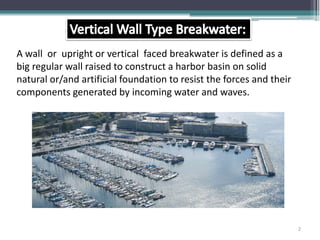
A wall or upright or vertical faced breakwater is defined as a
big regular wall raised to construct a harbor basin on solid
natural or/and artificial foundation to resist the forces and their
components generated by incoming water and waves.
2
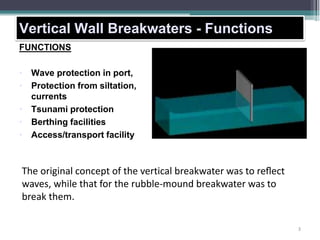
FUNCTIONS
• Wave protection in port,
• Protection from siltation,
currents
• Tsunami protection
• Berthing facilities
• Access/transport facility
Vertical Wall Breakwaters - Functions
The original concept of the vertical breakwater was to reflect
waves, while that for the rubble-mound breakwater was to
break them.
3
BREAKWATER LAYOUT-
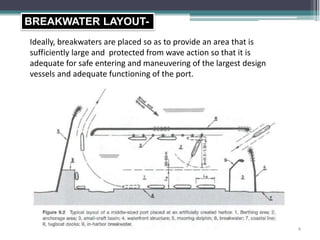
Ideally, breakwaters are placed so as to provide an area that is
sufficiently large and protected from wave action so that it is
adequate for safe entering and maneuvering of the largest design
vessels and adequate functioning of the port.
4
1. Caisson breakwaters
2. Block type
3. Piled breakwater with concrete wall
4. Perforated front wall
5. Semi-circular caisson
6. Dual cylindrical caisson
5
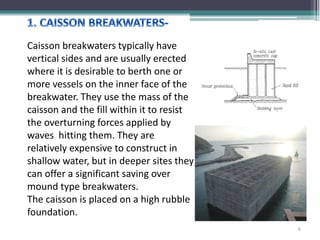
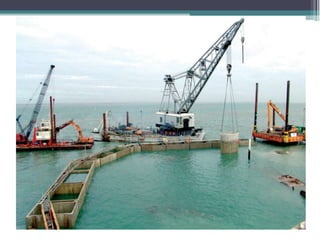
Caisson breakwaters typically have
vertical sides and are usually erected
where it is desirable to berth one or
more vessels on the inner face of the
breakwater. They use the mass of the
caisson and the fill within it to resist
the overturning forces applied by
waves hitting them. They are
relatively expensive to construct in
shallow water, but in deeper sites they
can offer a significant saving over
mound type breakwaters.
The caisson is placed on a high rubble
foundation.
6
7
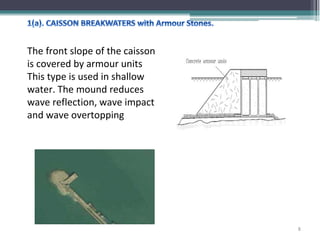
The front slope of the caisson
is covered by armour units
This type is used in shallow
water. The mound reduces
wave reflection, wave impact
and wave overtopping
Gela (Sicily, Italy)
8
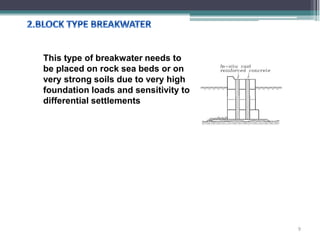
This type of breakwater needs to
be placed on rock sea beds or on
very strong soils due to very high
foundation loads and sensitivity to
differential settlements
9
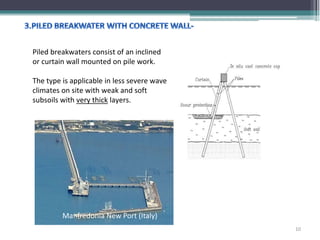
Piled breakwaters consist of an inclined
or curtain wall mounted on pile work.
The type is applicable in less severe wave
climates on site with weak and soft
subsoils with very thick layers.
Manfredonia New Port (Italy)
10
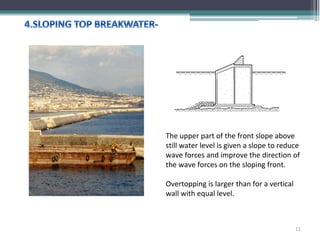
The upper part of the front slope above
still water level is given a slope to reduce
wave forces and improve the direction of
the wave forces on the sloping front.
Overtopping is larger than for a vertical
wall with equal level.
11
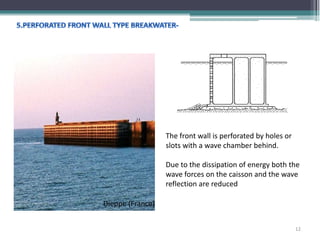
The front wall is perforated by holes or
slots with a wave chamber behind.
Due to the dissipation of energy both the
wave forces on the caisson and the wave
reflection are reduced
Dieppe (France)
12
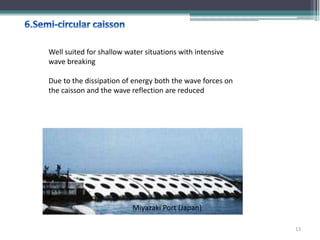
Well suited for shallow water situations with intensive
wave breaking
Due to the dissipation of energy both the wave forces on
the caisson and the wave reflection are reduced
Miyazaki Port (Japan)
13
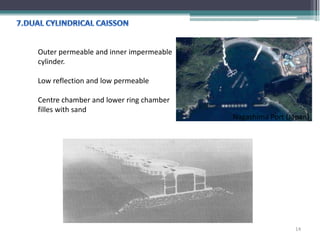
Outer permeable and inner impermeable
cylinder.
Low reflection and low permeable
Centre chamber and lower ring chamber
filles with sand
Nagashima Port (Japan)
14
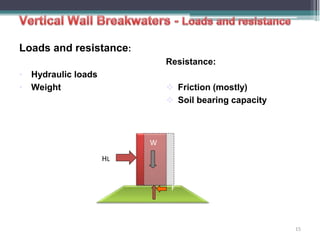
Loads and resistance:
• Hydraulic loads
• Weight
Resistance:
 Friction (mostly)
 Soil bearing capacity
HL
W
F
R
15
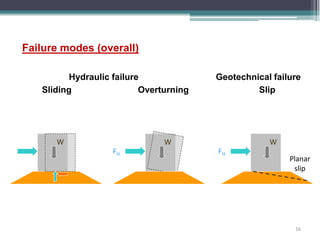
Failure modes (overall)
Hydraulic failure Geotechnical failure
Sliding Overturning Slip
W
FH
W
FH
W
Planar
slip
16
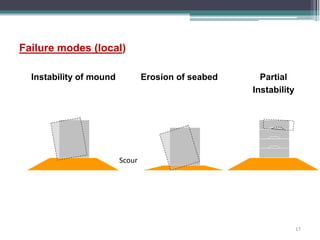
Failure modes (local)
Instability of mound Erosion of seabed Partial
Instability
U
Scour
17
Advantages
1. Provide a larger harbor area and
narrower entrance
2. Reduce the amount of material.
3. Avoid dangers of unequal
settlement
4. Maintenance costs are nearly
eliminated'
5. Where rock unavailable, may
save time and money
Disadvantages
1. Can be constructed only where
foundation conditions are favorable
2. Not flexible~ e.g.~ in
adjusting to settlement and
disturbance
3. Difficult to repair if
damaged
4. Construction requires more
extensive and heavier equipment
18
References-
HARBOUR DOCK ENGINEERING :by R.Srinivasan
PORT ENGINEERING: by Gregory P. Tsinker
http://www.bscw.ihe.nl/
http://www.wikipedia.org/
19
20

Vertical wall type breakwaters

  • 1.
  • 2.
    A wall orupright or vertical faced breakwater is defined as a big regular wall raised to construct a harbor basin on solid natural or/and artificial foundation to resist the forces and their components generated by incoming water and waves. 2
  • 3.
    FUNCTIONS • Wave protectionin port, • Protection from siltation, currents • Tsunami protection • Berthing facilities • Access/transport facility Vertical Wall Breakwaters - Functions The original concept of the vertical breakwater was to reflect waves, while that for the rubble-mound breakwater was to break them. 3
  • 4.
    BREAKWATER LAYOUT- Ideally, breakwatersare placed so as to provide an area that is sufficiently large and protected from wave action so that it is adequate for safe entering and maneuvering of the largest design vessels and adequate functioning of the port. 4
  • 5.
    1. Caisson breakwaters 2.Block type 3. Piled breakwater with concrete wall 4. Perforated front wall 5. Semi-circular caisson 6. Dual cylindrical caisson 5
  • 6.
    Caisson breakwaters typicallyhave vertical sides and are usually erected where it is desirable to berth one or more vessels on the inner face of the breakwater. They use the mass of the caisson and the fill within it to resist the overturning forces applied by waves hitting them. They are relatively expensive to construct in shallow water, but in deeper sites they can offer a significant saving over mound type breakwaters. The caisson is placed on a high rubble foundation. 6
  • 7.
  • 8.
    The front slopeof the caisson is covered by armour units This type is used in shallow water. The mound reduces wave reflection, wave impact and wave overtopping Gela (Sicily, Italy) 8
  • 9.
    This type ofbreakwater needs to be placed on rock sea beds or on very strong soils due to very high foundation loads and sensitivity to differential settlements 9
  • 10.
    Piled breakwaters consistof an inclined or curtain wall mounted on pile work. The type is applicable in less severe wave climates on site with weak and soft subsoils with very thick layers. Manfredonia New Port (Italy) 10
  • 11.
    The upper partof the front slope above still water level is given a slope to reduce wave forces and improve the direction of the wave forces on the sloping front. Overtopping is larger than for a vertical wall with equal level. 11
  • 12.
    The front wallis perforated by holes or slots with a wave chamber behind. Due to the dissipation of energy both the wave forces on the caisson and the wave reflection are reduced Dieppe (France) 12
  • 13.
    Well suited forshallow water situations with intensive wave breaking Due to the dissipation of energy both the wave forces on the caisson and the wave reflection are reduced Miyazaki Port (Japan) 13
  • 14.
    Outer permeable andinner impermeable cylinder. Low reflection and low permeable Centre chamber and lower ring chamber filles with sand Nagashima Port (Japan) 14
  • 15.
    Loads and resistance: •Hydraulic loads • Weight Resistance:  Friction (mostly)  Soil bearing capacity HL W F R 15
  • 16.
    Failure modes (overall) Hydraulicfailure Geotechnical failure Sliding Overturning Slip W FH W FH W Planar slip 16
  • 17.
    Failure modes (local) Instabilityof mound Erosion of seabed Partial Instability U Scour 17
  • 18.
    Advantages 1. Provide alarger harbor area and narrower entrance 2. Reduce the amount of material. 3. Avoid dangers of unequal settlement 4. Maintenance costs are nearly eliminated' 5. Where rock unavailable, may save time and money Disadvantages 1. Can be constructed only where foundation conditions are favorable 2. Not flexible~ e.g.~ in adjusting to settlement and disturbance 3. Difficult to repair if damaged 4. Construction requires more extensive and heavier equipment 18
  • 19.
    References- HARBOUR DOCK ENGINEERING:by R.Srinivasan PORT ENGINEERING: by Gregory P. Tsinker http://www.bscw.ihe.nl/ http://www.wikipedia.org/ 19
  • 20.