Basics of Substation Protection
By Said Salim Palayi
Telegram: t.me/electrical_transmision
Version 1.2 edited on 18.10.2020
Protection - Why Is It Needed?
FAULT
• Short circuit produced by failure of insulation.
PROTECTION IS INSTALLED TO :
• Detect fault occurrence and isolate the faulted equipment.
SO THAT :
• Damage to the faulted equipment is limited;
• Disruption of supplies to adjacent equipment is minimized.
• Danger to staff or the public is avoided
All Power Systems may experience faults
at some time.
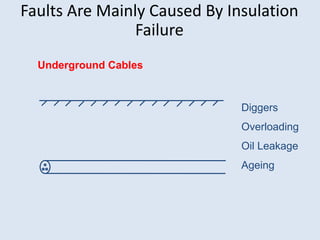
Faults Are Mainly Caused By Insulation
Failure
Underground Cables
Diggers
Overloading
Oil Leakage
Ageing
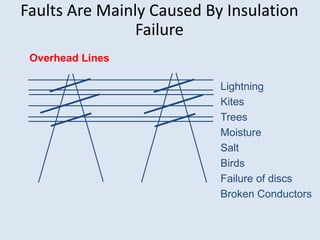
Faults Are Mainly Caused By Insulation
Failure
Overhead Lines
Lightning
Kites
Trees
Moisture
Salt
Birds
Failure of discs
Broken Conductors
Faults Are Mainly Caused By Insulation
Failure
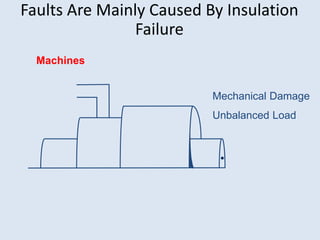
Machines
Mechanical Damage
Unbalanced Load
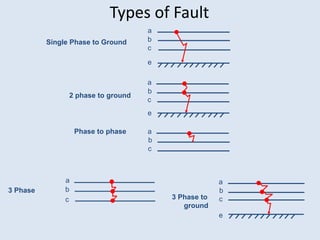
Types of Fault
a
b
c
e
Single Phase to Ground
2 phase to ground
Phase to phase
e
a
b
c
3 Phase
3 Phase to
ground
e
a
b
c
a
b
c
a
b
c
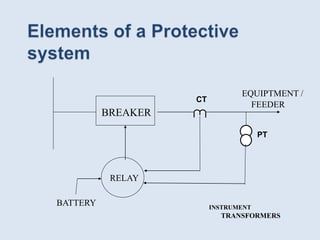
EQUIPTMENT /
FEEDER
BREAKER
RELAY
BATTERY INSTRUMENT
TRANSFORMERS
CT
PT
Types of Protection - Principles
Most of the protective relays in substation works in the
following fundamental principles.
1. Over current Protection Principle
2. Differential Protection
3. Pilot wire protection
4. Distance Protection
1. Overcurrent Protection
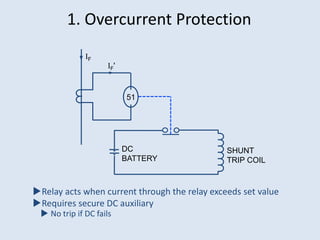
Relay acts when current through the relay exceeds set value
Requires secure DC auxiliary
 No trip if DC fails
IF'
IF
DC
BATTERY
SHUNT
TRIP COIL
51
Overcurrent Protection
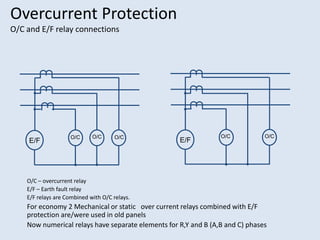
O/C and E/F relay connections
O/C – overcurrent relay
E/F – Earth fault relay
E/F relays are Combined with O/C relays.
For economy 2 Mechanical or static over current relays combined with E/F
protection are/were used in old panels
Now numerical relays have separate elements for R,Y and B (A,B and C) phases
E/F
O/C O/C O/C
E/F
O/C O/C
Over current protection Parallel Feeders
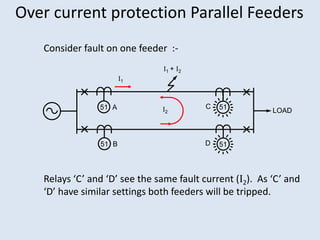
Consider fault on one feeder :-
Relays ‘C’ and ‘D’ see the same fault current (I2). As ‘C’ and
‘D’ have similar settings both feeders will be tripped.
51 A 51
C
51 B 51
D
LOAD
I1 + I2
I1
I2
Parallel Feeders
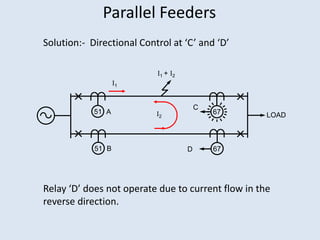
Solution:- Directional Control at ‘C’ and ‘D’
Relay ‘D’ does not operate due to current flow in the
reverse direction.
51 A 67
C
51 B 67
D
LOAD
I1 + I2
I1
I2
Establishing Direction:- Polarising Voltage
The DIRECTION of Alternating Current may only be
determined with respect to a COMMON REFERENCE.
The most convenient reference quantity is POLARISING
VOLTAGE taken from the Power System Voltages.
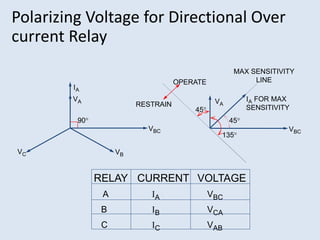
Polarizing Voltage for Directional Over
current Relay
IA
VA
90
VB
VC
MAX SENSITIVITY
LINE
OPERATE
IA FOR MAX
SENSITIVITY
RESTRAIN
45
45
135
VA
VBC VBC
RELAY CURRENT VOLTAGE
A IA VBC
B IB VCA
C IC VAB
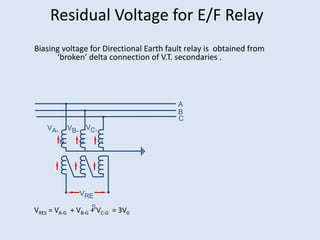
Residual Voltage for E/F Relay
Biasing voltage for Directional Earth fault relay is obtained from
‘broken’ delta connection of V.T. secondaries .
VRES = VA-G + VB-G + VC-G = 3V0
A
B
C
VRE
S
VC-
G
VB-
G
VA-
G
Application of Overcurrent
Protection
Overcurrent & Earth fault Protection is used.
• HT lines
• Transformers
• Generators
• Reactors
• Capacitor Banks
• Motors
• Neutral displacement relays in capacitor banks
• EHT lines (Directional overcurrent &E/F)
• Breaker failure Protection
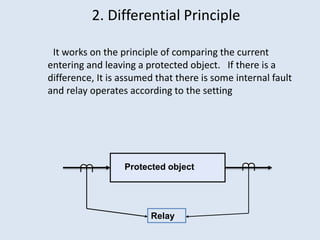
2. Differential Principle
It works on the principle of comparing the current
entering and leaving a protected object. If there is a
difference, It is assumed that there is some internal fault
and relay operates according to the setting
Protected object
Relay
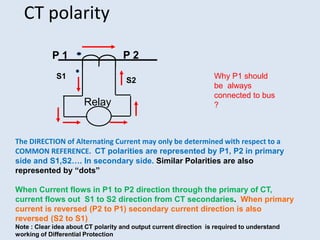
CT polarity
P 2
The DIRECTION of Alternating Current may only be determined with respect to a
COMMON REFERENCE. CT polarities are represented by P1, P2 in primary
side and S1,S2…. In secondary side. Similar Polarities are also
represented by “dots”
When Current flows in P1 to P2 direction through the primary of CT,
current flows out S1 to S2 direction from CT secondaries. When primary
current is reversed (P2 to P1) secondary current direction is also
reversed (S2 to S1)
Note : Clear idea about CT polarity and output current direction is required to understand
working of Differential Protection
P 1
S1
Relay
Why P1 should
be always
connected to bus
?
S2
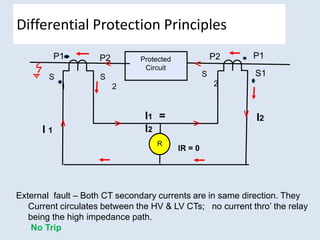
Differential Protection Principles
P1 P2
S1
P1
P2
External fault – Both CT secondary currents are in same direction. They
Current circulates between the HV & LV CTs; no current thro’ the relay
being the high impedance path.
No Trip
I2
Protected
Circuit
R
S
2
S
2
S
1
I 1
I1 =
I2
IR = 0
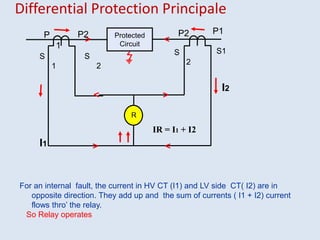
Differential Protection Principale
For an internal fault, the current in HV CT (I1) and LV side CT( I2) are in
opposite direction. They add up and the sum of currents ( I1 + I2) current
flows thro’ the relay.
So Relay operates
P1
I1
I2
Protected
Circuit
R
P
1
P2
P2
S1
S
1
S
2
S
2
IR = I1 + I2
Differential Relays are widely used for
Transformer protection
Generator protection
Motor protection
Applications of Differential Relays
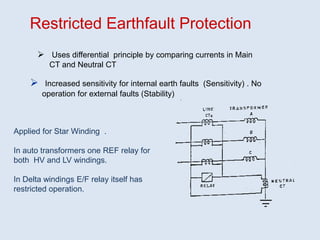
Restricted Earthfault Protection
 Increased sensitivity for internal earth faults (Sensitivity) . No
operation for external faults (Stability)
 Uses differential principle by comparing currents in Main
CT and Neutral CT
Applied for Star Winding .
In auto transformers one REF relay for
both HV and LV windings.
In Delta windings E/F relay itself has
restricted operation.
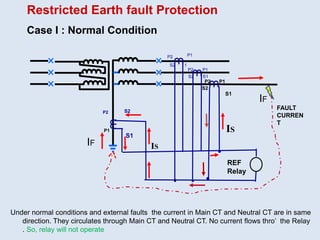
Restricted Earth fault Protection
Case I : Normal Condition
Under normal conditions and external faults the current in Main CT and Neutral CT are in same
direction. They circulates through Main CT and Neutral CT. No current flows thro’ the Relay
. So, relay will not operate
P2
S2
P1
1
P2
S2
P1
S1
P2
S2
P1
S1
P1
P2
S1
S2
FAULT
CURREN
T
IF
IF
REF
Relay
IS
IS
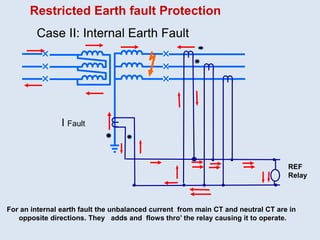
Restricted Earth fault Protection
Case II: Internal Earth Fault
For an internal earth fault the unbalanced current from main CT and neutral CT are in
opposite directions. They adds and flows thro’ the relay causing it to operate.
REF
Relay
I Fault
Bus bar protection Relay
• Bus bar protection works on the differential
principle.
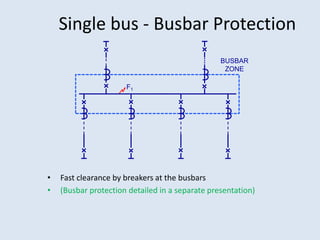
Single bus - Busbar Protection
• Fast clearance by breakers at the busbars
• (Busbar protection detailed in a separate presentation)
BUSBAR
ZONE
F1
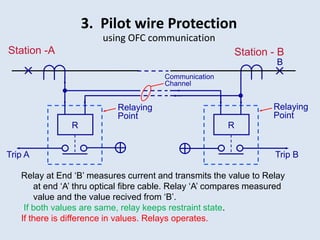
3. Pilot wire Protection
using OFC communication
Relay at End ‘B’ measures current and transmits the value to Relay
at end ‘A’ thru optical fibre cable. Relay ‘A’ compares measured
value and the value recived from ‘B’.
If both values are same, relay keeps restraint state.
If there is difference in values. Relays operates.
B
R R
Relaying
Point
Trip A Trip B
Communication
Channel
Relaying
Point
Station -A Station - B
Pilot wire protection
Applied for protection of
– EHT cables
– short distance EHT transmission lines.
Type of Piolot wires
– Copper Cable was used piolot wire in earlier days
– Fibre optic cable is now used as piolot wire.
4.Distance Protection
Measures line impedance from line current (I) and
Line voltage (V)
Line impedance Z= V/I
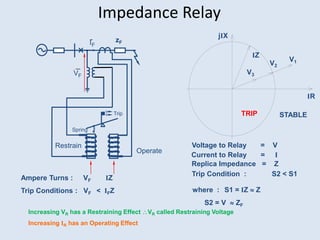
Impedance Relay
Operate
IF
VF
Restrain
Spring
Trip
zF
Ampere Turns : VF IZ
Trip Conditions : VF < IFZ
jIX
IZ
V1
V2
V3
IR
TRIP STABLE
Voltage to Relay = V
Current to Relay = I
Replica Impedance = Z
Trip Condition : S2 < S1
where : S1 = IZ  Z
S2 = V  ZF
Increasing VR has a Restraining Effect VR called Restraining Voltage
Increasing IR has an Operating Effect
Basic Principle of Distance Protection
LOAD
L
R
R
R Z
Z
V
Z
measured
Impedance 



Relay
PT.
Normal
Load
IR ZL
ZS
VR
VS
ZLOAD
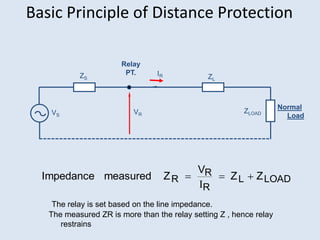
The relay is set based on the line impedance.
The measured ZR is more than the relay setting Z , hence relay
restrains
Basic Principle of Distance Protection
Fault
IR
ZS
VR
VS
ZLOAD
ZL
ZF
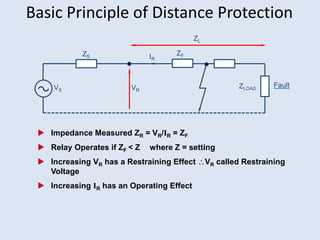
 Impedance Measured ZR = VR/IR = ZF
 Relay Operates if ZF < Z where Z = setting
 Increasing VR has a Restraining Effect VR called Restraining
Voltage
 Increasing IR has an Operating Effect
Application of Distance Protection
Distance Protection is applied to
Transmission Lines
Sub-Transmission Lines (33 KV and 66 KV)
Back-up Protection for Transformers and Generators
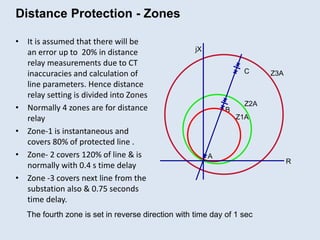
• It is assumed that there will be
an error up to 20% in distance
relay measurements due to CT
inaccuracies and calculation of
line parameters. Hence distance
relay setting is divided into Zones
• Normally 4 zones are for distance
relay
• Zone-1 is instantaneous and
covers 80% of protected line .
• Zone- 2 covers 120% of line & is
normally with 0.4 s time delay
• Zone -3 covers next line from the
substation also & 0.75 seconds
time delay.
Distance Protection - Zones
R
A
C
B
Z1A
Z2A
Z3A
jX
The fourth zone is set in reverse direction with time day of 1 sec
Zones of Protection
R
A
C
B
Z1A
Z2A
Z3A
jX
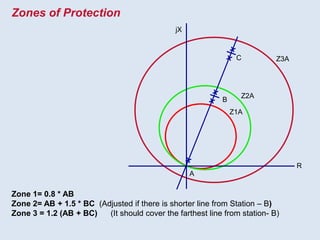
Zone 1= 0.8 * AB
Zone 2= AB + 1.5 * BC (Adjusted if there is shorter line from Station – B)
Zone 3 = 1.2 (AB + BC) (It should cover the farthest line from station- B)
Zones of Protection
Z2A Z2B
Z3A Z3B
Time
T3
T2
Z1B
Z1A
Z1B D
C
A
Z2B
T2
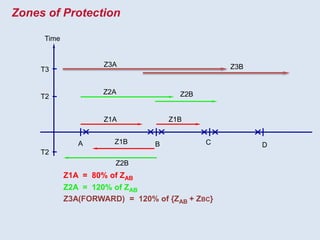
Z1A = 80% of ZAB
Z2A = 120% of ZAB
Z3A(FORWARD) = 120% of {ZAB + ZBC}
B
Distance Relay -features
POWER SWING BLOCKING
Provides Stability during Power swing.
VT SUPERVISION
Blocks tripping of Distance Relay when VT supply fails.
SOTF (Switch- On-To-Fault.)
Function enables high speed tripping when line is
energized to a persisting fault.
AUTORECLOSING
In a three-phase system synchronization can be maintained
by 2 phases in case of single-phase tripping.
MAINTAINS STABILITY AND SUPPLY BY FAST RECLOSING OF THE
TRIPPED FEEDER.
Distance Protection- features
CARRIER INTERTRIPS
Are provided for fast clearance of faults for entire line
beyond Zone-1.
Zone -1 is set to cover only 80% of the line .
Tripping for a fault in remaining portion of line beyond in the protected line
beyond Zone -1 (ie, 80 % - 100 % length of line ) is covered by Zone-2, which
is time delayed for 0.4 Sec, which is not desirable in a power system.
Tripping for faults beyond zone-1 (up to next station -B) can be made fast by
providing a signaling system which communicates between distance relays
of both ends of line in Station-A and Station-B .
Communication channels used are
• PLCC (Power Line Carrier Communication )
• Fibre optic cable communication
Carrier inter trip Schemes
. Permissive Under Reach (PUTT)
. Permissive Overreach (POTT)
Distance Relay Applications
• Transmission lines
• Sub transmission line
• Backup protection for generators
Other type of Protective relays used in
substations
1.Under / Over Voltage Relays
– Used for protection of capacitor banks.
– for interlocking like Earth switches.
2.Under Frequency Relays
– Monitors the frequency of Power system
– Initiates commands for load shedding if system
frequency goes below specified value.
3. DC supervision Relay
– Indicates the failure of DC supply to the panel.
– DC source holds the flag in reset condition
– When DC fails, the flag drops giving mechanical
indication.
– Signal goes to annunciator and SCADA circuits
also.
4. AC supervision relay
• Indicates the failure of AC to the panel.
• AC is necessary for the operation of space heaters.
• Signal goes to Annunciator and SCADA
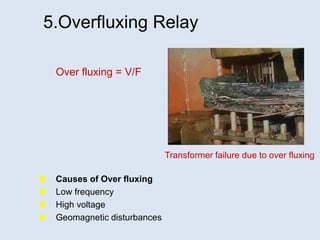
5.Overfluxing Relay
 Causes of Over fluxing
 Low frequency
 High voltage
 Geomagnetic disturbances
Transformer failure due to over fluxing
Over fluxing = V/F
Over fluxing Relay
 Transient Over fluxing - Tripping of differential element
 Prolonged Over fluxing - Damage to transformers
 Over flux relay measures V/f ratio and in it gives alarm in stage-1
(usually set at 110%)
 It gives trip signal in stage-2 (set at 120%)
Effects of over fluxing
Remember, Continues over fluxing causes destruction of
transformer core beyond imagination
6.Master Trip Relay
• It will transfer the actuation of trip signal from relays to the
circuit breaker
• A circuit breaker normally open (52a) contact is used to
interrupt trip coil current. This saves trip coil from burning
out due to continuous current flow.
• Burning of trip coil may happen if this contact is faulty.
7. Trip circuit supervision relay
It supervises trip circuit healthiness
Pre close supervision
Checks the healthiness of CB when the CB is open condition.
(It is wired through the Normally Closed ( 52b) auxiliary contact
of the CB).
Post close supervision
Checks the healthiness of CB when the CB is in Closed condition.
(it is wired though Normally Open ( 52b) auxiliary contact of the
CB)
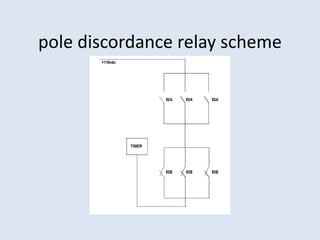
8.Pole discordance relay
• Used in CBs with single pole tripping
• This relay confirm whether all poles are
Opened or Closed, if not it will generate a trip
signal.
pole discordance relay scheme
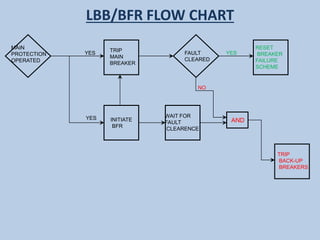
9.Breaker Failure Protection (BFR / LBB)
A PROTECTION WHICH IS DESIGNED TO CLEAR A
SYSTEM FAULTY BY INITIATING TRIPPING OTHER
CIRCUIT BREAKER(S) IN THE CASE OF FAILURE TO TRIP
OF THE APPROPRIATE CIRCUIT BREAKER.
IN MODERN NETWORKS THE CRITICAL FAULT CLEARING
TIME MAY BE LESS THAN 200ms. HENCE, IF THE FAULT IS NOT
CLEARED DUE TO FAILURE OF THE PRIMARY PROTECTIVE RELAYS
OR THEIR ASSOCIATED CIRCUIT BREAKER, A FAST ACTING BACK-
UP PROTECTIVE RELAY MUST CLEAR THE FAULT.
LBB/BFR FLOW CHART
MAIN
PROTECTION
OPERATED
YES
YES
TRIP
MAIN
BREAKER
INITIATE
BFR
WAIT FOR
FAULT
CLEARENCE
AND
FAULT
CLEARED
YES
NO
RESET
BREAKER
FAILURE
SCHEME
TRIP
BACK-UP
BREAKERS
10. Low SF6 alarm/lockout
Monitors SF6 pressure inside Circuit breaker
Stage-1 : Alarm
• Alarm stage indicates the inadequate gas pressure
inside CB.
• Action shall be immediately taken to top up gas level
Stage-2 :Lockout.
• Operates when pressure reduces below permitted operating
level.
• Lock out stage blocks the operation of CB. No tripping or
closing will happen then.
11.Control Relays
• Auto-Reclose Relay
In some schemes modern numerical distance
relay itself acts as a reclosing relay.
Some schemes use separate auto reclosure relay
for auto reclosing of feeders
• Tap change control Relay
Used for regulating the output voltage of
transformer by raising/lowering the tap
Transformer Mechanical Protection
Relays
1) Oil Temperature Indicator.
2) Winding Temperature Indicator.
3) Buchholz Relay.
4) Pressure relief device ( PDR).
5) Magnetic Oil Level Gauge ( MOLG).
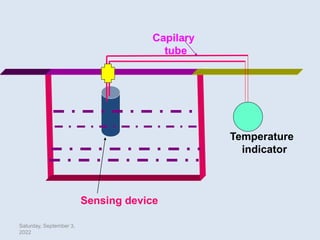
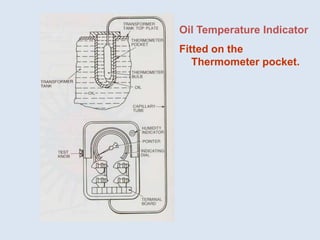
1. Oil temperature Indicator.
• Indicates the temperature of the oil inside
transformer.
• Gives alarm/Trip signal
Saturday, September 3,
2022
Sensing device
Temperature
indicator
Capilary
tube
Oil Temperature Indicator
Fitted on the
Thermometer pocket.
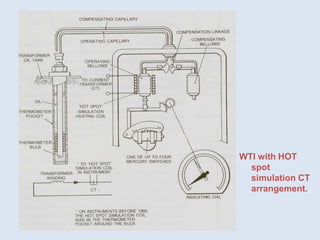
2. Winding Temperature relay
• Give indications about the temperature of
winding temperature .
• WTI works with HOT spot simulation CT
arrangement.
WTI with HOT
spot
simulation CT
arrangement.
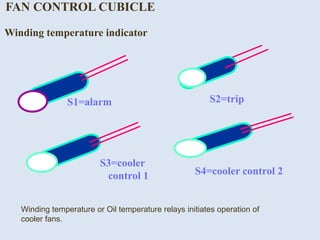
FAN CONTROL CUBICLE
S1=alarm S2=trip
S3=cooler
control 1 S4=cooler control 2
Winding temperature indicator
Winding temperature or Oil temperature relays initiates operation of
cooler fans.
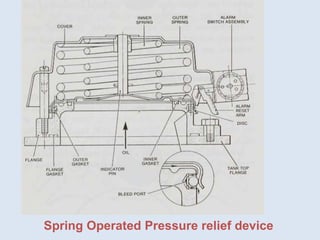
12.3 Pressure Relief Device (PRD)
• When pressure inside transformer exceeds the PRV
will operate to release excessive pressure inside the
transformer.
• It issues a trip command and visual indication by
operation of a liver (from horizontal position to
vertical position)
Spring Operated Pressure relief device
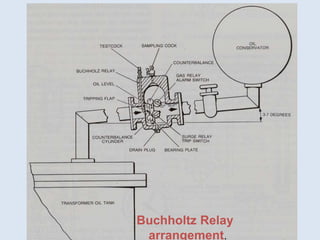
12.4 Buchholz relay
• Buchholz relays are provided for both main tank and
OLTC tank
• Mechanical relay which has two mercury switches.
• When gas or oil surge produced by internal fault
enters the chamber the position of switches deflects
and it will make alarm in stage-1,
• trip is provided in stage-2 of Main tank Buchholz
relay.
• Only trip output is provided in OLTC buchholz relay.
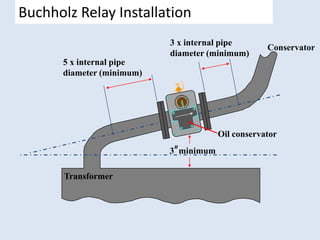
Buchholz Relay Installation
5 x internal pipe
diameter (minimum)
3 x internal pipe
diameter (minimum)
Transformer
3 minimum
Oil conservator
Conservator
Buchholtz Relay
arrangement.
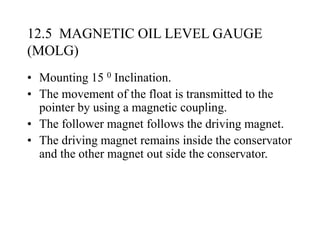
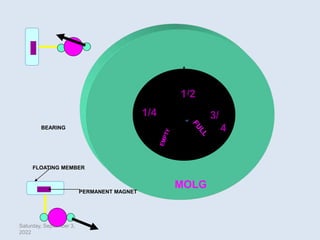
12.5 MAGNETIC OIL LEVEL GAUGE
(MOLG)
• Mounting 15 0 Inclination.
• The movement of the float is transmitted to the
pointer by using a magnetic coupling.
• The follower magnet follows the driving magnet.
• The driving magnet remains inside the conservator
and the other magnet out side the conservator.
Saturday, September 3,
2022
1/4
1/2
3/
4
MOLG
FLOATING MEMBER
PERMANENT MAGNET
BEARING

substation protection basics.ppt

  • 1.
    Basics of SubstationProtection By Said Salim Palayi Telegram: t.me/electrical_transmision Version 1.2 edited on 18.10.2020
  • 2.
    Protection - WhyIs It Needed? FAULT • Short circuit produced by failure of insulation. PROTECTION IS INSTALLED TO : • Detect fault occurrence and isolate the faulted equipment. SO THAT : • Damage to the faulted equipment is limited; • Disruption of supplies to adjacent equipment is minimized. • Danger to staff or the public is avoided All Power Systems may experience faults at some time.
  • 3.
    Faults Are MainlyCaused By Insulation Failure Underground Cables Diggers Overloading Oil Leakage Ageing
  • 4.
    Faults Are MainlyCaused By Insulation Failure Overhead Lines Lightning Kites Trees Moisture Salt Birds Failure of discs Broken Conductors
  • 5.
    Faults Are MainlyCaused By Insulation Failure Machines Mechanical Damage Unbalanced Load
  • 6.
    Types of Fault a b c e SinglePhase to Ground 2 phase to ground Phase to phase e a b c 3 Phase 3 Phase to ground e a b c a b c a b c
  • 7.
  • 8.
    Types of Protection- Principles Most of the protective relays in substation works in the following fundamental principles. 1. Over current Protection Principle 2. Differential Protection 3. Pilot wire protection 4. Distance Protection
  • 9.
    1. Overcurrent Protection Relayacts when current through the relay exceeds set value Requires secure DC auxiliary  No trip if DC fails IF' IF DC BATTERY SHUNT TRIP COIL 51
  • 10.
    Overcurrent Protection O/C andE/F relay connections O/C – overcurrent relay E/F – Earth fault relay E/F relays are Combined with O/C relays. For economy 2 Mechanical or static over current relays combined with E/F protection are/were used in old panels Now numerical relays have separate elements for R,Y and B (A,B and C) phases E/F O/C O/C O/C E/F O/C O/C
  • 11.
    Over current protectionParallel Feeders Consider fault on one feeder :- Relays ‘C’ and ‘D’ see the same fault current (I2). As ‘C’ and ‘D’ have similar settings both feeders will be tripped. 51 A 51 C 51 B 51 D LOAD I1 + I2 I1 I2
  • 12.
    Parallel Feeders Solution:- DirectionalControl at ‘C’ and ‘D’ Relay ‘D’ does not operate due to current flow in the reverse direction. 51 A 67 C 51 B 67 D LOAD I1 + I2 I1 I2
  • 13.
    Establishing Direction:- PolarisingVoltage The DIRECTION of Alternating Current may only be determined with respect to a COMMON REFERENCE. The most convenient reference quantity is POLARISING VOLTAGE taken from the Power System Voltages.
  • 14.
    Polarizing Voltage forDirectional Over current Relay IA VA 90 VB VC MAX SENSITIVITY LINE OPERATE IA FOR MAX SENSITIVITY RESTRAIN 45 45 135 VA VBC VBC RELAY CURRENT VOLTAGE A IA VBC B IB VCA C IC VAB
  • 15.
    Residual Voltage forE/F Relay Biasing voltage for Directional Earth fault relay is obtained from ‘broken’ delta connection of V.T. secondaries . VRES = VA-G + VB-G + VC-G = 3V0 A B C VRE S VC- G VB- G VA- G
  • 16.
    Application of Overcurrent Protection Overcurrent& Earth fault Protection is used. • HT lines • Transformers • Generators • Reactors • Capacitor Banks • Motors • Neutral displacement relays in capacitor banks • EHT lines (Directional overcurrent &E/F) • Breaker failure Protection
  • 17.
    2. Differential Principle Itworks on the principle of comparing the current entering and leaving a protected object. If there is a difference, It is assumed that there is some internal fault and relay operates according to the setting Protected object Relay
  • 18.
    CT polarity P 2 TheDIRECTION of Alternating Current may only be determined with respect to a COMMON REFERENCE. CT polarities are represented by P1, P2 in primary side and S1,S2…. In secondary side. Similar Polarities are also represented by “dots” When Current flows in P1 to P2 direction through the primary of CT, current flows out S1 to S2 direction from CT secondaries. When primary current is reversed (P2 to P1) secondary current direction is also reversed (S2 to S1) Note : Clear idea about CT polarity and output current direction is required to understand working of Differential Protection P 1 S1 Relay Why P1 should be always connected to bus ? S2
  • 19.
    Differential Protection Principles P1P2 S1 P1 P2 External fault – Both CT secondary currents are in same direction. They Current circulates between the HV & LV CTs; no current thro’ the relay being the high impedance path. No Trip I2 Protected Circuit R S 2 S 2 S 1 I 1 I1 = I2 IR = 0
  • 20.
    Differential Protection Principale Foran internal fault, the current in HV CT (I1) and LV side CT( I2) are in opposite direction. They add up and the sum of currents ( I1 + I2) current flows thro’ the relay. So Relay operates P1 I1 I2 Protected Circuit R P 1 P2 P2 S1 S 1 S 2 S 2 IR = I1 + I2
  • 21.
    Differential Relays arewidely used for Transformer protection Generator protection Motor protection Applications of Differential Relays
  • 22.
    Restricted Earthfault Protection Increased sensitivity for internal earth faults (Sensitivity) . No operation for external faults (Stability)  Uses differential principle by comparing currents in Main CT and Neutral CT Applied for Star Winding . In auto transformers one REF relay for both HV and LV windings. In Delta windings E/F relay itself has restricted operation.
  • 23.
    Restricted Earth faultProtection Case I : Normal Condition Under normal conditions and external faults the current in Main CT and Neutral CT are in same direction. They circulates through Main CT and Neutral CT. No current flows thro’ the Relay . So, relay will not operate P2 S2 P1 1 P2 S2 P1 S1 P2 S2 P1 S1 P1 P2 S1 S2 FAULT CURREN T IF IF REF Relay IS IS
  • 24.
    Restricted Earth faultProtection Case II: Internal Earth Fault For an internal earth fault the unbalanced current from main CT and neutral CT are in opposite directions. They adds and flows thro’ the relay causing it to operate. REF Relay I Fault
  • 25.
    Bus bar protectionRelay • Bus bar protection works on the differential principle.
  • 26.
    Single bus -Busbar Protection • Fast clearance by breakers at the busbars • (Busbar protection detailed in a separate presentation) BUSBAR ZONE F1
  • 27.
    3. Pilot wireProtection using OFC communication Relay at End ‘B’ measures current and transmits the value to Relay at end ‘A’ thru optical fibre cable. Relay ‘A’ compares measured value and the value recived from ‘B’. If both values are same, relay keeps restraint state. If there is difference in values. Relays operates. B R R Relaying Point Trip A Trip B Communication Channel Relaying Point Station -A Station - B
  • 28.
    Pilot wire protection Appliedfor protection of – EHT cables – short distance EHT transmission lines. Type of Piolot wires – Copper Cable was used piolot wire in earlier days – Fibre optic cable is now used as piolot wire.
  • 29.
    4.Distance Protection Measures lineimpedance from line current (I) and Line voltage (V) Line impedance Z= V/I
  • 30.
    Impedance Relay Operate IF VF Restrain Spring Trip zF Ampere Turns: VF IZ Trip Conditions : VF < IFZ jIX IZ V1 V2 V3 IR TRIP STABLE Voltage to Relay = V Current to Relay = I Replica Impedance = Z Trip Condition : S2 < S1 where : S1 = IZ  Z S2 = V  ZF Increasing VR has a Restraining Effect VR called Restraining Voltage Increasing IR has an Operating Effect
  • 31.
    Basic Principle ofDistance Protection LOAD L R R R Z Z V Z measured Impedance     Relay PT. Normal Load IR ZL ZS VR VS ZLOAD The relay is set based on the line impedance. The measured ZR is more than the relay setting Z , hence relay restrains
  • 32.
    Basic Principle ofDistance Protection Fault IR ZS VR VS ZLOAD ZL ZF  Impedance Measured ZR = VR/IR = ZF  Relay Operates if ZF < Z where Z = setting  Increasing VR has a Restraining Effect VR called Restraining Voltage  Increasing IR has an Operating Effect
  • 33.
    Application of DistanceProtection Distance Protection is applied to Transmission Lines Sub-Transmission Lines (33 KV and 66 KV) Back-up Protection for Transformers and Generators
  • 34.
    • It isassumed that there will be an error up to 20% in distance relay measurements due to CT inaccuracies and calculation of line parameters. Hence distance relay setting is divided into Zones • Normally 4 zones are for distance relay • Zone-1 is instantaneous and covers 80% of protected line . • Zone- 2 covers 120% of line & is normally with 0.4 s time delay • Zone -3 covers next line from the substation also & 0.75 seconds time delay. Distance Protection - Zones R A C B Z1A Z2A Z3A jX The fourth zone is set in reverse direction with time day of 1 sec
  • 35.
    Zones of Protection R A C B Z1A Z2A Z3A jX Zone1= 0.8 * AB Zone 2= AB + 1.5 * BC (Adjusted if there is shorter line from Station – B) Zone 3 = 1.2 (AB + BC) (It should cover the farthest line from station- B)
  • 36.
    Zones of Protection Z2AZ2B Z3A Z3B Time T3 T2 Z1B Z1A Z1B D C A Z2B T2 Z1A = 80% of ZAB Z2A = 120% of ZAB Z3A(FORWARD) = 120% of {ZAB + ZBC} B
  • 37.
    Distance Relay -features POWERSWING BLOCKING Provides Stability during Power swing. VT SUPERVISION Blocks tripping of Distance Relay when VT supply fails. SOTF (Switch- On-To-Fault.) Function enables high speed tripping when line is energized to a persisting fault.
  • 38.
    AUTORECLOSING In a three-phasesystem synchronization can be maintained by 2 phases in case of single-phase tripping. MAINTAINS STABILITY AND SUPPLY BY FAST RECLOSING OF THE TRIPPED FEEDER. Distance Protection- features
  • 39.
    CARRIER INTERTRIPS Are providedfor fast clearance of faults for entire line beyond Zone-1. Zone -1 is set to cover only 80% of the line . Tripping for a fault in remaining portion of line beyond in the protected line beyond Zone -1 (ie, 80 % - 100 % length of line ) is covered by Zone-2, which is time delayed for 0.4 Sec, which is not desirable in a power system. Tripping for faults beyond zone-1 (up to next station -B) can be made fast by providing a signaling system which communicates between distance relays of both ends of line in Station-A and Station-B .
  • 40.
    Communication channels usedare • PLCC (Power Line Carrier Communication ) • Fibre optic cable communication Carrier inter trip Schemes . Permissive Under Reach (PUTT) . Permissive Overreach (POTT)
  • 41.
    Distance Relay Applications •Transmission lines • Sub transmission line • Backup protection for generators
  • 42.
    Other type ofProtective relays used in substations
  • 43.
    1.Under / OverVoltage Relays – Used for protection of capacitor banks. – for interlocking like Earth switches.
  • 44.
    2.Under Frequency Relays –Monitors the frequency of Power system – Initiates commands for load shedding if system frequency goes below specified value.
  • 45.
    3. DC supervisionRelay – Indicates the failure of DC supply to the panel. – DC source holds the flag in reset condition – When DC fails, the flag drops giving mechanical indication. – Signal goes to annunciator and SCADA circuits also.
  • 46.
    4. AC supervisionrelay • Indicates the failure of AC to the panel. • AC is necessary for the operation of space heaters. • Signal goes to Annunciator and SCADA
  • 47.
    5.Overfluxing Relay  Causesof Over fluxing  Low frequency  High voltage  Geomagnetic disturbances Transformer failure due to over fluxing Over fluxing = V/F
  • 48.
    Over fluxing Relay Transient Over fluxing - Tripping of differential element  Prolonged Over fluxing - Damage to transformers  Over flux relay measures V/f ratio and in it gives alarm in stage-1 (usually set at 110%)  It gives trip signal in stage-2 (set at 120%) Effects of over fluxing Remember, Continues over fluxing causes destruction of transformer core beyond imagination
  • 49.
    6.Master Trip Relay •It will transfer the actuation of trip signal from relays to the circuit breaker • A circuit breaker normally open (52a) contact is used to interrupt trip coil current. This saves trip coil from burning out due to continuous current flow. • Burning of trip coil may happen if this contact is faulty.
  • 50.
    7. Trip circuitsupervision relay It supervises trip circuit healthiness Pre close supervision Checks the healthiness of CB when the CB is open condition. (It is wired through the Normally Closed ( 52b) auxiliary contact of the CB). Post close supervision Checks the healthiness of CB when the CB is in Closed condition. (it is wired though Normally Open ( 52b) auxiliary contact of the CB)
  • 51.
    8.Pole discordance relay •Used in CBs with single pole tripping • This relay confirm whether all poles are Opened or Closed, if not it will generate a trip signal.
  • 52.
  • 53.
    9.Breaker Failure Protection(BFR / LBB) A PROTECTION WHICH IS DESIGNED TO CLEAR A SYSTEM FAULTY BY INITIATING TRIPPING OTHER CIRCUIT BREAKER(S) IN THE CASE OF FAILURE TO TRIP OF THE APPROPRIATE CIRCUIT BREAKER. IN MODERN NETWORKS THE CRITICAL FAULT CLEARING TIME MAY BE LESS THAN 200ms. HENCE, IF THE FAULT IS NOT CLEARED DUE TO FAILURE OF THE PRIMARY PROTECTIVE RELAYS OR THEIR ASSOCIATED CIRCUIT BREAKER, A FAST ACTING BACK- UP PROTECTIVE RELAY MUST CLEAR THE FAULT.
  • 54.
    LBB/BFR FLOW CHART MAIN PROTECTION OPERATED YES YES TRIP MAIN BREAKER INITIATE BFR WAITFOR FAULT CLEARENCE AND FAULT CLEARED YES NO RESET BREAKER FAILURE SCHEME TRIP BACK-UP BREAKERS
  • 55.
    10. Low SF6alarm/lockout Monitors SF6 pressure inside Circuit breaker Stage-1 : Alarm • Alarm stage indicates the inadequate gas pressure inside CB. • Action shall be immediately taken to top up gas level Stage-2 :Lockout. • Operates when pressure reduces below permitted operating level. • Lock out stage blocks the operation of CB. No tripping or closing will happen then.
  • 56.
    11.Control Relays • Auto-RecloseRelay In some schemes modern numerical distance relay itself acts as a reclosing relay. Some schemes use separate auto reclosure relay for auto reclosing of feeders • Tap change control Relay Used for regulating the output voltage of transformer by raising/lowering the tap
  • 57.
    Transformer Mechanical Protection Relays 1)Oil Temperature Indicator. 2) Winding Temperature Indicator. 3) Buchholz Relay. 4) Pressure relief device ( PDR). 5) Magnetic Oil Level Gauge ( MOLG).
  • 58.
    1. Oil temperatureIndicator. • Indicates the temperature of the oil inside transformer. • Gives alarm/Trip signal
  • 59.
    Saturday, September 3, 2022 Sensingdevice Temperature indicator Capilary tube
  • 60.
    Oil Temperature Indicator Fittedon the Thermometer pocket.
  • 61.
    2. Winding Temperaturerelay • Give indications about the temperature of winding temperature . • WTI works with HOT spot simulation CT arrangement.
  • 62.
  • 63.
    FAN CONTROL CUBICLE S1=alarmS2=trip S3=cooler control 1 S4=cooler control 2 Winding temperature indicator Winding temperature or Oil temperature relays initiates operation of cooler fans.
  • 64.
    12.3 Pressure ReliefDevice (PRD) • When pressure inside transformer exceeds the PRV will operate to release excessive pressure inside the transformer. • It issues a trip command and visual indication by operation of a liver (from horizontal position to vertical position)
  • 65.
  • 66.
    12.4 Buchholz relay •Buchholz relays are provided for both main tank and OLTC tank • Mechanical relay which has two mercury switches. • When gas or oil surge produced by internal fault enters the chamber the position of switches deflects and it will make alarm in stage-1, • trip is provided in stage-2 of Main tank Buchholz relay. • Only trip output is provided in OLTC buchholz relay.
  • 67.
    Buchholz Relay Installation 5x internal pipe diameter (minimum) 3 x internal pipe diameter (minimum) Transformer 3 minimum Oil conservator Conservator
  • 68.
  • 69.
    12.5 MAGNETIC OILLEVEL GAUGE (MOLG) • Mounting 15 0 Inclination. • The movement of the float is transmitted to the pointer by using a magnetic coupling. • The follower magnet follows the driving magnet. • The driving magnet remains inside the conservator and the other magnet out side the conservator.
  • 70.