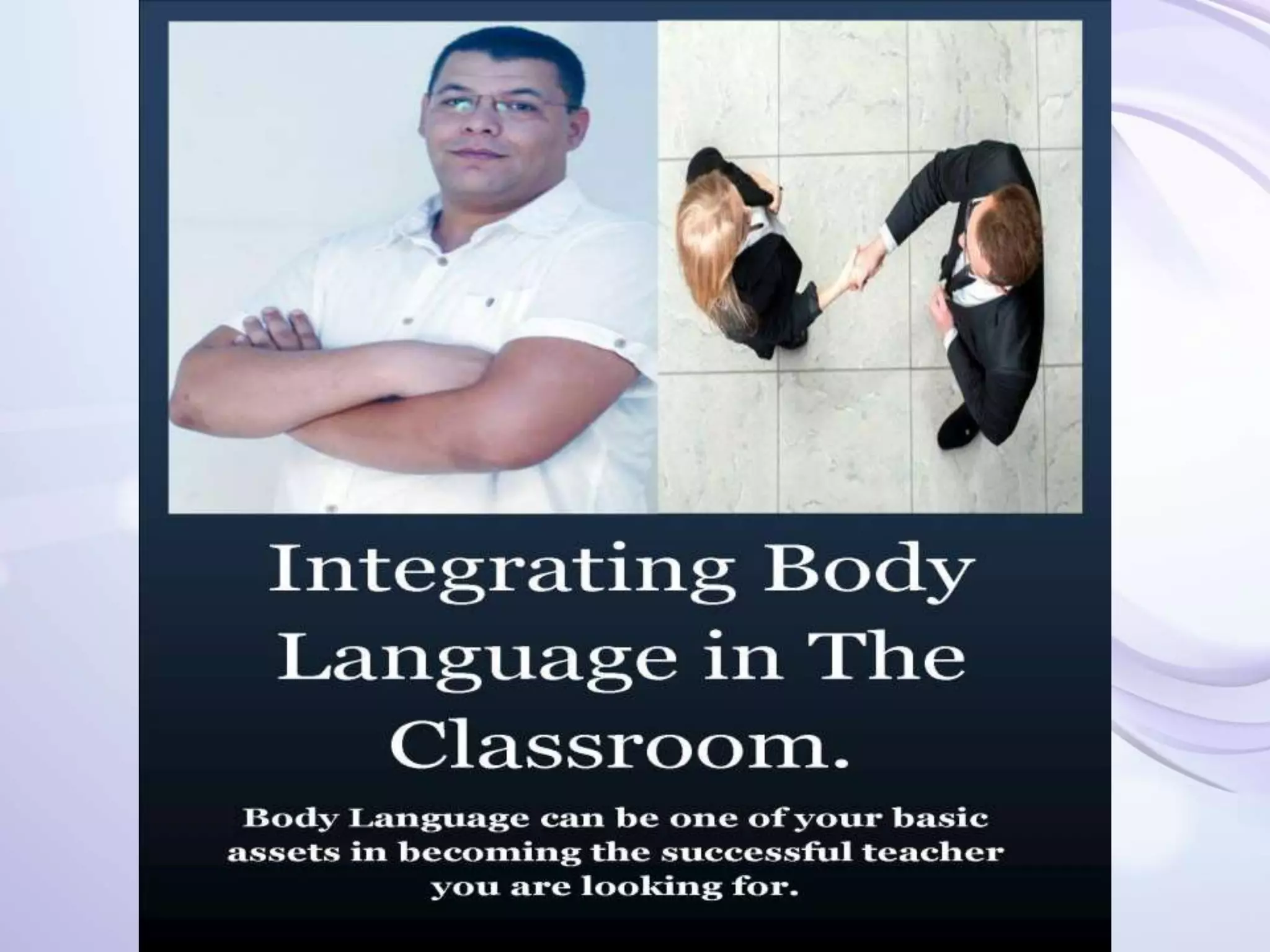
Integrating Body
Language in the
Classroom
Mr. Talel Soualhia
Let the fun begin
• Green card when you approve
• Red card when you disapprove
Integrating Body Language in the Classroom
What is language?
What is communication?
Communication Defined
Types of Communication
Verbal
Written.
Nonverbal
Body language
Components of the communication process
Body language basics.
Game one
Objective: identify the feeling.
Game two:
objective: understand the message from non verbal
clues.
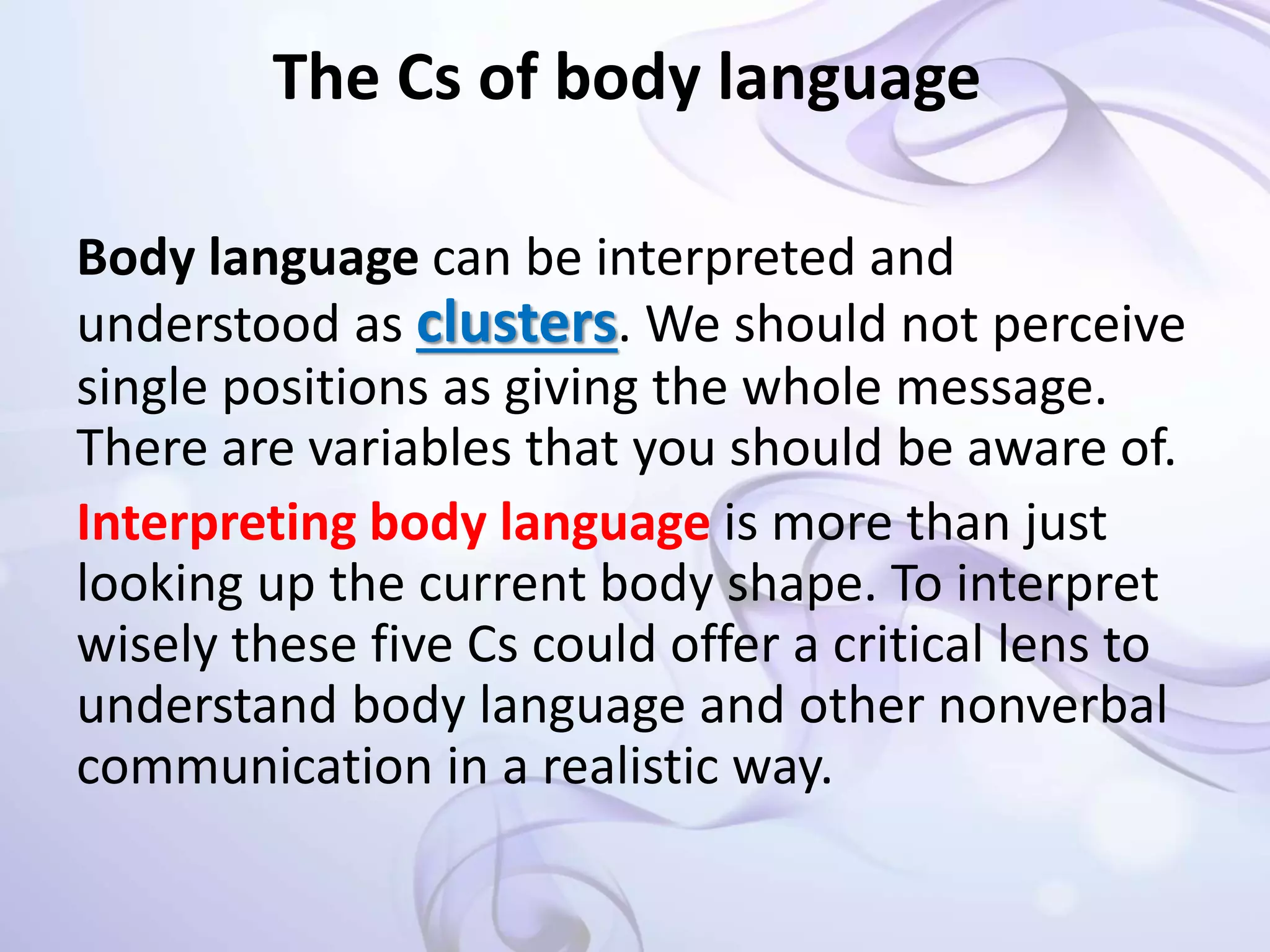
The Cs of body language
Interpreting body language
Cues (triggers)
Changes: (transitions)
Clusters
Character
Context: (the broader context)
Understanding and using body language for teachers.
Elements
KINESICS
Proxemics
Paralanguage
Physical Context
Haptics: the touch
Chronemics
Artifactics
Posture
1- Power posing postures to boost your confidence.
The power of eye gaze: eye contact
The smile: facial expression
Making a grand entrance.
The speaking positions
BLAMER
PLACATER
LEVELLER
COMPUTER
DISTRACTER
What is language?
• Language is the system of words or signs that
people use to express thoughts and feelings to
each other.
• Any of one of the systems of human language
that are used and understood by a particular
group of people.
• (Merriam Webster Dictionary)
What is communication?
Any task or
transaction that
requires more
than one
person can only
be successfully
completed with
communication
Communication Defined
It's nearly impossible to go through a day
without the use of communication.
Communication is sending and receiving
information between two or more people. The
person sending the message is referred to as the
sender, while the person receiving the information
is called the receiver.
The information conveyed can include facts, ideas,
concepts, opinions, beliefs, attitudes, instructions
and even emotions.
Types of Communication
Methods of communication vary, and you are
almost certainly familiar with all of them. Let's
take a look at some of the primary methods.
Verbal communication is
simply sending a message
through a spoken language that
is understood by both the
sender and receiver of the
message.
face-to-face talking
listening to a lecture or seminar
listening to a television
program.
In fact, if you are listening now,
you are engaged in a verbal
form of communication.
Written communication is sending a message by
the use of symbols that are understood by both
the sender and receiver of the message.
If you are reading this transcript, you are
engaged in written communication.
Nonverbal communication is the process
of communication through sending and
receiving wordless (mostly visual) cues between
people.
Body language is a form of nonverbal
communication that can be used to send a
message.
You can often tell if your boss is pleased or upset
simply by looking at his facial expressions,
posture and gestures.
For example, a flushed face may mean
embarrassment; a clinched fist may indicate
anger; and the rolling of one's eyes may signal
disbelief or annoyance.
Components of the
communication process
We portray body
language
that’s why we
need to be
aware of the
message we are
sending out.
93 percent
Body language basics.
Joe Navaro (What everybody is saying) 2011.
For millions of years, humans ambled this planet
navigating a very dangerous world and shared
their knowledge, their fears and desires with
others.
We did it because, as humans we developed a
system of communication. This system instantly
communicates to others around us, whether
consciously or subconsciously, through our
bodies.
This is also why we understand
that when we are talking to someone
we know and like and suddenly they
have their feet pointing to the door
we understand that he or she needs
to go.
How it is done:
Our emotions are processed by the limbic
system of the brain. It does not think. It just
reacts in real times to the world and our bodies
show how we feel.
Game one
Objective: identify the
feeling.
Participants: a volunteer
and audience
Task: the volunteer
enacts the feeling
mentioned in the card
and the audience
guesses it
Time: 2 minutes
Game two:
- objective: understand the
message from non verbal clues.
- Participants: a volunteer to
act + audience
- Task: Audience guesses the
message or what does he want
to convey.
- Material: cards to the
volunteer
- Time: 7 minutes.
Cs
of body language
The Cs of body language
Body language can be interpreted and
understood as clusters. We should not perceive
single positions as giving the whole message.
There are variables that you should be aware of.
Interpreting body language is more than just
looking up the current body shape. To interpret
wisely these five Cs could offer a critical lens to
understand body language and other nonverbal
communication in a realistic way.
Cues (triggers)
What led to the posture, the act, the facial
expression, the movement…
Changes: (transitions)
From open to closed formation as an example.
Changes: (transitions)
From closed to open formation as an example.
Changes: (transitions)
Clusters
While body language can appear as single
events, they often appear as a group of different
movements occurring one after the other.
Clustersexercise:
can you explain what is going on?
Identify the roles
Character
Character
This factor can confound and also can explain.
The general character of the other person.
Is he introverted or extroverted?
He will frequently display large body movements
or concise depending on his character.
(also can be confound with exhibitionism and timidity)
Temperament, mood, and even short-term
emotions can also act as modifiers that affect body
language. Yet, determining the current emotional state,
you may apply this knowledge in your interpretation.
Context: (the broader context)
It affects how the other person thinks, feels and
acts.
- What is going on in his immediate environment.
- Where are you?
- Who is with you?
- Gender interaction.
Understanding and using body
language for teachers.
By following some principles, your
classroom management plan will
be built on a solid foundation.
However, to be remarkably
effective, to create the class you
really want, you have to learn how
to create leverage.
Leverage simply means having
great influence with your
students.
This is where the real power
comes from.
Elements
1. KINESICS
2. Proxemics
3. Paralanguage
4. Physical Context
5. Haptics
6. Chronemics
7. Artifactics
KINESICS
Kinesics is the study of body movements to
judge inner state of emotions expressed through
different parts of the body .
a. Facial Expression and Eyes
b. Gestures
c. Postures
Proxemics
Proxemics is the study of how we use space
round to communicate the message.
• Intimate space
• Personal space
• Social space
• Public space
Invading someone’s
personal space causes
arousal. this arousal
can be interpreted
positively or negatively
depending on the
person (familiar /
stranger)
• In the classroom
Some classroom management
“experts” recommend
standing close to difficult
students during lessons.
But moving into someone’s
personal space without
permission is a show of
dominance. It won’t create
leverage in the long run.
Allow students their personal
space. They’ll appreciate and
respect you for it.
Paralanguage
Paralanguage involves the study of voice quality,
volume, speech rate and the manner of
speaking beyond the said words.
• Tone
• Pitch
• Intensity
• Rhythm
• Tempo
Physical Context
The physical context reflects the space around
something and how that influences how you see
it.
Pay a close attention to your classroom
Haptics: the touch
• Haptics is the study of touching in
communication situation
The subtle
power of
touch:
It boosts
confidence and
happiness.
• In the classroom
A brief tap on the shoulder or arm of a student
you’re speaking with can elicit a subconscious
response that makes you more persuasive.
It does help build rapport
Chronemics
Chronemics is the study of the use of time
in Nonverbal communication. Amount of time
spent with another and time spent in waiting for
others indicate a lot.
Artifactics
Artifactics is the study of non verbal message
signals that an individual sends across through
appearance, clothing, personal objects like pens,
briefcases etc.
Posture
A sagging posture displays
a lack of confidence and is
associated with weak
leadership.
To students, it says that
you’re unsure of yourself.
They won’t listen to or trust
you
Walking tall, with your
body erect and shoulders
straight, engenders
confidence in you as a
leader.
1- Power posing postures to boost
your confidence.
The power of eye gaze: eye contact
the most powerful way we communicate.
A single fleeting look from across the classroom can speak
volumes.
Longer eye contact is associated with trust, good feelings
Be aware, however, that too much eye contact can be
intimidating, especially for shy students.
So we shouldn’t over do it.
The power of eye gaze: eye contact
the most powerful way we communicate.
A single fleeting look from across the classroom can speak
volumes.
Longer eye contact is associated with trust, good feelings
Be aware, however, that too much eye contact can be
intimidating, especially for shy students.
So we shouldn’t over do it.
The smile: facial expression
A smile makes communication easier, less
awkward, and more persuasive. It’s also a mood-
changer and will evoke warm and happy feelings
in both the giver and the recipient.
The smile: facial expression
• According to (facial feedback theory) smiling
makes a person happy.
Making a grand
entrance.
Making a grand entrance.
The cues that you give during the first
seconds or minutes of meeting others can
impress and have a huge impact on them.
How you walk would even control how the rest
of the encounter would be like.
1 – Assess the situation beforehand.
2 – Do not be late.
3 – Show the appropriate emotions for the
situation.
4 – Pause briefly to gather your thoughts.
5 – Maintain eye contact / Gaze at the audience.
6 – Determine when you are not the center of
attention.
7 – Look as if you are glad to be there.
8 – Do not despair if you have blown your opening
move.
The speaking positions
The Satir Categories – 5 non-verbal
patterns of communication –
The Satir Categories – 5 non-verbal
patterns of communication – were described in
the 1970’s by Virginia Satir, a renowned family
therapist.
These gestures/postures communicate
certain archetypal messages that work
internationally and across cultures.
They produce an internal response in both
the presenter and the audience, with the
audience feeling different emotions depending
on how you are standing/gesturing.
BLAMER
• DEMONSTRATES – power, dominance, authority,
in charge and superiority – on the offensive….it’s
your fault not mine…
• VOICE – shrill, tight, loud voice
• AUDIENCE – feel told off/blamed
• USAGE – very sparingly – positively to empower
an individual, punch a point home, to get through
to someone who just isn’t getting the message or
for short guilt trips. Soften by pointing above the
audience or using two fingers.
PLACATER
• DEMONSTRATES – helplessness, pleading,
dependence, vulnerability, begging.
• AUDIENCE – feel you’re a “Yes man”, can’t think
for yourself, just want their approval, trying to
please, run from conflict…
• WARNING – women should avoid this gesture –
ingratiating, weakens your position.
• USAGE – men only, use when say something
confrontational to soften the blow or for
sympathy.
LEVELLER
(hands start at chest height and move down and out
as if resting on a desk)
• DEMONSTRATES – frankness, truth, strength,
honesty, openness, sincerity, calming.
• VOICE – slow, calm, includes pauses.
• AUDIENCE – feels you level with them –
candid and forthright – tell them the truth.
• USAGE – good for giving impartial or factual
information, use for believability, to convince
an audience, bring them down to earth.
COMPUTER
• DEMONSTRATES – intellect, thinker, professor,
logical, sensible, considering, rational, analytical,
unemotional and super reasonable.
• VOICE – slow/monotone voice and long words.
• USAGE – great to show someone you’re
considering what they say, good diffusion tactic
when challenged by the audience, use to
separate your message from emotions or to buy
time.
DISTRACTER
• DEMONSTRATES – fun, laughs, jokes, clown – literally distracting.
• WARNING – avoid for serious messages, always asymmetric in
gesture/posture – switches continually between categories, never
makes sense! Can seem panicky…
• USAGE – use only for fun and to create energy/surprise. Don’t
overuse!
• So next time you’re presenting, or even just talking to someone
face to face, try these out. Computer is a perfect starting point and
can be of value in a host of different situations. Are there any other
gestures or postures that you use that you think are great for
getting a certain message across?
Notes
In general people are good at
understanding facial expressions, body language
and finally personal space and touch.
Even understanding one channel is
sometimes difficult as we may decode pleasant
facial expressions rather than unpleasant.
• In the far lands of Peru, there lived a tribe of warriors
called Lingo. Juan, was the youngest among seven of the
chief’s tribe sons. Lingo was preparing for the battle
against Mingo and all the members of the tribe were
ready for it. They were all born to be warriors.
• Juan was very little and young but full of eagerness and
willingness. He wants to join the battle with his brothers
but his weak body didn’t give him way. Hence, he went to
his older brother Bruno to teach him how to use the
sword. “Juan, take the sword and fight me like a warrior
must do” ordered Bruno. Juan took the sword awkwardly
and tried to direct a hit or cover himself from being killed
but he couldn’t. “you must use your body aptly as for the
sword to travel to its purpose ” advised Bruno.
• The chief was inspecting the scene and with the words of
the wise told Juan “When you fight stand up firmly use
your hands firmly and never lean your back and always
inspect the eyes and they will know your will”.

Body language for teachers

  • 2.
    Integrating Body Language inthe Classroom Mr. Talel Soualhia
  • 6.
    Let the funbegin • Green card when you approve • Red card when you disapprove
  • 7.
    Integrating Body Languagein the Classroom What is language? What is communication? Communication Defined Types of Communication Verbal Written. Nonverbal Body language Components of the communication process Body language basics. Game one Objective: identify the feeling. Game two: objective: understand the message from non verbal clues. The Cs of body language Interpreting body language Cues (triggers) Changes: (transitions) Clusters Character Context: (the broader context) Understanding and using body language for teachers. Elements KINESICS Proxemics Paralanguage Physical Context Haptics: the touch Chronemics Artifactics Posture 1- Power posing postures to boost your confidence. The power of eye gaze: eye contact The smile: facial expression Making a grand entrance. The speaking positions BLAMER PLACATER LEVELLER COMPUTER DISTRACTER
  • 8.
    What is language? •Language is the system of words or signs that people use to express thoughts and feelings to each other. • Any of one of the systems of human language that are used and understood by a particular group of people. • (Merriam Webster Dictionary)
  • 9.
    What is communication? Anytask or transaction that requires more than one person can only be successfully completed with communication
  • 10.
    Communication Defined It's nearlyimpossible to go through a day without the use of communication. Communication is sending and receiving information between two or more people. The person sending the message is referred to as the sender, while the person receiving the information is called the receiver. The information conveyed can include facts, ideas, concepts, opinions, beliefs, attitudes, instructions and even emotions.
  • 11.
    Types of Communication Methodsof communication vary, and you are almost certainly familiar with all of them. Let's take a look at some of the primary methods.
  • 12.
    Verbal communication is simplysending a message through a spoken language that is understood by both the sender and receiver of the message. face-to-face talking listening to a lecture or seminar listening to a television program. In fact, if you are listening now, you are engaged in a verbal form of communication.
  • 13.
    Written communication issending a message by the use of symbols that are understood by both the sender and receiver of the message. If you are reading this transcript, you are engaged in written communication.
  • 14.
    Nonverbal communication isthe process of communication through sending and receiving wordless (mostly visual) cues between people.
  • 15.
    Body language isa form of nonverbal communication that can be used to send a message. You can often tell if your boss is pleased or upset simply by looking at his facial expressions, posture and gestures. For example, a flushed face may mean embarrassment; a clinched fist may indicate anger; and the rolling of one's eyes may signal disbelief or annoyance.
  • 16.
  • 17.
    We portray body language that’swhy we need to be aware of the message we are sending out.
  • 18.
  • 21.
    Body language basics. JoeNavaro (What everybody is saying) 2011. For millions of years, humans ambled this planet navigating a very dangerous world and shared their knowledge, their fears and desires with others. We did it because, as humans we developed a system of communication. This system instantly communicates to others around us, whether consciously or subconsciously, through our bodies.
  • 22.
    This is alsowhy we understand that when we are talking to someone we know and like and suddenly they have their feet pointing to the door we understand that he or she needs to go.
  • 23.
    How it isdone: Our emotions are processed by the limbic system of the brain. It does not think. It just reacts in real times to the world and our bodies show how we feel.
  • 24.
    Game one Objective: identifythe feeling. Participants: a volunteer and audience Task: the volunteer enacts the feeling mentioned in the card and the audience guesses it Time: 2 minutes
  • 25.
    Game two: - objective:understand the message from non verbal clues. - Participants: a volunteer to act + audience - Task: Audience guesses the message or what does he want to convey. - Material: cards to the volunteer - Time: 7 minutes.
  • 26.
  • 28.
    The Cs ofbody language Body language can be interpreted and understood as clusters. We should not perceive single positions as giving the whole message. There are variables that you should be aware of. Interpreting body language is more than just looking up the current body shape. To interpret wisely these five Cs could offer a critical lens to understand body language and other nonverbal communication in a realistic way.
  • 29.
    Cues (triggers) What ledto the posture, the act, the facial expression, the movement…
  • 30.
  • 31.
    Changes: (transitions) From opento closed formation as an example.
  • 32.
    Changes: (transitions) From closedto open formation as an example.
  • 33.
  • 34.
    Clusters While body languagecan appear as single events, they often appear as a group of different movements occurring one after the other.
  • 35.
    Clustersexercise: can you explainwhat is going on? Identify the roles
  • 36.
  • 39.
    Character This factor canconfound and also can explain. The general character of the other person. Is he introverted or extroverted? He will frequently display large body movements or concise depending on his character. (also can be confound with exhibitionism and timidity) Temperament, mood, and even short-term emotions can also act as modifiers that affect body language. Yet, determining the current emotional state, you may apply this knowledge in your interpretation.
  • 40.
  • 41.
    Context: (the broadercontext) It affects how the other person thinks, feels and acts. - What is going on in his immediate environment. - Where are you? - Who is with you? - Gender interaction.
  • 42.
    Understanding and usingbody language for teachers.
  • 45.
    By following someprinciples, your classroom management plan will be built on a solid foundation. However, to be remarkably effective, to create the class you really want, you have to learn how to create leverage. Leverage simply means having great influence with your students. This is where the real power comes from.
  • 46.
    Elements 1. KINESICS 2. Proxemics 3.Paralanguage 4. Physical Context 5. Haptics 6. Chronemics 7. Artifactics
  • 47.
    KINESICS Kinesics is thestudy of body movements to judge inner state of emotions expressed through different parts of the body . a. Facial Expression and Eyes b. Gestures c. Postures
  • 48.
    Proxemics Proxemics is thestudy of how we use space round to communicate the message. • Intimate space • Personal space • Social space • Public space
  • 52.
    Invading someone’s personal spacecauses arousal. this arousal can be interpreted positively or negatively depending on the person (familiar / stranger)
  • 53.
    • In theclassroom Some classroom management “experts” recommend standing close to difficult students during lessons. But moving into someone’s personal space without permission is a show of dominance. It won’t create leverage in the long run. Allow students their personal space. They’ll appreciate and respect you for it.
  • 54.
    Paralanguage Paralanguage involves thestudy of voice quality, volume, speech rate and the manner of speaking beyond the said words. • Tone • Pitch • Intensity • Rhythm • Tempo
  • 55.
    Physical Context The physicalcontext reflects the space around something and how that influences how you see it. Pay a close attention to your classroom
  • 56.
    Haptics: the touch •Haptics is the study of touching in communication situation
  • 57.
    The subtle power of touch: Itboosts confidence and happiness.
  • 58.
    • In theclassroom A brief tap on the shoulder or arm of a student you’re speaking with can elicit a subconscious response that makes you more persuasive. It does help build rapport
  • 59.
    Chronemics Chronemics is thestudy of the use of time in Nonverbal communication. Amount of time spent with another and time spent in waiting for others indicate a lot.
  • 60.
    Artifactics Artifactics is thestudy of non verbal message signals that an individual sends across through appearance, clothing, personal objects like pens, briefcases etc.
  • 61.
    Posture A sagging posturedisplays a lack of confidence and is associated with weak leadership. To students, it says that you’re unsure of yourself. They won’t listen to or trust you Walking tall, with your body erect and shoulders straight, engenders confidence in you as a leader.
  • 63.
    1- Power posingpostures to boost your confidence.
  • 67.
    The power ofeye gaze: eye contact the most powerful way we communicate. A single fleeting look from across the classroom can speak volumes. Longer eye contact is associated with trust, good feelings Be aware, however, that too much eye contact can be intimidating, especially for shy students. So we shouldn’t over do it.
  • 68.
    The power ofeye gaze: eye contact the most powerful way we communicate. A single fleeting look from across the classroom can speak volumes. Longer eye contact is associated with trust, good feelings Be aware, however, that too much eye contact can be intimidating, especially for shy students. So we shouldn’t over do it.
  • 69.
    The smile: facialexpression A smile makes communication easier, less awkward, and more persuasive. It’s also a mood- changer and will evoke warm and happy feelings in both the giver and the recipient.
  • 70.
    The smile: facialexpression • According to (facial feedback theory) smiling makes a person happy.
  • 71.
  • 72.
    Making a grandentrance. The cues that you give during the first seconds or minutes of meeting others can impress and have a huge impact on them. How you walk would even control how the rest of the encounter would be like.
  • 73.
    1 – Assessthe situation beforehand. 2 – Do not be late. 3 – Show the appropriate emotions for the situation. 4 – Pause briefly to gather your thoughts. 5 – Maintain eye contact / Gaze at the audience. 6 – Determine when you are not the center of attention. 7 – Look as if you are glad to be there. 8 – Do not despair if you have blown your opening move.
  • 74.
    The speaking positions TheSatir Categories – 5 non-verbal patterns of communication –
  • 75.
    The Satir Categories– 5 non-verbal patterns of communication – were described in the 1970’s by Virginia Satir, a renowned family therapist. These gestures/postures communicate certain archetypal messages that work internationally and across cultures. They produce an internal response in both the presenter and the audience, with the audience feeling different emotions depending on how you are standing/gesturing.
  • 77.
    BLAMER • DEMONSTRATES –power, dominance, authority, in charge and superiority – on the offensive….it’s your fault not mine… • VOICE – shrill, tight, loud voice • AUDIENCE – feel told off/blamed • USAGE – very sparingly – positively to empower an individual, punch a point home, to get through to someone who just isn’t getting the message or for short guilt trips. Soften by pointing above the audience or using two fingers.
  • 79.
    PLACATER • DEMONSTRATES –helplessness, pleading, dependence, vulnerability, begging. • AUDIENCE – feel you’re a “Yes man”, can’t think for yourself, just want their approval, trying to please, run from conflict… • WARNING – women should avoid this gesture – ingratiating, weakens your position. • USAGE – men only, use when say something confrontational to soften the blow or for sympathy.
  • 81.
    LEVELLER (hands start atchest height and move down and out as if resting on a desk) • DEMONSTRATES – frankness, truth, strength, honesty, openness, sincerity, calming. • VOICE – slow, calm, includes pauses. • AUDIENCE – feels you level with them – candid and forthright – tell them the truth. • USAGE – good for giving impartial or factual information, use for believability, to convince an audience, bring them down to earth.
  • 83.
    COMPUTER • DEMONSTRATES –intellect, thinker, professor, logical, sensible, considering, rational, analytical, unemotional and super reasonable. • VOICE – slow/monotone voice and long words. • USAGE – great to show someone you’re considering what they say, good diffusion tactic when challenged by the audience, use to separate your message from emotions or to buy time.
  • 85.
    DISTRACTER • DEMONSTRATES –fun, laughs, jokes, clown – literally distracting. • WARNING – avoid for serious messages, always asymmetric in gesture/posture – switches continually between categories, never makes sense! Can seem panicky… • USAGE – use only for fun and to create energy/surprise. Don’t overuse! • So next time you’re presenting, or even just talking to someone face to face, try these out. Computer is a perfect starting point and can be of value in a host of different situations. Are there any other gestures or postures that you use that you think are great for getting a certain message across?
  • 86.
    Notes In general peopleare good at understanding facial expressions, body language and finally personal space and touch. Even understanding one channel is sometimes difficult as we may decode pleasant facial expressions rather than unpleasant.
  • 87.
    • In thefar lands of Peru, there lived a tribe of warriors called Lingo. Juan, was the youngest among seven of the chief’s tribe sons. Lingo was preparing for the battle against Mingo and all the members of the tribe were ready for it. They were all born to be warriors. • Juan was very little and young but full of eagerness and willingness. He wants to join the battle with his brothers but his weak body didn’t give him way. Hence, he went to his older brother Bruno to teach him how to use the sword. “Juan, take the sword and fight me like a warrior must do” ordered Bruno. Juan took the sword awkwardly and tried to direct a hit or cover himself from being killed but he couldn’t. “you must use your body aptly as for the sword to travel to its purpose ” advised Bruno. • The chief was inspecting the scene and with the words of the wise told Juan “When you fight stand up firmly use your hands firmly and never lean your back and always inspect the eyes and they will know your will”.