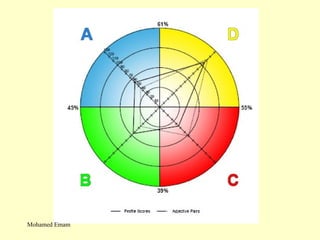
Mohamed Emam
HBDI   ; The Hermann Brain Dominance Instrument  Thinking Preferences in the Workplace JOHAN OLWAGEN  MA (Counselling Psychology); HDE (Post Grad) Director: Kitso-Khumo Business Consulting (Pty) Ltd [email_address] 082-552-9542 ()12) 344-1390 Mohamed Emam Wisdom  Is Wealth
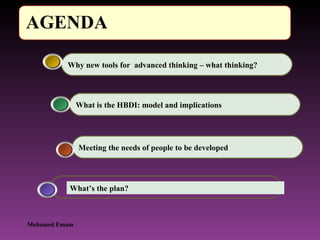
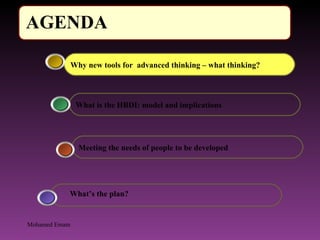
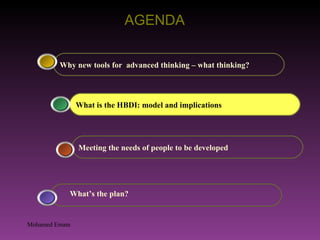
Meeting the needs of people to be developed What is the HBDI: model and implications Why new tools for  advanced thinking – what thinking? What’s the plan? Mohamed Emam
HBDI OBJECTIVES Applying modern tools  To create advanced thinking skills  To enrich the learning experience  Mohamed Emam
Mohamed Emam Cognitive Modifiability proposes  that every person has the capacity to reach their own personal potential of excellence,  if their teachers, facilitators, trainers, managers, therapists and parents understand  how better to relate and transfer information; how better to interact on a human-to-human level. Who is the best leader ??
Meeting the needs of people to be developed What is the HBDI: model and implications Why new tools for  advanced thinking – what thinking? What’s the plan? Mohamed Emam
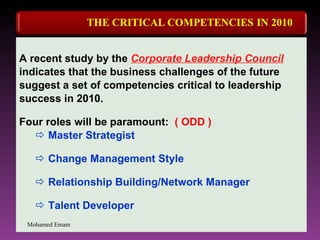
A recent study by the  Corporate Leadership Council   indicates that the business challenges of the future  suggest a set of competencies critical to leadership  success in 2010.  Four roles will be paramount:  ( ODD ) Master Strategist  Change Management Style Relationship Building/Network Manager Talent Developer Mohamed Emam
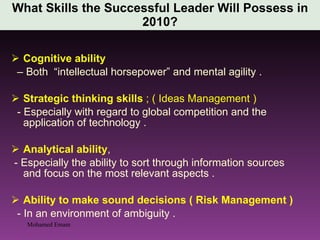
What Skills the Successful Leader Will Possess in 2010? Cognitive ability  –  Both  “intellectual horsepower” and mental agility . Strategic thinking skills  ; ( Ideas Management ) - Especially with regard to global competition and the  application of technology . Analytical ability ,  - Especially the ability to sort through information sources and focus on the most relevant aspects . Ability to make sound decisions ( Risk Management ) - In an environment of ambiguity . Mohamed Emam
Influence and persuasion  - Within the organization as well as with customers, suppliers, strategic partners, external constituents, and investors . Ability to manage diversity in the environment  . Employing variety of management styles  -  To deal with multiple generations in the workplace . What Skills the Successful Leader Will Possess in 2010? Mohamed Emam
The ability to delegate tasks and responsibilities to others, while at the same time managing risk and establishing appropriate controls . The ability to identify, attract, develop, and retain talent at all levels . Personal adaptability . What Skills the Successful Leader Will Possess in 2010? Mohamed Emam
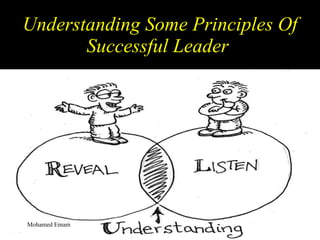
Understanding Some Principles Of Successful Leader  Mohamed Emam
Mohamed Emam
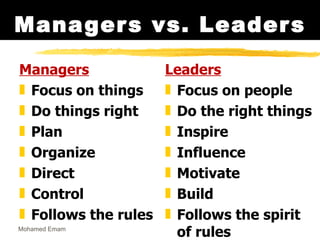
Managers vs. Leaders Managers Focus on things Do things right Plan Organize Direct Control Follows the rules Leaders Focus on people Do the right things Inspire Influence Motivate Build  Follows the spirit of rules Mohamed Emam
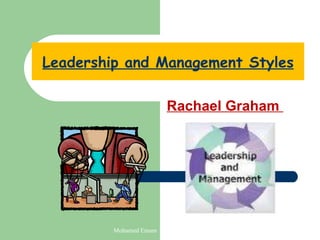
Leadership and Management Styles Rachael Graham  Mohamed Emam
Styles of Leadership… There are four basic categories of leadership style… Autocratic or authoritarian leadership Paternalistic leadership Democratic leadership MBO Mohamed Emam
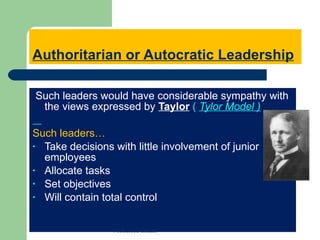
Authoritarian or Autocratic Leadership Such leaders would have considerable sympathy with the views expressed by  Taylor   (  Tylor Model ) Such leaders… Take decisions with little involvement of junior employees Allocate tasks Set objectives Will contain total control  Mohamed Emam
Authoritarian Ctd… Such leaders, use a one-way communication system, downwards from leader to subordinate. Is it applied ….. !! This style of leadership may be appropriate when  quick decisions are required, or when large numbers of un-skilled employees are involved . Mohamed Emam
Paternalistic Leadership This is a leadership style which is quite dictatorial, yet decisions are taken in the best interests of the employees. This style’s key features include… This form of leadership explains decisions It also ensures employees’ social and leisure needs are met. Mohamed Emam
Democratic Leadership Bill Gates Model  This form of leadership involves running a business on the basis on the majority of decisions. This methods main features include… Encourages employees to take part in decision-making . This method also uses delegation . Mohamed Emam
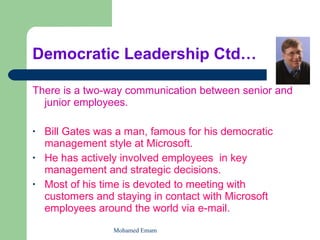
Democratic Leadership Ctd… There is a two-way communication between senior and junior employees.   Bill Gates was a man, famous for his democratic management style at Microsoft.  He has actively involved employees  in key management and strategic decisions.  Most of his time is devoted to meeting with customers and staying in contact with Microsoft employees around the world via e-mail.   Mohamed Emam
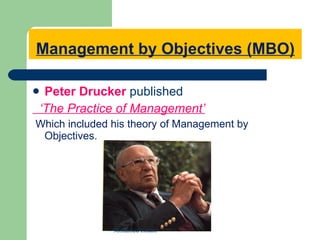
Management by Objectives (MBO) Peter Drucker   published  ‘ The Practice of Management’ Which included his theory of Management by Objectives. Mohamed Emam
Advantages of MBO It can improve the communication within the organisation as the target-setting and evaluation process takes place  ( ENHANCE self management ) Employees may be  motivated  by understanding what they are trying to achieve, and how it helps the business achieve its overall goal. MBO can highlight training needs for managers and sub-ordinates, improving their performance and productivity . Mohamed Emam
Disadvantages of MBO Some employees may see the setting of targets as threatening. A manager might set targets that the subordinate considers unachievable ( T ) Now Threat become Challenge (SWOT)  (SWOC) Mohamed Emam
Mohamed Emam
Definition Thoughtful, Careful, and Systematic examination of Ideas Mohamed Emam
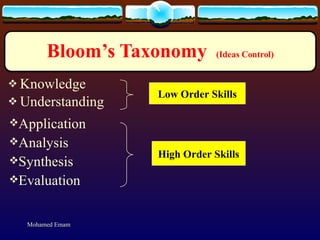
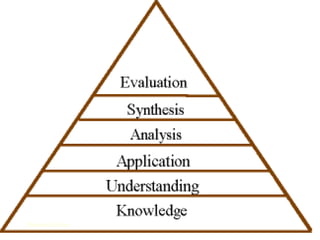
Knowledge Understanding Low Order Skills High Order Skills Application Analysis Synthesis Evaluation Mohamed Emam
Mohamed Emam
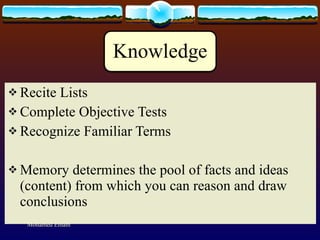
Recite Lists Complete Objective Tests Recognize Familiar Terms Memory determines the pool of facts and ideas (content) from which you can reason and draw conclusions Mohamed Emam
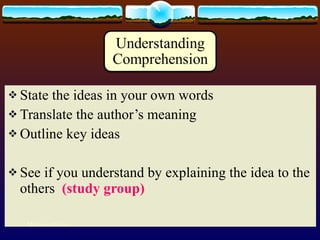
State the ideas in your own words Translate the author’s meaning Outline key ideas See if you understand by explaining the idea to the others  (study group) Mohamed Emam
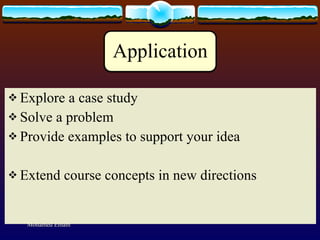
Explore a case study Solve a problem  Provide examples to support your idea Extend course concepts in new directions Mohamed Emam
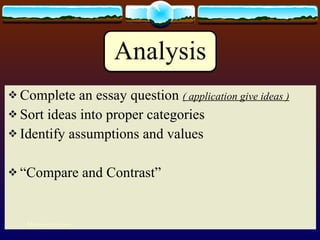
Complete an essay question  ( application give ideas ) Sort ideas into proper categories Identify assumptions and values “ Compare and Contrast” Mohamed Emam
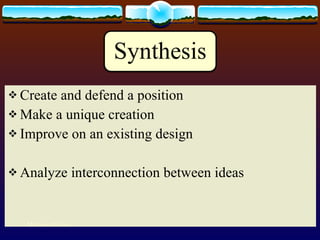
Create and defend a position Make a unique creation Improve on an existing design Analyze interconnection between ideas Mohamed Emam
Criticize a position Judge quality using criteria Cite advantages and disadvantages Key to making decisions Mohamed Emam
Mohamed Emam
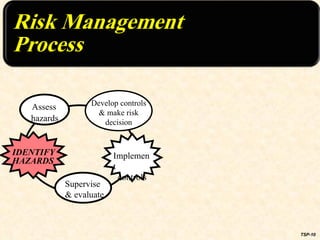
TSP-5 Risk Management  ; -  The process of identifying and controlling hazards to protect the force. It’s five steps represent a logical thought process from which users develop tools, techniques, and procedures for applying risk management in their areas of responsibility. It is a closed-loop process applicable to any situation and environment. Understanding Risk Management Principles
TSP-6 Hazard   ; Any real or potential condition  that can cause injury, illness or death of personnel, or damage to, or loss of equipment or property, or mission degradation.  Risk  - chance of hazard or bad consequences; exposure to chance of injury or loss. (Oxford Dictionary, 1976)
TSP-7 Risk level  ; -  It  is expressed in terms of hazard probability and severity. Probability   - the likelihood that an event will occur. Severity  - the expected consequence of an  event in terms of  degree of injury, property damage, or other mission impairing factors  (loss of combat power, etc..,) that could occur.
TSP-8 Risk Assessment  ; The identification and assessment of hazards (first two steps of the Risk Management process). Controls  - actions taken to eliminate hazards or reduce their risk(s).
TSP-9 Residual Risk ; the level of risk remaining after controls have been identified and selected.  Risk Decision  ; -  the decision to accept or not accept the risk(s) associated with an action made  by the commander, leader, or the individual responsible for performing that action.
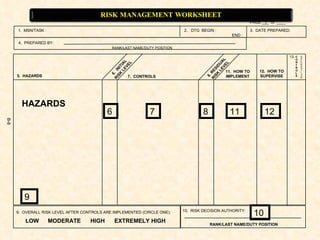
1.  MSN/TASK :  2.  DTG  BEGIN :  3.  DATE PREPARED:      END :  4.  PREPARED BY: 9.  OVERALL RISK LEVEL AFTER CONTROLS ARE IMPLEMENTED (CIRCLE ONE): 5.  HAZARDS 7.  CONTROLS 11.  HOW TO IMPLEMENT 12.  HOW TO SUPERVISE 6.  INITIAL  RISK LEVEL 8. RESIDUAL RISK LEVEL RANK/LAST NAME/DUTY POSITION 10.  RISK DECISION AUTHORITY: RANK/LAST NAME/DUTY POSITION LOW  MODERATE  HIGH  EXTREMELY HIGH C O N T R  O L S E F F E C T I V E 13. PAGE ___  of  ____ 1 B-8 6 7 8 11 12 HAZARDS 9 10
TSP-10 Assess hazards Implement controls Supervise & evaluate IDENTIFY  HAZARDS Develop controls & make risk decision
AGENDA Meeting the needs of people to be developed What is the HBDI: model and implications Why new tools for  advanced thinking – what thinking? What’s the plan? Mohamed Emam
Mohamed Emam
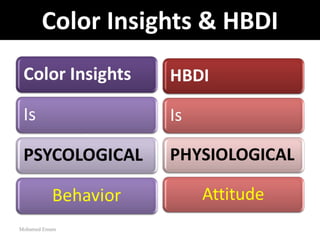
Color Insights & HBDI Mohamed Emam
Mohamed Emam
Mohamed Emam
Mohamed Emam
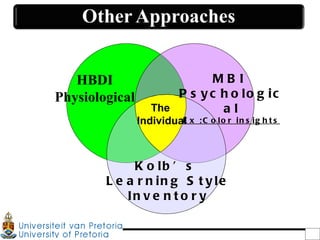
MBI  Psychological Ex ;Color insights HBDI Physiological Kolb’s  Learning Style Inventory The  Individual
Mohamed Emam
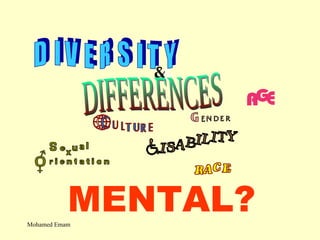
DIVERSITY DIFFERENCES MENTAL? Mohamed Emam
Mohamed Emam
Mohamed Emam
The Herrmann Model of Thinking Preferences Monika Lumsdaine Management Consultant for Corporate Behavior Certified HBDI Practitioner, Textbook Co-Author
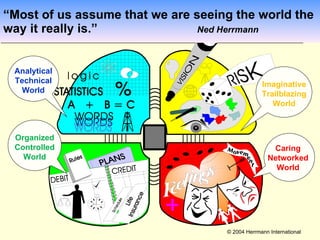
“ Most of us assume that we are seeing the world the way it really is.”   Ned Herrmann Analytical Technical World Organized Controlled World Imaginative Trailblazing World Caring Networked World
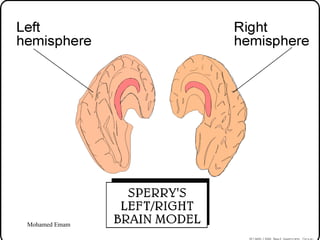
Benefits of Understanding and Using the HBDI  Personal Benefits Understanding the brain dominance model  and your own thinking patterns can lead to improved teamwork and communication skills Organizational Benefits Mentally diverse teams can obtain optimum problem solving results. The purposeful use of multiple thinking styles  can meet the requirements of a global marketplace,  diverse customers, changing technology, and innovation.
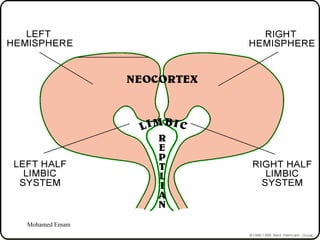
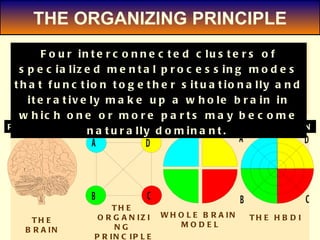
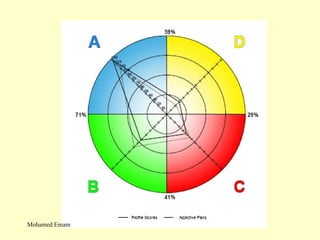
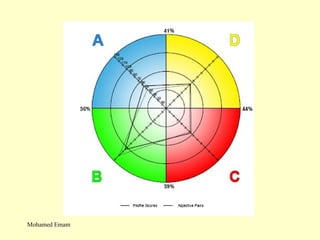
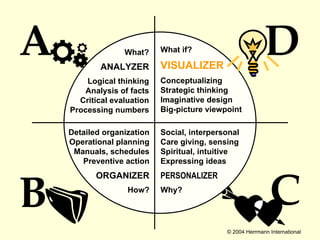
THE ORGANIZING PRINCIPLE PHYSIOLOGY THE BRAIN METAPHOR WHOLE BRAIN  MODEL ARCHITECTURE THE  ORGANIZING  PRINCIPLE APPLICATION THE HBDI Four interconnected clusters of specialized mental processing modes that function together situationally and iteratively make up a whole brain in which one or more parts may become naturally dominant.
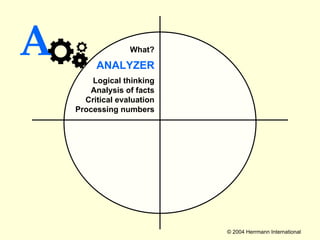
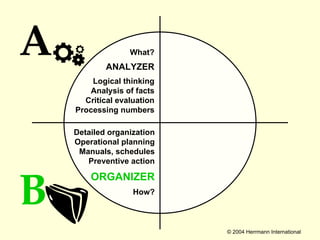
What? ANALYZER Logical thinking Analysis of facts Critical evaluation Processing numbers A
Mohamed Emam
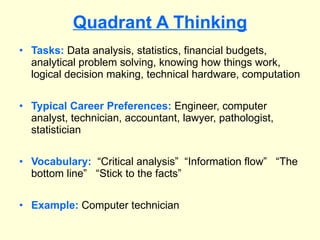
Quadrant A Thinking Tasks:   Data analysis, statistics, financial budgets, analytical problem solving, knowing how things work, logical decision making, technical hardware, computation Typical Career Preferences:   Engineer, computer analyst, technician, accountant, lawyer, pathologist, statistician Vocabulary:   “Critical analysis”  “Information flow”  “The bottom line”  “Stick to the facts” Example:   Computer technician
What? ANALYZER Logical thinking Analysis of facts Critical evaluation Processing numbers A Detailed organization Operational planning Manuals, schedules Preventive action ORGANIZER How? B
Mohamed Emam
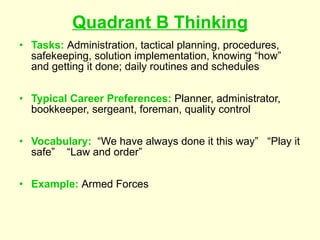
Quadrant B Thinking Tasks:   Administration, tactical planning, procedures, safekeeping, solution implementation, knowing “how” and getting it done; daily routines and schedules Typical Career Preferences:   Planner, administrator, bookkeeper, sergeant, foreman, quality control Vocabulary:   “We have always done it this way”  “Play it safe”  “Law and order” Example:   Armed Forces
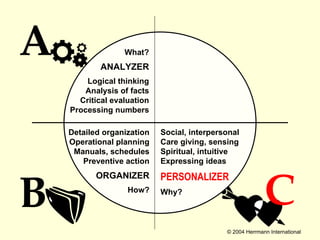
What? ANALYZER Logical thinking Analysis of facts Critical evaluation Processing numbers A Detailed organization Operational planning Manuals, schedules Preventive action ORGANIZER How? B Social, interpersonal Care giving, sensing Spiritual, intuitive Expressing ideas PERSONALIZER Why? C
 
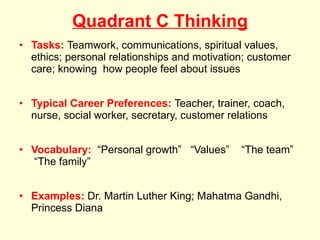
Quadrant C Thinking Tasks:   Teamwork, communications, spiritual values, ethics; personal relationships and motivation; customer care; knowing  how people feel about issues Typical Career Preferences:   Teacher, trainer, coach, nurse, social worker, secretary, customer relations Vocabulary:   “Personal growth”  “Values”  “The team”  “The family” Examples:   Dr. Martin Luther King; Mahatma Gandhi, Princess Diana
What? ANALYZER Logical thinking Analysis of facts Critical evaluation Processing numbers A Detailed organization Operational planning Manuals, schedules Preventive action ORGANIZER How? B Social, interpersonal Care giving, sensing Spiritual, intuitive Expressing ideas PERSONALIZER Why? C What if? VISUALIZER Conceptualizing Strategic thinking Imaginative design Big-picture viewpoint D
Mohamed Emam
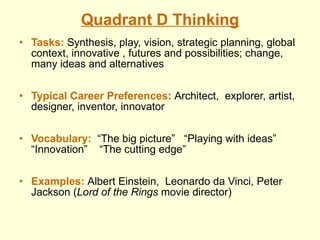
Quadrant D Thinking Tasks:   Synthesis, play, vision, strategic planning, global context, innovative , futures and possibilities; change, many ideas and alternatives Typical Career Preferences :   Architect,  explorer, artist, designer, inventor, innovator Vocabulary:   “The big picture”  “Playing with ideas”  “Innovation”  “The cutting edge” Examples:   Albert Einstein,  Leonardo da Vinci, Peter Jackson ( Lord of the Rings  movie director)
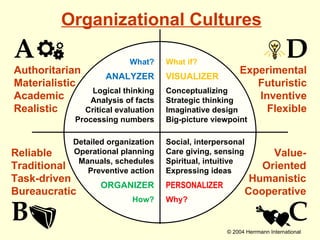
Organizational Cultures What? ANALYZER Logical thinking Analysis of facts Critical evaluation Processing numbers A Detailed organization Operational planning Manuals, schedules Preventive action ORGANIZER How? B Social, interpersonal Care giving, sensing Spiritual, intuitive Expressing ideas PERSONALIZER Why? C What if? VISUALIZER Conceptualizing Strategic thinking Imaginative design Big-picture viewpoint D Authoritarian Materialistic Academic Realistic Reliable Traditional Task-driven Bureaucratic Value- Oriented Humanistic Cooperative Experimental Futuristic Inventive Flexible
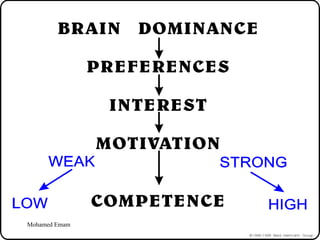
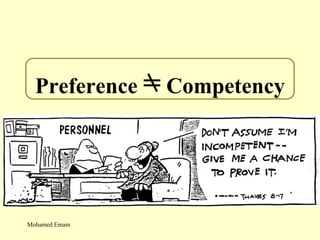
Preference  =  Competency Mohamed Emam
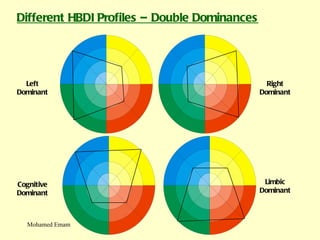
Different HBDI Profiles – Double Dominances Left Dominant Right Dominant Cognitive Dominant Limbic Dominant Mohamed Emam ©2000 Ned Herrmann Group
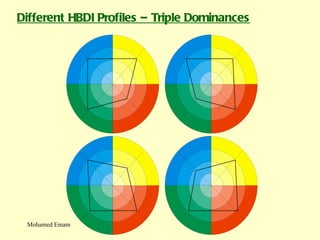
Different HBDI Profiles – Triple Dominances Mohamed Emam ©2000 Ned Herrmann Group
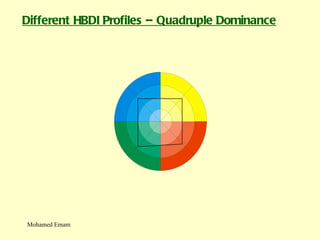
Different HBDI Profiles – Quadruple Dominance Mohamed Emam
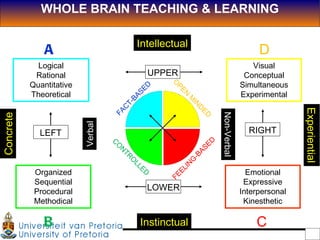
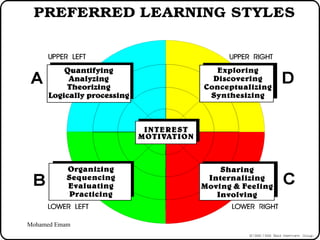
WHOLE BRAIN TEACHING & LEARNING Logical Rational Quantitative Theoretical Organized Sequential Procedural Methodical Visual Conceptual Simultaneous Experimental Emotional Expressive Interpersonal Kinesthetic A B C D RIGHT LEFT UPPER LOWER Experiential Concrete Intellectual Instinctual OPEN MINDED FEELING-BASED CONTROLLED FACT-BASED Non-Verbal Verbal
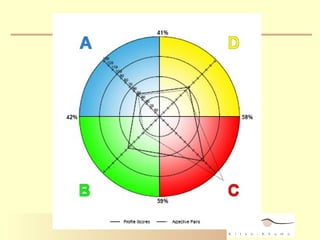
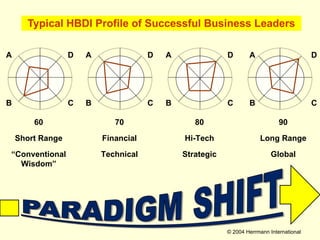
Typical HBDI Profile of Successful Business Leaders A   D B  C 60 Short Range “ Conventional Wisdom” A   D B  C 70 Financial Technical A   D B  C 80 Hi-Tech Strategic A   D B  C 90 Long Range Global
AGENDA Meeting the needs of people to be developed What is the HBDI: model and implications Why new tools for  advanced thinking – what thinking? What’s the plan? Mohamed Emam
THE HBDI & LEARNING Mohamed Emam
Mohamed Emam
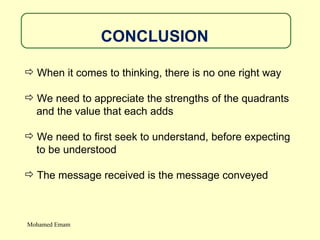
CONCLUSION When it comes to thinking, there is no one right way We need to appreciate the strengths of the quadrants  and the value that each adds We need to first seek to understand, before expecting  to be understood The message received is the message conveyed Mohamed Emam
Thanks Mohamed Emam Mohamed Emam

Hbdi

  • 1.
  • 2.
    HBDI ; The Hermann Brain Dominance Instrument Thinking Preferences in the Workplace JOHAN OLWAGEN MA (Counselling Psychology); HDE (Post Grad) Director: Kitso-Khumo Business Consulting (Pty) Ltd [email_address] 082-552-9542 ()12) 344-1390 Mohamed Emam Wisdom Is Wealth
  • 3.
    Meeting the needsof people to be developed What is the HBDI: model and implications Why new tools for advanced thinking – what thinking? What’s the plan? Mohamed Emam
  • 4.
    HBDI OBJECTIVES Applyingmodern tools To create advanced thinking skills To enrich the learning experience Mohamed Emam
  • 5.
    Mohamed Emam CognitiveModifiability proposes that every person has the capacity to reach their own personal potential of excellence, if their teachers, facilitators, trainers, managers, therapists and parents understand how better to relate and transfer information; how better to interact on a human-to-human level. Who is the best leader ??
  • 6.
    Meeting the needsof people to be developed What is the HBDI: model and implications Why new tools for advanced thinking – what thinking? What’s the plan? Mohamed Emam
  • 7.
    A recent studyby the Corporate Leadership Council indicates that the business challenges of the future suggest a set of competencies critical to leadership success in 2010. Four roles will be paramount: ( ODD ) Master Strategist Change Management Style Relationship Building/Network Manager Talent Developer Mohamed Emam
  • 8.
    What Skills theSuccessful Leader Will Possess in 2010? Cognitive ability – Both “intellectual horsepower” and mental agility . Strategic thinking skills ; ( Ideas Management ) - Especially with regard to global competition and the application of technology . Analytical ability , - Especially the ability to sort through information sources and focus on the most relevant aspects . Ability to make sound decisions ( Risk Management ) - In an environment of ambiguity . Mohamed Emam
  • 9.
    Influence and persuasion - Within the organization as well as with customers, suppliers, strategic partners, external constituents, and investors . Ability to manage diversity in the environment . Employing variety of management styles - To deal with multiple generations in the workplace . What Skills the Successful Leader Will Possess in 2010? Mohamed Emam
  • 10.
    The ability todelegate tasks and responsibilities to others, while at the same time managing risk and establishing appropriate controls . The ability to identify, attract, develop, and retain talent at all levels . Personal adaptability . What Skills the Successful Leader Will Possess in 2010? Mohamed Emam
  • 11.
    Understanding Some PrinciplesOf Successful Leader Mohamed Emam
  • 12.
  • 13.
    Managers vs. LeadersManagers Focus on things Do things right Plan Organize Direct Control Follows the rules Leaders Focus on people Do the right things Inspire Influence Motivate Build Follows the spirit of rules Mohamed Emam
  • 14.
    Leadership and ManagementStyles Rachael Graham Mohamed Emam
  • 15.
    Styles of Leadership…There are four basic categories of leadership style… Autocratic or authoritarian leadership Paternalistic leadership Democratic leadership MBO Mohamed Emam
  • 16.
    Authoritarian or AutocraticLeadership Such leaders would have considerable sympathy with the views expressed by Taylor ( Tylor Model ) Such leaders… Take decisions with little involvement of junior employees Allocate tasks Set objectives Will contain total control Mohamed Emam
  • 17.
    Authoritarian Ctd… Suchleaders, use a one-way communication system, downwards from leader to subordinate. Is it applied ….. !! This style of leadership may be appropriate when quick decisions are required, or when large numbers of un-skilled employees are involved . Mohamed Emam
  • 18.
    Paternalistic Leadership Thisis a leadership style which is quite dictatorial, yet decisions are taken in the best interests of the employees. This style’s key features include… This form of leadership explains decisions It also ensures employees’ social and leisure needs are met. Mohamed Emam
  • 19.
    Democratic Leadership BillGates Model This form of leadership involves running a business on the basis on the majority of decisions. This methods main features include… Encourages employees to take part in decision-making . This method also uses delegation . Mohamed Emam
  • 20.
    Democratic Leadership Ctd…There is a two-way communication between senior and junior employees. Bill Gates was a man, famous for his democratic management style at Microsoft. He has actively involved employees in key management and strategic decisions. Most of his time is devoted to meeting with customers and staying in contact with Microsoft employees around the world via e-mail. Mohamed Emam
  • 21.
    Management by Objectives(MBO) Peter Drucker published ‘ The Practice of Management’ Which included his theory of Management by Objectives. Mohamed Emam
  • 22.
    Advantages of MBOIt can improve the communication within the organisation as the target-setting and evaluation process takes place ( ENHANCE self management ) Employees may be motivated by understanding what they are trying to achieve, and how it helps the business achieve its overall goal. MBO can highlight training needs for managers and sub-ordinates, improving their performance and productivity . Mohamed Emam
  • 23.
    Disadvantages of MBOSome employees may see the setting of targets as threatening. A manager might set targets that the subordinate considers unachievable ( T ) Now Threat become Challenge (SWOT) (SWOC) Mohamed Emam
  • 24.
  • 25.
    Definition Thoughtful, Careful,and Systematic examination of Ideas Mohamed Emam
  • 26.
    Knowledge Understanding LowOrder Skills High Order Skills Application Analysis Synthesis Evaluation Mohamed Emam
  • 27.
  • 28.
    Recite Lists CompleteObjective Tests Recognize Familiar Terms Memory determines the pool of facts and ideas (content) from which you can reason and draw conclusions Mohamed Emam
  • 29.
    State the ideasin your own words Translate the author’s meaning Outline key ideas See if you understand by explaining the idea to the others (study group) Mohamed Emam
  • 30.
    Explore a casestudy Solve a problem Provide examples to support your idea Extend course concepts in new directions Mohamed Emam
  • 31.
    Complete an essayquestion ( application give ideas ) Sort ideas into proper categories Identify assumptions and values “ Compare and Contrast” Mohamed Emam
  • 32.
    Create and defenda position Make a unique creation Improve on an existing design Analyze interconnection between ideas Mohamed Emam
  • 33.
    Criticize a positionJudge quality using criteria Cite advantages and disadvantages Key to making decisions Mohamed Emam
  • 34.
  • 35.
    TSP-5 Risk Management ; - The process of identifying and controlling hazards to protect the force. It’s five steps represent a logical thought process from which users develop tools, techniques, and procedures for applying risk management in their areas of responsibility. It is a closed-loop process applicable to any situation and environment. Understanding Risk Management Principles
  • 36.
    TSP-6 Hazard ; Any real or potential condition that can cause injury, illness or death of personnel, or damage to, or loss of equipment or property, or mission degradation. Risk - chance of hazard or bad consequences; exposure to chance of injury or loss. (Oxford Dictionary, 1976)
  • 37.
    TSP-7 Risk level ; - It is expressed in terms of hazard probability and severity. Probability - the likelihood that an event will occur. Severity - the expected consequence of an event in terms of degree of injury, property damage, or other mission impairing factors (loss of combat power, etc..,) that could occur.
  • 38.
    TSP-8 Risk Assessment ; The identification and assessment of hazards (first two steps of the Risk Management process). Controls - actions taken to eliminate hazards or reduce their risk(s).
  • 39.
    TSP-9 Residual Risk; the level of risk remaining after controls have been identified and selected. Risk Decision ; - the decision to accept or not accept the risk(s) associated with an action made by the commander, leader, or the individual responsible for performing that action.
  • 40.
    1. MSN/TASK: 2. DTG BEGIN : 3. DATE PREPARED: END : 4. PREPARED BY: 9. OVERALL RISK LEVEL AFTER CONTROLS ARE IMPLEMENTED (CIRCLE ONE): 5. HAZARDS 7. CONTROLS 11. HOW TO IMPLEMENT 12. HOW TO SUPERVISE 6. INITIAL RISK LEVEL 8. RESIDUAL RISK LEVEL RANK/LAST NAME/DUTY POSITION 10. RISK DECISION AUTHORITY: RANK/LAST NAME/DUTY POSITION LOW MODERATE HIGH EXTREMELY HIGH C O N T R O L S E F F E C T I V E 13. PAGE ___ of ____ 1 B-8 6 7 8 11 12 HAZARDS 9 10
  • 41.
    TSP-10 Assess hazardsImplement controls Supervise & evaluate IDENTIFY HAZARDS Develop controls & make risk decision
  • 42.
    AGENDA Meeting theneeds of people to be developed What is the HBDI: model and implications Why new tools for advanced thinking – what thinking? What’s the plan? Mohamed Emam
  • 43.
  • 44.
    Color Insights &HBDI Mohamed Emam
  • 45.
  • 46.
  • 47.
  • 48.
    MBI PsychologicalEx ;Color insights HBDI Physiological Kolb’s Learning Style Inventory The Individual
  • 49.
  • 50.
  • 51.
  • 52.
  • 53.
    The Herrmann Modelof Thinking Preferences Monika Lumsdaine Management Consultant for Corporate Behavior Certified HBDI Practitioner, Textbook Co-Author
  • 54.
    “ Most ofus assume that we are seeing the world the way it really is.” Ned Herrmann Analytical Technical World Organized Controlled World Imaginative Trailblazing World Caring Networked World
  • 55.
    Benefits of Understandingand Using the HBDI Personal Benefits Understanding the brain dominance model and your own thinking patterns can lead to improved teamwork and communication skills Organizational Benefits Mentally diverse teams can obtain optimum problem solving results. The purposeful use of multiple thinking styles can meet the requirements of a global marketplace, diverse customers, changing technology, and innovation.
  • 56.
    THE ORGANIZING PRINCIPLEPHYSIOLOGY THE BRAIN METAPHOR WHOLE BRAIN MODEL ARCHITECTURE THE ORGANIZING PRINCIPLE APPLICATION THE HBDI Four interconnected clusters of specialized mental processing modes that function together situationally and iteratively make up a whole brain in which one or more parts may become naturally dominant.
  • 57.
    What? ANALYZER Logicalthinking Analysis of facts Critical evaluation Processing numbers A
  • 58.
  • 59.
    Quadrant A ThinkingTasks: Data analysis, statistics, financial budgets, analytical problem solving, knowing how things work, logical decision making, technical hardware, computation Typical Career Preferences: Engineer, computer analyst, technician, accountant, lawyer, pathologist, statistician Vocabulary: “Critical analysis” “Information flow” “The bottom line” “Stick to the facts” Example: Computer technician
  • 60.
    What? ANALYZER Logicalthinking Analysis of facts Critical evaluation Processing numbers A Detailed organization Operational planning Manuals, schedules Preventive action ORGANIZER How? B
  • 61.
  • 62.
    Quadrant B ThinkingTasks: Administration, tactical planning, procedures, safekeeping, solution implementation, knowing “how” and getting it done; daily routines and schedules Typical Career Preferences: Planner, administrator, bookkeeper, sergeant, foreman, quality control Vocabulary: “We have always done it this way” “Play it safe” “Law and order” Example: Armed Forces
  • 63.
    What? ANALYZER Logicalthinking Analysis of facts Critical evaluation Processing numbers A Detailed organization Operational planning Manuals, schedules Preventive action ORGANIZER How? B Social, interpersonal Care giving, sensing Spiritual, intuitive Expressing ideas PERSONALIZER Why? C
  • 64.
  • 65.
    Quadrant C ThinkingTasks: Teamwork, communications, spiritual values, ethics; personal relationships and motivation; customer care; knowing how people feel about issues Typical Career Preferences: Teacher, trainer, coach, nurse, social worker, secretary, customer relations Vocabulary: “Personal growth” “Values” “The team” “The family” Examples: Dr. Martin Luther King; Mahatma Gandhi, Princess Diana
  • 66.
    What? ANALYZER Logicalthinking Analysis of facts Critical evaluation Processing numbers A Detailed organization Operational planning Manuals, schedules Preventive action ORGANIZER How? B Social, interpersonal Care giving, sensing Spiritual, intuitive Expressing ideas PERSONALIZER Why? C What if? VISUALIZER Conceptualizing Strategic thinking Imaginative design Big-picture viewpoint D
  • 67.
  • 68.
    Quadrant D ThinkingTasks: Synthesis, play, vision, strategic planning, global context, innovative , futures and possibilities; change, many ideas and alternatives Typical Career Preferences : Architect, explorer, artist, designer, inventor, innovator Vocabulary: “The big picture” “Playing with ideas” “Innovation” “The cutting edge” Examples: Albert Einstein, Leonardo da Vinci, Peter Jackson ( Lord of the Rings movie director)
  • 69.
    Organizational Cultures What?ANALYZER Logical thinking Analysis of facts Critical evaluation Processing numbers A Detailed organization Operational planning Manuals, schedules Preventive action ORGANIZER How? B Social, interpersonal Care giving, sensing Spiritual, intuitive Expressing ideas PERSONALIZER Why? C What if? VISUALIZER Conceptualizing Strategic thinking Imaginative design Big-picture viewpoint D Authoritarian Materialistic Academic Realistic Reliable Traditional Task-driven Bureaucratic Value- Oriented Humanistic Cooperative Experimental Futuristic Inventive Flexible
  • 70.
    Preference = Competency Mohamed Emam
  • 71.
    Different HBDI Profiles– Double Dominances Left Dominant Right Dominant Cognitive Dominant Limbic Dominant Mohamed Emam ©2000 Ned Herrmann Group
  • 72.
    Different HBDI Profiles– Triple Dominances Mohamed Emam ©2000 Ned Herrmann Group
  • 73.
    Different HBDI Profiles– Quadruple Dominance Mohamed Emam
  • 74.
    WHOLE BRAIN TEACHING& LEARNING Logical Rational Quantitative Theoretical Organized Sequential Procedural Methodical Visual Conceptual Simultaneous Experimental Emotional Expressive Interpersonal Kinesthetic A B C D RIGHT LEFT UPPER LOWER Experiential Concrete Intellectual Instinctual OPEN MINDED FEELING-BASED CONTROLLED FACT-BASED Non-Verbal Verbal
  • 75.
    Typical HBDI Profileof Successful Business Leaders A D B C 60 Short Range “ Conventional Wisdom” A D B C 70 Financial Technical A D B C 80 Hi-Tech Strategic A D B C 90 Long Range Global
  • 76.
    AGENDA Meeting theneeds of people to be developed What is the HBDI: model and implications Why new tools for advanced thinking – what thinking? What’s the plan? Mohamed Emam
  • 77.
    THE HBDI &LEARNING Mohamed Emam
  • 78.
  • 79.
    CONCLUSION When itcomes to thinking, there is no one right way We need to appreciate the strengths of the quadrants and the value that each adds We need to first seek to understand, before expecting to be understood The message received is the message conveyed Mohamed Emam
  • 80.
    Thanks Mohamed EmamMohamed Emam