Management Functions, Skills and Roles
Brigadier General Dr Zulfiquer Ahmed Amin
M Phil, MPH, PGD (Health Economics), Fellow HA (AIIMS, Delhi), MBBS
Managerial functions define managerial processes that are used by
managers to convert inputs into outcome to achieve organizational
goals.
Management skills are the learned abilities, competencies and
expertise that help people in leadership positions succeed and
achieve perfection.
Roles define pattern of behavior socially recognized, providing a
means for identifying and placing an individual in an organization or
society (eg parent–child roles). Managerial role is an obligation.
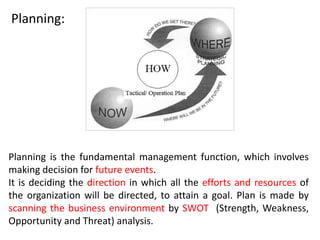
Planning is the fundamental management function, which involves
making decision for future events.
It is deciding the direction in which all the efforts and resources of
the organization will be directed, to attain a goal. Plan is made by
scanning the business environment by SWOT (Strength, Weakness,
Opportunity and Threat) analysis.
Planning:
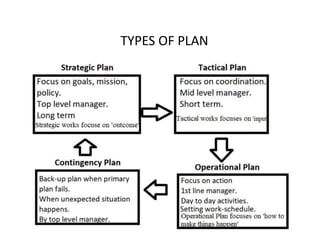
TYPES OF PLAN
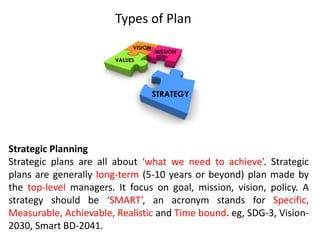
Types of Plan
Strategic Planning
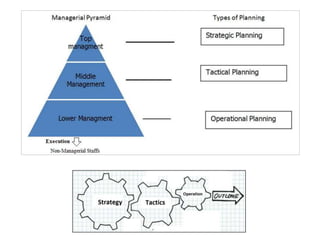
Strategic plans are all about ‘what we need to achieve’. Strategic
plans are generally long-term (5-10 years or beyond) plan made by
the top-level managers. It focus on goal, mission, vision, policy. A
strategy should be ‘SMART’, an acronym stands for Specific,
Measurable, Achievable, Realistic and Time bound. eg, SDG-3, Vision-
2030, Smart BD-2041.
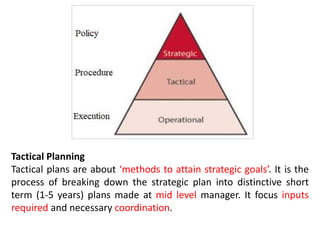
Tactical Planning
Tactical plans are about ‘methods to attain strategic goals’. It is the
process of breaking down the strategic plan into distinctive short
term (1-5 years) plans made at mid level manager. It focus inputs
required and necessary coordination.
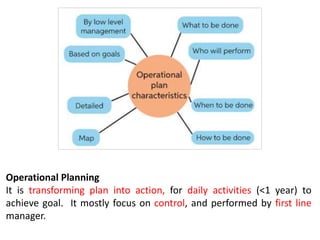
Operational Planning
It is transforming plan into action, for daily activities (<1 year) to
achieve goal. It mostly focus on control, and performed by first line
manager.
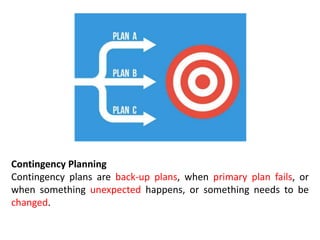
Contingency Planning
Contingency plans are back-up plans, when primary plan fails, or
when something unexpected happens, or something needs to be
changed.
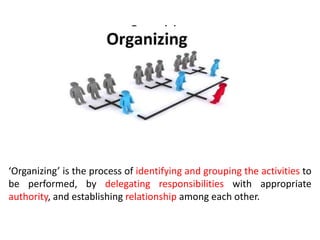
Organizing
‘Organizing’ is the process of identifying and grouping the activities to
be performed, by delegating responsibilities with appropriate
authority, and establishing relationship among each other.
In organizing a task, there are 3 factors:
• Authority: Is the right to make decisions, issue orders and allocate
resources.
• Responsibility: This is an obligation incurred by individuals in
performing their roles in the formal organization.
• Accountability: The extent to which an individual is answerable to
the stakeholders.
Types of Organization
 Line Organization
 Line and Staff Organization
 Functional/ Staff Organization
 Matrix Organization
 Project Structure Organization
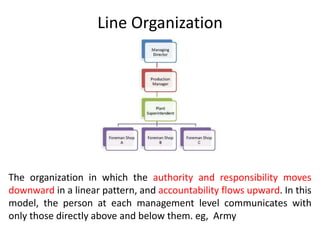
Line Organization
The organization in which the authority and responsibility moves
downward in a linear pattern, and accountability flows upward. In this
model, the person at each management level communicates with
only those directly above and below them. eg, Army
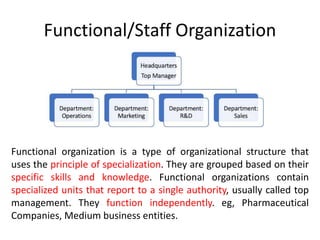
Functional/Staff Organization
Functional organization is a type of organizational structure that
uses the principle of specialization. They are grouped based on their
specific skills and knowledge. Functional organizations contain
specialized units that report to a single authority, usually called top
management. They function independently. eg, Pharmaceutical
Companies, Medium business entities.
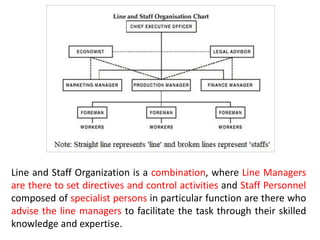
Line and Staff Organization is a combination, where Line Managers
are there to set directives and control activities and Staff Personnel
composed of specialist persons in particular function are there who
advise the line managers to facilitate the task through their skilled
knowledge and expertise.
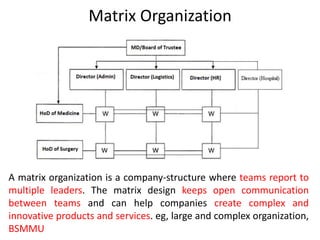
Matrix Organization
A matrix organization is a company-structure where teams report to
multiple leaders. The matrix design keeps open communication
between teams and can help companies create complex and
innovative products and services. eg, large and complex organization,
BSMMU
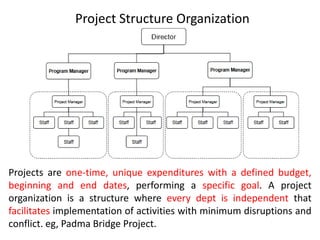
Project Structure Organization
Projects are one-time, unique expenditures with a defined budget,
beginning and end dates, performing a specific goal. A project
organization is a structure where every dept is independent that
facilitates implementation of activities with minimum disruptions and
conflict. eg, Padma Bridge Project.
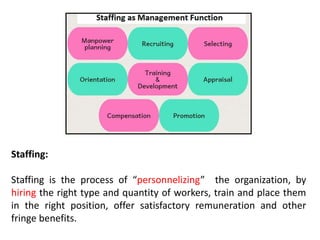
Staffing:
Staffing is the process of “personnelizing” the organization, by
hiring the right type and quantity of workers, train and place them
in the right position, offer satisfactory remuneration and other
fringe benefits.
Directing
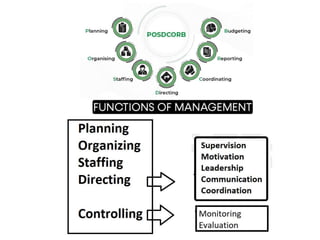
Directing is an aspect of management that deals with influencing,
guiding, supervising, and motivating staffs for goal directed
behaviors.
Elements of Directing:
1. Leadership.
2. Supervision.
3. Motivation.
4. Communication.
5. Coordination.
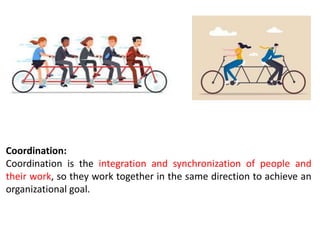
Coordination:
Coordination is the integration and synchronization of people and
their work, so they work together in the same direction to achieve an
organizational goal.
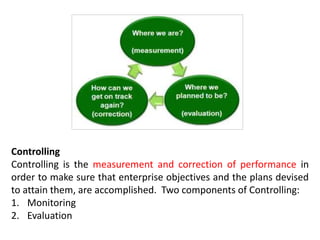
Controlling
Controlling is the measurement and correction of performance in
order to make sure that enterprise objectives and the plans devised
to attain them, are accomplished. Two components of Controlling:
1. Monitoring
2. Evaluation
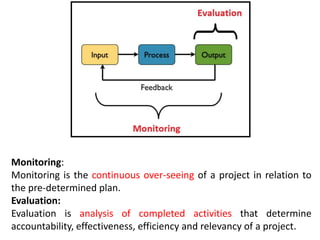
Monitoring:
Monitoring is the continuous over-seeing of a project in relation to
the pre-determined plan.
Evaluation:
Evaluation is analysis of completed activities that determine
accountability, effectiveness, efficiency and relevancy of a project.
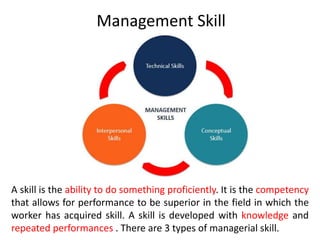
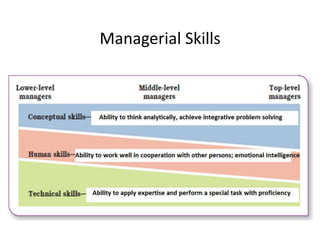
A skill is the ability to do something proficiently. It is the competency
that allows for performance to be superior in the field in which the
worker has acquired skill. A skill is developed with knowledge and
repeated performances . There are 3 types of managerial skill.
Management Skill
Managerial Skills
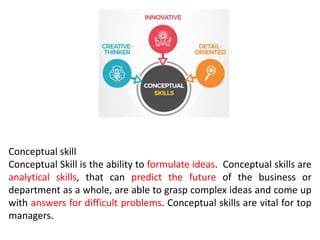
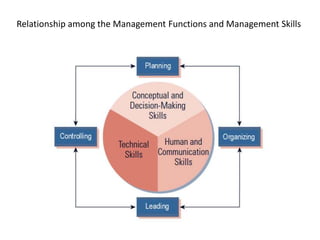
Conceptual skill
Conceptual Skill is the ability to formulate ideas. Conceptual skills are
analytical skills, that can predict the future of the business or
department as a whole, are able to grasp complex ideas and come up
with answers for difficult problems. Conceptual skills are vital for top
managers.
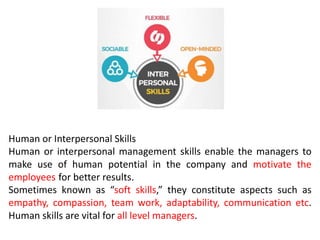
Human or Interpersonal Skills
Human or interpersonal management skills enable the managers to
make use of human potential in the company and motivate the
employees for better results.
Sometimes known as “soft skills,” they constitute aspects such as
empathy, compassion, team work, adaptability, communication etc.
Human skills are vital for all level managers.
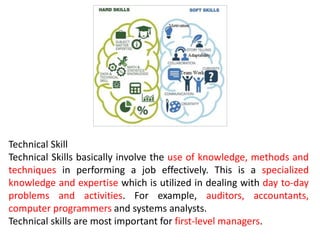
Technical Skill
Technical Skills basically involve the use of knowledge, methods and
techniques in performing a job effectively. This is a specialized
knowledge and expertise which is utilized in dealing with day to-day
problems and activities. For example, auditors, accountants,
computer programmers and systems analysts.
Technical skills are most important for first-level managers.
Relationship among the Management Functions and Management Skills
Managerial Roles
Role is the position that one gets by its virtue; whereas function is
the performance/functions that a role entails. eg, ‘father’ is position
(Role), the function of which is to take care of family, earn livelihood
etc.
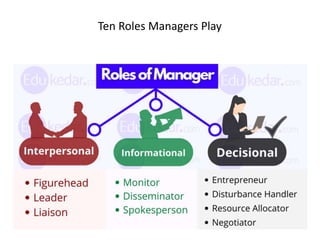
Henry Mintzberg distinguishes ten key managerial roles grouped into
3 categories, that managers need to fulfill.
Ten Roles Managers Play
Management Functions, Skills and Roles.pptx

Management Functions, Skills and Roles.pptx

  • 1.
    Management Functions, Skillsand Roles Brigadier General Dr Zulfiquer Ahmed Amin M Phil, MPH, PGD (Health Economics), Fellow HA (AIIMS, Delhi), MBBS
  • 2.
    Managerial functions definemanagerial processes that are used by managers to convert inputs into outcome to achieve organizational goals. Management skills are the learned abilities, competencies and expertise that help people in leadership positions succeed and achieve perfection. Roles define pattern of behavior socially recognized, providing a means for identifying and placing an individual in an organization or society (eg parent–child roles). Managerial role is an obligation.
  • 4.
    Planning is thefundamental management function, which involves making decision for future events. It is deciding the direction in which all the efforts and resources of the organization will be directed, to attain a goal. Plan is made by scanning the business environment by SWOT (Strength, Weakness, Opportunity and Threat) analysis. Planning:
  • 5.
  • 7.
    Types of Plan StrategicPlanning Strategic plans are all about ‘what we need to achieve’. Strategic plans are generally long-term (5-10 years or beyond) plan made by the top-level managers. It focus on goal, mission, vision, policy. A strategy should be ‘SMART’, an acronym stands for Specific, Measurable, Achievable, Realistic and Time bound. eg, SDG-3, Vision- 2030, Smart BD-2041.
  • 8.
    Tactical Planning Tactical plansare about ‘methods to attain strategic goals’. It is the process of breaking down the strategic plan into distinctive short term (1-5 years) plans made at mid level manager. It focus inputs required and necessary coordination.
  • 9.
    Operational Planning It istransforming plan into action, for daily activities (<1 year) to achieve goal. It mostly focus on control, and performed by first line manager.
  • 10.
    Contingency Planning Contingency plansare back-up plans, when primary plan fails, or when something unexpected happens, or something needs to be changed.
  • 11.
    Organizing ‘Organizing’ is theprocess of identifying and grouping the activities to be performed, by delegating responsibilities with appropriate authority, and establishing relationship among each other.
  • 12.
    In organizing atask, there are 3 factors: • Authority: Is the right to make decisions, issue orders and allocate resources. • Responsibility: This is an obligation incurred by individuals in performing their roles in the formal organization. • Accountability: The extent to which an individual is answerable to the stakeholders.
  • 13.
    Types of Organization Line Organization  Line and Staff Organization  Functional/ Staff Organization  Matrix Organization  Project Structure Organization
  • 14.
    Line Organization The organizationin which the authority and responsibility moves downward in a linear pattern, and accountability flows upward. In this model, the person at each management level communicates with only those directly above and below them. eg, Army
  • 15.
    Functional/Staff Organization Functional organizationis a type of organizational structure that uses the principle of specialization. They are grouped based on their specific skills and knowledge. Functional organizations contain specialized units that report to a single authority, usually called top management. They function independently. eg, Pharmaceutical Companies, Medium business entities.
  • 16.
    Line and StaffOrganization is a combination, where Line Managers are there to set directives and control activities and Staff Personnel composed of specialist persons in particular function are there who advise the line managers to facilitate the task through their skilled knowledge and expertise.
  • 17.
    Matrix Organization A matrixorganization is a company-structure where teams report to multiple leaders. The matrix design keeps open communication between teams and can help companies create complex and innovative products and services. eg, large and complex organization, BSMMU
  • 18.
    Project Structure Organization Projectsare one-time, unique expenditures with a defined budget, beginning and end dates, performing a specific goal. A project organization is a structure where every dept is independent that facilitates implementation of activities with minimum disruptions and conflict. eg, Padma Bridge Project.
  • 19.
    Staffing: Staffing is theprocess of “personnelizing” the organization, by hiring the right type and quantity of workers, train and place them in the right position, offer satisfactory remuneration and other fringe benefits.
  • 20.
    Directing Directing is anaspect of management that deals with influencing, guiding, supervising, and motivating staffs for goal directed behaviors. Elements of Directing: 1. Leadership. 2. Supervision. 3. Motivation. 4. Communication. 5. Coordination.
  • 21.
    Coordination: Coordination is theintegration and synchronization of people and their work, so they work together in the same direction to achieve an organizational goal.
  • 22.
    Controlling Controlling is themeasurement and correction of performance in order to make sure that enterprise objectives and the plans devised to attain them, are accomplished. Two components of Controlling: 1. Monitoring 2. Evaluation
  • 23.
    Monitoring: Monitoring is thecontinuous over-seeing of a project in relation to the pre-determined plan. Evaluation: Evaluation is analysis of completed activities that determine accountability, effectiveness, efficiency and relevancy of a project.
  • 24.
    A skill isthe ability to do something proficiently. It is the competency that allows for performance to be superior in the field in which the worker has acquired skill. A skill is developed with knowledge and repeated performances . There are 3 types of managerial skill. Management Skill
  • 25.
  • 26.
    Conceptual skill Conceptual Skillis the ability to formulate ideas. Conceptual skills are analytical skills, that can predict the future of the business or department as a whole, are able to grasp complex ideas and come up with answers for difficult problems. Conceptual skills are vital for top managers.
  • 27.
    Human or InterpersonalSkills Human or interpersonal management skills enable the managers to make use of human potential in the company and motivate the employees for better results. Sometimes known as “soft skills,” they constitute aspects such as empathy, compassion, team work, adaptability, communication etc. Human skills are vital for all level managers.
  • 28.
    Technical Skill Technical Skillsbasically involve the use of knowledge, methods and techniques in performing a job effectively. This is a specialized knowledge and expertise which is utilized in dealing with day to-day problems and activities. For example, auditors, accountants, computer programmers and systems analysts. Technical skills are most important for first-level managers.
  • 29.
    Relationship among theManagement Functions and Management Skills
  • 30.
    Managerial Roles Role isthe position that one gets by its virtue; whereas function is the performance/functions that a role entails. eg, ‘father’ is position (Role), the function of which is to take care of family, earn livelihood etc. Henry Mintzberg distinguishes ten key managerial roles grouped into 3 categories, that managers need to fulfill.
  • 31.