Brain
and
Language
BRAIN AND LANGUAGE 2
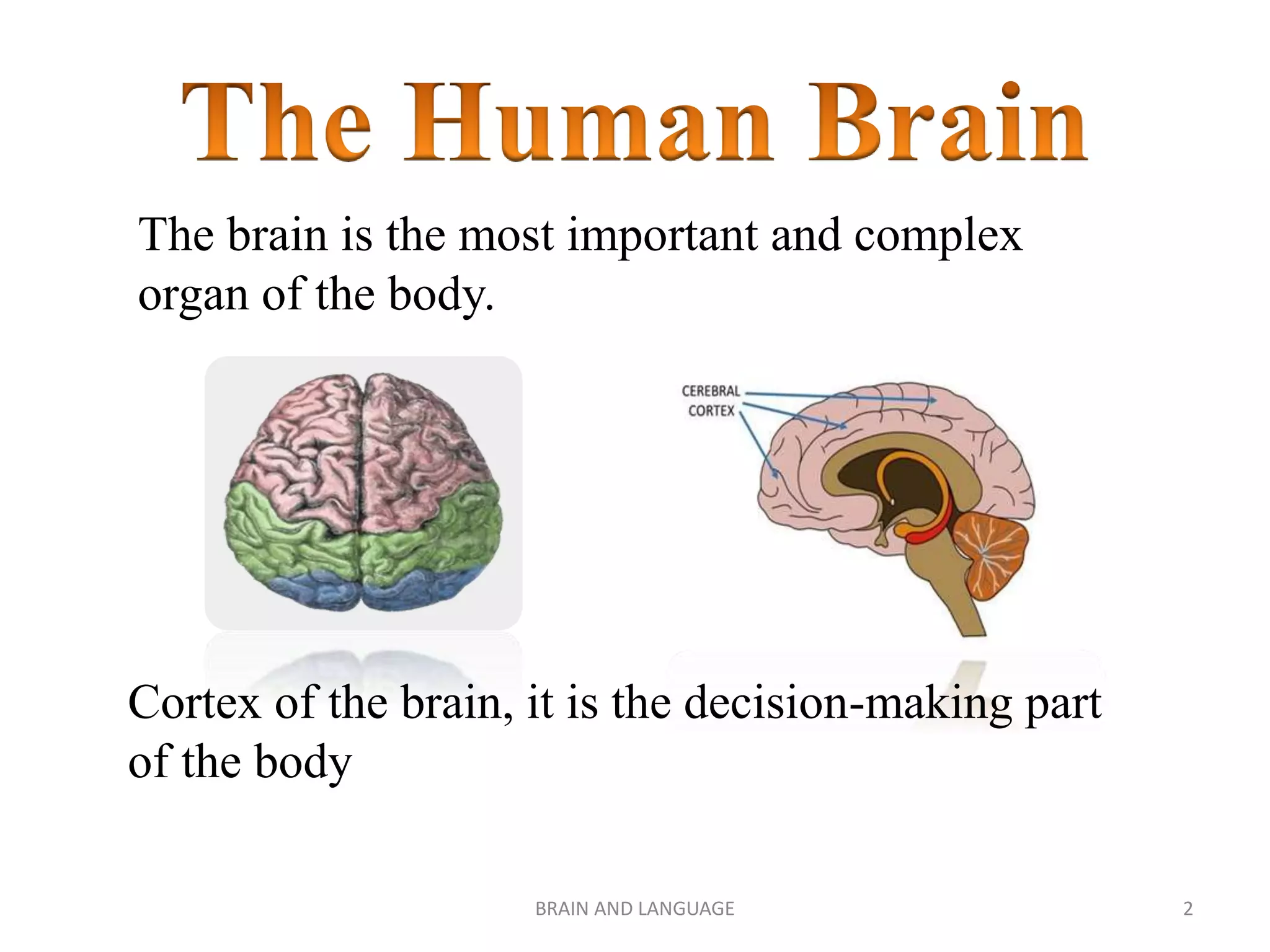
The brain is the most important and complex
organ of the body.
Cortex of the brain, it is the decision-making part
of the body
BRAIN AND LANGUAGE 3
Franz Joseph Gall -Theory of
localization Different human
cognitive abilities and behaviors are
localized in specific parts of the
brain.
He proposed that language is located
in the frontal lobe of the brain
BRAIN AND LANGUAGE 4
Aphasia is a neurological term for any
language disorder that results from acquired
brain damage caused by disease or trauma.
BRAIN AND LANGUAGE 5
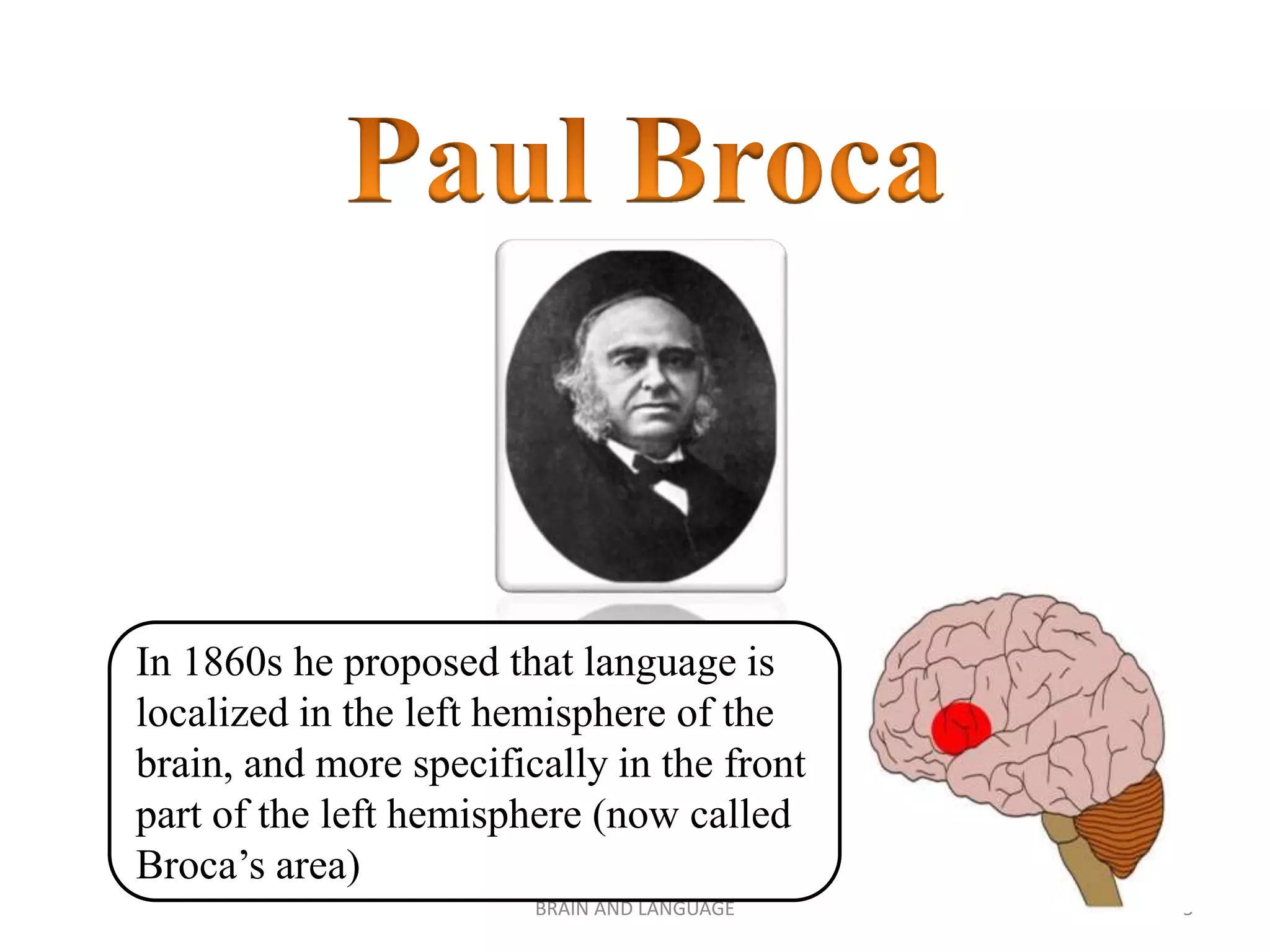
In 1860s he proposed that language is
localized in the left hemisphere of the
brain, and more specifically in the front
part of the left hemisphere (now called
Broca’s area)
BRAIN AND LANGUAGE 6
It is when surgeon severs the corpus callosum, the
fibrous network that connects the two halves.
Brain Plasticity
BRAIN AND LANGUAGE 7
BRAIN AND LANGUAGE 8
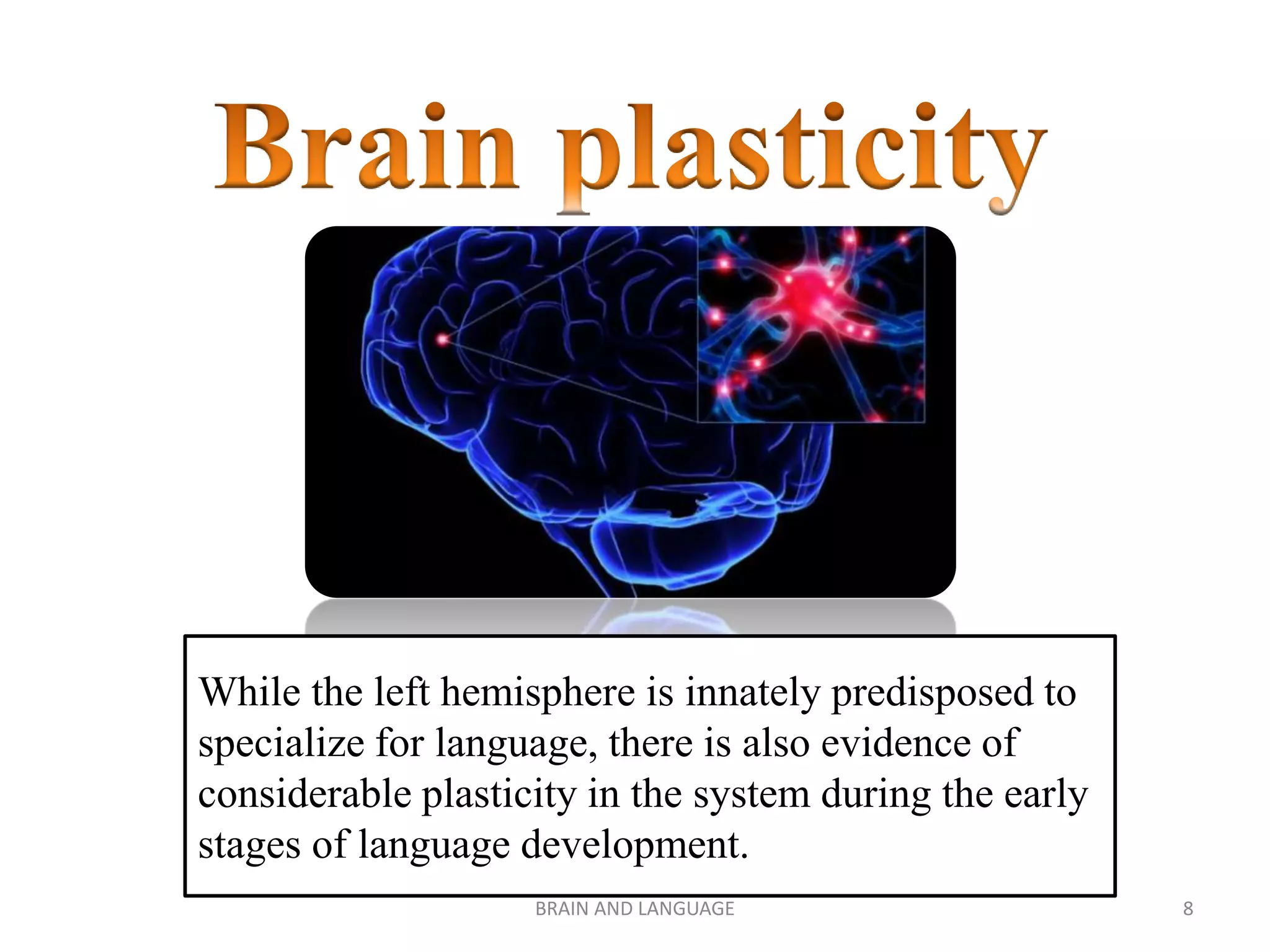
While the left hemisphere is innately predisposed to
specialize for language, there is also evidence of
considerable plasticity in the system during the early
stages of language development.
BRAIN AND LANGUAGE 9
Children, who undergo a left
hemispherectomy experience
an initial period of aphasia,
but in certain cases, may
reacquire a linguistic system
like that of normal children.
The plasticity of the brain
decreases with age and with
the increasing specialization
of the different hemispheres
and regions of the brain.
The
CriticalPeriod
BRAIN AND LANGUAGE 10
BRAIN AND LANGUAGE 11
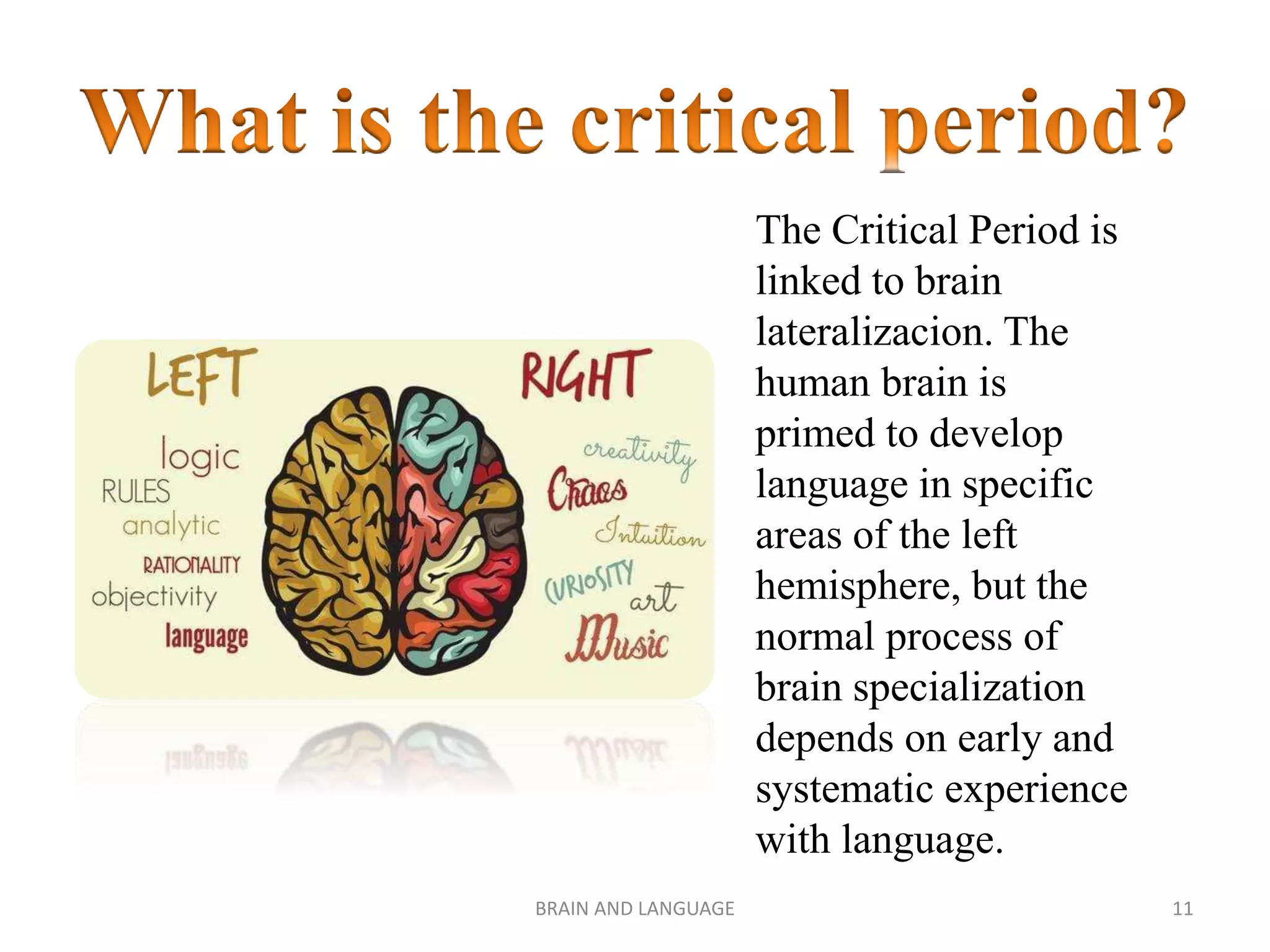
The Critical Period is
linked to brain
lateralizacion. The
human brain is
primed to develop
language in specific
areas of the left
hemisphere, but the
normal process of
brain specialization
depends on early and
systematic experience
with language.
BRAIN AND LANGUAGE 12
The Critical-age
hyphethesis asserts that
language is biologically
based and that the ability
to learn a native language
develops within a fixed
period, from birth to
middle childhood. .
BRAIN AND LANGUAGE 13
During this Critical period,
language acquisition proceeds
easily, swiftly, and without
external intervention. After this
period, the acquisition of
grammar is difficult and, for
most individuals, never fully
achieved. (Children deprived of
language during this critical
period show atypical patterns of
brain lateralization).
BRAIN AND LANGUAGE 14
Regardless of the case of the
isolation, none of these children
was able to speak or knew any
language at time they were
reintroduced into society. In the
documented cases of Victor And
Genie, however, these children
were unable to acquire grammar
even after years of exposure, and
despite the ability to learn many
words.
The Modular Mind:
Dissociations of
Language and
Cognition
BRAIN AND LANGUAGE 15
There are numerous cases of
intellectually handicapped
individuals who despite their
disabilities in certain spheres,
show remarkable talents in other.
There are superb musicians and
artists who lack the simple
abilities required to take care of
themselves. Such people are
referred to as savants.
BRAIN AND LANGUAGE 16
BRAIN AND LANGUAGE 17
1. Case:
Christopher. He lives in an institution
because he is unable to take care of
himself. However, his linguistic
competence is as rich and as sophisticated
as that of any native speaker. He can
translate quickly: Germanic languages such
as Danish, Dutch, and German; Romance
languages such as French, Italian,
Portuguese, and Spanish, as well as Polish,
Finnish, Greek, Hindi, Turkish, and Welsh.
BRAIN AND LANGUAGE 18
People like Laura and Christopher
have normal or superior linguistic
skill though their abilities in other
areas are very limited. There are
individuals who show the opposite
profile: among these are children
with Specific Language
Impairment. They show no other
cognitive deficits, they are not
autistic or retarder, and they have
no perceptual problem. Only their
linguistic ability is affected, and
often only specific aspects of
grammar are impaired.
BRAIN AND LANGUAGE 19
Research like Geschwind’s
sits at the intersection of two
fields: behavioral genetics
and evolutionary biology.
Each field depends on the
other to make sense of the
flood of studies on the
genetics of language now
pouring out of labs around the
world.
BRAIN AND LANGUAGE 20
THANK YOU FOR
YOUR ATTENTION!

Brain and language

  • 1.
  • 2.
    BRAIN AND LANGUAGE2 The brain is the most important and complex organ of the body. Cortex of the brain, it is the decision-making part of the body
  • 3.
    BRAIN AND LANGUAGE3 Franz Joseph Gall -Theory of localization Different human cognitive abilities and behaviors are localized in specific parts of the brain. He proposed that language is located in the frontal lobe of the brain
  • 4.
    BRAIN AND LANGUAGE4 Aphasia is a neurological term for any language disorder that results from acquired brain damage caused by disease or trauma.
  • 5.
    BRAIN AND LANGUAGE5 In 1860s he proposed that language is localized in the left hemisphere of the brain, and more specifically in the front part of the left hemisphere (now called Broca’s area)
  • 6.
    BRAIN AND LANGUAGE6 It is when surgeon severs the corpus callosum, the fibrous network that connects the two halves.
  • 7.
  • 8.
    BRAIN AND LANGUAGE8 While the left hemisphere is innately predisposed to specialize for language, there is also evidence of considerable plasticity in the system during the early stages of language development.
  • 9.
    BRAIN AND LANGUAGE9 Children, who undergo a left hemispherectomy experience an initial period of aphasia, but in certain cases, may reacquire a linguistic system like that of normal children. The plasticity of the brain decreases with age and with the increasing specialization of the different hemispheres and regions of the brain.
  • 10.
  • 11.
    BRAIN AND LANGUAGE11 The Critical Period is linked to brain lateralizacion. The human brain is primed to develop language in specific areas of the left hemisphere, but the normal process of brain specialization depends on early and systematic experience with language.
  • 12.
    BRAIN AND LANGUAGE12 The Critical-age hyphethesis asserts that language is biologically based and that the ability to learn a native language develops within a fixed period, from birth to middle childhood. .
  • 13.
    BRAIN AND LANGUAGE13 During this Critical period, language acquisition proceeds easily, swiftly, and without external intervention. After this period, the acquisition of grammar is difficult and, for most individuals, never fully achieved. (Children deprived of language during this critical period show atypical patterns of brain lateralization).
  • 14.
    BRAIN AND LANGUAGE14 Regardless of the case of the isolation, none of these children was able to speak or knew any language at time they were reintroduced into society. In the documented cases of Victor And Genie, however, these children were unable to acquire grammar even after years of exposure, and despite the ability to learn many words.
  • 15.
    The Modular Mind: Dissociationsof Language and Cognition BRAIN AND LANGUAGE 15
  • 16.
    There are numerouscases of intellectually handicapped individuals who despite their disabilities in certain spheres, show remarkable talents in other. There are superb musicians and artists who lack the simple abilities required to take care of themselves. Such people are referred to as savants. BRAIN AND LANGUAGE 16
  • 17.
    BRAIN AND LANGUAGE17 1. Case: Christopher. He lives in an institution because he is unable to take care of himself. However, his linguistic competence is as rich and as sophisticated as that of any native speaker. He can translate quickly: Germanic languages such as Danish, Dutch, and German; Romance languages such as French, Italian, Portuguese, and Spanish, as well as Polish, Finnish, Greek, Hindi, Turkish, and Welsh.
  • 18.
    BRAIN AND LANGUAGE18 People like Laura and Christopher have normal or superior linguistic skill though their abilities in other areas are very limited. There are individuals who show the opposite profile: among these are children with Specific Language Impairment. They show no other cognitive deficits, they are not autistic or retarder, and they have no perceptual problem. Only their linguistic ability is affected, and often only specific aspects of grammar are impaired.
  • 19.
    BRAIN AND LANGUAGE19 Research like Geschwind’s sits at the intersection of two fields: behavioral genetics and evolutionary biology. Each field depends on the other to make sense of the flood of studies on the genetics of language now pouring out of labs around the world.
  • 20.
    BRAIN AND LANGUAGE20 THANK YOU FOR YOUR ATTENTION!