Copyright © 2004 South-Western. All rights reserved.
PowerPoint Presentation by Charlie Cook
Copyright © 2004 South-
Western. All rights reserved. 16–2
Objectives
After studying this chapter, you should be able to:
1. Discuss the underlying principles of high-
performance work systems.
2. Identify the components that make up a high-
performance work system.
3. Describe how the components fit together and
support strategy.
4. Recommend processes for implementing high-
performance work systems.
5. Discuss the outcomes for both employees and the
organization.
Copyright © 2004 South-
Western. All rights reserved. 16–3
Objectives (cont’d)
After studying this chapter, you should be able to:
6. Explain how the principles of high-performance work
systems apply to small, medium-sized, and large
organizations.
Copyright © 2004 South-
Western. All rights reserved. 16–4
High-performance Work System (HPWS)
• A specific combination of HR practices, work
structures, and processes that maximizes
employee knowledge, skill, commitment, and
flexibility.
• Systems composed of many interrelated parts
that complement one another to reach the goals
of an organization, large or small.
Copyright © 2004 South-
Western. All rights reserved. 16–5
Developing
High-Performance
Work Systems
Figure 16.1
Linkages toLinkages to
StrategyStrategy
Linkages toLinkages to
StrategyStrategy
Principles ofPrinciples of
HighHigh
InvolvementInvolvement
Principles ofPrinciples of
HighHigh
InvolvementInvolvement
OUTCOMESOUTCOMES
• OrganizationalOrganizational
• EmployeeEmployee
OUTCOMESOUTCOMES
• OrganizationalOrganizational
• EmployeeEmployee
System Design
• Work flow
• HRM practices
• Support
technology
System Design
• Work flow
• HRM practices
• Support
technology
TheThe
ImplementationImplementation
ProcessProcess
TheThe
ImplementationImplementation
ProcessProcess
Presentation Slide 16–1
Copyright © 2004 South-
Western. All rights reserved. 16–6
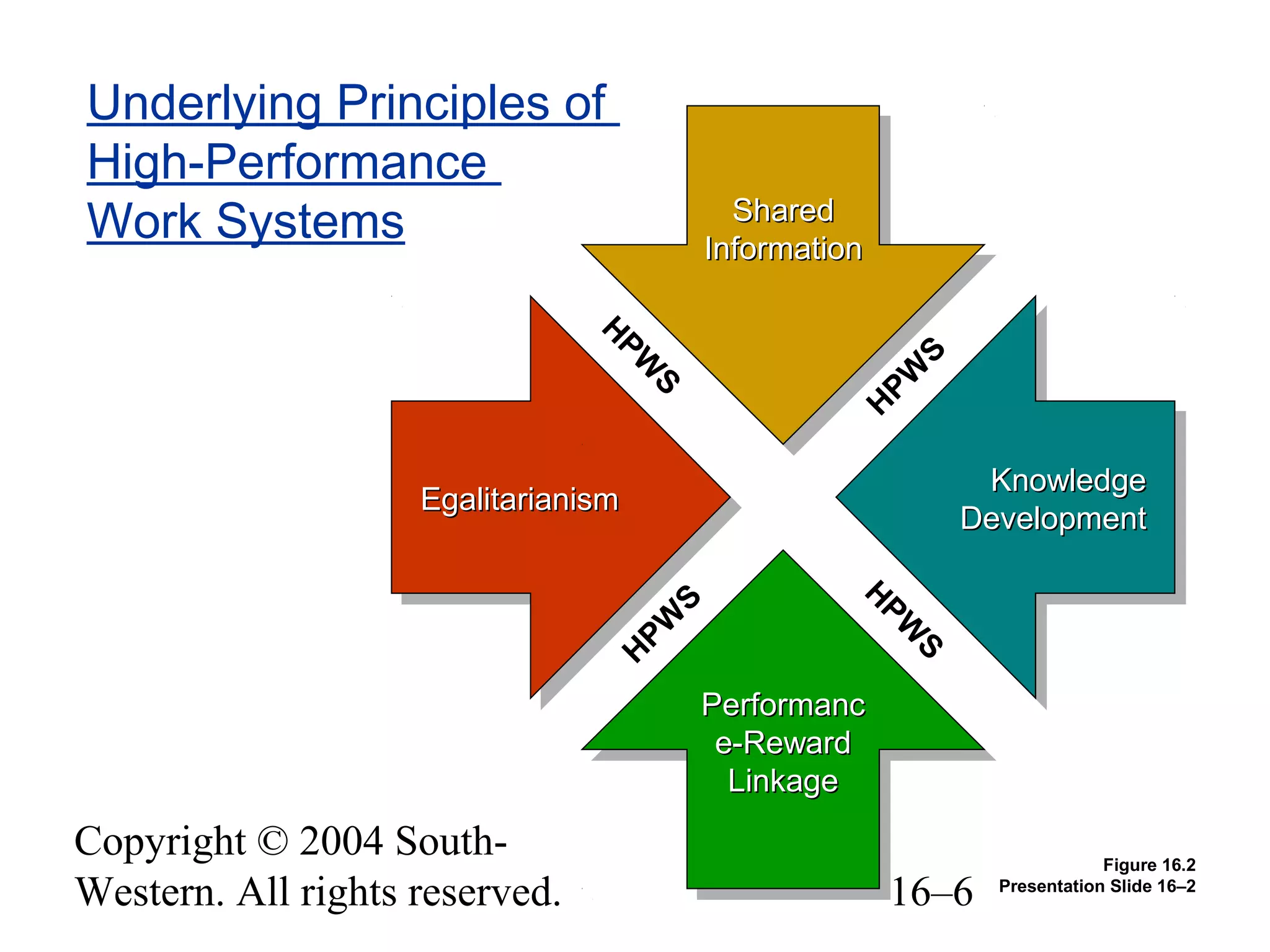
Underlying Principles of
High-Performance
Work Systems
Figure 16.2
EgalitarianismEgalitarianismEgalitarianismEgalitarianism
SharedShared
InformationInformation
SharedShared
InformationInformation
PerformancPerformanc
e-Rewarde-Reward
LinkageLinkage
PerformancPerformanc
e-Rewarde-Reward
LinkageLinkage
KnowledgeKnowledge
DevelopmentDevelopment
KnowledgeKnowledge
DevelopmentDevelopment
H
PW
S
Presentation Slide 16–2
H
PW
S
H
PW
S
H
PW
S
Copyright © 2004 South-
Western. All rights reserved. 16–7
Principles of HPWS
• The Principle of Shared Information
A shift away from the mentality of command and
control toward one more focused on employee
commitment.
Creating a culture of information sharing where
employees are more willing (and able) to work toward
the goals for the organization.
Copyright © 2004 South-
Western. All rights reserved. 16–8
Principles of HPWS (cont’d)
• The Principle of Knowledge Development
Employees in high-performance work systems need
to learn in “real time,” on the job, using innovative
new approaches to solve novel problems
The number of jobs requiring little knowledge and skill
is declining while the number of jobs requiring greater
knowledge and skill is growing rapidly.
Copyright © 2004 South-
Western. All rights reserved. 16–9
Principles of HPWS (cont’d)
• The Principle of Performance-Reward Linkage
It is important to align employee and organizational
goals. When rewards are connected to performance,
employees will naturally pursue outcomes that are
mutually beneficial to themselves and the
organization.
Copyright © 2004 South-
Western. All rights reserved. 16–10
Principles of HPWS (cont’d)
• The Principle of Egalitarianism
Egalitarian work environments eliminate status and
power differences and, in the process, increase
collaboration and teamwork.
When this happens, productivity can improve if
people who once worked in isolation from (or
opposition to) one another begin to work together.
Copyright © 2004 South-
Western. All rights reserved. 16–11
Anatomy of High-Performance Work Systems
Figure 16.3
Copyright © 2004 South-
Western. All rights reserved. 16–12
Complementary Human Resources
Policies and Practices
StaffingStaffingStaffingStaffing
Training andTraining and
DevelopmentDevelopment
Training andTraining and
DevelopmentDevelopment
CompensationCompensationCompensationCompensation
Copyright © 2004 South-
Western. All rights reserved. 16–13
Ensuring Fit
• Internal fit
The situation in which all the internal elements of the
work system complement and reinforce one another.
• External fit
The situation in which the work system supports the
organization’s goals and strategies.
Copyright © 2004 South-
Western. All rights reserved. 16–14
Achieving
Strategic Fit
Figure 16.4
Presentation Slide 16–3
Competitive
Challenges
Com
pany
Values
Employee
Concerns
Internal FitInternal FitInternal FitInternal Fit
Work-flowWork-flow
DesignDesign
Work-flowWork-flow
DesignDesign
TechnologiesTechnologiesTechnologiesTechnologies
HR PracticesHR PracticesHR PracticesHR Practices
LeadershipLeadershipLeadershipLeadership
External Fit
High
Performance
Work Systems
StrategyStrategy
Copyright © 2004 South-
Western. All rights reserved. 16–15
Diagnosing Internal Fit
HRM 1-ASource: Brian Becker, Mark Huselid, and Dave Ulrich, The HR Scorecard (Cambridge, Mass.: Howard University Press, 2001).
Copyright © 2004 South-
Western. All rights reserved. 16–16
Assuring HPWS Success
• Necessary Actions for a Successful HPWS:
Make a compelling case for change linked to the
company’s business strategy.
Make certain that change is owned by senior and line
managers.
Allocate sufficient resources and support for the
change effort.
Ensure early and broad communication.
Copyright © 2004 South-
Western. All rights reserved. 16–17 HRM 1-B
Copyright © 2004 South-
Western. All rights reserved. 16–18 HRM 1-C
Copyright © 2004 South-
Western. All rights reserved. 16–19
Implementing High-Performance Work
Systems
Figure 16.5
Build aBuild a
case forcase for
changechange
Build aBuild a
case forcase for
changechange
CommunicateCommunicateCommunicateCommunicate InvolveInvolve
unionunion
InvolveInvolve
unionunion
NavigateNavigate
transitiontransition
NavigateNavigate
transitiontransition
Evaluation
Presentation Slide 16–4
Copyright © 2004 South-
Western. All rights reserved. 16–20
Building Cooperation with Unions
Figure 16.6Source: The Conference Board of Canada.
Copyright © 2004 South-
Western. All rights reserved. 16–21
Benefits of HPWS
• Employee Benefits
Have more involvement in the organization.
Experience growth and satisfaction, and become
more valuable as contributors.
• Organizational Benefits
High productivity
Quality
Flexibility
Customer satisfaction.
Copyright © 2004 South-
Western. All rights reserved. 16–22
Navigating the Transition
to High-Performance Work Systems
• Build a Transition Structure
• Implementation of High-performance Work
• Incorporate the HR Function as a Valuable
Partner
Copyright © 2004 South-
Western. All rights reserved. 16–23
Evaluating the Success of the System
• Process audit
Determining whether the high-performance work
system has been implemented as designed:
 Are employees actually working together, or is the term
“team” just a label?
 Are employees getting the information they need to make
empowered decisions?
 Are training programs developing the knowledge and
skills employees need?
 Are employees being rewarded for good performance
and useful suggestions?
 Are employees treated fairly so that power differences
are minimal?
Copyright © 2004 South-
Western. All rights reserved. 16–24
Evaluating the Success of the System
(cont’d)
• To determine if the HPWS program is
succeeding in reaching its goals, managers
should look at such issues as:
Are desired behaviors being exhibited on the job?
Are quality, productivity, flexibility, and customer
service objectives being met?
Are quality-of-life goals being achieved for
employees?
Is the organization more competitive than in the past?
Copyright © 2004 South-
Western. All rights reserved. 16–25
Outcomes of High-Performance Work
Systems
• Employee Benefits of HPWS Systems
More involved in work, more likely to be satisfied and
find that needs for growth are more fully met.
More informed and empowered, they are likely to feel
that they have a fuller role to play in the organization
and that their opinions and expertise are valued more.
Greater commitment comes from higher skills and
greater potential for contribution,
Copyright © 2004 South-
Western. All rights reserved. 16–26
Outcomes of High-Performance Work
Systems (cont’d)
• Organizational Outcomes and Competitive
Advantage
Higher productivity
Lower costs
Better responsiveness to customers
Greater flexibility
Higher profitability
Copyright © 2004 South-
Western. All rights reserved. 16–27
Achieving Sustainable Competitive
Advantage through Employees
CharacteristicsCharacteristics
of Employees’of Employees’
CompetenciesCompetencies
CharacteristicsCharacteristics
of Employees’of Employees’
CompetenciesCompetencies
ValuableValuableValuableValuable RareRareRareRare
Difficult to ImitateDifficult to ImitateDifficult to ImitateDifficult to ImitateOrganizedOrganizedOrganizedOrganized

Chapter 16 Creating High-Performance Work Systems

  • 1.
    Copyright © 2004South-Western. All rights reserved. PowerPoint Presentation by Charlie Cook
  • 2.
    Copyright © 2004South- Western. All rights reserved. 16–2 Objectives After studying this chapter, you should be able to: 1. Discuss the underlying principles of high- performance work systems. 2. Identify the components that make up a high- performance work system. 3. Describe how the components fit together and support strategy. 4. Recommend processes for implementing high- performance work systems. 5. Discuss the outcomes for both employees and the organization.
  • 3.
    Copyright © 2004South- Western. All rights reserved. 16–3 Objectives (cont’d) After studying this chapter, you should be able to: 6. Explain how the principles of high-performance work systems apply to small, medium-sized, and large organizations.
  • 4.
    Copyright © 2004South- Western. All rights reserved. 16–4 High-performance Work System (HPWS) • A specific combination of HR practices, work structures, and processes that maximizes employee knowledge, skill, commitment, and flexibility. • Systems composed of many interrelated parts that complement one another to reach the goals of an organization, large or small.
  • 5.
    Copyright © 2004South- Western. All rights reserved. 16–5 Developing High-Performance Work Systems Figure 16.1 Linkages toLinkages to StrategyStrategy Linkages toLinkages to StrategyStrategy Principles ofPrinciples of HighHigh InvolvementInvolvement Principles ofPrinciples of HighHigh InvolvementInvolvement OUTCOMESOUTCOMES • OrganizationalOrganizational • EmployeeEmployee OUTCOMESOUTCOMES • OrganizationalOrganizational • EmployeeEmployee System Design • Work flow • HRM practices • Support technology System Design • Work flow • HRM practices • Support technology TheThe ImplementationImplementation ProcessProcess TheThe ImplementationImplementation ProcessProcess Presentation Slide 16–1
  • 6.
    Copyright © 2004South- Western. All rights reserved. 16–6 Underlying Principles of High-Performance Work Systems Figure 16.2 EgalitarianismEgalitarianismEgalitarianismEgalitarianism SharedShared InformationInformation SharedShared InformationInformation PerformancPerformanc e-Rewarde-Reward LinkageLinkage PerformancPerformanc e-Rewarde-Reward LinkageLinkage KnowledgeKnowledge DevelopmentDevelopment KnowledgeKnowledge DevelopmentDevelopment H PW S Presentation Slide 16–2 H PW S H PW S H PW S
  • 7.
    Copyright © 2004South- Western. All rights reserved. 16–7 Principles of HPWS • The Principle of Shared Information A shift away from the mentality of command and control toward one more focused on employee commitment. Creating a culture of information sharing where employees are more willing (and able) to work toward the goals for the organization.
  • 8.
    Copyright © 2004South- Western. All rights reserved. 16–8 Principles of HPWS (cont’d) • The Principle of Knowledge Development Employees in high-performance work systems need to learn in “real time,” on the job, using innovative new approaches to solve novel problems The number of jobs requiring little knowledge and skill is declining while the number of jobs requiring greater knowledge and skill is growing rapidly.
  • 9.
    Copyright © 2004South- Western. All rights reserved. 16–9 Principles of HPWS (cont’d) • The Principle of Performance-Reward Linkage It is important to align employee and organizational goals. When rewards are connected to performance, employees will naturally pursue outcomes that are mutually beneficial to themselves and the organization.
  • 10.
    Copyright © 2004South- Western. All rights reserved. 16–10 Principles of HPWS (cont’d) • The Principle of Egalitarianism Egalitarian work environments eliminate status and power differences and, in the process, increase collaboration and teamwork. When this happens, productivity can improve if people who once worked in isolation from (or opposition to) one another begin to work together.
  • 11.
    Copyright © 2004South- Western. All rights reserved. 16–11 Anatomy of High-Performance Work Systems Figure 16.3
  • 12.
    Copyright © 2004South- Western. All rights reserved. 16–12 Complementary Human Resources Policies and Practices StaffingStaffingStaffingStaffing Training andTraining and DevelopmentDevelopment Training andTraining and DevelopmentDevelopment CompensationCompensationCompensationCompensation
  • 13.
    Copyright © 2004South- Western. All rights reserved. 16–13 Ensuring Fit • Internal fit The situation in which all the internal elements of the work system complement and reinforce one another. • External fit The situation in which the work system supports the organization’s goals and strategies.
  • 14.
    Copyright © 2004South- Western. All rights reserved. 16–14 Achieving Strategic Fit Figure 16.4 Presentation Slide 16–3 Competitive Challenges Com pany Values Employee Concerns Internal FitInternal FitInternal FitInternal Fit Work-flowWork-flow DesignDesign Work-flowWork-flow DesignDesign TechnologiesTechnologiesTechnologiesTechnologies HR PracticesHR PracticesHR PracticesHR Practices LeadershipLeadershipLeadershipLeadership External Fit High Performance Work Systems StrategyStrategy
  • 15.
    Copyright © 2004South- Western. All rights reserved. 16–15 Diagnosing Internal Fit HRM 1-ASource: Brian Becker, Mark Huselid, and Dave Ulrich, The HR Scorecard (Cambridge, Mass.: Howard University Press, 2001).
  • 16.
    Copyright © 2004South- Western. All rights reserved. 16–16 Assuring HPWS Success • Necessary Actions for a Successful HPWS: Make a compelling case for change linked to the company’s business strategy. Make certain that change is owned by senior and line managers. Allocate sufficient resources and support for the change effort. Ensure early and broad communication.
  • 17.
    Copyright © 2004South- Western. All rights reserved. 16–17 HRM 1-B
  • 18.
    Copyright © 2004South- Western. All rights reserved. 16–18 HRM 1-C
  • 19.
    Copyright © 2004South- Western. All rights reserved. 16–19 Implementing High-Performance Work Systems Figure 16.5 Build aBuild a case forcase for changechange Build aBuild a case forcase for changechange CommunicateCommunicateCommunicateCommunicate InvolveInvolve unionunion InvolveInvolve unionunion NavigateNavigate transitiontransition NavigateNavigate transitiontransition Evaluation Presentation Slide 16–4
  • 20.
    Copyright © 2004South- Western. All rights reserved. 16–20 Building Cooperation with Unions Figure 16.6Source: The Conference Board of Canada.
  • 21.
    Copyright © 2004South- Western. All rights reserved. 16–21 Benefits of HPWS • Employee Benefits Have more involvement in the organization. Experience growth and satisfaction, and become more valuable as contributors. • Organizational Benefits High productivity Quality Flexibility Customer satisfaction.
  • 22.
    Copyright © 2004South- Western. All rights reserved. 16–22 Navigating the Transition to High-Performance Work Systems • Build a Transition Structure • Implementation of High-performance Work • Incorporate the HR Function as a Valuable Partner
  • 23.
    Copyright © 2004South- Western. All rights reserved. 16–23 Evaluating the Success of the System • Process audit Determining whether the high-performance work system has been implemented as designed:  Are employees actually working together, or is the term “team” just a label?  Are employees getting the information they need to make empowered decisions?  Are training programs developing the knowledge and skills employees need?  Are employees being rewarded for good performance and useful suggestions?  Are employees treated fairly so that power differences are minimal?
  • 24.
    Copyright © 2004South- Western. All rights reserved. 16–24 Evaluating the Success of the System (cont’d) • To determine if the HPWS program is succeeding in reaching its goals, managers should look at such issues as: Are desired behaviors being exhibited on the job? Are quality, productivity, flexibility, and customer service objectives being met? Are quality-of-life goals being achieved for employees? Is the organization more competitive than in the past?
  • 25.
    Copyright © 2004South- Western. All rights reserved. 16–25 Outcomes of High-Performance Work Systems • Employee Benefits of HPWS Systems More involved in work, more likely to be satisfied and find that needs for growth are more fully met. More informed and empowered, they are likely to feel that they have a fuller role to play in the organization and that their opinions and expertise are valued more. Greater commitment comes from higher skills and greater potential for contribution,
  • 26.
    Copyright © 2004South- Western. All rights reserved. 16–26 Outcomes of High-Performance Work Systems (cont’d) • Organizational Outcomes and Competitive Advantage Higher productivity Lower costs Better responsiveness to customers Greater flexibility Higher profitability
  • 27.
    Copyright © 2004South- Western. All rights reserved. 16–27 Achieving Sustainable Competitive Advantage through Employees CharacteristicsCharacteristics of Employees’of Employees’ CompetenciesCompetencies CharacteristicsCharacteristics of Employees’of Employees’ CompetenciesCompetencies ValuableValuableValuableValuable RareRareRareRare Difficult to ImitateDifficult to ImitateDifficult to ImitateDifficult to ImitateOrganizedOrganizedOrganizedOrganized