dta.gov.au
softed.com.au
Public Sector
Agility Accelerator
Craig Smith & Julian Smith
UNOFFICIAL
UNOFFICIAL
No
Relation!
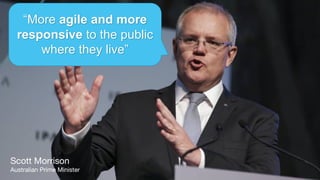
“More agile and more
responsive to the public
where they live”
Scott Morrison
Australian Prime Minister
6
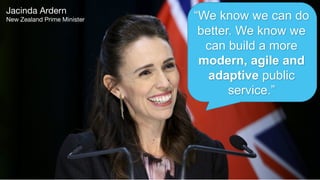
“We know we can do
better. We know we
can build a more
modern, agile and
adaptive public
service.”
Jacinda Ardern
New Zealand Prime Minister
Biden / US
7
“Governments at all
levels must improve
operations... assist
agencies to apply
agile to business
practices”
Teresa W. Gerton
President and CEO NAPA
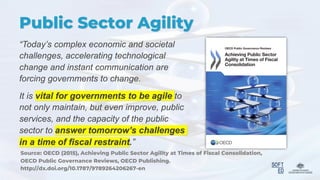
Public Sector Agility
“Today’s complex economic and societal
challenges, accelerating technological
change and instant communication are
forcing governments to change.
It is vital for governments to be agile to
not only maintain, but even improve, public
services, and the capacity of the public
sector to answer tomorrow’s challenges
in a time of fiscal restraint.”
Source: OECD (2015), Achieving Public Sector Agility at Times of Fiscal Consolidation,
OECD Public Governance Reviews, OECD Publishing.
http://dx.doi.org/10.1787/9789264206267-en
Agile Nations Charter
What is “Agile” anyway?
UNOFFICIAL
UNOFFICIAL
Image:
©
Talkback
Thames
https://pmcvariety.files.wordpress.com/2017/12/it-crowd.jpg?w=1000&h=563&crop=1
We traditionally started in IT…
UNOFFICIAL
UNOFFICIAL
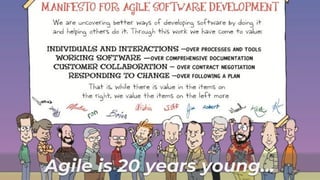
Agile is 20 years young…
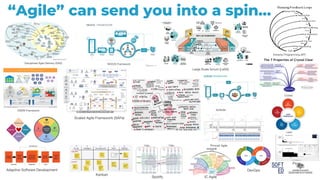
Adaptive Software Development
Scaled Agile Framework (SAFe)
DSDM Framework
Disciplined Agile Delivery (DAD) NEXUS Framework
Large Scale Scrum (LeSS)
Crystal
Lean
Extreme Programming (EP)
SCRUM
“Agile” can send you into a spin…
Prince2 Agile
Kanban
Spotify IC Agile
DevOps
Flow
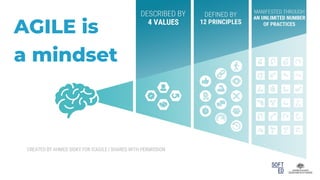
AGILE is
a mindset
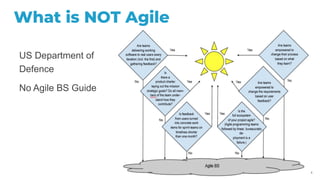
What is NOT Agile
US Department of
Defence
No Agile BS Guide
UNOFFICIAL
UNOFFICIAL
19
Raccoon!
Agile Doesn’t Come Easy or in a Box
UNOFFICIAL
UNOFFICIAL
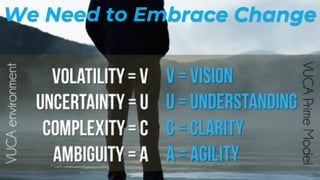
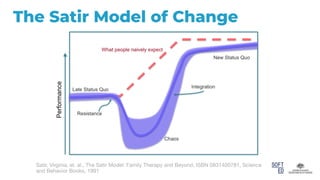
We Need to Embrace Change
The Satir Model of Change
Satir, Virginia, et. al., The Satir Model: Family Therapy and Beyond, ISBN 0831400781, Science
and Behavior Books, 1991
Focus on what matters
UNOFFICIAL
UNOFFICIAL
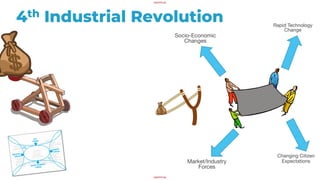
Socio-Economic
Changes
Rapid Technology
Change
Market/Industry
Forces
Changing Citizen
Expectations
4th Industrial Revolution
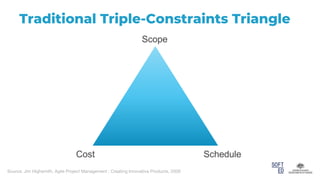
Scope
Schedule
Cost
Traditional Triple-Constraints Triangle
Source: Jim Highsmith, Agile Project Management : Creating Innovative Products, 2009
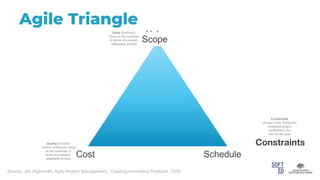
Agile Triangle
Value
Quality
Scope
Schedule
Cost
Constraints
Source: Jim Highsmith, Agile Project Management : Creating Innovative Products, 2009
Value (Extrinsic)
Value to the customer
in terms of a current
releasable product
Constraints
(Scope, Cost, Schedule)
Important project
parameters, but
are not the goal
Quality (Intrinsic)
Deliver continuous value
to the customer, in
terms of a reliable,
adaptable product
UNOFFICIAL
UNOFFICIAL
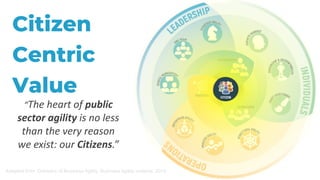
Citizen
Centric
Value
“The heart of public
sector agility is no less
than the very reason
we exist: our Citizens.”
Adapted from: Domains of Business Agility, Business Agility Institute, 2019
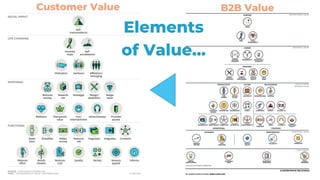
Elements
of Value…
Customer Value B2B Value
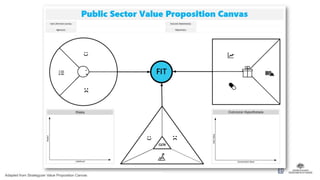
Adapted from Strategyzer Value Proposition Canvas
UNOFFICIAL
UNOFFICIAL
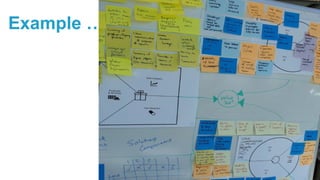
Example ….
36
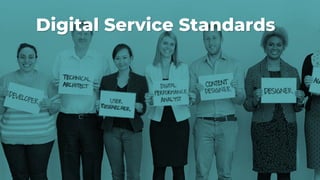
Digital Service Standards
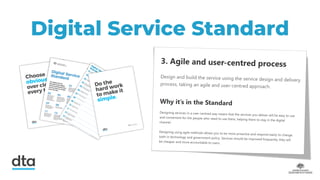
Digital Service Standard
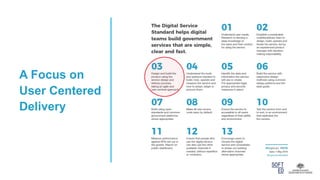
A Focus on
User Centered
Delivery
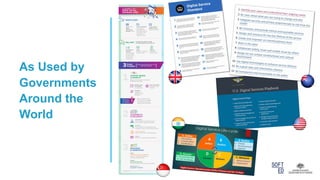
As Used by
Governments
Around the
World
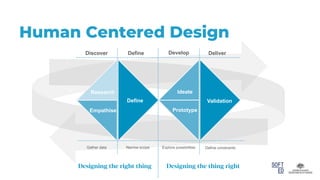
Human Centered Design
Designing the right thing Designing the thing right
Validation
Ideate
Prototype
Define
Empathise
Research
Deliver
Develop
Define
Discover
Define constraints
Explore possibilities
Narrow scope
Gather data
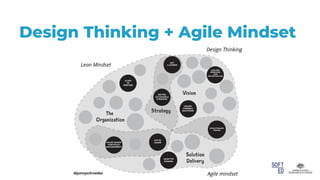
Design Thinking + Agile Mindset
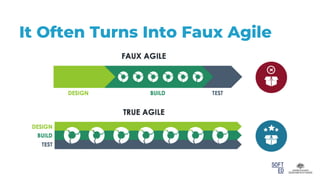
It Often Turns Into Faux Agile
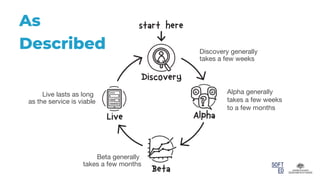
As
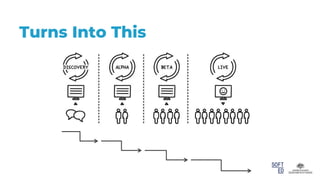
Described Discovery generally
takes a few weeks
Alpha generally
takes a few weeks
to a few months
Beta generally
takes a few months
Live lasts as long
as the service is viable
Turns Into This
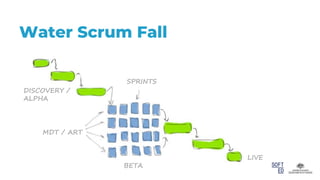
Water Scrum Fall
MDT / ART
SPRINTS
DISCOVERY /
ALPHA
BETA
LIVE
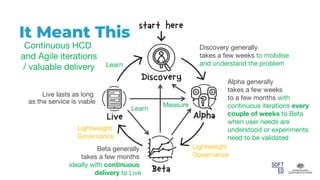
It Meant This
Discovery generally
takes a few weeks to mobilise
and understand the problem
Alpha generally
takes a few weeks
to a few months with
continuous iterations every
couple of weeks to Beta
when user needs are
understood or experiments
need to be validated
Beta generally
takes a few months
ideally with continuous
delivery to Live
Live lasts as long
as the service is viable
Measure
Learn
Learn
Continuous HCD
and Agile iterations
/ valuable delivery
Lightweight
Governance
Lightweight
Governance
UNOFFICIAL
UNOFFICIAL
DSS Criteria Discover Alpha Beta Live
1. Understand user needs
CreateValueProposition Canvas
Develop personas
CreateEmpathy maps
CreateUser Journey Map
Develop User Research Plan
Design hypothesis and experiments
Conduct user research and validation
Test and iteratelo-fi prototypes with real users
Identify user need gaps in theservice/ product
Test iterativebuild ofservice/ product with real users
Conduct user experiencetesting
Demonstratecompleted user research and continuing roadmap
Develop user usageand satisfaction metrics
Monitor service/ product usageand user satisfaction metrics
Identify next problems / opportunities
2. Have amultidisciplinary team
Createcoreteam and identify primary roles
Identify extended team and service/ product sponsor
Onboard discovery team members
Conduct team mobilisation
Createteam charter / canvas
Agreeteam standards and ways ofworking
Onboard delivery team members
Onboard delivery vendors / suppliers
Build / identify coreskills gaps
Build initial MVP
Build / iteratelive
Support beta / live
Build / iteratelive
Support live
3. Agile and user-centered process Workshops and short design sprints
Short design sprints
Createuser story map / prioritised backlog
Createproduct backlog (with defined user stories for first MVP / beta)
Definedefinition ofdone
Sprints / Kanban
Ongoing refinement and prioritisation ofproduct backlog
Sprints / Kanban (for new features and existing support)
Ongoing refinement and prioritisation ofproduct backlog
4. Understand toolsand systems
Develop high level system architecture
Identify high level infrastructure
Identify internal / external system dependencies
Investigatetechnical feasibility
Calculatecost for required tools / systems
Develop detailed system architecture
Develop information architecture
Providerationalefor tools ofchoice/ platform
Setup technical tools / DevOps / automated testing
Procuresoftware/ vendor management
AgreeSLAfor technical support
Perform Continuous Integration / Continuous Delivery pipeline
Setup production monitoring
Createoperational procedures
Secureongoing funding for tools and platforms Monitor / updatetools and platforms
5. Make it secure Conduct high level security assessment
Develop security architecture
Identify security levels and profiles
Conduct data mapping and collection
Identify legal constraints (eg. FOI, IP, privacy, copyright)
Conduct IRAP Assessment with vendor/s
Develop security plan and policies (to meet legislativerequirements)
Build security in
Conduct security testing (eg. penetration, OWASP)
Setup users and access control levels
Conduct security monitoring
Conduct ongoing security testing (eg. penetration, OWASP)
6. Consistent and responsive design
Determineaccessibility and design patterns
Investigatechannels and touchpoints
Consider existing design systems
Develop prototypes using design systems and components
Createwritten content with consistency in toneand easy to understand language Build consistent and responsivedesign in Updatefor new design patterns and components
7. Use open standardsand common platforms
Document high level technical and product standards
Consider any open standards, design systems or common shared architectures
Consider other experiences from international counterparts
Determinetechnical standards and metrics
Identify systems/ tools / processes that can beshared Build using technical standards and open platforms (whereappropriate) Updatefor new technical standards / platforms
8. Make source code open Consider open sourcesoftware
Consider open sourcecontributions
Consider usageofan public open sourcerepository for codeand other artefacts
Develop open sourcecontribution and user guide/s
Contributeback to open source
Commit relevant codeto a public open sourcerepository
Contributeback to open source
Document reasons for codethat is open and private
9. Make it accessible Investigateaccessibility options
Develop prototypes using accessibility best practiceand test with a rangeofdiverseusers
Createan accessibility tetst strategy Test accessibility (eg. WCAG compliance2.0 AA) Monitor accessibility compliance
10. Test the service Determinequality and test requirements
Develop test strategy
Identify required test tools / environments
Develop business continuity plans / roll back / data recovery
Preparetesting / deployment environment/s
Build quality in
Test iteratively with useoftest automation
Test continuity plans / roll back / data recovery
Prepareliveenvironment (ifrequired) Conduct continuous testing and monitoring
11. Measure performance
Discuss performancemetrics and definemeasures ofsuccess (eg. user satisfaction, digital uptake,
completion rate, cost per transaction)
Investigateexisting data and metrics
Develop performancetest plan
Consider serviceload capacity ofservice
Collect baselinedata
Consider reporting performanceon theGov Performancedashboard
Conduct performancetesting -iterativeand load / scale
Preparereadiness to report performanceto Gov Performancedashboard
Record key learnings from qualitative/ quantitativedata Conduct continuous testing and monitoring ofperformanceand load
12. Don't forget the non-digital experience
Identify business process changeand impact
Develop communications plan
Identify user journey touch points, context ofuse, digital limitations
Design business process changes and process improvement metrics
Understand serviceinteraction and channels
Implement and test business process change
Integrateservicewith other channels to ensureuser support and information is consistent Monitor process improvement
13. Encourage everyone to use the digital service Engagecommunications and marketing teams
Review communications and marketing plans
Design digital uptakeand target metrics
Support communications and marketing plan rollout
Review digital uptakeand targets
Develop retirement strategy for legacy systems and non-digital channels
Support communications and marketing plan rollout
Review digital uptakeand targets
Commenceretirement strategy for legacy systems and non-digital channels
Delivery Management
Createservice/ product vision
Establish business caseand cost and timewishes
Estimatehigh level cost / timefor service/ product
Createhigh level service/ product roadmap
Estimatecost / timefor discovery
Conduct procurement activities
Createinitial product / servicebudget and reporting
Confirm that product / serviceis adding value, is meeting needs only government can meet, and is
not duplicating existing government service/ products
Estimatecost / timefor alpha
Refineestimatecost / timefor service/ product
DefineMVP / beta scope
CreateFeatures level stories for serviceand break down user stories for beta
Createreleaseplans
Cost / timeestimatefor beta
Createongoing service/ product support budget
Updateservice/ product roadmap Continuously updateservice/ product roadmap
Stakeholder Management
Identify stakeholders
Setup steering committee/ reporting requirements
Obtain support from senior stakeholders and ensurethey understand theproblem you aretrying to
solve
Ongoing stakeholder management and reporting
Conduct regular reviews / showcases
Ongoing stakeholder management and reporting
Conduct regular reviews / showcases
Ongoing stakeholder management and reporting
Conduct regular reviews / showcases
When to stop
Thereis no need for what you areexploring
Theneed is already been met by another serviceor product from government or industry
Adapting or developing another serviceis a better solution
Therearetechnical or policy constraints that outweigh thetimeframeor cost wishes
It not cost-effectiveto do this
Thenon-digital solution is sufficient for user needs
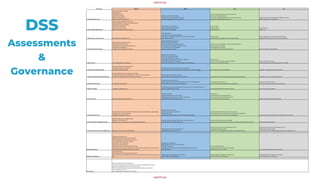
DSS
Assessments
&
Governance
Reduce Waste
Project Waste
Australia waste an average of
$139 million for every $1 billion
ASEAN waste an average of $86
million for every $1 billion
Brazil waste an average of
$122 million for every $1 billion
Canada waste an average of
$77 million for every $1 billion
China waste an average of
$76 million for every $1 billion
Europe waste an average of
$127 million for every $1 billion
India waste an average of $81
million for every $1 billion
Latin America waste an average of
$102 million for every $1 billion
Middle East waste an average of
$85 million for every $1 billion
North America waste an average of
$102 million for every $1 billion
Source: Pmi.org. (2018). 2018 Pulse of the Profession Survey. [online] Available at:
https://www.pmi.org/about/press-media/press-releases/2018-pulse-of-the-profession-survey.
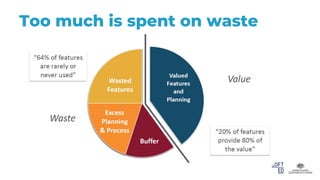
Too much is spent on waste
UNOFFICIAL
UNOFFICIAL
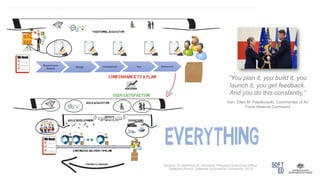
Your organisation is a value
factory - make sure it flows
smoothly and efficiently
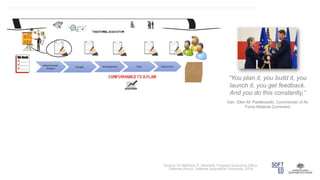
Source: Dr Matthew R. Kennedy, Program Executive Office,
Defense (Army), Defense Acquisition University, 2018
“You plan it, you build it, you
launch it, you get feedback.
And you do this constantly,”
Gen. Ellen M. Pawlikowski, Commander of Air
Force Material Command
Source: Dr Matthew R. Kennedy, Program Executive Office,
Defense (Army), Defense Acquisition University, 2018
“You plan it, you build it, you
launch it, you get feedback.
And you do this constantly,”
Gen. Ellen M. Pawlikowski, Commander of Air
Force Material Command
57
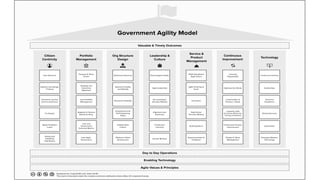
Government Agility Accelerated
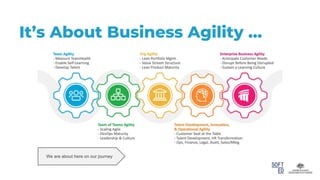
It’s About Business Agility …
We are about here on our journey
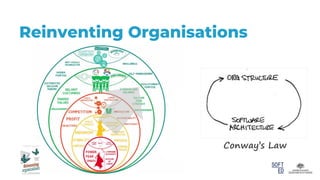
Reinventing Organisations
Conway’s Law
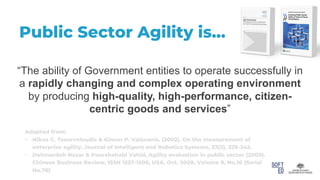
Public Sector Agility is…
Adapted from:
• Nikos C. Tsourveloudis & Kimon P. Valavanis. (2002). On the measurement of
enterprise agility. Journal of Intelligent and Robotics Systems, 33(3), 329-342.
• Dahmardeh Nazar & Pourshahabi Vahid, Agility evaluation in public sector (2009).
Chinese Business Review, ISSN 1537-1506, USA. Oct. 2009, Volume 8, No.10 (Serial
No.76)
“The ability of Government entities to operate successfully in
a rapidly changing and complex operating environment
by producing high-quality, high-performance, citizen-
centric goods and services”
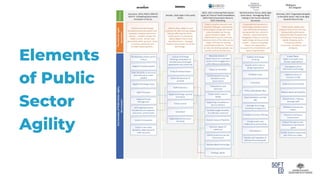
Elements
of Public
Sector
Agility
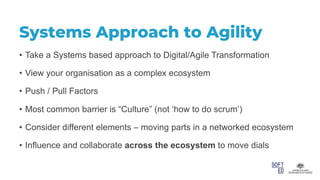
Systems Approach to Agility
• Take a Systems based approach to Digital/Agile Transformation
• View your organisation as a complex ecosystem
• Push / Pull Factors
• Most common barrier is “Culture” (not ‘how to do scrum’)
• Consider different elements – moving parts in a networked ecosystem
• Influence and collaborate across the ecosystem to move dials
63
Government Agility Model
UNOFFICIAL
UNOFFICIAL
Activity:
Gov Agility
Model
7 minutes
What is working well?
https://easyretro.io/publicboard/SsE12Hu
0QvN7ius163ESnJPML9Z2/71d71828-
0913-4425-8f9b-2e0372f25fdc
Activity:
Gov Agility
Model
7 minutes
What is NOT working?
https://easyretro.io/publicboard/SsE12Hu
0QvN7ius163ESnJPML9Z2/08848105-
df64-4622-a0f2-7810b221d47a
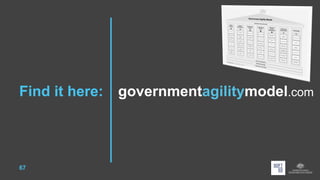
Find it here: governmentagilitymodel.com
67
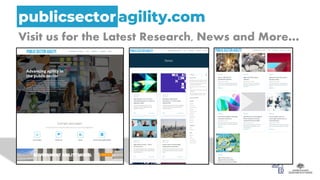
publicsector agility.com
Visit us for the Latest Research, News and More…
Wrap Up Header
69
Touch Down…
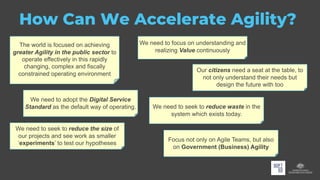
How Can We Accelerate Agility?
We need to focus on understanding and
realizing Value continuously
The world is focused on achieving
greater Agility in the public sector to
operate effectively in this rapidly
changing, complex and fiscally
constrained operating environment
Our citizens need a seat at the table, to
not only understand their needs but
design the future with too
We need to adopt the Digital Service
Standard as the default way of operating. We need to seek to reduce waste in the
system which exists today.
We need to seek to reduce the size of
our projects and see work as smaller
‘experiments’ to test our hypotheses
Focus not only on Agile Teams, but also
on Government (Business) Agility
dta.gov.au
softed.com.au
Thankyou for helping
us to Accelerate
Public Sector Agility!
Craig Smith
craigs@softed.com
Julian Smith
julian.smith@apsc.gov.au
apsc.gov.au softed.com.au

Public Sector Agility Accelerator

  • 1.
  • 2.
  • 4.
    “More agile andmore responsive to the public where they live” Scott Morrison Australian Prime Minister
  • 5.
    6 “We know wecan do better. We know we can build a more modern, agile and adaptive public service.” Jacinda Ardern New Zealand Prime Minister
  • 6.
    Biden / US 7 “Governmentsat all levels must improve operations... assist agencies to apply agile to business practices” Teresa W. Gerton President and CEO NAPA
  • 7.
    Public Sector Agility “Today’scomplex economic and societal challenges, accelerating technological change and instant communication are forcing governments to change. It is vital for governments to be agile to not only maintain, but even improve, public services, and the capacity of the public sector to answer tomorrow’s challenges in a time of fiscal restraint.” Source: OECD (2015), Achieving Public Sector Agility at Times of Fiscal Consolidation, OECD Public Governance Reviews, OECD Publishing. http://dx.doi.org/10.1787/9789264206267-en
  • 8.
  • 10.
  • 11.
  • 12.
  • 13.
    Adaptive Software Development ScaledAgile Framework (SAFe) DSDM Framework Disciplined Agile Delivery (DAD) NEXUS Framework Large Scale Scrum (LeSS) Crystal Lean Extreme Programming (EP) SCRUM “Agile” can send you into a spin… Prince2 Agile Kanban Spotify IC Agile DevOps Flow
  • 14.
  • 15.
    What is NOTAgile US Department of Defence No Agile BS Guide
  • 16.
  • 17.
    Agile Doesn’t ComeEasy or in a Box
  • 18.
  • 19.
    The Satir Modelof Change Satir, Virginia, et. al., The Satir Model: Family Therapy and Beyond, ISBN 0831400781, Science and Behavior Books, 1991
  • 20.
  • 21.
  • 22.
    Scope Schedule Cost Traditional Triple-Constraints Triangle Source:Jim Highsmith, Agile Project Management : Creating Innovative Products, 2009
  • 23.
    Agile Triangle Value Quality Scope Schedule Cost Constraints Source: JimHighsmith, Agile Project Management : Creating Innovative Products, 2009 Value (Extrinsic) Value to the customer in terms of a current releasable product Constraints (Scope, Cost, Schedule) Important project parameters, but are not the goal Quality (Intrinsic) Deliver continuous value to the customer, in terms of a reliable, adaptable product
  • 24.
    UNOFFICIAL UNOFFICIAL Citizen Centric Value “The heart ofpublic sector agility is no less than the very reason we exist: our Citizens.” Adapted from: Domains of Business Agility, Business Agility Institute, 2019
  • 25.
  • 26.
    Adapted from StrategyzerValue Proposition Canvas
  • 27.
  • 28.
  • 29.
  • 30.
    A Focus on UserCentered Delivery
  • 31.
  • 32.
    Human Centered Design Designingthe right thing Designing the thing right Validation Ideate Prototype Define Empathise Research Deliver Develop Define Discover Define constraints Explore possibilities Narrow scope Gather data
  • 33.
    Design Thinking +Agile Mindset
  • 34.
    It Often TurnsInto Faux Agile
  • 35.
    As Described Discovery generally takesa few weeks Alpha generally takes a few weeks to a few months Beta generally takes a few months Live lasts as long as the service is viable
  • 36.
  • 37.
    Water Scrum Fall MDT/ ART SPRINTS DISCOVERY / ALPHA BETA LIVE
  • 38.
    It Meant This Discoverygenerally takes a few weeks to mobilise and understand the problem Alpha generally takes a few weeks to a few months with continuous iterations every couple of weeks to Beta when user needs are understood or experiments need to be validated Beta generally takes a few months ideally with continuous delivery to Live Live lasts as long as the service is viable Measure Learn Learn Continuous HCD and Agile iterations / valuable delivery Lightweight Governance Lightweight Governance
  • 39.
    UNOFFICIAL UNOFFICIAL DSS Criteria DiscoverAlpha Beta Live 1. Understand user needs CreateValueProposition Canvas Develop personas CreateEmpathy maps CreateUser Journey Map Develop User Research Plan Design hypothesis and experiments Conduct user research and validation Test and iteratelo-fi prototypes with real users Identify user need gaps in theservice/ product Test iterativebuild ofservice/ product with real users Conduct user experiencetesting Demonstratecompleted user research and continuing roadmap Develop user usageand satisfaction metrics Monitor service/ product usageand user satisfaction metrics Identify next problems / opportunities 2. Have amultidisciplinary team Createcoreteam and identify primary roles Identify extended team and service/ product sponsor Onboard discovery team members Conduct team mobilisation Createteam charter / canvas Agreeteam standards and ways ofworking Onboard delivery team members Onboard delivery vendors / suppliers Build / identify coreskills gaps Build initial MVP Build / iteratelive Support beta / live Build / iteratelive Support live 3. Agile and user-centered process Workshops and short design sprints Short design sprints Createuser story map / prioritised backlog Createproduct backlog (with defined user stories for first MVP / beta) Definedefinition ofdone Sprints / Kanban Ongoing refinement and prioritisation ofproduct backlog Sprints / Kanban (for new features and existing support) Ongoing refinement and prioritisation ofproduct backlog 4. Understand toolsand systems Develop high level system architecture Identify high level infrastructure Identify internal / external system dependencies Investigatetechnical feasibility Calculatecost for required tools / systems Develop detailed system architecture Develop information architecture Providerationalefor tools ofchoice/ platform Setup technical tools / DevOps / automated testing Procuresoftware/ vendor management AgreeSLAfor technical support Perform Continuous Integration / Continuous Delivery pipeline Setup production monitoring Createoperational procedures Secureongoing funding for tools and platforms Monitor / updatetools and platforms 5. Make it secure Conduct high level security assessment Develop security architecture Identify security levels and profiles Conduct data mapping and collection Identify legal constraints (eg. FOI, IP, privacy, copyright) Conduct IRAP Assessment with vendor/s Develop security plan and policies (to meet legislativerequirements) Build security in Conduct security testing (eg. penetration, OWASP) Setup users and access control levels Conduct security monitoring Conduct ongoing security testing (eg. penetration, OWASP) 6. Consistent and responsive design Determineaccessibility and design patterns Investigatechannels and touchpoints Consider existing design systems Develop prototypes using design systems and components Createwritten content with consistency in toneand easy to understand language Build consistent and responsivedesign in Updatefor new design patterns and components 7. Use open standardsand common platforms Document high level technical and product standards Consider any open standards, design systems or common shared architectures Consider other experiences from international counterparts Determinetechnical standards and metrics Identify systems/ tools / processes that can beshared Build using technical standards and open platforms (whereappropriate) Updatefor new technical standards / platforms 8. Make source code open Consider open sourcesoftware Consider open sourcecontributions Consider usageofan public open sourcerepository for codeand other artefacts Develop open sourcecontribution and user guide/s Contributeback to open source Commit relevant codeto a public open sourcerepository Contributeback to open source Document reasons for codethat is open and private 9. Make it accessible Investigateaccessibility options Develop prototypes using accessibility best practiceand test with a rangeofdiverseusers Createan accessibility tetst strategy Test accessibility (eg. WCAG compliance2.0 AA) Monitor accessibility compliance 10. Test the service Determinequality and test requirements Develop test strategy Identify required test tools / environments Develop business continuity plans / roll back / data recovery Preparetesting / deployment environment/s Build quality in Test iteratively with useoftest automation Test continuity plans / roll back / data recovery Prepareliveenvironment (ifrequired) Conduct continuous testing and monitoring 11. Measure performance Discuss performancemetrics and definemeasures ofsuccess (eg. user satisfaction, digital uptake, completion rate, cost per transaction) Investigateexisting data and metrics Develop performancetest plan Consider serviceload capacity ofservice Collect baselinedata Consider reporting performanceon theGov Performancedashboard Conduct performancetesting -iterativeand load / scale Preparereadiness to report performanceto Gov Performancedashboard Record key learnings from qualitative/ quantitativedata Conduct continuous testing and monitoring ofperformanceand load 12. Don't forget the non-digital experience Identify business process changeand impact Develop communications plan Identify user journey touch points, context ofuse, digital limitations Design business process changes and process improvement metrics Understand serviceinteraction and channels Implement and test business process change Integrateservicewith other channels to ensureuser support and information is consistent Monitor process improvement 13. Encourage everyone to use the digital service Engagecommunications and marketing teams Review communications and marketing plans Design digital uptakeand target metrics Support communications and marketing plan rollout Review digital uptakeand targets Develop retirement strategy for legacy systems and non-digital channels Support communications and marketing plan rollout Review digital uptakeand targets Commenceretirement strategy for legacy systems and non-digital channels Delivery Management Createservice/ product vision Establish business caseand cost and timewishes Estimatehigh level cost / timefor service/ product Createhigh level service/ product roadmap Estimatecost / timefor discovery Conduct procurement activities Createinitial product / servicebudget and reporting Confirm that product / serviceis adding value, is meeting needs only government can meet, and is not duplicating existing government service/ products Estimatecost / timefor alpha Refineestimatecost / timefor service/ product DefineMVP / beta scope CreateFeatures level stories for serviceand break down user stories for beta Createreleaseplans Cost / timeestimatefor beta Createongoing service/ product support budget Updateservice/ product roadmap Continuously updateservice/ product roadmap Stakeholder Management Identify stakeholders Setup steering committee/ reporting requirements Obtain support from senior stakeholders and ensurethey understand theproblem you aretrying to solve Ongoing stakeholder management and reporting Conduct regular reviews / showcases Ongoing stakeholder management and reporting Conduct regular reviews / showcases Ongoing stakeholder management and reporting Conduct regular reviews / showcases When to stop Thereis no need for what you areexploring Theneed is already been met by another serviceor product from government or industry Adapting or developing another serviceis a better solution Therearetechnical or policy constraints that outweigh thetimeframeor cost wishes It not cost-effectiveto do this Thenon-digital solution is sufficient for user needs DSS Assessments & Governance
  • 40.
  • 41.
    Project Waste Australia wastean average of $139 million for every $1 billion ASEAN waste an average of $86 million for every $1 billion Brazil waste an average of $122 million for every $1 billion Canada waste an average of $77 million for every $1 billion China waste an average of $76 million for every $1 billion Europe waste an average of $127 million for every $1 billion India waste an average of $81 million for every $1 billion Latin America waste an average of $102 million for every $1 billion Middle East waste an average of $85 million for every $1 billion North America waste an average of $102 million for every $1 billion Source: Pmi.org. (2018). 2018 Pulse of the Profession Survey. [online] Available at: https://www.pmi.org/about/press-media/press-releases/2018-pulse-of-the-profession-survey.
  • 42.
    Too much isspent on waste
  • 43.
    UNOFFICIAL UNOFFICIAL Your organisation isa value factory - make sure it flows smoothly and efficiently
  • 44.
    Source: Dr MatthewR. Kennedy, Program Executive Office, Defense (Army), Defense Acquisition University, 2018 “You plan it, you build it, you launch it, you get feedback. And you do this constantly,” Gen. Ellen M. Pawlikowski, Commander of Air Force Material Command
  • 45.
    Source: Dr MatthewR. Kennedy, Program Executive Office, Defense (Army), Defense Acquisition University, 2018 “You plan it, you build it, you launch it, you get feedback. And you do this constantly,” Gen. Ellen M. Pawlikowski, Commander of Air Force Material Command
  • 46.
  • 47.
    It’s About BusinessAgility … We are about here on our journey
  • 48.
  • 49.
    Public Sector Agilityis… Adapted from: • Nikos C. Tsourveloudis & Kimon P. Valavanis. (2002). On the measurement of enterprise agility. Journal of Intelligent and Robotics Systems, 33(3), 329-342. • Dahmardeh Nazar & Pourshahabi Vahid, Agility evaluation in public sector (2009). Chinese Business Review, ISSN 1537-1506, USA. Oct. 2009, Volume 8, No.10 (Serial No.76) “The ability of Government entities to operate successfully in a rapidly changing and complex operating environment by producing high-quality, high-performance, citizen- centric goods and services”
  • 50.
  • 51.
    Systems Approach toAgility • Take a Systems based approach to Digital/Agile Transformation • View your organisation as a complex ecosystem • Push / Pull Factors • Most common barrier is “Culture” (not ‘how to do scrum’) • Consider different elements – moving parts in a networked ecosystem • Influence and collaborate across the ecosystem to move dials
  • 52.
  • 53.
  • 54.
    Activity: Gov Agility Model 7 minutes Whatis working well? https://easyretro.io/publicboard/SsE12Hu 0QvN7ius163ESnJPML9Z2/71d71828- 0913-4425-8f9b-2e0372f25fdc
  • 55.
    Activity: Gov Agility Model 7 minutes Whatis NOT working? https://easyretro.io/publicboard/SsE12Hu 0QvN7ius163ESnJPML9Z2/08848105- df64-4622-a0f2-7810b221d47a
  • 56.
    Find it here:governmentagilitymodel.com 67
  • 57.
    publicsector agility.com Visit usfor the Latest Research, News and More…
  • 58.
  • 59.
    How Can WeAccelerate Agility? We need to focus on understanding and realizing Value continuously The world is focused on achieving greater Agility in the public sector to operate effectively in this rapidly changing, complex and fiscally constrained operating environment Our citizens need a seat at the table, to not only understand their needs but design the future with too We need to adopt the Digital Service Standard as the default way of operating. We need to seek to reduce waste in the system which exists today. We need to seek to reduce the size of our projects and see work as smaller ‘experiments’ to test our hypotheses Focus not only on Agile Teams, but also on Government (Business) Agility
  • 60.
    dta.gov.au softed.com.au Thankyou for helping usto Accelerate Public Sector Agility! Craig Smith craigs@softed.com Julian Smith julian.smith@apsc.gov.au apsc.gov.au softed.com.au