10/3/2013 | Universal Agile Thinking 1
Hashtag: #UnAgTh
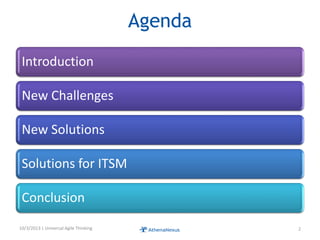
Agenda
Introduction
New Challenges
New Solutions
Solutions for ITSM
Conclusion
10/3/2013 | Universal Agile Thinking 2
Introduction
10/3/2013 | Universal Agile Thinking 3
NEW CHALLENGES
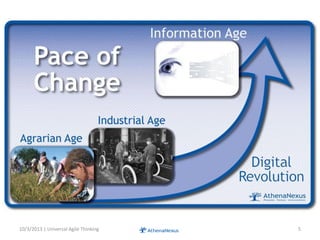
The Digital Revolution triggers an incredible pace of unrelenting change
10/3/2013 | Universal Agile Thinking 4
10/3/2013 | Universal Agile Thinking 5
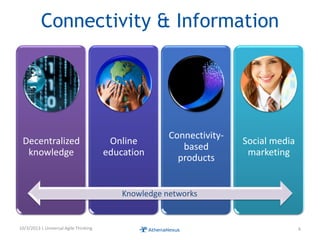
Connectivity & Information
Decentralized
knowledge
Online
education
Connectivity-
based
products
Social media
marketing
10/3/2013 | Universal Agile Thinking 6
Knowledge networks
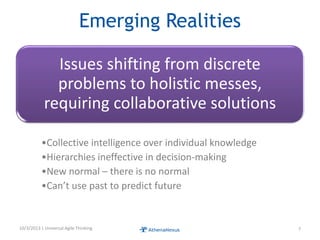
Emerging Realities
Issues shifting from discrete
problems to holistic messes,
requiring collaborative solutions
•Collective intelligence over individual knowledge
•Hierarchies ineffective in decision-making
•New normal – there is no normal
•Can’t use past to predict future
10/3/2013 | Universal Agile Thinking 7
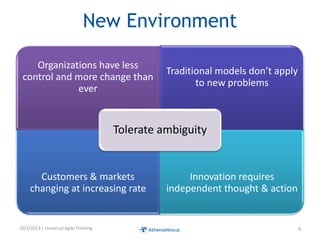
New Environment
Organizations have less
control and more change than
ever
Traditional models don’t apply
to new problems
Customers & markets
changing at increasing rate
Innovation requires
independent thought & action
Tolerate ambiguity
10/3/2013 | Universal Agile Thinking 8
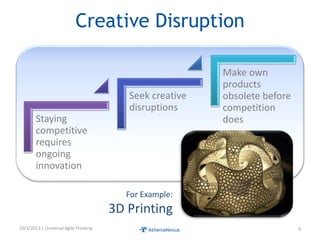
Creative Disruption
Staying
competitive
requires
ongoing
innovation
Seek creative
disruptions
Make own
products
obsolete before
competition
does
10/3/2013 | Universal Agile Thinking 9
For Example:
3D Printing
NEW SOLUTIONS
Non-traditional approaches are showing up throughout our businesses, governments
and educational institutions
10/3/2013 | Universal Agile Thinking 10
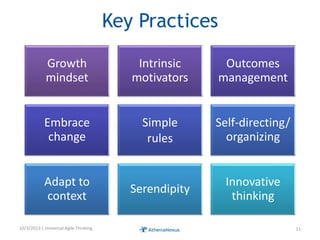
Key Practices
Growth
mindset
Intrinsic
motivators
Outcomes
management
Embrace
change
Simple
rules
Self-directing/
organizing
Adapt to
context
Serendipity
Innovative
thinking
10/3/2013 | Universal Agile Thinking 11
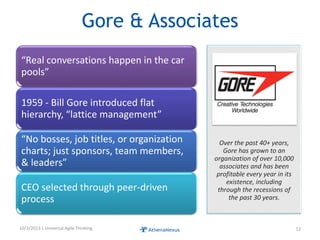
Gore & Associates
“Real conversations happen in the car
pools”
1959 - Bill Gore introduced flat
hierarchy, “lattice management”
“No bosses, job titles, or organization
charts; just sponsors, team members,
& leaders”
CEO selected through peer-driven
process
10/3/2013 | Universal Agile Thinking 12
Over the past 40+ years,
Gore has grown to an
organization of over 10,000
associates and has been
profitable every year in its
existence, including
through the recessions of
the past 30 years.
Non-Traditional Businesses
Ford Motor Company
Blue Cross Blue Shield FEIP
SalesForce
Self-Organized Learning Environments (SOLEs)
10/3/2013 | Universal Agile Thinking 13
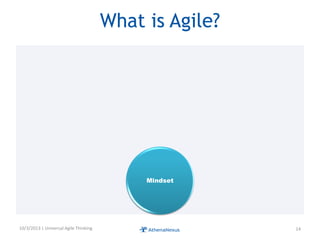
What is Agile?
Mindset
10/3/2013 | Universal Agile Thinking 14
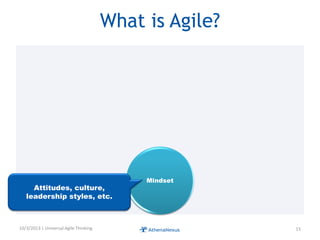
What is Agile?
Mindset
10/3/2013 | Universal Agile Thinking 15
Attitudes, culture,
leadership styles, etc.
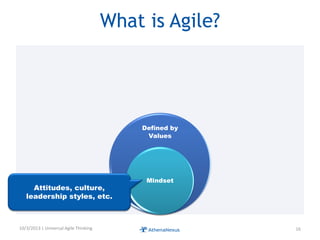
What is Agile?
Defined by
Values
Mindset
10/3/2013 | Universal Agile Thinking 16
Attitudes, culture,
leadership styles, etc.
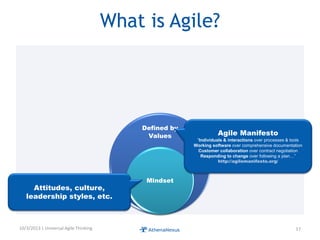
What is Agile?
Defined by
Values
Mindset
10/3/2013 | Universal Agile Thinking 17
Attitudes, culture,
leadership styles, etc.
Agile Manifesto
“Individuals & interactions over processes & tools
Working software over comprehensive documentation
Customer collaboration over contract negotiation
Responding to change over following a plan…”
http://agilemanifesto.org/
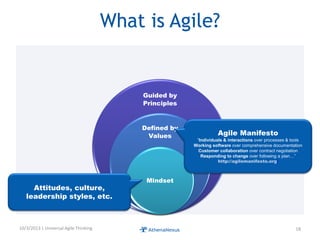
What is Agile?
Guided by
Principles
Defined by
Values
Mindset
10/3/2013 | Universal Agile Thinking 18
Attitudes, culture,
leadership styles, etc.
Agile Manifesto
“Individuals & interactions over processes & tools
Working software over comprehensive documentation
Customer collaboration over contract negotiation
Responding to change over following a plan…”
http://agilemanifesto.org/
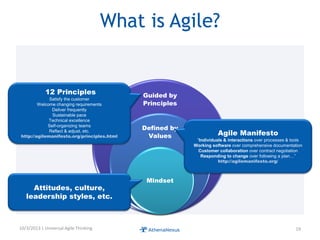
What is Agile?
Guided by
Principles
Defined by
Values
Mindset
10/3/2013 | Universal Agile Thinking 19
Attitudes, culture,
leadership styles, etc.
Agile Manifesto
“Individuals & interactions over processes & tools
Working software over comprehensive documentation
Customer collaboration over contract negotiation
Responding to change over following a plan…”
http://agilemanifesto.org/
12 Principles
Satisfy the customer
Welcome changing requirements
Deliver frequently
Sustainable pace
Technical excellence
Self-organizing teams
Reflect & adjust, etc.
http://agilemanifesto.org/principles.html
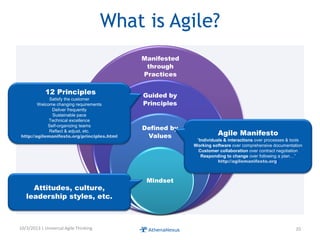
What is Agile?
Manifested
through
Practices
Guided by
Principles
Defined by
Values
Mindset
10/3/2013 | Universal Agile Thinking 20
Attitudes, culture,
leadership styles, etc.
Agile Manifesto
“Individuals & interactions over processes & tools
Working software over comprehensive documentation
Customer collaboration over contract negotiation
Responding to change over following a plan…”
http://agilemanifesto.org/
12 Principles
Satisfy the customer
Welcome changing requirements
Deliver frequently
Sustainable pace
Technical excellence
Self-organizing teams
Reflect & adjust, etc.
http://agilemanifesto.org/principles.html
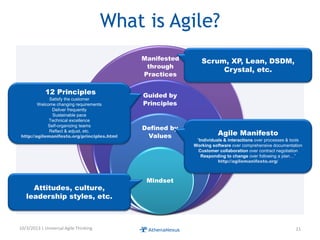
What is Agile?
Manifested
through
Practices
Guided by
Principles
Defined by
Values
Mindset
10/3/2013 | Universal Agile Thinking 21
Attitudes, culture,
leadership styles, etc.
Agile Manifesto
“Individuals & interactions over processes & tools
Working software over comprehensive documentation
Customer collaboration over contract negotiation
Responding to change over following a plan…”
http://agilemanifesto.org/
12 Principles
Satisfy the customer
Welcome changing requirements
Deliver frequently
Sustainable pace
Technical excellence
Self-organizing teams
Reflect & adjust, etc.
http://agilemanifesto.org/principles.html
Scrum, XP, Lean, DSDM,
Crystal, etc.
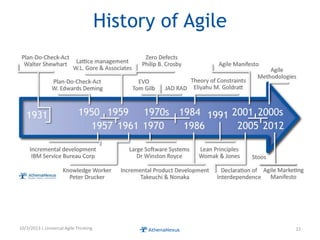
History of Agile
10/3/2013 | Universal Agile Thinking 22
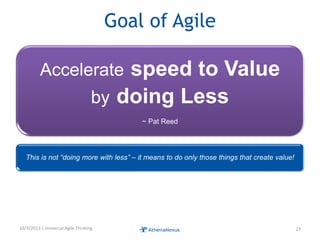
Goal of Agile
Accelerate speed to Value
by doing Less
~ Pat Reed
This is not “doing more with less” – it means to do only those things that create value!
10/3/2013 | Universal Agile Thinking 23
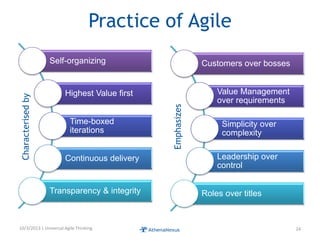
Practice of Agile
Self-organizing
Highest Value first
Time-boxed
iterations
Continuous delivery
Transparency & integrity
10/3/2013 | Universal Agile Thinking 24
Customers over bosses
Value Management
over requirements
Simplicity over
complexity
Leadership over
control
Roles over titles
Characterisedby
Emphasizes
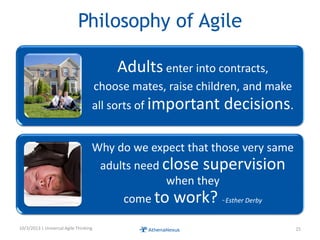
Philosophy of Agile
Adults enter into contracts,
choose mates, raise children, and make
all sorts of important decisions.
Why do we expect that those very same
adults need close supervision
when they
come to work? ~ Esther Derby
10/3/2013 | Universal Agile Thinking 25
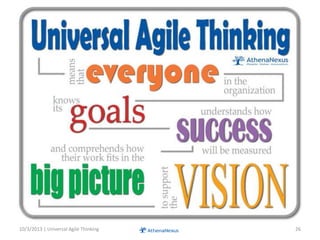
10/3/2013 | Universal Agile Thinking 26
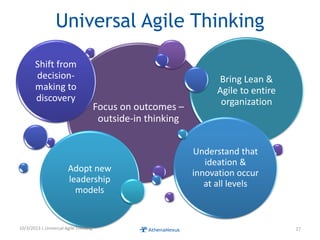
Universal Agile Thinking
Focus on outcomes –
outside-in thinking
Shift from
decision-
making to
discovery
Bring Lean &
Agile to entire
organization
Understand that
ideation &
innovation occur
at all levels
Adopt new
leadership
models
10/3/2013 | Universal Agile Thinking 27
SOLUTIONS FOR ITSM
ITSM leaders and professionals need to understand that IT isn’t separate from the
business; it’s an integral part of the whole
10/3/2013 | Universal Agile Thinking 28
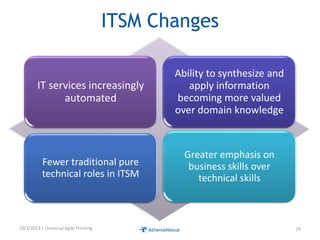
ITSM Changes
IT services increasingly
automated
Ability to synthesize and
apply information
becoming more valued
over domain knowledge
Fewer traditional pure
technical roles in ITSM
Greater emphasis on
business skills over
technical skills
10/3/2013 | Universal Agile Thinking 29
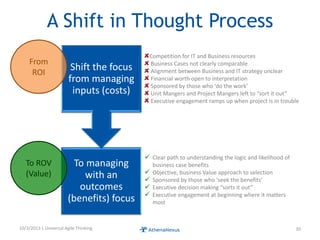
A Shift in Thought Process
To managing
with an
outcomes
(benefits) focus
Shift the focus
from managing
inputs (costs)
10/3/2013 | Universal Agile Thinking 30
Competition for IT and Business resources
Business Cases not clearly comparable
Alignment between Business and IT strategy unclear
Financial worth open to interpretation
Sponsored by those who ‘do the work’
Unit Mangers and Project Mangers left to “sort it out”
Executive engagement ramps up when project is in trouble
 Clear path to understanding the logic and likelihood of
business case benefits
 Objective, business Value approach to selection
 Sponsored by those who ‘seek the benefits’
 Executive decision making “sorts it out”
 Executive engagement at beginning where it matters
most
From
ROI
To ROV
(Value)
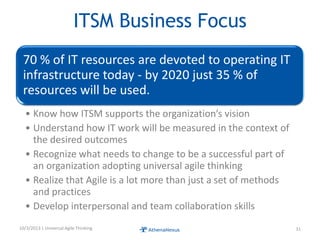
ITSM Business Focus
70 % of IT resources are devoted to operating IT
infrastructure today - by 2020 just 35 % of
resources will be used.
• Know how ITSM supports the organization’s vision
• Understand how IT work will be measured in the context of
the desired outcomes
• Recognize what needs to change to be a successful part of
an organization adopting universal agile thinking
• Realize that Agile is a lot more than just a set of methods
and practices
• Develop interpersonal and team collaboration skills
10/3/2013 | Universal Agile Thinking 31
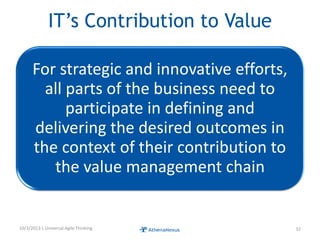
IT’s Contribution to Value
For strategic and innovative efforts,
all parts of the business need to
participate in defining and
delivering the desired outcomes in
the context of their contribution to
the value management chain
10/3/2013 | Universal Agile Thinking 32
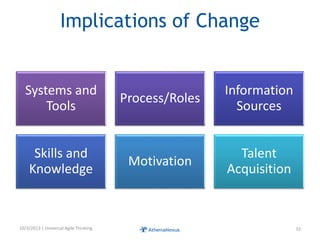
Implications of Change
Systems and
Tools
Process/Roles
Information
Sources
Skills and
Knowledge
Motivation
Talent
Acquisition
10/3/2013 | Universal Agile Thinking 33
DEVOPS
DevOps is the point at which development and operations integrate
10/3/2013 | Universal Agile Thinking 34
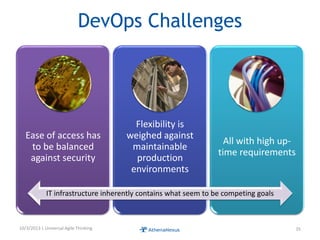
DevOps Challenges
Ease of access has
to be balanced
against security
Flexibility is
weighed against
maintainable
production
environments
All with high up-
time requirements
10/3/2013 | Universal Agile Thinking 35
IT infrastructure inherently contains what seem to be competing goals
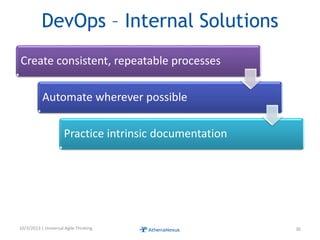
DevOps – Internal Solutions
Create consistent, repeatable processes
Automate wherever possible
Practice intrinsic documentation
10/3/2013 | Universal Agile Thinking 36
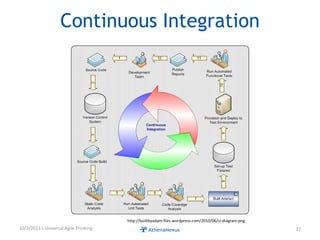
Continuous Integration
10/3/2013 | Universal Agile Thinking 37
http://builtbyadam.files.wordpress.com/2010/06/ci-diagram.png
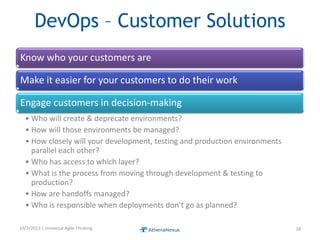
DevOps – Customer Solutions
Know who your customers are
Make it easier for your customers to do their work
Engage customers in decision-making
• Who will create & deprecate environments?
• How will those environments be managed?
• How closely will your development, testing and production environments
parallel each other?
• Who has access to which layer?
• What is the process from moving through development & testing to
production?
• How are handoffs managed?
• Who is responsible when deployments don’t go as planned?
10/3/2013 | Universal Agile Thinking 38
SUPPLIER MANAGEMENT
Procurement is often the bane of projects and managers in many organizations
10/3/2013 | Universal Agile Thinking 39
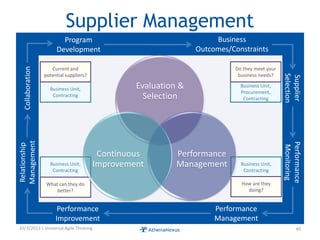
Supplier Management
10/3/2013 | Universal Agile Thinking 40
Monitor
Contract
Business
Outcomes/Constraints
Program
Development
Performance
Improvement
Performance
Management
Supplier
Selection
Performance
Monitoring
Collaboration
Relationship
Management
Business Unit,
Contracting
How are they
doing?
Business Unit,
Contracting
What can they do
better?
Business Unit,
Contracting
Current and
potential suppliers?
Business Unit,
Procurement,
Contracting
Do they meet your
business needs?
Evaluation &
Selection
Performance
Management
Continuous
Improvement
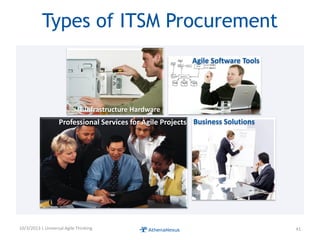
Types of ITSM Procurement
Professional Services for Agile Projects
Agile Software Tools
Business Solutions
IT Infrastructure Hardware
10/3/2013 | Universal Agile Thinking 41
Hardware Procurement
Procuring hardware in traditional
organizations can be challenging
Not uncommon to face crippling lead
times following byzantine processes
• 6-8 months to place an order
• 2-6 months to receive the equipment
• Days or weeks to provision it
10/3/2013 | Universal Agile Thinking 42
Professional Services Procurement
Whether the vendor can work in an agile project environment and, if so, how
much experience the vendor has
• Ensuring only vendors with prior successful experience working with clients on Agile projects
are considered
• Ensuring internal and vendor processes and methods are compatible
Terms and conditions and performance criteria
• Updated T&Cs and performance criteria from traditional contracts (need to reflect Agile
metrics)
• Need to accommodate iterative, adaptive, and discovery-based practices
• Fixed-price, Fixed-price with specific deadline, Time-and-materials
Contract close-out
• Formal acknowledgement of what was delivered
10/3/2013 | Universal Agile Thinking 43
Business Solutions Procurement
Ability/in-ability to focus on the “vital few” capabilities
that matter (business value)
• How to avoid procuring 60%+ of capabilities that are rarely or never used
• Tools/techniques that enable collaborative and incremental definition of
what is needed
• Ability to balance technical, security and business considerations
Ability to establish evaluation criteria that are clear,
transparent and relatively easy to asses
• Evaluators and vendors should have same understanding
10/3/2013 | Universal Agile Thinking 44
Agile Software Tools
DevOps and Continuous Integration require sufficient
tooling and Environments
• Automated testing is required to ensure smooth and error-free
migration to production
• Dev, Test and Prod need sufficient resources and Test and Prod need
to be closely mirrored
Agile Tools need to support Agile practices
• Not all things Agile need software tools – white boards and stickies
are can be very effective for the team to manage its work and for
communicating progress to stakeholder
10/3/2013 | Universal Agile Thinking 45
Procurement Implications
Procurement needs to be simpler, faster
& driven by value delivery goals
• Collaborative approach among stakeholders to develop Agile
procurement processes Agile contract provisions
• Collaborative model with vendors after the contract is signed
• Construct procurement processes with outcomes (the vital
few) in mind
10/3/2013 | Universal Agile Thinking 46
RESOURCES
Business solutions are detailed, contextual and require a lot more than an
introductory webinar to resolve – contact us today
10/3/2013 | Universal Agile Thinking 47
Additional Resources
• White papers
– Available in 2-3 weeks
• Infographics
– Agile history
– What is Agile?
– Agile ITSM procurement
– DevOps
• Blog posts
10/3/2013 | Universal Agile Thinking 48
Contact Us
Larry Cooper
President, AthenaNexus
larry.cooper@athenanexus.com
Jen Stone
CEO, AthenaNexus
jen.stone@athenanexus.com
10/3/2013 | Universal Agile Thinking 49

Universal Agile Thinking - Supporting the Organization

  • 1.
    10/3/2013 | UniversalAgile Thinking 1 Hashtag: #UnAgTh
  • 2.
    Agenda Introduction New Challenges New Solutions Solutionsfor ITSM Conclusion 10/3/2013 | Universal Agile Thinking 2
  • 3.
  • 4.
    NEW CHALLENGES The DigitalRevolution triggers an incredible pace of unrelenting change 10/3/2013 | Universal Agile Thinking 4
  • 5.
    10/3/2013 | UniversalAgile Thinking 5
  • 6.
    Connectivity & Information Decentralized knowledge Online education Connectivity- based products Socialmedia marketing 10/3/2013 | Universal Agile Thinking 6 Knowledge networks
  • 7.
    Emerging Realities Issues shiftingfrom discrete problems to holistic messes, requiring collaborative solutions •Collective intelligence over individual knowledge •Hierarchies ineffective in decision-making •New normal – there is no normal •Can’t use past to predict future 10/3/2013 | Universal Agile Thinking 7
  • 8.
    New Environment Organizations haveless control and more change than ever Traditional models don’t apply to new problems Customers & markets changing at increasing rate Innovation requires independent thought & action Tolerate ambiguity 10/3/2013 | Universal Agile Thinking 8
  • 9.
    Creative Disruption Staying competitive requires ongoing innovation Seek creative disruptions Makeown products obsolete before competition does 10/3/2013 | Universal Agile Thinking 9 For Example: 3D Printing
  • 10.
    NEW SOLUTIONS Non-traditional approachesare showing up throughout our businesses, governments and educational institutions 10/3/2013 | Universal Agile Thinking 10
  • 11.
  • 12.
    Gore & Associates “Realconversations happen in the car pools” 1959 - Bill Gore introduced flat hierarchy, “lattice management” “No bosses, job titles, or organization charts; just sponsors, team members, & leaders” CEO selected through peer-driven process 10/3/2013 | Universal Agile Thinking 12 Over the past 40+ years, Gore has grown to an organization of over 10,000 associates and has been profitable every year in its existence, including through the recessions of the past 30 years.
  • 13.
    Non-Traditional Businesses Ford MotorCompany Blue Cross Blue Shield FEIP SalesForce Self-Organized Learning Environments (SOLEs) 10/3/2013 | Universal Agile Thinking 13
  • 14.
    What is Agile? Mindset 10/3/2013| Universal Agile Thinking 14
  • 15.
    What is Agile? Mindset 10/3/2013| Universal Agile Thinking 15 Attitudes, culture, leadership styles, etc.
  • 16.
    What is Agile? Definedby Values Mindset 10/3/2013 | Universal Agile Thinking 16 Attitudes, culture, leadership styles, etc.
  • 17.
    What is Agile? Definedby Values Mindset 10/3/2013 | Universal Agile Thinking 17 Attitudes, culture, leadership styles, etc. Agile Manifesto “Individuals & interactions over processes & tools Working software over comprehensive documentation Customer collaboration over contract negotiation Responding to change over following a plan…” http://agilemanifesto.org/
  • 18.
    What is Agile? Guidedby Principles Defined by Values Mindset 10/3/2013 | Universal Agile Thinking 18 Attitudes, culture, leadership styles, etc. Agile Manifesto “Individuals & interactions over processes & tools Working software over comprehensive documentation Customer collaboration over contract negotiation Responding to change over following a plan…” http://agilemanifesto.org/
  • 19.
    What is Agile? Guidedby Principles Defined by Values Mindset 10/3/2013 | Universal Agile Thinking 19 Attitudes, culture, leadership styles, etc. Agile Manifesto “Individuals & interactions over processes & tools Working software over comprehensive documentation Customer collaboration over contract negotiation Responding to change over following a plan…” http://agilemanifesto.org/ 12 Principles Satisfy the customer Welcome changing requirements Deliver frequently Sustainable pace Technical excellence Self-organizing teams Reflect & adjust, etc. http://agilemanifesto.org/principles.html
  • 20.
    What is Agile? Manifested through Practices Guidedby Principles Defined by Values Mindset 10/3/2013 | Universal Agile Thinking 20 Attitudes, culture, leadership styles, etc. Agile Manifesto “Individuals & interactions over processes & tools Working software over comprehensive documentation Customer collaboration over contract negotiation Responding to change over following a plan…” http://agilemanifesto.org/ 12 Principles Satisfy the customer Welcome changing requirements Deliver frequently Sustainable pace Technical excellence Self-organizing teams Reflect & adjust, etc. http://agilemanifesto.org/principles.html
  • 21.
    What is Agile? Manifested through Practices Guidedby Principles Defined by Values Mindset 10/3/2013 | Universal Agile Thinking 21 Attitudes, culture, leadership styles, etc. Agile Manifesto “Individuals & interactions over processes & tools Working software over comprehensive documentation Customer collaboration over contract negotiation Responding to change over following a plan…” http://agilemanifesto.org/ 12 Principles Satisfy the customer Welcome changing requirements Deliver frequently Sustainable pace Technical excellence Self-organizing teams Reflect & adjust, etc. http://agilemanifesto.org/principles.html Scrum, XP, Lean, DSDM, Crystal, etc.
  • 22.
    History of Agile 10/3/2013| Universal Agile Thinking 22
  • 23.
    Goal of Agile Acceleratespeed to Value by doing Less ~ Pat Reed This is not “doing more with less” – it means to do only those things that create value! 10/3/2013 | Universal Agile Thinking 23
  • 24.
    Practice of Agile Self-organizing HighestValue first Time-boxed iterations Continuous delivery Transparency & integrity 10/3/2013 | Universal Agile Thinking 24 Customers over bosses Value Management over requirements Simplicity over complexity Leadership over control Roles over titles Characterisedby Emphasizes
  • 25.
    Philosophy of Agile Adultsenter into contracts, choose mates, raise children, and make all sorts of important decisions. Why do we expect that those very same adults need close supervision when they come to work? ~ Esther Derby 10/3/2013 | Universal Agile Thinking 25
  • 26.
    10/3/2013 | UniversalAgile Thinking 26
  • 27.
    Universal Agile Thinking Focuson outcomes – outside-in thinking Shift from decision- making to discovery Bring Lean & Agile to entire organization Understand that ideation & innovation occur at all levels Adopt new leadership models 10/3/2013 | Universal Agile Thinking 27
  • 28.
    SOLUTIONS FOR ITSM ITSMleaders and professionals need to understand that IT isn’t separate from the business; it’s an integral part of the whole 10/3/2013 | Universal Agile Thinking 28
  • 29.
    ITSM Changes IT servicesincreasingly automated Ability to synthesize and apply information becoming more valued over domain knowledge Fewer traditional pure technical roles in ITSM Greater emphasis on business skills over technical skills 10/3/2013 | Universal Agile Thinking 29
  • 30.
    A Shift inThought Process To managing with an outcomes (benefits) focus Shift the focus from managing inputs (costs) 10/3/2013 | Universal Agile Thinking 30 Competition for IT and Business resources Business Cases not clearly comparable Alignment between Business and IT strategy unclear Financial worth open to interpretation Sponsored by those who ‘do the work’ Unit Mangers and Project Mangers left to “sort it out” Executive engagement ramps up when project is in trouble  Clear path to understanding the logic and likelihood of business case benefits  Objective, business Value approach to selection  Sponsored by those who ‘seek the benefits’  Executive decision making “sorts it out”  Executive engagement at beginning where it matters most From ROI To ROV (Value)
  • 31.
    ITSM Business Focus 70% of IT resources are devoted to operating IT infrastructure today - by 2020 just 35 % of resources will be used. • Know how ITSM supports the organization’s vision • Understand how IT work will be measured in the context of the desired outcomes • Recognize what needs to change to be a successful part of an organization adopting universal agile thinking • Realize that Agile is a lot more than just a set of methods and practices • Develop interpersonal and team collaboration skills 10/3/2013 | Universal Agile Thinking 31
  • 32.
    IT’s Contribution toValue For strategic and innovative efforts, all parts of the business need to participate in defining and delivering the desired outcomes in the context of their contribution to the value management chain 10/3/2013 | Universal Agile Thinking 32
  • 33.
    Implications of Change Systemsand Tools Process/Roles Information Sources Skills and Knowledge Motivation Talent Acquisition 10/3/2013 | Universal Agile Thinking 33
  • 34.
    DEVOPS DevOps is thepoint at which development and operations integrate 10/3/2013 | Universal Agile Thinking 34
  • 35.
    DevOps Challenges Ease ofaccess has to be balanced against security Flexibility is weighed against maintainable production environments All with high up- time requirements 10/3/2013 | Universal Agile Thinking 35 IT infrastructure inherently contains what seem to be competing goals
  • 36.
    DevOps – InternalSolutions Create consistent, repeatable processes Automate wherever possible Practice intrinsic documentation 10/3/2013 | Universal Agile Thinking 36
  • 37.
    Continuous Integration 10/3/2013 |Universal Agile Thinking 37 http://builtbyadam.files.wordpress.com/2010/06/ci-diagram.png
  • 38.
    DevOps – CustomerSolutions Know who your customers are Make it easier for your customers to do their work Engage customers in decision-making • Who will create & deprecate environments? • How will those environments be managed? • How closely will your development, testing and production environments parallel each other? • Who has access to which layer? • What is the process from moving through development & testing to production? • How are handoffs managed? • Who is responsible when deployments don’t go as planned? 10/3/2013 | Universal Agile Thinking 38
  • 39.
    SUPPLIER MANAGEMENT Procurement isoften the bane of projects and managers in many organizations 10/3/2013 | Universal Agile Thinking 39
  • 40.
    Supplier Management 10/3/2013 |Universal Agile Thinking 40 Monitor Contract Business Outcomes/Constraints Program Development Performance Improvement Performance Management Supplier Selection Performance Monitoring Collaboration Relationship Management Business Unit, Contracting How are they doing? Business Unit, Contracting What can they do better? Business Unit, Contracting Current and potential suppliers? Business Unit, Procurement, Contracting Do they meet your business needs? Evaluation & Selection Performance Management Continuous Improvement
  • 41.
    Types of ITSMProcurement Professional Services for Agile Projects Agile Software Tools Business Solutions IT Infrastructure Hardware 10/3/2013 | Universal Agile Thinking 41
  • 42.
    Hardware Procurement Procuring hardwarein traditional organizations can be challenging Not uncommon to face crippling lead times following byzantine processes • 6-8 months to place an order • 2-6 months to receive the equipment • Days or weeks to provision it 10/3/2013 | Universal Agile Thinking 42
  • 43.
    Professional Services Procurement Whetherthe vendor can work in an agile project environment and, if so, how much experience the vendor has • Ensuring only vendors with prior successful experience working with clients on Agile projects are considered • Ensuring internal and vendor processes and methods are compatible Terms and conditions and performance criteria • Updated T&Cs and performance criteria from traditional contracts (need to reflect Agile metrics) • Need to accommodate iterative, adaptive, and discovery-based practices • Fixed-price, Fixed-price with specific deadline, Time-and-materials Contract close-out • Formal acknowledgement of what was delivered 10/3/2013 | Universal Agile Thinking 43
  • 44.
    Business Solutions Procurement Ability/in-abilityto focus on the “vital few” capabilities that matter (business value) • How to avoid procuring 60%+ of capabilities that are rarely or never used • Tools/techniques that enable collaborative and incremental definition of what is needed • Ability to balance technical, security and business considerations Ability to establish evaluation criteria that are clear, transparent and relatively easy to asses • Evaluators and vendors should have same understanding 10/3/2013 | Universal Agile Thinking 44
  • 45.
    Agile Software Tools DevOpsand Continuous Integration require sufficient tooling and Environments • Automated testing is required to ensure smooth and error-free migration to production • Dev, Test and Prod need sufficient resources and Test and Prod need to be closely mirrored Agile Tools need to support Agile practices • Not all things Agile need software tools – white boards and stickies are can be very effective for the team to manage its work and for communicating progress to stakeholder 10/3/2013 | Universal Agile Thinking 45
  • 46.
    Procurement Implications Procurement needsto be simpler, faster & driven by value delivery goals • Collaborative approach among stakeholders to develop Agile procurement processes Agile contract provisions • Collaborative model with vendors after the contract is signed • Construct procurement processes with outcomes (the vital few) in mind 10/3/2013 | Universal Agile Thinking 46
  • 47.
    RESOURCES Business solutions aredetailed, contextual and require a lot more than an introductory webinar to resolve – contact us today 10/3/2013 | Universal Agile Thinking 47
  • 48.
    Additional Resources • Whitepapers – Available in 2-3 weeks • Infographics – Agile history – What is Agile? – Agile ITSM procurement – DevOps • Blog posts 10/3/2013 | Universal Agile Thinking 48
  • 49.
    Contact Us Larry Cooper President,AthenaNexus larry.cooper@athenanexus.com Jen Stone CEO, AthenaNexus jen.stone@athenanexus.com 10/3/2013 | Universal Agile Thinking 49