Technical Information Sheet_10 
SCR = 
dry weight of the covering structures 
(endocarp and testa) 
dry weight of the total dispersal unit 
3.269 - 9.974a + 2.156b 
Millennium Seed Bank Project, Wakehurst Place, Ardingly, 
West Sussex RH17 6TN, UK 
© Copyright 2008, Board of Trustees of the Royal Botanic Gardens, Kew 
www.kew.org/msbp 
Identifying desiccation-sensitive 
Technical Information Sheet_10 
seeds 
The first stage in developing an 
ex-situ conservation strategy for 
a particular plant species is to 
determine seed storage behaviour. 
Seed desiccation sensitivity may 
limit the conservation of some 
species, particularly trees and shrubs 
from wet tropical habitats. This 
information sheet provides practical 
guidance on identifying desiccation 
sensitive seeds. 
Seed storage behaviour refers 
to the capacity of seeds to survive 
desiccation: 
• Desiccation tolerant, or 
orthodox, seeds can be dried, 
without damage, to low moisture 
content (mc). Seed longevity 
increases with reductions in mc and 
temperature in a quantifiable and 
predictable way. 
• Desiccation sensitive, or 
recalcitrant, seeds do not survive 
drying to any large degree, and 
are thus not amenable to long-term 
storage, although the critical 
moisture level for survival varies 
among species. 
• Intermediate seeds tolerate 
drying to around 8% mc. They 
generally lose viability more rapidly 
at low temperature and do not 
withstand storage at -20°C. 
How do you know if seeds are 
desiccation sensitive? 
• RBG Kew’s Seed Information 
Database: 
This database currently contains 
information on seed storage 
behaviour for more than 10,600 
species. 
• Desiccation tolerance screening: 
Protocols, e.g. Hong & Ellis 
(1996), to determine seed storage 
behaviour are based on drying 
seeds to two or three different 
moisture levels and assessing 
percentage germination. To date, 
about 540 species with desiccation-sensitive 
seeds have been identified 
by the Millennium Seed Bank, using 
such methods. 
Kate Gold and Fiona Hay, Seed Conservation Department 
Most of these are trees and shrubs; 
very few herbaceous species 
produce desiccation-sensitive seeds. 
If very few seeds are available, a 
100-seed test (see box overleaf) can 
provide a preliminary indication of 
desiccation tolerance. 
• Seed morphology: 
A good indication of desiccation 
sensitivity is provided by seed 
morphology. With the exception of 
palms, desiccation sensitive seeds 
tend to be large with thin seed 
coats. A recently developed model 
(see box overleaf) uses seed weight 
and seed coat ratio (SCR = seed coat 
mass : whole seed mass) to predict 
the likelihood of woody species 
possessing desiccation sensitive 
seeds. 
• Seed provenance: 
This can also provide clues 
about the likelihood of desiccation 
tolerance. 
- Tropical rainforest species are 
more likely to produce desiccation 
sensitive seeds. 
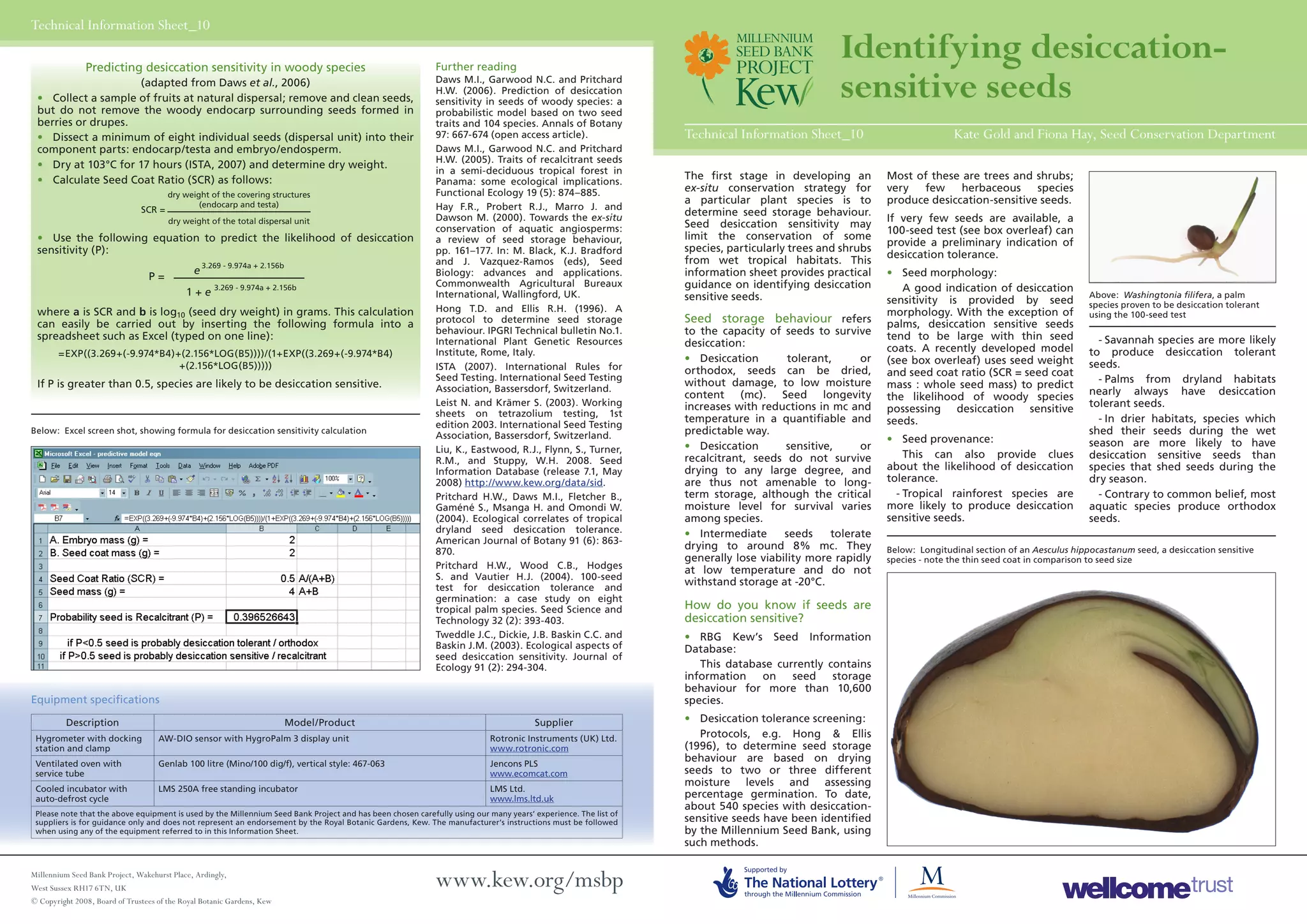
Above: Washingtonia filifera, a palm 
species proven to be desiccation tolerant 
using the 100-seed test 
Below: Longitudinal section of an Aesculus hippocastanum seed, a desiccation sensitive 
species - note the thin seed coat in comparison to seed size 
Predicting desiccation sensitivity in woody species 
(adapted from Daws et al., 2006) 
• Collect a sample of fruits at natural dispersal; remove and clean seeds, 
but do not remove the woody endocarp surrounding seeds formed in 
berries or drupes. 
• Dissect a minimum of eight individual seeds (dispersal unit) into their 
component parts: endocarp/testa and embryo/endosperm. 
• Dry at 103°C for 17 hours (ISTA, 2007) and determine dry weight. 
• Calculate Seed Coat Ratio (SCR) as follows: 
• Use the following equation to predict the likelihood of desiccation 
sensitivity (P): 
where a is SCR and b is log10 (seed dry weight) in grams. This calculation 
can easily be carried out by inserting the following formula into a 
spreadsheet such as Excel (typed on one line): 
=EXP((3.269+(-9.974*B4)+(2.156*LOG(B5))))/(1+EXP((3.269+(-9.974*B4) 
+(2.156*LOG(B5))))) 
If P is greater than 0.5, species are likely to be desiccation sensitive. 
Below: Excel screen shot, showing formula for desiccation sensitivity calculation 
Equipment specifications 
Description Model/Product Supplier 
Hygrometer with docking 
station and clamp 
AW-DIO sensor with HygroPalm 3 display unit Rotronic Instruments (UK) Ltd. 
www.rotronic.com 
Ventilated oven with 
service tube 
Genlab 100 litre (Mino/100 dig/f), vertical style: 467-063 Jencons PLS 
www.ecomcat.com 
Cooled incubator with 
auto-defrost cycle 
LMS 250A free standing incubator LMS Ltd. 
www.lms.ltd.uk 
Please note that the above equipment is used by the Millennium Seed Bank Project and has been chosen carefully using our many years’ experience. The list of 
suppliers is for guidance only and does not represent an endorsement by the Royal Botanic Gardens, Kew. The manufacturer’s instructions must be followed 
when using any of the equipment referred to in this Information Sheet. 
- Savannah species are more likely 
to produce desiccation tolerant 
seeds. 
- Palms from dryland habitats 
nearly always have desiccation 
tolerant seeds. 
- In drier habitats, species which 
shed their seeds during the wet 
season are more likely to have 
desiccation sensitive seeds than 
species that shed seeds during the 
dry season. 
- Contrary to common belief, most 
aquatic species produce orthodox 
seeds. 
Further reading 
Daws M.I., Garwood N.C. and Pritchard 
H.W. (2006). Prediction of desiccation 
sensitivity in seeds of woody species: a 
probabilistic model based on two seed 
traits and 104 species. Annals of Botany 
97: 667-674 (open access article). 
Daws M.I., Garwood N.C. and Pritchard 
H.W. (2005). Traits of recalcitrant seeds 
in a semi-deciduous tropical forest in 
Panama: some ecological implications. 
Functional Ecology 19 (5): 874–885. 
Hay F.R., Probert R.J., Marro J. and 
Dawson M. (2000). Towards the ex-situ 
conservation of aquatic angiosperms: 
a review of seed storage behaviour, 
pp. 161–177. In: M. Black, K.J. Bradford 
and J. Vazquez-Ramos (eds), Seed 
Biology: advances and applications. 
Commonwealth Agricultural Bureaux 
International, Wallingford, UK. 
Hong T.D. and Ellis R.H. (1996). A 
protocol to determine seed storage 
behaviour. IPGRI Technical bulletin No.1. 
International Plant Genetic Resources 
Institute, Rome, Italy. 
ISTA (2007). International Rules for 
Seed Testing. International Seed Testing 
Association, Bassersdorf, Switzerland. 
Leist N. and Krämer S. (2003). Working 
sheets on tetrazolium testing, 1st 
edition 2003. International Seed Testing 
Association, Bassersdorf, Switzerland. 
Liu, K., Eastwood, R.J., Flynn, S., Turner, 
R.M., and Stuppy, W.H. 2008. Seed 
Information Database (release 7.1, May 
2008) http://www.kew.org/data/sid. 
Pritchard H.W., Daws M.I., Fletcher B., 
Gaméné S., Msanga H. and Omondi W. 
(2004). Ecological correlates of tropical 
dryland seed desiccation tolerance. 
American Journal of Botany 91 (6): 863- 
870. 
Pritchard H.W., Wood C.B., Hodges 
S. and Vautier H.J. (2004). 100-seed 
test for desiccation tolerance and 
germination: a case study on eight 
tropical palm species. Seed Science and 
Technology 32 (2): 393-403. 
Tweddle J.C., Dickie, J.B. Baskin C.C. and 
Baskin J.M. (2003). Ecological aspects of 
seed desiccation sensitivity. Journal of 
Ecology 91 (2): 294-304. 
P = e 
1 + e 
3.269 - 9.974a + 2.156b
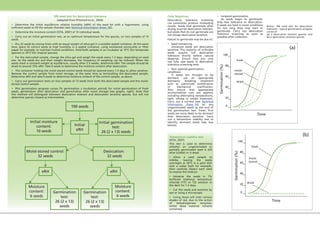
100-seed test for desiccation tolerance 
(adapted from Pritchard et al., 2004) 
• Determine the initial equilibrium relative humidity (eRH) of the seed lot with a hygrometer, using 
sufficient seeds to fill the sample chamber (see Technical Information Sheet_05). 
• Determine the moisture content (ISTA, 2007) of 10 individual seeds. 
• Carry out an initial germination test, at an optimum temperature for the species, on two samples of 13 
seeds. 
• Dry 32 seeds by mixing them with an equal weight of silica gel in a suitable sealed container. At the same 
time, place 32 control seeds at high humidity in a sealed container, using moistened vermiculite or filter 
paper for example, to maintain humid conditions. Hold both samples in an incubator at 15°C (for temperate 
species) or 25°C (for tropical species). 
• For the desiccated sample, change the silica gel and weigh the seeds every 1-3 days, depending on seed 
size. As the seeds dry and their weight decreases, the frequency of weighing can be reduced. When the 
seeds reach a constant weight at equilibrium, usually after 2-3 weeks, determine eRH. The sample should be 
dried to around 15% eRH. Take 6 seeds to determine the moisture content after desiccation. 
• The container holding the moist-stored control seeds should be opened every 1-3 days to allow aeration. 
Remove the control sample from moist storage, at the same time as terminating the desiccated sample. 
Determine eRH and take 6 seeds to determine moisture content of the control sample, as above. 
• Carry out germination tests on two samples of 13 seeds from both the desiccated sample and the moist-stored 
control sample. 
• Plot germination progress curves (% germination x incubation period) for initial germination of fresh 
seeds, germination after desiccation and germination after moist storage (see graphs, right). Note that 
this method will distinguish between desiccation tolerant and desiccation sensitive species, but will not 
determine species classed as Intermediate. 
Initial moisture 
content: 
10 seeds 
eRH 
100 seeds 
Initial germination 
test: 
26 (2 x 13) seeds 
Initial 
eRH 
Moisture 
content: 
6 seeds 
eRH 
Germination 
test: 
26 (2 x 13) 
seeds 
Moisture 
content: 
6 seeds 
Germination 
test: 
26 (2 x 13) 
seeds 
Moist-stored control: 
32 seeds 
Desiccation: 
32 seeds 
Below: 100 seed test for desiccation 
tolerance - typical germination progress 
curves of 
(a) a desiccation tolerant species, and 
(b) a desiccation sensitive species 
False Negatives 
Desiccation tolerance screening 
can sometimes produce misleading 
results. Seeds that germinate after 
drying must be desiccation tolerant, 
but seeds that do not germinate are 
not always desiccation sensitive. 
Failure to germinate may be due to: 
• Seed immaturity 
Immature seeds are desiccation 
sensitive. The majority of orthodox 
seeds acquire full desiccation 
tolerance shortly before natural 
dispersal. Ensure that you only 
use fully ripe seeds in desiccation 
tolerance screening tests. 
• Non-optimal germination 
conditions 
If seeds are thought to be 
dormant, use an appropriate 
dormancy breaking treatment 
such as warm/cold stratification 
or mechanical scarification. 
Also ensure that appropriate 
environmental cues are applied, 
including alternating temperatures, 
light, nitrate or smoke treatment. 
Carry out a cut-test (see Technical 
Information Sheet_14) on any 
ungerminated seeds at the end of 
the germination test. Fresh, firm 
seeds are more likely to be dormant 
than desiccation sensitive. Carry 
out a tetrazolium viability test to 
identify dormant seeds (see box 
below). 
Tetrazolium viability test 
(ISTA, 2007) 
This test is used to determine 
whether an ungerminated or 
partially germinated seed is still 
alive (viable) or is dead. 
• Allow a seed sample to 
imbibe, leaving the seeds 
overnight at 20ºC in a petri dish 
over a water bath for example, 
then carefully dissect each seed 
to expose the embryo. 
• Immerse the seeds in 1% 
buffered triphenyl tetrazolium 
chloride (TTC or TZ) solution in 
the dark for 1-2 days. 
• Cut the seeds and examine by 
eye or using a microscope. 
• Living tissue will stain various 
shades of red, due to the action 
of dehydrogenase enzymes, 
whilst dead material remains 
unstained. 
100 
80 
60 
40 
20 
0 
Germination (%) 
Time 
fresh 
moist-stored 
dried 
(a) 
100 
80 
60 
40 
20 
0 
Germination (%) 
Time 
fresh 
moist-stored 
dried 
(b) 
• Incipient germination 
As seeds begin to germinate, 
they lose tolerance to desiccation. 
If seeds are held in moist conditions 
for too long they may start to 
germinate. Carry out desiccation 
tolerance screening as soon as 
possible after collection.

Identifying Desiccation-Sensitive Seeds

  • 1.
    Technical Information Sheet_10 SCR = dry weight of the covering structures (endocarp and testa) dry weight of the total dispersal unit 3.269 - 9.974a + 2.156b Millennium Seed Bank Project, Wakehurst Place, Ardingly, West Sussex RH17 6TN, UK © Copyright 2008, Board of Trustees of the Royal Botanic Gardens, Kew www.kew.org/msbp Identifying desiccation-sensitive Technical Information Sheet_10 seeds The first stage in developing an ex-situ conservation strategy for a particular plant species is to determine seed storage behaviour. Seed desiccation sensitivity may limit the conservation of some species, particularly trees and shrubs from wet tropical habitats. This information sheet provides practical guidance on identifying desiccation sensitive seeds. Seed storage behaviour refers to the capacity of seeds to survive desiccation: • Desiccation tolerant, or orthodox, seeds can be dried, without damage, to low moisture content (mc). Seed longevity increases with reductions in mc and temperature in a quantifiable and predictable way. • Desiccation sensitive, or recalcitrant, seeds do not survive drying to any large degree, and are thus not amenable to long-term storage, although the critical moisture level for survival varies among species. • Intermediate seeds tolerate drying to around 8% mc. They generally lose viability more rapidly at low temperature and do not withstand storage at -20°C. How do you know if seeds are desiccation sensitive? • RBG Kew’s Seed Information Database: This database currently contains information on seed storage behaviour for more than 10,600 species. • Desiccation tolerance screening: Protocols, e.g. Hong & Ellis (1996), to determine seed storage behaviour are based on drying seeds to two or three different moisture levels and assessing percentage germination. To date, about 540 species with desiccation-sensitive seeds have been identified by the Millennium Seed Bank, using such methods. Kate Gold and Fiona Hay, Seed Conservation Department Most of these are trees and shrubs; very few herbaceous species produce desiccation-sensitive seeds. If very few seeds are available, a 100-seed test (see box overleaf) can provide a preliminary indication of desiccation tolerance. • Seed morphology: A good indication of desiccation sensitivity is provided by seed morphology. With the exception of palms, desiccation sensitive seeds tend to be large with thin seed coats. A recently developed model (see box overleaf) uses seed weight and seed coat ratio (SCR = seed coat mass : whole seed mass) to predict the likelihood of woody species possessing desiccation sensitive seeds. • Seed provenance: This can also provide clues about the likelihood of desiccation tolerance. - Tropical rainforest species are more likely to produce desiccation sensitive seeds. Above: Washingtonia filifera, a palm species proven to be desiccation tolerant using the 100-seed test Below: Longitudinal section of an Aesculus hippocastanum seed, a desiccation sensitive species - note the thin seed coat in comparison to seed size Predicting desiccation sensitivity in woody species (adapted from Daws et al., 2006) • Collect a sample of fruits at natural dispersal; remove and clean seeds, but do not remove the woody endocarp surrounding seeds formed in berries or drupes. • Dissect a minimum of eight individual seeds (dispersal unit) into their component parts: endocarp/testa and embryo/endosperm. • Dry at 103°C for 17 hours (ISTA, 2007) and determine dry weight. • Calculate Seed Coat Ratio (SCR) as follows: • Use the following equation to predict the likelihood of desiccation sensitivity (P): where a is SCR and b is log10 (seed dry weight) in grams. This calculation can easily be carried out by inserting the following formula into a spreadsheet such as Excel (typed on one line): =EXP((3.269+(-9.974*B4)+(2.156*LOG(B5))))/(1+EXP((3.269+(-9.974*B4) +(2.156*LOG(B5))))) If P is greater than 0.5, species are likely to be desiccation sensitive. Below: Excel screen shot, showing formula for desiccation sensitivity calculation Equipment specifications Description Model/Product Supplier Hygrometer with docking station and clamp AW-DIO sensor with HygroPalm 3 display unit Rotronic Instruments (UK) Ltd. www.rotronic.com Ventilated oven with service tube Genlab 100 litre (Mino/100 dig/f), vertical style: 467-063 Jencons PLS www.ecomcat.com Cooled incubator with auto-defrost cycle LMS 250A free standing incubator LMS Ltd. www.lms.ltd.uk Please note that the above equipment is used by the Millennium Seed Bank Project and has been chosen carefully using our many years’ experience. The list of suppliers is for guidance only and does not represent an endorsement by the Royal Botanic Gardens, Kew. The manufacturer’s instructions must be followed when using any of the equipment referred to in this Information Sheet. - Savannah species are more likely to produce desiccation tolerant seeds. - Palms from dryland habitats nearly always have desiccation tolerant seeds. - In drier habitats, species which shed their seeds during the wet season are more likely to have desiccation sensitive seeds than species that shed seeds during the dry season. - Contrary to common belief, most aquatic species produce orthodox seeds. Further reading Daws M.I., Garwood N.C. and Pritchard H.W. (2006). Prediction of desiccation sensitivity in seeds of woody species: a probabilistic model based on two seed traits and 104 species. Annals of Botany 97: 667-674 (open access article). Daws M.I., Garwood N.C. and Pritchard H.W. (2005). Traits of recalcitrant seeds in a semi-deciduous tropical forest in Panama: some ecological implications. Functional Ecology 19 (5): 874–885. Hay F.R., Probert R.J., Marro J. and Dawson M. (2000). Towards the ex-situ conservation of aquatic angiosperms: a review of seed storage behaviour, pp. 161–177. In: M. Black, K.J. Bradford and J. Vazquez-Ramos (eds), Seed Biology: advances and applications. Commonwealth Agricultural Bureaux International, Wallingford, UK. Hong T.D. and Ellis R.H. (1996). A protocol to determine seed storage behaviour. IPGRI Technical bulletin No.1. International Plant Genetic Resources Institute, Rome, Italy. ISTA (2007). International Rules for Seed Testing. International Seed Testing Association, Bassersdorf, Switzerland. Leist N. and Krämer S. (2003). Working sheets on tetrazolium testing, 1st edition 2003. International Seed Testing Association, Bassersdorf, Switzerland. Liu, K., Eastwood, R.J., Flynn, S., Turner, R.M., and Stuppy, W.H. 2008. Seed Information Database (release 7.1, May 2008) http://www.kew.org/data/sid. Pritchard H.W., Daws M.I., Fletcher B., Gaméné S., Msanga H. and Omondi W. (2004). Ecological correlates of tropical dryland seed desiccation tolerance. American Journal of Botany 91 (6): 863- 870. Pritchard H.W., Wood C.B., Hodges S. and Vautier H.J. (2004). 100-seed test for desiccation tolerance and germination: a case study on eight tropical palm species. Seed Science and Technology 32 (2): 393-403. Tweddle J.C., Dickie, J.B. Baskin C.C. and Baskin J.M. (2003). Ecological aspects of seed desiccation sensitivity. Journal of Ecology 91 (2): 294-304. P = e 1 + e 3.269 - 9.974a + 2.156b
  • 2.
    100-seed test fordesiccation tolerance (adapted from Pritchard et al., 2004) • Determine the initial equilibrium relative humidity (eRH) of the seed lot with a hygrometer, using sufficient seeds to fill the sample chamber (see Technical Information Sheet_05). • Determine the moisture content (ISTA, 2007) of 10 individual seeds. • Carry out an initial germination test, at an optimum temperature for the species, on two samples of 13 seeds. • Dry 32 seeds by mixing them with an equal weight of silica gel in a suitable sealed container. At the same time, place 32 control seeds at high humidity in a sealed container, using moistened vermiculite or filter paper for example, to maintain humid conditions. Hold both samples in an incubator at 15°C (for temperate species) or 25°C (for tropical species). • For the desiccated sample, change the silica gel and weigh the seeds every 1-3 days, depending on seed size. As the seeds dry and their weight decreases, the frequency of weighing can be reduced. When the seeds reach a constant weight at equilibrium, usually after 2-3 weeks, determine eRH. The sample should be dried to around 15% eRH. Take 6 seeds to determine the moisture content after desiccation. • The container holding the moist-stored control seeds should be opened every 1-3 days to allow aeration. Remove the control sample from moist storage, at the same time as terminating the desiccated sample. Determine eRH and take 6 seeds to determine moisture content of the control sample, as above. • Carry out germination tests on two samples of 13 seeds from both the desiccated sample and the moist-stored control sample. • Plot germination progress curves (% germination x incubation period) for initial germination of fresh seeds, germination after desiccation and germination after moist storage (see graphs, right). Note that this method will distinguish between desiccation tolerant and desiccation sensitive species, but will not determine species classed as Intermediate. Initial moisture content: 10 seeds eRH 100 seeds Initial germination test: 26 (2 x 13) seeds Initial eRH Moisture content: 6 seeds eRH Germination test: 26 (2 x 13) seeds Moisture content: 6 seeds Germination test: 26 (2 x 13) seeds Moist-stored control: 32 seeds Desiccation: 32 seeds Below: 100 seed test for desiccation tolerance - typical germination progress curves of (a) a desiccation tolerant species, and (b) a desiccation sensitive species False Negatives Desiccation tolerance screening can sometimes produce misleading results. Seeds that germinate after drying must be desiccation tolerant, but seeds that do not germinate are not always desiccation sensitive. Failure to germinate may be due to: • Seed immaturity Immature seeds are desiccation sensitive. The majority of orthodox seeds acquire full desiccation tolerance shortly before natural dispersal. Ensure that you only use fully ripe seeds in desiccation tolerance screening tests. • Non-optimal germination conditions If seeds are thought to be dormant, use an appropriate dormancy breaking treatment such as warm/cold stratification or mechanical scarification. Also ensure that appropriate environmental cues are applied, including alternating temperatures, light, nitrate or smoke treatment. Carry out a cut-test (see Technical Information Sheet_14) on any ungerminated seeds at the end of the germination test. Fresh, firm seeds are more likely to be dormant than desiccation sensitive. Carry out a tetrazolium viability test to identify dormant seeds (see box below). Tetrazolium viability test (ISTA, 2007) This test is used to determine whether an ungerminated or partially germinated seed is still alive (viable) or is dead. • Allow a seed sample to imbibe, leaving the seeds overnight at 20ºC in a petri dish over a water bath for example, then carefully dissect each seed to expose the embryo. • Immerse the seeds in 1% buffered triphenyl tetrazolium chloride (TTC or TZ) solution in the dark for 1-2 days. • Cut the seeds and examine by eye or using a microscope. • Living tissue will stain various shades of red, due to the action of dehydrogenase enzymes, whilst dead material remains unstained. 100 80 60 40 20 0 Germination (%) Time fresh moist-stored dried (a) 100 80 60 40 20 0 Germination (%) Time fresh moist-stored dried (b) • Incipient germination As seeds begin to germinate, they lose tolerance to desiccation. If seeds are held in moist conditions for too long they may start to germinate. Carry out desiccation tolerance screening as soon as possible after collection.