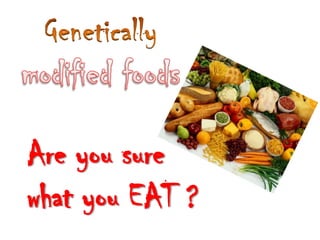







Are you sure
what you EAT ?
WHAT IS
GENETICALLY

   MODIFIFIED

        FOOD
OR


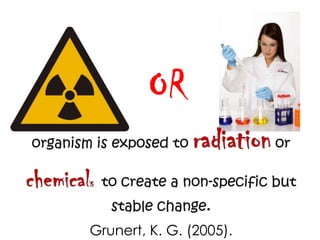
Grunert, K. G. (2005).
CALGENE
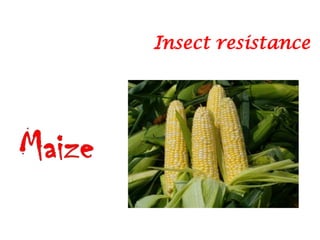
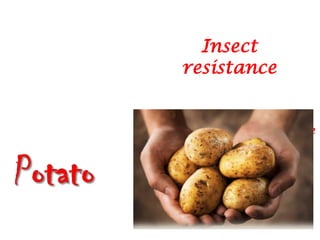
Insect resistance
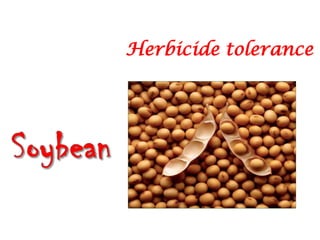
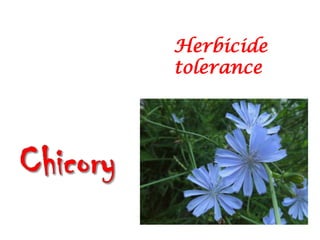
Herbicide tolerance
Herbicide
tolerance
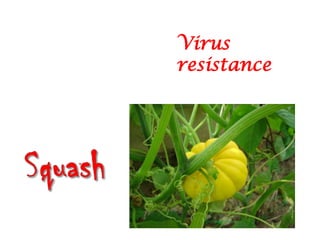
Virus
resistance
Insect
resistance


     Canada, Unite
     d States
MAJOR GMO CROP
     PRODUCTION
  COUNTRIES ON 2006


AROUND THE WORLD
CANADA 10%


                                          CHINA 3%
                 USA
                 20%              INDIA
                                    5%
                                                     PHILIPPINES
                         BRASIL                          5%
PARAGUAY
   55%                    10%

 URUGUAY 40%
                             SOUTH AFRICA            AUSTRALIA
             ARGENTINA           10%                    5%
                45%
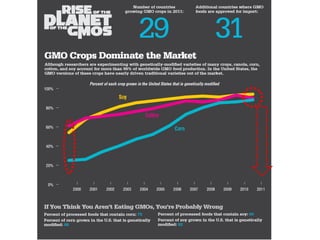
GMO’s crop are start

      increasing
         rapidly in
the world market from year
      2000 until now.
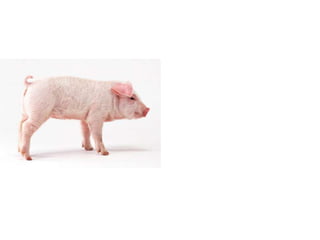
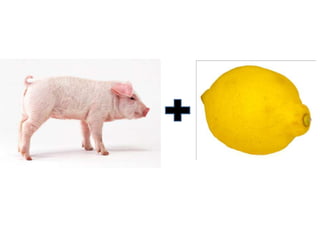
Islam too forbids eating
of pork, and Islamic
scholars have also
raised
concern about the
theoretical production of
foods with genes from
pigs.
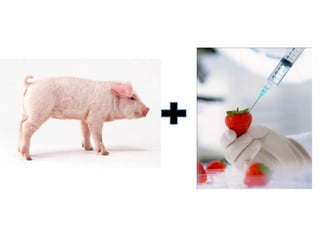
Will Effect
Genetically modified
 food controversies
RESEARCH BY


   Monsanto (American multinational
 agricultural biotechnology corporation
headquartered in Creve Coeur, Missouri.)
Corn
Monsanto

has revealed that half of the US’s sweet corn
farms are planted with genetically modified
seed. Mice fed with GM corn were discovered to
have


    smaller offspring and
    fertility problems.
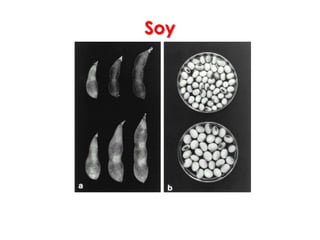
Soy
Hamsters fed with GM soy were


unable to have offspring and
 suffered a high mortality
           rate.
Rice
China Daily
an online journal, reported potential serious
 public health and environment problems
                    with

       genetically modified rice

considering its   tendency to cause allergic
reactions with the concurrent possibility of
                  gene transfers.
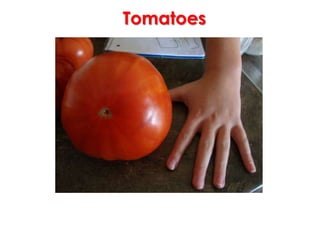
Tomatoes
In a test conducted to determine the safety of
     GM tomatoes, some animal subjects


 died within a few weeks
             after consuming GM tomatoes
Dairy products
Milk from cows contains increased levels of

IGF-1 (insulin growth factors-1).

Humans also have  IGF-1    in their system.
 Scientists have expressed concerns that
  increased levels of IGF-1 in
   humans have been associated with


colon and breast cancer.
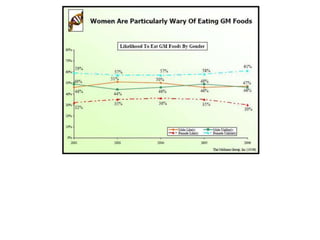
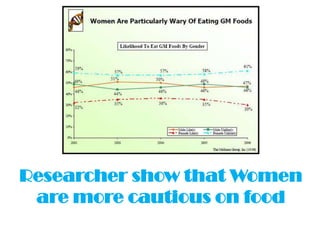
Researcher show that Women
 are more cautious on food
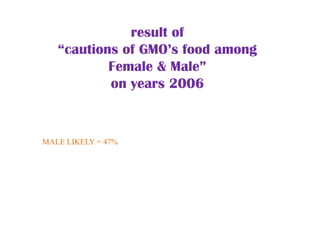
result of
   “cautions of GMO’s food among
           Female & Male”
           on years 2006


MALE LIKELY = 47%
result of
   “cautions of GMO’s food among
           Female & Male”
           on years 2006


MALE LIKELY = 47%   FEMALE LIKELY = 30%
result of
     “cautions of GMO’s food among
             Female & Male”
             on years 2006


 MALE LIKELY = 47%    FEMALE LIKELY = 30%


MALE UNLIKELY = 46%
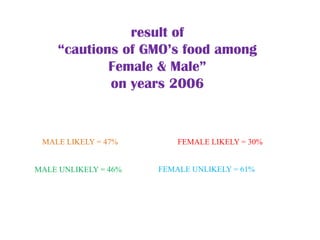
result of
     “cautions of GMO’s food among
             Female & Male”
             on years 2006


 MALE LIKELY = 47%        FEMALE LIKELY = 30%


MALE UNLIKELY = 46%   FEMALE UNLIKELY = 61%
VIDEO OF “The Health Dangers of Genetically
           Modified Foods” pt. 1 – 6
                 on YouTube


        http://www.youtube.com/watch?v=94d-KVorSHM
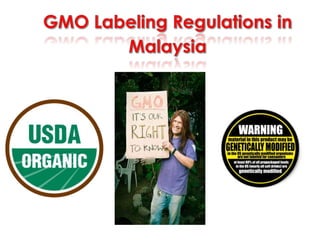
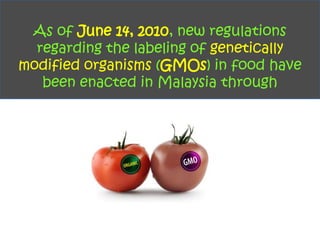
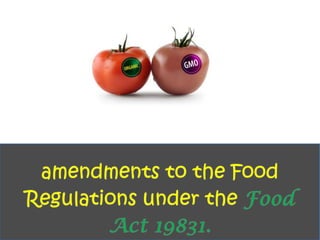
As of June 14, 2010, new regulations
  regarding the labeling of genetically
modified organisms (GMOs) in food have
   been enacted in Malaysia through
Malaysian signed the Cartagena Protocol on
     Biosafety (CPB) on May 24, 2000
under Section 61, which states that


“Factors Influencing Malaysian Public Attitudes to Agro-Biotechnology”, (Latifah
Amin, 2010, )
objective
of implementing mandatory
GMO labeling is to provide
        consumers
with additional information
  and increase consumer
          choice.
Malaysian consumers maybe know about the
existence of the GMF but do not have enough
understanding of the underlying concept,
which might be influencing their purchasing
intentions regarding GMF.
As Malaysian consumers are found to show
greater concerns for the risks attached with the
   GM food, it is suggested that more efforts
   should be laid by the policymakers from
     government and industry to increase
    knowledge about benefits of GM food.
This increased knowledge is a key to help lower
 the consumers‟ perception level of risks and
 lever the perceived quality in turn (Klerck &
          Sweeney, 2007; Linh, 2009).
REFERENCE
JOURNAL
-Abadias, M., Usall, J., Anguera, M., Solson, C., & Vinas, I. (2008).
Microbiological quality of fresh, minimally-processed fruit and vegetables, and
sprouts from retail establishments. International Journal of Food
Microbiology, 123, 121e129.

-Baert, L., Mattison, K., Loisy-Hamon, F., Harlow, J., Martyres, A., Lebeau, B., et
al.(2011). Review: norovirus prevalence in Belgian, Canadian and French fresh
produce: a threat to human health? International Journal of Food
Microbiology,151, 261e269.


-Latifah Amin ,(2010), et al, “Factors Influencing Malaysian Public Attitudes
to Agro-Biotechnology”, Journal of Public Understanding of Science.

-Mike Adcock,” 2007 Intellectual Property , Genetically Modified Crops
and Bioethics 1088 –1092.
WEBSITE
-EFSA (European food safety authority). (2009). Report advisory group on
risk communication. Risk Communication Annual Review (pp. 1e48)
http://www.efsa.europa.eu/en/agrc/documents/agrccommreview.pdf.

-EFSA (European food safety authority). (2011a). Scientific colloquium on
emerging risks in food: from identification to communication. In EFSA
Scientific Colloquium Summary Report 15, 1e170.
http://www.efsa.europa.eu/en/supporting/pub/114e.htm.

-Kinni, T. B. (2004) Genetically modified food controversies.
http://en.wikipedia.org/wiki/Genetically_modified_food_controversies
ARTICLES

-Grunert, K. G. (2005). Food quality and safety: consumer perception and
demand.

-Hatanaka, M., Bain, C., & Busch, L. (2005). Third-party certification in the
global agrifood system.

-(Klerck & Sweeney, 2007; Linh, 2009). GMO Labeling Regulations in
Malaysia .
HELLO !!!

      MY NAME IS
  MOHD SHAHMIR ZAINON

2010130137   

Genetic modification food ver2

  • 1.
  • 2.
    WHAT IS GENETICALLY MODIFIFIED FOOD
  • 7.
  • 12.
  • 28.
  • 29.
  • 30.
  • 31.
  • 32.
    Insect resistance Canada, Unite d States
  • 33.
    MAJOR GMO CROP PRODUCTION COUNTRIES ON 2006 AROUND THE WORLD
  • 35.
    CANADA 10% CHINA 3% USA 20% INDIA 5% PHILIPPINES BRASIL 5% PARAGUAY 55% 10% URUGUAY 40% SOUTH AFRICA AUSTRALIA ARGENTINA 10% 5% 45%
  • 36.
    GMO’s crop arestart increasing rapidly in the world market from year 2000 until now.
  • 42.
    Islam too forbidseating of pork, and Islamic scholars have also raised
  • 43.
    concern about the theoreticalproduction of foods with genes from pigs.
  • 48.
  • 50.
  • 51.
    RESEARCH BY Monsanto (American multinational agricultural biotechnology corporation headquartered in Creve Coeur, Missouri.)
  • 52.
  • 53.
    Monsanto has revealed thathalf of the US’s sweet corn farms are planted with genetically modified seed. Mice fed with GM corn were discovered to have smaller offspring and fertility problems.
  • 54.
  • 55.
    Hamsters fed withGM soy were unable to have offspring and suffered a high mortality rate.
  • 56.
  • 57.
    China Daily an onlinejournal, reported potential serious public health and environment problems with genetically modified rice considering its tendency to cause allergic reactions with the concurrent possibility of gene transfers.
  • 58.
  • 59.
    In a testconducted to determine the safety of GM tomatoes, some animal subjects died within a few weeks after consuming GM tomatoes
  • 60.
  • 61.
    Milk from cowscontains increased levels of IGF-1 (insulin growth factors-1). Humans also have IGF-1 in their system. Scientists have expressed concerns that increased levels of IGF-1 in humans have been associated with colon and breast cancer.
  • 64.
    Researcher show thatWomen are more cautious on food
  • 65.
    result of “cautions of GMO’s food among Female & Male” on years 2006 MALE LIKELY = 47%
  • 66.
    result of “cautions of GMO’s food among Female & Male” on years 2006 MALE LIKELY = 47% FEMALE LIKELY = 30%
  • 67.
    result of “cautions of GMO’s food among Female & Male” on years 2006 MALE LIKELY = 47% FEMALE LIKELY = 30% MALE UNLIKELY = 46%
  • 68.
    result of “cautions of GMO’s food among Female & Male” on years 2006 MALE LIKELY = 47% FEMALE LIKELY = 30% MALE UNLIKELY = 46% FEMALE UNLIKELY = 61%
  • 69.
    VIDEO OF “TheHealth Dangers of Genetically Modified Foods” pt. 1 – 6 on YouTube http://www.youtube.com/watch?v=94d-KVorSHM
  • 72.
    As of June14, 2010, new regulations regarding the labeling of genetically modified organisms (GMOs) in food have been enacted in Malaysia through
  • 75.
    Malaysian signed theCartagena Protocol on Biosafety (CPB) on May 24, 2000
  • 78.
    under Section 61,which states that “Factors Influencing Malaysian Public Attitudes to Agro-Biotechnology”, (Latifah Amin, 2010, )
  • 81.
    objective of implementing mandatory GMOlabeling is to provide consumers with additional information and increase consumer choice.
  • 83.
    Malaysian consumers maybeknow about the existence of the GMF but do not have enough understanding of the underlying concept, which might be influencing their purchasing intentions regarding GMF.
  • 84.
    As Malaysian consumersare found to show greater concerns for the risks attached with the GM food, it is suggested that more efforts should be laid by the policymakers from government and industry to increase knowledge about benefits of GM food.
  • 85.
    This increased knowledgeis a key to help lower the consumers‟ perception level of risks and lever the perceived quality in turn (Klerck & Sweeney, 2007; Linh, 2009).
  • 87.
  • 88.
    JOURNAL -Abadias, M., Usall,J., Anguera, M., Solson, C., & Vinas, I. (2008). Microbiological quality of fresh, minimally-processed fruit and vegetables, and sprouts from retail establishments. International Journal of Food Microbiology, 123, 121e129. -Baert, L., Mattison, K., Loisy-Hamon, F., Harlow, J., Martyres, A., Lebeau, B., et al.(2011). Review: norovirus prevalence in Belgian, Canadian and French fresh produce: a threat to human health? International Journal of Food Microbiology,151, 261e269. -Latifah Amin ,(2010), et al, “Factors Influencing Malaysian Public Attitudes to Agro-Biotechnology”, Journal of Public Understanding of Science. -Mike Adcock,” 2007 Intellectual Property , Genetically Modified Crops and Bioethics 1088 –1092.
  • 89.
    WEBSITE -EFSA (European foodsafety authority). (2009). Report advisory group on risk communication. Risk Communication Annual Review (pp. 1e48) http://www.efsa.europa.eu/en/agrc/documents/agrccommreview.pdf. -EFSA (European food safety authority). (2011a). Scientific colloquium on emerging risks in food: from identification to communication. In EFSA Scientific Colloquium Summary Report 15, 1e170. http://www.efsa.europa.eu/en/supporting/pub/114e.htm. -Kinni, T. B. (2004) Genetically modified food controversies. http://en.wikipedia.org/wiki/Genetically_modified_food_controversies
  • 90.
    ARTICLES -Grunert, K. G.(2005). Food quality and safety: consumer perception and demand. -Hatanaka, M., Bain, C., & Busch, L. (2005). Third-party certification in the global agrifood system. -(Klerck & Sweeney, 2007; Linh, 2009). GMO Labeling Regulations in Malaysia .
  • 91.
    HELLO !!! MY NAME IS MOHD SHAHMIR ZAINON 2010130137 