1
2
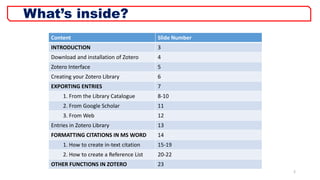
What’s inside?
Content Slide Number
INTRODUCTION 3
Download and installation of Zotero 4
Zotero Interface 5
Creating your Zotero Library 6
EXPORTING ENTRIES 7
1. From the Library Catalogue 8-10
2. From Google Scholar 11
3. From Web 12
Entries in Zotero Library 13
FORMATTING CITATIONS IN MS WORD 14
1. How to create in-text citation 15-19
2. How to create a Reference List 20-22
OTHER FUNCTIONS IN ZOTERO 23
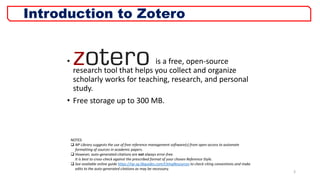
• is a free, open-source
research tool that helps you collect and organize
scholarly works for teaching, research, and personal
study.
• Free storage up to 300 MB.
3
Introduction to Zotero
NOTES:
 NP Library suggests the use of free reference management software(s) from open-access to automate
formatting of sources in academic papers.
 However, auto-generated citations are not always error-free.
It is best to cross-check against the prescribed format of your chosen Reference Style.
 See available online guide https://np-sg.libguides.com/CitingResources to check citing conventions and make
edits to the auto-generated citations as may be necessary.
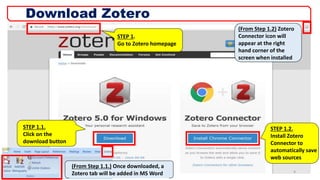
Download Zotero
STEP 1.
Go to Zotero homepage
STEP 1.2.
Install Zotero
Connector to
automatically save
web sources
STEP 1.1.
Click on the
download button
4
(From Step 1.1.) Once downloaded, a
Zotero tab will be added in MS Word
(From Step 1.2) Zotero
Connector icon will
appear at the right
hand corner of the
screen when installed
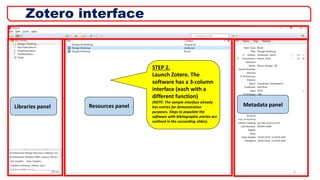
STEP 2.
Launch Zotero. The
software has a 3-column
interface (each with a
different function)
(NOTE: The sample interface already
has entries for demonstration
purposes. Steps to populate the
software with bibliographic entries are
outlined in the succeeding slides).
Libraries panel Resources panel Metadata panel
5
Zotero interface
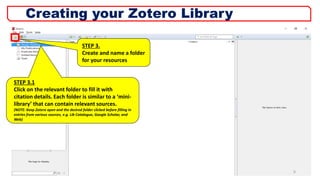
STEP 3.
Create and name a folder
for your resources
STEP 3.1
Click on the relevant folder to fill it with
citation details. Each folder is similar to a ‘mini-
library’ that can contain relevant sources.
(NOTE: Keep Zotero open and the desired folder clicked before filling in
entries from various sources, e.g. Lib Catalogue, Google Scholar, and
Web)
6
Creating your Zotero Library
7
Automatically export entries from
1. Library Catalogue
2. Google Scholar
3. Web
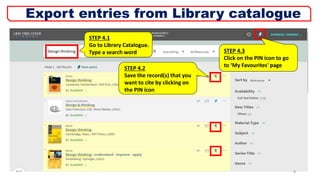
STEP 4.1
Go to Library Catalogue.
Type a search word
STEP 4.2
Save the record(s) that you
want to cite by clicking on
the PIN icon
STEP 4.3
Click on the PIN icon to go
to ‘My Favourites' page
8
Export entries from Library catalogue
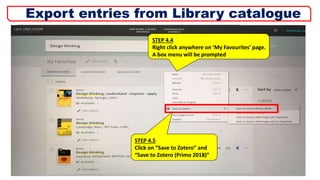
STEP 4.5
Click on “Save to Zotero” and
“Save to Zotero (Primo 2018)”
STEP 4.4
Right click anywhere on ‘My Favourites’ page.
A box menu will be prompted
9
Export entries from Library catalogue
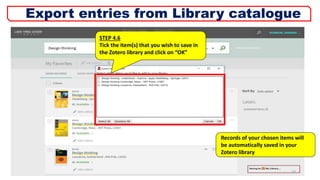
STEP 4.6
Tick the item(s) that you wish to save in
the Zotero library and click on “OK”
Records of your chosen items will
be automatically saved in your
Zotero library
10
Export entries from Library catalogue
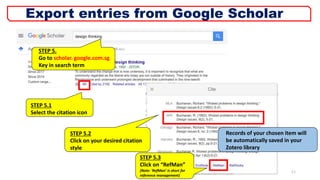
STEP 5.
Go to scholar. google.com.sg
Key in search term
STEP 5.2
Click on your desired citation
style
STEP 5.3
Click on “RefMan”
(Note: ‘RefMan’ is short for
reference management)
Records of your chosen item will
be automatically saved in your
Zotero library
STEP 5.1
Select the citation icon
11
Export entries from Google Scholar
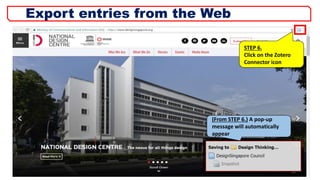
STEP 6.
Click on the Zotero
Connector icon
12
Export entries from the Web
(From STEP 6.) A pop-up
message will automatically
appear
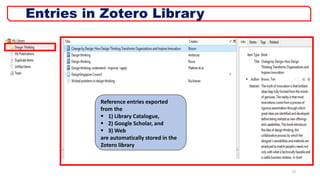
Reference entries exported
from the
 1) Library Catalogue,
 2) Google Scholar, and
 3) Web
are automatically stored in the
Zotero library
13
Entries in Zotero Library
14
Formatting citations in MS Word
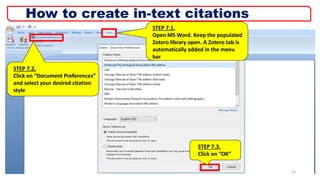
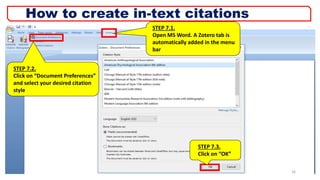
STEP 7.1.
Open MS Word. Keep the populated
Zotero library open. A Zotero tab is
automatically added in the menu
bar
STEP 7.2.
Click on “Document Preferences”
and select your desired citation
style
STEP 7.3.
Click on “OK”
15
How to create in-text citations
STEP 7.1.
Open MS Word. A Zotero tab is
automatically added in the menu
bar
STEP 7.2.
Click on “Document Preferences”
and select your desired citation
style
STEP 7.3.
Click on “OK”
16
How to create in-text citations
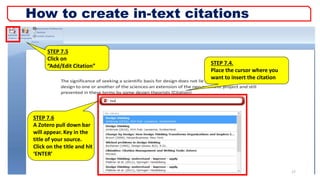
STEP 7.5
Click on
“Add/Edit Citation” STEP 7.4.
Place the cursor where you
want to insert the citation
STEP 7.6
A Zotero pull down bar
will appear. Key in the
title of your source.
Click on the title and hit
‘ENTER’
17
How to create in-text citations
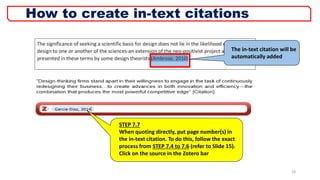
The in-text citation will be
automatically added
18
STEP 7.7
When quoting directly, put page number(s) in
the in-text citation. To do this, follow the exact
process from STEP 7.4 to 7.6 (refer to Slide 15).
Click on the source in the Zotero bar
How to create in-text citations
19
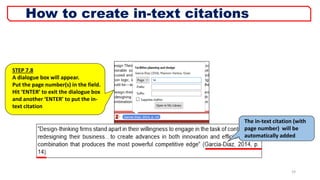
STEP 7.8
A dialogue box will appear.
Put the page number(s) in the field.
Hit ‘ENTER’ to exit the dialogue box
and another ‘ENTER’ to put the in-
text citation
The in-text citation (with
page number) will be
automatically added
How to create in-text citations
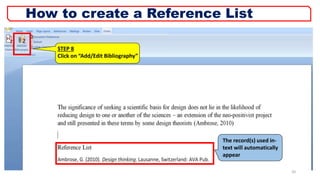
STEP 8
Click on “Add/Edit Bibliography”
The record(s) used in-
text will automatically
appear
20
How to create a Reference List
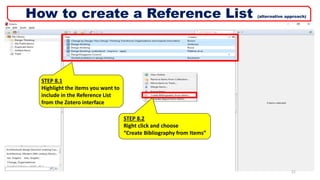
STEP 8.1
Highlight the items you want to
include in the Reference List
from the Zotero interface
STEP 8.2
Right click and choose
“Create Bibliography from Items”
21
How to create a Reference List (alternative approach)
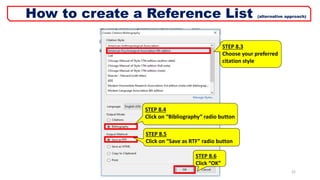
STEP 8.3
Choose your preferred
citation style
STEP 8.4
Click on “Bibliography” radio button
STEP 8.5
Click on “Save as RTF” radio button
STEP 8.6
Click “OK”
22
How to create a Reference List (alternative approach)
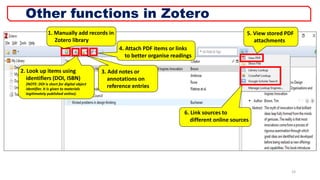
1. Manually add records in
Zotero library
2. Look up items using
identifiers (DOI, ISBN)
(NOTE: DOI is short for digital object
identifier. It is given to materials
legitimately published online).
4. Attach PDF items or links
to better organise readings
5. View stored PDF
attachments
6. Link sources to
different online sources
3. Add notes or
annotations on
reference entries
23
Other functions in Zotero

Zotero ppt

  • 1.
  • 2.
    2 What’s inside? Content SlideNumber INTRODUCTION 3 Download and installation of Zotero 4 Zotero Interface 5 Creating your Zotero Library 6 EXPORTING ENTRIES 7 1. From the Library Catalogue 8-10 2. From Google Scholar 11 3. From Web 12 Entries in Zotero Library 13 FORMATTING CITATIONS IN MS WORD 14 1. How to create in-text citation 15-19 2. How to create a Reference List 20-22 OTHER FUNCTIONS IN ZOTERO 23
  • 3.
    • is afree, open-source research tool that helps you collect and organize scholarly works for teaching, research, and personal study. • Free storage up to 300 MB. 3 Introduction to Zotero NOTES:  NP Library suggests the use of free reference management software(s) from open-access to automate formatting of sources in academic papers.  However, auto-generated citations are not always error-free. It is best to cross-check against the prescribed format of your chosen Reference Style.  See available online guide https://np-sg.libguides.com/CitingResources to check citing conventions and make edits to the auto-generated citations as may be necessary.
  • 4.
    Download Zotero STEP 1. Goto Zotero homepage STEP 1.2. Install Zotero Connector to automatically save web sources STEP 1.1. Click on the download button 4 (From Step 1.1.) Once downloaded, a Zotero tab will be added in MS Word (From Step 1.2) Zotero Connector icon will appear at the right hand corner of the screen when installed
  • 5.
    STEP 2. Launch Zotero.The software has a 3-column interface (each with a different function) (NOTE: The sample interface already has entries for demonstration purposes. Steps to populate the software with bibliographic entries are outlined in the succeeding slides). Libraries panel Resources panel Metadata panel 5 Zotero interface
  • 6.
    STEP 3. Create andname a folder for your resources STEP 3.1 Click on the relevant folder to fill it with citation details. Each folder is similar to a ‘mini- library’ that can contain relevant sources. (NOTE: Keep Zotero open and the desired folder clicked before filling in entries from various sources, e.g. Lib Catalogue, Google Scholar, and Web) 6 Creating your Zotero Library
  • 7.
    7 Automatically export entriesfrom 1. Library Catalogue 2. Google Scholar 3. Web
  • 8.
    STEP 4.1 Go toLibrary Catalogue. Type a search word STEP 4.2 Save the record(s) that you want to cite by clicking on the PIN icon STEP 4.3 Click on the PIN icon to go to ‘My Favourites' page 8 Export entries from Library catalogue
  • 9.
    STEP 4.5 Click on“Save to Zotero” and “Save to Zotero (Primo 2018)” STEP 4.4 Right click anywhere on ‘My Favourites’ page. A box menu will be prompted 9 Export entries from Library catalogue
  • 10.
    STEP 4.6 Tick theitem(s) that you wish to save in the Zotero library and click on “OK” Records of your chosen items will be automatically saved in your Zotero library 10 Export entries from Library catalogue
  • 11.
    STEP 5. Go toscholar. google.com.sg Key in search term STEP 5.2 Click on your desired citation style STEP 5.3 Click on “RefMan” (Note: ‘RefMan’ is short for reference management) Records of your chosen item will be automatically saved in your Zotero library STEP 5.1 Select the citation icon 11 Export entries from Google Scholar
  • 12.
    STEP 6. Click onthe Zotero Connector icon 12 Export entries from the Web (From STEP 6.) A pop-up message will automatically appear
  • 13.
    Reference entries exported fromthe  1) Library Catalogue,  2) Google Scholar, and  3) Web are automatically stored in the Zotero library 13 Entries in Zotero Library
  • 14.
  • 15.
    STEP 7.1. Open MSWord. Keep the populated Zotero library open. A Zotero tab is automatically added in the menu bar STEP 7.2. Click on “Document Preferences” and select your desired citation style STEP 7.3. Click on “OK” 15 How to create in-text citations
  • 16.
    STEP 7.1. Open MSWord. A Zotero tab is automatically added in the menu bar STEP 7.2. Click on “Document Preferences” and select your desired citation style STEP 7.3. Click on “OK” 16 How to create in-text citations
  • 17.
    STEP 7.5 Click on “Add/EditCitation” STEP 7.4. Place the cursor where you want to insert the citation STEP 7.6 A Zotero pull down bar will appear. Key in the title of your source. Click on the title and hit ‘ENTER’ 17 How to create in-text citations
  • 18.
    The in-text citationwill be automatically added 18 STEP 7.7 When quoting directly, put page number(s) in the in-text citation. To do this, follow the exact process from STEP 7.4 to 7.6 (refer to Slide 15). Click on the source in the Zotero bar How to create in-text citations
  • 19.
    19 STEP 7.8 A dialoguebox will appear. Put the page number(s) in the field. Hit ‘ENTER’ to exit the dialogue box and another ‘ENTER’ to put the in- text citation The in-text citation (with page number) will be automatically added How to create in-text citations
  • 20.
    STEP 8 Click on“Add/Edit Bibliography” The record(s) used in- text will automatically appear 20 How to create a Reference List
  • 21.
    STEP 8.1 Highlight theitems you want to include in the Reference List from the Zotero interface STEP 8.2 Right click and choose “Create Bibliography from Items” 21 How to create a Reference List (alternative approach)
  • 22.
    STEP 8.3 Choose yourpreferred citation style STEP 8.4 Click on “Bibliography” radio button STEP 8.5 Click on “Save as RTF” radio button STEP 8.6 Click “OK” 22 How to create a Reference List (alternative approach)
  • 23.
    1. Manually addrecords in Zotero library 2. Look up items using identifiers (DOI, ISBN) (NOTE: DOI is short for digital object identifier. It is given to materials legitimately published online). 4. Attach PDF items or links to better organise readings 5. View stored PDF attachments 6. Link sources to different online sources 3. Add notes or annotations on reference entries 23 Other functions in Zotero

Editor's Notes

  • #5 Crop the word
  • #10 Demo also using Databases
  • #11 Can also be done on Amazon, The New York Times