© 2009 IBM Corporation
zIIP Capacity Planning
Martin Packer
martin_packer@uk.ibm.com @martinpacker
© 2015 IBM Corporation2
Abstract
zIIP Capacity Planning tends to be neglected - in favour of General-Purpose Engines (GCPs).
With recent enhancements to DB2 allowing you to offload critical CPU to zIIPs, and to get the
most out of zAAP-on-zIIP, it's time to take zIIP Capacity Planning seriously.
This presentation describes how to do zIIP Capacity Planning properly - with instrumentation
and guidelines.
© 2015 IBM Corporation3
If You Only Remember 3 4 Things
 Capacity Planning for zIIPs has become much more important
 Pay especial attention to what % Busy represents “full”
 Measure zIIP potential and usage down to the address space level
 Consider LPAR configuration carefully for zIIPs
© 2015 IBM Corporation4
Why People Don't Do zIIP Capacity Planning
 zIIPs are much cheaper than general purpose processors (GCPs)
– Maintenance cost lower also
 zIIPs don't attract a software bill
 zIIP Utilization hasn't historically been all that high
 zIIP-eligible work can spill to GCPs at a pinch
 zIIPs are sometimes not the most carefully considered part of a purchase
 Ignoring zIIPs, ICFs, IFLs, zAAPs simplifies things to a single processor pool
© 2015 IBM Corporation5
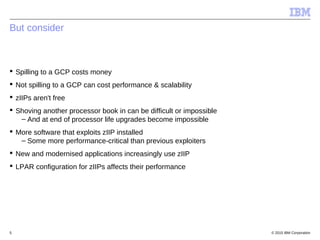
But consider
 Spilling to a GCP costs money
 Not spilling to a GCP can cost performance & scalability
 zIIPs aren't free
 Shoving another processor book in can be difficult or impossible
– And at end of processor life upgrades become impossible
 More software that exploits zIIP installed
– Some more performance-critical than previous exploiters
 New and modernised applications increasingly use zIIP
 LPAR configuration for zIIPs affects their performance
© 2015 IBM Corporation6
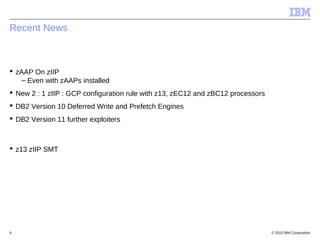
Recent News
 zAAP On zIIP
– Even with zAAPs installed
 New 2 : 1 zIIP : GCP configuration rule with z13, zEC12 and zBC12 processors
 DB2 Version 10 Deferred Write and Prefetch Engines
 DB2 Version 11 further exploiters
 z13 zIIP SMT
© 2015 IBM Corporation7
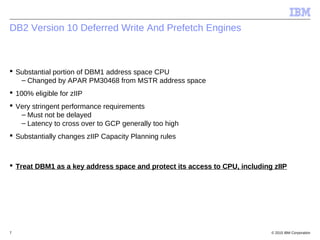
DB2 Version 10 Deferred Write And Prefetch Engines
 Substantial portion of DBM1 address space CPU
– Changed by APAR PM30468 from MSTR address space
 100% eligible for zIIP
 Very stringent performance requirements
– Must not be delayed
– Latency to cross over to GCP generally too high
 Substantially changes zIIP Capacity Planning rules
 Treat DBM1 as a key address space and protect its access to CPU, including zIIP
© 2015 IBM Corporation8
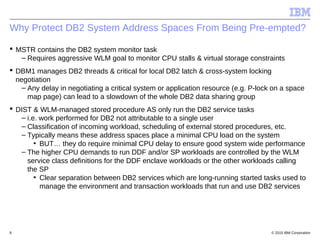
Why Protect DB2 System Address Spaces From Being Pre-empted?
 MSTR contains the DB2 system monitor task
– Requires aggressive WLM goal to monitor CPU stalls & virtual storage constraints
 DBM1 manages DB2 threads & critical for local DB2 latch & cross-system locking
negotiation
– Any delay in negotiating a critical system or application resource (e.g. P-lock on a space
map page) can lead to a slowdown of the whole DB2 data sharing group
 DIST & WLM-managed stored procedure AS only run the DB2 service tasks
– i.e. work performed for DB2 not attributable to a single user
– Classification of incoming workload, scheduling of external stored procedures, etc.
– Typically means these address spaces place a minimal CPU load on the system
• BUT… they do require minimal CPU delay to ensure good system wide performance
– The higher CPU demands to run DDF and/or SP workloads are controlled by the WLM
service class definitions for the DDF enclave workloads or the other workloads calling
the SP
• Clear separation between DB2 services which are long-running started tasks used to
manage the environment and transaction workloads that run and use DB2 services
© 2015 IBM Corporation9
© 2015 IBM Corporation10
So Let's Take This Seriously...
© 2015 IBM Corporation11
Many Sources Of Information

 From RMF:
– SMF 70
– SMF 72-3
 From z/OS:
– SMF 30
 From middleware:
– SMF 101 DB2 Accounting Trace
– SMF 110 CICS Statistics Trace
© 2015 IBM Corporation12
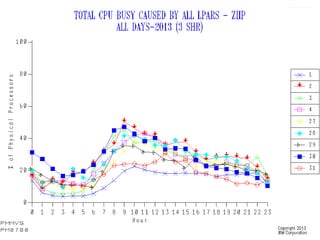
With RMF data you can ... see zIIP Pool Busy
© 2015 IBM Corporation13
© 2015 IBM Corporation14
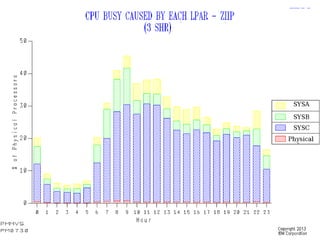
...break down by LPAR
© 2015 IBM Corporation15
© 2015 IBM Corporation16
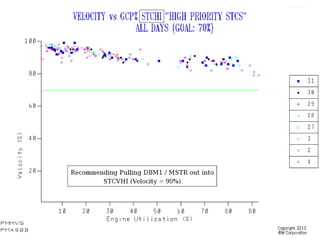
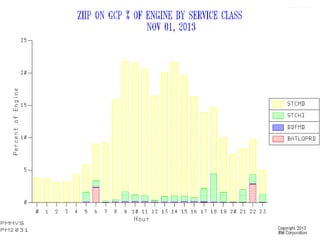
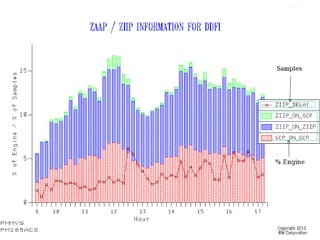
...drive down to the Service Class level
(Slide is for zIIP on GCP)
© 2015 IBM Corporation17
© 2015 IBM Corporation18
Service Class (Period) Information
 For Velocity Goal service class periods you get samples...
 For work that's not zIIP eligible you get e.g. Using and Delay samples for CPU and I/O
– These are the sample counters that affect the velocity calculation:
Velocity % = 100 x Using / (Using + Delay)
 With zIIP-eligible work you get better resolution – as you get Using and Delay samples
specific to zIIP
 Useful to correlate Delay for zIIP with % zIIP on GCP
– Can explain behaviour
© 2015 IBM Corporation19
© 2015 IBM Corporation20
Understanding Your Exploiters
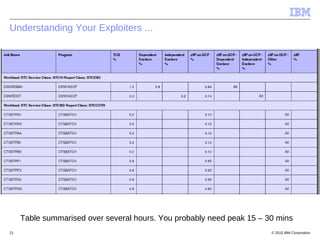
 Exploiters come in different shapes and sizes
– And leave “footprints” accordingly
 Dependent Enclave
– e.g. DBM1 Prefetch / Deferred Write
 Independent Enclave
– e.g. DDF
 zAAP-on-zIIP
– Formerly zAAP-eligible e.g. Java
 e.g. Dependent Enclave for DBM1 Address Space is Performance Critical from DB2 Version 10
© 2015 IBM Corporation21
Understanding Your Exploiters ...
Table summarised over several hours. You probably need peak 15 – 30 mins
© 2015 IBM Corporation22
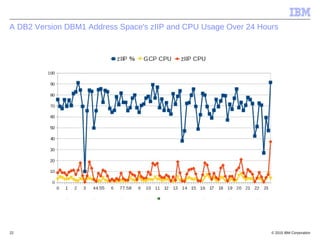
A DB2 Version DBM1 Address Space's zIIP and CPU Usage Over 24 Hours
© 2015 IBM Corporation23
Projections
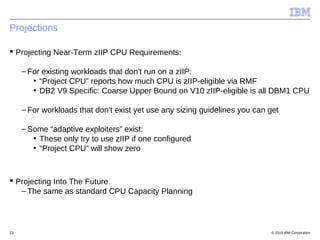
 Projecting Near-Term zIIP CPU Requirements:
– For existing workloads that don't run on a zIIP:
• “Project CPU” reports how much CPU is zIIP-eligible via RMF
• DB2 V9 Specific: Coarse Upper Bound on V10 zIIP-eligible is all DBM1 CPU
– For workloads that don't exist yet use any sizing guidelines you can get
– Some “adaptive exploiters” exist:
• These only try to use zIIP if one configured
• “Project CPU” will show zero
 Projecting Into The Future
– The same as standard CPU Capacity Planning
© 2015 IBM Corporation24
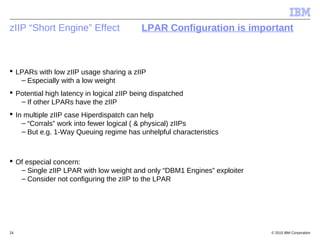
zIIP “Short Engine” Effect LPAR Configuration is important
 LPARs with low zIIP usage sharing a zIIP
– Especially with a low weight
 Potential high latency in logical zIIP being dispatched
– If other LPARs have the zIIP
 In multiple zIIP case Hiperdispatch can help
– “Corrals” work into fewer logical ( & physical) zIIPs
– But e.g. 1-Way Queuing regime has unhelpful characteristics
 Of especial concern:
– Single zIIP LPAR with low weight and only “DBM1 Engines” exploiter
– Consider not configuring the zIIP to the LPAR
© 2015 IBM Corporation25
zIIP To GCP Ratios
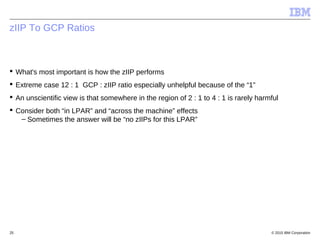
 What's most important is how the zIIP performs
 Extreme case 12 : 1 GCP : zIIP ratio especially unhelpful because of the “1”
 An unscientific view is that somewhere in the region of 2 : 1 to 4 : 1 is rarely harmful
 Consider both “in LPAR” and “across the machine” effects
– Sometimes the answer will be “no zIIPs for this LPAR”
© 2015 IBM Corporation26
Subcapacity General Purpose Processors
 zIIP runs at full speed
– e.g. about twice as fast as a 6xx General Purpose Processor (GCP)
 Good news:
– zIIP higher capacity and faster than GCP
 Not so good news:
– zIIP-eligible work running on a GCP is worse
– Variability in speed if some runs on zIIP and some not
• Not terribly different to DDF situation since PM12256
 How this plays depends on numbers of threads and CPU-intensiveness
 CPU Conversion Factor:
– Use R723NFFS to convert zIIP CPU to GCP equivalent (and vice versa)
 Consider configuring more zIIPs than the raw capacity requirement would suggest
© 2015 IBM Corporation27
And just when you thought it couldn't get any more complicated...
… Here are Horst Sinram's z13 zIIP SMT slides
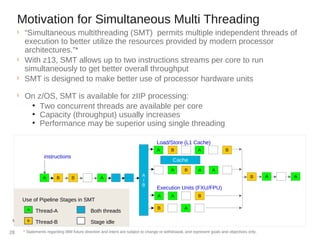
Motivation for Simultaneous Multi Threading
§
“Simultaneous multithreading (SMT) permits multiple independent threads of
execution to better utilize the resources provided by modern processor
architectures.”*
§
With z13, SMT allows up to two instructions streams per core to run
simultaneously to get better overall throughput
§
SMT is designed to make better use of processor hardware units
§
On z/OS, SMT is available for zIIP processing:
●
Two concurrent threads are available per core
●
Capacity (throughput) usually increases
●
Performance may be superior using single threading
*Wikipedia®
A
/
B
A
B
B
Load/Store (L1 Cache)
A A B
Execution Units (FXU/FPU)
instructions
A B A A
B AA
B
Shared Cache
A B A A
B A
BA
Cache
Thread-A
Thread-B
Use of Pipeline Stages in SMT
Both threads
Stage idle
* Statements regarding IBM future direction and intent are subject to change or withdrawal, and represent goals and objectives only.28
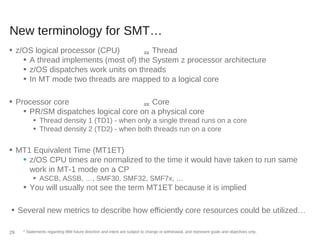
New terminology for SMT…
■ z/OS logical processor (CPU)  Thread
■ A thread implements (most of) the System z processor architecture
■ z/OS dispatches work units on threads
■ In MT mode two threads are mapped to a logical core
■ Processor core  Core
■ PR/SM dispatches logical core on a physical core
■ Thread density 1 (TD1) - when only a single thread runs on a core
■ Thread density 2 (TD2) - when both threads run on a core
■ MT1 Equivalent Time (MT1ET)
■ z/OS CPU times are normalized to the time it would have taken to run same
work in MT-1 mode on a CP
■ ASCB, ASSB, …, SMF30, SMF32, SMF7x, …
■ You will usually not see the term MT1ET because it is implied
■ Several new metrics to describe how efficiently core resources could be utilized…
* Statements regarding IBM future direction and intent are subject to change or withdrawal, and represent goals and objectives only.29
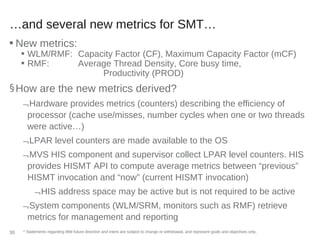
…and several new metrics for SMT…
■ New metrics:
■ WLM/RMF: Capacity Factor (CF), Maximum Capacity Factor (mCF)
■ RMF: Average Thread Density, Core busy time,
Productivity (PROD)
§How are the new metrics derived?
Hardware provides metrics (counters) describing the efficiency of
processor (cache use/misses, number cycles when one or two threads
were active…)
LPAR level counters are made available to the OS
MVS HIS component and supervisor collect LPAR level counters. HIS
provides HISMT API to compute average metrics between “previous”
HISMT invocation and “now” (current HISMT invocation)
HIS address space may be active but is not required to be active
System components (WLM/SRM, monitors such as RMF) retrieve
metrics for management and reporting
* Statements regarding IBM future direction and intent are subject to change or withdrawal, and represent goals and objectives only.30
z/OS MT Capacity Factors - used by WLM/SRM
■ Capacity Factor (CF)
How much work core actually completes for a given workload mix at current utilization -
relative to single thread
Therefore, MT1 Capacity Factor is 1.0 (100%)
MT2 Capacity Factor is workload dependent
Describes the actual, current efficiency of MT2
Maximum Capacity Factor (mCF)
How much work a core can complete for a given workload mix at most relative to MT-1
mode
Used to estimate MT2 efficiency if the system was fully utilized
E.g., to derive WLM view of total system capacity or free capacity
Value range of CF and mCF is [0.5 … 2.0]
Expect CF in a range of 1.0 -1 .4 (100%-140%) for typical workloads
Untypical (“pathological”) workloads may see untypical/pathological
CF/mCFs, such as <1
* Statements regarding IBM future direction and intent are subject to change or withdrawal, and represent goals and objectives only.31
ing Core Busy Time
nterval
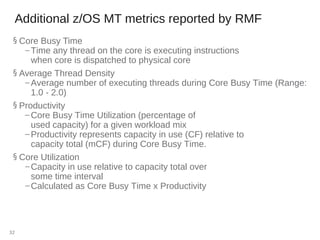
Additional z/OS MT metrics reported by RMF
§ Core Busy Time
– Time any thread on the core is executing instructions
when core is dispatched to physical core
§ Average Thread Density
– Average number of executing threads during Core Busy Time (Range:
1.0 - 2.0)
§ Productivity
– Core Busy Time Utilization (percentage of
used capacity) for a given workload mix
– Productivity represents capacity in use (CF) relative to
capacity total (mCF) during Core Busy Time.
§ Core Utilization
– Capacity in use relative to capacity total over
some time interval
– Calculated as Core Busy Time x Productivity
32
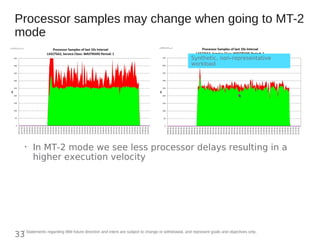
Processor samples may change when going to MT-2
mode
•
In MT-2 mode we see less processor delays resulting in a
higher execution velocity
* Statements regarding IBM future direction and intent are subject to change or withdrawal, and represent goals and objectives only.
33
Synthetic, non-representative
workload
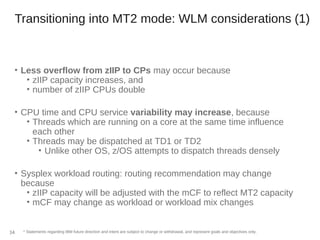
Transitioning into MT2 mode: WLM considerations (1)
• Less overflow from zIIP to CPs may occur because
• zIIP capacity increases, and
• number of zIIP CPUs double
• CPU time and CPU service variability may increase, because
• Threads which are running on a core at the same time influence
each other
• Threads may be dispatched at TD1 or TD2
• Unlike other OS, z/OS attempts to dispatch threads densely
• Sysplex workload routing: routing recommendation may change
because
• zIIP capacity will be adjusted with the mCF to reflect MT2 capacity
• mCF may change as workload or workload mix changes
* Statements regarding IBM future direction and intent are subject to change or withdrawal, and represent goals and objectives only.34
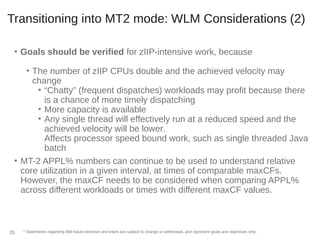
Transitioning into MT2 mode: WLM Considerations (2)
• Goals should be verified for zIIP-intensive work, because
• The number of zIIP CPUs double and the achieved velocity may
change
• “Chatty” (frequent dispatches) workloads may profit because there
is a chance of more timely dispatching
• More capacity is available
• Any single thread will effectively run at a reduced speed and the
achieved velocity will be lower.
Affects processor speed bound work, such as single threaded Java
batch
• MT-2 APPL% numbers can continue to be used to understand relative
core utilization in a given interval, at times of comparable maxCFs.
However, the maxCF needs to be considered when comparing APPL%
across different workloads or times with different maxCF values.
* Statements regarding IBM future direction and intent are subject to change or withdrawal, and represent goals and objectives only.35
© 2015 IBM Corporation36
Conclusions
© 2015 IBM Corporation37
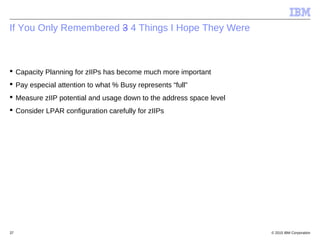
If You Only Remembered 3 4 Things I Hope They Were
 Capacity Planning for zIIPs has become much more important
 Pay especial attention to what % Busy represents “full”
 Measure zIIP potential and usage down to the address space level
 Consider LPAR configuration carefully for zIIPs
© 2015 IBM Corporation38
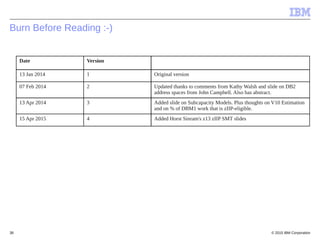
Burn Before Reading :-)
Date Version
13 Jan 2014 1 Original version
07 Feb 2014 2 Updated thanks to comments from Kathy Walsh and slide on DB2
address spaces from John Campbell. Also has abstract.
13 Apr 2014 3 Added slide on Subcapacity Models. Plus thoughts on V10 Estimation
and on % of DBM1 work that is zIIP-eligible.
15 Apr 2015 4 Added Horst Sinram's z13 zIIP SMT slides

zIIP Capacity Planning

  • 1.
    © 2009 IBMCorporation zIIP Capacity Planning Martin Packer martin_packer@uk.ibm.com @martinpacker
  • 2.
    © 2015 IBMCorporation2 Abstract zIIP Capacity Planning tends to be neglected - in favour of General-Purpose Engines (GCPs). With recent enhancements to DB2 allowing you to offload critical CPU to zIIPs, and to get the most out of zAAP-on-zIIP, it's time to take zIIP Capacity Planning seriously. This presentation describes how to do zIIP Capacity Planning properly - with instrumentation and guidelines.
  • 3.
    © 2015 IBMCorporation3 If You Only Remember 3 4 Things  Capacity Planning for zIIPs has become much more important  Pay especial attention to what % Busy represents “full”  Measure zIIP potential and usage down to the address space level  Consider LPAR configuration carefully for zIIPs
  • 4.
    © 2015 IBMCorporation4 Why People Don't Do zIIP Capacity Planning  zIIPs are much cheaper than general purpose processors (GCPs) – Maintenance cost lower also  zIIPs don't attract a software bill  zIIP Utilization hasn't historically been all that high  zIIP-eligible work can spill to GCPs at a pinch  zIIPs are sometimes not the most carefully considered part of a purchase  Ignoring zIIPs, ICFs, IFLs, zAAPs simplifies things to a single processor pool
  • 5.
    © 2015 IBMCorporation5 But consider  Spilling to a GCP costs money  Not spilling to a GCP can cost performance & scalability  zIIPs aren't free  Shoving another processor book in can be difficult or impossible – And at end of processor life upgrades become impossible  More software that exploits zIIP installed – Some more performance-critical than previous exploiters  New and modernised applications increasingly use zIIP  LPAR configuration for zIIPs affects their performance
  • 6.
    © 2015 IBMCorporation6 Recent News  zAAP On zIIP – Even with zAAPs installed  New 2 : 1 zIIP : GCP configuration rule with z13, zEC12 and zBC12 processors  DB2 Version 10 Deferred Write and Prefetch Engines  DB2 Version 11 further exploiters  z13 zIIP SMT
  • 7.
    © 2015 IBMCorporation7 DB2 Version 10 Deferred Write And Prefetch Engines  Substantial portion of DBM1 address space CPU – Changed by APAR PM30468 from MSTR address space  100% eligible for zIIP  Very stringent performance requirements – Must not be delayed – Latency to cross over to GCP generally too high  Substantially changes zIIP Capacity Planning rules  Treat DBM1 as a key address space and protect its access to CPU, including zIIP
  • 8.
    © 2015 IBMCorporation8 Why Protect DB2 System Address Spaces From Being Pre-empted?  MSTR contains the DB2 system monitor task – Requires aggressive WLM goal to monitor CPU stalls & virtual storage constraints  DBM1 manages DB2 threads & critical for local DB2 latch & cross-system locking negotiation – Any delay in negotiating a critical system or application resource (e.g. P-lock on a space map page) can lead to a slowdown of the whole DB2 data sharing group  DIST & WLM-managed stored procedure AS only run the DB2 service tasks – i.e. work performed for DB2 not attributable to a single user – Classification of incoming workload, scheduling of external stored procedures, etc. – Typically means these address spaces place a minimal CPU load on the system • BUT… they do require minimal CPU delay to ensure good system wide performance – The higher CPU demands to run DDF and/or SP workloads are controlled by the WLM service class definitions for the DDF enclave workloads or the other workloads calling the SP • Clear separation between DB2 services which are long-running started tasks used to manage the environment and transaction workloads that run and use DB2 services
  • 9.
    © 2015 IBMCorporation9
  • 10.
    © 2015 IBMCorporation10 So Let's Take This Seriously...
  • 11.
    © 2015 IBMCorporation11 Many Sources Of Information   From RMF: – SMF 70 – SMF 72-3  From z/OS: – SMF 30  From middleware: – SMF 101 DB2 Accounting Trace – SMF 110 CICS Statistics Trace
  • 12.
    © 2015 IBMCorporation12 With RMF data you can ... see zIIP Pool Busy
  • 13.
    © 2015 IBMCorporation13
  • 14.
    © 2015 IBMCorporation14 ...break down by LPAR
  • 15.
    © 2015 IBMCorporation15
  • 16.
    © 2015 IBMCorporation16 ...drive down to the Service Class level (Slide is for zIIP on GCP)
  • 17.
    © 2015 IBMCorporation17
  • 18.
    © 2015 IBMCorporation18 Service Class (Period) Information  For Velocity Goal service class periods you get samples...  For work that's not zIIP eligible you get e.g. Using and Delay samples for CPU and I/O – These are the sample counters that affect the velocity calculation: Velocity % = 100 x Using / (Using + Delay)  With zIIP-eligible work you get better resolution – as you get Using and Delay samples specific to zIIP  Useful to correlate Delay for zIIP with % zIIP on GCP – Can explain behaviour
  • 19.
    © 2015 IBMCorporation19
  • 20.
    © 2015 IBMCorporation20 Understanding Your Exploiters  Exploiters come in different shapes and sizes – And leave “footprints” accordingly  Dependent Enclave – e.g. DBM1 Prefetch / Deferred Write  Independent Enclave – e.g. DDF  zAAP-on-zIIP – Formerly zAAP-eligible e.g. Java  e.g. Dependent Enclave for DBM1 Address Space is Performance Critical from DB2 Version 10
  • 21.
    © 2015 IBMCorporation21 Understanding Your Exploiters ... Table summarised over several hours. You probably need peak 15 – 30 mins
  • 22.
    © 2015 IBMCorporation22 A DB2 Version DBM1 Address Space's zIIP and CPU Usage Over 24 Hours
  • 23.
    © 2015 IBMCorporation23 Projections  Projecting Near-Term zIIP CPU Requirements: – For existing workloads that don't run on a zIIP: • “Project CPU” reports how much CPU is zIIP-eligible via RMF • DB2 V9 Specific: Coarse Upper Bound on V10 zIIP-eligible is all DBM1 CPU – For workloads that don't exist yet use any sizing guidelines you can get – Some “adaptive exploiters” exist: • These only try to use zIIP if one configured • “Project CPU” will show zero  Projecting Into The Future – The same as standard CPU Capacity Planning
  • 24.
    © 2015 IBMCorporation24 zIIP “Short Engine” Effect LPAR Configuration is important  LPARs with low zIIP usage sharing a zIIP – Especially with a low weight  Potential high latency in logical zIIP being dispatched – If other LPARs have the zIIP  In multiple zIIP case Hiperdispatch can help – “Corrals” work into fewer logical ( & physical) zIIPs – But e.g. 1-Way Queuing regime has unhelpful characteristics  Of especial concern: – Single zIIP LPAR with low weight and only “DBM1 Engines” exploiter – Consider not configuring the zIIP to the LPAR
  • 25.
    © 2015 IBMCorporation25 zIIP To GCP Ratios  What's most important is how the zIIP performs  Extreme case 12 : 1 GCP : zIIP ratio especially unhelpful because of the “1”  An unscientific view is that somewhere in the region of 2 : 1 to 4 : 1 is rarely harmful  Consider both “in LPAR” and “across the machine” effects – Sometimes the answer will be “no zIIPs for this LPAR”
  • 26.
    © 2015 IBMCorporation26 Subcapacity General Purpose Processors  zIIP runs at full speed – e.g. about twice as fast as a 6xx General Purpose Processor (GCP)  Good news: – zIIP higher capacity and faster than GCP  Not so good news: – zIIP-eligible work running on a GCP is worse – Variability in speed if some runs on zIIP and some not • Not terribly different to DDF situation since PM12256  How this plays depends on numbers of threads and CPU-intensiveness  CPU Conversion Factor: – Use R723NFFS to convert zIIP CPU to GCP equivalent (and vice versa)  Consider configuring more zIIPs than the raw capacity requirement would suggest
  • 27.
    © 2015 IBMCorporation27 And just when you thought it couldn't get any more complicated... … Here are Horst Sinram's z13 zIIP SMT slides
  • 28.
    Motivation for SimultaneousMulti Threading § “Simultaneous multithreading (SMT) permits multiple independent threads of execution to better utilize the resources provided by modern processor architectures.”* § With z13, SMT allows up to two instructions streams per core to run simultaneously to get better overall throughput § SMT is designed to make better use of processor hardware units § On z/OS, SMT is available for zIIP processing: ● Two concurrent threads are available per core ● Capacity (throughput) usually increases ● Performance may be superior using single threading *Wikipedia® A / B A B B Load/Store (L1 Cache) A A B Execution Units (FXU/FPU) instructions A B A A B AA B Shared Cache A B A A B A BA Cache Thread-A Thread-B Use of Pipeline Stages in SMT Both threads Stage idle * Statements regarding IBM future direction and intent are subject to change or withdrawal, and represent goals and objectives only.28
  • 29.
    New terminology forSMT… ■ z/OS logical processor (CPU)  Thread ■ A thread implements (most of) the System z processor architecture ■ z/OS dispatches work units on threads ■ In MT mode two threads are mapped to a logical core ■ Processor core  Core ■ PR/SM dispatches logical core on a physical core ■ Thread density 1 (TD1) - when only a single thread runs on a core ■ Thread density 2 (TD2) - when both threads run on a core ■ MT1 Equivalent Time (MT1ET) ■ z/OS CPU times are normalized to the time it would have taken to run same work in MT-1 mode on a CP ■ ASCB, ASSB, …, SMF30, SMF32, SMF7x, … ■ You will usually not see the term MT1ET because it is implied ■ Several new metrics to describe how efficiently core resources could be utilized… * Statements regarding IBM future direction and intent are subject to change or withdrawal, and represent goals and objectives only.29
  • 30.
    …and several newmetrics for SMT… ■ New metrics: ■ WLM/RMF: Capacity Factor (CF), Maximum Capacity Factor (mCF) ■ RMF: Average Thread Density, Core busy time, Productivity (PROD) §How are the new metrics derived? Hardware provides metrics (counters) describing the efficiency of processor (cache use/misses, number cycles when one or two threads were active…) LPAR level counters are made available to the OS MVS HIS component and supervisor collect LPAR level counters. HIS provides HISMT API to compute average metrics between “previous” HISMT invocation and “now” (current HISMT invocation) HIS address space may be active but is not required to be active System components (WLM/SRM, monitors such as RMF) retrieve metrics for management and reporting * Statements regarding IBM future direction and intent are subject to change or withdrawal, and represent goals and objectives only.30
  • 31.
    z/OS MT CapacityFactors - used by WLM/SRM ■ Capacity Factor (CF) How much work core actually completes for a given workload mix at current utilization - relative to single thread Therefore, MT1 Capacity Factor is 1.0 (100%) MT2 Capacity Factor is workload dependent Describes the actual, current efficiency of MT2 Maximum Capacity Factor (mCF) How much work a core can complete for a given workload mix at most relative to MT-1 mode Used to estimate MT2 efficiency if the system was fully utilized E.g., to derive WLM view of total system capacity or free capacity Value range of CF and mCF is [0.5 … 2.0] Expect CF in a range of 1.0 -1 .4 (100%-140%) for typical workloads Untypical (“pathological”) workloads may see untypical/pathological CF/mCFs, such as <1 * Statements regarding IBM future direction and intent are subject to change or withdrawal, and represent goals and objectives only.31 ing Core Busy Time nterval
  • 32.
    Additional z/OS MTmetrics reported by RMF § Core Busy Time – Time any thread on the core is executing instructions when core is dispatched to physical core § Average Thread Density – Average number of executing threads during Core Busy Time (Range: 1.0 - 2.0) § Productivity – Core Busy Time Utilization (percentage of used capacity) for a given workload mix – Productivity represents capacity in use (CF) relative to capacity total (mCF) during Core Busy Time. § Core Utilization – Capacity in use relative to capacity total over some time interval – Calculated as Core Busy Time x Productivity 32
  • 33.
    Processor samples maychange when going to MT-2 mode • In MT-2 mode we see less processor delays resulting in a higher execution velocity * Statements regarding IBM future direction and intent are subject to change or withdrawal, and represent goals and objectives only. 33 Synthetic, non-representative workload
  • 34.
    Transitioning into MT2mode: WLM considerations (1) • Less overflow from zIIP to CPs may occur because • zIIP capacity increases, and • number of zIIP CPUs double • CPU time and CPU service variability may increase, because • Threads which are running on a core at the same time influence each other • Threads may be dispatched at TD1 or TD2 • Unlike other OS, z/OS attempts to dispatch threads densely • Sysplex workload routing: routing recommendation may change because • zIIP capacity will be adjusted with the mCF to reflect MT2 capacity • mCF may change as workload or workload mix changes * Statements regarding IBM future direction and intent are subject to change or withdrawal, and represent goals and objectives only.34
  • 35.
    Transitioning into MT2mode: WLM Considerations (2) • Goals should be verified for zIIP-intensive work, because • The number of zIIP CPUs double and the achieved velocity may change • “Chatty” (frequent dispatches) workloads may profit because there is a chance of more timely dispatching • More capacity is available • Any single thread will effectively run at a reduced speed and the achieved velocity will be lower. Affects processor speed bound work, such as single threaded Java batch • MT-2 APPL% numbers can continue to be used to understand relative core utilization in a given interval, at times of comparable maxCFs. However, the maxCF needs to be considered when comparing APPL% across different workloads or times with different maxCF values. * Statements regarding IBM future direction and intent are subject to change or withdrawal, and represent goals and objectives only.35
  • 36.
    © 2015 IBMCorporation36 Conclusions
  • 37.
    © 2015 IBMCorporation37 If You Only Remembered 3 4 Things I Hope They Were  Capacity Planning for zIIPs has become much more important  Pay especial attention to what % Busy represents “full”  Measure zIIP potential and usage down to the address space level  Consider LPAR configuration carefully for zIIPs
  • 38.
    © 2015 IBMCorporation38 Burn Before Reading :-) Date Version 13 Jan 2014 1 Original version 07 Feb 2014 2 Updated thanks to comments from Kathy Walsh and slide on DB2 address spaces from John Campbell. Also has abstract. 13 Apr 2014 3 Added slide on Subcapacity Models. Plus thoughts on V10 Estimation and on % of DBM1 work that is zIIP-eligible. 15 Apr 2015 4 Added Horst Sinram's z13 zIIP SMT slides