DEFINITION
• Zero-based budgeting (ZBB) is a method of budgeting in which all expenses must be
justified for each new period. Zero-based budgeting starts from a "zero base," and every
function within an organization is analyzed for its needs and costs.
• Budgets are then built around what is needed for the upcoming period, regardless of
the budget is higher or lower than the previous one.
• ZBB identifies alternative and efficient methods of utilizing limited resources in the effective
attainment of selected benefits.
• Resources are not necessarily allocated in accordance with previous patterns and
each existing item of expenditure has to be annually re-justified.
• The objective of Zero Based Budgeting is to “reset the clock” each year.
HISTORICAL DEVELOPMENT
• As an accounting manager for Texas Instruments, Pete Pyhrr created zero-based
budgeting in 1962. In the same year, the U.S Department of Agriculture adopted a
ground up system of budgeting which is considered to be the first formal use of ZBB in
U.S. Government.
• Jimmy Carter, then Governor of Georgia, read his article, was impressed with it, and
invited Pyhrr to join him in adapting ZBB for Georgia’s 1972/1973 budget. Carter was
enthusiastic about the system that, when he became President, he ordered all Federal
Agencies to implement a ZBB system by 1979.
• The concept of ZBB soon spread throughout both the public and private sector with
mixed results.
HISTORICAL DEVELOPMENT - INDIA
• In India, ZBB was implemented in Science and Technology in the year 1983.
• It was adopted by the Govt. India in 1986 as a technique for determining expenditure
budgets. The ministry of Finance made it mandatory for all the administrative ministers
to review their respective programs and activities in order to prepare expenditure
budget estimates based on principles of ZBB.
• ZBB was implemented in the Seventh Five year Plan(1988-93) – Transportation Sector.
• However not much progress in this regard has happened on this area since.
STEPS INVOLVED IN ZBB
1. Identification of decision units.
2. Analysis of each decision unit through development
of decision packages.
3. Evaluation and ranking of decision packages to
develop the budget.
4. Preparing the budget including those decision
packages which have been approved.
DEFINING A DECISION UNIT…
• A ZBB decision unit is an activity/programme or department for which
decision packages are to be developed and analysed. It can be described as a
cost or a budget centre. Managers of each decision units are responsible for
developing a description of each programme to be operated in the next fiscal
year. For e.g. In a district, the decision units could be different specialist
clinics, programme units, hospital OPD unit, dispensaries or individual PHC’s.
• A specific manager should be clearly responsible for the operation of the
program.
• Identify and describe a particular activity.
• It must have well defined & measurable objectives.
• It must have well defined & measurable impacts.
DEVELOPMENT OF DECISION
PACKAGES• After the identification of appropriate decision units, the next step is to prepare a
document for each of these describing the objectives or purposes of the decision unit
and the actions that could be taken to achieve them. Such document is called “Decision
Package”.
1. Mutually exclusive – Contains alternative ways of doing a job.
2. Incremental – Defining different levels of efforts
Decision packages will have work packages
Costs, returns, purpose, expected results, alternatives available, Consequences if
activity is not performed or reduced.
Example -
• A specialist clinic can be a referral unit with only diagnostic facilities, the treatment and
after care being done at district and PHC level.
• Equipment i.e. an X Ray unit may have just a vertical unit, or an additional horizontal
unit, or a unit for bedside operation.
• Increased emergency beds and less normal beds.
DECISION MAKING - REVIEW AND
RANKING OF DECISION PACKAGE
• Deciding to accept or reject or amend the activity.
• There is always a certain minimum level of effort in decision units which have to be
necessarily performed (high priority units) –funds to be committed.
• Once the decision packages have been prepared, they are ranked on an ordinal scale
i.e. 1st, 2nd, 3rd, etc in order of priority using Cost benefit Analysis.
• Surplus funds are then allocated to these decision packages.
Take a Decision Package:
1. Is the activity under our control.
2. Recognize less effective activities.
3. Validate – Arrangements(Elimination)
4. Make the activity profitable
ZBB APPROACH
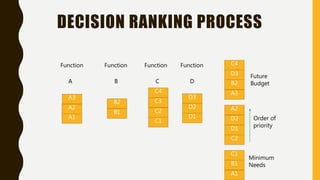
• As an example: consider 4 functions/activities to be performed by a decision unit – decision
packages A,B,C and D.
 Decision package A – OPD can have 3 alternatives
 A1 - OPD giving only Allopathic treatment
 A2 - OPD Allopathic + Ayurveda
 A3 - OPD Allopathic + Ayurveda + Homeopathy
 Decision package B – Pathology unit
 B1 – Basic Path lab with referral services
 B2 – Well equipped Path Lab
 Decision package C – Specialist clinics
 C1 – Child care unit
 C2 – Family welfare clinic
 C3 – Orthopaedic rehabilitation centre
 C4 – Leprosy clinic
 Decision package D – X-ray Unit
 D1 – Single vertical machine
 D2 – additional horizontal bed machine
 D3 – well equipped Radiology department.
ZBB APPROACH
• Having identified the different decision packages and different alternatives, the
next decision is to prioritise alternatives
A 3+ B 2+ C 4+ D 3 12 alternatives
The absolute basic minimum need would be to have :
1. OPD with Allopathy A1
2. Basic Pathology lab B1
3. Child care unit C1
4. Family welfare C2
5. Single vertical X-ray D1
These are now ranked as
D1 – C2 – C1 – B1 – A1
Funds – in order of priority i.e. well equipped radiology department.
Prioritisation depends on the specific needs of the particular district/hospital/PHC and
may be pre determined.
DECISION RANKING PROCESS
Function Function Function Function
A B C D
A3
A2
A1
B1
B2
C1
C2
C3
C4
D1
D2
D3
A1
B1
C1
C2
D1
D2
A2
A3
B2
D3
C4
Future
Budget
Minimum
Needs
Order of
priority
1.There are many ways to create company budgets. Let's take the marketing department of Company XYZ
as an example. Last year, the department spent $1 million. What's the right way to set a budget for next
year?
You might simply give the department $1 million again, but this might not reflect the changes in the
marketing programs next year, the need to hire more marketing people due to additional sales, or
other factors.
Another way might be to give all departments a 10% increase or decrease based on what the board of
directors would like earnings per share to be next year. This would give the department $1.1 million or
$900,000, depending on which way the board goes.
A third way would be zero-based budgeting, whereby the department starts with no budgeted fundsand must
justify every person and expense that should be included in the budget for the coming year. This might result
in a budget of, say, $1,024,314, which is higher than last year but reflective of the actual needs next year.
2.Suppose a company making construction equipment implements a zero-based budgeting process calling
for closer scrutiny of the expenses in its manufacturing department. The company notices that the cost of
certain parts used in its final products and outsourced to another manufacturer is increasing 5% every year.
The company has the capability to make those parts in-house and with its own workers. After weighing the
positives and negatives of making the parts in-house, the company finds that it can make the parts cheaper
than the outside supplier.
Instead of blindly increasing the budget by a certain percentage and masking the cost increase, the company
has identified a situation in which it can either make the part or buy the part for its end products. With
traditional budgeting, cost drivers within departments may not be identified, while zero-based budgeting is
a more granular process that aims to identify and justify expenditures. Since zero-based budgeting is more
involved, however, the costs of the process itself must be weighed against the savings it may identify
ADVANTAGES OF ZBB
I. Accuracy- Zero base budgeting makes every department relook each
and every item of cash flow and compute their operation costs. This
to some extent help in cost reduction as I gives a clear picture of cost
against the desired performance.
II. Efficiency- This helps in efficient allocation of resources(department-
wise) as it does not look at the historical numbers but looks at the
actual numbers.
III. Budget inflation- since every line is to be justified, zero-based
budget overcomes the weakness of incremental budgeting of budget
inflation.
IV. Reduction in redundant activities- it leads to the identification of
opportunities and more cost effective ways of doing things by
removing all unproductive or redundant activities.
V. Coordination and communication- it also improves coordination
and communication within the department and motivates employees
by involving them in decision-making.
LIMITATIONS OF ZBB
I. Implementation problems: successful implementation of ZBB
may require wholehearted support from the top management,
which may not readily be available owing to fear and problems
minds of top management.
II. Formulation problems: considerable problems may arise while
formulating decision packages. For example, problems may arise
in the fixation of minimum level below the current levels. Similarly
problems may arise in formulating meaningful performance
evaluation measures.
III. Ranking problems: problems may arise in ranking of decision
packages. General packages may like to continue their
projects for the reasons best known to them. Rankings may also
become difficult when there are a large number of decision
packages, particularly in a multi-product manufacturing firm.
I N C R E M E N T A L B U D G E T I N G
I N I N C R E M E N TA L B U D G E T I N G B U D G E T I S P R E PA R E D B Y TA K I N G T H E
C U R R E N T P E R I O D ' S B U D G E T O R A C T U A L P E R F O R M A N C E A S A B A S E ,
W I T H I N C R E M E N TA L A M O U N T S T H E N B E I N G A D D E D F O R T H E N E W
B U D G E T P E R I O D. T H E S E I N C R E M E N TA L A M O U N T S W I L L I N C L U D E
A D J U S T M E N T S F O R T H I N G S S U C H A S I N F L AT I O N , O R P L A N N E D
I N C R E A S E S I N S A L E S P R I C E S A N D C O S T S .
B E N E F I T S
• A S I N D I C AT E D A B O V E , I T I S E A S Y TO P R E PA R E A N D I S T H E R E F O R E
Q U I C K . S I N C E I T I S E A S Y TO P R E PA R E , I T I S A L S O E A S I LY A L L O C AT E D
TO M O R E J U N I O R M E M B E R S O F S TA F F.
• A S W E L L A S B E I N G E A S Y TO P R E PA R E , I T I S E A S Y TO U N D E R S TA N D.
• L E S S P R E PA R AT I O N T I M E L E A D S TO L O W E R P R E PA R AT I O N C O S T S .
• P R E V E N T S C O N F L I C T B E T W E E N D E PA R T M E N TA L M A N A G E R S S I N C E A
C O N S I S T E N T A P P R O A C H I S A D O P T E D T H R O U G H O U T T H E
O R G A N I Z AT I O N .
ACTIVITY-BASED BUDGETING
Activity-based budgeting concentrates on the factors that drive the costs, not just
on historical expenditure. The strategic objectives can drive the budgetary targets
and determine the volume of activities to be performed. The budgets are then
derived from the activities using estimated cost rates.
Benefits
• Allows the managers and business owners view the business as a system from
start to finish, rather than individual departments.
• Produces a “culture of customer focus is reinforced, when employees understand
they are in business to produce products and services for customers” Strategic
Costing Techniques: Activity-Based Budgeting.
• The money saved from removing unnecessary process steps can be used for future
projects and new products.
• Helps to eliminate unnecessary steps in products processing
zero base budgeting
zero base budgeting

zero base budgeting

  • 2.
    DEFINITION • Zero-based budgeting(ZBB) is a method of budgeting in which all expenses must be justified for each new period. Zero-based budgeting starts from a "zero base," and every function within an organization is analyzed for its needs and costs. • Budgets are then built around what is needed for the upcoming period, regardless of the budget is higher or lower than the previous one. • ZBB identifies alternative and efficient methods of utilizing limited resources in the effective attainment of selected benefits. • Resources are not necessarily allocated in accordance with previous patterns and each existing item of expenditure has to be annually re-justified. • The objective of Zero Based Budgeting is to “reset the clock” each year.
  • 4.
    HISTORICAL DEVELOPMENT • Asan accounting manager for Texas Instruments, Pete Pyhrr created zero-based budgeting in 1962. In the same year, the U.S Department of Agriculture adopted a ground up system of budgeting which is considered to be the first formal use of ZBB in U.S. Government. • Jimmy Carter, then Governor of Georgia, read his article, was impressed with it, and invited Pyhrr to join him in adapting ZBB for Georgia’s 1972/1973 budget. Carter was enthusiastic about the system that, when he became President, he ordered all Federal Agencies to implement a ZBB system by 1979. • The concept of ZBB soon spread throughout both the public and private sector with mixed results.
  • 5.
    HISTORICAL DEVELOPMENT -INDIA • In India, ZBB was implemented in Science and Technology in the year 1983. • It was adopted by the Govt. India in 1986 as a technique for determining expenditure budgets. The ministry of Finance made it mandatory for all the administrative ministers to review their respective programs and activities in order to prepare expenditure budget estimates based on principles of ZBB. • ZBB was implemented in the Seventh Five year Plan(1988-93) – Transportation Sector. • However not much progress in this regard has happened on this area since.
  • 7.
    STEPS INVOLVED INZBB 1. Identification of decision units. 2. Analysis of each decision unit through development of decision packages. 3. Evaluation and ranking of decision packages to develop the budget. 4. Preparing the budget including those decision packages which have been approved.
  • 8.
    DEFINING A DECISIONUNIT… • A ZBB decision unit is an activity/programme or department for which decision packages are to be developed and analysed. It can be described as a cost or a budget centre. Managers of each decision units are responsible for developing a description of each programme to be operated in the next fiscal year. For e.g. In a district, the decision units could be different specialist clinics, programme units, hospital OPD unit, dispensaries or individual PHC’s. • A specific manager should be clearly responsible for the operation of the program. • Identify and describe a particular activity. • It must have well defined & measurable objectives. • It must have well defined & measurable impacts.
  • 9.
    DEVELOPMENT OF DECISION PACKAGES•After the identification of appropriate decision units, the next step is to prepare a document for each of these describing the objectives or purposes of the decision unit and the actions that could be taken to achieve them. Such document is called “Decision Package”. 1. Mutually exclusive – Contains alternative ways of doing a job. 2. Incremental – Defining different levels of efforts Decision packages will have work packages Costs, returns, purpose, expected results, alternatives available, Consequences if activity is not performed or reduced. Example - • A specialist clinic can be a referral unit with only diagnostic facilities, the treatment and after care being done at district and PHC level. • Equipment i.e. an X Ray unit may have just a vertical unit, or an additional horizontal unit, or a unit for bedside operation. • Increased emergency beds and less normal beds.
  • 10.
    DECISION MAKING -REVIEW AND RANKING OF DECISION PACKAGE • Deciding to accept or reject or amend the activity. • There is always a certain minimum level of effort in decision units which have to be necessarily performed (high priority units) –funds to be committed. • Once the decision packages have been prepared, they are ranked on an ordinal scale i.e. 1st, 2nd, 3rd, etc in order of priority using Cost benefit Analysis. • Surplus funds are then allocated to these decision packages. Take a Decision Package: 1. Is the activity under our control. 2. Recognize less effective activities. 3. Validate – Arrangements(Elimination) 4. Make the activity profitable
  • 11.
    ZBB APPROACH • Asan example: consider 4 functions/activities to be performed by a decision unit – decision packages A,B,C and D.  Decision package A – OPD can have 3 alternatives  A1 - OPD giving only Allopathic treatment  A2 - OPD Allopathic + Ayurveda  A3 - OPD Allopathic + Ayurveda + Homeopathy  Decision package B – Pathology unit  B1 – Basic Path lab with referral services  B2 – Well equipped Path Lab  Decision package C – Specialist clinics  C1 – Child care unit  C2 – Family welfare clinic  C3 – Orthopaedic rehabilitation centre  C4 – Leprosy clinic  Decision package D – X-ray Unit  D1 – Single vertical machine  D2 – additional horizontal bed machine  D3 – well equipped Radiology department.
  • 12.
    ZBB APPROACH • Havingidentified the different decision packages and different alternatives, the next decision is to prioritise alternatives A 3+ B 2+ C 4+ D 3 12 alternatives The absolute basic minimum need would be to have : 1. OPD with Allopathy A1 2. Basic Pathology lab B1 3. Child care unit C1 4. Family welfare C2 5. Single vertical X-ray D1 These are now ranked as D1 – C2 – C1 – B1 – A1 Funds – in order of priority i.e. well equipped radiology department. Prioritisation depends on the specific needs of the particular district/hospital/PHC and may be pre determined.
  • 13.
    DECISION RANKING PROCESS FunctionFunction Function Function A B C D A3 A2 A1 B1 B2 C1 C2 C3 C4 D1 D2 D3 A1 B1 C1 C2 D1 D2 A2 A3 B2 D3 C4 Future Budget Minimum Needs Order of priority
  • 14.
    1.There are manyways to create company budgets. Let's take the marketing department of Company XYZ as an example. Last year, the department spent $1 million. What's the right way to set a budget for next year? You might simply give the department $1 million again, but this might not reflect the changes in the marketing programs next year, the need to hire more marketing people due to additional sales, or other factors. Another way might be to give all departments a 10% increase or decrease based on what the board of directors would like earnings per share to be next year. This would give the department $1.1 million or $900,000, depending on which way the board goes. A third way would be zero-based budgeting, whereby the department starts with no budgeted fundsand must justify every person and expense that should be included in the budget for the coming year. This might result in a budget of, say, $1,024,314, which is higher than last year but reflective of the actual needs next year. 2.Suppose a company making construction equipment implements a zero-based budgeting process calling for closer scrutiny of the expenses in its manufacturing department. The company notices that the cost of certain parts used in its final products and outsourced to another manufacturer is increasing 5% every year. The company has the capability to make those parts in-house and with its own workers. After weighing the positives and negatives of making the parts in-house, the company finds that it can make the parts cheaper than the outside supplier. Instead of blindly increasing the budget by a certain percentage and masking the cost increase, the company has identified a situation in which it can either make the part or buy the part for its end products. With traditional budgeting, cost drivers within departments may not be identified, while zero-based budgeting is a more granular process that aims to identify and justify expenditures. Since zero-based budgeting is more involved, however, the costs of the process itself must be weighed against the savings it may identify
  • 15.
    ADVANTAGES OF ZBB I.Accuracy- Zero base budgeting makes every department relook each and every item of cash flow and compute their operation costs. This to some extent help in cost reduction as I gives a clear picture of cost against the desired performance. II. Efficiency- This helps in efficient allocation of resources(department- wise) as it does not look at the historical numbers but looks at the actual numbers. III. Budget inflation- since every line is to be justified, zero-based budget overcomes the weakness of incremental budgeting of budget inflation. IV. Reduction in redundant activities- it leads to the identification of opportunities and more cost effective ways of doing things by removing all unproductive or redundant activities. V. Coordination and communication- it also improves coordination and communication within the department and motivates employees by involving them in decision-making.
  • 16.
    LIMITATIONS OF ZBB I.Implementation problems: successful implementation of ZBB may require wholehearted support from the top management, which may not readily be available owing to fear and problems minds of top management. II. Formulation problems: considerable problems may arise while formulating decision packages. For example, problems may arise in the fixation of minimum level below the current levels. Similarly problems may arise in formulating meaningful performance evaluation measures. III. Ranking problems: problems may arise in ranking of decision packages. General packages may like to continue their projects for the reasons best known to them. Rankings may also become difficult when there are a large number of decision packages, particularly in a multi-product manufacturing firm.
  • 17.
    I N CR E M E N T A L B U D G E T I N G I N I N C R E M E N TA L B U D G E T I N G B U D G E T I S P R E PA R E D B Y TA K I N G T H E C U R R E N T P E R I O D ' S B U D G E T O R A C T U A L P E R F O R M A N C E A S A B A S E , W I T H I N C R E M E N TA L A M O U N T S T H E N B E I N G A D D E D F O R T H E N E W B U D G E T P E R I O D. T H E S E I N C R E M E N TA L A M O U N T S W I L L I N C L U D E A D J U S T M E N T S F O R T H I N G S S U C H A S I N F L AT I O N , O R P L A N N E D I N C R E A S E S I N S A L E S P R I C E S A N D C O S T S . B E N E F I T S • A S I N D I C AT E D A B O V E , I T I S E A S Y TO P R E PA R E A N D I S T H E R E F O R E Q U I C K . S I N C E I T I S E A S Y TO P R E PA R E , I T I S A L S O E A S I LY A L L O C AT E D TO M O R E J U N I O R M E M B E R S O F S TA F F. • A S W E L L A S B E I N G E A S Y TO P R E PA R E , I T I S E A S Y TO U N D E R S TA N D. • L E S S P R E PA R AT I O N T I M E L E A D S TO L O W E R P R E PA R AT I O N C O S T S . • P R E V E N T S C O N F L I C T B E T W E E N D E PA R T M E N TA L M A N A G E R S S I N C E A C O N S I S T E N T A P P R O A C H I S A D O P T E D T H R O U G H O U T T H E O R G A N I Z AT I O N .
  • 18.
    ACTIVITY-BASED BUDGETING Activity-based budgetingconcentrates on the factors that drive the costs, not just on historical expenditure. The strategic objectives can drive the budgetary targets and determine the volume of activities to be performed. The budgets are then derived from the activities using estimated cost rates. Benefits • Allows the managers and business owners view the business as a system from start to finish, rather than individual departments. • Produces a “culture of customer focus is reinforced, when employees understand they are in business to produce products and services for customers” Strategic Costing Techniques: Activity-Based Budgeting. • The money saved from removing unnecessary process steps can be used for future projects and new products. • Helps to eliminate unnecessary steps in products processing