FORMS OF BUDGETING
Incremental Budgeting 
• Starts with previous period’s budget or actual results. 
• Add/subtract an incremental amount to cover 
any known changes to the business 
inflation. 
• Only the increment needs to be justified. 
• May be appropriate for stable business with good cost 
control
Incremental Budgeting 
Advantages Disadvantages 
• Inefficiencies may be 
compounded 
example budget slack. 
• Budget holder might spend 
to the limit of the budget 
just to ensure future budget 
not cut – dysfunctional 
behavior. 
• Quick. 
• Easy. 
• Cost effective. 
• Assuming historic figures 
are acceptable, only increment 
need be justified.
Zero based budgeting (ZBB) 
Managers justify all income and expenditure items for each budgeting cycle. 
• Starts with assumption that the budget for next period is zero. 
• Budget holder prepares a “decision package” for the department which includes: 
-function of department 
-goal of department 
-measure of performance 
-level of funding required and justification 
-consequences to the company of the department not performing its function. 
• Senior management rank decision packages. 
• Resources allocated to departments according to ranking
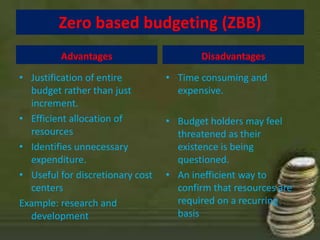
Zero based budgeting (ZBB) 
Advantages 
• Justification of entire 
budget rather than just 
increment. 
• Efficient allocation of 
resources 
• Identifies unnecessary 
expenditure. 
• Useful for discretionary cost 
centers 
Example: research and 
development 
Disadvantages 
• Time consuming and 
expensive. 
• Budget holders may feel 
threatened as their 
existence is being 
questioned. 
• An inefficient way to 
confirm that resources are 
required on a recurring 
basis
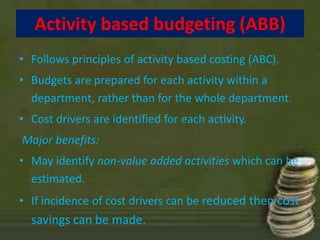
Activity based budgeting (ABB) 
• Follows principles of activity based costing (ABC). 
• Budgets are prepared for each activity within a 
department, rather than for the whole department. 
• Cost drivers are identified for each activity. 
Major benefits: 
• May identify non-value added activities which can be 
estimated. 
• If incidence of cost drivers can be reduced then cost 
savings can be made.
PROCESSES OF BUDGETING
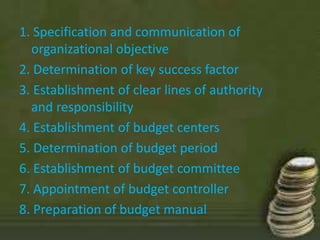
1. Specification and communication of 
organizational objective 
2. Determination of key success factor 
3. Establishment of clear lines of authority 
and responsibility 
4. Establishment of budget centers 
5. Determination of budget period 
6. Establishment of budget committee 
7. Appointment of budget controller 
8. Preparation of budget manual

Forms of Budgeting

  • 1.
  • 2.
    Incremental Budgeting •Starts with previous period’s budget or actual results. • Add/subtract an incremental amount to cover any known changes to the business inflation. • Only the increment needs to be justified. • May be appropriate for stable business with good cost control
  • 3.
    Incremental Budgeting AdvantagesDisadvantages • Inefficiencies may be compounded example budget slack. • Budget holder might spend to the limit of the budget just to ensure future budget not cut – dysfunctional behavior. • Quick. • Easy. • Cost effective. • Assuming historic figures are acceptable, only increment need be justified.
  • 4.
    Zero based budgeting(ZBB) Managers justify all income and expenditure items for each budgeting cycle. • Starts with assumption that the budget for next period is zero. • Budget holder prepares a “decision package” for the department which includes: -function of department -goal of department -measure of performance -level of funding required and justification -consequences to the company of the department not performing its function. • Senior management rank decision packages. • Resources allocated to departments according to ranking
  • 5.
    Zero based budgeting(ZBB) Advantages • Justification of entire budget rather than just increment. • Efficient allocation of resources • Identifies unnecessary expenditure. • Useful for discretionary cost centers Example: research and development Disadvantages • Time consuming and expensive. • Budget holders may feel threatened as their existence is being questioned. • An inefficient way to confirm that resources are required on a recurring basis
  • 6.
    Activity based budgeting(ABB) • Follows principles of activity based costing (ABC). • Budgets are prepared for each activity within a department, rather than for the whole department. • Cost drivers are identified for each activity. Major benefits: • May identify non-value added activities which can be estimated. • If incidence of cost drivers can be reduced then cost savings can be made.
  • 7.
  • 8.
    1. Specification andcommunication of organizational objective 2. Determination of key success factor 3. Establishment of clear lines of authority and responsibility 4. Establishment of budget centers 5. Determination of budget period 6. Establishment of budget committee 7. Appointment of budget controller 8. Preparation of budget manual