Upgrading to 11.1.2.4 and Other Technical Considerations
Finit Solutions is an experienced provider of EPM services, having managed several large-scale EPM projects and offering comprehensive technical support, product upgrades, and infrastructure solutions. The document discusses upgrading to Oracle Hyperion EPM version 11.1.2.4, providing insights into virtualization, disaster recovery, and support considerations. It highlights the company's commitment to customer satisfaction and the technical complexities involved in upgrading EPM systems.
Upgrading to 11.1.2.4 and Other Technical Considerations
1.
www.finitsolutions.com
Getting the Mostout of EPM:
Upgrading to 11.1.2.4 and Other Technical
Considerations
June 12, 2015
Frank Zidar (fzidar@finitsolutions.com)
Dawn Mathews (dmathews@finitsolutions.com)
2.
www.finitsolutions.com
- 2 -
FinitOverview
• Founded in 2002
• 75+ employees in 20+ states
– Mostly CPAs, MBAs
– We have extensive Hyperion product and financial reporting
backgrounds
• 80+ HFM Clients
– Managed several of the largest EPM projects in the U.S.
– Including the largest roll-out of HFM in North America
• Market Leader in ARM/FCM
• World Leader in FDM implementations and custom solutions
• 50+ Planning / Essbase Clients
3.
www.finitsolutions.com
- 3 -
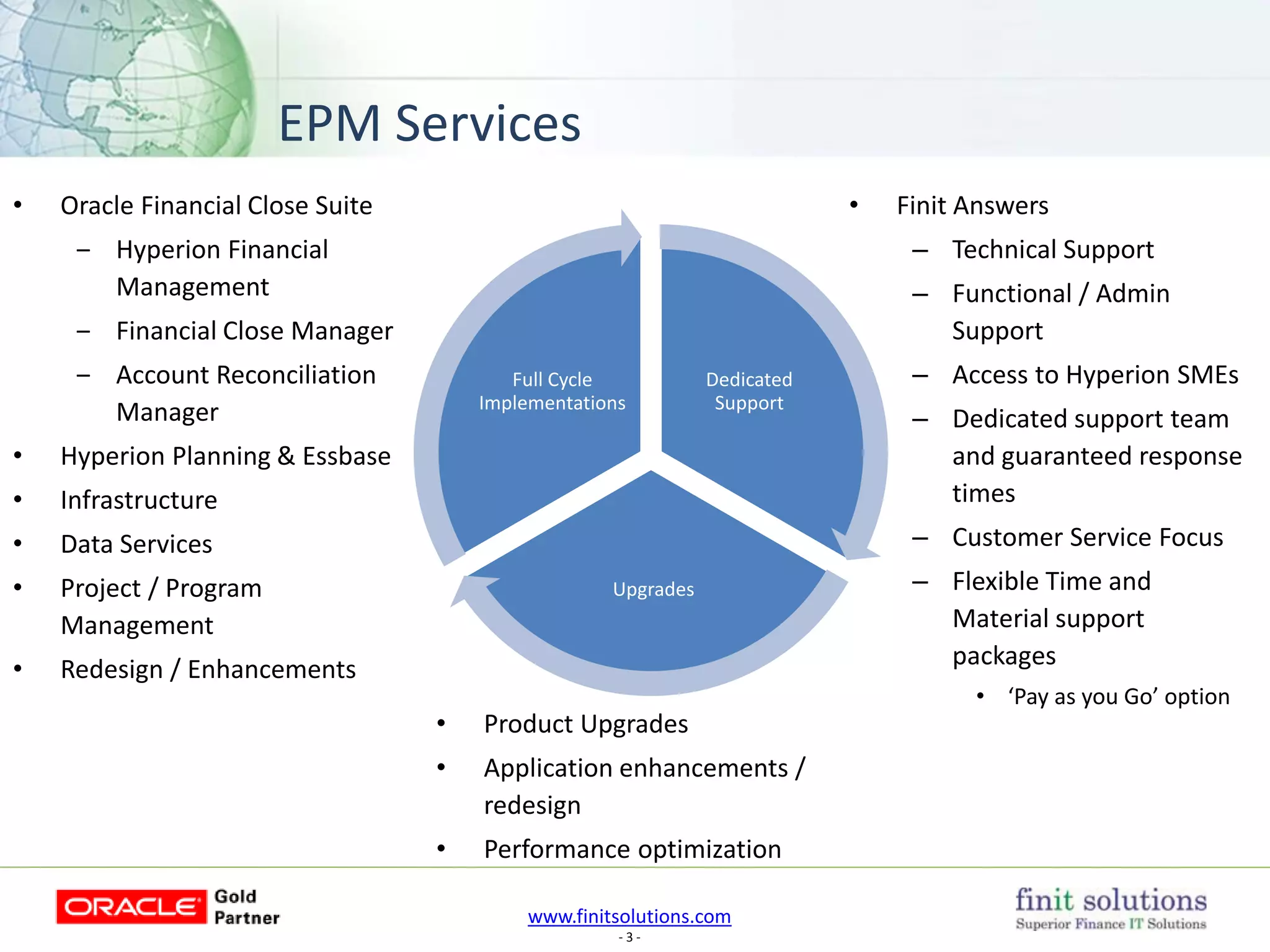
EPMServices
• Finit Answers
– Technical Support
– Functional / Admin
Support
– Access to Hyperion SMEs
– Dedicated support team
and guaranteed response
times
– Customer Service Focus
– Flexible Time and
Material support
packages
• ‘Pay as you Go’ option
• Oracle Financial Close Suite
‒ Hyperion Financial
Management
‒ Financial Close Manager
‒ Account Reconciliation
Manager
• Hyperion Planning & Essbase
• Infrastructure
• Data Services
• Project / Program
Management
• Redesign / Enhancements
• Product Upgrades
• Application enhancements /
redesign
• Performance optimization
Dedicated
Support
Upgrades
Full Cycle
Implementations
www.finitsolutions.com
- 5 -
•We make and deliver personalized financial
reporting solutions and experiences.
– By listening, questioning, and analyzing
– By building relationships
…not company to company, but person to person.
– We are Makers and Doers
WHY is Finit Here?
6.
www.finitsolutions.com
- 6 -
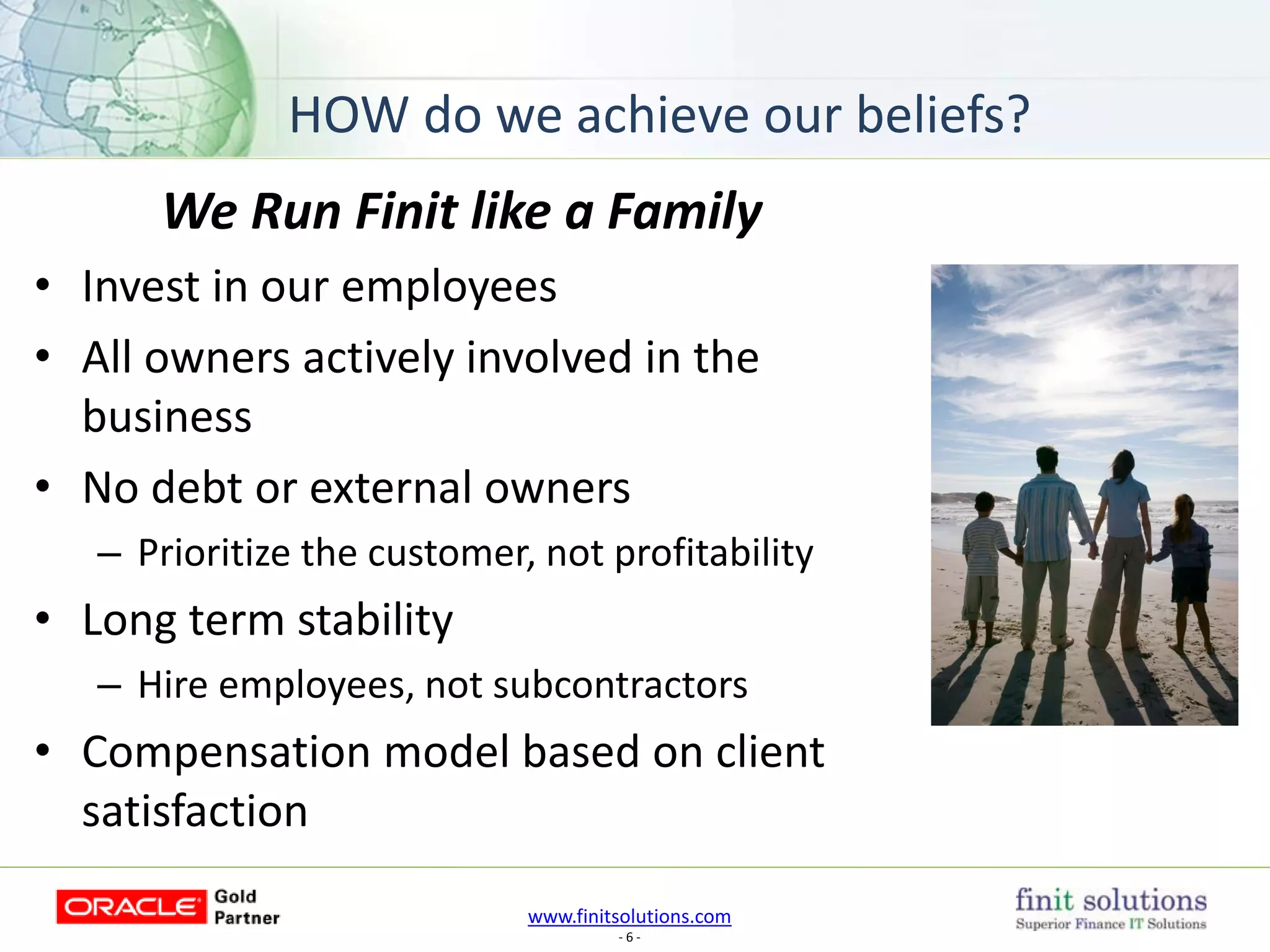
WeRun Finit like a Family
• Invest in our employees
• All owners actively involved in the
business
• No debt or external owners
– Prioritize the customer, not profitability
• Long term stability
– Hire employees, not subcontractors
• Compensation model based on client
satisfaction
HOW do we achieve our beliefs?
www.finitsolutions.com
- 8 -
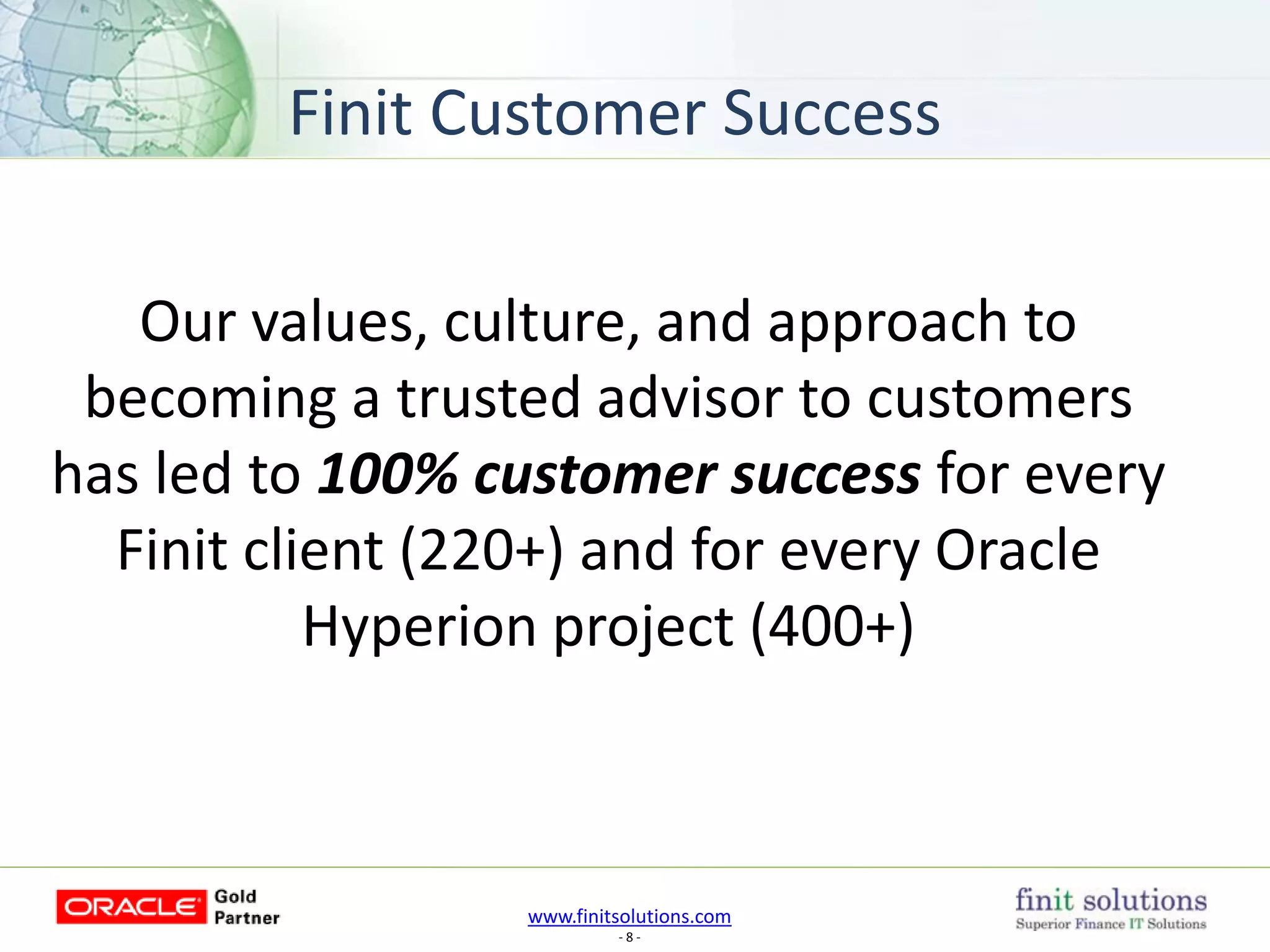
Ourvalues, culture, and approach to
becoming a trusted advisor to customers
has led to 100% customer success for every
Finit client (220+) and for every Oracle
Hyperion project (400+)
Finit Customer Success
www.finitsolutions.com
- 11 -
Aboutthe Presenters
Dawn Mathews
(dmathews@finitsolutions.com)
• Practice Director, Finit Answers
• Eleven years Oracle EPM experience
• HFM, FDM, Hyperion Enterprise
• Project manager in multi-product
projects
• Oracle HFM 11 Certified
Implementation Specialist
• Support lead for 60+ clients
12.
www.finitsolutions.com
- 12 -
Aboutthe Presenters
Frank Zidar
(fzidar@finitsolutions.com)
• Practice Director, Infrastructure
Services
• Nearly 25 years experience with
software and information systems
• Specializes in environment design
and sizing, performance testing and
tuning, disaster recovery
13.
www.finitsolutions.com
- 13 -
•Common Questions and Technical Background
– Virtualization
– Exalytics and Exadata
– Disaster Recovery and High Availability
– Oracle’s Version Numbering
• Upgrade Methodologies (11.1.2.4)
Agenda
14.
www.finitsolutions.com
- 14 -
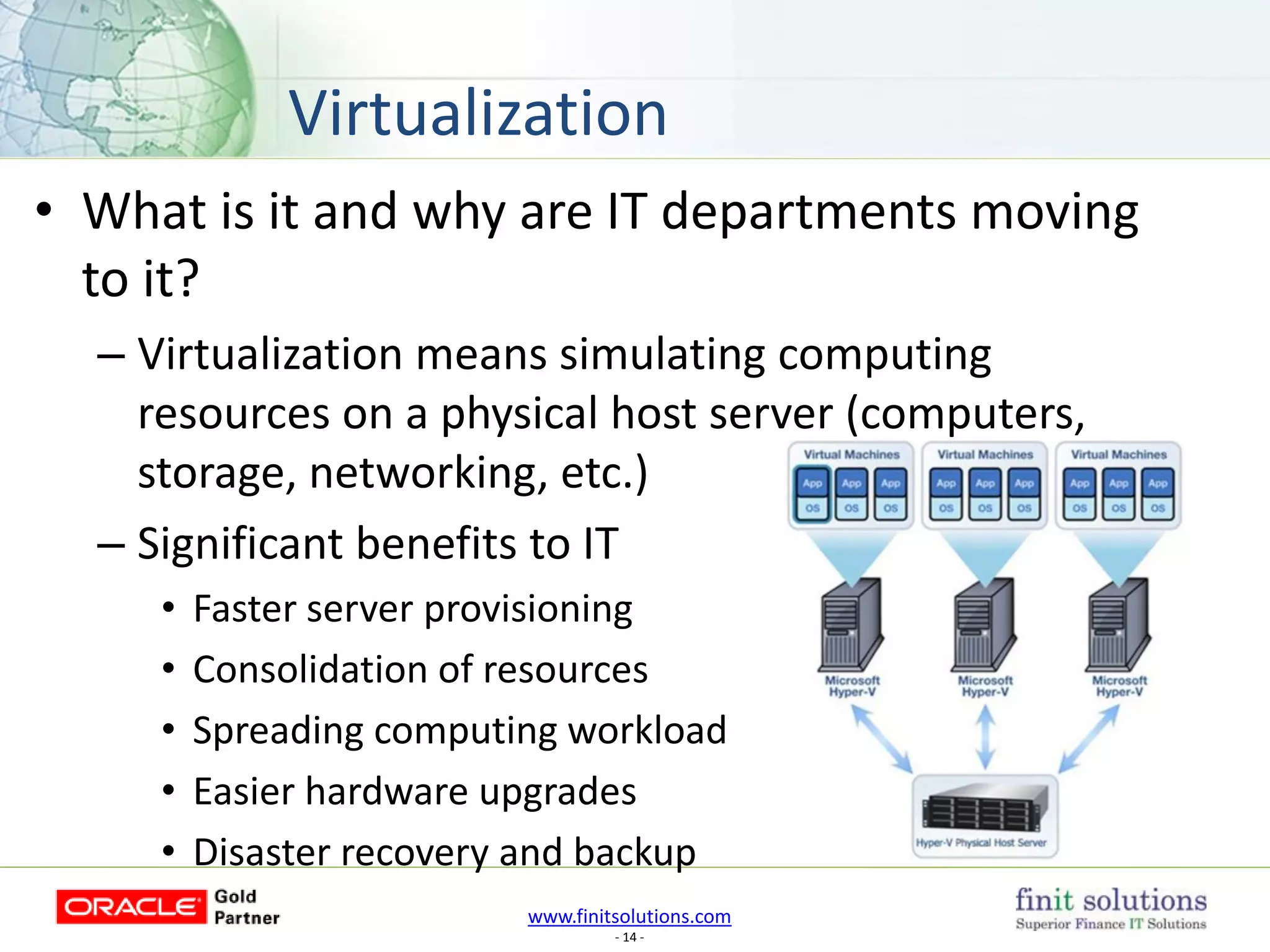
•What is it and why are IT departments moving
to it?
– Virtualization means simulating computing
resources on a physical host server (computers,
storage, networking, etc.)
– Significant benefits to IT
• Faster server provisioning
• Consolidation of resources
• Spreading computing workload
• Easier hardware upgrades
• Disaster recovery and backup
Virtualization
15.
www.finitsolutions.com
- 15 -
•Nearly all of our customers employing some
level of virtualization
– Most often used for non-production environments
– Many production environments have
virtual/physical mix
– Some have corporate mandates to go 100% virtual
• Will EPM work in a virtual
environment and what happens with
support?
Virtualization
16.
www.finitsolutions.com
- 16 -
•Everything about Oracle’s stance on virtualization is
detailed in doc ID: 562663.1 on Oracle’s support site.
At a high level:
– Oracle will support but does not certify EPM in a virtualized
environment
– Only certified on Oracle VM
– Oracle may ask you to try to replicate an unknown issue in a
physical environment
• We have not encountered such a situation
• All of EPM works perfectly with virtualization
• Can be problematic for Finance team
Virtualization
17.
www.finitsolutions.com
- 17 -
•Extra layer of software and complexity
– Shared server resources means variable
performance
– Difficult to diagnose performance issues
– Processing overhead
• You will not be able to achieve the same level of
performance as you can with physical
• Mitigation with CPU and RAM affinity might go against IT
policies
• We have encountered all of these situations at clients
Virtualization
18.
www.finitsolutions.com
- 18 -
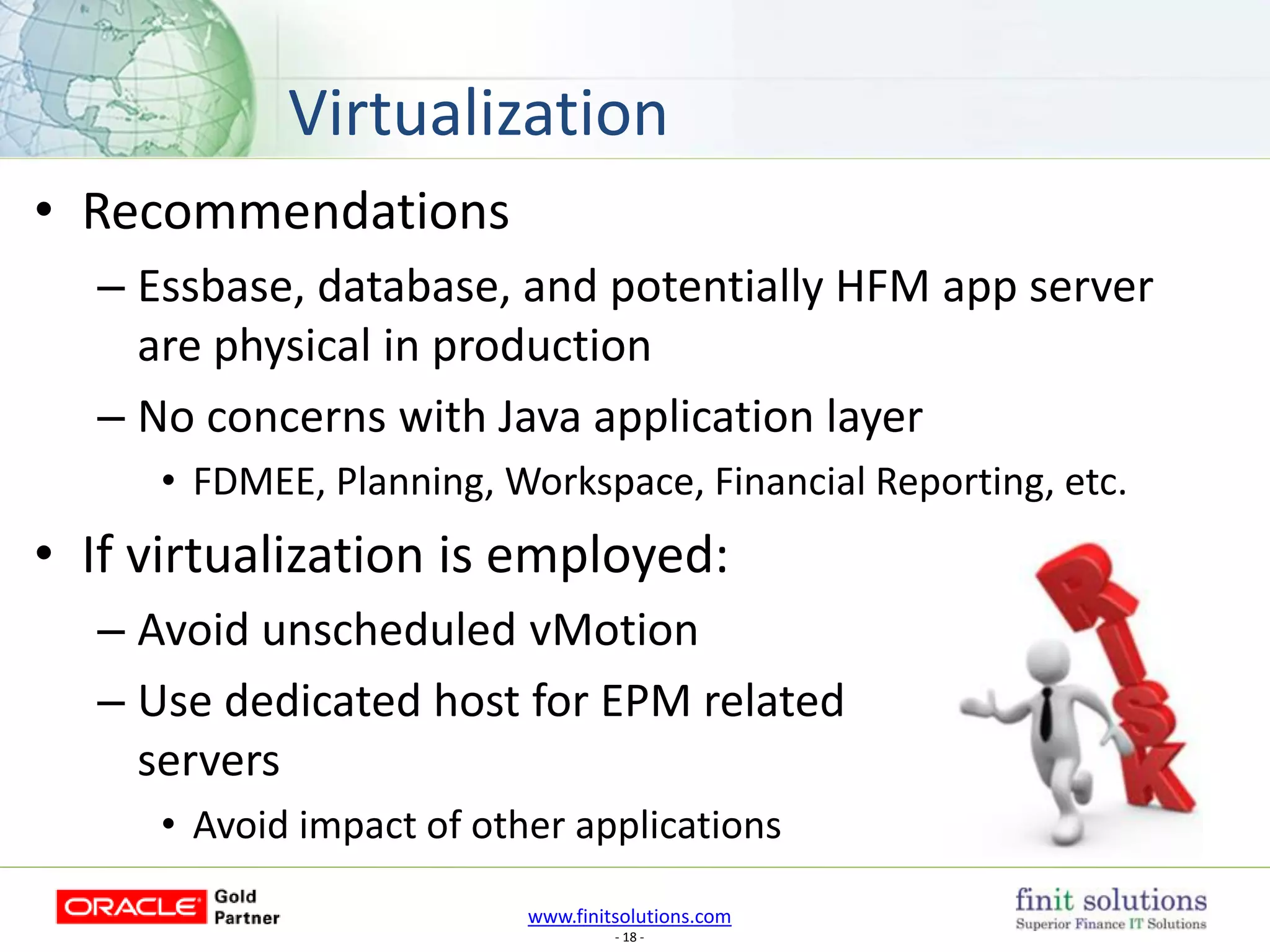
•Recommendations
– Essbase, database, and potentially HFM app server
are physical in production
– No concerns with Java application layer
• FDMEE, Planning, Workspace, Financial Reporting, etc.
• If virtualization is employed:
– Avoid unscheduled vMotion
– Use dedicated host for EPM related
servers
• Avoid impact of other applications
Virtualization
19.
www.finitsolutions.com
- 19 -
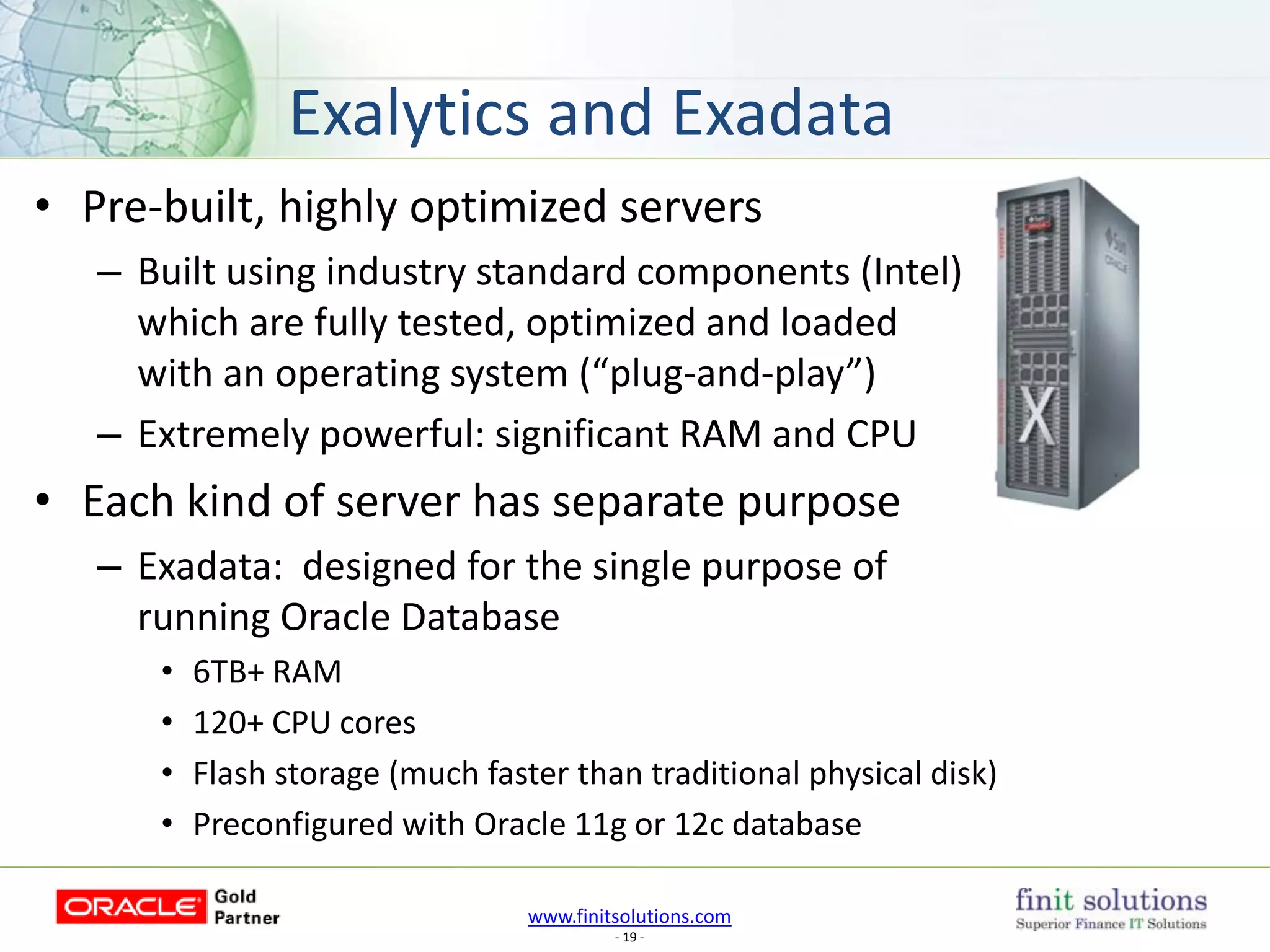
•Pre-built, highly optimized servers
– Built using industry standard components (Intel)
which are fully tested, optimized and loaded
with an operating system (“plug-and-play”)
– Extremely powerful: significant RAM and CPU
• Each kind of server has separate purpose
– Exadata: designed for the single purpose of
running Oracle Database
• 6TB+ RAM
• 120+ CPU cores
• Flash storage (much faster than traditional physical disk)
• Preconfigured with Oracle 11g or 12c database
Exalytics and Exadata
20.
www.finitsolutions.com
- 20 -
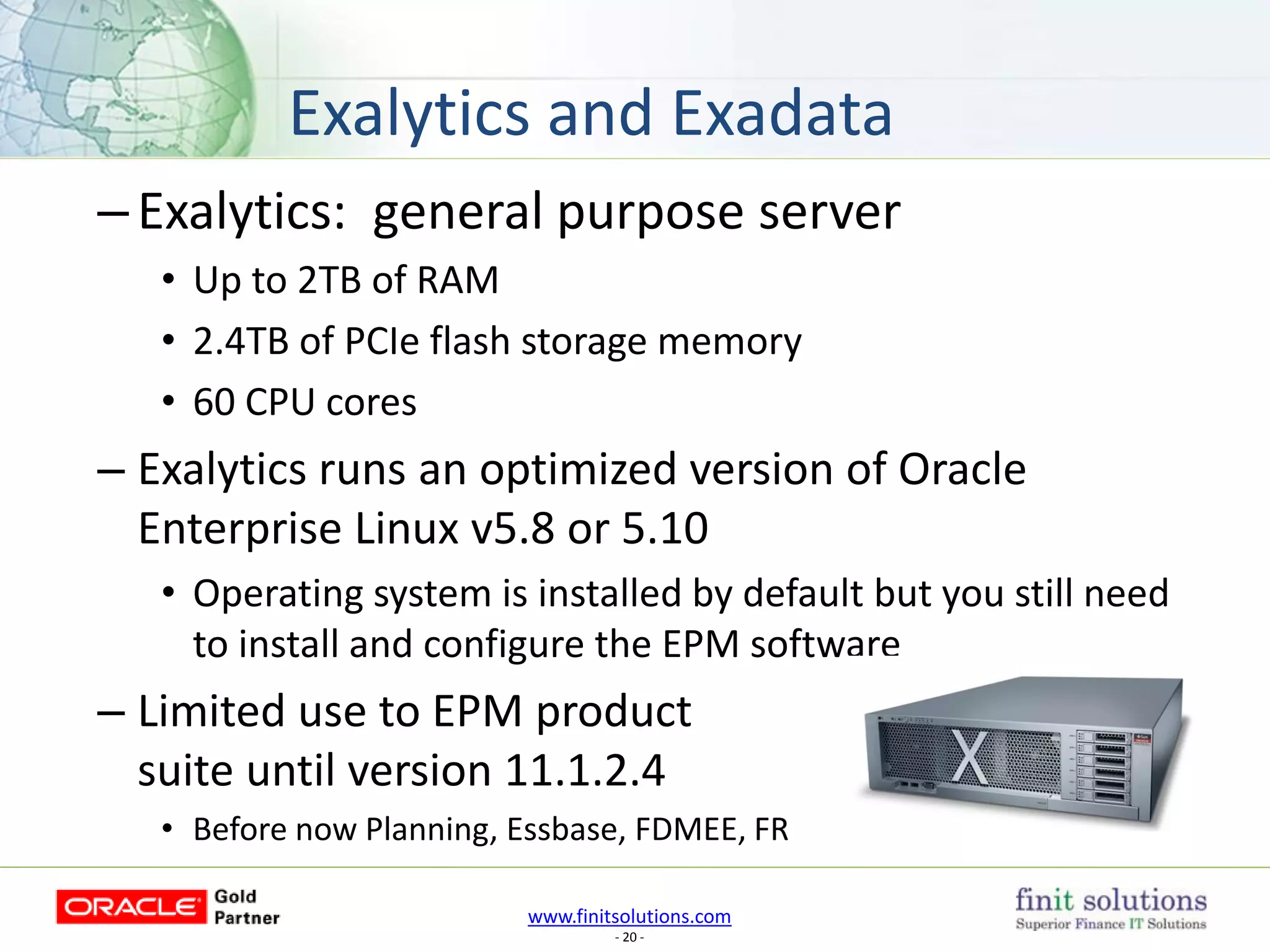
–Exalytics:general purpose server
• Up to 2TB of RAM
• 2.4TB of PCIe flash storage memory
• 60 CPU cores
– Exalytics runs an optimized version of Oracle
Enterprise Linux v5.8 or 5.10
• Operating system is installed by default but you still need
to install and configure the EPM software
– Limited use to EPM product
suite until version 11.1.2.4
• Before now Planning, Essbase, FDMEE, FR
Exalytics and Exadata
21.
www.finitsolutions.com
- 21 -
•11.1.2.4 has extended HFM server OS compatibility
with Linux and eliminated classic FDM
• This allows very nearly the entire EPM product suite
to run on an Exalytics machine
• Product exceptions for Exalytics support
– EPMA Dimension Server
• Provides back-end services for dimensionality, applications, and jobs
console
• Web and Data Synchronization front-end components are
supported
– DRM
– Will need separate Windows servers
Exalytics and Exadata
22.
www.finitsolutions.com
- 22 -
•Additional benefits of Exalytics
– Essbase has special optimizations on Exalytics to MDX query
engine and parallel operations
• Take advantage of the number of CPU cores
– HFM consolidation times will be reduced because of
available RAM and number of cores
• Entire application can be loaded into memory (“In- Memory
Machine”)
• Network and database latency are dramatically reduced
– Drawbacks to keep in mind
• Pre-built Linux server - no virtualization
• Single point of failure
Exalytics and Exadata
23.
www.finitsolutions.com
- 23 -
•Disaster recovery and high availability are very
different in terms of what they are attempting to
accomplish
• High Availability – how to maximize up time of system
– Also called fault tolerance
– Multiple machines for each EPM function clustered
together in an environment
• Other machines take over immediately in the event of a failure on
another
– Automatically handled via WebLogic and HFM application server
clusters – users automatically routed to various servers in the cluster(s)
– Allows I.T. to handle scheduled system maintenance without down time
Disaster Recovery and High
Availability
24.
www.finitsolutions.com
- 24 -
•Additional benefits of a highly available configuration
in EPM
– Load balancing
• Multiple servers means more horsepower available
• For larger clients this is more important than HA
– Performance scaling
• If you outgrow your system, easy to add additional servers to the
cluster
• As always, this creates added complexity
– Multiple servers means it will be much more challenging to
debug sporadic issues
Disaster Recovery and High
Availability
25.
www.finitsolutions.com
- 25 -
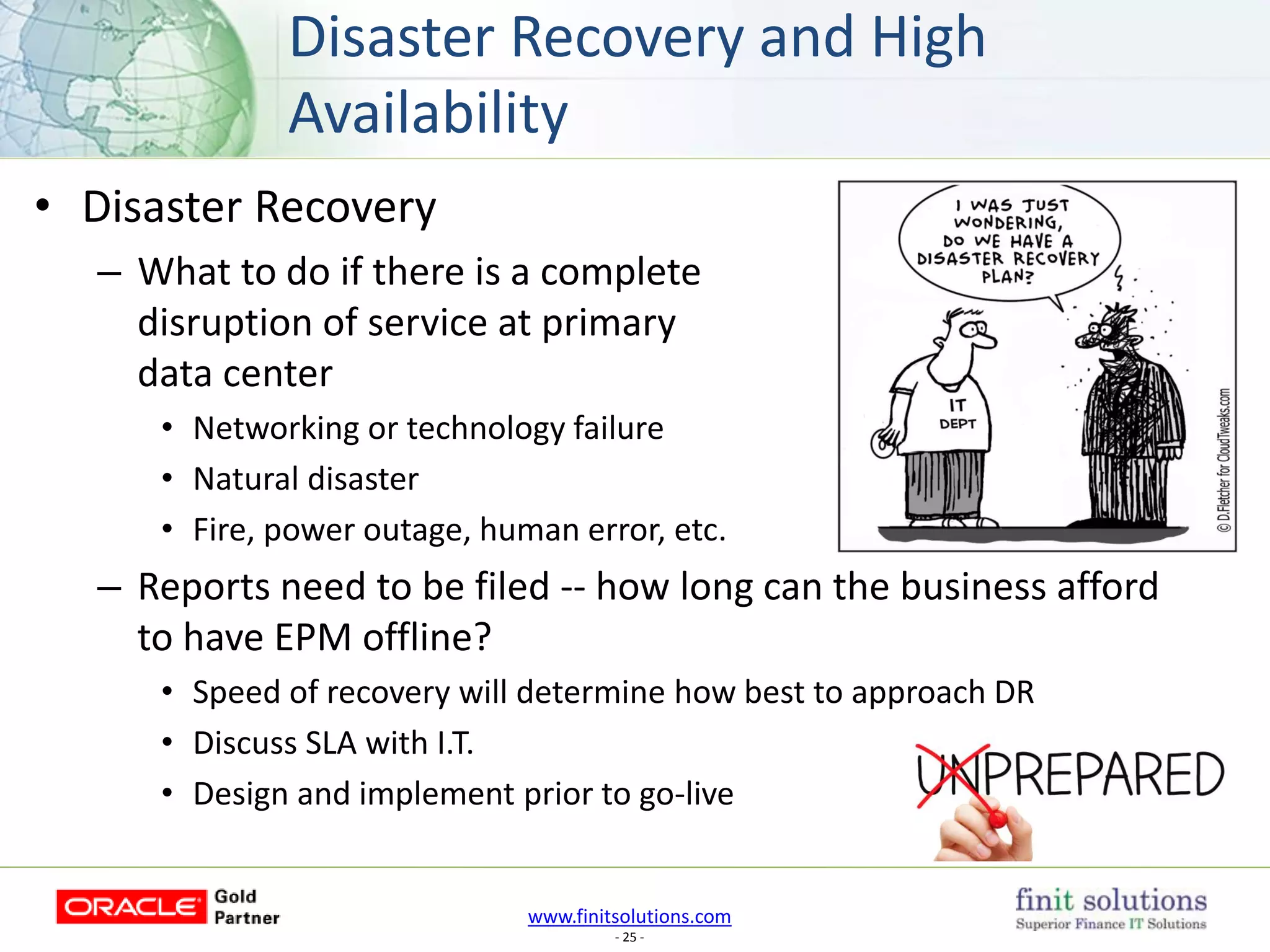
•Disaster Recovery
– What to do if there is a complete
disruption of service at primary
data center
• Networking or technology failure
• Natural disaster
• Fire, power outage, human error, etc.
– Reports need to be filed -- how long can the business afford
to have EPM offline?
• Speed of recovery will determine how best to approach DR
• Discuss SLA with I.T.
• Design and implement prior to go-live
Disaster Recovery and High
Availability
26.
www.finitsolutions.com
- 26 -
•Approaches
– “Hot site”
• Completely separate installation of EPM that is always up and
running in a separate data center
• Different URLs and separate databases
• Data kept in sync via LCM, RDBMS backups, HFM CopyApp process
• Refreshed nightly or potentially more frequently
– This can be a significant drawback
• Benefit of a nearly instant failover
• Can also be used as a DEV/QA system to overcome waste of
resources for a system that is *hopefully* never used
Disaster Recovery and High
Availability
27.
www.finitsolutions.com
- 27 -
•Approaches
– “Cold site”
• Separate EPM installation that is completely offline
– This allows IT to perform operations that are not possible with a
live system
• Best configuration has databases replicated between
data centers
– Almost up to the minute data/information
• FDM data replicated
• LCM extracts taken nightly for Financial Reports, user
provisioning and stored in the DR data center
• Will take time to get system back online
Disaster Recovery and High
Availability
28.
www.finitsolutions.com
- 28 -
•Approaches
– “Cold site” (with virtualization)
• Virtualization systems have some kind of DR mechanism
built in to replicate entire active virtual machines to
other facilities
• In the event of a disaster, full and complete replications
of the existing PROD systems can be booted up in DR
data center
Disaster Recovery and High
Availability
29.
www.finitsolutions.com
- 29 -
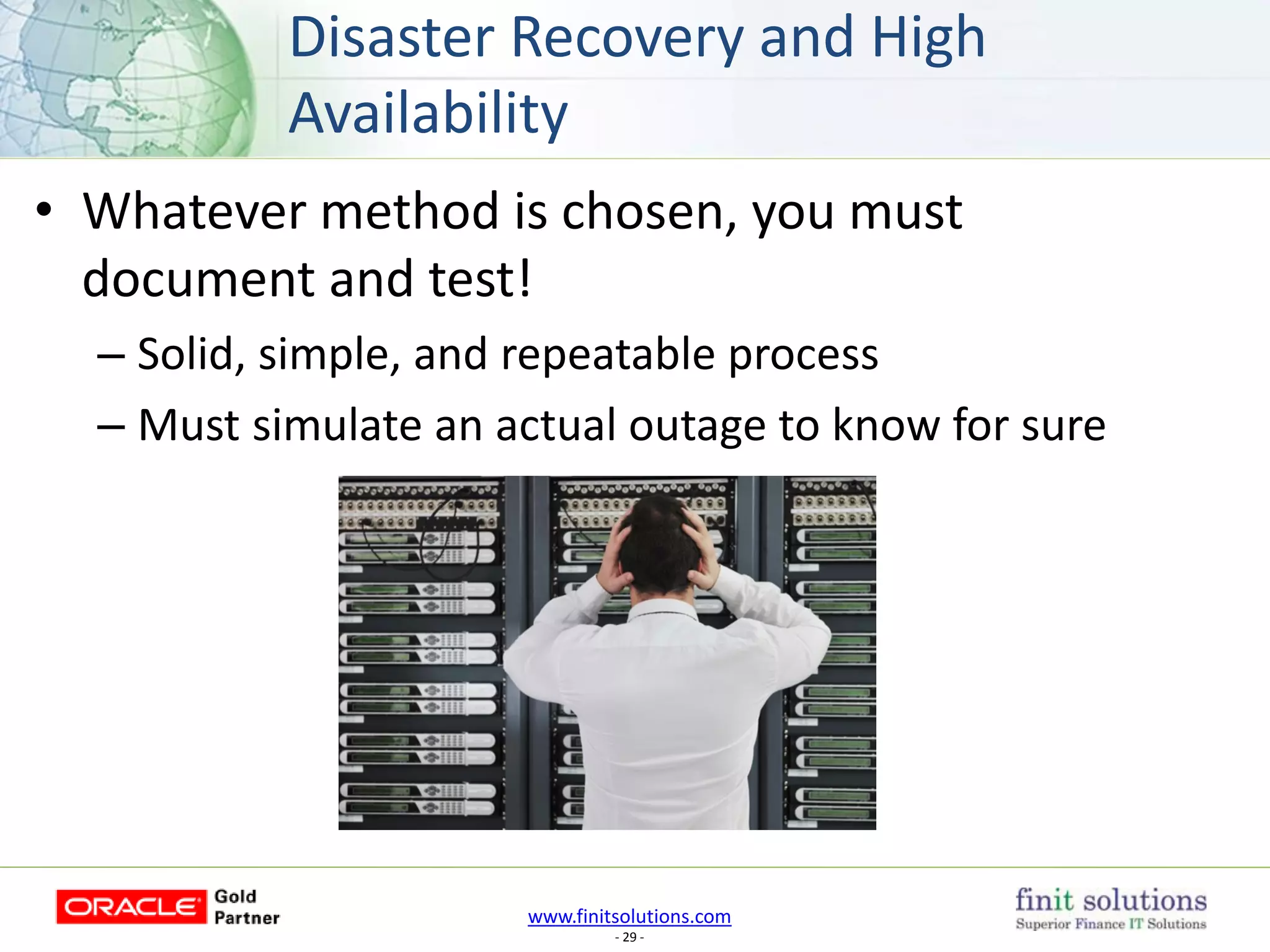
•Whatever method is chosen, you must
document and test!
– Solid, simple, and repeatable process
– Must simulate an actual outage to know for sure
Disaster Recovery and High
Availability
30.
www.finitsolutions.com
- 30 -
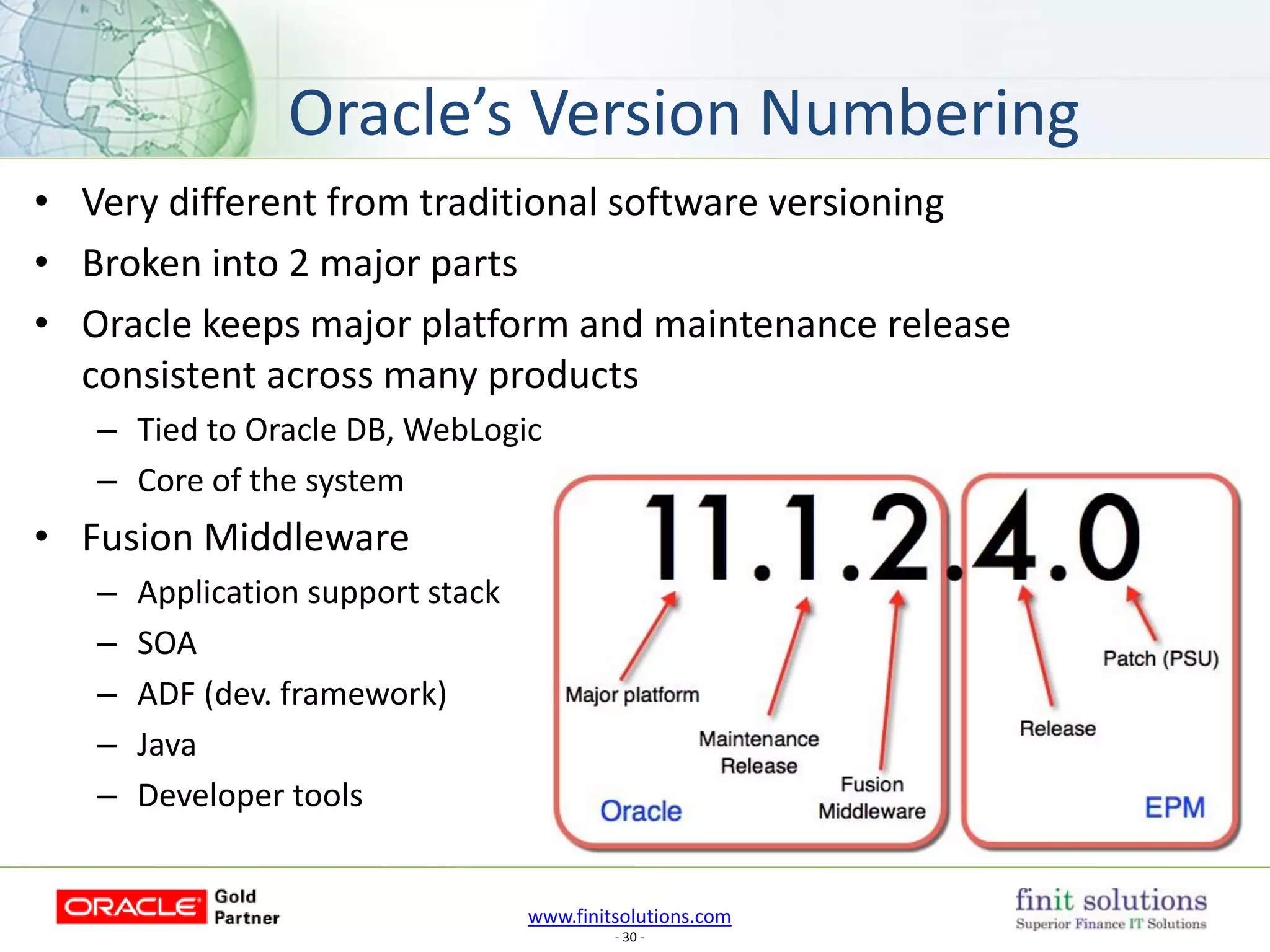
•Very different from traditional software versioning
• Broken into 2 major parts
• Oracle keeps major platform and maintenance release
consistent across many products
– Tied to Oracle DB, WebLogic
– Core of the system
• Fusion Middleware
– Application support stack
– SOA
– ADF (dev. framework)
– Java
– Developer tools
Oracle’s Version Numbering
31.
www.finitsolutions.com
- 31 -
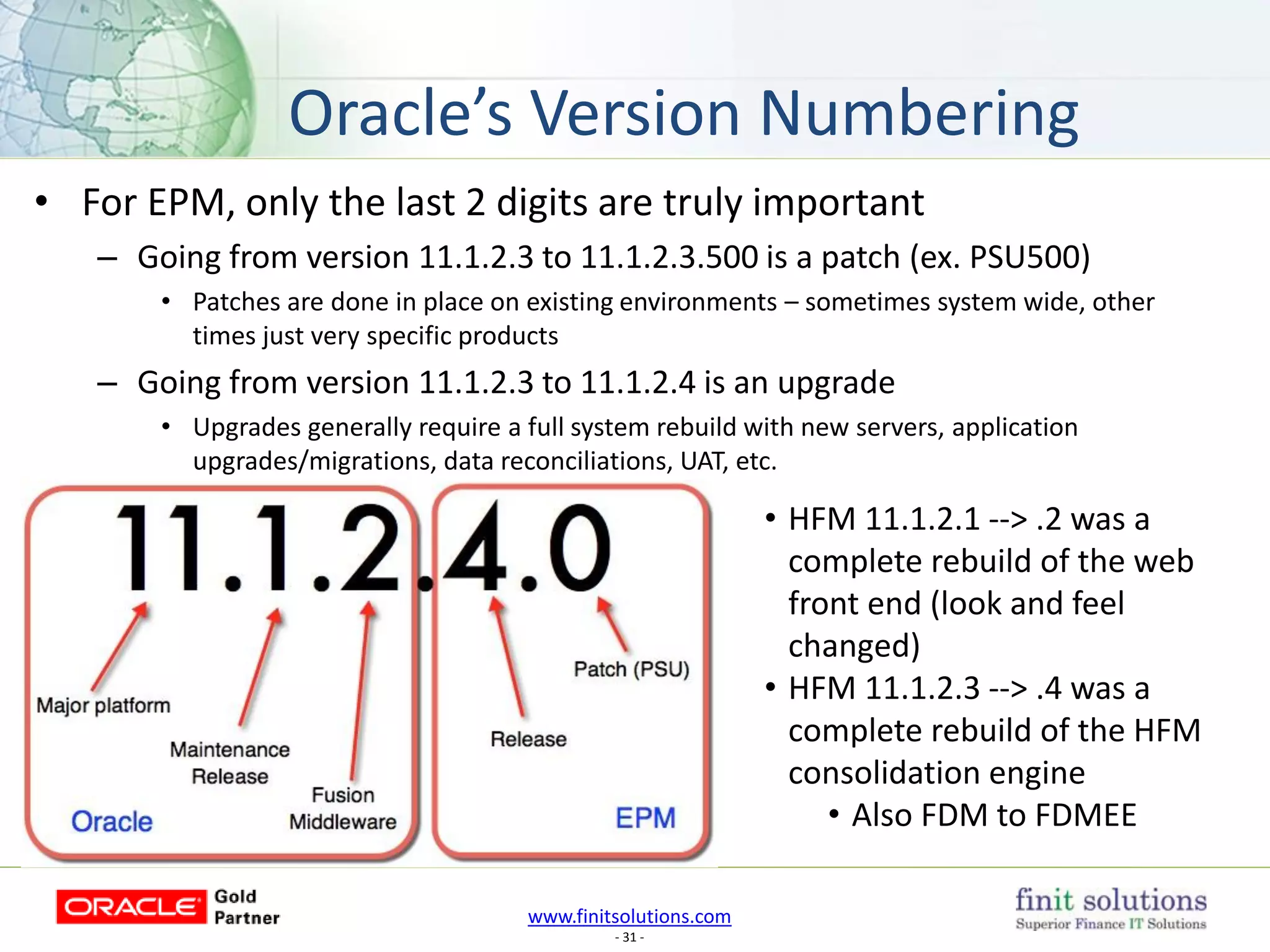
•For EPM, only the last 2 digits are truly important
– Going from version 11.1.2.3 to 11.1.2.3.500 is a patch (ex. PSU500)
• Patches are done in place on existing environments – sometimes system wide, other
times just very specific products
– Going from version 11.1.2.3 to 11.1.2.4 is an upgrade
• Upgrades generally require a full system rebuild with new servers, application
upgrades/migrations, data reconciliations, UAT, etc.
• wef
Oracle’s Version Numbering
• HFM 11.1.2.1 --> .2 was a
complete rebuild of the web
front end (look and feel
changed)
• HFM 11.1.2.3 --> .4 was a
complete rebuild of the HFM
consolidation engine
• Also FDM to FDMEE
32.
www.finitsolutions.com
- 32 -
•Reasons you may want to upgrade:
– Oracle Premier Support
• 11.1.2.x versions on Premier Support until April 2018
• Extended support until April 2021
– Additional third party software support
• Windows 8
• IE11
• Office 2013
– Platform independence, including Exalytics
– New modules desired, such as SDM
– Substantial application enhancements desired
To Upgrade, or Not to Upgrade:
That is the Question
33.
www.finitsolutions.com
- 33 -
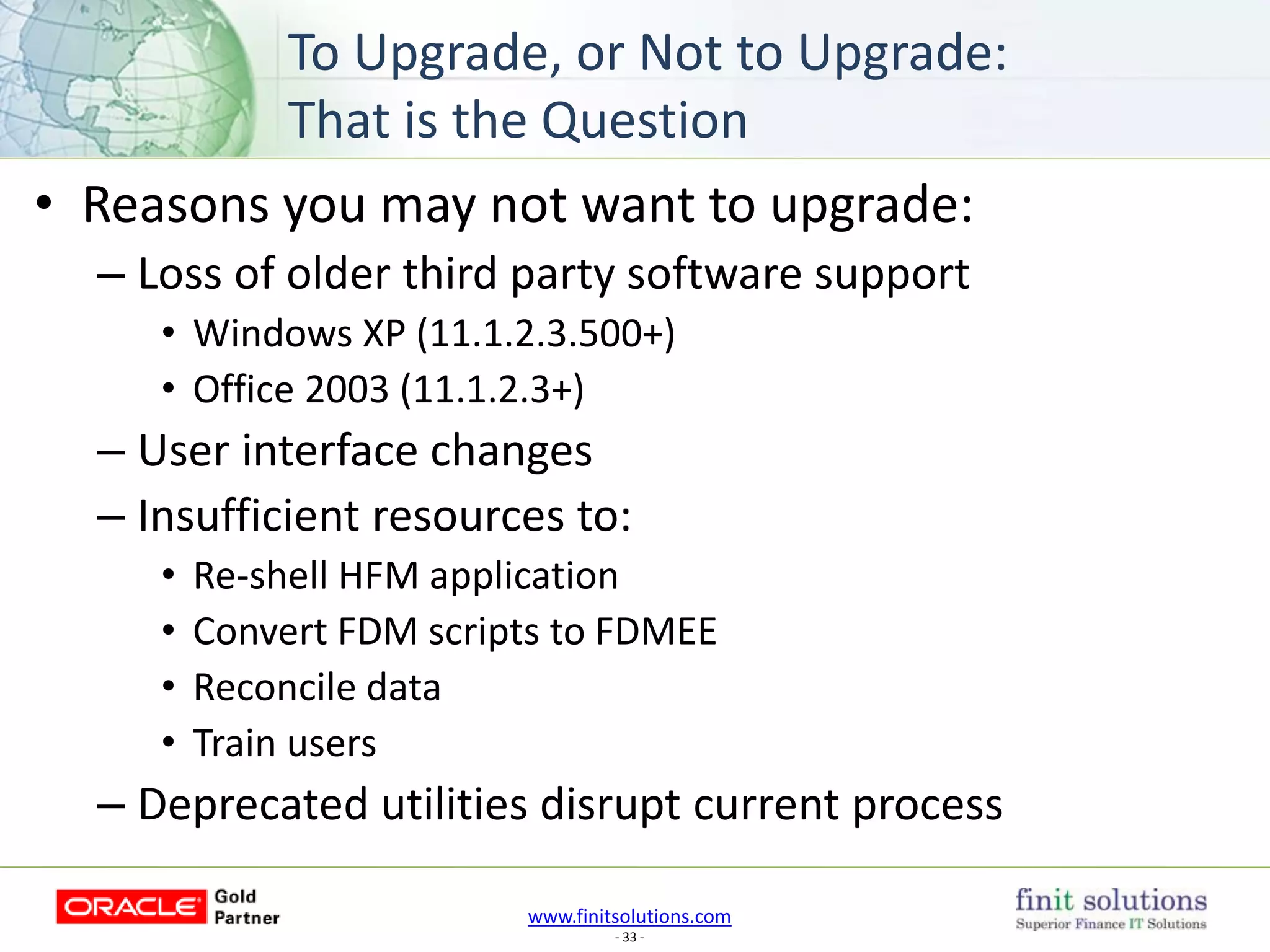
•Reasons you may not want to upgrade:
– Loss of older third party software support
• Windows XP (11.1.2.3.500+)
• Office 2003 (11.1.2.3+)
– User interface changes
– Insufficient resources to:
• Re-shell HFM application
• Convert FDM scripts to FDMEE
• Reconcile data
• Train users
– Deprecated utilities disrupt current process
To Upgrade, or Not to Upgrade:
That is the Question
34.
www.finitsolutions.com
- 34 -
•Once your organization has decided to move forward
with an upgrade, how you go about doing it needs to
be determined
• Two methods: In place (existing servers) vs. out of
place (new servers)
– In place upgrade is also known as a “maintenance release”
– Oracle promotes maintenance releases as the preferred and
tested method to upgrade EPM systems
– Because of this, over time Oracle has been reducing the
supported paths and options available during the upgrade
process…
Upgrading EPM
35.
www.finitsolutions.com
- 35 -
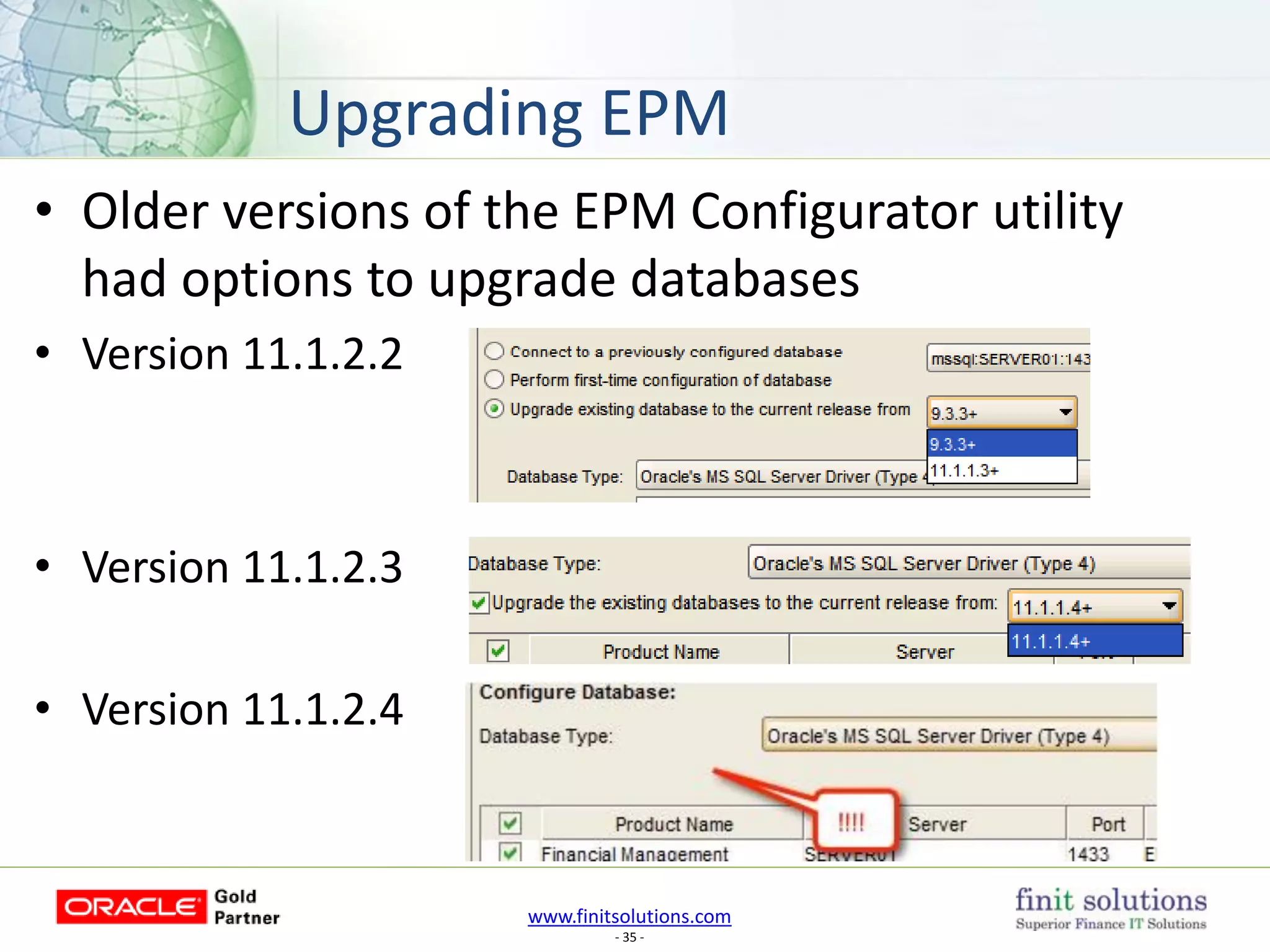
•Older versions of the EPM Configurator utility
had options to upgrade databases
• Version 11.1.2.2
• Version 11.1.2.3
• Version 11.1.2.4
Upgrading EPM
36.
www.finitsolutions.com
- 36 -
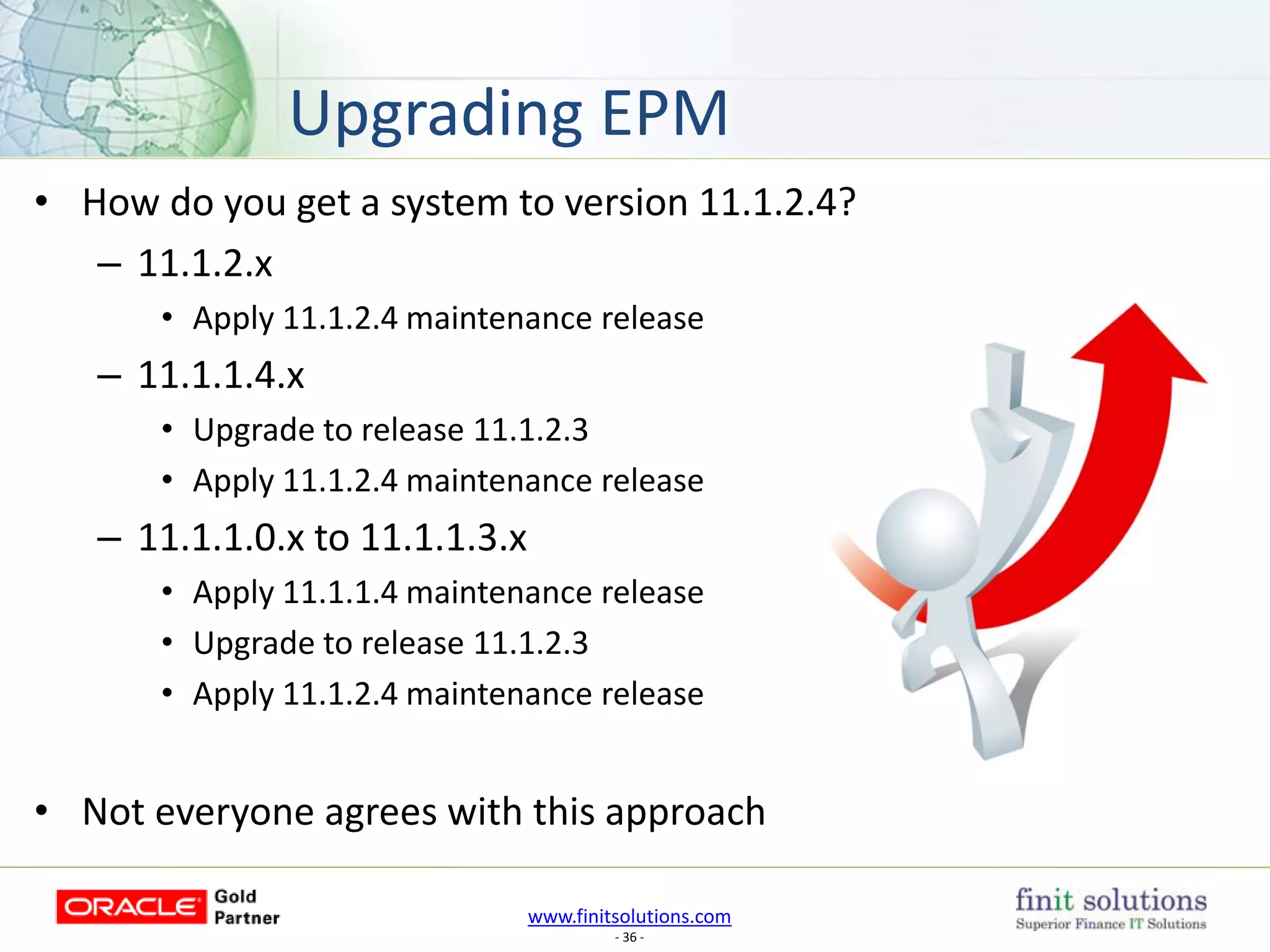
•How do you get a system to version 11.1.2.4?
– 11.1.2.x
• Apply 11.1.2.4 maintenance release
– 11.1.1.4.x
• Upgrade to release 11.1.2.3
• Apply 11.1.2.4 maintenance release
– 11.1.1.0.x to 11.1.1.3.x
• Apply 11.1.1.4 maintenance release
• Upgrade to release 11.1.2.3
• Apply 11.1.2.4 maintenance release
• Not everyone agrees with this approach
Upgrading EPM
37.
www.finitsolutions.com
- 37 -
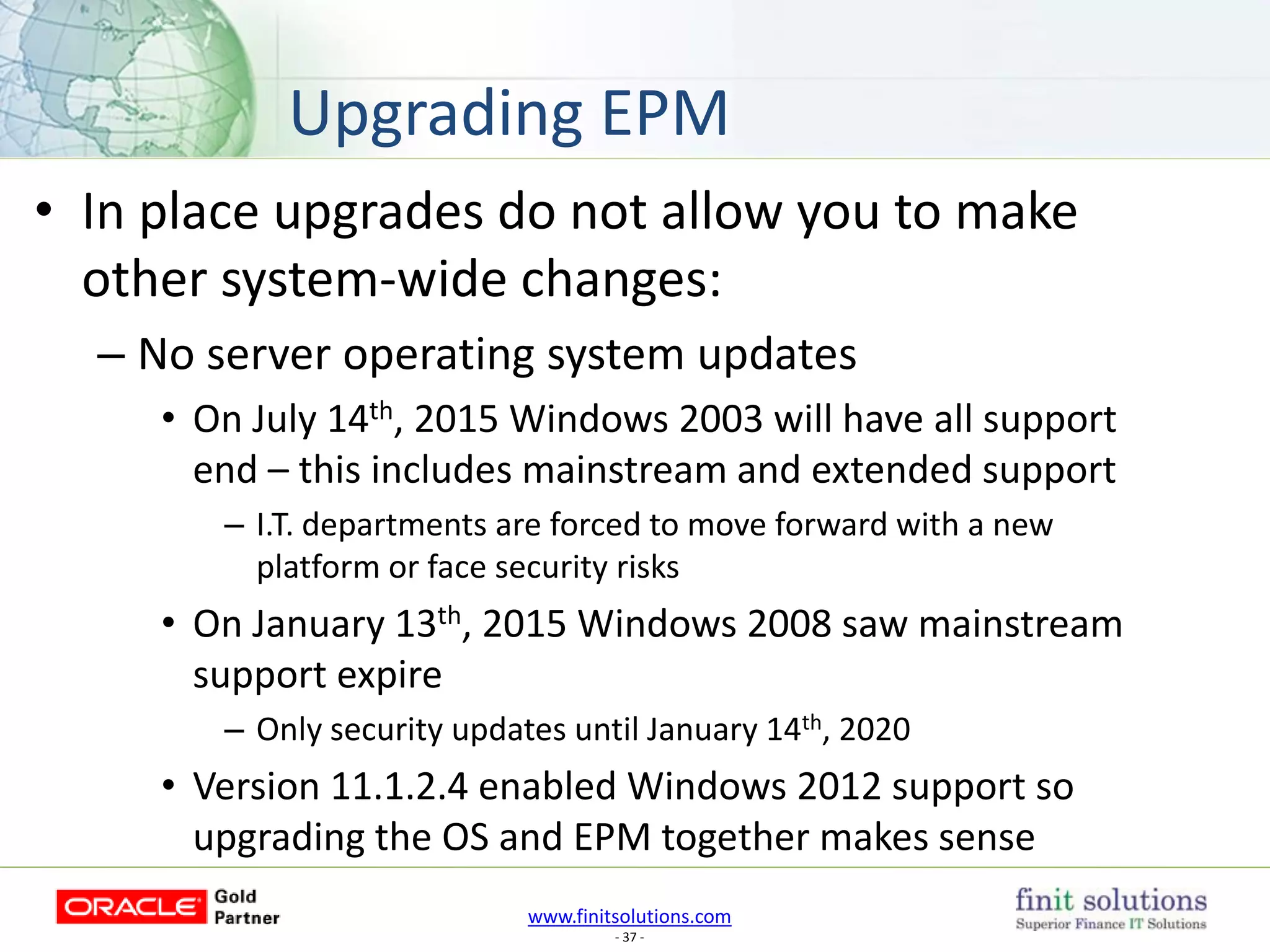
•In place upgrades do not allow you to make
other system-wide changes:
– No server operating system updates
• On July 14th, 2015 Windows 2003 will have all support
end – this includes mainstream and extended support
– I.T. departments are forced to move forward with a new
platform or face security risks
• On January 13th, 2015 Windows 2008 saw mainstream
support expire
– Only security updates until January 14th, 2020
• Version 11.1.2.4 enabled Windows 2012 support so
upgrading the OS and EPM together makes sense
Upgrading EPM
38.
www.finitsolutions.com
- 38 -
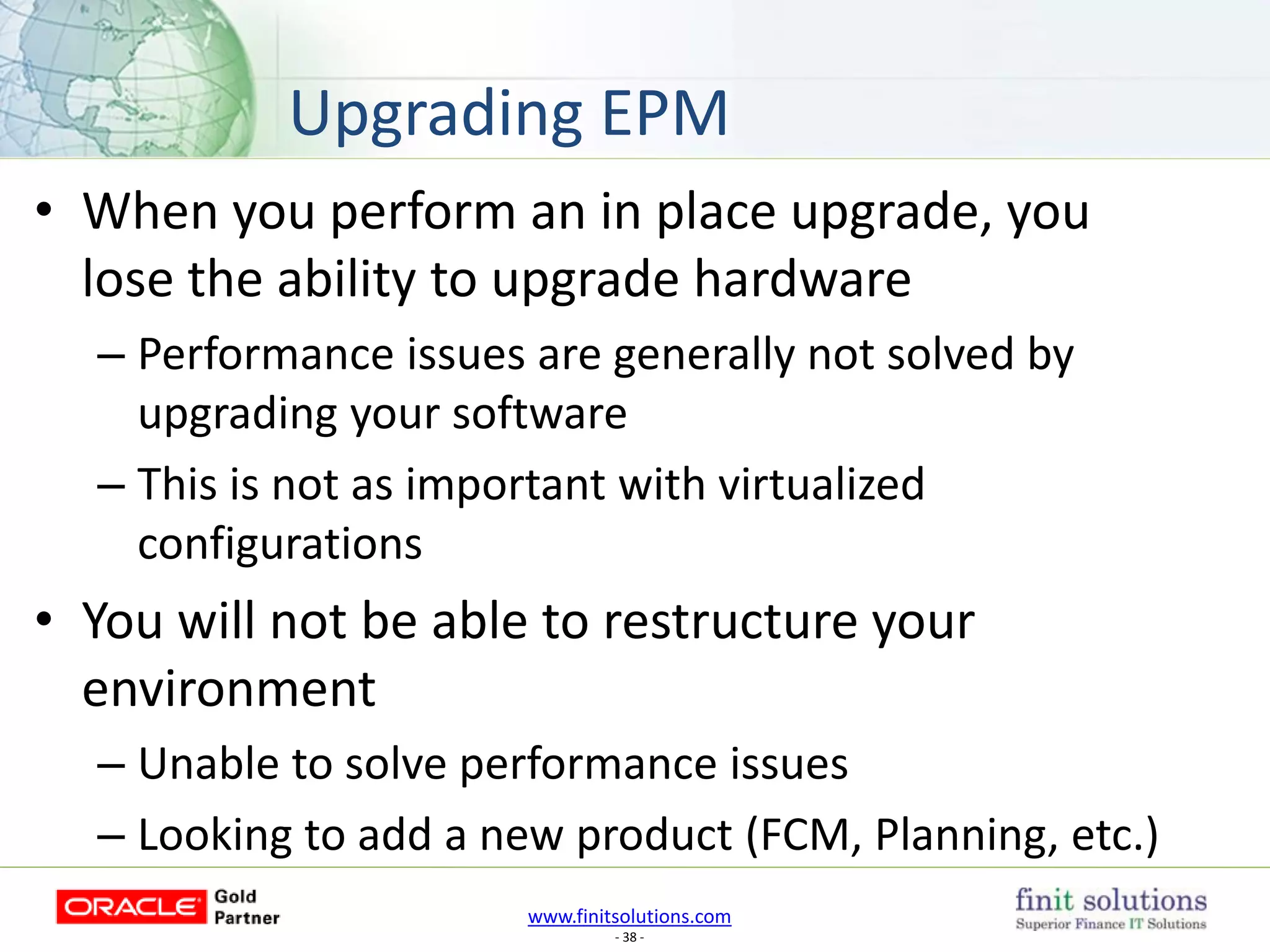
•When you perform an in place upgrade, you
lose the ability to upgrade hardware
– Performance issues are generally not solved by
upgrading your software
– This is not as important with virtualized
configurations
• You will not be able to restructure your
environment
– Unable to solve performance issues
– Looking to add a new product (FCM, Planning, etc.)
Upgrading EPM
39.
www.finitsolutions.com
- 39 -
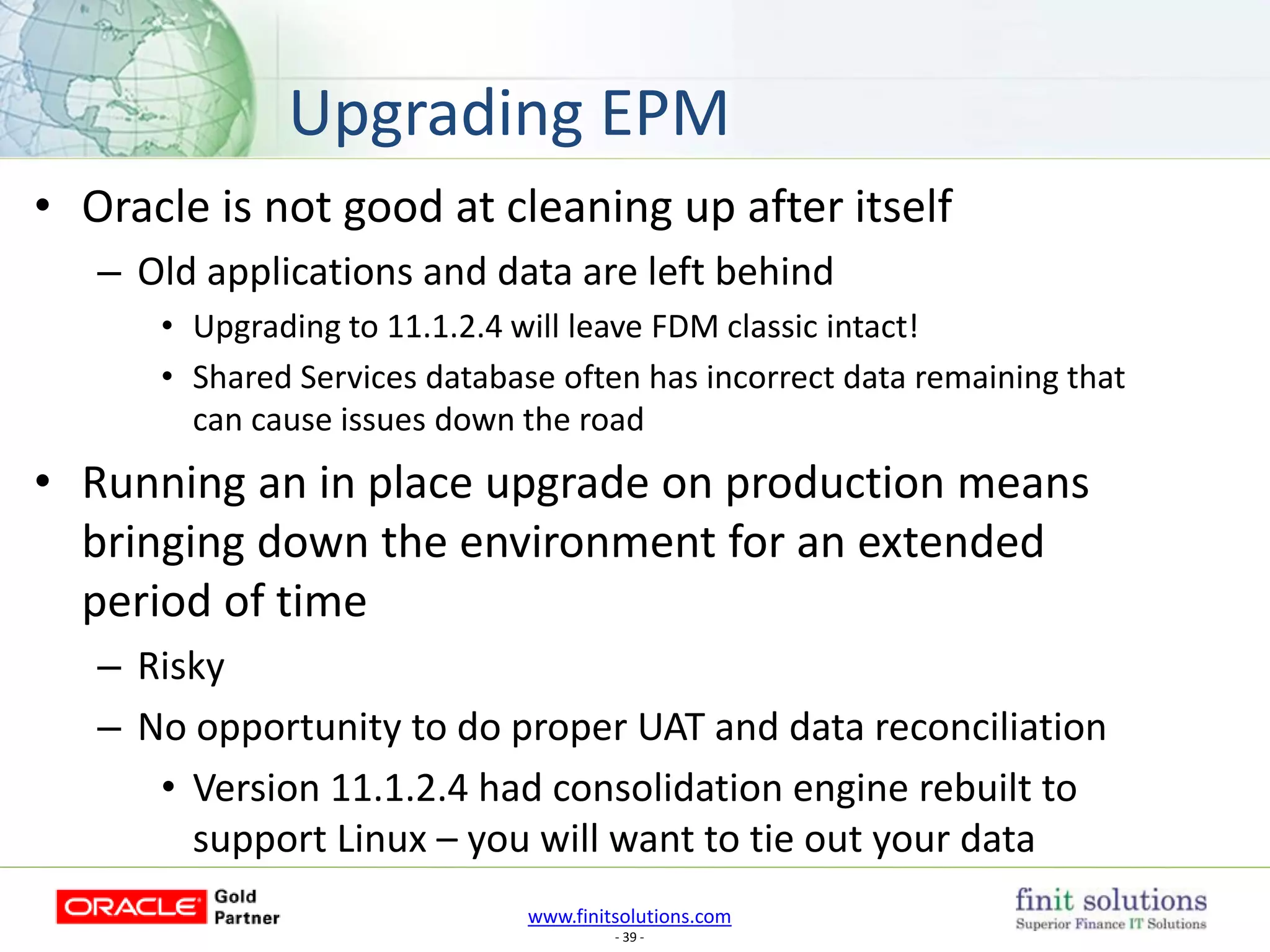
•Oracle is not good at cleaning up after itself
– Old applications and data are left behind
• Upgrading to 11.1.2.4 will leave FDM classic intact!
• Shared Services database often has incorrect data remaining that
can cause issues down the road
• Running an in place upgrade on production means
bringing down the environment for an extended
period of time
– Risky
– No opportunity to do proper UAT and data reconciliation
• Version 11.1.2.4 had consolidation engine rebuilt to
support Linux – you will want to tie out your data
Upgrading EPM
40.
www.finitsolutions.com
- 40 -
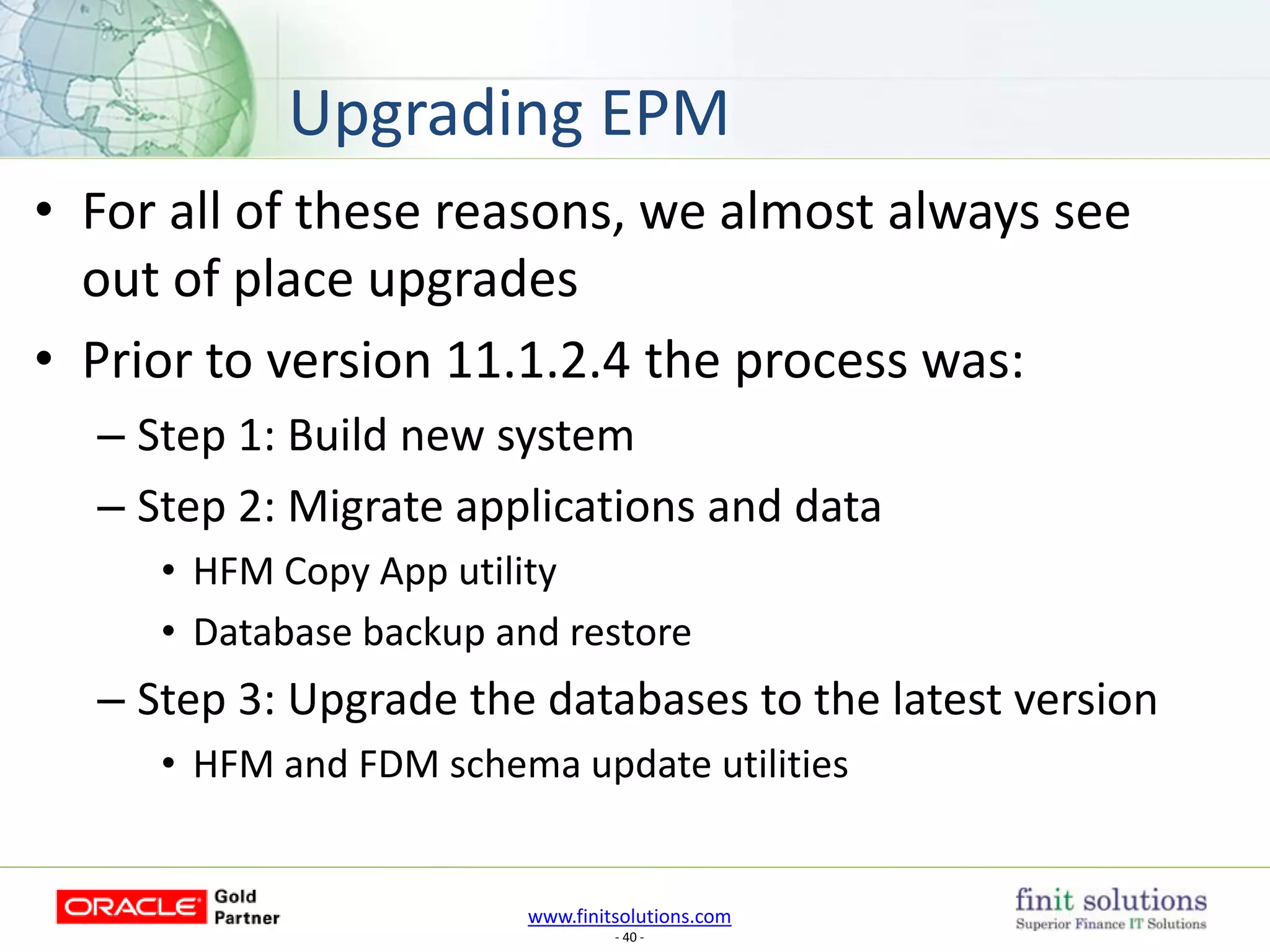
•For all of these reasons, we almost always see
out of place upgrades
• Prior to version 11.1.2.4 the process was:
– Step 1: Build new system
– Step 2: Migrate applications and data
• HFM Copy App utility
• Database backup and restore
– Step 3: Upgrade the databases to the latest version
• HFM and FDM schema update utilities
Upgrading EPM
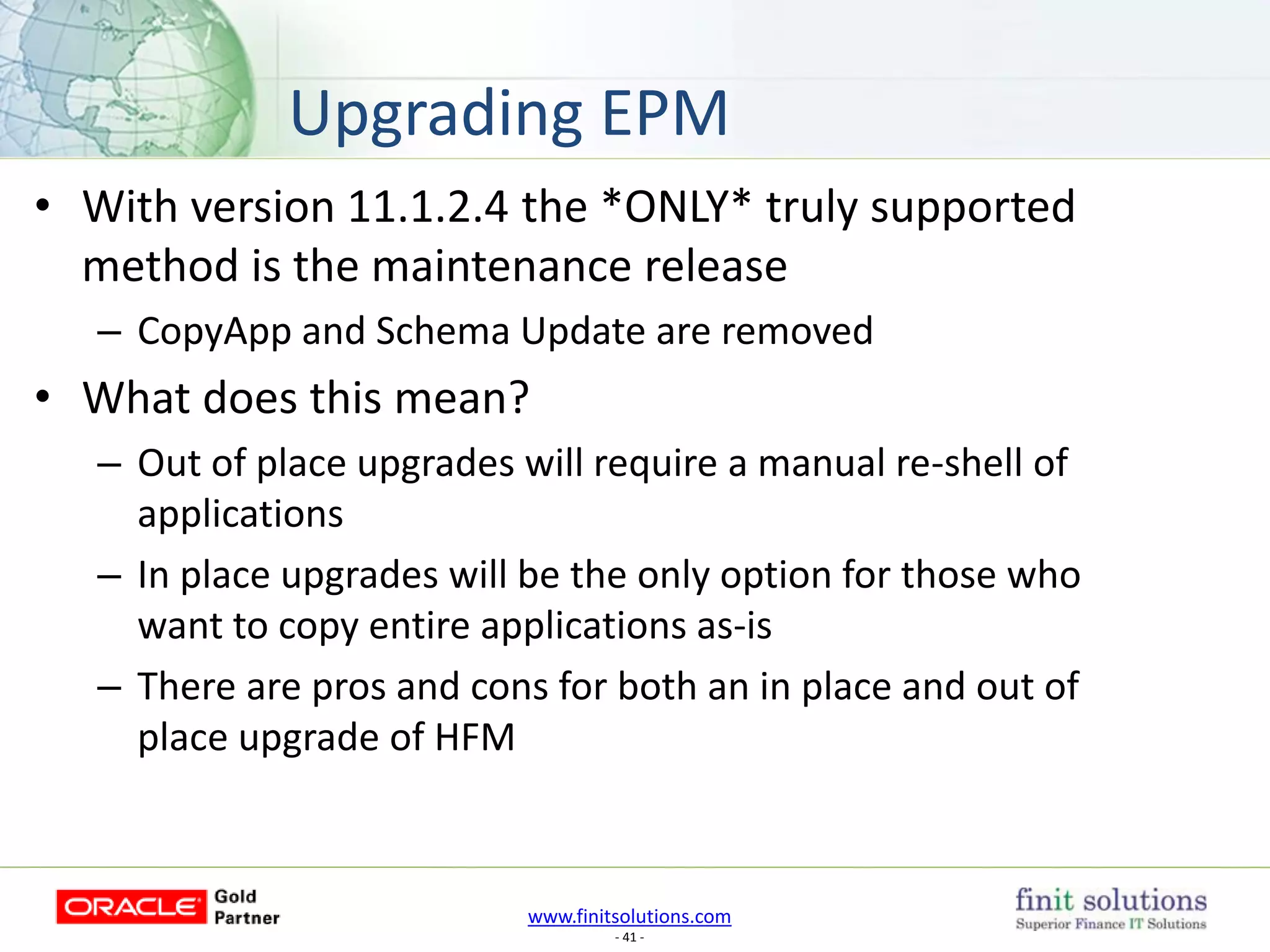
41.
www.finitsolutions.com
- 41 -
•With version 11.1.2.4 the *ONLY* truly supported
method is the maintenance release
– CopyApp and Schema Update are removed
• What does this mean?
– Out of place upgrades will require a manual re-shell of
applications
– In place upgrades will be the only option for those who
want to copy entire applications as-is
– There are pros and cons for both an in place and out of
place upgrade of HFM
Upgrading EPM
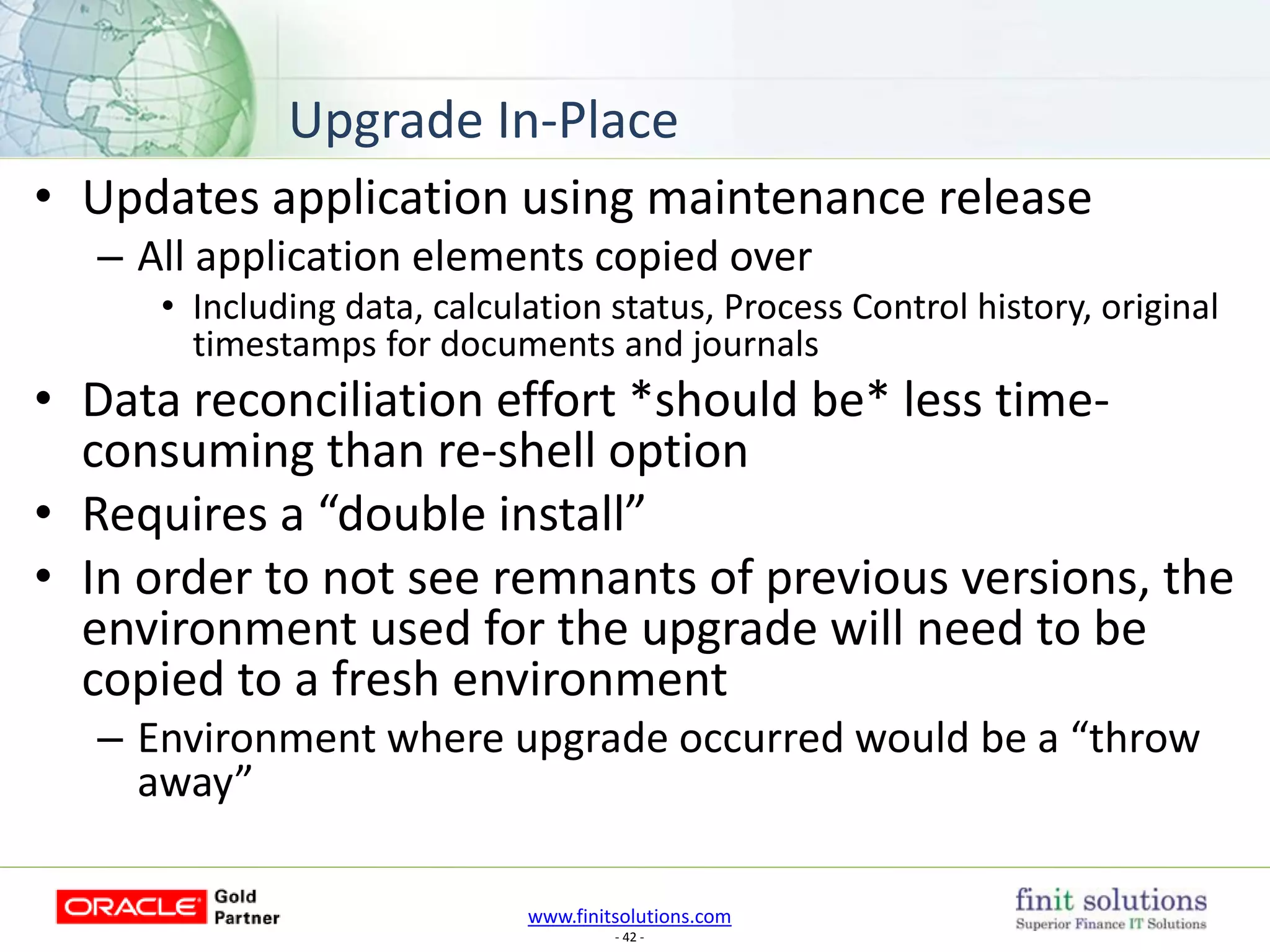
42.
www.finitsolutions.com
- 42 -
•Updates application using maintenance release
– All application elements copied over
• Including data, calculation status, Process Control history, original
timestamps for documents and journals
• Data reconciliation effort *should be* less time-
consuming than re-shell option
• Requires a “double install”
• In order to not see remnants of previous versions, the
environment used for the upgrade will need to be
copied to a fresh environment
– Environment where upgrade occurred would be a “throw
away”
Upgrade In-Place
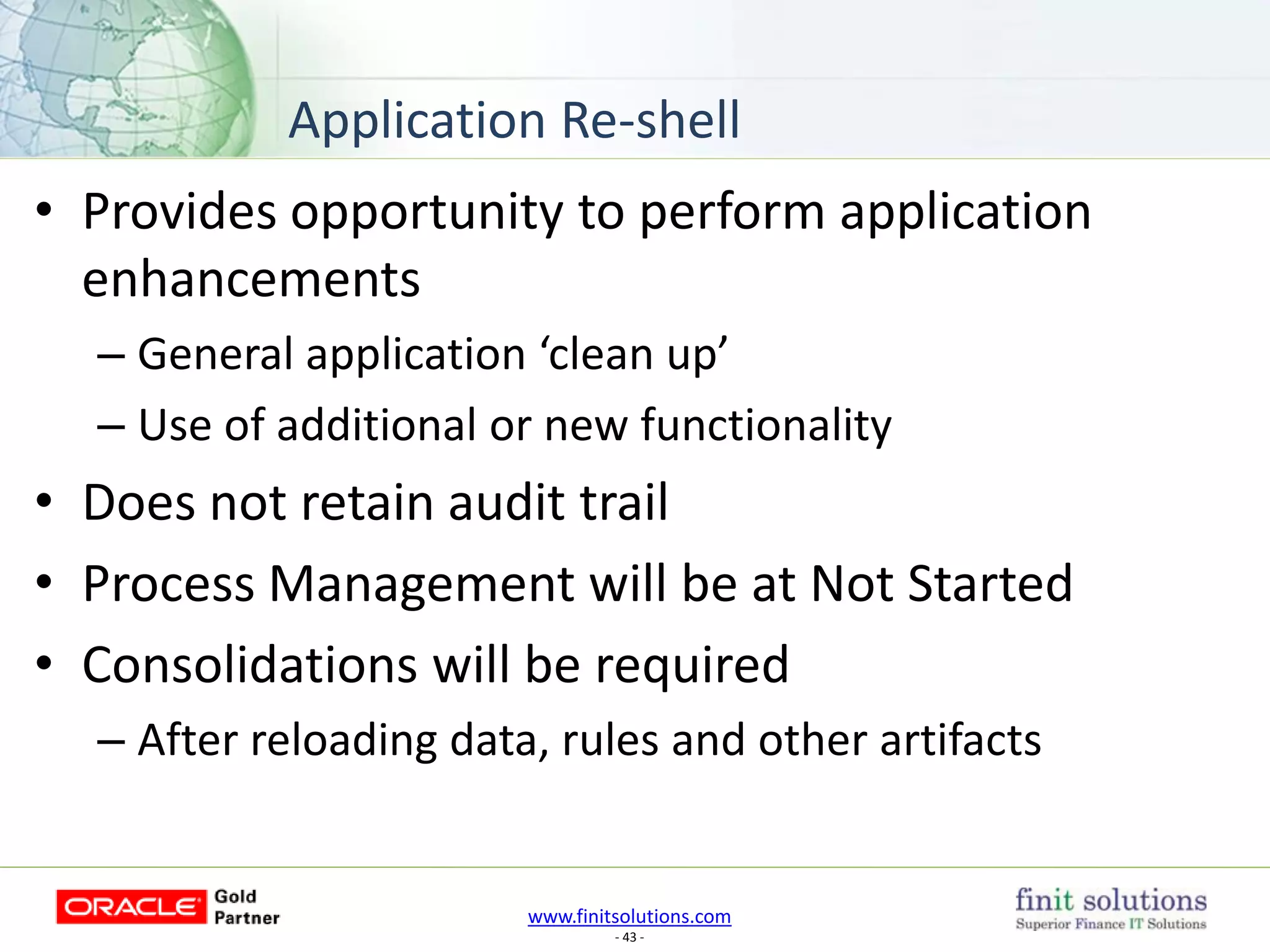
43.
www.finitsolutions.com
- 43 -
•Provides opportunity to perform application
enhancements
– General application ‘clean up’
– Use of additional or new functionality
• Does not retain audit trail
• Process Management will be at Not Started
• Consolidations will be required
– After reloading data, rules and other artifacts
Application Re-shell
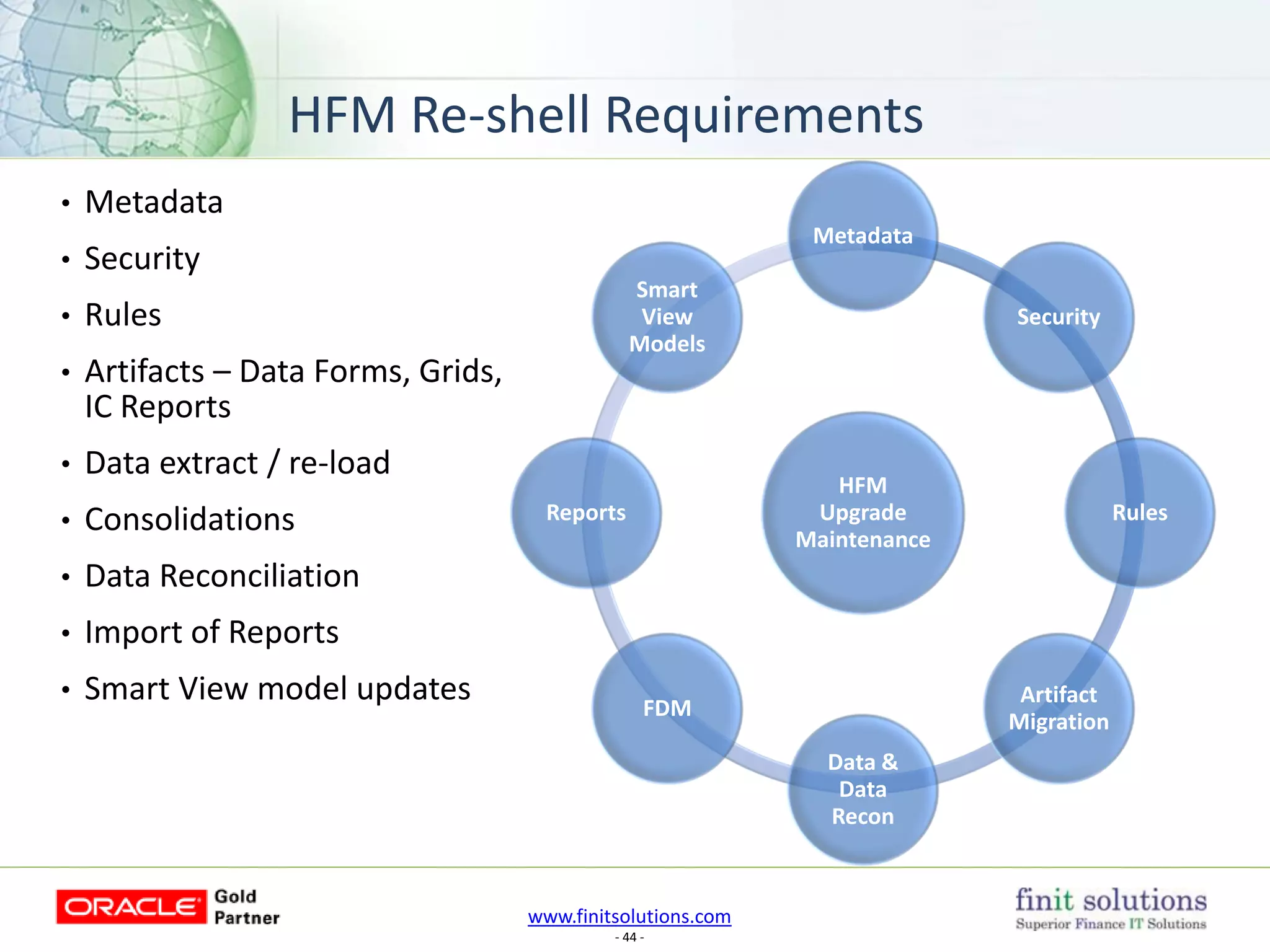
44.
www.finitsolutions.com
- 44 -
HFMRe-shell Requirements
HFM
Upgrade
Maintenance
Metadata
Security
Rules
Artifact
Migration
Data &
Data
Recon
FDM
Reports
Smart
View
Models
• Metadata
• Security
• Rules
• Artifacts – Data Forms, Grids,
IC Reports
• Data extract / re-load
• Consolidations
• Data Reconciliation
• Import of Reports
• Smart View model updates
45.
www.finitsolutions.com
- 45 -
NoteworthyFinit Solutions EPM 11.1.2.4 Webinars
– Introduction to Oracle Hyperion Planning - New Features in
11.1.2.4
– Hyperion Financial Management - Deep Dive into 11.1.2.4
– Introduction to FDMEE - New Features in 11.1.2.4
Getting the Most out of EPM
46.
www.finitsolutions.com
- 46 -
Questions?
Emailus for a
copy of the slides or
link to the recording.
Thank you for attending!
- > Frank Zidar
(fzidar@finitsolutions.com)
- > Dawn Mathews
(dmathews@finitsolutions.com)
- > Insights@finitsolutions.com
- > General Questions
Greg Barrett
(gbarrett@finitsolutions.com)
Joe Mizerk
(jmizerk@finitsolutions.com)


![S04_Microsoft XDR によるセキュアなハイブリッドクラウド環境の実現 [Microsoft Japan Digital Days]](https://cdn.slidesharecdn.com/ss_thumbnails/s04microsoftxdr-211028134250-thumbnail.jpg?width=640&height=640&fit=bounds)


![Vibe Coding vs. Spec-Driven Development [Free Meetup]](https://cdn.slidesharecdn.com/ss_thumbnails/vibecodingvsspecdrivendevelopment-251209105622-43f455e7-thumbnail.jpg?width=640&height=640&fit=bounds)


