Prepared BY: HirenVanara
Introduction
■ Founded on 24th May 1974 at Artexio, Spain
■ Founders: AmancioOrtega & Rosalía Mera
■ Current Owner: Casper Schmedes
■ BrandValue: 23,140 Million $
■ No of Stores Worldwide: More than 1000
■ Parental Company: Inditex Group (World’s Largest Apparel Retailer)
■ CurrentWorldwide Rank: 37
Mission &Vision
■ Vision
“ZARA is committed to satisfying the desires of our customers. As a result we pledge to
continuously innovate our business to improve your experience. We promise to provide
new designs made from quality materials that are affordable”
■ Mission
“Through Zara’s business model, we aim to contribute to the sustainable development
of society and that of the environment with which we interacts.”
Brand Identity
■ World’s largest fashion retailer
■ Fast fashion, creativity, flexibility, quality design and rapid turnaround are all part of its
approach to expand at international Level.
■ Zara stores are usually situated at upscale locations in the world’s largest cities.
■ Its strategy is to get as close as possible to luxury brands but at the same time
maintain its mid-range affordable prices.
Target Market
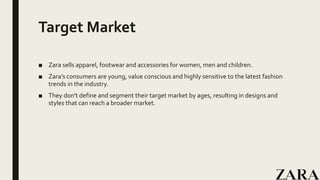
■ Zara sells apparel, footwear and accessories for women, men and children.
■ Zara’s consumers are young, value conscious and highly sensitive to the latest fashion
trends in the industry.
■ They don't define and segment their target market by ages, resulting in designs and
styles that can reach a broader market.
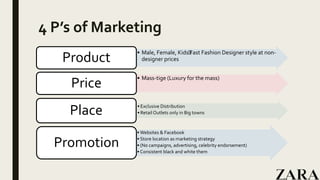
4 P’s of Marketing
• Male, Female, KidsFast Fashion Designer style at non-
designer pricesProduct
• Mass-tige (Luxury for the mass)
Price
• Exclusive Distribution
• Retail Outlets only in Big townsPlace
• Websites & Facebook
• Store location as marketing strategy
• (No campaigns, advertising, celebrity endorsement)
• Consistent black and white them
Promotion
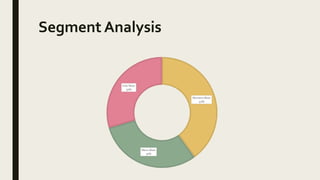
Segment Analysis
Womens Wear
40%
Mens Wear
30%
Kids Wear
30%
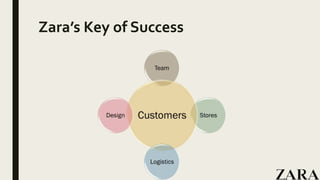
Zara’s Key of Success
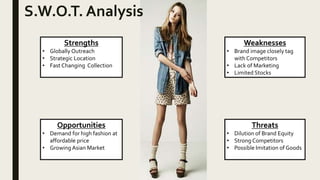
Strengths
• Globally Outreach
• Strategic Location
• Fast Changing Collection
S.W.O.T. Analysis
Opportunities
• Demand for high fashion at
affordable price
• Growing Asian Market
Weaknesses
• Brand image closely tag
with Competitors
• Lack of Marketing
• Limited Stocks
Threats
• Dilution of Brand Equity
• Strong Competitors
• Possible Imitation of Goods
Zara Retailer

Zara Retailer

  • 1.
  • 2.
    Introduction ■ Founded on24th May 1974 at Artexio, Spain ■ Founders: AmancioOrtega & Rosalía Mera ■ Current Owner: Casper Schmedes ■ BrandValue: 23,140 Million $ ■ No of Stores Worldwide: More than 1000 ■ Parental Company: Inditex Group (World’s Largest Apparel Retailer) ■ CurrentWorldwide Rank: 37
  • 3.
    Mission &Vision ■ Vision “ZARAis committed to satisfying the desires of our customers. As a result we pledge to continuously innovate our business to improve your experience. We promise to provide new designs made from quality materials that are affordable” ■ Mission “Through Zara’s business model, we aim to contribute to the sustainable development of society and that of the environment with which we interacts.”
  • 4.
    Brand Identity ■ World’slargest fashion retailer ■ Fast fashion, creativity, flexibility, quality design and rapid turnaround are all part of its approach to expand at international Level. ■ Zara stores are usually situated at upscale locations in the world’s largest cities. ■ Its strategy is to get as close as possible to luxury brands but at the same time maintain its mid-range affordable prices.
  • 5.
    Target Market ■ Zarasells apparel, footwear and accessories for women, men and children. ■ Zara’s consumers are young, value conscious and highly sensitive to the latest fashion trends in the industry. ■ They don't define and segment their target market by ages, resulting in designs and styles that can reach a broader market.
  • 6.
    4 P’s ofMarketing • Male, Female, KidsFast Fashion Designer style at non- designer pricesProduct • Mass-tige (Luxury for the mass) Price • Exclusive Distribution • Retail Outlets only in Big townsPlace • Websites & Facebook • Store location as marketing strategy • (No campaigns, advertising, celebrity endorsement) • Consistent black and white them Promotion
  • 7.
  • 8.
  • 9.
    Strengths • Globally Outreach •Strategic Location • Fast Changing Collection S.W.O.T. Analysis Opportunities • Demand for high fashion at affordable price • Growing Asian Market Weaknesses • Brand image closely tag with Competitors • Lack of Marketing • Limited Stocks Threats • Dilution of Brand Equity • Strong Competitors • Possible Imitation of Goods

Editor's Notes

  • #2 The Zara logotype is a supreme example of a simple yet successful corporate identity. It is based on a custom typeface. The black colour in the Zara logo represents elegance, style and excellence of the brand. The wordmark’s success can be seen by the fact that, despite being one of the fastest growing fashion chains in the world, Zara doesn’t advertise, while largely depending on sale promotions and its visually distinctive corporate identity. The Zara logo has, however, also attracted criticism for being too simple and generic.
  • #3 Amancio Ortega opened the first Zara store in 1975 in downtown Spain. Ortega initially named the store Zorba after the classic film Zorba the Greek, but after learning there was a bar with the same name two blocks away, they rearranged the letters molded for the sign to 'Zara.' It is believed the extra 'a' came from an additional set of letters that had been made for the company