Basic Infrastructures for water
        and sanitation


        María J. Ledesma-Carbayo
Contents

• Introduction
• Methodology levels
• Safe, affordable and sustainable
  water & sanitation services
• Governance practices in water,
  sanitation and management
Introduction I
• Human Right to Water: Confirmed in the General
  Comment No. 15 of the UN Committee on
  Economic, Social and Cultural Rights that:

    ‘the human right to water entitles everyone to
    sufficient, safe, acceptable, physically accessible
    and affordable water for personal and domestic
    uses’.

    ‘the human right to water is indispensable for
    leading a life in human dignity. It is a prerequisite
    for the realization of other human rights’.
Introduction II
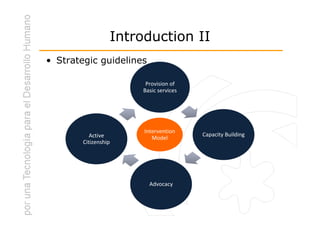
• Strategic guidelines

                        Provision of
                       Basic services


                       Intervention
           Active                       Capacity Building
                          Model
        Citizenship


                         Advocacy
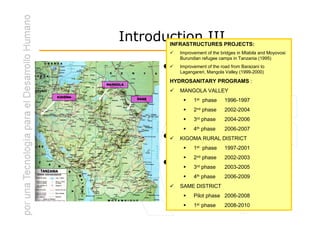
Introduction III
                           INFRASTRUCTURES PROJECTS:
                              Improvement of the bridges in Mtabila and Moyovosi
                              Burundian refugee camps in Tanzania (1995)

                          • Tanzania
                              Improvement of the road from Barazani to
                              Lagangareri, Mangola Valley (1999-2000)
                             – POPULATION: 37.6 millions
                           HYDROSANITARY PROGRAMS :
         MANGOLA
                             – LANGUAGE: Swahili & English
                              MANGOLA VALLEY
KIGOMA
                   SAME
                             – HDI:st162 of 177
                                    1     phase    1996-1997
                             – LIFEndEXPECTANCY: 47.9 años.
                                    2 phase        2002-2004
                             – MORTALITY (<5 años): 14,8%
                                 rd 3 phase        2004-2006
                             – GDP per capita: 674 PPA$.
                                    4th phase      2006-2007
                          • EU +RURAL DISTRICT
                              KIGOMA Spanish

                            Funding 1997-2001
                                     st
                                  1 phase
                                     nd
                                  2 phase     2002-2003
                          • Learning2003-2005 and
                                     rd
                                  3 phase
                                                from
                            with phase 2006-2009
                                  4 others-
                                     th


                            Universities, NGO,
                              SAME DISTRICT

                            local phase 2008-2010
                                        goverment
                                  Pilot phase 2006-2008
                                  1  st
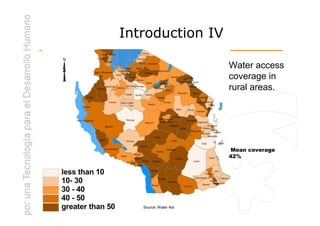
Introduction IV

                       Water access
                       coverage in
                       rural areas.


                       Mean coverage
                       42%


   Source: Water Aid
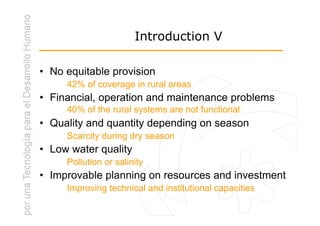
Introduction V

• No equitable provision
     42% of coverage in rural areas
• Financial, operation and maintenance problems
     40% of the rural systems are not functional
• Quality and quantity depending on season
     Scarcity during dry season
• Low water quality
     Pollution or salinity
• Improvable planning on resources and investment
     Improving technical and institutional capacities
Introduction VI
AIM: Water Right Fulfillment

  – equitable provision of water and
   sanitation services in rural areas

  BY improving:
  – the access to W&S
  – hygienic practices
  – the service delivery
  – management at the community and
   district levels
Methodology I

• Two levels of intervention
   – Establishment of safe, affordable and
     sustainable water & sanitation services
   – Improvement of governance practices in
     water and sanitation services and
     management of water resources.
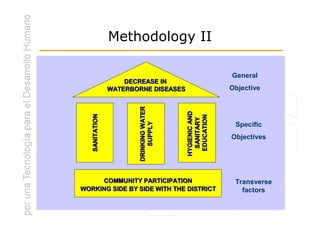
Methodology II

                                                        General
                    DECREASE IN
                WATERBORNE DISEASES                     Objective


                        DRINKING WATER


                                         HYGIENIC AND
   SANITATION


                                          EDUCATION
                                           SANITARY
                            SUPPLY
                                                         Specific
                                                        Objectives


     COMMUNITY PARTICIPATION                             Transverse
WORKING SIDE BY SIDE WITH THE DISTRICT                     factors
Safe, affordable and sustainable water
         & sanitation services I

• Demand responsive.
  – The community identifies the needs
  – The community has to open a bank
    account


                EQUITY!!!
Safe, affordable and sustainable water
        & sanitation services II
• Appropriate technology.
  – possible technical proposals in the
    lowest appropriate level
  – the community chooses the option they
    consider themselves able to maintain
  – Participatory final design with the
    community leaders (source choice,
    number, kind and situation of taps...).
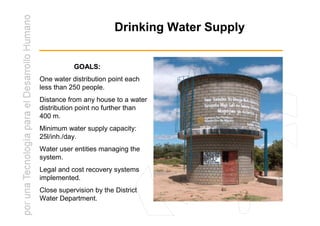
Drinking Water Supply


           GOALS:
One water distribution point each
less than 250 people.
Distance from any house to a water
distribution point no further than
400 m.
Minimum water supply capacity:
25l/inh./day.
Water user entities managing the
system.
Legal and cost recovery systems
implemented.
Close supervision by the District
Water Department.
Drinking Water Supply

                    Intake


Installing pipes


                             Hand water well pump
Drinking water supply


      Tanks
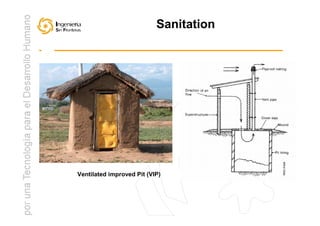
Sanitation


Ventilated improved Pit (VIP)
Safe, affordable and sustainable water
       & sanitation services III
• Social marketing and one to one
  promotion for hygiene and sanitation.
  – PHAST approach- Health Promoters
  – Social marketing techniques
  – Child to Chilid school activities
  – house-by-house campaigns
Hygiene promotion


Social Marketing:
• Demonstrative Pits and Tilt taps
• Sanitation competitions
•Theater, T-Shirts, Wall painting, comics, …
• POSITIVE MESSAGES!!!
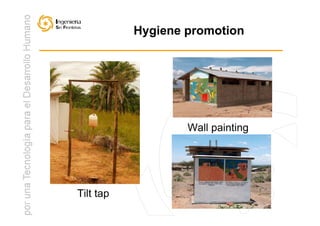
Hygiene promotion


                   Wall painting


Tilt tap
Safe, affordable and sustainable water
        & sanitation services IV
• Participatory Techniques.
  – Community participation and
    management
  – the community is fully involved and
    responsible for planning, design and
    decision-making to maintenance and
    expansion.
Communities involved in all the
          project cycle

                 THE MAIN ACTORS
THEY WILL BE THE OWNERS AND USERS OF THE SYSTEMS
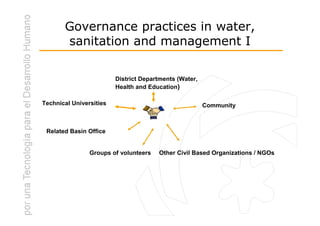
Governance practices in water,
       sanitation and management I

                         District Departments (Water,
                         Health and Education)

Technical Universities                                  Community


 Related Basin Office


                Groups of volunteers   Other Civil Based Organizations / NGOs
Governance practices in water,
    sanitation and management I
• Capacity building.
  – Strengthening the capabilities and the
    relationship between local and district levels.
  – The district health, education and water
    departments are involved in all stages of the
    program and trained on matters like PHAST,
    water and sanitation project designing,
    planning, monitoring and assessment.
  – At village level, the Water Users Entities are
    trained on operation, maintenance and
    management. The Village Health Committee is
    also trained on hygiene promotion.
• Increase of awareness of water
  policy and related rights and
  obligations in the communities
Governance practices in water,
    sanitation and management II
• Information Management System.
  – facilitate decision-making and resources
    allocation at District Level.
  – Geographical Information System (GIS) with
    relevant data has been demonstrated as a
    valuable tool to strengthen District capacities
    in raising other external funds based on
    reliable studies and proposals.
• Water Resources Management
  – Increase access to water resources information
    at District and Basin level to promote effective
    Integrated Water Resources Management.
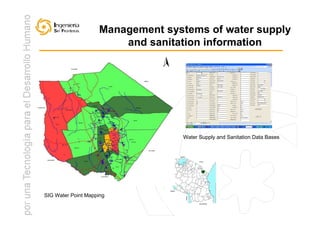
Management systems of water supply
                        and sanitation information


                                  Water Supply and Sanitation Data Bases


SIG Water Point Mapping
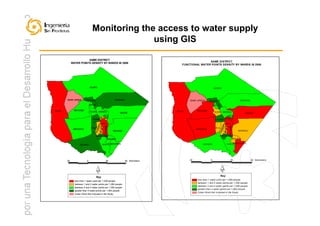
Monitoring the access to water supply
                                             using GIS

                       SAME DISTRICT
                                                                                                         SAME DISTRICT
            WATER POINTS DENSITY BY WARDS IN 2006
                                                                                         FUNCTIONAL WATER POINTS DENSITY BY WARDS IN 2006


                             NJORO                                                                                NJORO


       SAME URBAN       MSHEWA                             KISIWANI                          SAME UR BAN                                       KISIWANI
                                                                                                             MSHEWA
                             MHEZI                                                                                MHEZI

RUVU          MWEMBE                                                                  RUVU        MW EMBE
                             VUDEE MSINDO                                                                         VUDEE MSINDO
                                                               MAORE                                                                               MAORE
                                             VUJE                                                                                VUJE
                                           BOMBO                                                                               BO MBO
                               CHOME                                                                                CHOME
                                            MTII                                                                                 MT II
                                            BO


                                                                                                                                BO
                                                 MYAMBA


                                                                                                                                     MYAMBA
                                      MPINJI


                                                                                                                          MPINJI
                                         AM


                                                                                                                             AM
                              SUJI                                                                                 SU JI
             MAKANYA                                                                              MAKANYA


                                                                                                                          BW
                                     BW


                                                          NDUNGU                                                                              NDUNGU

                                     KIRANGARE                                                                            KIRANG ARE
                                             KIHURIO                                                                               KIHURIO

                  HEDARU                     VUNTA BENDERA                                             HEDARU                    VUNTA BENDERA


       20                0                         20                 40 Kilometers          20               0                          20               40 Kilometers


                                                                                                                           N
                                      N

                                     Key                                                                                   Key
                                                                                                   less than 1 water point per 1,000 people
              less than 1 water point per 1,000 people
                                                                                                   between 1 and 2 water points per 1,000 people
              between 1 and 2 water points per 1,000 people
                                                                                                   between 2 and 4 water points per 1,000 people
              between 2 and 4 water points per 1,000 people
                                                                                                   greater than 4 water points per 1,000 people
              greater than 4 water points per 1,000 people
                                                                                                   Urban W ard Not Included in the Study
              Urban Ward Not Included in the Study
Open Challenges!!

• Low cost appropriate technology vs
  maintenance management systems
• Social Research to promote
  – Hygienic habits
  – Enhancing the feeling of ownership
  – Active Citizenship
• Empowerment and Involvement of local
  Universities
• Innovative technologies to monitor the
  coverage of access and health indicators
Ahsante sana!

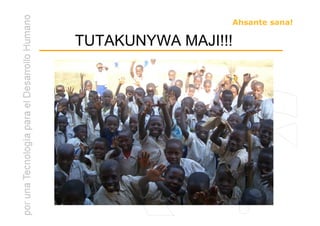
TUTAKUNYWA MAJI!!!

Basic Infrastructures for water and sanitation

  • 1.
    Basic Infrastructures forwater and sanitation María J. Ledesma-Carbayo
  • 2.
    Contents • Introduction • Methodologylevels • Safe, affordable and sustainable water & sanitation services • Governance practices in water, sanitation and management
  • 3.
    Introduction I • HumanRight to Water: Confirmed in the General Comment No. 15 of the UN Committee on Economic, Social and Cultural Rights that: ‘the human right to water entitles everyone to sufficient, safe, acceptable, physically accessible and affordable water for personal and domestic uses’. ‘the human right to water is indispensable for leading a life in human dignity. It is a prerequisite for the realization of other human rights’.
  • 4.
    Introduction II • Strategicguidelines Provision of Basic services Intervention Active Capacity Building Model Citizenship Advocacy
  • 5.
    Introduction III INFRASTRUCTURES PROJECTS: Improvement of the bridges in Mtabila and Moyovosi Burundian refugee camps in Tanzania (1995) • Tanzania Improvement of the road from Barazani to Lagangareri, Mangola Valley (1999-2000) – POPULATION: 37.6 millions HYDROSANITARY PROGRAMS : MANGOLA – LANGUAGE: Swahili & English MANGOLA VALLEY KIGOMA SAME – HDI:st162 of 177 1 phase 1996-1997 – LIFEndEXPECTANCY: 47.9 años. 2 phase 2002-2004 – MORTALITY (<5 años): 14,8% rd 3 phase 2004-2006 – GDP per capita: 674 PPA$. 4th phase 2006-2007 • EU +RURAL DISTRICT KIGOMA Spanish Funding 1997-2001 st 1 phase nd 2 phase 2002-2003 • Learning2003-2005 and rd 3 phase from with phase 2006-2009 4 others- th Universities, NGO, SAME DISTRICT local phase 2008-2010 goverment Pilot phase 2006-2008 1 st
  • 6.
    Introduction IV Water access coverage in rural areas. Mean coverage 42% Source: Water Aid
  • 7.
    Introduction V • Noequitable provision 42% of coverage in rural areas • Financial, operation and maintenance problems 40% of the rural systems are not functional • Quality and quantity depending on season Scarcity during dry season • Low water quality Pollution or salinity • Improvable planning on resources and investment Improving technical and institutional capacities
  • 8.
    Introduction VI AIM: WaterRight Fulfillment – equitable provision of water and sanitation services in rural areas BY improving: – the access to W&S – hygienic practices – the service delivery – management at the community and district levels
  • 9.
    Methodology I • Twolevels of intervention – Establishment of safe, affordable and sustainable water & sanitation services – Improvement of governance practices in water and sanitation services and management of water resources.
  • 10.
    Methodology II General DECREASE IN WATERBORNE DISEASES Objective DRINKING WATER HYGIENIC AND SANITATION EDUCATION SANITARY SUPPLY Specific Objectives COMMUNITY PARTICIPATION Transverse WORKING SIDE BY SIDE WITH THE DISTRICT factors
  • 11.
    Safe, affordable andsustainable water & sanitation services I • Demand responsive. – The community identifies the needs – The community has to open a bank account EQUITY!!!
  • 12.
    Safe, affordable andsustainable water & sanitation services II • Appropriate technology. – possible technical proposals in the lowest appropriate level – the community chooses the option they consider themselves able to maintain – Participatory final design with the community leaders (source choice, number, kind and situation of taps...).
  • 13.
    Drinking Water Supply GOALS: One water distribution point each less than 250 people. Distance from any house to a water distribution point no further than 400 m. Minimum water supply capacity: 25l/inh./day. Water user entities managing the system. Legal and cost recovery systems implemented. Close supervision by the District Water Department.
  • 14.
    Drinking Water Supply Intake Installing pipes Hand water well pump
  • 15.
  • 16.
  • 17.
    Safe, affordable andsustainable water & sanitation services III • Social marketing and one to one promotion for hygiene and sanitation. – PHAST approach- Health Promoters – Social marketing techniques – Child to Chilid school activities – house-by-house campaigns
  • 18.
    Hygiene promotion Social Marketing: •Demonstrative Pits and Tilt taps • Sanitation competitions •Theater, T-Shirts, Wall painting, comics, … • POSITIVE MESSAGES!!!
  • 19.
    Hygiene promotion Wall painting Tilt tap
  • 20.
    Safe, affordable andsustainable water & sanitation services IV • Participatory Techniques. – Community participation and management – the community is fully involved and responsible for planning, design and decision-making to maintenance and expansion.
  • 21.
    Communities involved inall the project cycle THE MAIN ACTORS THEY WILL BE THE OWNERS AND USERS OF THE SYSTEMS
  • 22.
    Governance practices inwater, sanitation and management I District Departments (Water, Health and Education) Technical Universities Community Related Basin Office Groups of volunteers Other Civil Based Organizations / NGOs
  • 23.
    Governance practices inwater, sanitation and management I • Capacity building. – Strengthening the capabilities and the relationship between local and district levels. – The district health, education and water departments are involved in all stages of the program and trained on matters like PHAST, water and sanitation project designing, planning, monitoring and assessment. – At village level, the Water Users Entities are trained on operation, maintenance and management. The Village Health Committee is also trained on hygiene promotion. • Increase of awareness of water policy and related rights and obligations in the communities
  • 24.
    Governance practices inwater, sanitation and management II • Information Management System. – facilitate decision-making and resources allocation at District Level. – Geographical Information System (GIS) with relevant data has been demonstrated as a valuable tool to strengthen District capacities in raising other external funds based on reliable studies and proposals. • Water Resources Management – Increase access to water resources information at District and Basin level to promote effective Integrated Water Resources Management.
  • 25.
    Management systems ofwater supply and sanitation information Water Supply and Sanitation Data Bases SIG Water Point Mapping
  • 26.
    Monitoring the accessto water supply using GIS SAME DISTRICT SAME DISTRICT WATER POINTS DENSITY BY WARDS IN 2006 FUNCTIONAL WATER POINTS DENSITY BY WARDS IN 2006 NJORO NJORO SAME URBAN MSHEWA KISIWANI SAME UR BAN KISIWANI MSHEWA MHEZI MHEZI RUVU MWEMBE RUVU MW EMBE VUDEE MSINDO VUDEE MSINDO MAORE MAORE VUJE VUJE BOMBO BO MBO CHOME CHOME MTII MT II BO BO MYAMBA MYAMBA MPINJI MPINJI AM AM SUJI SU JI MAKANYA MAKANYA BW BW NDUNGU NDUNGU KIRANGARE KIRANG ARE KIHURIO KIHURIO HEDARU VUNTA BENDERA HEDARU VUNTA BENDERA 20 0 20 40 Kilometers 20 0 20 40 Kilometers N N Key Key less than 1 water point per 1,000 people less than 1 water point per 1,000 people between 1 and 2 water points per 1,000 people between 1 and 2 water points per 1,000 people between 2 and 4 water points per 1,000 people between 2 and 4 water points per 1,000 people greater than 4 water points per 1,000 people greater than 4 water points per 1,000 people Urban W ard Not Included in the Study Urban Ward Not Included in the Study
  • 27.
    Open Challenges!! • Lowcost appropriate technology vs maintenance management systems • Social Research to promote – Hygienic habits – Enhancing the feeling of ownership – Active Citizenship • Empowerment and Involvement of local Universities • Innovative technologies to monitor the coverage of access and health indicators
  • 28.