Teenagers & Stereotypes
A case study
Richard Dyer - 1979
 Many of the debates and critical approaches to
representation focus upon stereotypes, which, according to
Dyer (1979), involve a number of processes:
 The complexity and variety of a group is reduced to few
characteristics
 An exaggerated version of these characteristics is applied to
everyone in the group as if they are an essential element of all
members of the social group
 These characteristics are represented in the media through
media language
Stereotyping – theoretical perspective
 Stereotyping can be seen to exaggerate difference and in
doing so may increase antagonisms between
groups .
 A problem with the media’s use of stereotypes is its
selectivity , as it conveys values and assumptions that may
help construct the audience’s perception of the world and
consequently their behaviour.
 It is important to note that the media does not invent
stereotypes, but by repeatedly using them, media can be
accused of reinforcing certain values and assumptions.
Stereotyping – theoretical perspective
 It can be argued that it is not the media’s use of stereotypes
that is problematic but the audience’s assumption
that this representation can be applied to all
members of a particular group .
Stereotyping – theoretical perspective
 Consider how the stereotypes are constructed with
reference to…
 clothing
 body language or mannerisms
 décor of habitat
 location
 accent or language
 music
 Relationships
 lifestyle.
Stereotyping – theoretical perspective
 Task 2 : Analyse the following extracts in terms of how the
stereotypes are constructed. Remember to detail your
response.
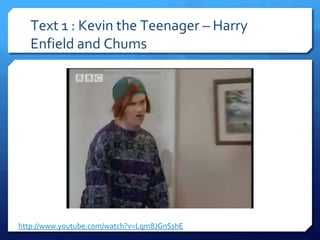
 Text 1 : Kevin theTeenager – Harry Enfield and Chums
 Text 2:Vicky Pollard – Little Britain
 Text 3 : Lauren –The CatherineTate Show
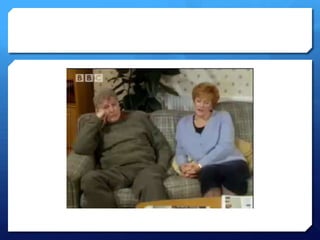
Text 1 : Kevin the Teenager – Harry
Enfield and Chums
http://www.youtube.com/watch?v=Lqm8JGnSshE
Text 2:Vicky Pollard – Little Britain
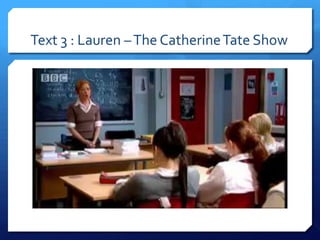
Text 3 : Lauren –The CatherineTate Show

Youth Representations & Stereotypes

  • 1.
  • 2.
    Richard Dyer -1979  Many of the debates and critical approaches to representation focus upon stereotypes, which, according to Dyer (1979), involve a number of processes:  The complexity and variety of a group is reduced to few characteristics  An exaggerated version of these characteristics is applied to everyone in the group as if they are an essential element of all members of the social group  These characteristics are represented in the media through media language
  • 3.
    Stereotyping – theoreticalperspective  Stereotyping can be seen to exaggerate difference and in doing so may increase antagonisms between groups .  A problem with the media’s use of stereotypes is its selectivity , as it conveys values and assumptions that may help construct the audience’s perception of the world and consequently their behaviour.  It is important to note that the media does not invent stereotypes, but by repeatedly using them, media can be accused of reinforcing certain values and assumptions.
  • 4.
    Stereotyping – theoreticalperspective  It can be argued that it is not the media’s use of stereotypes that is problematic but the audience’s assumption that this representation can be applied to all members of a particular group .
  • 5.
    Stereotyping – theoreticalperspective  Consider how the stereotypes are constructed with reference to…  clothing  body language or mannerisms  décor of habitat  location  accent or language  music  Relationships  lifestyle.
  • 6.
    Stereotyping – theoreticalperspective  Task 2 : Analyse the following extracts in terms of how the stereotypes are constructed. Remember to detail your response.  Text 1 : Kevin theTeenager – Harry Enfield and Chums  Text 2:Vicky Pollard – Little Britain  Text 3 : Lauren –The CatherineTate Show
  • 7.
    Text 1 :Kevin the Teenager – Harry Enfield and Chums http://www.youtube.com/watch?v=Lqm8JGnSshE
  • 9.
    Text 2:Vicky Pollard– Little Britain
  • 10.
    Text 3 :Lauren –The CatherineTate Show