+
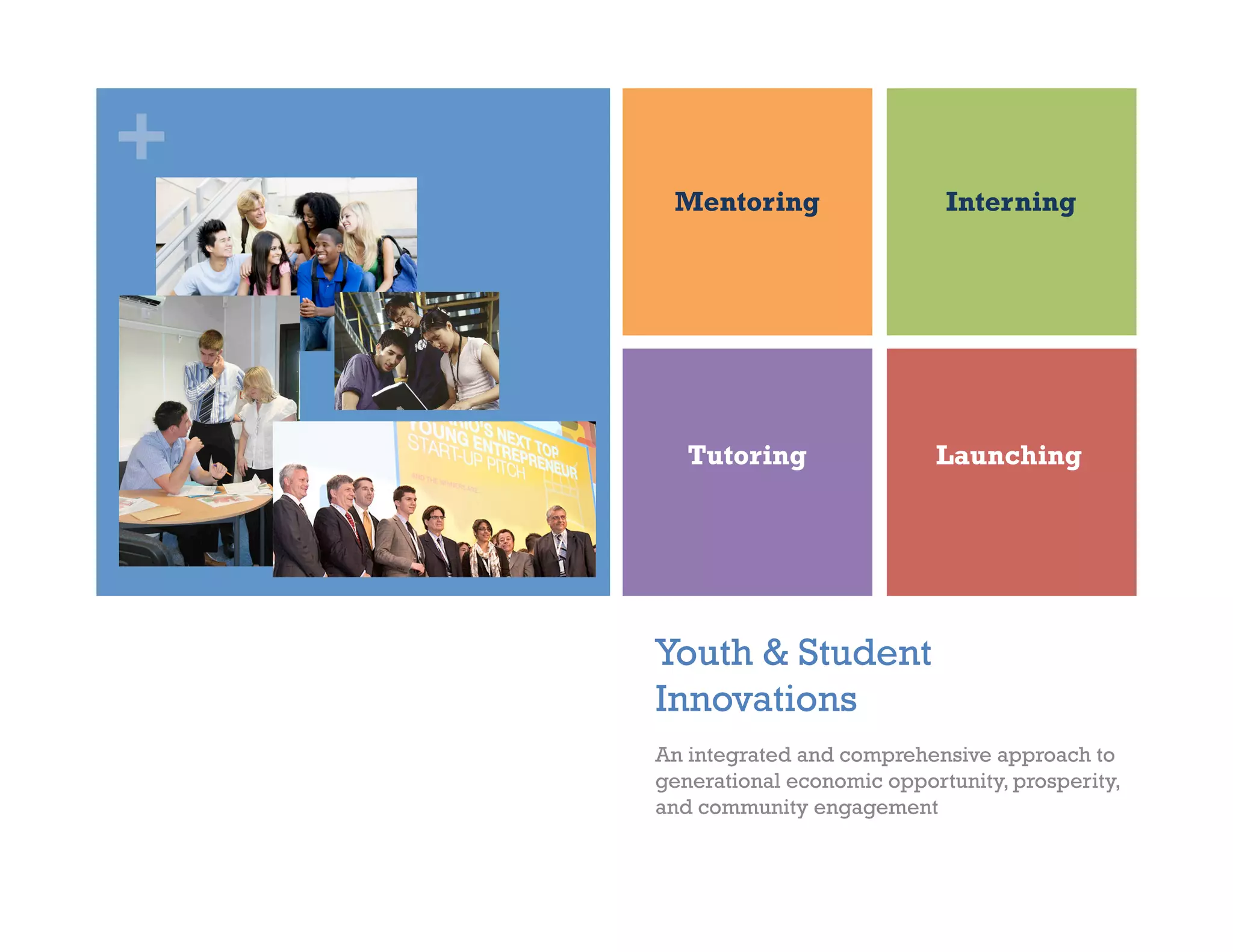
Youth & Student
Innovations
An integrated and comprehensive approach to
generational economic opportunity, prosperity,
and community engagement
Mentoring Interning
LaunchingTutoring
+
Overview
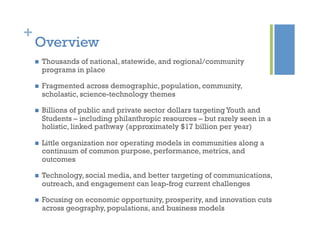
  Thousands of national, statewide, and regional/community
programs in place
  Fragmented across demographic, population, community,
scholastic, science-technology themes
  Billions of public and private sector dollars targetingYouth and
Students – including philanthropic resources – but rarely seen in a
holistic, linked pathway (approximately $17 billion per year)
  Little organization nor operating models in communities along a
continuum of common purpose, performance, metrics, and
outcomes
  Technology, social media, and better targeting of communications,
outreach, and engagement can leap-frog current challenges
  Focusing on economic opportunity, prosperity, and innovation cuts
across geography, populations, and business models
+
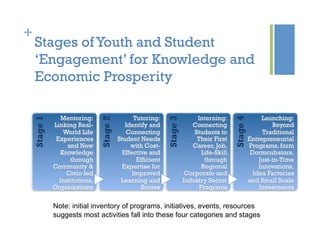
Stages ofYouth and Student
‘Engagement’ for Knowledge and
Economic Prosperity
Stage1
Mentoring:
Linking Real-
World Life
Experiences
and New
Knowledge
through
Community &
Civic-led
Institutions,
Organizations
Stage2
Tutoring:
Identify and
Connecting
Student Needs
with Cost-
Effective and
Efficient
Expertise for
Improved
Learning and
Scores
Stage3
Interning:
Connecting
Students to
Their First
Career, Job,
Life-Skill
through
Regional
Corporate and
Industry Sector
Programs
Stage4
Launching:
Beyond
Traditional
Entrepreneurial
Programs, form
Dormcubators,
Just-in-Time
Innovations,
Idea Factories
and Small Scale
Investments
Note: initial inventory of programs, initiatives, events, resources
suggests most activities fall into these four categories and stages
+
Case for Integration
  By creating a continuum of services, information, resources,
and engagement, youth and students can access the critical
knowledge needed to complete course work as well as seek
immediate employment and business development
  As an individual advances along the continuum, the service
model makes the progression easier and affordable
  Partnerships seek one-stop, packaged, and measurable results-
oriented solutions; such partnerships include corporations,
foundations, public sector officials, and economic
communities/regions
  Technological platforms exist and are emerging that strengthen
the integration models for a continuum of services and
business activities
  Monetizing the continuum model is evident and tested already
+
Goals: Immediate and Long-Term
  Create technology platforms that minimize barriers for
integration while advancing revenue generation
  Create a network of communities/regions, partnerships, and
campuses that can establish ‘brand/market-share’ of no less
than 30% within one year
  Create a delivery system that attracts the best-in-class
content, leadership, resource partners, and obviously youth
and students
  Create additional methods for revenue generation including
reinvestment and charitable giving for purchase of ‘time’
packages, content roll-ups, and content sharing
  Create long-term value for repeat customer loyalty through
unique campaigns, incentives, and national/regional contests
+
Unique ‘Delivery’ towards Goals
  Leverage Generation Internet Networks (GIN)/Tutor Matching –
and similar existing and evolving technology platforms on
Facebook, other Social Media, Phones,Tools
  Leverage GINS/Collegia/Other Networks across campuses,
communities, and corporate/philanthropic institutions
  Leverage Popular Media and Related Social Media interests in
Youth and Student Progress/Performance/Prosperity – a
grassroots scenario in urban AND rural America
  Leverage Expertise through Thought-Leadership Forums,
Briefings, and Reports – leading to recognition AND new
content models
  Leverage Funding Sources as Drivers of Idea/Pilot-Development
– federal, state, and regional grants and contracts in need of
tested solutions
+Vehicle: “Youth and Student
Collaboratory”
  National “platform” that brings together Mentoring, Interning,
Tutoring, and Launching as a one-stop operating model
  Serves as a potential 501c3 for addressing side-by-side relationship
building, thought-leadership, and engagement support for acquisition
of other related services, products, and programs – as well as sponsors
for youth and students that cannot afford such on-going expenditures
  Hosts national and regional forums and roundtables on the future of
youth and student learners, innovators, technology-users, economic
‘engines’ in communities, institutions – creates a National Scorecard
  Identifies trends, forecasts, and ultimately demand for new ideas,
products, services, and leverage of the Youth and Student enterprise
capabilities and capacities; provides research, survey, and other forms
of data, information, insight to issues and opportunities in the youth
and student arena.

Youth & Student Initiative

  • 1.
    + Youth & Student Innovations Anintegrated and comprehensive approach to generational economic opportunity, prosperity, and community engagement Mentoring Interning LaunchingTutoring
  • 2.
    + Overview   Thousands ofnational, statewide, and regional/community programs in place   Fragmented across demographic, population, community, scholastic, science-technology themes   Billions of public and private sector dollars targetingYouth and Students – including philanthropic resources – but rarely seen in a holistic, linked pathway (approximately $17 billion per year)   Little organization nor operating models in communities along a continuum of common purpose, performance, metrics, and outcomes   Technology, social media, and better targeting of communications, outreach, and engagement can leap-frog current challenges   Focusing on economic opportunity, prosperity, and innovation cuts across geography, populations, and business models
  • 3.
    + Stages ofYouth andStudent ‘Engagement’ for Knowledge and Economic Prosperity Stage1 Mentoring: Linking Real- World Life Experiences and New Knowledge through Community & Civic-led Institutions, Organizations Stage2 Tutoring: Identify and Connecting Student Needs with Cost- Effective and Efficient Expertise for Improved Learning and Scores Stage3 Interning: Connecting Students to Their First Career, Job, Life-Skill through Regional Corporate and Industry Sector Programs Stage4 Launching: Beyond Traditional Entrepreneurial Programs, form Dormcubators, Just-in-Time Innovations, Idea Factories and Small Scale Investments Note: initial inventory of programs, initiatives, events, resources suggests most activities fall into these four categories and stages
  • 4.
    + Case for Integration  By creating a continuum of services, information, resources, and engagement, youth and students can access the critical knowledge needed to complete course work as well as seek immediate employment and business development   As an individual advances along the continuum, the service model makes the progression easier and affordable   Partnerships seek one-stop, packaged, and measurable results- oriented solutions; such partnerships include corporations, foundations, public sector officials, and economic communities/regions   Technological platforms exist and are emerging that strengthen the integration models for a continuum of services and business activities   Monetizing the continuum model is evident and tested already
  • 5.
    + Goals: Immediate andLong-Term   Create technology platforms that minimize barriers for integration while advancing revenue generation   Create a network of communities/regions, partnerships, and campuses that can establish ‘brand/market-share’ of no less than 30% within one year   Create a delivery system that attracts the best-in-class content, leadership, resource partners, and obviously youth and students   Create additional methods for revenue generation including reinvestment and charitable giving for purchase of ‘time’ packages, content roll-ups, and content sharing   Create long-term value for repeat customer loyalty through unique campaigns, incentives, and national/regional contests
  • 6.
    + Unique ‘Delivery’ towardsGoals   Leverage Generation Internet Networks (GIN)/Tutor Matching – and similar existing and evolving technology platforms on Facebook, other Social Media, Phones,Tools   Leverage GINS/Collegia/Other Networks across campuses, communities, and corporate/philanthropic institutions   Leverage Popular Media and Related Social Media interests in Youth and Student Progress/Performance/Prosperity – a grassroots scenario in urban AND rural America   Leverage Expertise through Thought-Leadership Forums, Briefings, and Reports – leading to recognition AND new content models   Leverage Funding Sources as Drivers of Idea/Pilot-Development – federal, state, and regional grants and contracts in need of tested solutions
  • 7.
    +Vehicle: “Youth andStudent Collaboratory”   National “platform” that brings together Mentoring, Interning, Tutoring, and Launching as a one-stop operating model   Serves as a potential 501c3 for addressing side-by-side relationship building, thought-leadership, and engagement support for acquisition of other related services, products, and programs – as well as sponsors for youth and students that cannot afford such on-going expenditures   Hosts national and regional forums and roundtables on the future of youth and student learners, innovators, technology-users, economic ‘engines’ in communities, institutions – creates a National Scorecard   Identifies trends, forecasts, and ultimately demand for new ideas, products, services, and leverage of the Youth and Student enterprise capabilities and capacities; provides research, survey, and other forms of data, information, insight to issues and opportunities in the youth and student arena.