Introduction

The new marketing paradigm

Why you should optimise your online presence

How it should tie into your business goals

Fundamentals of Search Engine Optimisation (SEO)

Introduction to social media marketing

Workshop exercises – work on your business
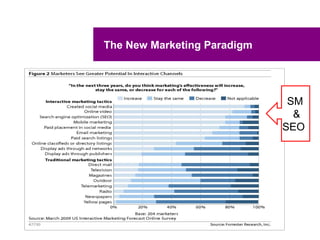
The New Marketing Paradigm


                              SM
                               &
                             SEO
New Marketing: Tools to consider

Social Networking and Social Media

Blogging

Local and Universal Search

Video

Adwords
Essential Building Blocks


Google Analytics

Google Places

Content Management Systems

Google Webmaster tools
Search Engine Optimisation
Why Perform Search Engine Optimisation
                  (SEO)?


The online retail space is set to grow with 69 per cent
of respondents planning to invest in improved site
content and 66 per cent will spend more time on
online marketing. Some 70 per cent cited SEO as
being the most effective source to acquire customers.
From Forrester Report: “Online retailing in Australia 2010: Marketing,
merchandising and customer service”
Why Perform Search Engine Optimisation
             (SEO)?

Gives higher long term ROI compared to any other
online marketing vehicles (Source: Marketing Sherpa
Report 2010).

Higher natural rankings builds trust among searchers.

80% of websites are found through search engines
(Source: Forrester Research).

Research suggests that if your not in the top 5 – 15 for
your search terms your website is almost non- existent
on the internet.
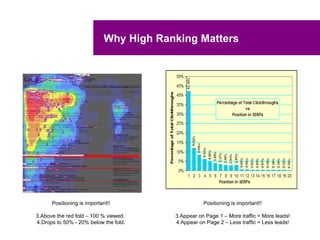
Why High Ranking Matters


      Positioning is important!!                    Positioning is important!!

3.Above the red fold – 100 % viewed.     3.Appear on Page 1 – More traffic = More leads!
4.Drops to 50% - 20% below the fold.     4.Appear on Page 2 – Less traffic = Less leads!
Your Competition Keeps Getting Bigger


Search Drives Sales, Both Online and Offline:
  For every dollar spent online, the average search
  user spends $2.56 offline
  'Search influences 20-30% of purchases made at
  retail locations’
                                       eMarketer 2007
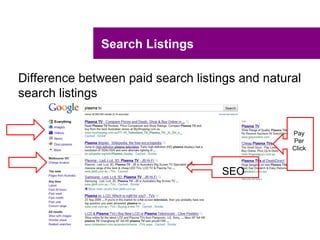
Search Listings

Difference between paid search listings and natural
search listings


                                                 Pay
                                                 Per
                                                 Click


                                    SEO
What is SEO?


The process of ensuring that your website is
highly visible and relevant to search engines:
   On-Page SEO
   Off-Page SEO
What is a Search Engine and how does it work?
   Robots, crawlers, spiders or ‘bots’
   The Index
   The Algorithm
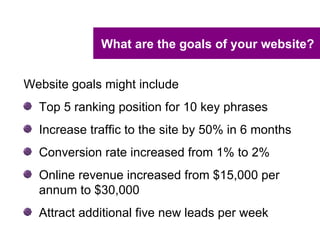
What are the goals of your website?


Website goals might include
  Top 5 ranking position for 10 key phrases
  Increase traffic to the site by 50% in 6 months
  Conversion rate increased from 1% to 2%
  Online revenue increased from $15,000 per
  annum to $30,000
  Attract additional five new leads per week
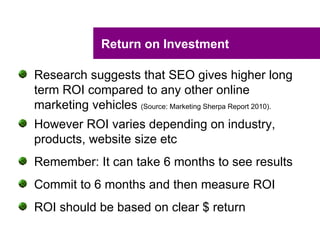
Return on Investment

Research suggests that SEO gives higher long
term ROI compared to any other online
marketing vehicles (Source: Marketing Sherpa Report 2010).
However ROI varies depending on industry,
products, website size etc
Remember: It can take 6 months to see results
Commit to 6 months and then measure ROI
ROI should be based on clear $ return
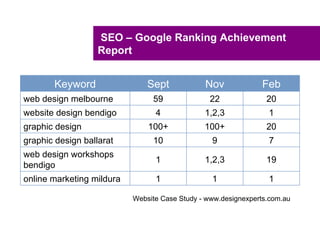
SEO – Google Ranking Achievement
                   Report


       Keyword                 Sept            Nov             Feb
web design melbourne            59               22              20
website design bendigo           4             1,2,3             1
graphic design                 100+            100+              20
graphic design ballarat         10               9               7
web design workshops
                                 1             1,2,3             19
bendigo
online marketing mildura         1               1               1

                           Website Case Study - www.designexperts.com.au
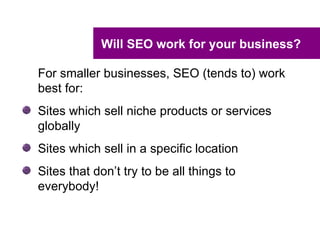
Will SEO work for your business?

For smaller businesses, SEO (tends to) work
best for:
Sites which sell niche products or services
globally
Sites which sell in a specific location
Sites that don’t try to be all things to
everybody!
Exercise


Are you on Google? Do a search for your
business’ brand name at Google, Yahoo and
ninemsn. Where does your website rank?
Do a search for your key product or service
(not using brand names)
How do search engines reference a
         website?


Direct submission
Search engines can use your XML site map
(if you have one)
Following links from other web pages
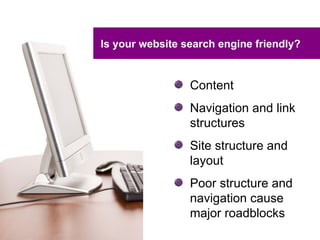
Is your website search engine friendly?


                 Content
                 Navigation and link
                 structures
                 Site structure and
                 layout
                 Poor structure and
                 navigation cause
                 major roadblocks
Which pages should you optimise?


Analyse your website structure and content
Prioritise your home page
Optimise your top level category pages
If you sell products at your site optimise your
product pages
Which pages should you NOT optimise?


Privacy page
Terms and conditions/legal information
Disclaimers etc.
Add as PDF’s
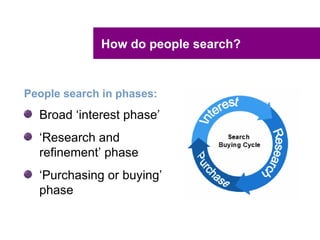
How do people search?


People search in phases:
  Broad ‘interest phase’
  ‘Research and
  refinement’ phase
  ‘Purchasing or buying’
  phase
Who searches for your product?


Understand your target market(s):
  Who are they? Develop personas
  What problem are you solving for them?
  How are they likely to search?
Analysing your competition


An important step in the keyword research
process is competitive analysis:
  Identify direct competitors
  Which sites rank in top positions for your
  important search phrases?
  Check their source code for key phrase
  selection
Keyword Research Tools


Keyword research tools help you:
  Decide on keywords and key phrases
  Understand search volumes
Two types:
  Free
  Paid
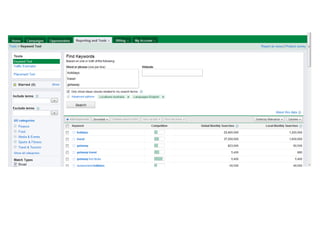
Free Keyword Research Tools


Google’s AdWords Keyword Tool
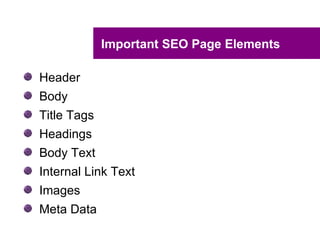
Important SEO Page Elements

Header
Body
Title Tags
Headings
Body Text
Internal Link Text
Images
Meta Data
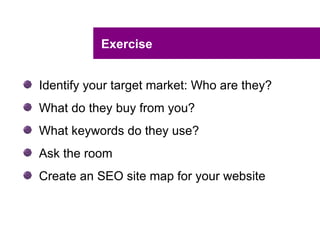
Exercise


Identify your target market: Who are they?
What do they buy from you?
What keywords do they use?
Ask the room
Create an SEO site map for your website
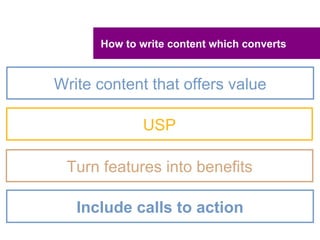
How to write content which converts


Write content that offers value

             USP

 Turn features into benefits

   Include calls to action
Off-Page SEO


Off-page optimisation

        Google PageRank

               Importance of links

                        Where to get links
Link Building


Directory Listing
Article Submission
Blog Comments
Forum Posting
Social Bookmarking
Video Submission
…..Notice how many are social media?
Ongoing SEO


Reviewing
Link building
On-page refinement
New pages
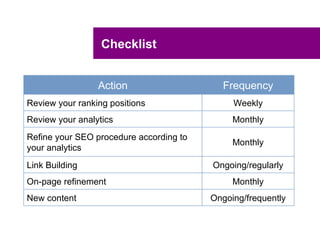
Checklist


                 Action                    Frequency
Review your ranking positions                 Weekly
Review your analytics                         Monthly
Refine your SEO procedure according to
                                              Monthly
your analytics
Link Building                            Ongoing/regularly
On-page refinement                            Monthly
New content                              Ongoing/frequently
Social Media Marketing
Why Social Media Marketing?


Customers are spending a large amount of
time there!
It’s low cost and easy to use
It’s online word of mouth marketing – and
it’s highly effective (network effect)
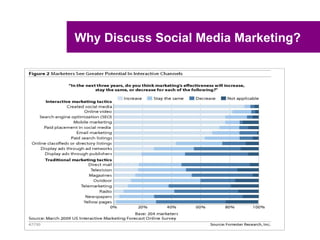
Why Discuss Social Media Marketing?
Social Media Risks


Fear by some businesses
Loss of control of brand
Time-wasting by employees
Waste of time and resources
And others, both real and perceived
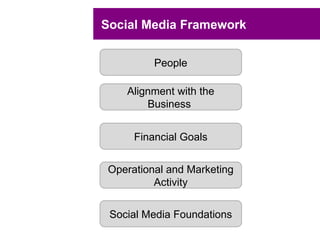
Social Media Framework


          People

    Alignment with the
        Business


      Financial Goals


 Operational and Marketing
          Activity


 Social Media Foundations
People


Can you describe your audience?
Do you know their needs?
Who are the influencers you need to reach?
Social Media Foundations


Do you have the skills, culture leadership in
your business?
Do you have a social media policy?
Do you have a budget?
Do you know which tools to use?
What data are you going to collect?
Marketing Activity


What are your communications strategies?
Do you have a listening strategy?
Are you going to talk and inform?
If so, what are you going to say?
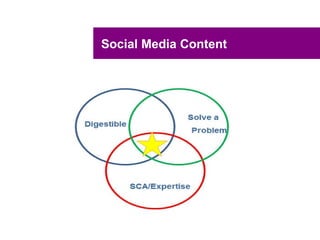
Social Media Content
Marketing Activity (continued)


Can you support your customers?
Do you have the ability to engage and
energise your customers?
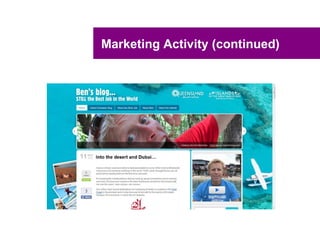
Marketing Activity (continued)
Conclusion


SEO and Social does provide long term ROI in
many cases
You will see revenue increases if implemented
correctly
It can take time to see results
Measure online success using analytics
Ensure you also measure business benefits
Small Business Mentoring Service


Business mentors help you to identify a clear direction
for you and your business.
Business mentors can also advise you on how to:
    conduct market research
    price and/or cost your products or services
    develop an effective marketing strategy
    use other business management tools

       To arrange a session with a business mentor go to:
                       www.sbms.org.au
Questions?


   Thank you for attending

          Check out
business.vic.gov.au/workshops
for more workshop information

Your Business Online

  • 2.
    Introduction The new marketingparadigm Why you should optimise your online presence How it should tie into your business goals Fundamentals of Search Engine Optimisation (SEO) Introduction to social media marketing Workshop exercises – work on your business
  • 3.
    The New MarketingParadigm SM & SEO
  • 4.
    New Marketing: Toolsto consider Social Networking and Social Media Blogging Local and Universal Search Video Adwords
  • 5.
    Essential Building Blocks GoogleAnalytics Google Places Content Management Systems Google Webmaster tools
  • 6.
  • 7.
    Why Perform SearchEngine Optimisation (SEO)? The online retail space is set to grow with 69 per cent of respondents planning to invest in improved site content and 66 per cent will spend more time on online marketing. Some 70 per cent cited SEO as being the most effective source to acquire customers. From Forrester Report: “Online retailing in Australia 2010: Marketing, merchandising and customer service”
  • 8.
    Why Perform SearchEngine Optimisation (SEO)? Gives higher long term ROI compared to any other online marketing vehicles (Source: Marketing Sherpa Report 2010). Higher natural rankings builds trust among searchers. 80% of websites are found through search engines (Source: Forrester Research). Research suggests that if your not in the top 5 – 15 for your search terms your website is almost non- existent on the internet.
  • 9.
    Why High RankingMatters Positioning is important!! Positioning is important!! 3.Above the red fold – 100 % viewed. 3.Appear on Page 1 – More traffic = More leads! 4.Drops to 50% - 20% below the fold. 4.Appear on Page 2 – Less traffic = Less leads!
  • 10.
    Your Competition KeepsGetting Bigger Search Drives Sales, Both Online and Offline: For every dollar spent online, the average search user spends $2.56 offline 'Search influences 20-30% of purchases made at retail locations’ eMarketer 2007
  • 11.
    Search Listings Difference betweenpaid search listings and natural search listings Pay Per Click SEO
  • 12.
    What is SEO? Theprocess of ensuring that your website is highly visible and relevant to search engines: On-Page SEO Off-Page SEO What is a Search Engine and how does it work? Robots, crawlers, spiders or ‘bots’ The Index The Algorithm
  • 13.
    What are thegoals of your website? Website goals might include Top 5 ranking position for 10 key phrases Increase traffic to the site by 50% in 6 months Conversion rate increased from 1% to 2% Online revenue increased from $15,000 per annum to $30,000 Attract additional five new leads per week
  • 14.
    Return on Investment Researchsuggests that SEO gives higher long term ROI compared to any other online marketing vehicles (Source: Marketing Sherpa Report 2010). However ROI varies depending on industry, products, website size etc Remember: It can take 6 months to see results Commit to 6 months and then measure ROI ROI should be based on clear $ return
  • 15.
    SEO – GoogleRanking Achievement Report Keyword Sept Nov Feb web design melbourne 59 22 20 website design bendigo 4 1,2,3 1 graphic design 100+ 100+ 20 graphic design ballarat 10 9 7 web design workshops 1 1,2,3 19 bendigo online marketing mildura 1 1 1 Website Case Study - www.designexperts.com.au
  • 16.
    Will SEO workfor your business? For smaller businesses, SEO (tends to) work best for: Sites which sell niche products or services globally Sites which sell in a specific location Sites that don’t try to be all things to everybody!
  • 17.
    Exercise Are you onGoogle? Do a search for your business’ brand name at Google, Yahoo and ninemsn. Where does your website rank? Do a search for your key product or service (not using brand names)
  • 18.
    How do searchengines reference a website? Direct submission Search engines can use your XML site map (if you have one) Following links from other web pages
  • 19.
    Is your websitesearch engine friendly? Content Navigation and link structures Site structure and layout Poor structure and navigation cause major roadblocks
  • 20.
    Which pages shouldyou optimise? Analyse your website structure and content Prioritise your home page Optimise your top level category pages If you sell products at your site optimise your product pages
  • 21.
    Which pages shouldyou NOT optimise? Privacy page Terms and conditions/legal information Disclaimers etc. Add as PDF’s
  • 22.
    How do peoplesearch? People search in phases: Broad ‘interest phase’ ‘Research and refinement’ phase ‘Purchasing or buying’ phase
  • 23.
    Who searches foryour product? Understand your target market(s): Who are they? Develop personas What problem are you solving for them? How are they likely to search?
  • 24.
    Analysing your competition Animportant step in the keyword research process is competitive analysis: Identify direct competitors Which sites rank in top positions for your important search phrases? Check their source code for key phrase selection
  • 25.
    Keyword Research Tools Keywordresearch tools help you: Decide on keywords and key phrases Understand search volumes Two types: Free Paid
  • 26.
    Free Keyword ResearchTools Google’s AdWords Keyword Tool
  • 29.
    Important SEO PageElements Header Body Title Tags Headings Body Text Internal Link Text Images Meta Data
  • 30.
    Exercise Identify your targetmarket: Who are they? What do they buy from you? What keywords do they use? Ask the room Create an SEO site map for your website
  • 31.
    How to writecontent which converts Write content that offers value USP Turn features into benefits Include calls to action
  • 32.
    Off-Page SEO Off-page optimisation Google PageRank Importance of links Where to get links
  • 33.
    Link Building Directory Listing ArticleSubmission Blog Comments Forum Posting Social Bookmarking Video Submission …..Notice how many are social media?
  • 34.
  • 35.
    Checklist Action Frequency Review your ranking positions Weekly Review your analytics Monthly Refine your SEO procedure according to Monthly your analytics Link Building Ongoing/regularly On-page refinement Monthly New content Ongoing/frequently
  • 36.
  • 37.
    Why Social MediaMarketing? Customers are spending a large amount of time there! It’s low cost and easy to use It’s online word of mouth marketing – and it’s highly effective (network effect)
  • 38.
    Why Discuss SocialMedia Marketing?
  • 39.
    Social Media Risks Fearby some businesses Loss of control of brand Time-wasting by employees Waste of time and resources And others, both real and perceived
  • 40.
    Social Media Framework People Alignment with the Business Financial Goals Operational and Marketing Activity Social Media Foundations
  • 41.
    People Can you describeyour audience? Do you know their needs? Who are the influencers you need to reach?
  • 42.
    Social Media Foundations Doyou have the skills, culture leadership in your business? Do you have a social media policy? Do you have a budget? Do you know which tools to use? What data are you going to collect?
  • 43.
    Marketing Activity What areyour communications strategies? Do you have a listening strategy? Are you going to talk and inform? If so, what are you going to say?
  • 44.
  • 45.
    Marketing Activity (continued) Canyou support your customers? Do you have the ability to engage and energise your customers?
  • 46.
  • 47.
    Conclusion SEO and Socialdoes provide long term ROI in many cases You will see revenue increases if implemented correctly It can take time to see results Measure online success using analytics Ensure you also measure business benefits
  • 48.
    Small Business MentoringService Business mentors help you to identify a clear direction for you and your business. Business mentors can also advise you on how to: conduct market research price and/or cost your products or services develop an effective marketing strategy use other business management tools To arrange a session with a business mentor go to: www.sbms.org.au
  • 49.
    Questions? Thank you for attending Check out business.vic.gov.au/workshops for more workshop information

Editor's Notes

  • #3 Engage with participants and discuss each of their Web sites e.g. ask them if they are aware of how many people are visiting their site, how and where that traffic comes from, and what the user reads while at the site.
  • #4 Talk about the changes to marketing over the last few years – people moving away from traditional print advertising, yellow pages, radio and TV advertising to online. Exercise: To prove how things have changed ask the group how many of them have used yellow pages recently? How many have responded to traditional ads in the newspaper or on TV, how many have responded to a direct mail advertisement. How many have used Google to find a product? How many have used social networks?
  • #5 Talk to participants about how SEO forms part of an overall online strategy – this also may include Adwords for search marketing and will almost certainly include social networking and perhaps blogging and other social media tools. It is important to also consider how SEO has changed with Universal search meaning more people are finding video content (and images and news). YouTube is the world’s second largest search engine according to some stats.
  • #6 This slide explains some of the key tools you will need to implement a strong SEO strategy. Explain what Google Analytics is and ask the group if they currently use it. Show the group Google Places and explain that for local businesses this is essential – it is the quickest way to get to page one and if they do one thing after the session it should be to sign up to Google Places Explain what a Content Management System is. If you can access a CMS show them how it works – explain that tools like Wordpress which were initially blogs can be used for full websites. Google Webmaster tools – explain that Google Webmaster tools provides a lot of information on your site and is important to have if you are thinking of managing your own SEO process
  • #7 This slide explains some of the key tools you will need to implement a strong SEO strategy. Explain what Google Analytics is and ask the group if they currently use it. Show the group Google Places and explain that for local businesses this is essential – it is the quickest way to get to page one and if they do one thing after the session it should be to sign up to Google Places Explain what a Content Management System is. If you can access a CMS show them how it works – explain that tools like Wordpress which were initially blogs can be used for full websites. Google Webmaster tools – explain that Google Webmaster tools provides a lot of information on your site and is important to have if you are thinking of managing your own SEO process
  • #8 The stat speaks for itself and is backed up by the statistics on the next slides regarding ROI.
  • #9 Read the first bullet point regarding ROI. It is important to explain at this stage that a positive ROI can’t be guaranteed for every business. Business owners need to understand that SEO professionals who guarantee number one placings are making promises they can’t be sure of fulfilling. However if you follow the basic guidelines you will see improvements in traffic – whether that results in increased business will depend on many factors, including the competition, and the quality of your product and services
  • #10 Show how the red indicates where people look and that the thick red line is above the fold – (people don’t need to scroll) this has major implications for getting seen – the second graph shows the diminishing rate of clickthroughs as rankings drop away – 1 st place gets 42%, 2nd gets 12%, 3 rd gets 8% etc
  • #11 This is an old stat – however it is important to stress that SEO can assist greatly with offline sales as people research products before they go to a store to buy the product.
  • #12 This slide shows the difference between pay per click and natural search and the percentage of clicks – it also shows universal search( where Google makes it easier to search for images video etc) and also the focus on local search
  • #13 The goal of SEO is to give pages in your Web site the best possible chance to rank highly in search results and attract targeted traffic. On-Page SEO On-page optimisation involves incorporating keywords relevant to the topic of a page into the specific areas of the page that search engines scan to determine relevance. Off-Page SEO Off-page SEO involves influencing the ranking position of your Web site by securing links from other Web sites to improve the perceived ‘popularity’ of your site in the eyes of the search engines. So what is a Search Engine and how does it Work? Understanding how a search engine works helps your audience understand the fundamentals of SEO
  • #14 Explain that each website is different. What is important is that your website goals are directly tied back to business metrics. (For example, high traffic is no good unless it is the right visitors who are visiting (E.g. What point is there in getting thousands of visits from America if you only sell to people in Victoria). The challenge is to convert the right visitors with the right messages so that they become customers or advocates.
  • #15 ROI – the amount of profit you generate from an activity minus the amount of money you spent to generate the profit performing the activity. The key message is for the business to decide whether it wants to commit to SEO. If so they need to invest time and resources for at least six months. After six months they need to see whether the sales or awareness they have generated justifies the time and money they have invested in SEO.
  • #17 Key Message: SEO will work best for businesses that have a clearly defined target market, a clear defined product or service offering (niche is often best) If a business doesn’t have an overall marketing plan they should develop one before committing to SEO
  • #18 The first exercise really only tells you if you are indexed on Google. If you put in your company name you should expect to be in the first few places. The second exercise is far more important. It will give you an indication of how well you currently rank
  • #20 Explain the importance of valuable content – both of r search engines but even more importantly for human visitors. Content will influence conversions. Explain the importance of navigation and link structures – explain how to build a logical sitemap
  • #22 Obviously you don’t optimise these pages – some web developers recommend adding them as pdf’s
  • #24 Keyword research is the most important function of SEO as it dictates everything else you do. However in order to undertake good keyword research you need to understand your target market. Who are they? Why will they use your product or service? How will your target market search for your product. How your target market searches may be completely different to how you search.
  • #25 Competitor Analysis It is easy to analyse what keywords your competition are targeting. Simply right click and select ‘view page source’ to analyse their site’s title tags and meta information. Quite often the keywords listed in the meta keywords tag will reveal their complete keyword strategy.
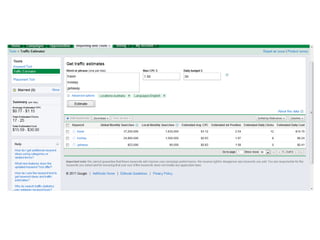
  • #26 Keyword research tools are extremely important in helping you decide on keywords and key phrases you should target on your website for high rankings. Keyword research tools help you understand volumes, that is, how many people type in certain phrases every month (or day), and in some cases, competition for those phrases.
  • #27 Please place emphasis on this tool as a really strong starting point for key word research for your group. Paid tools are available but Adwords will meet the needs (and budget!) of most small businesses who want to do SEO themselves.
  • #31 See handout
  • #32 It is important to mention that as Google and other Search engines have become smarter, content has become more important than ever. Google has become far better at recognising relevant content – your content should always add value to the person who has entered the search term you are trying to be found for. Once you get people to your page you need to provide valuable content as mentioned above. You also need to understand what you want the visitor to do once they get to your page. If you understand what you want them to do you can provide calls to action to enable you to achieve your goals. This might include buying something, subscribing to a newsletter or filling out an inquiry form
  • #33 Off-page optimisation refers to SEO strategies that are done off the pages of a Web site to maximise its performance in the search engines for target keywords related to the page content. PageRank 'PageRank' is Google’s system for measuring the importance of a Web page. It is based on an analysis of both the quantity and quality of all links that point to that page. Google provides a measurement on a scale from 0 - 10, where 10 is the highest. You can see the PageRank attributed to any page you visit on the Web by downloading the Google Toolbar. Very few Web sites have a PageRank Score of 10. Adobe and Microsoft have a PR 9. Google itself has a PR 8. A link from a page with high PageRank score will help to lift the PageRank score of a low PageRank page. Explain the following three additional Off-page SEO techniques: Creating an XML Site Map XML Site maps are useful for helping search engines find and index all the pages on a Web site. There are a number of free tools that create XML Site maps, for example GsiteCrawler ( http://gsitecrawler.com/ ). Setting-up a Google Webmaster Tools Account Google Webmaster Tools offer valuable information on how a Web site is viewed by Google. Webmaster Tools are free and can be set up through any Google account. Participants can start the process at https://www.google.com/webmasters/tools/docs/en/about.html . Setting-up a Google Analytics Account Google Analytics is a free service that generates detailed statistics about Web site visitors and their behaviour/browsing while on a site ( http://www.google.com/analytics/ ).
  • #34 The list above shows some of the ways and places to build inbound links to your website. Google is changing is search engine all the time so if you submit links via articles make sure they are relevant.
  • #45 Conclusion SEO has long lasting benefits You WILL see increased traffic and revenue from a properly implemented SEO program – however no one can make firm guarantees Remember – to successfully implement your SEO strategy you must: Set goals and means to measure your success; Target the right people Perform intensive keyword research; Integrate top key phrases properly onto your Web site; Target the right pages on your site Write Web copy which helps lift conversions; Set up reporting; Perform Off-page SEO; link building etc.; Continually refine your project; AND Avoid deceptive SEO practices!
  • #48 Conclusion SEO has long lasting benefits You WILL see increased traffic and revenue from a properly implemented SEO program – however no one can make firm guarantees Remember – to successfully implement your SEO strategy you must: Set goals and means to measure your success; Target the right people Perform intensive keyword research; Integrate top key phrases properly onto your Web site; Target the right pages on your site Write Web copy which helps lift conversions; Set up reporting; Perform Off-page SEO; link building etc.; Continually refine your project; AND Avoid deceptive SEO practices!